1930s Fashion Designers Predict How People Would Dress in the Year 2000
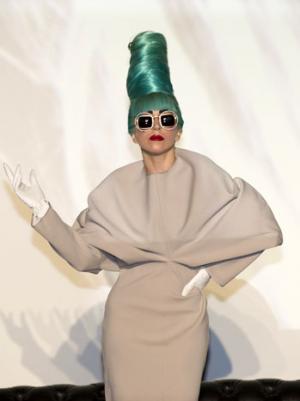
From 1930 to 1941, Pathetone Weekly ran film clips that highlighted ‘the novel, the amusing and the strange.’ At some point during the 1930s (the exact date isn’t clear), Pathetone asked American designers to look roughly 70 years into the future and hazard a guess about how women might dress in Year 2000. Apparently, fashion designers don’t make great futurists, and the designs fell rather wide of the mark — unless you want to count Lady Gaga’s wardrobe, in which case they didn’t do a half bad job. Or, for that matter, the male connected 24/7 to his phone and sundry gadgets…
If you would like to support the mission of Open Culture, consider making a donation to our site. It’s hard to rely 100% on ads, and your contributions will help us continue providing the best free cultural and educational materials to learners everywhere. You can contribute through PayPal, Patreon, and Venmo (@openculture). Thanks!
Related Content:
How French Artists in 1899 Envisioned Life in the Year 2000: Drawing the Future
Isaac Asimov’s 1964 Predictions About What the World Will Look 50 Years Later — in 2014
Arthur C. Clarke Predicts the Future in 1964 … And Kind of Nails It
In 1900, Ladies’ Home Journal Publishes 28 Predictions for the Year 2000
Read More...Hear a 64-Hour Playlist of Sherlock Holmes Stories, With Performances by Sir John Gielgud, Sir Ralph Richardson & Many More
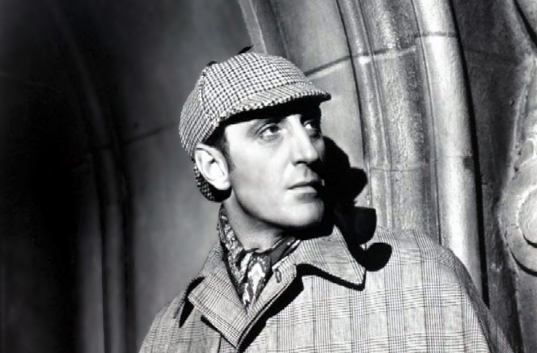
Image via Wikimedia Commons
When I first read all of Sir Arthur Conan Doyle’s Sherlock Holmes stories, having found them collected in full (not, of course, including last year’s “lost” story) in two old volumes at an antique store, I understood immediately why they’d so quickly become so popular with their first readership in the late 19th and early 20th centuries. Or rather, I should say that I felt it–that perfect alignment of form and substance that only comes along in popular art every few decades.
Whether that happened as a result of Doyle’s craftsmanship or his luck I don’t know, but it turns out that the adventures of his consulting detective play as well on the speakers as they do on the page, though in quite a different way. You can experience that difference for yourself, and experience it extensively, with Spotify’s 64-hour, 163-track playlist of Sherlock Holmes stories performed aloud. (If you don’t have Spotify’s free software, download it here.)
The very first voice it presents is Doyle’s own, speaking briefly on Holmes and spiritualism, which gives us time to settle in for a five-part rendition of the very first in the Holmes canon (and thanks to “more female interest than is usual,” one of Doyle’s personal favorites), “A Scandal in Bohemia.” It comes performed by Sir John Gielgud and Sir Ralph Richardson, two of the most respected actors in 20th-century British theater. We’ve previously featured their portrayals, Gielgud’s of Holmes and Richardson’s of Watson (and we can hardly neglect to mention the one and only Orson Welles’, of Moriarty), on the New Adventures of Sherlock Holmes radio drama.
But this playlist provides a wealth of other voices from various eras interpreting Doyle’s most beloved works as well, a variety that certainly suits its protagonist, the most-portrayed literary character of all time — which means that, unlike the collected print canon of Sherlock Holmes adventures (that “lost” story and its mysterious authorship aside), the collected audio adventures of Sherlock Holmes will only grow longer and longer, so those who want to listen to them all had best get on the case without delay.
You can find this playlist added to our collection, 1,000 Free Audio Books: Download Great Books for Free.
Also find Sherlock Holmes stories in our other collection, 800 Free eBooks for iPad, Kindle & Other Devices.
Related Content:
Read the Lost Sherlock Holmes Story That Was Just Discovered in an Attic in Scotland
Download the Complete Sherlock Holmes, Arthur Conan Doyle’s Masterpiece
Arthur Conan Doyle Names His 19 Favorite Sherlock Holmes Stories
Arthur Conan Doyle Discusses Sherlock Holmes and Psychics in a Rare Filmed Interview (1927)
Based in Seoul, Colin Marshall writes and broadcasts on cities, language, and style. He’s at work on a book about Los Angeles, A Los Angeles Primer, the video series The City in Cinema, the crowdfunded journalism project Where Is the City of the Future?, and the Los Angeles Review of Books’ Korea Blog. Follow him on Twitter at @colinmarshall or on Facebook.
Read More...Van Gogh’s “Starry Night” and “Self Portrait” Painted on Dark Water, Using a Traditional Turkish Art Form
And now for something a little whimsical and fun.
Above, watch artist Garip Ay use a traditional Turkish art form, known as Ebru art, or marbling, to paint Van Gogh’s ‘Starry Night’ and ‘Self-Portrait’ on water. Marbling, Ay told ABC News, is “the practice of applying paint to the surface of thickened water and creating patterns and images by manipulating the paint.” “The water, in addition to being thickened by carrageenan powder, was colored black for this project.” Give the video four short minutes, and you can watch Ay’s project unfold. Find many more marbling videos on the artist’s website.
If you would like to support the mission of Open Culture, consider making a donation to our site. It’s hard to rely 100% on ads, and your contributions will help us continue providing the best free cultural and educational materials to learners everywhere. You can contribute through PayPal, Patreon, and Venmo (@openculture). Thanks!
via ABC News/The Kids Should See This
Related Content:
Download Hundreds of Van Gogh Paintings, Sketches & Letters in High Resolution
Van Gogh’s 1888 Painting, “The Night Cafe,” Animated with Oculus Virtual Reality Software
The Unexpected Math Behind Van Gogh’s “Starry Night”
Artist Turns a Crop Field Into a Van Gogh Painting, Seen Only From Airplanes
Read More...Hear the Great Mixtapes Richard Linklater Created to Psych Up the Actors in Dazed and Confused and Everybody Wants Some!!
Richard Linklater’s films have become increasingly sophisticated as the 90s indie breakout writer-director has grown into his auteurhood. From the loose stoner vérité of Slackers (watch it online) to the loose but heady animation of Waking Life to the painstakingly meticulous “model of cinematic realism” of Boyhood, Linklater has a uniquely American vision and the undeniable talent to realize it in full.
But mostly when I think of Linklater, I think—excuse my language—of cock rock.
I think of Dazed and Confused’s super senior Wooderson, leaning against a muscle car, drawling “alright, alright, alright,” and cranking Aerosmith. I think of wild-eyed Jack Black in School of Rock, strapping a Gibson Flying V on an uptight, sweater-vested youth and teaching him Black Sabbath’s “Iron Man” riff. And now, I think of a gang of short shorts-wearing college baseball dudes in the “campus bromance” Everybody Wants Some!!, singing along (above) to Sugar Hill Gang’s “Rapper’s Delight”…. wait…
So, okay, it ain’t all cock rock. But Linklater’s films are often so dude-centric, and so informed by popular music of certain eras, that he titled two of his most personal—Dazed and Confused and its recent “spiritual sequel”—after anthems from the two most archetypically cock rock bands, Led Zeppelin and Van Halen.
Where Dazed and Confused’s high school milieu more or less stayed anchored in 70s hard rock, Everybody Wants Some!!—like its comparatively adventurous college jocks—takes several musical detours from beer-and-babes 80s clichés. The film’s soundtrack, for example, includes “deep cuts” from Brian Eno, obscure local Texas punk rock band The Big Boys, and L.A.-based 80s New Wave/R&B band The Busboys.
It’s true, then, that the songs choices on Everybody Wants Some!!, which you can hear almost in their entirely (sans a few) above, are fairly diverse, genre-wise, compared to the cock-rock-heavy list of songs from Dazed and Confused (further up). And when it comes to Linklater’s musical inspirations for both films, we see that difference as well.
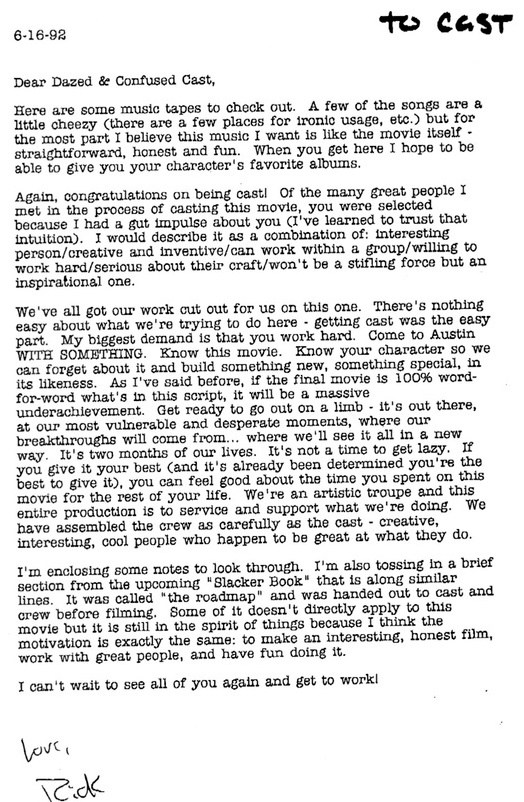
As the Criterion Collection blog documents—bringing us the 1992 letter above (read it here) from Linklater to his cast—the director put together “a thoughtful series of mixtapes to get his cast into the mind-set” of Dazed and Confused. And Criterion put together the Spotify playlist below of the songs Linklater gave his actors. As you’ll see, it’s mostly balls-to-the-wall hard rock, with some obligatory 70s disco and a few cuts from Lou Reed, David Bowie, and Elton John. In his accompanying letter, Linklater admits “a few of the songs are a little cheezy,” but also notes “there are a few places for ironic usage.” For the most part, he says, “this music… is like the movie itself—straightforward, honest and fun.”
When it came time to begin shooting Everybody Wants Some!! (get the official soundtrack here), Linklater again used the same method to get his cast in the mood, circulating the songs in the playlist below (though probably not on cassettes). Here we get a much more diverse, comprehensive musical summary of the decade in question, with Michael Jackson sitting next to Elvis Costello, Pat Benatar and Dire Straits next to Pink Floyd, Sister Sledge, Queen, and Chaka Khan.
It’s an interesting transition that may—musically—signal the move from teenage fandom to the more curious, adventurous listening habits of early adulthood. College, after all, is not only where young Americans of the modern era discover new sexual and chemical pleasures, but also where they acquire new musical tastes. And in the 80s especially, the boundaries of pop music expanded.
“That’s just how it felt to me to be a young person at that time. It was cool to be into everything,” Linklater commented to Cornelia Rowe at Yahoo: “There was a lot of newness in the era. You didn’t really appreciate it at the time – it’s like, there are all these new bands! There’s this new wave, punk, party, R&B – there’s a thing called rap music from New York!”
The athlete bros in Linklater’s latest, very male-oriented piece of cinematic nostalgia “at once embody and upend the stereotype of the shallow, sexually entitled jock,” writes A.O. Scott in his review. Roaming far afield of their comfort zones, they “have a good time wherever they are.” That’s pretty much guaranteed, I think, with the finely-curated 80s gems in these playlists as their soundtrack.
via the Criterion Collection
Related Content:
Watch Free Online: Richard Linklater’s Slacker, the Classic Gen‑X Indie Film
Josh Jones is a writer and musician based in Durham, NC. Follow him at @jdmagness
Read More...Surrealist Filmmaker Jan Švankmajer Is About to Make His Final Feature Film, and You Can Help Produce It
No filmmaker combines live action with stop-motion quite like Jan Švankmajer, and certainly no filmmaker has used that combination to such imaginative and troubling ends. An avowed surrealist who got his start in animation more than half a century ago in his homeland of the former Czechoslovakia, he’s continued to craft his distinctive cinematic experiences however and whenever possible through the decades. His filmography now includes such enduring trips as Dimensions of Dialogue (see below), which no less a visionary than Terry Gilliam calls one of the best animated films of all time; Alice, his dark interpretation of Alice’s Adventures in Wonderland; and Little Otik, a modernization of a folktale about a tree stump that turns into a monstrous baby.
But as well as he brings the bizarre to vivid life on screen, he’s always had higher ambitions than that. “Švankmajer is capable of creating dark yet playful worlds that dissect the very core of our society,” says the Indiegogo page now raising the funds for his latest — and last — feature film, Insects. “The civilization we live in has little interest in authentic artistic creation,” laments the filmmaker. “What it needs is well-working advertisement, the iconographic contemporary art, pushing people towards more and more mass consumption. It gets increasingly difficult to fund independent art that scrutinizes the very core of our society. Who would deliberately support their own critics?”
Now, in this age of crowdfunding, you can support one of its most entertaining critics alive yourself. Insects has already succeeded in raising the first phase of its budget, but still has a way to go before it can assure its esteemed creator and his collaborators full artistic freedom (Švankmajer is looking to raise $400,000 in total), so if you’d like to chip in, you can make yourself eligible for such rewards as the first opportunity to download the film, its Blu-Ray edition with an accompanying art book, or even — if you’ve got $15,000 to put toward the cause — “a dinner with Jan Švankmajer at his mansion in Czech Republic and a commented visit to his Kunstkabinet.” Even now, work on Insects, its Indiegogo page assures us, is underway, with Švankmajer “very busy visiting entomological auctions, buying various kinds of bugs, doing rehearsal shots with them and so on.”
If you’d like to learn more about the drama that they’ll ultimately act out, watch the promo video at the top of the post. In it, Švankmajer describes it as set in a pub, after hours, where an amateur theater group has gathered to rehearse The Insect Play by the Čapek brothers. But “as the rehearsal progresses, the characters of the play are born and die with no regard to time,” and the actors “experience frightening transformations.” Švankmajer, who has planned not a direct adaptation of The Insect Play but a more complex work that draws inspiration both from it and The Metamorphosis by his other well-known countryman Franz Kafka, puts the appeal of this story where “bugs behave as human beings, and people behave as insects” simply: “The Čapek brothers’ play is very misanthropic. I’ve always liked that.”
Related Content:
The Mascot, Pioneering Stop Animation Film, by Wladyslaw Starewicz
Dimensions of Dialogue by Jan Svankmajer (1982)
The Best Animated Films of All Time, According to Terry Gilliam
4,000+ Free Movies Online: Great Classics, Indies, Noir, Westerns, Documentaries & More
Based in Seoul, Colin Marshall writes and broadcasts on cities, language, and style. He’s at work on a book about Los Angeles, A Los Angeles Primer, the video series The City in Cinema, the crowdfunded journalism project Where Is the City of the Future?, and the Los Angeles Review of Books’ Korea Blog. Follow him on Twitter at @colinmarshall or on Facebook.
Read More...Meet Four Women Who Pioneered Electronic Music: Daphne Oram, Laurie Spiegel, Éliane Radigue & Pauline Oliveros
My small city is still coming down from the elation of last month’s Moogfest, a three-day extravaganza of performances, workshops, seminars, films, and other activities relating to music made by the synthesizers designed and influenced by Robert Moog.
This year’s festivities included several performances from New Wave star Gary Numan; appearances by legends like Devo’s Mark Mothersbaugh, Parliament-Funkadelic’s Bernie Worrell, Negativland’s Chris Grigg, and Can’s Malcolm Moony; and tributes to recently deceased Japanese synth master Isao Tomita and British prog rock superstar Keith Emerson…. And yes, many excellent younger female artists performed and gave workshops and talks, but as a newcomer to the scene, you’d be forgiven for thinking that earlier generations of electronic musicians were almost exclusively male.
And that impression would be entirely off the mark, even if it has been reinforced again and again in retrospectives, documentaries, and popular histories. But perspectives are shifting, and we’ve tried to highlight some of the alternate histories of electronic music that document female artists’ indispensable contributions to the field.
Recent documentaries about influential BBC Radio composer and musician Delia Derbyshire, for example, have reintroduced her work to a new generation. A wider appreciation came in the form of KPFA’s “Crack O’ Dawn” program broadcasting seven hours of music by over two dozen important women composers and musicians from 1938–2014.
On the live circuit, “’all-female bills,’” writes Jennifer Lucy Allan at The Guardian, “have gained traction to address the stark gender imbalance in dance and electronic music bookings.” But “they can feel tokenist, where gender comes before talent… not so at London’s Southbank Centre next weekend: its Deep Minimalism festival presents compositions by some of electronic music’s early frontrunners, going as far back as the 1950s. They just so happen to be almost exclusively female.”
One early frontrunner, Daphne Oram, was a contemporary and colleague of Delia Derbyshire. Oram, writes Allan, “noodled with modular machines at the BBC Radiophonic Workshop in its early days, before the studio created the seminal Doctor Who theme” (largely Derbyshire’s doing). That description doesn’t do her justice. Oram was in fact a co-founder of the hugely influential Radiophonic Workshop, and her work deserves, and has begun to receive, the kind of critical re-evaluation that Derbyshire has attained recently.
The Wire magazine centered Oram’s work in a 2012 discussion, “Attack of the Radiophonic Women: How Synthesizers Cracked Music’s Glass Ceiling.” They feature much more info on Oram on their site, including a “Daphne Oram Portal” with links to articles about her sophisticated work. At the top of the post, you can hear the subtle drones, ringing, and echoes of Oram’s “Pulse Persephone,” and just above, listen to a 2008, 40-minute radio documentary on her work called “Wee Have Also Sound-Houses,” made in celebration of the Radiophonic Workshop’s 50th anniversary.
Oram has been lauded by the BBC as “the unsung pioneer of techno” and there is currently a Kickstarter campaign to republish her book, An Individual Note: Of Music, Sound and Electronics, and to “write Daphne Oram back into music history.” Oram’s book explains her philosophy of sound, which she called “Oramics.” Like many an early electronic musical pioneer, she not only created original sound designs but designed original equipment to make them—in her case, an “optical synthesizer” called the Oramics Machine (read about it here). Just above, see a clip from Atlantis Anew, a film about the Oramics Machine.
Another pioneering composer, Laurie Spiegel, is also an engineer and software designer with a long resume that includes working with synthesizer designers (and Moog competitors) Buchla and Electronic Music Laboratories. See her above in 1977 playing the Alles Machine, a very early digital synthesizer she worked on with Hal Alles at Bell Labs. Spiegel worked for Bell Labs for several years, creating one of the first computer drawing programs in the mid-70s, and she is widely known as the designer of Music Mouse, a MIDI program created for Apple in 1985.
Spiegel, writes Allan, “programmed synths before computer-based controllers were a twinkle in the techno DJ’s eye.” If her list of accomplishments as an engineer seems impressive, her contributions as a composer and musician certainly are as well. In 1977, her realization of Johannes Kepler’s 17th century composition “Harmonices Mundi” (“Harmony of the Worlds,” above) was chosen as the first musical recording on the Voyager probe’s “Golden Record,” a cultural time capsule sent into space for ears of extraterrestrials (“assuming they have ears,” writes Pitchfork in a glowing profile of Spiegel).
Spiegel has composed soundtracks for television shows and films, including a 1980 PBS adaptation of Ursula K. LeGuin’s The Lathe of Heaven. That same year, she released her acclaimed first album The Expanding Universe, now a recently re-released classic. (Hear the album’s 28-minute title track here.)
And though it isn’t included in the official chart-topping soundtrack album, Spiegel’s 1972 composition “Sediment,” just above, appears in the first Hunger Games score, a “left-field” development that Spiegel views very positively. “There are quite a few films and TV shows lately that have strong female protagonists who aren’t just co-stars to a male hero,” she told Wired, “We have yet to get to the point where we see a lot of female composers appearing in soundtrack credits, but maybe that will change.”
Perhaps it already is, very, very slowly. The work of French composer and onetime Spiegel collaborator Éliane Radigue was among the two dozen electronic, orchestral, and avant-garde pieces on the soundtrack for Alejandro Innaritu’s The Revenant, for example. Radigue began her career studying musique concrete with experimental pioneers Pierre Schaeffer and Pierre Henry in the 50s. She began making synth-based music in 1970 on a Buchla synthesizer while she shared a studio with Spiegel. “In the beginning,” says Radigue above in a documentary about her life and career, “there was a certain music that I wished to make. It was this particular music and no other.” That music—slow, droning, immersive—became religious in nature when she converted to Tibetan Buddhism.
Radigue’s Buddhist-inspired piece “Jetsun Mila” (Hear Part One above, Part Two here)—excerpted in The Revenant—is “deeply meditative,” writes Other Music’s Michael Klausman, in its “exploration of inaudible subharmonics and overtones,” which have a “way of physically changing the landscape of the room her music inhabits.”
Radigue is a fanatically patient composer, “an important, intriguing figure within the European musical avant-garde,” as Electronic Beats describes her in a 2012 interview; her “work is defined by its painstaking creation and singular methodology.” From 1970 to 2004, when she transitioned to writing acoustic music, Radigue’s work was “created exclusively on the unwieldy but brilliant ARP 2500 modular synth,” a machine inspired by Wendy Carlos’ use of Moog’s synthesizers on her Switched on Bach album.
The three women profiled above represent a small sampling of too-often-overlooked electronic composers, musicians, engineers, and theorists whose work deserves wider appreciation, not because it’s made by women, but because it’s innovative, technically brilliant, and beautiful music made by people who happen to be women.
And yet, it’s likely the case that the work of Oram, Spiegel, and Radigue flies so far under the radar because so many histories of electronic music focus almost exclusively on men. One salient example is the exclusion of Pauline Oliveros from many of those histories. “A constant presence” at the upcoming Deep Minimalism festival, Oliveros was “at the vanguard of electronics, working with tape machines,” writes Tom Service, and she “collaborated with Terry Riley… and Morton Subtonick,” as well as Steve Reich, all very well-known experimental composers.
She also happened to be a “friend, colleague, and performer of John Cage and his music.” Oliveros’ philosophy of “Deep Listening” had a profound influence on Cage and many others, but her name rarely comes up in discussions of experimental, improvisatory minimalist music. (Cultural theorist Tracy McMullen has her own theory about Oliveros’ obscurity relative to Cage.) You can see Oliveros describe her philosophy in the TED talk further up, listen to her early, 1965 composition “Mnemonics III” just above, and learn much more about her fascinating life and work in Service’s Guardian profile.
Related Content:
Two Documentaries Introduce Delia Derbyshire, the Pioneer in Electronic Music
Hear Seven Hours of Women Making Electronic Music (1938- 2014)
The History of Electronic Music in 476 Tracks (1937–2001)
The Mastermind of Devo, Mark Mothersbaugh, Shows Off His Synthesizer Collection
Josh Jones is a writer and musician based in Durham, NC. Follow him at @jdmagness
Read More...Andrei Tarkovsky Answers the Essential Questions: What is Art & the Meaning of Life?
“An artist never works under ideal conditions,” says Andrei Tarkovsky, who, even under his own set of less-than-ideal conditions, managed to make movies like Solaris, The Mirror, and Stalker. (Watch them free online here.) “If they existed, his work wouldn’t exist, for the artist doesn’t live in a vacuum. Some sort of pressure must exist. The artist exists because the world is not perfect. Art would be useless if the world were perfect, as man wouldn’t look for harmony but simply live in it. Art is born out of an ill-designed world.”
Tarkovsky calls that the central issue of Andrei Rublev, his earlier historical drama about the titular 15th-century icon painter, footage of which we see in the clip at the top. It comes extracted from the documentary A Poet in Cinema, essential viewing for those seeking to understand the mind behind all these singular cinematic visions. Tarkovsky used film in an art form in a way that no other director did before or has quite done since, which will raise a certain curiosity in any of his viewers: how, then, did he conceive of art itself?
Just before the beginning of the clip below, a disembodied voice put the question to him directly: “Andrei, what is art?” Tarkovsky, looking even more pensive than usual, declares that “before defining art — or any concept — we must answer a far broader question: what is the meaning of Man’s life on Earth?” An ambitious topic, certainly, but he, in his own way, embodied the very concept of the ambitious filmmaker. “Maybe we are here to enhance ourselves spiritually. If our life tends to this spiritual enrichment, then art is a means to get there. Art should help man in this process.”
Rejecting the idea “that art helps man to know the world like any other intellectual activity,” Tarkovsky made films from his lack of belief in the “possibility of knowing. Knowledge distracts us from our main purpose in life. The more we know, the less we know. Getting deeper, our horizon becomes narrower. Art enriches man’s own spiritual capabilities, and he can then rise above himself, to use what we call ‘free will.’ ” Those who subscribe to these views of the world and of art will find that his work still serves this purpose. Even many of those who don’t accept Tarkovsky’s austere philosophical premises have to admit that, if a perfect world doesn’t contain his movies, we’d probably rather not live in it.
Related Content:
Andrei Tarkovsky’s Advice to Young Filmmakers: Sacrifice Yourself for Cinema
A Poet in Cinema: Andrei Tarkovsky Reveals the Director’s Deep Thoughts on Filmmaking and Life
“Auteur in Space”: A Video Essay on How Andrei Tarkovsky’s Solaris Transcends Science Fiction
Andrei Tarkovsky’s Solaris Shot by Shot: A 22-Minute Breakdown of the Director’s Filmmaking
Based in Seoul, Colin Marshall writes and broadcasts on cities, language, and style. He’s at work on a book about Los Angeles, A Los Angeles Primer, the video series The City in Cinema, the crowdfunded journalism project Where Is the City of the Future?, and the Los Angeles Review of Books’ Korea Blog. Follow him on Twitter at @colinmarshall or on Facebook.
Read More...An Animated Introduction to Charles Dickens’ Life & Literary Works
The social role of the writer changes from generation to generation, but at no time in the history of literary culture have novelists and poets faced more competition for the attention of their readers than they do today. Before visual media took over as the primary means of storytelling, however, many writers enjoyed the measure of fame now given to film and pop music stars. Or at least they did in the age of Charles Dickens, whose tireless self-promotion and populist sentiments endeared him to the public and made him one of the most famous men of his day.
Dickens was “a great showman” says Alain de Botton above in his School of Life introduction to the author of Great Expectations, Oliver Twist, A Tale of Two Cities, and too many more great books to name. (Find them in our collections of Free eBooks and Free Audio Books.) He was a natural celebrity before radio and television and, to the dismay of his more high-minded colleagues, “entertainment was at the heart of what Dickens was up to.”
But Dickens used his public platform not only to advance his career, but also to “get us interested in some pretty serious things: the evils of an industrializing society, the working conditions in factories, child labor, vicious social snobbery, the maddening inefficiencies of government bureaucracy.” Then and now, these are hardly subjects readers want to be reminded of. And yet, then as now, great storytellers can make us care despite our apathy and desire for escapist pleasure. And few writers have made readers care more than Dickens.
His “genius was to discover that the big ambitions to educate a society about its failings didn’t have to be opposed to what his critics called ‘fun’—racy plots, a chatty style, clownish characters, weepy moments, and happy endings.” Yet Dickens didn’t only seek to educate, de Botton argues; he “believed that writing could play a big role in fixing the problems of the world.” In this he was not entirely wrong, despite the anti-political sentiments of so many aesthetes who have argued otherwise, from Oscar Wilde to W.H. Auden.
Though he opposed many working class movements and had no “coherent doctrine” of social change, says Hugh Cunningham, professor of social history at the University of Kent, Dickens “helped create a climate of opinion” by emotionally moving people to sympathize with the poor and to take action in controversies already raging in the zeitgeist. In this role, Dickens preceded dozens of writers who—like himself—began their careers in journalism and sought through fiction to motivate complacent readers: naturalist novelists like Emile Zola, Stephen Crane, and Theodore Dreiser, and muckraking realists like Upton Sinclair all owe something to Dickens’ mode of social protest through novel-writing.
De Botton goes on in his introduction to explain some of the biographical origins of Dickens’ sympathy for the afflicted, including his own time spent as a child laborer and his father’s confinement in debtor’s prison. The conditions Dickens and his characters endured are unimaginable to most privileged readers, but not to millions of people in poverty around the world who still live under the kind of squalid oppression the Victorian poor suffered. Whether any author in the 21st century can bring the same kind of sympathetic attention to their lives that Dickens did in his time is debatable, but De Botton uses Dickens’ example to argue that art and entertainment can “seduce” us into compassion and taking action for others.
Related Content:
Download 55 Free Online Literature Courses: From Dante and Milton to Kerouac and Tolkien
Celebrate the 200th Birthday of Charles Dickens with Free Movies, eBooks and Audio Books
An Animated Introduction to Jane Austen
Fyodor Dostoyevsky’s Life & Literature Introduced in a Monty Python-Style Animation
Josh Jones is a writer and musician based in Durham, NC. Follow him at @jdmagness
Read More...James Joyce’s Finnegans Wake Gets Turned into an Interactive Web Film, the Medium It Was Destined For
Two radical modernists, James Joyce and Sergei Eisenstein, once met in Paris in 1929 and, “depending on who you read,” writes Dan McGinn, “are purported to have discussed a film version of ‘Ulysses’ and how Karl Marx’s ‘Das Kapital’ could be depicted onscreen.” For many years, an adaptation of Marx’s dense political-economic critique seemed about as plausible as a film version of Joyce’s famously dense novel, which takes place on a single day, June 16th—forever after known as Bloomsday.
A great admirer of Joyce’s cinematic imagination, Eisenstein once remarked that “formally Joyce went as far as literature could go.” Given the conventionally narrative, realist route film eventually traveled, Ulysses, with its recursive digressions and hyperallusive interiority, seemed unfilmable until Joseph Strick’s admirable effort in 1967.
Just as Eisenstein admired Joyce’s literary experimentation, Joyce was a lover of Eisenstein’s experiments in film. He founded Ireland’s first movie house, the Volta, in 1909, and though the venture flopped a year later, Joyce’s investment in the aesthetics of film survived. Colm McAuliffe observes that Ulysses “deployed a whole range of techniques such as montage and rapid scene dissolves which are more commonly associated with the cinema.” Eisenstein “raved about the way Joyce had adopted a scientific approach to the story of a day in the life of one man,” writes McGinn, “putting almost every aspect of that day under the microscope.” After Joyce, Eisenstein said, “the next leap is to film.”
But if Ulysses went as far as the novel could go, Finnegans Wake exploded the form altogether, dissolving the boundaries between prose and poetry, subject and object, history and myth. Ulysses employed the techniques of film; Finnegans Wake imagined technology which did not even exist. It is a novel—if we are to call it such—written for the 21st century, and perhaps the only way it can be adapted in other media is through the internet’s nonlinear, labyrinthine structures; the online project First We Feel Then We Fall does just that, creating a multimedia adaptation of Finnegans Wake that “transfers” the novel “to audiovisual language,” and demonstrates the novel as—in the words of The Guardian’s Billy Mills—“the book the web was invented for.”
Conceived and executed by Polish artist Jakub Wróblewski and scholar Katarzyna Bazarnik, the project’s “main goal,” its press release announces, “is to show complexity of narration, language and meanings included in this masterpiece. Based on an interdisciplinary analysis, the work translates the text into the cinematic form.” As you can see in the short clips here, it’s a form much like we might imagine Eisenstein adopting to film Finnegans Wake, had Eisenstein had access to web technology. Central to the project is “an interactive video app… designed in order to enhance an experience of Joycean stream of consciousness.”
Selected passages and within them specific words, phrases or sentences serve as the basis for video sequences. Shots illustrating a passage are divided into four separate channels. The viewers have the opportunity to choose in real time which channel they would like to watch…. This system is supposed to reflect the tenets of Joyce’s fiction: that the book can be read in different ways, while the readers can solve its verbal puzzles, yield to the melodious rhythm or look for hidden meanings.
The project’s creators base their adaptation on the novel’s conceptual principles: “Based on a cyclical vision of history, the book is a textual merry-go-round, too: it begins mid sentence and ends with another one broken in the middle, which finds it continuation on the first page: the same anew.” And although they don’t say so explicitly, they also employ Eisenstein’s theoretical principles of montage: “Primo: photo-fragments of nature are recorded; secundo: these fragments are combined in various ways.”
In addition to a jumble of abstract images, the project’s short videos—as you can see in these excerpts—incorporate a wide range of voices, accents, and musical and sonic accompaniment. The only way to experience the full effect of First We Feel Then We Fall is to visit the site’s player and spend some time cycling through its dizzying collection of images and voices reading from the text, using the up and down arrows on your keyboard to move from video to video. As a key to understanding Joyce’s work and their own adaptation, the project’s artists chose the Joycean words “Meandertale” and “Meanderthalltale,”—“two of innumerable puns making up the textual labyrinth of Finnegans Wake,” neologisms that nudge us to read the book “as a ‘tall tale” wandering waywardly, looping backward and flashing forward, into the pre-historic past, and the origins of the human species.”
If Ulysses seemed unfilmable, Finnegans Wake truly is—at least in the conventional narrative language film has settled into since Eisenstein’s time. But in using the abstract vocabulary of avant-garde film and the post-modern technology of the internet, First We Feel Then We Fall has created an adaptation that seems worthy of the book’s innovations, and that authentically translates its vertiginously playful poetic strangeness to the screen. Enter First We Feel Then We Fall here.
Related Content:
Hear James Joyce’s Finnegans Wake Read Unabridged & Set to Music By 17 Different Artists
James Joyce Reads From Ulysses and Finnegans Wake In His Only Two Recordings (1924/1929)
Josh Jones is a writer and musician based in Durham, NC. Follow him at @jdmagness
Read More...R Crumb, the Father of Underground Comix, Takes Down Donald Trump in a NSFW 1989 Cartoon
Nature’s way is to take away from those that have too much and give to those that have too little. Man’s way, on the contrary, is to take away from those who have too little to give more to those who already have too much.
Lao Tzu, Tao Te Ching, circa 500 BC
Two and a half thousand years later, the ancient sage’s quote continues to resonate, especially in this election year.
Lest we get too gloomy, there is another quote I would like to submit:
And isn’t this a nutty kinda country where you can draw any irreverent, degrading thing about the most powerful people and nobody cares! You don’t get jailed. You don’t get persecuted. They just ice you out of the marketplace.
- R Crumb, Hup, 1989
Crumb is to underground comix as Lao Tzu was to Taoism, but the fame Crumb achieved in the late 60s and early 70s did not protect him from the 80s, “an awful decade” as he told the Observer. His astonishing creative output never flagged, but he hated the culture and struggled to make ends meet:
…it all gradually fell apart through the 70s, and by the 80s with the rise of the yuppies, Reagan’s election and the real estate boom. In California it was always about real estate ever since the Gold Rush, but the 80’s saw a new explosion of it. They went crazy. Everybody was getting their real estate license. They kept on building these hideous housing developments where we lived. It used to be farmland there when we first arrived, then everything became a fight. Dow Chemical tried to come there, we fought that. Then the Super Collider, we fought that. It was this constant battle against these forces of development and business.
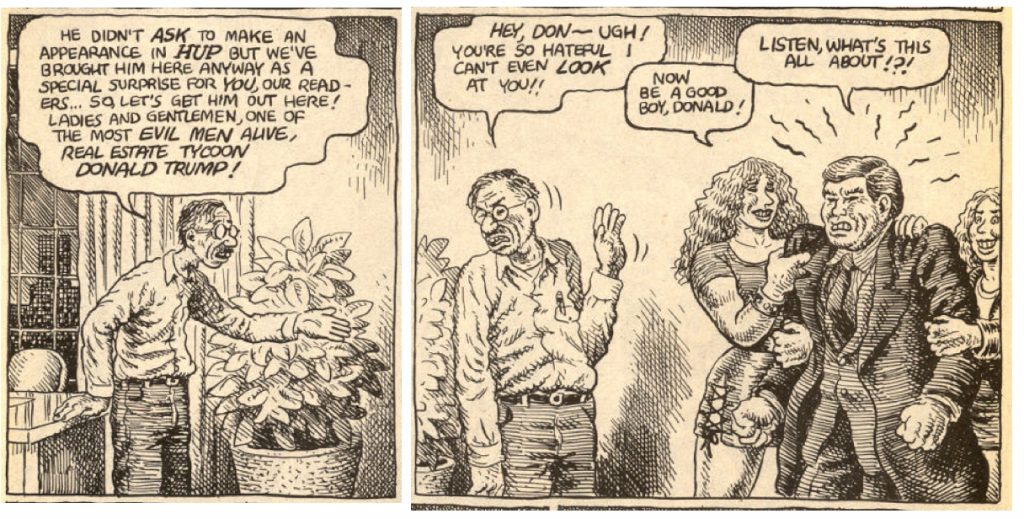
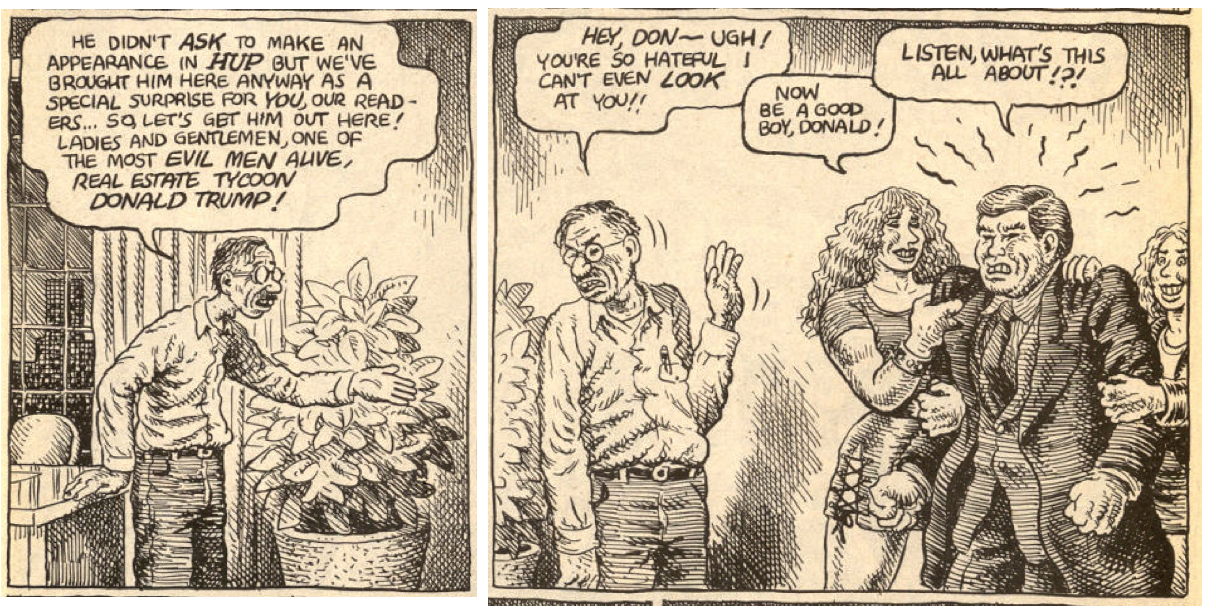
In 1991, he fled America for a small village in Southern France, a prescient move, given “Point the Finger,” a comic published two years earlier in his short-lived Hup series. The semi-fictional five-pager pits Crumb himself against real estate developer Donald Trump, billed as “one of the more visible big time predators who feed on society,” as well as “one of the most evil men alive.”
The then-42-year-old Trump is quick to take Crumb’s bait, piling on some insults of his own. He may not be familiar with the cartoonist’s work, but he knows how to mount an attack, with labels like “crass,” “venal,” “some kind of self-styled terrorist,” “the picture of negativity,” and “filled with hate.” Had Crumb set this smack down on a beach, Trump would be the bully kicking sand in the scrawny nerd’s face, as a couple of hot babes look on, admiringly.
In fact, the comic comes very close to ending on such a note. Two of Crumb’s characteristically powerfully-thighed females are on hand, ostensibly as members of his camp. Their heads are quickly turned, however, by an invitation to Mar-a-Lago, Trump’s lavish Palm Beach estate. The Donald starts looking pretty good to Tracy and Marny, bedazzled by the promise of banquets, manicures, world-class entertainment, and a hedonistic after-hours romp with Trump and his then-wife Ivana.
The cartoonist, defeated, compares the tycoon to Trimalchio, the vulgar but loaded host of Petronius’ Satyricon, before preparing to take things out with the Lao Tzu quote at the top of this post.
It’s here that things take a turn for the meta, as Stan “the Man” Shnooter, the self-assured fictional producer of Hup, rallies Crumb to assert authorial control.
Crumb rewinds to a pivotal moment. In this redo, Tracy and Marny remain steadfast. The bully is frogmarched to the toilet to be given a taste of his own medicine. The saga draws to a close with the sort of acrobatic, questionably consensual, NSFW sex that has rained feminist ire on Crumb for years, as the unlikely conquerer savors victory in his preferred style.
Is it fantasy? Reality? All just a dream?
(Any way you slice it, I’m pretty sure Tracy and Marny aren’t the winners…)
You can check out Crumb’s 1989 Trump comic in its extremely NSFW entirety here or buy Hup, Issue 3 to read it the old fashioned way. Some of the tamer panels can be sampled here.
Related Content:
R. Crumb Describes How He Dropped LSD in the 60s & Instantly Discovered His Artistic Style
Noam Chomsky on Whether the Rise of Trump Resembles the Rise of Fascism in 1930s Germany
Ayun Halliday is an author, illustrator, and Chief Primatologist of the East Village Inky zine. Follow her @AyunHalliday
Read More...Support Us
We're hoping to rely on loyal readers, rather than erratic ads. Please click the Donate button and support Open Culture. You can use Paypal, Venmo, Patreon, even Crypto! We thank you!

About Us

Open Culture scours the web for the best educational media. We find the free courses and audio books you need, the language lessons & educational videos you want, and plenty of enlightenment in between.
Advertise With Us

FREE UPDATES!
GET OUR DAILY EMAIL
Get the best cultural and educational resources on the web curated for you in a daily email. We never spam. Unsubscribe at any time.
FOLLOW ON SOCIAL MEDIA

Open Culture editor Dan Colman scours the web for the best educational media. He finds the free courses and audio books you need, the language lessons & movies you want, and plenty of enlightenment in between.
Advertise With Us