Hear 230 Episodes of Escape: Classic Radio Dramas of Stories by Ray Bradbury, Edgar Allan Poe, H.G. Wells & More (1947–1954)
“Worried about the price of butter and eggs? Fed up with the housing shortage? Want to get away from it all? CBS offers you Escape!” These words open October 1st, 1947’s broadcast adaptation of “The Most Dangerous Game,” Richard Connell’s safari culture-satirizing short thriller about a New York big-game hunter en route to Rio who falls off his yacht, swims to shore, and soon finds himself evading an eccentric Cossack aristocrat who hunts human beings for sport on his own private island. Not exactly the sort of material that takes all one’s cares away, but Escape, it seems, had its own definition of escapism.
Originally airing on CBS radio between 1947 and 1954 — time that, without a regular sponsor, it spent in eighteen different time slots — the program’s 230 episodes took material from all over the literary landscape: Ray Bradbury’s “Mars Is Heaven,” Daphne du Maurier’s “The Birds,” H.G. Wells’ “The Time Machine” (among several other of his tales), F. Scott Fitzgerald’s “A Diamond as Big as the Ritz,” Sir Arthur Conan Doyle’s “The Lost Special,” and Edgar Allan Poe’s “The Fall of the House of Usher.” You can listen to almost all its broadcasts, which mix then-new writers in with the established or already canonized ones, at the Internet Archive. (Stream all the episodes right above or find them here.) “Escape brings together everything that was good about old-time radio drama rolled into one,” say the notes there, calling each episode “a micro drama carefully planned to capture the listener’s attention for thirty minutes.”
“Many of the stories were later reused by more high profile shows such as Suspense, but on the whole the Escape versions were of equal quality and sometimes more dramatically focused and atmospheric. When Radio Life wrote ‘These stories all possess many times the reality that most radio writing conveys,’ it hit the nail on the head.” At the time, the show’s creators must have constantly worried that all their sponsorship troubles and time-slot changes would keep the show from lasting, but even listeners now, more than sixty years after the Golden Age of radio and with our own concerns about egg prices and housing shortages, can find in it a quality of escapism still unmatched by most popular culture.
Find other vintage radio dramas in our collection, 1,000 Free Audio Books: Download Great Books for Free.
Related Content:
Hear 90+ Episodes of Suspense, the Iconic Golden Age Radio Show Launched by Alfred Hitchcock
Hear 22-Year-Old Orson Welles Star in The Shadow, the Iconic 1930s Super Crimefighter Radio Show
X Minus One: More Classic 1950s Sci-Fi Radio from Asimov, Heinlein, Bradbury & Dick
Hear Ray Bradbury’s Beloved Sci-Fi Stories as Classic Radio Dramas
Based in Seoul, Colin Marshall writes and broadcasts on cities and culture. He’s at work on a book about Los Angeles, A Los Angeles Primer, the video series The City in Cinema, the crowdfunded journalism project Where Is the City of the Future?, and the Los Angeles Review of Books’ Korea Blog. Follow him on Twitter at @colinmarshall or on Facebook.
Read More...Hear Young Bob Dylan, Before Releasing His First Album, Tell Amazing Tales About Growing Up in a Carnival
Back in 2012, we featured a young Bob Dylan talking and playing on The Studs Terkel radio show in 1963. Open Culture’s Mike Springer prefaced the interview with these words, “Dylan had just finished recording the songs for his second album, The Freewheelin’ Bob Dylan, when he traveled from New York to Chicago to play a gig at a little place partly owned by his manager, Albert Grossman, called The Bear Club. The next day he went to the WFMT studios for the hour-long appearance on The Studs Terkel Program. Most sources give the date of the interview as April 26, 1963, though Dylan scholar Michael Krogsgaard has given it as May 3.” In talking with Studs, Dylan told some tall tales (scholars say) about his youth, ones that would have made Huckleberry Finn proud. And that tendency to create an alternative biography is on display again in an even earlier interview, dating back to March 11, 1962.
Animated by Blank on Blank above, the (excerpted) interview lets us hear Dylan, only 20 years old, before the release of his eponymous debut album, and before achieving any kind of fame. Young Dylan tells Cynthia Gooding, host of the “Folksinger’s Choice” radio program in NYC, about the six years he spent with the carnival.
I was with the carnival off and on for about six years… I was clean-up boy, I used to be on the main line, on the ferris wheel, uh, do just run rides. I used to do all kinds of stuff like that… And I didn’t go to school a bunch of years and I skipped this and I skipped that.
Later he continued:
I wrote a song once. I’m trying to find, a real good song I wrote. An’ it’s about this lady I knew in the carnival. An’ er, they had a side show, I only, I was, this was, Thomas show, Roy B Thomas shows, and there was, they had a freak show in it, you know, and all the midgets and all that kind of stuff. An’ there was one lady in there really bad shape. Like her skin had been all burned when she was a little baby, you know, and it didn’t grow right, and so she was like a freak. An’ all these people would pay money, you know, to come and see and … er … that really sort of got to me, you know. They’d come and see, and I mean, she was very, she didn’t really look like normal, she had this funny kind of skin and they passed her of as the elephant lady. And, er, like she was just burned completely since she was a little baby, er.
You can hear a nearly complete audio recording of the interview (55 minutes) below, and read a transcript of the full interview on Expecting Rain.
Over on Spotify, you can hear the 11 songs that Dylan played for Gooding that day.
They include several that Dylan wrote, along with some old folk and blues songs:
- “(I Heard That) Lonesome Whistle” (Hank Williams/Jimmie Davis)
- “Fixin’ to Die” (Bukka White)
- “Smokestack Lighning” (Howlin’ Wolf)
- “Hard Travelin’ ” (Woody Guthrie)
- “The Death of Emmett Till” (Bob Dylan)
- “Standing on the Highway” (Bob Dylan)
- “Roll on John” (Rufus Crisp)
- “Stealin’ ” (traditional)
- “It Makes a Long Time Man Feel Bad” (traditional)
- “Baby, Please Don’t Go” (Big Joe Williams)
- “Hard Times in New York Town” (Bob Dylan)
If you would like to support the mission of Open Culture, consider making a donation to our site. It’s hard to rely 100% on ads, and your contributions will help us continue providing the best free cultural and educational materials to learners everywhere. You can contribute through PayPal, Patreon, and Venmo (@openculture). Thanks!
Related Content:
Two Legends Together: A Young Bob Dylan Talks and Plays on The Studs Terkel Program, 1963
Bob Dylan Reads From T.S. Eliot’s Great Modernist PoemThe Waste Land
Bob Dylan & The Grateful Dead Rehearse Together in Summer 1987: Hear 74 Tracks
Read More...Hear Anaïs Nin Read From Her Celebrated Diary: A 60-Minute Vintage Recording (1966)
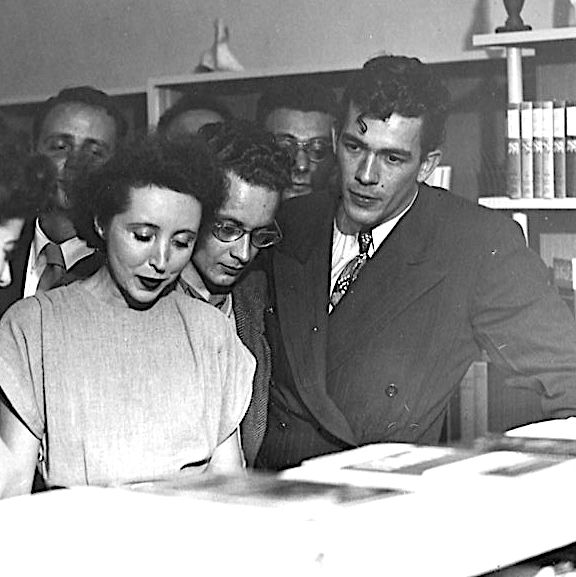
Image by George Leite, via Wikimedia Commons
At one time, writer Anaïs Nin’s reputation largely rested on her passionate, long-term love affair with novelist Henry Miller, whom she also financially supported while he wrote his best-known novels and became, writes Sady Doyle, a “darling of the avant-garde.” Nin herself was a marginalized, “unfashionable” writer, whose “frank portrayals of illegal abortions, extramarital affairs and incest” brought such critical opprobrium down on her that “by 1954, Nin believed the entire publishing industry saw her as a joke.” She had good reason to think so.
Miller’s notoriously censored books won him cult literary status, and inspired the Beats, Norman Mailer, Philip Roth, and many more hedonistic male writers seeking to turn their lives into art. Nin’s equally explicit work was met, she lamented, “with indifference, with insults.” Critics either ignored her novels, several of them self-published, or dismissed them as vulgar, artless, and worse. One headline, Doyle notes, called Nin “a monster of self-centeredness whose artistic pretentions now seem grotesque.”
All of that changed when Nin published the first volume of her diary in 1966. Thereafter, she achieved global fame as a feminist icon, and the next ten years saw the publication of an additional six volumes of her journals, then several more excerpts after her death in 1977. Most notably, Henry and June appeared in 1986 (subsequently made into a film by Philip Kaufman), a book which—in conjunction with the publication of her and Miller’s letters the following year—further added to the mythology of the two passionately erotic writers.
Nin had kept her diaries religiously since age 11, and has become known as “modernity’s most prolific and perceptive diarist,” writes Maria Popova, a distinction that has led to a tremendous resurgence in pop culture popularity in our time, when well-crafted self-revelation is de rigeur for artists, activists, online personalities, and aspirants of all kinds. Henry Miller is now “a marginalized and largely forgotten American writer” (or so claims his biographer Arthur Hoyle), and Nin has become a “patron saint of social media,” writes Doyle, a “proto-Lena-Dunham.” Pithy quotations from her diaries—properly credited or not—constantly circulate on Tumblr, Facebook, and Twitter.
A new generation just discovering Anaïs Nin can access her work in any number of ways—from hip, meme-heavy Tumblr accounts like Fuck Yeah Anais Nin to more formal online venues like the Anais Nin Blog, which aggregates biographies, podcasts, scholarship, bibliographies, controversies, and anything else one might want to know about the author. Anaïs Nin fans can also hear the author herself read from her famous diary in the audio here. At the top of the post, hear Nin’s reading, recorded in ’66, the year of the first volume’s publication. The complete recording runs about 60 minutes.
After the acclaim of Nin’s diaries, and the celebrity she enjoyed in her last decade, her reputation once again suffered, posthumously, as biographers and critics savaged her life and work in moralistic torrents of what would today be called “slut-shaming.” But Nin is now once again rightly revered as a writer fully dedicated to the art, no matter the reception or the audience. The astonishing stream of words that flowed from her, recording every detail of her experiences, “seems nothing less than phenomenal,” wrote Noel Young of Nin’s nonstop letter writing. When it came to the detailed, insightful, and acutely philosophical recording of her life, “the act of writing may have even surpassed the act of living.”
Related Content:
Simone de Beauvoir Explains “Why I’m a Feminist” in a Rare TV Interview (1975)
Henry Miller Makes a List of “The 100 Books That Influenced Me Most”
Josh Jones is a writer and musician based in Durham, NC. Follow him at @jdmagness
Read More...Colorful Animation Visualizes 200 Years of Immigration to the U.S. (1820-Present)
Many of us, whether born there, residing there, or just interested in the place, describe the United States of America as “a nation of immigrants.” What exactly that phrase means has in recent times become the subject of heated public debate. As this year’s presidential candidates strain to appeal to voters with a wide variety of views on the question of what role immigration should play in America’s future (to say nothing of what’s going on in Britain right now), it might help to look at what role immigration has played in its past, and a new animated infographic of who has immigrated from where since 1820 gives the clearest possible look at the whole picture.
“Through most of the 1800s, immigration came predominantly from Western Europe (Ireland, Germany, the U.K.),” writes the data visualization’s creator Max Galka at Metrocosm. “Toward the end of the century, countries further east in Europe (Italy, Russia, Hungary) took over as the largest source of migration. Beginning in the early 1900’s, most immigrants arrived from the Americas (Canada, Mexico). And the last few decades have seen a rise in migration from Asia.”
Each colored dot flying toward the U.S. represents a part of that country’s population, and the brightness of a country’s color on the map corresponds to its total migration to the U.S. at that particular time. Galka provides other charts that show immigration flows by country of origin over time, which makes immigration look higher than ever, and then the same data as a percentage of the total population of the United States, which makes it look almost lower than ever. (And as an American who moved to Korea last year, I can’t help but ask whether we should now give as much thought to emigration out of the U.S. as we have to immigration into it.)
To really feel the advantages and complications of the nation of immigrants first-hand, you’ll want to spend time in a major American city, those always vibrant, often troubled places that people like The Wire creator David Simon have dedicated themselves to observing. “You look at what New Orleans is capable of, as a product of the American melting pot, and it’s glorious,” he once said. “It’s in the friction and in the dynamic between the various groups that inhabit a city that creativity really happens. What makes cities work is a level of tolerance and human endeavor and wit that is absolutely required on the part of all people. Whether or not we succeed as an urban people is the only question worth asking.” And in America, an urban people has always been a diverse people.
via Mental Floss
Related Content:
Noam Chomsky on Whether the Rise of Trump Resembles the Rise of Fascism in 1930s Germany
Brexit 101: The UK’s Stunning Vote Explained in 4 Minutes
The Syrian Conflict & The European Refugee Crisis Explained in an Animated Primer
John Green’s Crash Course in U.S. History: From Colonialism to Obama in 47 Videos
Based in Seoul, Colin Marshall writes and broadcasts on cities and culture. He’s at work on a book about Los Angeles, A Los Angeles Primer, the video series The City in Cinema, the crowdfunded journalism project Where Is the City of the Future?, and the Los Angeles Review of Books’ Korea Blog. Follow him on Twitter at @colinmarshall or on Facebook.
Read More...Photographer Bill Cunningham (RIP) on Living La Vie Boheme Above Carnegie Hall
New York City lost some of its charm this weekend, with the news that Bill Cunningham, the Times’ beloved, on-the-street fashion photographer, had passed away at the age of 87.
Much has been made over the fact that he was designated a living landmark by the New York Landmarks Conservancy. It’s an honor he earned, hitting the streets daily in his usual mufti of khakis, sneakers, and bleu de travail cotton jacket to hunt his quarry by bicycle, but one could never accuse him of courting it.
His employer frequently sent him to cover the elite, but he had no interest in joining their ranks, despite his own growing celebrity. His “Evening Hours” column documented the dressed up doings on the “party circuit.” (This living New York landmark never shook his Boston accent, one of the chief delights of his weekly video series for the Times.) A recent installment suggests that shooting the likes of actress Nicole Kidman and Vogue Editor-in-Chief Anna Wintour during tony private functions at MoMA and the Metropolitan Museum of Art (“aht”) was far less exciting than encountering colorfully clad Himalayan dancers and a children’s craft table at an entirely free Sunday afternoon street fair sponsored by the Rubin Museum of Art.
Playwright Winter Miller shared this anecdote the morning Cunningham’s death was announced:
…he didn’t give a fk about who was famous or not. I once met Bill Murray in the lobby of the old New York Times building. He’d shown up to see if he could track down a photo of him and his then-wife that Bill had shot. I brought one Bill to the other, but Bill (Cunningham) was out on the streets with his blue jacket, white bike and camera. When he returned, I explained how I’d come to take Bill Murray under my wing to help him track down this photo. Bill had no idea who Bill Murray was and not unkindly told me (that) none of his photos were digital, so it would involve him personally digging through old files and he didn’t have time. I admired that he knew his priorities and never strayed from his task. I had been eager to get Bill Murray the thing he’d wanted and would have combed though vast files myself… but I never looked. Bill Cunningham’s files were impenetrable to an outsider.
One likes to think that Murray, who’s known for using his fame as his ticket to hang with ordinary mortals, would find much to love about that.
In fact, Murray strikes me as the perfect candidate to play Cunningham in a biopic covering the six decades spent living and working in a studio over Carnegie Hall. As far as I know, Bill Cunningham New York, a feature length documentary, is the only time his story has been captured on the silver screen. How can it be that no one has thought to make a movie centered on the lost bohemian period Cunningham recalls so fondly in the slideshow above? It sounds like an American spin on the Lost Generation—sneaking down to the unlocked stage for photographer Editta Sherman’s impromptu amateur performances of The Dying Swan, an elderly circus performer and her dog roaming the halls on a unicycle, someone always in a state of undress…
Perhaps Murray’s frequent collaborator, Wes Anderson, could be enlisted to set these wheels in motion. The colorful cast of characters seem tailor-made for this director, already a fashion world favorite.
Prior to acquiring an Olympus Pen D half-frame camera from a friend in 1966, Cunningham worked as a milliner. Marilyn Monroe used to crack herself up, trying them on in between classes at the Actor’s Studio. The wife of a Carnegie Hall neighbor and Cunningham’s boss, fashion photographer Ray Solowinski, served as his model. After he was established as a fashion expert in his own right, Cunningham admitted that his designs were “a little too exotic – you know, for normal people”.
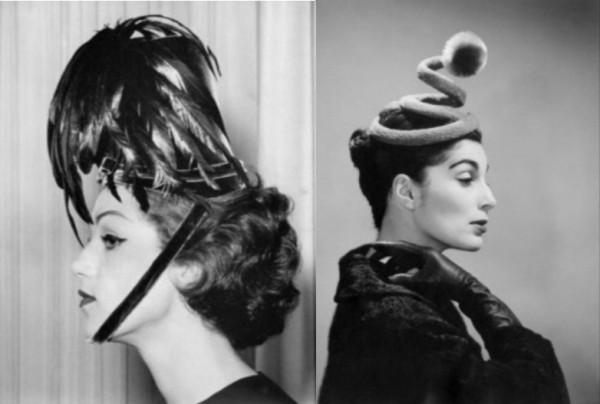
I think they’re wonderful, and hopefully, Bill Murray, Wes Anderson and you will agree. See below. I think they’re wonderful, and hopefully, Bill Murray, Wes Anderson and you will agree. Hats off to the inimitable Bill Cunningham, as much a fixture of New York as Carnegie Hall.
Related Content:
Hunter S. Thompson’s Advice for Aspiring Photographers: Skip the Fancy Equipment & Just Shoot
Alfred Stieglitz: The Eloquent Eye, a Revealing Look at “The Father of Modern Photography”
Stanley Kubrick’s Jazz Photography and The Film He Almost Made About Jazz Under Nazi Rule
Ayun Halliday is an author, illustrator, and Chief Primatologist of the East Village Inky zine. Follow her @AyunHalliday
Read More...Free: Hear 24 Hours of Noam Chomsky’s Lectures & Talks on the Powers That Subvert Our Democracies
Noam Chomsky is optimistic. Yes, the world seems to teeter on the brink of… well, name your dystopian scenario, but Noam Chomsky is optimistic. The same Chomsky who, for decades, has sought to show the myriad ways our most revered institutions are largely sham operations behind which powerful elites conduct secret wars, propaganda campaigns, environmental destruction, and concerted efforts to defraud the people and disable democratic processes… well, he tells us, in a recent interview with James Resnick, that we too “can be very optimistic. Things like this have happened before and they’ve been overcome.”
By “things like this,” the renowned linguist and anarchist political philosopher specifically means astounding levels of wealth inequality and the ascendency, once again, of far-right extremism in Europe and the U.S., a phenomenon he first observed in the years prior to World War II. Chomsky began his career of social and political critique in 1938 at the age of 10, “writing articles for the school newspaper on the rise of fascism in Europe and the threats to the world as I saw them.”
He went on to completely revolutionize the field of linguistics, an achievement that, stunningly, can seem secondary to his political writing and activism, given the sheer number of his books, essays, interviews, and speeches critical of state power, war, and media manipulation over the past several decades. (Some of his books you can read free online here.) I suppose if Chomsky weren’t something of an optimist, he would have given up a long time ago. He tells Resnik what keeps him going:
The things I consider inspiring is seeing people struggling: poor suffering people, with limited resources, struggling to really achieve anything. Some of them are very inspiring. For example, a remote very poor village in southern Colombia organizing to try to prevent a Canadian gold-mining operation from destroying their water supply and the environment; meanwhile, fending off para-military and military violence and so on. That kind of thing which you see all over the world is very inspiring.
Are you inspired? Maybe it depends on how many of these grassroots struggles you’ve witnessed. The worldwide, ground-level resistance Chomsky describes—and refers to again and again in his political work—is largely hidden from us, by a mass media that sees no dollar value in it, or perhaps obscures it for more sinister reasons. As Chomsky has argued since the sixties—most comprehensively in his 1988 Manufacturing Consent with Edward S. Herman—the campaigns of war and economic depredation conducted by the West against minorities, indigenous people, and small nations around the world mostly occur with the consent of Western people: a consent manufactured by a massive propaganda operation called the Free Press.
His position should not sound especially controversial to anyone who has paid the least bit of attention in the last few years. The seeming collusion of respected news organizations like The Washington Post and The New York Times in the push for the second Iraq War led to well over a decade of post-hoc introspection by journalists. Recent months have seen those same organs—for perhaps more baldly profit-seeking motives—provide a couple of billion dollars-worth of free PR for Donald Trump, a candidate who has on multiple occasions threatened to retaliate against the press for any criticism, and who recently revoked the Post’s credentials to cover his events. (A recent Harvard study concluded that during this protracted, ugly primary season, “the press became [Trump’s] dependable if unwitting ally.”)
As in these examples, the role of the British press in spreading fear and misinformation prior to this month’s Brexit vote has become its own significant story. We constantly see the press turning in agonized circles, trying to come to grips with its complicity in pushing various agendas. Whether or not mainstream media organizations take direct orders from government bodies or economic elites, they accede to the interests of the powerful all the same, and they wield enormous influence over a voting public who depend upon them for information. The situation presents a serious problem for the health of a functioning democracy, which itself depends upon an informed and educated electorate.
But as Chomsky has often argued—drawing as always on primary sources and directly quoting the West’s most influential political philosophers, policy architects, and business leaders—elites since the 17th and 18th centuries have intentionally thwarted the ability of the public to make informed decisions, and have shut the populace out of the most important decision-making processes. As he wrote in his 1999 critique of Neoliberalism, Profit Over People, “the general population must be excluded entirely from the economic arena, where what happens in the society is largely determined. Here the public is to have no role, according to prevailing democratic theory.”
Chomsky follows this line of reasoning in his talk “When Elites Fail,” at the top of the post, delivered as the keynote address for the Ecoconvergence Conference in Portland, Oregon in 2009. You can also hear this talk, along with 19 others, in the Spotify playlist just above—a total of 24 hours of Chomskyan social, political, and economic analysis, delivered by the man himself in his calm, measured, understated way. (If you need Spotify’s free software, download it here.) Chomsky addresses “The Tyranny of Corporations,” the “U.S. Media as Propaganda System,” “Politics and Language,” “Iraq: The Forever War,” and more—levying criticisms against the systems of power, whether Republican, Democratic, or international, that doggedly seek to increase their domains and, in the approving words of James Madison, to “protect the minority of the opulent against the majority.”
Related Content:
Noam Chomsky on Whether the Rise of Trump Resembles the Rise of Fascism in 1930s Germany
Clash of the Titans: Noam Chomsky & Michel Foucault Debate Human Nature & Power on Dutch TV, 1971
Read 9 Free Books By Noam Chomsky Online
Josh Jones is a writer and musician based in Durham, NC. Follow him at @jdmagness
Read More...And Now for Some Culinary Weirdness: Christopher Walken Shows You How to Cook Chicken & Pears
I don’t need to be made to look evil. I can do that on my own.
Five years ago, actor Christopher Walken casually shared a simple recipe for roast chicken with pears, above. The lighting was amateur, his implements fairly utilitarian, and, much to my gratification, he couldn’t keep his cat off the counter, either.
His improvised patter was as nonchalant as his handling of his ingredients. Undeterred, legions of fans still found plenty of Walken-esque quotes with which to spice up the video’s comments section.
Chalk it up to the dozens of soft spoken, seriously unhinged characters on which this actor’s reputation rests. It’s painfully easy to imagine a rival gang member or law enforcement official lashed to a chair just off camera, squirming in terror as Walken pauses to appreciate the “little cookies” the caramelized pears leave behind on the bottom of his pan.
Whatever he’s planning to do to this imaginary unfortunate, one hopes it won’t involve flaps of skin and a vertical poultry roaster.
As to the recipe, it’s as delicious as it is innocuous. Try it!
If you’re feeling less than adventurous, you can decrease the creep factor by replicating the shoot with a grandfatherly gent of your choosing prior to serving. (Anyone who’s not Christopher Walken will do.)
If you’re looking for further serving suggestions, the comedy channel Funny or Die revisited the dish in 2012, pairing it with salad, seafood melange, red wine, Law & Order: Special Victims Unit star Richard Belzer, and two heavily made up assistants who appear to be on loan from Robert Palmer’s “Addicted to Love” video.
Things get cooking with a visit to the Byzantine Stew Leonard’s supermarket, and end with a cell phone pic of Walken’s nose. There’s a live mandolin serenade and the kitchen seems vastly more expensive, but I found myself missing the homey sense of foreboding created by the original.
Still, one can never go wrong with poultry and pears.
Related Content:
Christopher Walken Reads The Three Little Pigs, The Raven, and a Little Lady Gaga
Edgar Allan Poe’s “The Raven,” Read by Christopher Walken, Vincent Price & Christopher Lee
Ayun Halliday is an author, illustrator, and Chief Primatologist of the East Village Inky zine. Follow her @AyunHalliday
Read More...What Does “Kafkaesque” Really Mean? A Short Animated Video Explains
We derive adjectives from great writers’ names meant to encapsulate entire philosophies or modes of expression. We have the Homeric, the Shakespearean, the Joycean, etc. Two such adjectives that seem to apply most to our contemporary condition sadly express much darker, more cramped visions than these: “Orwellian” and “Kafkaesque.” These adjectives also—suggests writer Noah Tavlin—name two of the most misunderstood of authorial visions. In a TEDEd video last year, Tavlin attempted to clear up confusion about the “Orwellian,” a term that’s tossed around by pundits like a political Frisbee.
Tavlin returns in the video above to explain the meaning of “Kafkaesque,” a less-abused descriptor but one we still may not fully appreciate. He begins with a brief summary of Kafka’s novel The Trial, in which “K, the protagonist, is arrested out of nowhere and made to go through a bewildering process where neither the cause of his arrest nor the nature of the judicial proceedings are made clear to him.” The scenario is “considered so characteristic of Kafka’s work” that scholars use the term “Kafkaesque” to describe it. Kafkaesque has become evocative of all “unnecessarily complicated and frustrating experiences, like being forced to navigate labyrinths of bureaucracy.”
But the word is much richer than such casual usage as describing a trip to the DMV.
Tavlin references Kafka’s short story “Poseiden,” in which the god of the sea can neither explore nor enjoy his realm because he is buried under mountains of paperwork. In truth, he is “a prisoner of his own ego,” unwilling to delegate because he sees his underlings as unworthy of the task. This story, Tavlin argues, “contains all of the elements that make for a truly Kafkaesque scenario.”
It’s not the absurdity of bureaucracy alone, but the irony of the character’s circular reasoning in reaction to it, that is emblematic of Kafka’s writing. His tragicomic stories act as a form of mythology for the modern industrial age, employing dream logic to explore the relationships between systems of arbitrary power and the individuals caught up in them.
Tavlin refers to The Metamorphosis and “A Hunger Artist” as further examples of how Kafka’s characters overcomplicate their own lives through their fanatical, singular devotion to absurd conditions.
But as Tavlin admits later in the video, the bewildering mechanisms of power in stories such as The Trial also “point to something much more sinister”—the idea that arcane bureaucracies become self-perpetuating and operate independently of the people supposedly in power, who are themselves reduced to functionaries of mysterious, unaccountable forces. Tavlin quotes Hannah Arendt, who studied the totalitarian nightmares Kafka presciently foresaw, and wrote of “tyranny without a tyrant.” More recently, philosopher Manuel De Landa has theorized increasingly complex, impersonal systems operating with little need for human intervention. His War in the Age of Intelligent Machines, for example, imagines modern warfare as the evolving operations of more-or-less self-organizing weapons systems. Theorists frequently observe that the speed of technological advancement now proceeds at such a dizzyingly exponential rate that it will soon surpass our ability to control or understand it at all. Perhaps, as Tesla’s Elon Musk suggests, we ourselves are no more than operations in a complex system, simulated beings inside a computer program.
But scenarios like De Landa’s and Musk’s are also not the Kafkaesque, for these theorists of modern technocracy lack a key feature of Kafka’s vision—his dark, tragicomic, absurdist sense of humor, which permeates even his bleakest visions. On the one hand, Tavlin says, we “rely on increasingly convoluted systems of administration” and find ourselves judged and ruled over “by people we can’t see according to rules we don’t know”—a situation bound to provoke profound anxiety and psychological distress. On the other hand, Kafka’s attention to the absurd, “reflects our shortcomings back at ourselves,” reminding us that “the world we live in is one we created.” I’m not so sure, as Tavlin concludes, that Kafka believed we have the “power to change for the better” the overcomplicated systems we barely understand. Kafka’s comic vision, I think, ultimately partakes in what Miguel de Unamuno called “the tragic sense of life.” But he does not fully deny his characters all freedom of choice, even if they frequently have no idea what it is they’re choosing between or why.
Note: You can download essential works by Franz Kafka as free audiobooks if you sign up for a 30-Day Free Trial with Audible. You get two free audiobooks with each trial. Find more information on that program here.
Related Content:
What “Orwellian” Really Means: An Animated Lesson About the Use & Abuse of the Term
Franz Kafka: An Animated Introduction to His Literary Genius
Franz Kafka’s Kafkaesque Love Letters
Josh Jones is a writer and musician based in Durham, NC. Follow him at @jdmagness
Read More...A Wonderful Archive of Historic Transit Maps: Expressive Art Meets Precise Graphic Design
Anyone who loves cities almost certainly loves transit maps: for well over a century, they’ve not only played an essential role in the navigation of urban spaces but developed into their very own distinctive form at the intersection of utility and aesthetics. The finest examples simultaneously possess the clarity and information-richness of the best graphic design and hold out promises of excitement and modernity that require a true artistic sensibility to properly express. None of this is lost on Cameron Booth, the Australian graphic designer living in Portland, Oregon who runs the site Transit Maps.
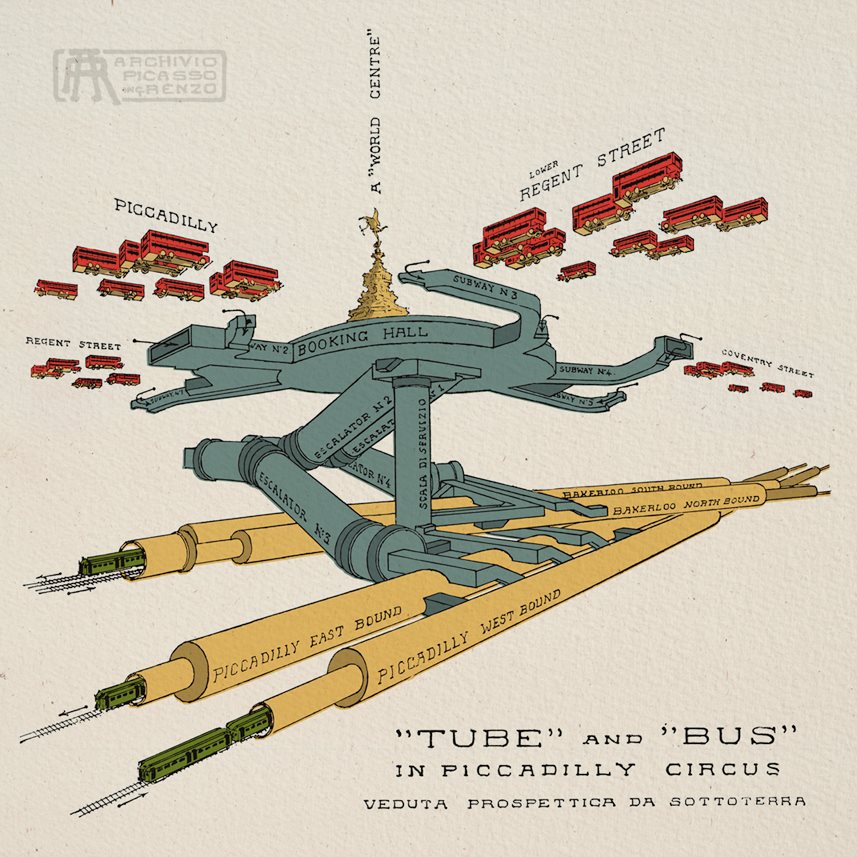
“A well designed transit map conveys a lot of information in a very small space,” writes Booth on the site’s About page. “In an instant, we learn how to get from ‘A’ to ‘B’, simply by following some coloured lines. The very best maps become symbols of their city, admired and loved by all.” None have become quite so symbolic as the map of the London Underground, the oldest subway system in the world, and Transit Maps’ posts filed under the London Underground tag, such as the 1929 cutaway diagram of its Piccadilly Circus station by Italian architect and urban designer Renzo Picasso just above provide plenty of good reading — and even better viewing — for its many enthusiasts.
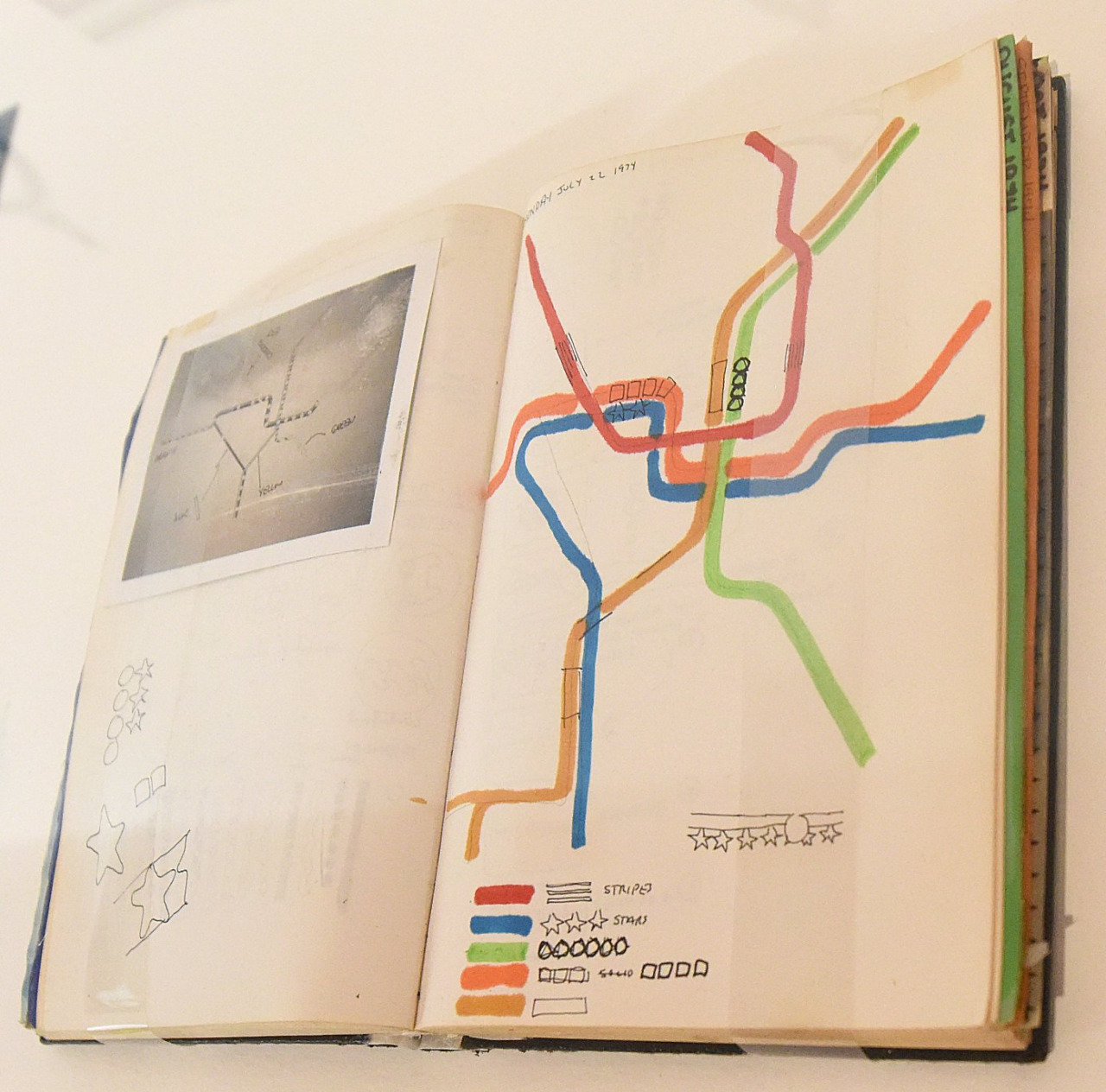
Among American cities, no subway system has a more respected map than Washington, DC’s, the work of graphic designer Lance Wyman, for whom it has remained a work in progress: he oversaw a redesign just five years ago, almost forty years after the system went into service and his original map made its debut. Here we have one of Wyman’s original working sketches for the map straight from his notebook. “Interestingly, it looks like Wyman was experimenting with textural treatments for the route lines at this time,” adds Booth, “an idea I’m ever so glad he abandoned, because it would have looked so busy and hideous.”
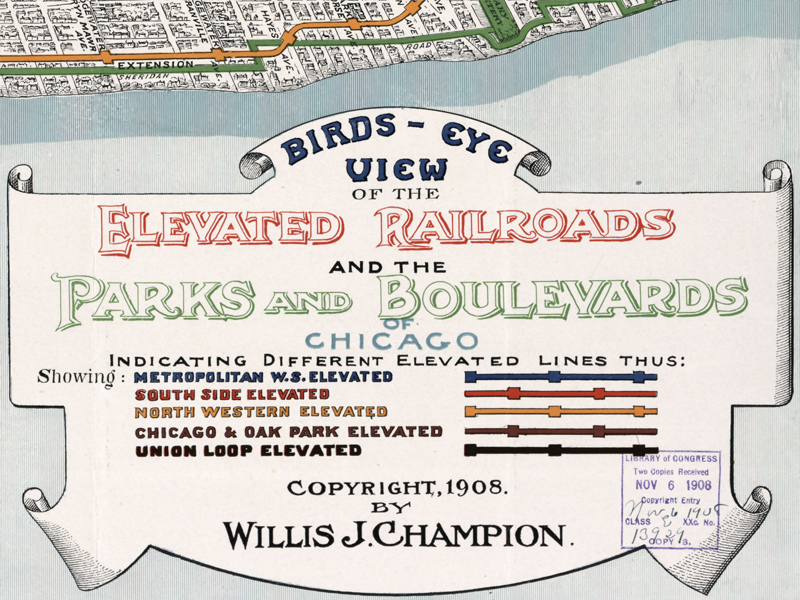
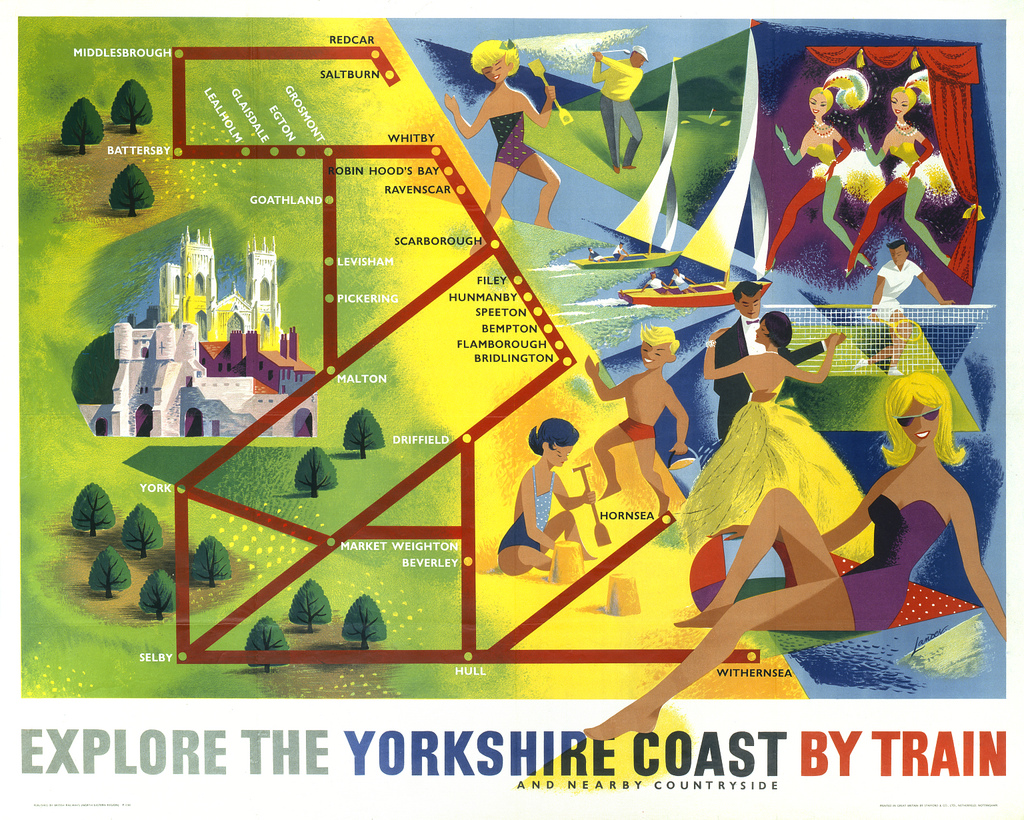
Having seen many more transit maps than most, and even having designed some of his own (including a reworking of the DC Metro map), Booth doesn’t hesitate to point out both the virtues and the flaws of the ones he posts. He even grades them on a star rating system (with, of course, circular London Underground logos substituting for actual stars), collecting the very best under the five-star tag. One such passage with flying colors, the 1950s Yorkshire coast train map at the top of the post, has Booth exclaiming that “they don’t make ‘em like this any more. The 1908 bird’s-eye view of Chicago, source of the legend above, scores its own five stars by “minute attention to detail,” down to the inclusion of “smoke curls from factory chimneys” and “almost every tree in the city’s parks.”
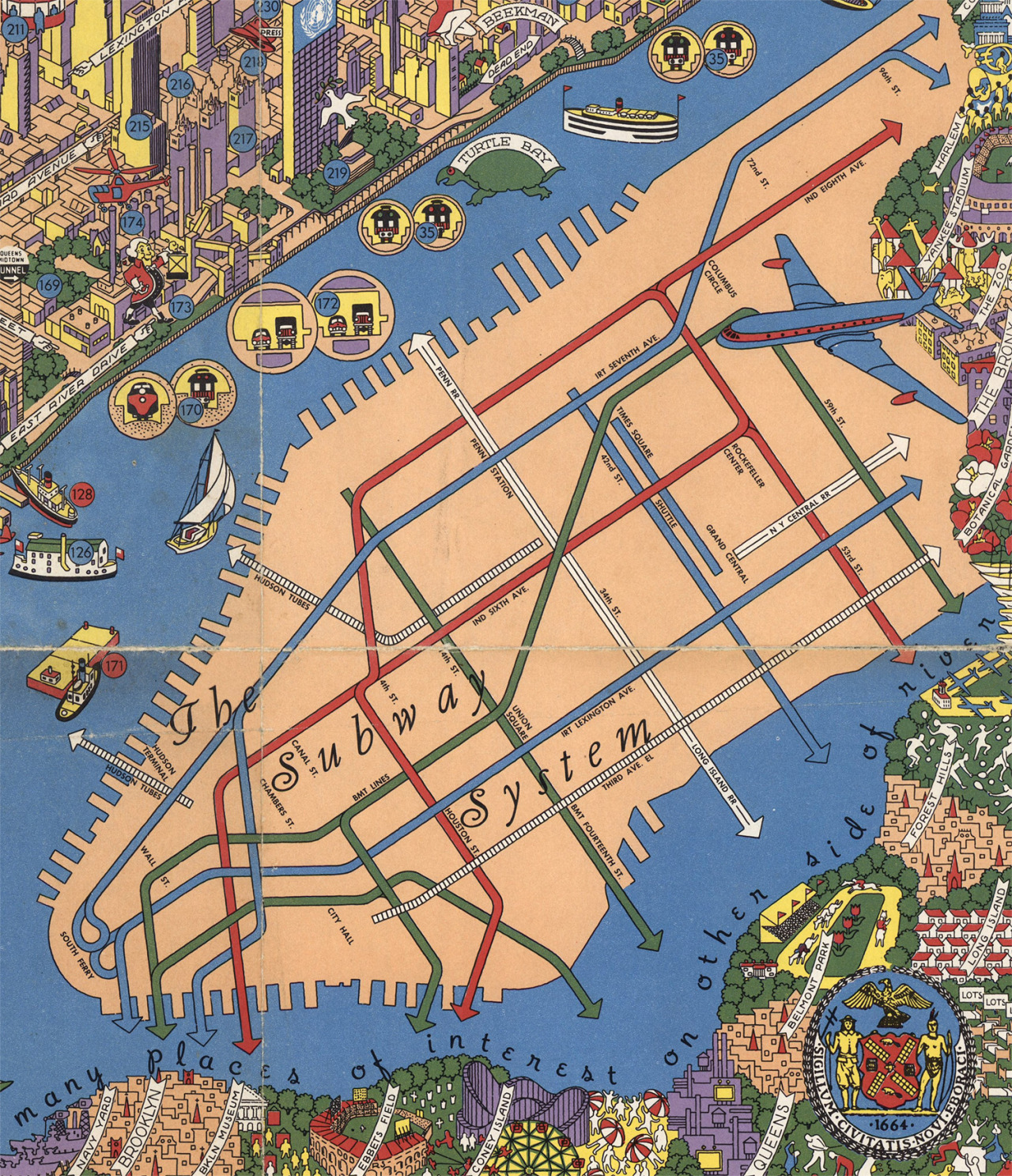
Few cities have attracted as much attention from mapmakers as New York, possibly due to all its wonders — or at least those are what IBM graphic designer Nils Hansell emphasizes in his mid-1950s map “Wonders of New York” which, despite not looking far past Manhattan, does include transit and much else besides: Booth mentions its depiction of “300-odd numbered points of interest” as well as “the last vestiges of New York’s once-extensive elevated railway lines.” You need quite a high-definition scan to really appreciate all this, and Booth found one in the David Rumsey Map Collection, which we’ve previously featured here on Open Culture.

Scroll through the pages and pages of Transit Maps’ historical tag, and you’ll find a wealth of fascinating showpieces of the transit mapper’s art, not just from the Londons and New Yorks of the world, but also from times and places like Berlin in 1931, Madison, Wisconsin in 1975, and Booth’s own old hometown of Sydney in 1950 and new hometown of Portland in 1978. The archive even includes transit maps from unusual places, such as a delightful one printed on the back of a Japanese matchbox in the 1920s, and maps for transit systems never completed, such as the one for the Baghdad Metro from the early 1980s just above. Iraq’s capital may still await a full-service subway system — and much else besides — but at least its map earns top marks.
Related Content:
Designer Massimo Vignelli Revisits and Defends His Iconic 1972 New York City Subway Map
Vintage Video: A New York City Subway Train Travels From 14th St. to 42nd Street (1905)
Vladimir Nabokov Creates a Hand-Drawn Map of James Joyce’s Ulysses
Based in Seoul, Colin Marshall writes and broadcasts on cities, language, and style. He’s at work on a book about Los Angeles, A Los Angeles Primer, the video series The City in Cinema, the crowdfunded journalism project Where Is the City of the Future?, and the Los Angeles Review of Books’ Korea Blog. Follow him on Twitter at @colinmarshall or on Facebook.
Read More...Brexit 101: The UK’s Stunning Vote Explained in 4 Minutes
The Brexit votes have been counted. The Brits have decided to leave the European Union. And the financial markets are taking it hard. Right now, futures on the London stock exchange are down 8%. The pound is down 9.8 percent, more than double its previous record decline of 4.1 percent. We’re living in interesting times.
No doubt, some of you are suddenly wondering, what exactly is Brexit? And what’s at stake? Up top, you can watch a four-minute primer created by The Wall Street Journal. Bloomberg has its own two-minute version here (or view below). The Toronto Star breaks down Brexit in 13 points. And The Guardian went so far as to create a guide just for Americans. (For anyone who wants to dissect the propaganda for leaving Brexit, you can watch the feature-length documentary film, Brexit: The Movie, released last month.) Please feel free to add other primers in the comments below.
For Americans reading this, I’d point out that Brexit and Trump share some important things in common: they’re both about putting up walls, placing blame on immigrants and minorities; exploiting the resentments of the economically disadvantaged; dismissing experts and establishment figures; and risking upending a fragile world order. How England looks on June 24th is perhaps a small preview of how America might look on November 9th. Only there will be trillions more at stake.
If you would like to support the mission of Open Culture, consider making a donation to our site. It’s hard to rely 100% on ads, and your contributions will help us continue providing the best free cultural and educational materials to learners everywhere. You can contribute through PayPal, Patreon, and Venmo (@openculture). Thanks!
Read More...Support Us
We're hoping to rely on loyal readers, rather than erratic ads. Please click the Donate button and support Open Culture. You can use Paypal, Venmo, Patreon, even Crypto! We thank you!

About Us

Open Culture scours the web for the best educational media. We find the free courses and audio books you need, the language lessons & educational videos you want, and plenty of enlightenment in between.
Advertise With Us

FREE UPDATES!
GET OUR DAILY EMAIL
Get the best cultural and educational resources on the web curated for you in a daily email. We never spam. Unsubscribe at any time.
FOLLOW ON SOCIAL MEDIA

Open Culture editor Dan Colman scours the web for the best educational media. He finds the free courses and audio books you need, the language lessons & movies you want, and plenty of enlightenment in between.
Advertise With Us