Watch UC Berkeley’s Free “Edible Education 101” Lecture Course, Featuring Michael Pollan, Alice Waters and Other Sustainable Food Superstars
Dinner at Berkeley’s famed Chez Panisse shows up on a lot of foodie’s bucket lists. Its founder, Alice Waters, has been promoting the importance of eating organically and locally for nearly half a century.
With the Edible Schoolyard Project, she found a way to share these beliefs in true hands-on fashion, by involving thousands of children and teens in kitchens and gardens across the country.
We will all benefit from this revolution, though I can’t help but envy the kids at its epicenter. Back when Waters was pioneering California cuisine, I was suffering under my school lunchroom’s mandatory “courtesy bite” policy. The remembered aroma of Salisbury steak and instant mashed potatoes still activates my gag reflex.
The University of California’s Edible Education 101 course has been continuing the Edible Schoolyard’s work at the collegiate level since 2011. It’s a glorious antidote to the culinary traumas experienced by earlier generations. UC Berkeley students can take Edible Education 101 for credit. The public is welcome to sit in on lectures featuring a pantheon of sustainable food superstars, including Waters, author Michael Pollan of The Omnivore’s Dilemma, above, and course leader Mark Bittman (you know him from The New York Times and his new startup The Purple Carrot).
Fortunately for those of us whose bucket list splurge at Chez Panisse requires such additional expenses as plane tickets and hotel rooms, many of the lectures are also viewable online.
The range of topics make clear that edible education is not simply a matter of learning to choose a locally grown portobello over a Big Mac. Transportation, technology, marketing, and pubic policy all factor into the goal of making healthy, equitably farmed food available to all at an a non-Chez Panisse price.
A complete playlist of 2015’s Edible Education 101 lectures is here, or stream them right above. A list of 2016’s topics and guest lecturers is here. The Edible Education lectures will be added to our collection, 1,700 Free Online Courses from Top Universities.
Related Content:
Michael Pollan Presents an Edible Education, A Free Online Course From UC Berkeley
Ayun Halliday is an author, illustrator, and Chief Primatologist of the East Village Inky zine. Follow her @AyunHalliday
Read More...1,000 Vintage Postcards Show Famous Actors Performing Shakespeare’s Plays from 1880 to 1914
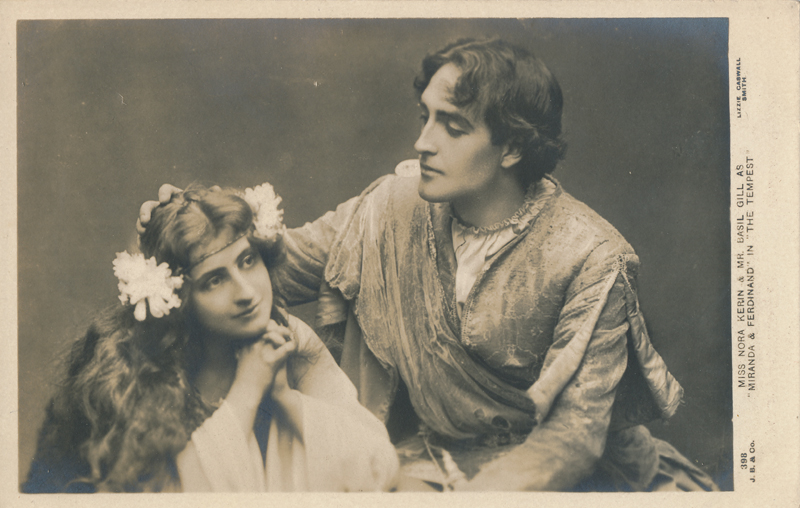
We’ll never fully know how anything looked in Shakespeare’s time, much less how the Bard’s own plays did when first performed on the stage of the Globe Theatre. Thorough scholarship of history in general and Shakespeare in particular has enabled us to imagine and reconstruct such a sight with reasonable credibility, but only so much direct accuracy, since the development of photography wouldn’t happen for a couple hundred years. But not long after humanity got its photographers did those photographers begin taking pictures of humanity’s best-known dramas, and a set of particularly vivid examples survives on Emory University’s relaunched web site Shakespeare and the Players.
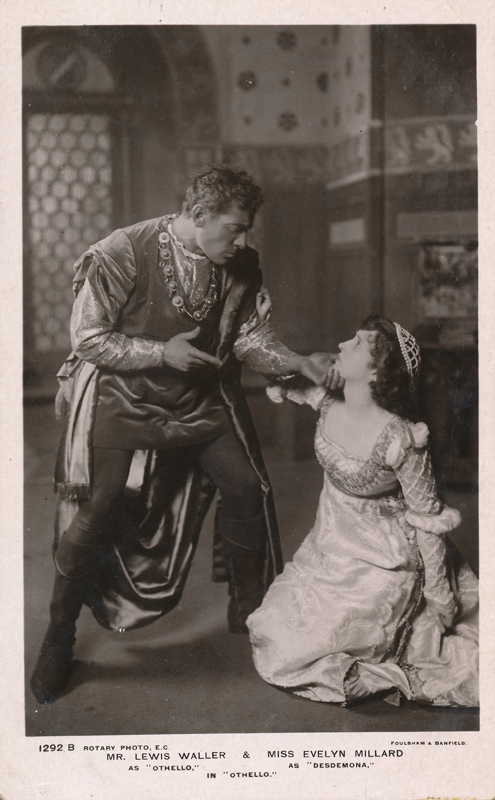
The site describes itself as “an online exhibition of nearly 1,000 postcards featuring many famous English and American actors who performed Shakespeare’s plays for late Victorian and Edwardian audiences,” specificially from around 1880 to 1914. It “showcases postcards featuring the dominating actors of the time in roles from some of the more popular and oft-performed plays, like Hamlet and Romeo & Juliet, as well as those from plays not often performed, like Cymbeline and The Merry Wives of Windsor.”
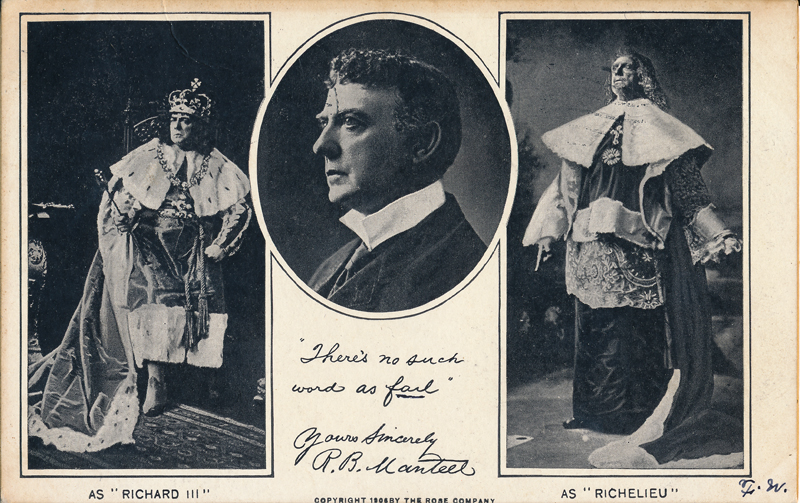
Slate’s Rebecca Onion refers to scholar Lawrence W. Levine, who writes of how, in the 19th century, “many Americans, even if illiterate, knew and loved Shakespeare’s plays; they were the source material for endless parodies, skits, and songs on the American stage. Nor was Shakespeare fandom confined to the elite; in the first half of the 19th century, theater ‘played the role that movies played in the first half of the twentieth … a kaleidoscopic, democratic institution presenting a widely varying bill of fare to all classes and socioeconomic groups.’ ”
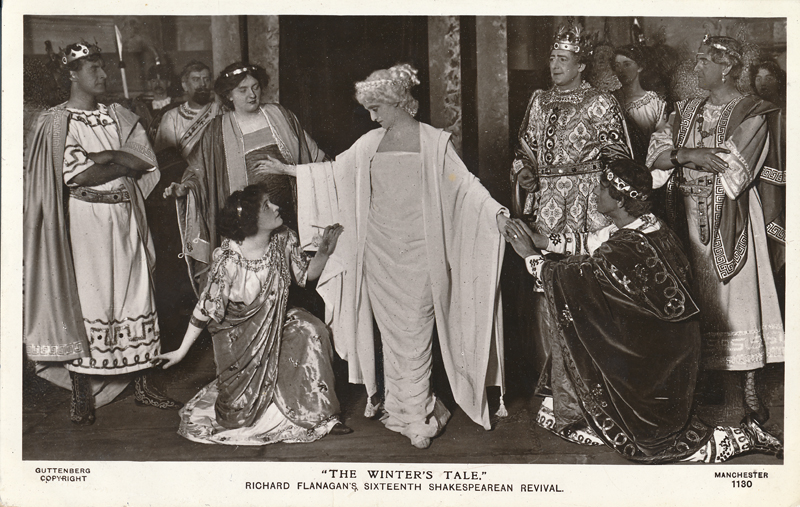
Shakespeare and the Players first went live back in the 1990s, a project of English professor Harry Rusche, who has written an informative preface for the site in its recently redesigned form (with its images completely re-digitized). “Postcards on Shakespeare appeared in a dizzying array of contexts,” he explains, “some humorous and some serious; these cards of actors were only a small part of Shakespeare and of the card-industry as a whole.” A “mania for collecting” swept up their contemporary buyers, not to mention an appreciation for the stars of the day: “handsome men and beautiful women are always popular in any medium.”
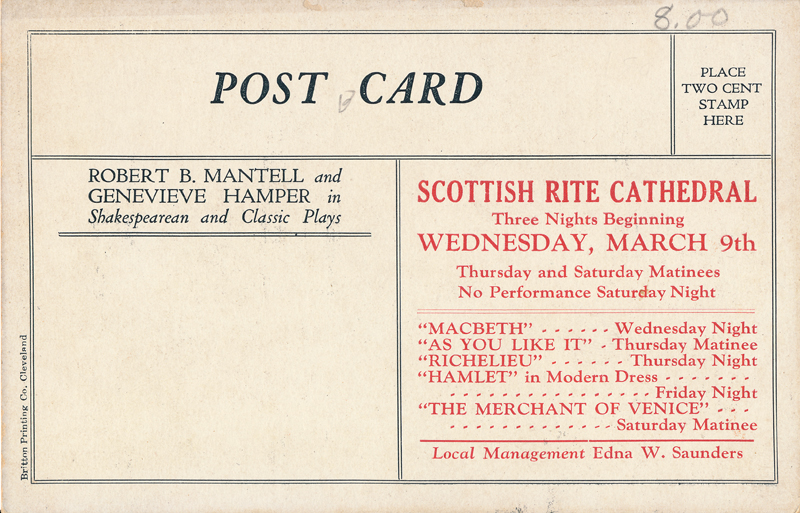
But plenty of them actually used these postcards for their intended purpose, about which you can learn more on the site’s postcard backs section. It notes that “the philosopher Jacques Derrida, in The Postcard, encourages us to read the two conflicting, yet resonating scenes — in our case, the Shakespeare image and the handwriting on the back — two sides of the postcards together,” an experience that may “be especially interesting to those of us born in the age of email, video conferences, Twitter, and text messaging,” those who will now wonder when a set of Shakespeare emoji will come along, providing us a means of continuing to incorporate these eternal characters into our correspondence today.
Related Content:
Free Online Shakespeare Courses: Primers on the Bard from Oxford, Harvard, Berkeley & More
Read All of Shakespeare’s Plays Free Online, Courtesy of the Folger Shakespeare Library
Shakespeare’s Restless World: A Portrait of the Bard’s Era in 20 Podcasts
Take a Virtual Tour of Shakespeare’s Globe Theatre
Drunk Shakespeare: The Trendy Way to Stage the Bard’s Plays in the US & the UK
Based in Seoul, Colin Marshall writes and broadcasts on cities, language, and style. He’s at work on a book about Los Angeles, A Los Angeles Primer, the video series The City in Cinema, the crowdfunded journalism project Where Is the City of the Future?, and the Los Angeles Review of Books’ Korea Blog. Follow him on Twitter at @colinmarshall or on Facebook.
Read More...A Handy Guide on How to Download Old Coursera Courses Before They Disappear
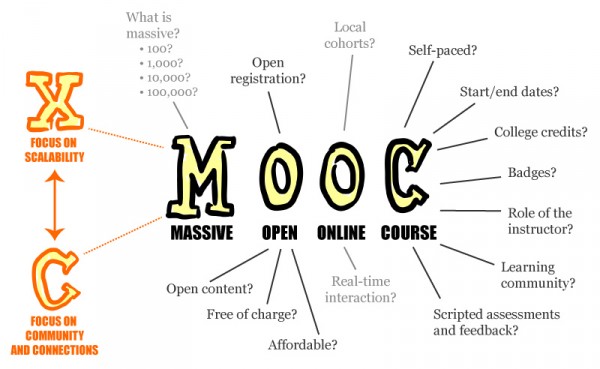
Image by Mathieu Plourd, via Wikimedia Commons
On June 30th, Coursera plans to wind down its old e‑learning platform. And according to this email the company sent around, any “courses and course materials on [that] old platform will no longer be accessible.” Concerned that dozens of older MOOCs could be lost, some have called this move a form of “cultural vandalism.” Others, like the good folks at Class Central, have created a very thorough and handy guide that will show you how to save the course materials (videos, slides, transcripts, etc.) before the June 30th deadline. You’re on notice. Start reading the guide and thank Dhawal Shah for putting it together.
For a list of MOOCs starting in the second half of June, click here.
If you would like to support the mission of Open Culture, consider making a donation to our site. It’s hard to rely 100% on ads, and your contributions will help us continue providing the best free cultural and educational materials to learners everywhere. You can contribute through PayPal, Patreon, and Venmo (@openculture). Thanks!
Read More...Hear Ernest Shackleton Speak About His Antarctic Expedition in a Rare 1909 Recording
What more harrowing story has the history of twentieth-century exploration produced than that of Ernest Shackleton’s disastrous Imperial Trans-Antarctic Expedition of 1914–17? With one of their ships, the appropriately named Endurance, crushed by pack ice, Shackleton and company had to spend years far outside civilization, living in makeshift camps and ultimately using a lifeboat to make the grueling 800-mile journey to the hope of rescue. Though the heroic efforts of Shackleton and others ensured no loss of life among the men they led, making the expedition at least a success in survival terms, the famed explorer had had much better luck last time.
Shackleton’s British Antarctic Expedition of 1907-09, also known as the Nimrod Expedition, took him and his crew nearly to the South Pole, setting a record for the longest southern polar expedition to that date. Or, to describe the achievement in Shackleton’s own words, “We reached a point within 97 geographical miles of the South Pole; the only thing that stopped us from reaching the actual point was the lack of fifty pounds of food. Another party reached, for the first time, the South Magnetic Pole; another party reached the summit of a great active volcano, Mount Erebus. We made many interesting geological and scientific discoveries and had many narrow escapes throughout the whole time.”
You can even hear that account given in Shackleton’s own voice in the video above, which captures the playback of My South Polar Expedition, an Edison Amberol wax cylinder record he recorded in New Zealand just a week after re-entering civilization. He returned to great acclaim, but also in serious debt, and so putting out a piece of merchandise like this, and setting out on the extensive lecture tour that followed, only made good financial sense. But before long, the celebrated Shackleton found himself at loose ends, becoming, in the words of journalist and politician Sir Harry Brittain, “a bit of a floating gent,” one who must have felt more than ready to take on a challenge as an ambitious Imperial Trans-Antarctic Expedition.
As vividly as history has remembered Shackleton’s Endurance experience, he himself came home from that second grueling voyage to little fanfare. He arrived in England not just during the news-dominating Great War but later than the rest of his crew, having given another lecture tour in America first. But this explorer, it seems, did not live for fanfare. Despite what happened in his second Antarctic expedition, he organized a third, the Shackleton-Rowett Expedition, in 1921, though he died of a heart attack the following year, with the journey still underway. Shackleton enthusiasts, and there are many, can only imagine what tales that expedition would have given their hero to tell — and how they might have sounded on the slightly higher-fidelity recording media developed by the time he’d planned to return.
To hear an audio version of Shackleton’s harrowing 1914–17 voyage, listen to Endurance: Shackleton’s Incredible Voyage, which you can download for free if you sign up for Audible.com’s 30-day Free Trial program.
Related Content:
Google Street View Opens Up a Look at Shackleton’s Antarctic
A Beautiful Drone’s Eye View of Antarctica
Based in Seoul, Colin Marshall writes and broadcasts on cities, language, and style. He’s at work on a book about Los Angeles, A Los Angeles Primer, the video series The City in Cinema, the crowdfunded journalism project Where Is the City of the Future?, and the Los Angeles Review of Books’ Korea Blog. Follow him on Twitter at @colinmarshall or on Facebook.
Read More...An Animated Intro to the Ideas of Jacques Lacan, “the Greatest French Psychoanalyst of the 20th Century”
You may still suffer from painful memories of having had to read Jacques Lacan in school, but look past all that verbiage about, say, desire’s “frenzied mocking of the abyss of the infinite, the secret collusion with which it envelops the pleasure of knowing and of dominating with jouissance,” and you can find real insights into humanity. The animated primer from Alain de Botton’s School of Life just above will give you a clear sense — a much clearer sense than any you might get from Lacan’s own prose — of what “the greatest French psychoanalyst of the 20th century” understood about us all.
This video, as well as Lacan’s entry in The Book of Life, breaks the man’s thought down into three parts. First, identity: following his fascination with the distinctively human experience of recognizing one’s own image, Lacan ultimately suggests that “we accept that other people simply won’t ever experience us the way we experience ourselves; that we will be almost entirely misunderstood – and will in turn deeply misunderstand.” Second, love: though given to grand statements such as “Men and women don’t exist,” Lacan comprehended “the extent to which we don’t truly comprehend our lovers and simply peg a range of fantasies drawn from childhood experiences to their physical forms,” which supports the eminently practical advice “not to be upset when we don’t feel a perfect rapport with someone who initially seemed a soulmate.”
The third part deals with the arena in which Lacan’s writings remain most often considered: politics. He came into his own as an international “intellectual celebrity” in the 1960s, the time of “the sexual revolution, great interest in communism, and lots of protests.” But he actually took a dimmer view of all that agitation than many, telling those student protesters chomping at the bit to remake society that “What you aspire to as revolutionaries is a new master. You will get one.” He saw early on what we still see in every election cycle: that “we desire to have someone else in charge who can make everything OK, someone who is, in a sense, an ideal parent – and we bring this peculiar-sounding bit of our psychological fantasies into the way we navigate politics.”
You can watch Lacan engaging with one particularly rebellious student in a 1972 video we featured a few years ago, and you can see an hourlong lecture he delivered at the Catholic University of Louvain that same year in this video we posted before that. Empowered by the kind of overview of Lacan’s ideas that the School of Life has put together, you can better confront his famously (or infamously) elaborate rhetoric and judge for yourself whether to consider him a thinker who “made some extremely useful additions to our understanding of ourselves” — or, in the judgment of Noam Chomsky, a mere practitioner of empty “posturing.” But then, having lived a life that, as de Botton puts it, mixed “intellectual truth with worldly success,” can’t he be both?
Related Content:
Charismatic Psychoanalyst Jacques Lacan Gives Public Lecture (1972)
Jacques Lacan’s Confrontation with a Young Rebel: Classic Moment, 1972
Jacques Lacan Talks About Psychoanalysis with Panache (1973)
Noam Chomsky Slams Žižek and Lacan: Empty ‘Posturing’
Based in Seoul, Colin Marshall writes and broadcasts on cities, language, and style. He’s at work on a book about Los Angeles, A Los Angeles Primer, the video series The City in Cinema, the crowdfunded journalism project Where Is the City of the Future?, and the Los Angeles Review of Books’ Korea Blog. Follow him on Twitter at @colinmarshall or on Facebook.
Read More...Carl Sagan Presents a Mini-Course on Earth, Mars & What’s Beyond Our Solar System: For Kids and Adults (1977)
Despite the intensive focus on STEM (as opposed to STEAM—a debate for another day), Americans still find themselves falling far behind in science education. According to the National Math and Science Initiative, U.S. students placed 20th in science in a recent ranking of 34 countries. “The way the U.S. teaches science,” argues Popular Science, “simply doesn’t work…. Since scientists don’t just stand around memorizing stuff, students shouldn’t either.” The approach isn’t only counter to the scientific method; it’s tedious and doesn’t engage that most important of intellectual faculties: curiosity.
The problems are beyond pedagogy, as we know from polls that show upwards of 42% of Americans subscribing to literalist interpretations of their religious texts, and actively rejecting scientific thinking. These cultural roadblocks were very familiar to Carl Sagan, who spent a good part of his career attempting to coax the public out of its belief in a “demon-haunted world.” As a science educator, Sagan not only knew how to draw out the childlike awe in grown-ups, but also how to engage the natural curiosity of children, who—as every parent knows—long to know the why of everything.
“As a child,” Sagan said of his formative years, “it was my immense good fortune to have parents and a few good teachers who encouraged my curiosity.” Now, whether or not kids have such parents or teachers, thanks to the internet, they have Carl Sagan, and specifically, they have Sagan’s Royal Institution Christmas Lectures, six talks he delivered in 1977 to eager, curious kids. Sagan taught on his usual topic: Planets, beginning with “The Earth as a Planet,” at the top of the post. As he mentions in his introduction, his lecture almost falls on the 150th anniversary of the first Christmas Lecture, a distinguished scientific tradition begun in 1825 by Michael Faraday at Britain’s Royal Institution.
Sagan’s first talk “explores the diversity of life on our own planet,” writes the Royal Institution, “and the building blocks behind it.” Then, he moves on to “questioning whether the same organic chemistry is occurring on planets in the outer solar system” in his second lecture, above. In the following three talks, below, Sagan takes us to Mars, a planet he helped explore without ever leaving the ground with his theories in the late 60s about the nature of the planet’s surface—theories later confirmed several years later by the Viking Project. Sagan’s talks below—“The History of Mars,” “Mars Before Viking,” and “Mars After Viking”—share the latest research with his young audience. With models of the planet and the Viking spacecraft, Sagan demonstrates in detail how NASA obtained its data.
The History of Mars
Mars Before Viking
Mars After Viking”>Mars After Viking
In his final Royal Institution Christmas Lecture, below, “Planetary Systems Beyond the Sun,” Sagan ventures far beyond the reach of NASA’s instruments (at the time) to speculate on what might lie beyond the Solar System. But first, he orients us—again using models and space photography—by explaining what a solar system is, and why other systems likely resemble ours. In his own scientific career, Sagan was instrumental in promoting the SETI Institute—which now has a center named after him. He believed unflaggingly in the possibility of extraterrestrial life, which he hypothesized based on many of the observations he shares below.
When Sagan delivered these lectures, the Royal Institution points out, “NASA had only just begun its Voyager program to the furthest planets in our solar system and no extra-solar planets were known to exist. Now, over three decades later, astronomers are looking at planets that lie beyond our solar system to ask the very same question we pondered over Mars: is there life out there?” As you may have heard, NASA’s Kepler mission has discovered a “habitable zone” of planets in another solar system with two suns—a find sure to pique the curiosity of kids of all ages, and one that would have excited Sagan to no end.
See Sagan’s Christmas lectures with better video and audio quality at the Royal Institution’s website, and please—whether you’re a parent, teacher, older sibling, etc.—share these with the kids in your life.
These lectures will be added to our collection, 1,700 Free Online Courses from Top Universities.
Related Content:
Carl Sagan Presents His “Baloney Detection Kit”: 8 Tools for Skeptical Thinking
Carl Sagan Explains Evolution in an Eight-Minute Animation
Carl Sagan Issues a Chilling Warning to America in His Final Interview (1996)
Josh Jones is a writer and musician based in Durham, NC. Follow him at @jdmagness
Read More...The History of Electronic Music, 1800–2015: Free Web Project Catalogues the Theremin, Fairlight & Other Instruments That Revolutionized Music
Hang around this site long enough and you’ll learn a thing or two about electronic music, whether it’s a very brief history of the Moog synthesizer, or the Theremin, or an enormous, obscure ancient ancestor, the Telharmonium. These mini-lessons are dwarfed, however, by the amount of information you’ll find on the site 120 Years of Electronic Music, wherein you can read about such strange creatures as the Choralcelo, the Staccatone, the Pianorad, Celluphone, Electronde, and Vibroexponator. Such oddities abound in the very long history of electronic musical instruments, which the site defines as “instruments that generate sounds from a purely electronic source rather than electro-mechanically or electro-acoustically.”
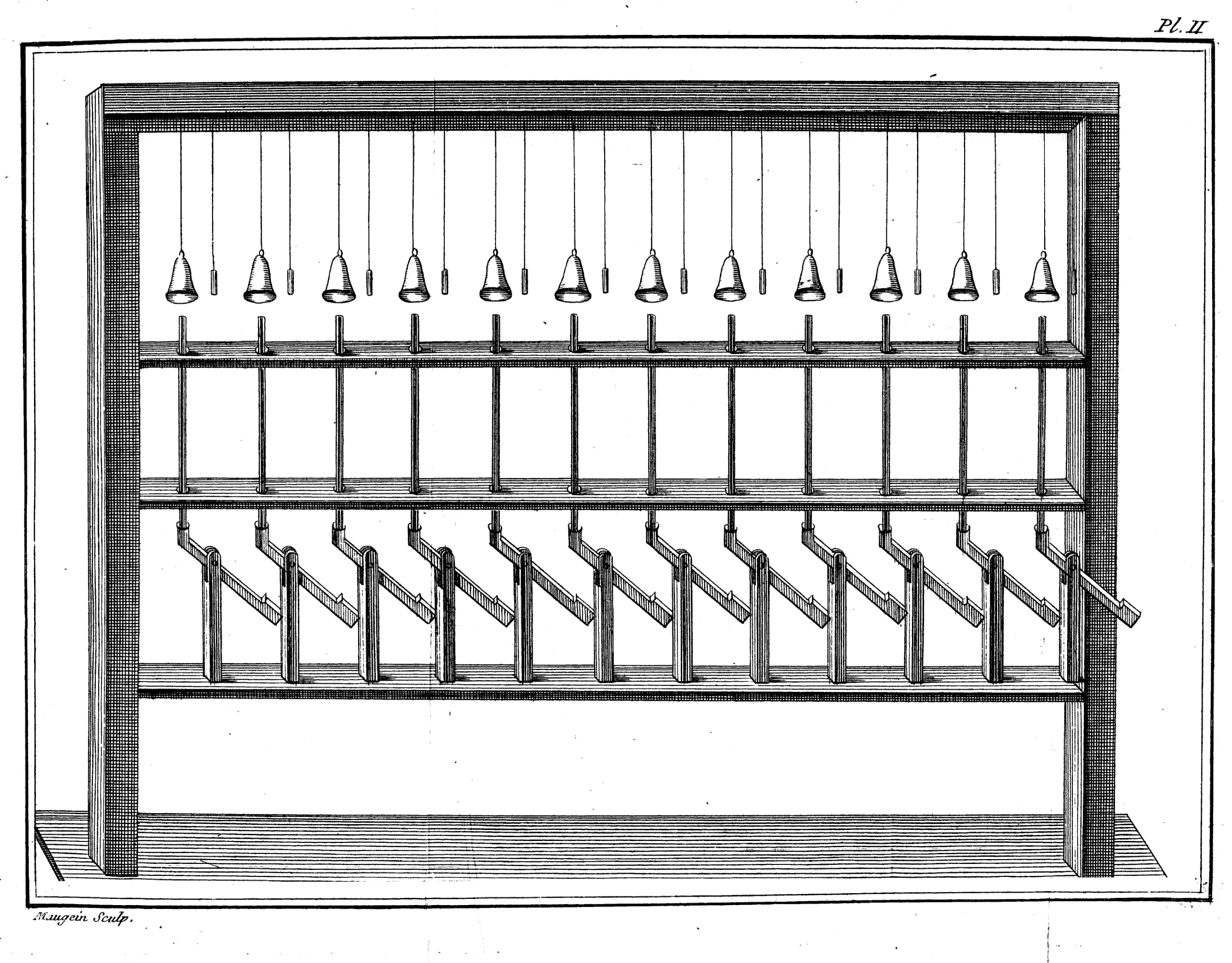
Despite these rather strict technical parameters, the site’s author Simon Crab admits that the boundaries “do become blurred with, say, Tone Wheel Generators and tape manipulation of the Musique Concrete era.” Then there are precursor instruments that predate the discovery and harnessing of electricity, such as the Clavecin Magnetique, above, invented by Abbé Bertholon de Saint-Lazare in 1789, a “simple instrument which produced sounds by attracting metal clappers to strike tuned bells by raising and lowering magnets operated by a keyboard.”
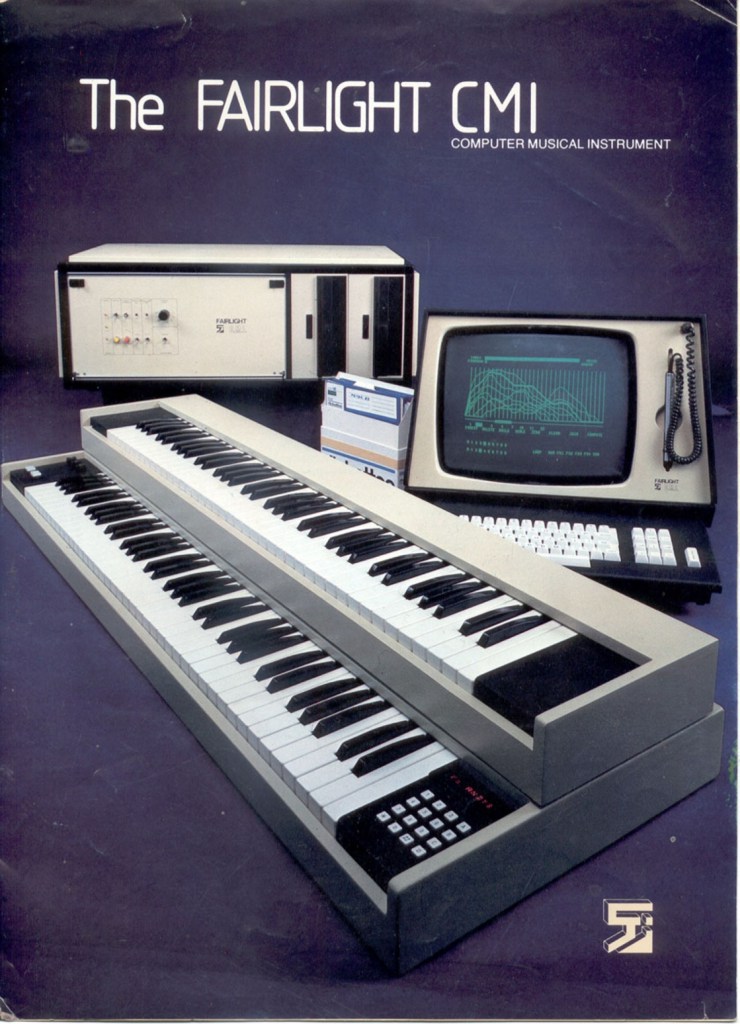
Yet the primary focus of 120 Years of Electronic Music is a period of growth and development from the late 1800s to the 1970s, when early digital synthesizers like the Fairlight (top) appeared. Thus, we should not expect here “an exhaustive list of recent commercial synthesizers or software packages”—the stuff of modern dance, pop, hip-hop, etc. Crab’s intent is academic, “encyclopedic, pedagogical,” and pitched to musicologists as well as “Synthesizer Geeks” likely to appreciate the niceties of the 1961 DIMI & Helsinki Electronic Music Studio.
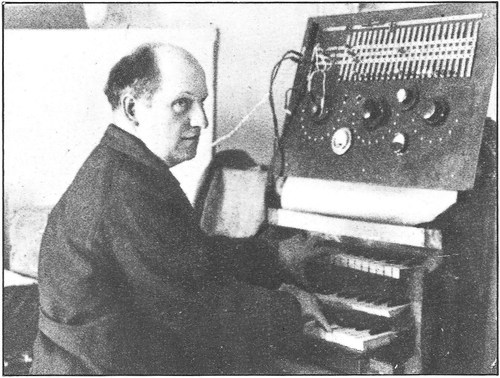
But even non-academics and non-geeks can learn much from the history of such unusual instruments as the Klaviatursphäraphon (above), one of several creations of German composer Jörg Mager in his pursuit of “a new type of utopian ‘free’ music by means of new electronic cathode-ray musical instruments.”
Amidst the weird obscurities and high-concept musical theory, you’ll also find old favorites that revolutionized pop music, like the Hammond Organ (see a making-of promotional video above), the various iterations of Moog synthesizers, and of course the Fairlight CMI (short for Computer Musical Instrument). Invented by Kim Ryrie and Peter Vogel in Australia in 1979, the Fairlight is affectionately known as the “mother of all samplers,” and its technology jumpstarted the revolution in computer music from the 80s to today. You can see Vogel demonstrate the first version of his Fairlight in this video, or—for a slightly less geeky intro—see Peter Gabriel demonstrate it below (or watch Herbie Hancock and Quincy Jones show you how it’s done in a clip from Sesame Street.)
The Hammond, Moogs, and Fairlight aside, very few of the instruments featured on 120 Years of Electronic Music had any kind of direct impact on popular music. But many of them, like Hugh Le Caine’s 1945 Electronic Sackbut, influenced the influencers, and they all represent some evolutionary step forward, or sideways, in the development of the sounds we hear all around us now in every possible genre.
Additionally, Crab’s historical project explores what he calls “the dichotomy between radical culture and radical social change,” with discussions on the links between Bolshevism and the avant-garde and modernism and fascism—discussions of keen interest to cultural historians and critical theorists. Oh, and the name? “The project,” Crab explains, “was begun in 1996; considering electronic music started around 1880 this was quite an accurate title for the time.” It’s now “a bit out of date but… something of a brand-name.” We’ll forgive him this minor chronological inaccuracy for the tremendous service his open access encyclopedia offers to scholars and enthusiasts alike. Explore it here.
Related Content:
Hear the Greatest Hits of Isao Tomita (RIP), the Father of Japanese Electronic Music
The History of Electronic Music in 476 Tracks (1937–2001)
Hear Seven Hours of Women Making Electronic Music (1938- 2014)
Josh Jones is a writer and musician based in Durham, NC. Follow him at @jdmagness
Read More...Stephen Fry Hates Dancing: Watch Fry’s Rant Against Dancing Get Turned into a Wonderful Interpretative Dance
Dancing, says Stephen Fry in a vehement diatribe, is “not so much an accomplishment as an affliction.” He delivers this pronouncement against dancing in one of his “podgrams,” as he calls them, podcasts in which the actor/writer/comedian/media personality rants, rhapsodizes, and rambles on about his favorite—and least favorite—subjects. Dancing falls so far afoul of Stephen Fry that he devotes nearly an entire episode to his hatred of this universal form of human physical expression.
“I hate doing it myself,” he begins, “which I can’t do anyway, but I loathe and detest the necessity to try.” He would deny others the pleasure as well, at least in his company, of “that slovenly mixture of sexual exhibitionism, strutting contempt, and repellant narcissism.” Is Fry a dance snob? Does he hate popular dance but love ballroom and ballet? No. “I hate it when it’s formless, meaningless bopping,” he seethes, “and I hate it even more when it’s formal and choreographed into genres like ballroom and schooled disco. Those cavortings are so embarrassing and dreadful as to force my hand to my mouth.”
We get it, Stephen, give it a rest! But no, he isn’t done. He goes on, for eleven whole minutes, in the anti-dancing harangue above, excerpted from his “Bored of the Dance.” How could one possibly respond to such a torrent of disgust and disdain? By dancing to it, of course. In the video at the top of the post, that’s exactly what L.A.-based dancer and filmmaker Jo Roy does, for nearly two and half minutes—enough time, I’m sure, to make Stephen Fry die of embarrassment.
Maybe Fry has the good humor to appreciate this offensive rejoinder, but I doubt he could stand to watch Roy twist, twirl, hop, pop, lock, and gesture expressively to his vicious attack on the dance.
But there’s much more to Fry’s hatred of dance than curmudgeonly prudery. His anti-dancing manifesto is almost a digression, really, in the scope of his longer “podgram,” which you can read in full at his website. What he’s getting at is why he prefers classical music to modern—and it is not, he insists, because of snobbery, but because popular music—“country, blues, rock and roll, gospel, zydeco, jazz, swing, Tin Pan Alley, roots, bluegrass, hillbilly… funk, soul, mo’town, rap, hip-hop, house, R and B”—is dance music. And Stephen Fry hates dancing. He is “allergic” to dancing.
“Classical music,” on the other hand, he says, “is there to be listened to. It doesn’t make it better. I really, really mean that I do not believe that it makes it better, and I despise the snobbery and ignorance that is convinced otherwise. But it does make it better suited to Stephens.” As he says, quoting River Phoenix’s character in Sidney Lumet’s Running on Empty, “You can’t dance to Beethoven.” And that’s just fine with Stephen. By the end of his prolix apology for his classical preference (not snobbery!)—which ranges in reference from Lumet to Led Zeppelin and Abba to Jane Austen—we believe him.
Stephen Fry hates dancing, perhaps more than anyone has ever hated dancing. See him go on record again in the clip above from the BBC’s The One Show, and imagine how appalled he would be, if he could bring himself to watch it, by the dance-off response at the top.
Related Content:
Stephen Fry, Language Enthusiast, Defends The “Unnecessary” Art Of Swearing
Stephen Fry Launches Pindex, a “Pinterest for Education”
Josh Jones is a writer and musician based in Durham, NC. Follow him at @jdmagness
Read More...The Atlantic Slave Trade Visualized in Two Minutes: 10 Million Lives, 20,000 Voyages, Over 315 Years
Not since the sixties and seventies, with the black power movement, flowering of Afrocentric scholarship, and debut of Alex Haley’s Roots, novel and mini-series, has there been so much popular interest in the history of slavery. We have seen Roots remade; award-winning books like Edward Baptist’s The Half Has Never Been Told climb bestseller lists; and The Freedman’s Bureau Project’s digitization of 1.5 million slavery-era documents gives citizen-scholars the tools to research the history on their own.
In addition to these developments, Slate magazine has designed a multipart, multimedia course, “The History of American Slavery,” as part of its online educational initiative, “Slate Academy.” Hosted by Slate’s Jamelle Bouie and Rebecca Onion and featuring guest historians like Baptist, Henry Louis Gates, Jr., Annette Gordon-Reed, Eric Foner and more, this thorough survey consists of a nine-part podcast, with copious supplementary essays, book excerpts, and other resources drawing on primary documents and artifacts. One supplement, the animation above, shows us the “The Atlantic Slave Trade in Two Minutes.”
Visualizing 315 years—“from the trade’s beginning in the 16th century to its conclusion in the 19th”—the animation displays slave ships as increasing numbers of black dots zipping across the Atlantic to the Americas from the African coasts. The dots “also correspond to the size of each voyage. The larger the dot, the more enslaved people on board.” The Youtube video above provides only a partial representation of this impressive graphic. The full animation at Slate allows users to pause, click on individual dots, and get detailed information, when available, about the name of the ship, number of enslaved people transported, and points of origin and entry in the New World.
In all, we see animated “more than 20,000 voyages catalogued in the Trans-Atlantic Slave Trade Database.” And though we typically, with typical U.S. solipsism, think of American slavery as a mostly North American phenomenon, the truth is quite the contrary:
Of the more than 10 million enslaved Africans to eventually reach the Western Hemisphere, just 388,747—less than 4 percent of the total—came to North America. This was dwarfed by the 1.3 million brought to Spanish Central America, the 4 million brought to British, French, Dutch, and Danish holdings in the Caribbean, and the 4.8 million brought to Brazil.
Early slave expeditions were conducted by the Spanish and Portuguese. “In the 1700s,” writes Bouie, “Spanish transport diminishes and is replaced (and exceeded) by British, French, Dutch, and—by the end of the century—American activity. This hundred years—from approximately 1725 to 1825—is also the high-water mark of the slave trade, as Europeans send more than 7.2 million people to forced labor, disease and death in the New World.” Surprisingly, Portugal remained one of the leading nations among enslavers for most of the slave-trade’s history.
The animation and short explanatory essay by Bouie show us the staggering historical scope of the immensely profitable and profoundly inhumane enterprise that shaped not only the United States, but also—in many ways more so—Central and South America and the Caribbean. There is no history of the Americas, and no growth of many of the colonies into wealthy, world-historical nations, without slavery, nor can the wealth of Europe be in any way divorced from the profits of the slave trade and slave industry. Bouie and Onion explain in the short video above why they decided to produce the course.
For a sense of how historians’ and the public’s understanding of slavery have changed over many decades—for all kinds of ideological reasons—read this excerpt from Baptist’s groundbreaking book. As he says in an interview with Salon, most histories and recreations of the period of enslavement attempt to hide the facts: “The resistance to reckoning with the role of slavery in the trajectory that makes the U.S. the most powerful nation on earth, that’s real; that’s very, very deep…. Whatever we say about the role of the U.S. in global history, it’s absolutely clear to me that slavery is essential to the rise of U.S. power.” Slate’s series goes a long way toward telling us the true history of slavery, from the mouths of writers and scholars who engage with it daily.
Related Content:
Crowdsourced Database Will Locate the Burial Sites of Forgotten US Slaves
Josh Jones is a writer and musician based in Durham, NC. Follow him at @jdmagness
Read More...Lena Dunham Shows Why It’s So Damn Hard to Meditate: A Four-Minute Comedy
Sit, focus on your breath, let errant thoughts drift past — we know how meditation supposedly works in theory, but how does it work in practice? Here we have one example, which comedically plays out at Sunset Boulevard’s show-biz-story-saturated Chateau Marmont. It stars Lena Dunham, filmmaker, writer, creator of the HBO series Girls, and, depending on who’s writing about her, the embodiment of the aspirations, delusions, or anxieties of a generation. Any way the profiles frame it, Dunham has a complicated life, which makes her as suitable a candidate as any for a daily meditation regimen.
Or as one of her assistants puts it after running down the day’s schedule — a photo shoot, an interview with Rihanna, a baptism, a Celiacs for Hillary Clinton dinner — “You do have to meditate twice or your brain will explode.” But just as soon as Dunham finds the right “om” to chant to herself, questions beset her consciousness: “Does my hand feel weird?” “Are Jack and I ready for adulthood? What if we have kids and it all goes wrong?” “Am I neglecting my friendships?” “What am I going to do after Girls ends?” “Do I spend enough time with my family? Is the internet right about me? Do all dogs secretly hate me?” Surely we all get caught in such tangled webs when first we practice meditating, but Dunham’s experience with short films empowers her to take the depiction one step further.
“Should we do, like, Thai tonight?” asks Dunham’s boyfriend, the musician Jack Antonoff, not just inside Dunham’s head but from a chair on the other side of the room. Other meditation-interrupting apparitions follow, taking the form of Dunham’s best friend (who’s found a new, also-famous best friend for herself), an infuriated fellow player on Girls, her misbehaving future daughter, and a couple of assistants about to defect for jobs with Mindy Kaling. And if you think using meditation as a way of dealing with the exigencies of a showbiz career, let alone doing it at the Chateau Marmont, seems like a preposterously southern Californian concept, wait until you see the solution at which Dunham ultimately arrives.
Related Content:
Free Guided Meditations From UCLA: Boost Your Awareness & Ease Your Stress
Meditation 101: A Short, Animated Beginner’s Guide
Daily Meditation Boosts & Revitalizes the Brain and Reduces Stress, Harvard Study Finds
Based in Seoul, Colin Marshall writes and broadcasts on cities, language, and style. He’s at work on a book about Los Angeles, A Los Angeles Primer, the video series The City in Cinema, the crowdfunded journalism project Where Is the City of the Future?, and the Los Angeles Review of Books’ Korea Blog. Follow him on Twitter at @colinmarshall or on Facebook.
Read More...Support Us
We're hoping to rely on loyal readers, rather than erratic ads. Please click the Donate button and support Open Culture. You can use Paypal, Venmo, Patreon, even Crypto! We thank you!

About Us

Open Culture scours the web for the best educational media. We find the free courses and audio books you need, the language lessons & educational videos you want, and plenty of enlightenment in between.
Advertise With Us

FREE UPDATES!
GET OUR DAILY EMAIL
Get the best cultural and educational resources on the web curated for you in a daily email. We never spam. Unsubscribe at any time.
FOLLOW ON SOCIAL MEDIA

Open Culture editor Dan Colman scours the web for the best educational media. He finds the free courses and audio books you need, the language lessons & movies you want, and plenty of enlightenment in between.
Advertise With Us


