Hear Oscar Wilde’s The Importance of Being Earnest Performed by Sir John Gielgud & Other Legends (1953)
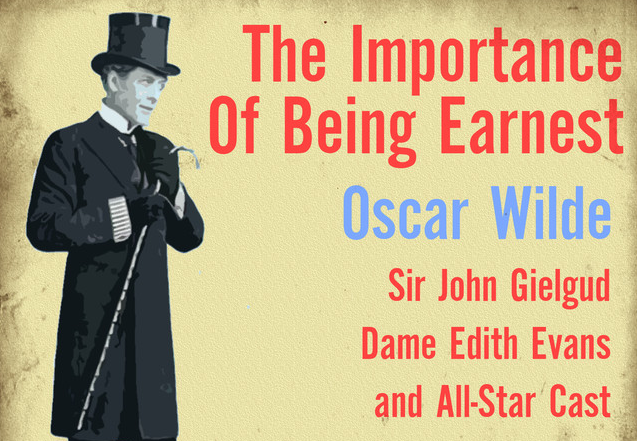
We here at Open Culture hardly have to tell you that, when a play often called the wittiest comedy in the English language meets the English actor often called the greatest of his generation, you won’t want to miss the resulting performance. Unfortunately, if you wanted to catch Sir John Gielgud’s turn as Jack Worthing in Oscar Wilde’s The Importance of Being Earnest, you’d have had to do so in the 1930s or 1940s. Though it came decades after the Victorian-era play’s 1895 debut in London (as well as Wilde’s own death), it defined the sensibility of this “Trivial Comedy for Serious People” for generations to come.
That owes not just to Gielgud’s Jack Worthing, but to Dame Edith Evans’ Lady Bracknell. Looking back at The Importance of Being Earnest’s 1939 revival at the Globe, the Guardian’s Samantha Ellis quotes a contemporary Times critic describing Evans as “born to play the part … Her appearance is masterly — perfectly upholstered, with a feminine art now lost, before and behind; and her voice is correspondingly upholstered so that every phrase, harsh or drawling, comes from the comfortable heart of Lady Bracknell’s arrogance.” The two together gave full life to the dynamic Wilde wrote for the characters, seemingly understanding well the pains he took to craft a perfect union of form and substance, raising social triviality to a kind of artistic sublimity.
But while the window to see Gielgud and Evans perform live on stage has long since closed, you can still savor their masterful exchange of these seriously light lines — in this piece of theater where words are all — through this 1953 recording available on Spotify. (If you don’t have Spotify’s free software, you can download it here. You can also hear the play on Youtube: Act 1 above, Act 2 here, Act 3 here.) Before these two master thespians took it on, some critics wondered whether Wilde’s signature work as a playwright had grown dated, the years having exposed its empty frivolity. But now that even more years have passed, The Importance of Being Earnest has undergone countless new productions, adaptations, and interpretations, becoming the most quoted English-language play after the works of Shakespeare and, in a way, proving one of its most oft-quoted lines: “In matters of grave importance, style, not sincerity, is the vital thing.”
You can find works by Oscar Wilde in our collections of Free eBooks and Free Audio Books.
Related Content:
Stephen Fry Reads Oscar Wilde’s Children’s Story “The Happy Prince”
Based in Seoul, Colin Marshall writes and broadcasts on cities, language, and style. He’s at work on a book about Los Angeles, A Los Angeles Primer, the video series The City in Cinema, the crowdfunded journalism project Where Is the City of the Future?, and the Los Angeles Review of Books’ Korea Blog. Follow him on Twitter at @colinmarshall or on Facebook.
Read More...How to Open a Wine Bottle with Your Shoe
Should you ever find yourself with a wine bottle and no bottle opener, this French video might come in handy. It outlines two methods for removing the cork with a shoe. Method 1: Remove the foil that covers the cork, then start tapping on the bottom of the bottle with a shoe. Eventually, the narrator tells us, the cork will make its way out. Next comes Method 2, the preferred method we’re told, and it involves putting a bottle in a shoe, then tapping the shoe repeatedly against the wall–not too hard–until, voila, the cork can be removed by hand. Try this method at your own risk. And needless to say start with a cheap bottle of wine, and far away from an expensive rug.
Update: And cover the bottle with cloth in case the bottle shatters. Apparently that’s been known to happen.
If you would like to support the mission of Open Culture, consider making a donation to our site. It’s hard to rely 100% on ads, and your contributions will help us continue providing the best free cultural and educational materials to learners everywhere. You can contribute through PayPal, Patreon, and Venmo (@openculture). Thanks!
Related Content:
Storm: New Short Film Captures the Artistry of Winemaking
How to Clean Your Vinyl Records with Wood Glue
Vintage Wine in our Collection of 1100 Free Online Courses
Read More...The Math Behind Beethoven’s Music
Almost all the biggest math enthusiasts I’ve known have also loved classical music, especially the work of Bach, Mozart, and Beethoven. Of course, as San Francisco Symphony music director Michael Tilson Thomas once put it, you can’t have those three as your favorite composers, because “they simply define what music is.” But don’t tell that to the mathematically minded, on whom all of them, especially Bach and Beethoven, have always exerted a strong pull.
But why? Do their musical compositions have some underlying quantitative appeal? And by the way, “how is it that Beethoven, who is celebrated as one of the most significant composers of all time, wrote many of his most beloved songs while going deaf?” The question comes from a TED-Ed segment and its accompanying blog post by Natalya St. Clair which explains, using the example of the “Moonlight Sonata,” what the formidable composer did it using math. (You might also want to see St. Clair’s other vides: The Unexpected Math Behind Van Gogh’s “Starry Night.”)
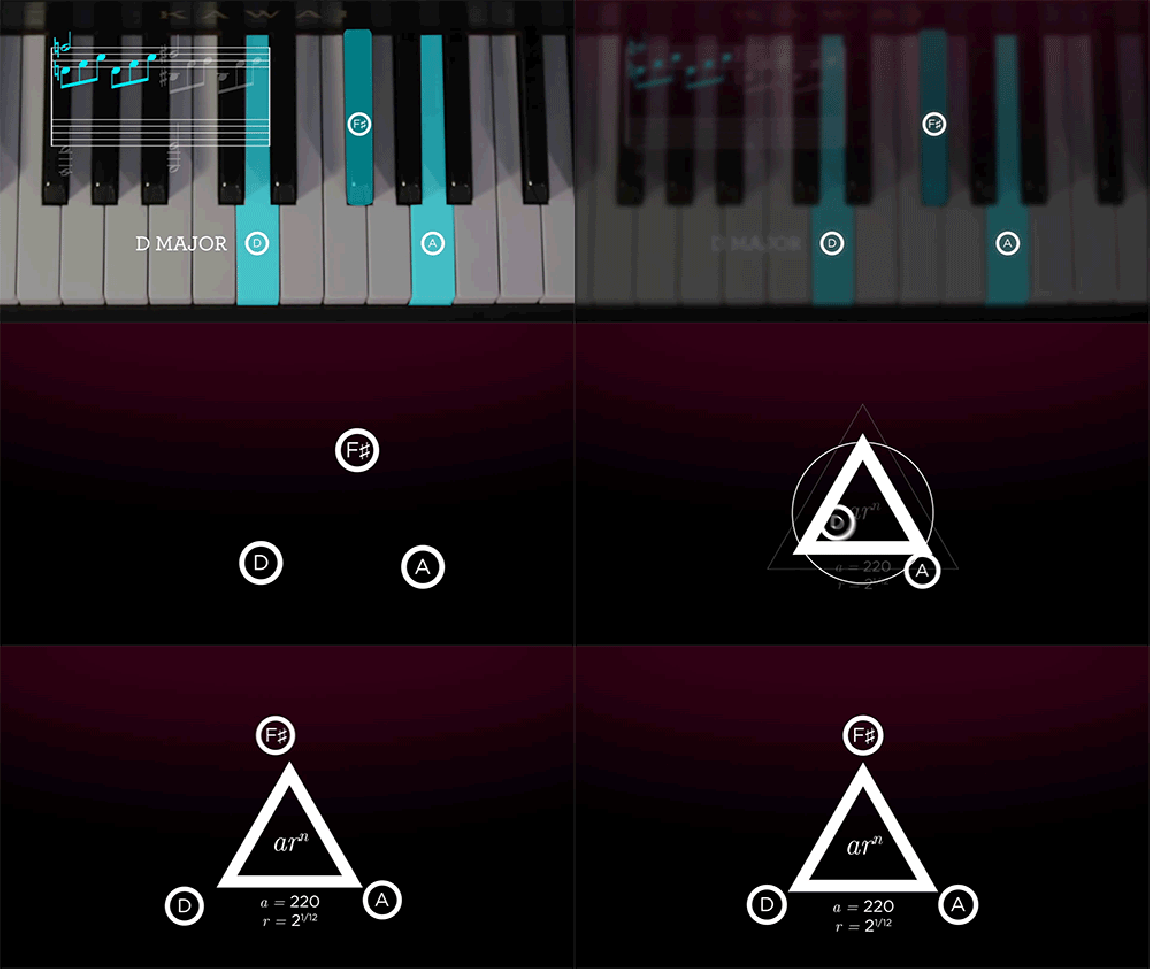
“The standard piano octave consists of 13 keys, each separated by a half step,” St. Clair writes. “A standard major or minor scale uses 8 of these keys with 5 whole step intervals and 2 half step ones.” So far, so good. “The first half of measure 50 of ‘Moonlight Sonata’ consists of three notes in D major, separated by intervals called thirds that skip over the next note in the scale. By stacking the first, third, and fifth notes — D, F sharp, and A — we get a harmonic pattern known as a triad.” These three frequencies together create “ ‘consonance,’ which sounds naturally pleasant to our ears. Examining Beethoven’s use of both consonance and dissonance can help us begin to understand how he added the unquantifiable elements of emotion and creativity to the certainty of mathematics.”
Explained in words, Beethoven’s use of mathematics in his music may or may not seem easy to understand. But it all gets clearer and much more vivid when you watch the TED-Ed video about it, which brings together visuals of the piano keyboard, the musical score, and even the relevant geometric diagrams and sine waves. Nor does it miss the opportunity to use music itself, breaking it down into its constituent sounds and building it back up again into the “Moonlight Sonata” we know and love — and can now, having learned a little more about what mathematician James Sylvester called the “music of the reason” underlying the “mathematics of the sense,” appreciate a little more deeply.
Related Content:
Stream the Complete Works of Bach & Beethoven: 250 Free Hours of Music
Beethoven’s 5th: The Animated Score
Leonard Bernstein Conducts Beethoven’s 9th in a Classic 1979 Performance
Beethoven’s Ode to Joy Played With 167 Theremins Placed Inside Matryoshka Dolls in Japan
Man Hauls a Piano Up a Mountain in Thailand and Plays Beethoven for Injured Elephants
Slavoj Žižek Examines the Perverse Ideology of Beethoven’s Ode to Joy
Oliver Sacks’ Last Tweet Shows Beethoven’s “Ode to Joy” Movingly Flashmobbed in Spain
Based in Seoul, Colin Marshall writes and broadcasts on cities, language, and style. He’s at work on a book about Los Angeles, A Los Angeles Primer, the video series The City in Cinema, the crowdfunded journalism project Where Is the City of the Future?, and the Los Angeles Review of Books’ Korea Blog. Follow him on Twitter at @colinmarshall or on Facebook.
Read More...50 Must-See Documentaries, Selected by 10 Influential Documentary Filmmakers
How to get a handle on documentary film? Given not just the quantity but the wide variety of works in the field, with all their vast differences in style, duration, approach, and epistemology, getting up to speed with the state of the art (or perhaps you consider it a form of essay, or of journalism) can seem a daunting task indeed. But as luck would have it, ten experts on documentary film — documentarians themselves, in fact — have just done some of the work for you, selecting a total of “Fifty Documentaries You Need to See” for The Guardian.
Few pictures in the history of cinema have played as important a role in the formation of a genre as has Dziga Vertov’s 1929 Man with a Movie Camera, which Man on Wire director James Marsh named as an essential. “This was the first truly subversive, playful documentary,” he says. “It’s notionally a day in the life of a city in the Soviet Union and so it has, on a purely sociological/historical level, great value. But what it does beyond that is to show you the means of production: the filming, the cutting room, the editing – all the things that are going into the making of this film.”
You can, of course, watch Man with a Movie Camera free at the top of this post. For the other 49 Documentaries You Need to See, you may have to do some more searching, but they’ll repay the effort many times over with their intellectual stimulation, their unexpected drama, and their exploration of the borderlands between cinematic fiction and cinematic fact. Few films of any kind perform that last mission as astutely as Abbas Kiarostami’s Close-up (available on Hulu if you start a free trial), about a man’s impersonation of famous Iranian filmmaker Mohsen Makhmalbaf, re-enacted with the very same people originally involved: the impostor, the family he tried to trick, the judge who presided over the ensuing trial, and even Makhmalbaf himself.
Close-up (as well as one of Makhmalbaf’s own movies, Salaam Cinema) appears among the picks from Joshua Oppenheimer, a documentarian specializing in examinations of massacres in Indonesia. When you’ve watched all the recommendations, you might consider circling back and checking out Oppenheimer’s The Act of Killing and The Look of Silence. By the same token, after you’ve seen Agnès Varda’s The Gleaners and I, have a look at Lucy Walker’s Waste Land; after Werner Herzog’s Grizzly Man, Khalo Matabane’s Story of a Beautiful Country. But fair warning before you launch into this viewing project: once you come out of it, you won’t see the possibilities of cinema in quite the same way ever again — at the very least, you’ll see infinitely more of them.
For another list, see The 10 Greatest Documentaries of All Time According to 340 Filmmakers and Critics.
Related Content:
265 Free Documentaries Online
Free: Dziga Vertov’s A Man with a Movie Camera, the 8th Best Film Ever Made
Werner Herzog Narrates the Touching, Existential Journey of a Plastic Bag
Based in Seoul, Colin Marshall writes and broadcasts on cities, language, and style. He’s at work on a book about Los Angeles, A Los Angeles Primer, the video series The City in Cinema, the crowdfunded journalism project Where Is the City of the Future?, and the Los Angeles Review of Books’ Korea Blog. Follow him on Twitter at @colinmarshall or on Facebook.
Read More...Christopher Lee Reads Five Horror Classics: Dracula, Frankenstein, The Phantom of the Opera & More
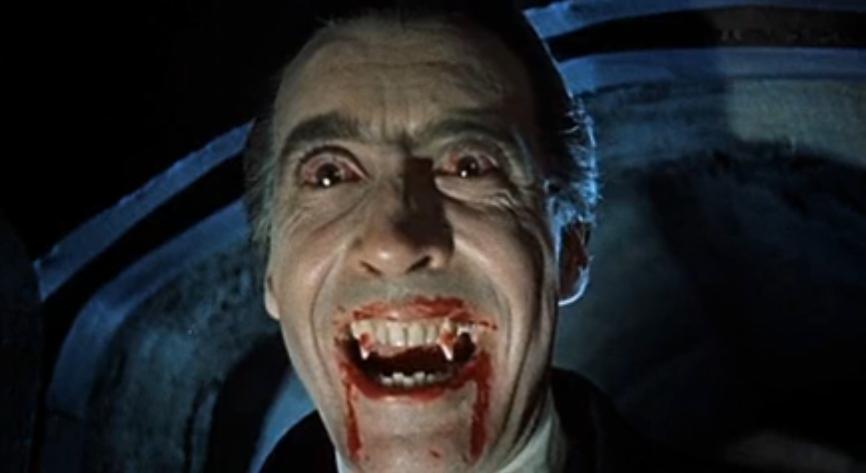
Image via Wikimedia Commons
The great horror actors of the genre’s golden age—the time of Dracula, Frankenstein, The Mummy, and yet more Dracula—succeeded on the strength of their highly unconventional looks. Boris Karloff, Bela Lugosi, and Christopher Lee were not faces you would pass on the street without a second look. But they succeeded equally because all three, including Karloff, made use of some very well trained voices—voices honed for the theatrical.
They have elevated even the campiest material through the use of their voices, and further elevated many already great stories by reading them aloud. Bela Lugosi contributed his Hungarian-accented baritone to a reading of Poe’s “The Telltale Heart,” sounding in every line like he might break into “I vant to suck your blood.” Karloff, the more versatile voice actor, narrated Aesop’s Fables, Rudyard Kipling’s Just So Stories, and too many other books to list.
Christopher Lee has also read Poe, a lot of Poe. And—rather typecast or landing the best voiceover gig of all—he recorded five classic horror novels: Dracula, Frankenstein, Phantom of the Opera, Dr. Jekyll and Mr. Hyde, and The Hunchback of Notre Dame. (Though we might argue about whether Victor Hugo’s novel belongs in this category).
Lee read Dracula once before, in an adaptation made for a graphic novel in 1966. Here, he reads Bram Stoker’s novel unabridged, unlike some of the other books. You can purchase these in a compilation CD. Or you can hear them on Spotify for free, either in your browser or using their software. (Hear Phantom of the Opera here and The Hunchback of Notre Dame here). However you hear his readings, like all of Lee’s voicework—even his heavy metal Christmas album—these narrations practically vibrate with ominous tension and suspense.
Looking for free, professionally-read audio books from Audible.com? Here’s a great, no-strings-attached deal. If you start a 30 day free trial with Audible.com, you can download two free audio books of your choice. Get more details on the offer here.
Related Content:
Christopher Lee Reads Edgar Allan Poe’s “The Raven,” and From “The Fall of the House of Usher”
Horror Legend Christopher Lee Reads Bram Stoker’s Dracula
Horror Legend Christopher Lee Presents a Heavy Metal Version of The Little Drummer Boy
Hear Edgar Allan Poe’s “The Tell Tale Heart” Read by the Great Bela Lugosi (1946)
Josh Jones is a writer and musician based in Durham, NC. Follow him at @jdmagness
Read More...An Animated Carl Sagan Talks with Studs Terkel About Finding Extraterrestrial Life (1985)
This week, Blank on Blank wraps up its series “The Experimenters,” with an episode animating a conversation between Carl Sagan and Studs Terkel–two figures we’ve highlighted on our site many times before. But never have we brought them together. So here they are.
Recorded in October, 1985, as part of Terkel’s long-running Chicago radio show (find an archive of complete episodes here), the conversation touched on some the big questions you might expect: the compatibility between science and religion; the probability we’ll encounter extraterrestrials if given enough time; and more. You can hear more outtakes from their conversation here:
Other episodes in “The Experimenters” series feature:
Related Content
Studs Terkel Interviews Bob Dylan, Shel Silverstein, Maya Angelou & More in New Audio Trove
Carl Sagan Presents Six Lectures on Earth, Mars & Our Solar System … For Kids (1977)
Simone de Beauvoir Tells Studs Terkel How She Became an Intellectual and Feminist (1960)
Two Legends Together: A Young Bob Dylan Talks and Plays on the Studs Terkel Program, 1963
Read More...The Met Digitally Restores the Colors of an Ancient Egyptian Temple, Using Projection Mapping Technology
Thanks to the tireless efforts of archaeologists, we have a pretty clear idea of what much of the ancient world looked like, at least as far as the clothes people wore and the structures in and around which they spent their days. But we seldom imagine these lives among the ruins-before-they-became-ruins in color, despite having read in the history books that some ancient builders and artists created a colorful world indeed, especially when a special architectural occasion like an Egyptian temple called for it.
“As depicted in popular culture, ancient Egypt is awash with the color beige,” writes the New York Times’ Joshua Barone. “A trip to the Metropolitan Museum of Art would seem to reflect that notion: The Temple of Dendur, with its weatherworn sandstone, could fit in naturally with the earth tones of Aida or The Mummy.
But Egyptologists know that this temple, like many others of the ancient world, was painted with vivid colors and patterns. In ‘Color the Temple,’ a marriage of research and projection-mapping technology, visitors to the Met can now glimpse what the Temple of Dendur may have looked like in its original, polychromatic form more than 2,000 years ago.”
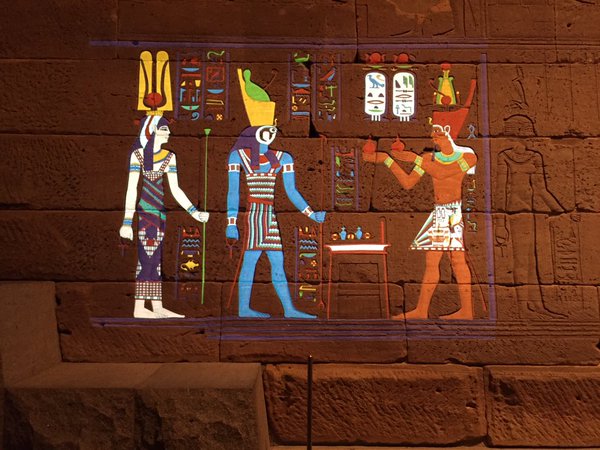
While the ravages of time haven’t destroyed the various scenes carved into the temple’s walls, they’ve long made it next to impossible for scholars to get an idea of what colors their creators painted them. Originally located on the banks of the Nile, the temple endured century after century of flooding (by the 1920s, almost nine months out of the year) which thoroughly washed away the surface of the images. But after some serious historical research, including the consultation of a 1906 survey by Egyptologist Aylward M. Blackman and the Napoleonic Description de l’Egypte, the Met’s team has come up with a pretty plausible idea of what the scene on the temple’s south wall, in which Emperor Caesar Augustus in Pharaoh garb presents wine to the deities Hathor and Horus, looked like in full color.
But it would hardly do to buy a few buckets from Sherwin-Williams and simply fill the wall in. Instead, the Met has used a much more advanced technology called digital projection mapping (also known, more Wired-ly, as “spatial augmented reality”) to restore the Temple of Dendur’s colors with light. You can get a sense of the result in the two videos at the top of the post, shot during the Color the Temple exhibition which ran through March 19.
For a closer look into the process, have a look at the video just above, created by Maria Paula Saba, who worked on the project. As you can see, the use of light rather than paint allows for the possibility of a variety of different color schemes, all of them quite possibly what the ancient Egyptians saw when they passed by, all of them fitting right in to the details and contours the ancient Egyptian artists put there — a thrill impossible to overstate for those of us who grew up with ancient-Egypt coloring books.
Related Content:
How the Egyptian Pyramids Were Built: A New Theory in 3D Animation
Try the Oldest Known Recipe For Toothpaste: From Ancient Egypt, Circa the 4th Century BC
The Turin Erotic Papyrus: The Oldest Known Depiction of Human Sexuality (Circa 1150 B.C.E.)
Read More...11 Shakespeare Tragedies Mapped Out with Network Visualizations
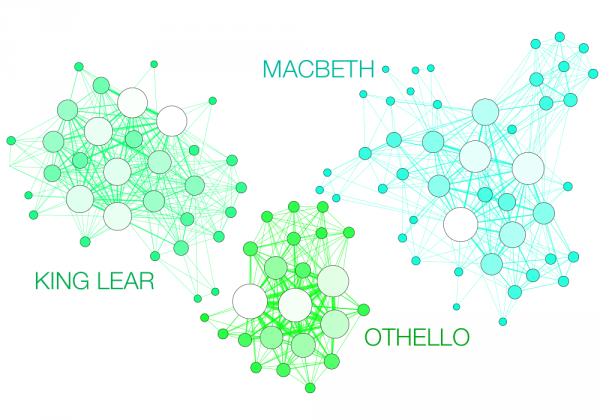
Every story has its architecture, its joints and crossbeams, ornaments and deep structure. The boundaries and scope of a story, its built environment, can determine the kind of story it is, tragedy, comedy, or otherwise. And every story also, it appears, generates a network—a web of weak and strong connections, hubs, and nodes.
Take Shakespeare’s tragedies. We would expect their networks of characters to be dense, what with all those plays’ intrigues and feasts. And they are, according to digital humanities, data visualization, and network analysis scholar Martin Grandjean, who created the charts you see here: “network visualization[s] in which each character is represented by a node connected with the characters that appear in the same scenes.”
The result speaks for itself: the longest tragedy (Hamlet) is not the most structurally complex and is less dense than King Lear, Titus Andronicus or Othello. Some plays reveal clearly the groups that shape the drama: Montague and Capulets in Romeo and Juliet, Trojans and Greeks in Troilus and Cressida, the triumvirs parties and Egyptians in Antony and Cleopatra, the Volscians and the Romans in Coriolanus or the conspirators in Julius Caesar.
Grandjean’s visualizations show us how varied the density of these plays is. While Macbeth has 46 characters, it only achieves 25% network density. King Lear, with 33 characters, reaches 45%.
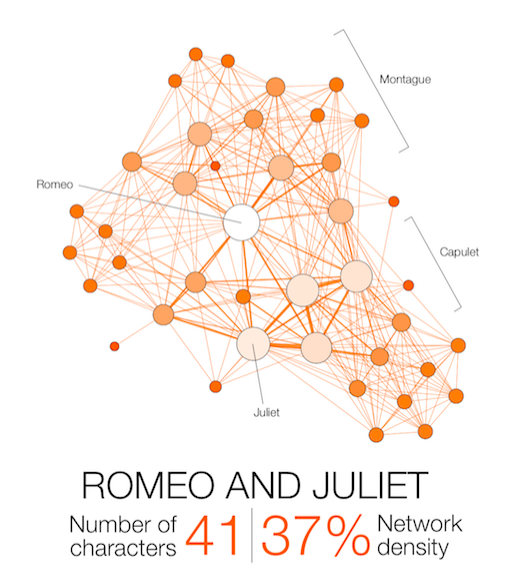
Hamlet’s density score nearly matches its number of characters, while Titus Andronicus’ density number exceeds its character number, as does that of Othello by over twice as much. Why is this? Grandjean doesn’t tell us. These data maps only provide an answer to the question of whether “Shakespeare’s tragedies” are “all structured in the same way.”
But does Grandjean’s “result speak for itself,” as he claims? Though he helps us visualize the way characters cluster around each other, most obviously in Romeo and Juliet, above, it’s not clear what a “density” score does for our understanding of the drama’s intent and purposes. With the exception of the most prominent few characters, the graphics only show various plays’ personae as nameless shaded circles, whereas Shakespeare’s skill was to turn most of those characters, even the most minor, into antitypes and anomalies. Perhaps as important as how they are connected is the question of who they are when they connect.
You can view and download a complete poster of all 11 of Shakespeare’s tragedies at Grandjean’s website.
Related Content:
Read All of Shakespeare’s Plays Free Online, Courtesy of the Folger Shakespeare Library
Josh Jones is a writer and musician based in Durham, NC. Follow him at @jdmagness
Read More...5 Books You Can Read Again .… and Again and Again: Here’s Our Picks, Now Yours
Recently, a Metafilter user asked the question: which books do you reread again and again, and why— whether for “comfort, difficulty, humour, identification, whatever”? It got me thinking about a few of the ways I’ve discovered such books.
Writing an essay or book about a novel is one good way to find out how well it holds up under multiple readings. You stare at plot holes, implausible character development, inconsistent chronologies, and other literary flaws (or maybe features) for weeks, months, sometimes even years. And you also live with the language that first seduced you, the characters who drew you in, the images, places, atmospheres you can’t forget….
But reading alone can mean that blind spots never get addressed. We hold to our biases, positive and negative, despite ourselves. Another great way to test the durability of work of fiction is to teach it for years, or otherwise read it in a group of engaged people, who will see what you don’t, can’t, or won’t, and help better your appreciation (or deepen your dislike).
Having spent many years doing both of these things as a student and teacher, there are a few books that survived semester after semester, and still sit prominently on my shelves, where at any time I can pull them down, open them up, and be immediately absorbed. Then there are books I read when younger, and which seemed so mysterious, so possessed of an almost religious significance, I returned to them again and again—looking for the most enchanted sentences.
If I had to narrow down to a short list the books I consistently reread, those books would come out of all three experiences above, and they would include, in no necessary order—
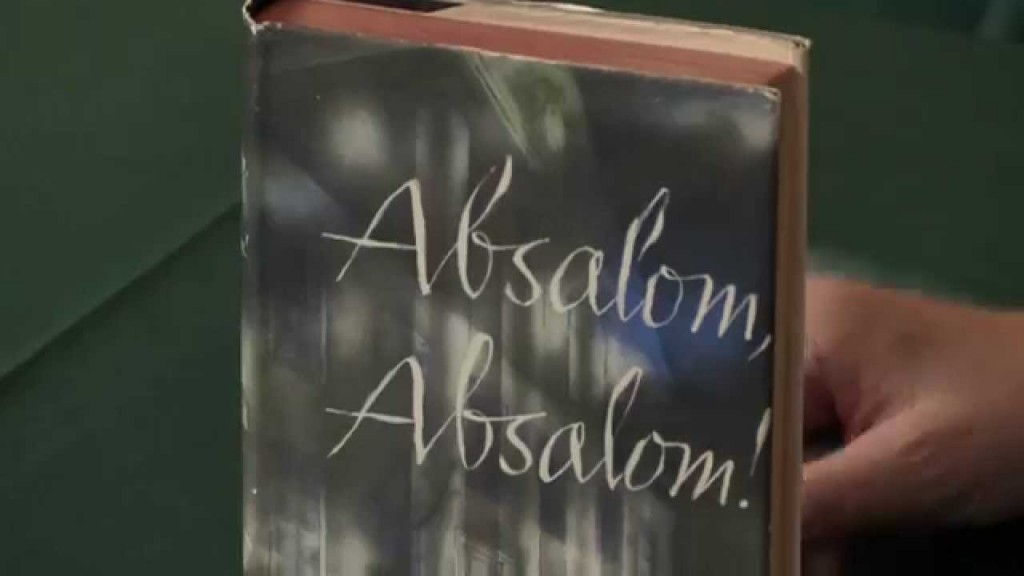
Absalom, Absalom!, by William Faulkner: I’ve written several essays on this novel, over the course of several years, and I love it as much or more as when I first picked it up. It’s a book that becomes both more grim and more darkly humorous as time goes on; its vertiginous narrative strategy creates an inexhaustible number of ways to see the story.
Wuthering Heights, by Emily Bronte: I read this novel as a child and understood almost nothing about it but the ghostly setting of “wiley, windy moors” (as Kate Bush described it) and the furious emotional intensity of Heathcliff and Catherine. These elements kept me coming back to discover just how much Bronte—like Faulkner—encircles her reader in a cyclone of possibility; multiple stories, told from multiple characters, times, and places, swirl around, never settling on what we most want in real life but never get there either—simple answers.
Song of Solomon, by Toni Morrison: Morrison’s novel extracts from the 20th century African American experience a tale of profound individual struggle, as characters in her fictional family fight to define themselves against social inequities and to transcend oppressive identities. Their failures to do so are just as poignant as their successes, and characters like Pilate and Milkman achieve an almost archetypal significance through the course of the novel. Morrison creates modern myth.
The Yiddish Policeman’s Union, by Michael Chabon. I taught this novel for years because it seemed like, and was, a great way to introduce students to the complications of plot, the joys of speculative fiction, and the empathetic imagining of other people and cultures that the novel can enable. I can think of many ways some critics might find Chabon’s book politically “problematic,” but my consistent enjoyment of its wild-eyed story has never diminished since I first picked up the book and read it straight through in a couple of days, fully convinced by its fictional world.
Labyrinths, by Jorge Luis Borges. The Argentinian writer’s best-known collection of stories and essays requires patient rereading. My first encounter with the book early in college provoked amazement, but little comprehension. I still can’t say that I understand Borges, but every time I reread him, I seem to discover some new alcove, and sometimes a whole other room, filled with inscrutable, mysterious treasures.
This list is not in any way comprehensive, but it covers a few of the books that have stayed with me, each of them for well over a decade, and a few of the reasons why. What books do you reread, and why? What is it about them that keeps you returning, and how did you discover these books? While I stuck with fiction above, I could also make a list of philosophical books, as well as poetry. Feel free to include such books in the comments section below as well.
Related Content:
The 10 Greatest Books Ever, According to 125 Top Authors (Download Them for Free)
Vladimir Nabokov Names the Greatest (and Most Overrated) Novels of the 20th Century
Read 700 Free eBooks Made Available by the University of California Press
Josh Jones is a writer and musician based in Durham, NC. Follow him at @jdmagness
Read More...Watch City Out of Time, A Short Tribute to Venice, Narrated by William Shatner in 1959
Last month, Canada lost one of its important filmmakers, Colin Low. Over a career spanning six decades, Low worked on over 200 productions at the National Film Board of Canada. He won countless awards, including two Short Film Palme d’Or awards at the Cannes Film Festival. His work inspired other soon-to-be-influential filmmakers, like Ken Burns and Stanley Kubrick. And he helped pioneer the giant-screen IMAX format.
Above you can watch City Out of Time, Low’s short tribute to Venice. The 1959 film, writes the National Film Board of Canada, “depicts Venice in all its splendor. In the tradition of Venetian painter Canaletto, the film captures the great Italian city’s elusive beauty and fabled landscapes, where spired churches and turreted palaces soar into a blue Mediterranean sky.” The film also features a narration by a young William Shatner, then only 28 years old, whose voice sounds nothing like the one we’d hear several years later in Star Trek, never mind those unforgettable spoken-word albums he started releasing in the late 1960s.
City Out of Time will be added to our list of Free Documentaries, a subset of our collection 4,000+ Free Movies Online: Great Classics, Indies, Noir, Westerns, Documentaries & More.
The second film on the page is Low’s 1952 animation, The Romance of Transportation in Canada, which won a Short Film Palme d’Or at the Cannes Film Festival.
Related Content:
William Shatner Narrates Space Shuttle Documentary
National Film Board of Canada Launches Free iPad App
Take a Virtual Tour of Venice (Its Streets, Plazas & Canals) with Google Street View
A Short History of the Venice Biennale, the World’s Most Important Art Exhibition
Read More...Support Us
We're hoping to rely on loyal readers, rather than erratic ads. Please click the Donate button and support Open Culture. You can use Paypal, Venmo, Patreon, even Crypto! We thank you!

About Us

Open Culture scours the web for the best educational media. We find the free courses and audio books you need, the language lessons & educational videos you want, and plenty of enlightenment in between.
Advertise With Us

FREE UPDATES!
GET OUR DAILY EMAIL
Get the best cultural and educational resources on the web curated for you in a daily email. We never spam. Unsubscribe at any time.
FOLLOW ON SOCIAL MEDIA

Open Culture editor Dan Colman scours the web for the best educational media. He finds the free courses and audio books you need, the language lessons & movies you want, and plenty of enlightenment in between.
Advertise With Us


