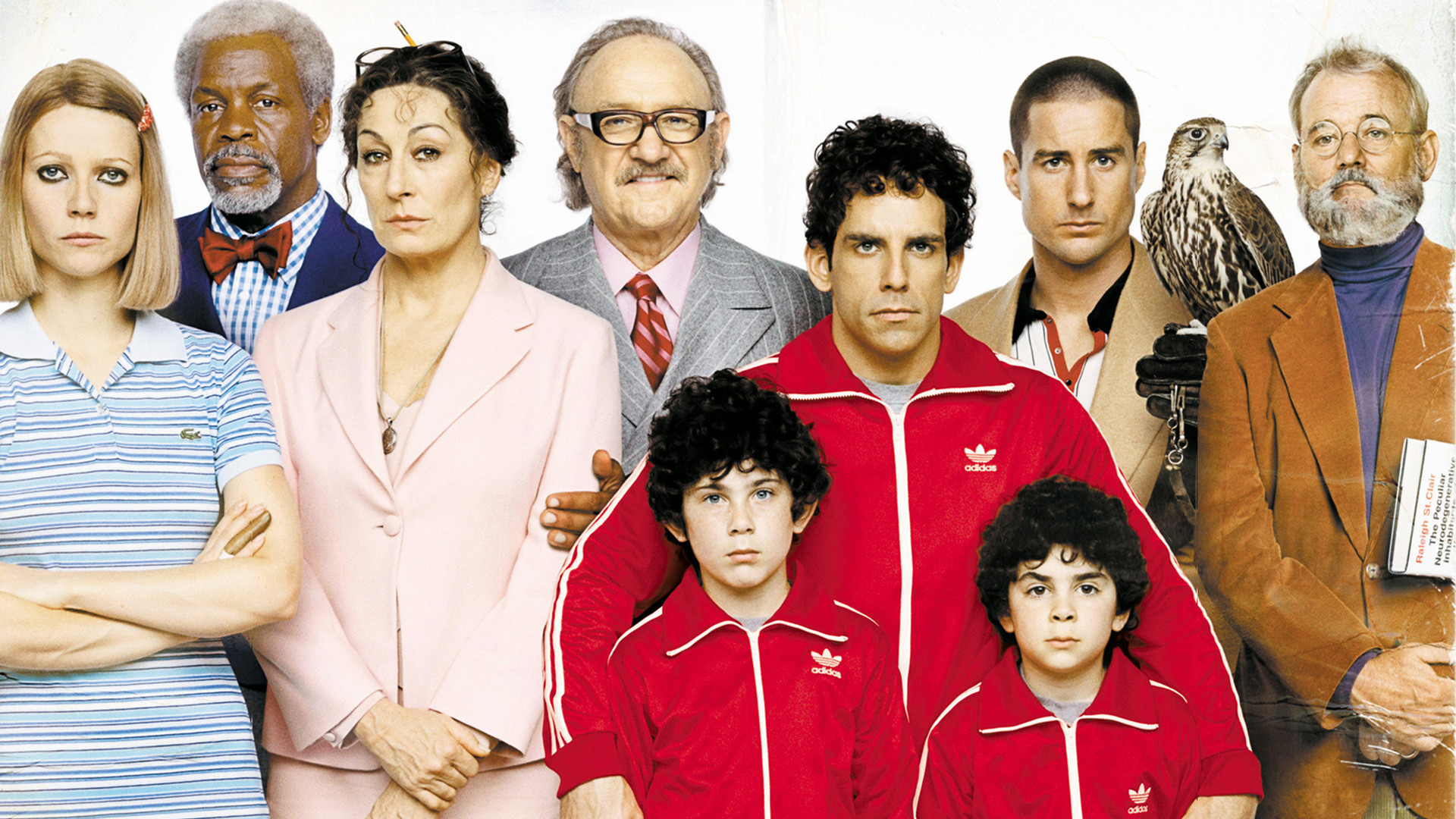
Watch the Trailer for a “Fully Painted” Van Gogh Film: Features 12 Oil Paintings Per Second by 100+ Painters
Loving Vincent, an homage to Vincent van Gogh, promises to be “the first fully painted feature film in the world.” What does that mean exactly? According to filmmakers Dorota Kobiela and Hugh Welchman, every frame of Loving Vincent will be an oil painting on canvas, created with the same techniques Van Gogh used over a century ago. To make these frames, Kobiela and Welchman plan to hire skilled painters and put them through a 3‑week intensive training course, teaching each to paint like Van Gogh himself. Or so that’s how they explained things during their Kickstarter campaign several years ago.
Although production is still ongoing, you can see the first fruits of their labors. Above, watch a trailer for Loving Vincent, which features (according to the Youtube blurb accompanying the video) “12 oil paintings per second, all done by over 100 painters trained in the same style.”
If you’re a talented painter and want to contribute to making this original film (you can get an idea of what that looks like below), please visit the Loving Vincent website and scroll down to the recruitment section. The site also includes other material that takes you inside the making of this innovative film.
Enjoy…
Related Content:
13 Van Gogh’s Paintings Painstakingly Brought to Life with 3D Animation & Visual Mapping
Watch as Van Gogh’s Famous Self-Portrait Morphs Into a Photograph
Van Gogh’s 1888 Painting, “The Night Cafe,” Animated with Oculus Virtual Reality Software
Read More...Gershwin Plays Gershwin: Hear the Original Recording of Rhapsody in Blue, with the Composer Himself at the Piano (1924)
There are a great many compositions I can never hear again the way I did the first time around. Aaron Copland’s American symphonies, for example—sentimental childhood favorites that once evoked memories of landscapes I knew well—have since become inseparable from advertisements for the meat industry and other disagreeable things. Many other iconic pieces of music from major composers have become woven into the fabric of marketing that blankets our lives, in part because many of those pieces don’t require expensive permissions for their use. Another unforgettable example: George Gershwin’s Rhapsody in Blue, the jazz concerto from 1924 that I cannot hear without thinking of “spacious seating options and thoughtful inflight amenities,” carefully orchestrated for my comfort and convenience.
But if there is some way to recover the purity of hearing Gershwin’s piece for the first time, no better one exists than the abridged recordings we have here, which represent some of what the very first audiences of Rhapsody in Blue heard in 1924, including Gershwin himself playing the piano.
They also represent exactly what the first listeners of Gershwin’s piece on record heard—the rather thin sound we’ve come to associate with early audio technology, which did not feature any electronics until 1925. Up until then, small classical ensembles, opera singers, and jazz and ragtime bands would stand around a horn, with engineers placing them forward or back depending on their emphasis. (Some jazz recordings with multiple soloists were made on rotating platforms for this purpose). As the musicians played, a vibrating diaphragm moved the stylus, mechanically etching the performance onto the record. At the top of the post, you can hear a modern remaster that removes most of the noise of the original, which is in two parts above and below.
In addition to Gershwin, the recording also features the original clarinetist, Ross Gorman, who played that famous opening glissando at the debut of Rhapsody in Blue on February 12, 1924, at New York’s Aeolian Hall. Gershwin’s piece was the capstone of an event billed as an “Experiment in Modern Music,” organized by Paul Whiteman, who conducted the orchestra onstage and record. The purpose of the event, writes History.com, was to “demonstrate that the relatively new form of music called jazz deserved to be regarded as a serious and sophisticated art form.” It sounds condescending, to say the least, but it brought us Gershwin’s wonderful composition and helped him “transcend the category of popular music” and become a well-regarded composer. New York Times critic Olin Downes wrote of Rhapsody in Blue, with its “outrageous cadenza of the clarinet,” that the “composition shows extraordinary talent, just as it also shows a young composer with aims that go far beyond those of his ilk.”
Certainly those of Gershwin’s “ilk” made their own extraordinary contributions to modern American music, as did Gershwin himself in Broadway show after show. But Gershwin’s interest in bringing jazz to the classical world has been shared by other famous jazz composers, from Duke Ellington to Charles Mingus. The results may not “transcend” more straight-ahead jazz in some hierarchical sense, but they innovate in the way that the very best “experiments in modern music” do, by boldly putting two or more forms in conversation with each other. In Gershwin’s piece, we hear jazz and classical figures argue and come to terms, jostling against each other as they come together—the laughing clarinet, pompous brass, romantic piano—producing the kind of genteel tension that… dammit, I guess is pretty well represented by reclining in an airplane seat, 30,000 feet above the ground.…
Related Content:
Ella Fitzgerald Sings ‘Summertime’ by George Gershwin, Berlin 1968
Such Sweet Thunder: Duke Ellington & Billy Strayhorn’s Musical Tribute to Shakespeare (1957)
Charles Mingus Explains in His Grammy-Winning Essay “What is a Jazz Composer?”
Josh Jones is a writer and musician based in Durham, NC. Follow him at @jdmagness
Read More...How Chris Marker’s Radical SciFi Film, La Jetée, Changed the Life of Cyberpunk Prophet, William Gibson
Everyone remembers the first time they saw La Jetée. For cyberspace- and cyberpunk-defining writer William Gibson, author of such sui generis science-fiction novels as Neuromancer, Virtual Light, and Pattern Recognition, that life-changing experience came in the early 1970s, during a film history course at the University of British Columbia. “Nothing I had read or seen had prepared me for it,” he tells The Guardian in a reflection on the legacy of Chris Marker’s “thrilling and prophetic” 1962 short film, a post-apocalyptic time-travel love story told almost entirely with still photos. (You can get a taste of it from the short clip above and a longer one here.) “Or perhaps everything had, which is essentially the same thing.”
I can’t remember another single work of art ever having had that immediate and powerful an impact, which of course makes the experience quite impossible to describe. As I experienced it, I think, it drove me, as RD Laing had it, out of my wretched mind. I left the lecture hall where it had been screened in an altered state, profoundly alone. I do know that I knew immediately that my sense of what science fiction could be had been permanently altered.
Part of what I find remarkable about this memory today was the temporally hermetic nature of the experience. I saw it, yet was effectively unable to see it again. It would be over a decade before I would happen to see it again, on television, its screening a rare event. Seeing a short foreign film, then, could be the equivalent of seeing a UFO, the experience surviving only as memory. The world of cultural artefacts was only atemporal in theory then, not yet literally and instantly atemporal. Carrying the memory of that screening’s intensity for a decade after has become a touchstone for me. What would have happened had I been able to rewind? Had been able to rent or otherwise access a copy? It was as though I had witnessed a Mystery, and I could only remember that when something finally moved – and I realised that I had been breathlessly watching a sequence of still images – I very nearly screamed.
You’d think that would count as enough Chris Marker-granted astonishment for one lifetime — and whatever inspiration Gibson drew from La Jetée, he’s certainly put to good use — but the filmmaker, ever-curious technology and media enthusiast, and “prototype of the twenty-first-century man” had another shock in store. Two years after Marker’s death, and about thirty after Gibson’s first viewing of La Jetée, the latter found that he had actually appeared, unbeknownst to himself, in one of the former’s other movies.
“I was in a Chris Marker film and I never knew until today,” tweeted Gibson, appending the entirely understandable tag #gobsmacked. His image pops up at the beginning of Level Five, Marker’s story of a computer programmer’s search for a way to virtually recreate the Second World War’s Battle of Okinawa, released in 1997 in France but not until 2014 in the United States. As a work concerned with reality’s relationship to its reconstruction by human memory — a fascination of Marker’s all the way through his career — as well as with reality’s relationship to its only-just-beginning reconstruction by computer technology, it makes sense that its narration, which takes the form of the protagonist’s video diary, would reference Gibson’s conception of cyberspace.
Always making maximally creative use of the relationship between their words and their images, Marker doesn’t hesitate to flash the author’s face onscreen between bursts of gray static (an element famously evoked in Neuromancer’s opening) and footage of Japan (another site of deep interest for both creators). Gibson himself always comes off as calm and reflective in person, especially for a craftsman of such stimulatingly realized, information-overloaded, sweepingly influential visions of the intensified present. But could anyone ever fully recover from the astonishment of seeing themselves passing through one of Chris Marker’s?
Related Content:
William Gibson Reads Neuromancer, His Cyberpunk-Defining Novel (1994)
Based in Seoul, Colin Marshall writes and broadcasts on cities, language, and style. He’s at work on a book about Los Angeles, A Los Angeles Primer, the video series The City in Cinema, the crowdfunded journalism project Where Is the City of the Future?, and the Los Angeles Review of Books’ Korea Blog. Follow him on Twitter at @colinmarshall or on Facebook.
Read More...Hear Harold Bloom Read From Three Sublime American Authors: Herman Melville, Emily Dickinson & Hart Crane
Before Shakespeare, literary characters mostly remained static, representing types rather than psychologically real human beings. At least according to critic and Yale academic Harold Bloom, who published a gargantuan book—Shakespeare: The Invention of the Human—to prove that “in Shakespeare, characters develop rather than unfold, and they develop because they reconceive themselves.” Shakespeare, in other words, invented psychological realism: that dynamism of character we recognize as one of the hallmarks of literature. Great books give us fictional people we believe in, suffer with, feel we know intimately when we’ve lived long with their stories.
For Bloom, Shakespeare’s characters often change because “they overhear themselves talking, whether to themselves or to others. Self-overhearing is their royal road to individualism.” When we look forward a couple hundred years, we find Herman Melville reaching for Shakespearean heights of tragedy and bombast in Moby Dick, his Ahab as outsized and unforgettable a character as Lear, Macbeth, or Richard II.
But does Ahab change? Perhaps only in that he grows more vehemently single-minded (and unstable) as the novel progresses, though his purpose never wavers from beginning to fateful end.
We can see Ahab’s intensification guided by the self-overhearing of his many crazed speeches—to his crew, himself, the whale, no one in particular. In the speech Bloom reads at the top of the post, Ahab addresses the purely elemental—St. Elmo’s fire—in Chapter 119, “The Candles,” asserting his selfhood against the sublime indifference of nature. “In the midst of the personified impersonal,” Ahab shouts at the luminous phenomenon, “a personality stands here.” In his critical book on Melville, Bloom interprets this speech as a Gnostic sermon, but we can just as well see it as a manifest refining of Ahab’s conscious sense of himself as an avatar of vengeance, animated against the world, though it seems not to recognize in him or anyone else the specialness of personality and its many lists of grievances.
The Melville reading, and the two above—from Hart Crane’s The Bridge and Emily Dickinson’s “There’s a Certain Slant of Light”—come to us from Random House, publisher of Bloom’s latest critical opus, The Daemon Knows, a study, as his subtitle states, of “Literary Greatness and the American Sublime.” As in nearly all of his popular critical books, in this most recent one, Bloom traces literary genealogies. And while all three of these American greats distantly descend from Shakespeare, “here,” writes Cynthia Ozick in her New York Times review, Bloom “invokes the primacy of Emerson as germinating ancestor.”
Emerson, writes Bloom, “is the fountain of the American will to know the self and its drive for sublimity.” As Bloom has interpreted the Western Canon for over half a century—serving as its self-appointed spokesman time and again—the great drive of literature since the Renaissance accords with the ancient command to know thyself… or, failing that, invent thyself.
Related Content:
Harold Bloom Recites ‘Tea at the Palaz of Hoon’ by Wallace Stevens
Harold Bloom on the Ghastly Decline of the Humanities (and on Obama’s Poetry)
Josh Jones is a writer and musician based in Durham, NC. Follow him at @jdmagness
Read More...Hear the Declassified, Eerie “Space Music” Heard During the Apollo 10 Mission (1969)
The above video is a breathless example of American cable television, and how we love a good story and seriously want something to be more fantastic than boring ol’ scientific fact. It also ties into our culture’s perpetual love and nostalgia for the space program of the 1960s.
The anecdote takes place in 1969 during the Apollo 10 mission, when the astronauts on board were in lunar orbit and flying around the dark side of the moon. Having temporarily lost radio contact with earth, they begin to hear “weird music.” Eugene Cernan and John Young can be heard on the recordings asking “You hear that? That whistling sound?” Another astronaut agrees: “That sure is weird music.” The sound lasted for about 60 minutes.
These recordings were only declassified in 2008 by NASA, which only adds to their mystery, along with the fact that the astronauts never spoke on the matter afterwards because they thought nobody would believe them, according to this BBC article.
So what could it have been? A Star Wars cantina on the moon? Martian ham radio operators? The monolith from 2001?
Well, cut through the internet interference and it seems to be radio interference. This thread on Metafilter has some great non-clickbait‑y discussion, including this:
The other likely explanation is that radio noise from the universe resonated with various components in Apollo, and ultimately induced enough current on the radio antenna to generate a signal. On the dark side of the moon, earth-based signals fine tuned for human listeners are absent. Background noise and its impact on Apollo’s communication systems would be prominent on the audio signal.
But maybe this comment offers a better explanation:
Space whales.
Meanwhile, you can cut through all that by listening to the full archive of Apollo 10 recordings that NASA posted on archive.org on 2012. You can find the “music” on track 7, 10–030702_5-OF‑6, starting at 44 minutes in, in all its static‑y glory.
And for those who dig the music of sine waves, you could just listen to this:
Related Content:
NASA Puts Online a Big Collection of Space Sounds, and They’re Free to Download and Use
Download Free NASA Software and Help Protect the Earth from Asteroids!
Neil deGrasse Tyson: ‘How Much Would You Pay for the Universe?’
Ted Mills is a freelance writer on the arts who currently hosts the FunkZone Podcast. You can also follow him on Twitter at @tedmills, read his other arts writing at tedmills.com and/or watch his films here.
Read More...13 Van Gogh’s Paintings Painstakingly Brought to Life with 3D Animation & Visual Mapping
Earlier this month, we told you how you can download hundreds of Van Gogh paintings in high resolution, courtesy of the Van Gogh Museum in Amsterdam. Now, the question is, what will you do with those images? You’re a little tech savvy? Maybe make yourself a nice screensaver. You’ve got some more serious tech chops? Even better. You can put those Van Gogh images in motion. Last year, Mac Cauley animated Van Gogh’s 1888 painting, “The Night Cafe,” using Oculus virtual reality Software. It’s a sight to behold. And above, we have 3D animations of thirteen Van Gogh paintings, all created by Luca Agnani, an Italian artist who specializes in visual mapping and design projections.
Agnani’s animations are painstaking and precise. Explaining the precision of his method, he told the The Creators Project, “To calculate the exact shadows, I tried to understand the position of the sun relative to Arles at different times of the day.” And he added: “If the video [above] was projected over [Van Gogh’s] paintings, my interpretations would superimpose perfectly, like a mapping of a framework.” To create similar animations you will want to get comfortable using software packages like Premiere and 3D Studio Max.
The Van Gogh paintings appearing in the video are as follows:
1. Fishing Boats on the Beach at Saintes-Maries
2. Langlois Bridge at Arles, The
3. Farmhouse in Provence
4. White House at Night, The
5. Still Life
6. Evening The Watch (after Millet)
7. View of Saintes-Maries
8. Bedroom
9. Factories at Asnieres Seen
10. White House at Night, The
11. Restaurant
12. First Steps (after Millet)
13. Self-Portrait
h/t Kim L.
If you would like to support the mission of Open Culture, consider making a donation to our site. It’s hard to rely 100% on ads, and your contributions will help us continue providing the best free cultural and educational materials to learners everywhere. You can contribute through PayPal, Patreon, and Venmo (@openculture). Thanks!
Related Content
Watch as Van Gogh’s Famous Self-Portrait Morphs Into a Photograph
Van Gogh’s 1888 Painting, “The Night Cafe,” Animated with Oculus Virtual Reality Software
The Unexpected Math Behind Van Gogh’s “Starry Night”
Read More...Take a Multimedia Tour of the Buttock Song in Hieronymus Bosch’s Painting The Garden of Earthly Delights
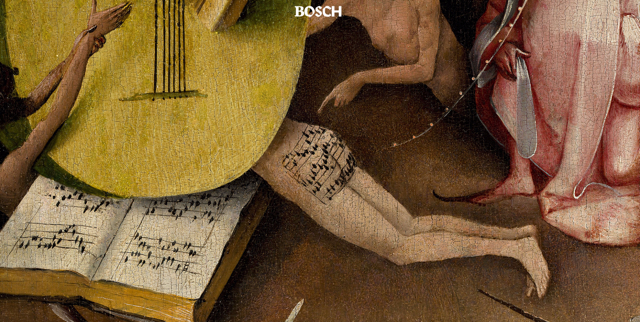
“Not a bum note in sight!” goes the headline, in all the Daily Mail’s trademark subtlety. Mark Prigg’s straight-to-the-point article tells us of “a musical score discreetly written on the butt of a figure in Garden Of Earthly Delights, the famous painting by Hieronymus Bosch,” which, thanks to the labor of love of Oklahoma Christian University student Amelia Hamrick, “has become an online hit.” The title of her rendition: “The 600-Year-Old Butt Song from Hell.”
Going a bit upmarket to Sean Michaels in the Guardian, we find the details that, “posting on her Tumblr, a self-described ‘huge nerd’ called Amelia explained that she and a friend had been examining a copy of Bosch’s famous triptych, which was painted around the year 1500. “[We] discovered, much to our amusement,” she wrote, “[a] 600-years-old butt song from Hell.” You can read about it on her viral post, which describes her project of transcribing Bosch’s posterior-written score “into modern notation, assuming the second line of the staff is C, as is common for chants of this era.”
You can actually hear a rendition of this heroically recovered composition by clicking on the video above. Some fine soul — presumably a fellow named Jim Spalink — took Hamrick’s notation and turned it into music. When you’re done, you can then give the Buttock song a close visual investigation by diving into the virtual tour of The Garden of Earthly Delights, featured here earlier this month. Look for the 13th stop on the guided tour, and you can see the musical notation in incredibly fine detail–finer detail than you could have ever hoped or imagined.
Related Content:
What Ancient Greek Music Sounded Like: Hear a Reconstruction That is ‘100% Accurate’
Listen to the Oldest Song in the World: A Sumerian Hymn Written 3,400 Years Ago
Based in Seoul, Colin Marshall writes and broadcasts on cities, language, and style. He’s at work on a book about Los Angeles, A Los Angeles Primer, the video series The City in Cinema, the crowdfunded journalism project Where Is the City of the Future?, and the Los Angeles Review of Books’ Korea Blog. Follow him on Twitter at @colinmarshall or on Facebook.
Read More...Wes Anderson Movie Sets Recreated in Cute, Miniature Dioramas
Wes Anderson’s perfectionist films often look like dollhouses enlarged to fit in human actors, but Barcelona-based illustrator Mar Cerdà has one-upped the director and created her own miniature dioramas replicating sets from several of his films.
This is meticulous work done in watercolor, then precisely cut and combined into scenes both two- and three-dimensional. For anyone who has tried to cut something very small and fiddly with an x‑acto knife, you’ll appreciate her skill. (The artist in me is complete jelly, as they say.) So far she has recreated the concierge desk from The Grand Budapest Hotel, the berth from The Darjeeling Limited, and the bathroom from The Royal Tenenbaums, complete with Margot and her mom Etheline. (If you look deeper, you will also find this mini Margot box.)
Her love of Anderson is no surprise if you look at the other work in her portfolio. Her book Familiari is a series of figures that can be flipped to make “80,000 different families,” all of which give off the Tenenbaum group shot vibe. And her lovingly detailed recreation of an entry in a Menorca-located house shares a love of cute and colorful with the director’s art direction.
Dioramas aside, by the way, her watercolor technique as well as her figurative work is on point.
Currently, Cerdà is working on a Star Wars-themed diorama because, hey why not? Most everybody in the world loves that universe. And she also just finished a recreation of a scene from Zoolander. Follow her on Instagram, because there’s sure to be more to come.
Related Content:
The Perfect Symmetry of Wes Anderson’s Movies
Books in the Films of Wes Anderson: A Supercut for Bibliophiles
Ted Mills is a freelance writer on the arts who currently hosts the FunkZone Podcast. You can also follow him on Twitter at @tedmills, read his other arts writing at tedmills.com and/or watch his films here.
Read More...See The Beatles’ “While My Guitar Gently Weeps” Played on the Oldest Martin Guitar in Existence (1834)
You may have heard the recent hubbub over an antique Martin guitar from the 1870s that ended up smashed to bits on the set of Quentin Tarantino’s ultraviolent Western The Hateful Eight. Maybe you saw people gnash their teeth online and said, “so what? It’s just a guitar!” Fair enough, and a Stradivarius is just a violin. I exaggerate a little, but many guitar lovers who watched the clip of Kurt Russell destroying the priceless artifact (unwittingly, it seems) felt the impact for days afterward. As Colin Marshall wrote in a post featuring that footage, “You can still go out and buy a serviceable guitar from the end of the 19th century without completely wiping out your savings, but you’d be hard pressed to find a Martin made a few decades earlier—such as the one smashed in The Hateful Eight—at any price at all; less than ten may exist anywhere.”
You can see one of those relics above; the oldest known Martin in existence, in fact, made decades earlier than the wrecked guitar from Tarantino’s set—made, in fact, in 1834, just one year after cabinet maker C.F. Martin moved to New York City from his native Germany, where he had run into trouble with the Violin Maker’s Guild who claimed exclusive rights over instrument manufacturing. Martin immediately began producing guitars, like the small-bodied Stauffer-style instrument above, before moving his factory to its current location of Nazareth, Pennsylvania, where the Martin Museum is located. In the video, folk guitarist Stevie Coyle has the pleasure of picking out The Beatles’ “While My Guitar Gently Weeps” and an original tune called “Saltflat Rhapsody” on the aged instrument, which sounds just a little bit like a Medieval lute.
Just above, see Chris Martin IV, great-great-great-grandson of the famed guitar maker and current CEO of the company give a tour of the museum, pointing out what guitar historians believe is the earliest guitar with X‑bracing, the innovative inner architecture C.F. Martin supposedly invented when coming up with his own designs and moving away from those of his mentor, Johann Stauffer. After the pain of watching a beautiful vintage Martin smashed to bits in Tarantino’s film, it’s a great consolation—for guitar nerds at least—to see how well the Martin Museum has preserved so much of the company’s history and kept such early models in playable condition.
Related Condition:
Musician Plays the Last Stradivarius Guitar in the World, the “Sabionari” Made in 1679
How Fender Guitars Are Made, Then (1959) and Nowadays (2012)
The Story of the Guitar: The Complete Three-Part Documentary
Josh Jones is a writer and musician based in Durham, NC. Follow him at @jdmagness
Read More...Orson Welles Narrates the Russian Revolution in Ten Days That Shook the World (1967)
“St. Petersburg, capital of Russia. October the 25th, 1917. The time: twenty-one minutes to ten in the evening. At anchor in the river Neva, the cruiser Aurora waits to take her place in history. In precisely one minute’s time, the crew, led by Bolsheviks, will fire a shot to signal the attack on the winter palace.” So begins Ten Days That Shook the World — not John Reed’s 1919 book of reportage on the October Revolution, nor Sergei Eisenstein’s 1928 film based on it, but a 1967 documentary by Granada Television. And who speaks those words? You won’t have to hear anything more than “St. Petersburg” to recognize the voice of the one and only Orson Welles.
Welles could tell the story of anything, of course, and he does the expected good job recounting that of the fall of Nicolas II, the Kerensky regime, the Bolshevik takeover, and the Russia that rose thereafter, working from a script by the Soviet filmmaker Grigori Alexsandrov, who co-directed Eisenstein’s film. As we listen to Welles speak, we see imagery drawn from a variety of sources: photographs and newspaper clippings, interview footage, contemporary newsreels, and even scenes from historical feature films about the Russian Revolution, especially Eisenstein and Alexandrov’s picture.
I like to think that Welles appreciated this method of documentary construction, which combines an overall adherence to fact with occasional visual departures from it — though the production tightly integrates the “fictional” footage with the “factual” footage, and the former has in many cases shaped our collective mental image of the Russian Revolution more than the latter has. He would step deep into this arena himself less than a decade later with F for Fake, his final, sui generis piece of filmmaking ostensibly about art forgery but really, in both its form and substance, about the line between the true and the false.
Watching Ten Days That Shook the World here almost a half-century into 1967’s future — itself a half-century into 1917’s future — makes it impossible not to think about the continuum of history, and the shifting ways in which we’ve told and retold the stories of those who came before us all along it. “Who dare say where the road they began to travel in 1917 will finally lead them,” asks Orson Welles of the Russians at the documentary’s end, “and us?” The question holds up today just as it did fifty years ago — or indeed a hundred.
Related Content:
War & Peace: An Epic of Soviet Cinema
F for Fake: Orson Welles’ Short Film & Trailer That Was Never Released in America
Based in Seoul, Colin Marshall writes and broadcasts on cities, language, and style. He’s at work on a book about Los Angeles, A Los Angeles Primer, the video series The City in Cinema, the crowdfunded journalism project Where Is the City of the Future?, and the Los Angeles Review of Books’ Korea Blog. Follow him on Twitter at @colinmarshall or on Facebook.
Read More...Support Us
We're hoping to rely on loyal readers, rather than erratic ads. Please click the Donate button and support Open Culture. You can use Paypal, Venmo, Patreon, even Crypto! We thank you!

About Us

Open Culture scours the web for the best educational media. We find the free courses and audio books you need, the language lessons & educational videos you want, and plenty of enlightenment in between.
Advertise With Us

FREE UPDATES!
GET OUR DAILY EMAIL
Get the best cultural and educational resources on the web curated for you in a daily email. We never spam. Unsubscribe at any time.
FOLLOW ON SOCIAL MEDIA

Open Culture editor Dan Colman scours the web for the best educational media. He finds the free courses and audio books you need, the language lessons & movies you want, and plenty of enlightenment in between.
Advertise With Us