Dr. Seuss’ “How the Grinch Stole Christmas” Read by Dateline’s Keith Morrison
There was something strange going on in Whoville… but what? Dateline’s Keith Morrison tells the classic tale of a sinister plot to stop Christmas. At the end — a twist no one saw coming.
The story, How the Grinch Stole Christmas, is now added to our collection, 1,000 Free Audio Books: Download Great Books for Free.
Looking for free, professionally-read audio books from Audible.com? Here’s a great, no-strings-attached deal. If you start a 30 day free trial with Audible.com, you can download two free audio books of your choice. Get more details on the offer here.
Related Content:
Dr. Seuss’ World War II Propaganda Films: Your Job in Germany (1945) and Our Job in Japan (1946)
Dr. Seuss Draws Anti-Japanese Cartoons During WWII, Then Atones withHorton Hears a Who!
Kafka’s Famous Character Gregor Samsa Meets Dr. Seuss in a Great Radio Play
Read More...Watch 34 of Quentin Tarantino’s Visual References to Citizen Kane, Blade Runner, 8 1/2 & Other Great Films
Sometimes when I enjoy a movie less than I thought I would, I find that my dissatisfaction stems from the feeling of having watched a movie made out of other movies, a Frankensteinian creation assembled from the dead bits and pieces that worked well when attached to their original bodies, alive long ago, but, when re-used, don’t come to life at all. When avid cinephile turned avid cinephile and director Quentin Tarantino plays the role of a cinematic Dr. Frankenstein, however, he turns the voltage much higher up, elevating the practice to an auteur’s art.
When Tarantino’s films reference his favorite films — be they classics of the canon, tried-and-true westerns, kung-fu obscurities, pieces of European new-wave, or grind-house exploitation flicks — they often transcend their sources. Jacob Swinney, whose supercuts of Tarantino’s use of sound, close-ups, and cars we featured back in April, has cut together 34 particularly impressive visual references of the thousands found in the director’s filmography and placed them alongside the works quoted.
The video covers, in three minutes, visual references from the “Mexican standoff” from City of Fire in Reservoir Dogs to the dances from Band of Outsiders and 8 1/2 in Pulp Fiction to Superchick and The Graduate’s opening titles in Jackie Brown to Bruce Lee’s tracksuit in Game of Death on Uma Thurman in Kill Bill Volume One to Daryl Hannah’s writhing from Blade Runner in Kill Bill Volume Two to framing from The Searchers in Inglorious Basterds.
It stops short of The Hateful Eight, Tarantino’s latest, leaving it as an exercise for the viewer to tabulate just how wide a swatch of cinema the man has repurposed this time. He’s gone on record as saying he’ll only make two more feature films, but don’t worry, cinephiles: they’ll more than likely contain enough references to other movies, visual and otherwise, to keep you in viewing material for the next twenty years.
Related Content:
Watch Free Online My Best Friend’s Birthday, Quentin Tarantino’s 1987 Debut Film
Based in Seoul, Colin Marshall writes and broadcasts on cities and culture. He’s at work on a book about Los Angeles, A Los Angeles Primer, the video series The City in Cinema, the crowdfunded journalism project Where Is the City of the Future?, and the Los Angeles Review of Books’ Korea Blog. Follow him on Twitter at @colinmarshall or on Facebook.
Read More...Muhammad Ali Sings in Broadway’s First Black Power Musical (1970)
The Great White Way is littered with flops.
Critic Frank Rich eviscerated a 1988 musical based on Stephen King’s Carrie, lamenting that a potential camp masterpiece wound up as “a typical musical-theater botch.”
Producer David Merrick pulled the plug on a 1966 musical adaptation of Breakfast at Tiffany’s starring Mary Tyler Moore long before its official opening night, thus sparing the drama critics and the public “an excruciatingly boring evening.”
And then there is 1970’s Big Time Buck White, activist Oscar Brown, Jr.’s adaptation of Joseph Dolan Tuotti’s play. It featured Muhammad Ali—temporarily benched from boxing for draft evasion—in the titular role of a militant lecturer, delivering a Black Power message to a character named Whitey.
The primarily white Broadway-going audience that embraced the countercultural “Tribal Love-Rock Musical” Hair two years earlier withheld its love. In a colorblind world, we might be able to chalk that up to the champ’s sub-par singing chops or some clunky lyrics, but it would be a mistake to turn a blind eye to the political climate.
(Eight years later, Ain’t Misbehavin’, a tribute to Fats Waller and the Harlem Renaissance was a bonafide hit.)
Big Time Buck White ran for just seven performances, posting its closing notice well in advance of its January 18th appearance on the Ed Sullivan Show, above.
These days, the producers would probably scramble to find a replacement, but Sullivan, a staunch supporter of Civil Rights, honored the booking, commanding his studio audience to give the costumed players “a fine reception.”
Afterward, the champ thanked Sullivan for inviting him and “the group” so that viewers who didn’t get a chance to could see “what type of play i was participating in.”
A bit of trivia. Playbill credits actor Donald Sutherland, in the role of Black Man. He may be a movie star, but he’s something of a Broadway flop himself, his only other credit that of Humbert Humbert in 1980’s Lolita, People Magazine’s Bomb of the Year.
Above is another scene from the musical, shared by Ali’s admirer, Mike Tyson.
via Messy N Chic
Related Content:
Leonard Cohen’s 1983 Musical for Canadian Television: I Am a Hotel
Watch Stephen Sondheim Teach a Kid How to Sing “Send In the Clowns”
- Ayun Halliday is an author, illustrator, and Chief Primatologist of the East Village Inky zine. Follow her @AyunHalliday
Read More...16 Great Star Wars Fan Films, Documentaries & Video Essays to Get You Ready for Star Wars: The Force Awakens
Have you had enough Star Wars yet? No, you will never have enough Star Wars, not even after you’ve acquired the Star Wars dinette set, Star Wars bed and bath collection, $400 Star Wars Lego Death Star, Star Wars chicken frankfurter snack with built-in ketchup (seriously)… and that’s not even to mention the first six movies, re-released every few years in new formats and expanded editions.
Yeah, the merchandising may be a little much; with the inaugural film of the rebooted franchise opening during the holidays, it’s a feeding frenzy, no doubt. But for true fans, no amount of crass materialism can put a damper on the enthusiasm, and yes, the anxiety, for Star Wars: The Force Awakens. Will it eclipse our painful memories of the prequels? Will Episode VII rekindle the magic of Episodes IV-VI (formerly Episodes I‑III)? By nearly all accounts, J.J. Abrams reimagining of the George Lucas legacy does all of the above.
To help you prepare for opening night (I’ve got my tickets!), we’ve compiled some of our top Star Wars posts, featuring all manner of documentary explainers, fan homages, interviews, parodies, remixes, etc. From the deadly serious to the ridiculous, perhaps no popular movie property has attracted as much commentary and meta-commentary as Star Wars. That isn’t likely to change anytime soon, what with the Star Wars universe again expanding into infinity. Before you take the leap forward into its future, revisit its past at the links below.
Documentary Features and Archival Footage:
Watch the Very First Trailers for Star Wars, The Empire Strikes Back & Return of the Jedi (1976–83) (see the first above)
The Making of Star Wars As Told by C‑3PO & R2-D2: The First-Ever Documentary on the Film (1977)
Kurt Russell Auditions for Star Wars
The Making of The Empire Strikes Back Showcased on Long-Lost Dutch TV Documentary
How Star Wars Borrowed From Akira Kurosawa’s Great Samurai Films
Joseph Campbell and Bill Moyers Break Down Star Wars as an Epic, Universal Myth
Adaptations, Fan Films, and Parodies:
Fans Reconstruct Authentic Version of Star Wars, As It Was Shown in Theaters in 1977
Star Wars Uncut: The Epic Fan Film
The Empire Strikes Back Uncut: A New Fan-Made, Shot-for-Shot Remake of the 1980 Sci-Fi Classic
The Existential Star Wars: Sartre Meets Darth Vader
Watch a New Star Wars Animation, Drawn in a Classic 80s Japanese Anime Style
And finally, if you’ve got the stomach for it and you want to catch up on the last six Star Wars films—or watch them all for the first time—you can do so all at once in the mind-bending Meta Star Wars, which layers all six films over each other to create a psychedelic onslaught of whooshing spaceships, droid bleeps and bloops, and flashing blasters and lightsabers. You won’t come away from the experience, if you can stand it, with any sense of plot or characters, but you’ll have an intimate knowledge of the Star Wars universe’s many unique sound effects.
Related Content:
Watch George Lucas’ Award-Winning Student Film Electronic Labyrinth THX 1138 4EB (1967)
Free: Download 151 Sci-Fi & Fantasy Stories from Tor.com
Blade Runner is a Waste of Time: Siskel & Ebert in 1982
Josh Jones is a writer and musician based in Durham, NC. Follow him at @jdmagness
Read More...How Marcel Marceau Started Miming to Save Children from the Holocaust
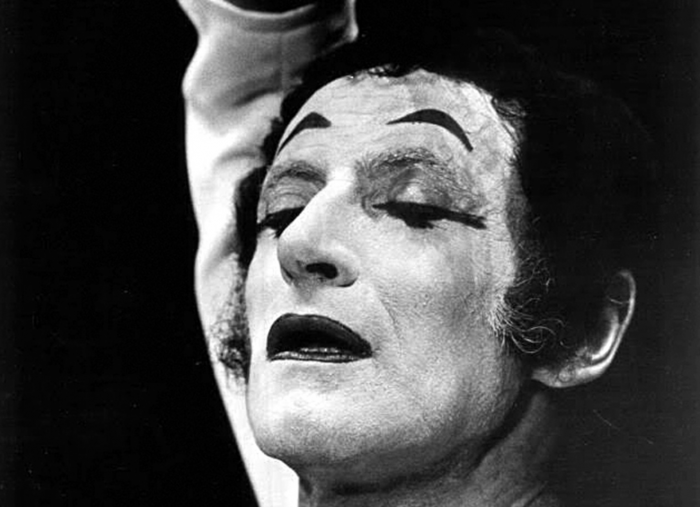
Image via Wikimedia Commons
If we think about the times evil has most notably reared its head, many of our minds go right to the Holocaust — as, no doubt, did Marcel Marceau’s, especially since he had first-hand experience with the horror of the Nazis, having lost his father in Auschwitz, and even used the art of mime against it.
The Jewish Marceau (née Mangel) got his first exposure to mime from a Charlie Chaplin film, which he saw at the age of five. Later, when France entered the Second World War, he and his family moved around the country to flee the Nazis, from whom it became increasingly difficult to hide as time went on. “I was hidden by my cousin Georges Loinger who was a heroic Resistance fighter,” Marceau recounted in a 2001 speech. “He said, ‘Marcel must hide for a while. He will play an important part in the theater after the war.’ How did he know that? Because he knew that when I was a child I created a theater for children already.”
The skills Marceau cultivated performing for other children came in more than handy not just after the war but during it, as he performed for youngsters on the run from Hitler. ”Marceau started miming to keep children quiet as they were escaping,” said documentarian Philippe Mora, son of the Resistance fighter who smuggled refugees alongside Marceau. “It had nothing to do with show business. He was miming for his life.”
“Paris was liberated after the Americans entered in August,” said Marceau, “but the war wasn’t finished. Two months before the liberation of France, I entered a famous theater school and a master of mime, Étienne Decroux, said to the young students, ‘Who wants a part?’ And I said I. And I mimed the killer. And the killer was a Nazi, but of course I didn’t say Nazi.” Impressed with his impromptu embodiment of evil, Decroux asked his name. “I said Marcel Marceau,” his new surname inspired by a general who fought in the French Revolution, the “Marceau on the Rhine” of Victor Hugo’s poem (“and I was born in Strasbourg on the Rhine,” the artist adds). “That’s a beautiful name,” said Decroux. And thus the career of a mime legend truly began.
Related Content:
Marcel Marceau Mimes the Progression of Human Life, From Birth to Death, in 4 Minutes
How Alice Herz-Sommer, the Oldest Holocaust Survivor, Survived the Horrific Ordeal with Music
The Touching Moment When Nicholas Winton Met the Children He Saved During the Holocaust
Behind-the-Scenes Footage of Jerry Lewis’ Ill-Conceived Holocaust Movie The Day The Clown Cried
Based in Seoul, Colin Marshall writes and broadcasts on cities and culture. He’s at work on a book about Los Angeles, A Los Angeles Primer, the video series The City in Cinema, the crowdfunded journalism project Where Is the City of the Future?, and the Los Angeles Review of Books’ Korea Blog. Follow him on Twitter at @colinmarshall or on Facebook.
Read More...Old Book Illustrations: Free Archive Lets You Download Beautiful Images From the Golden Age of Book Illustration
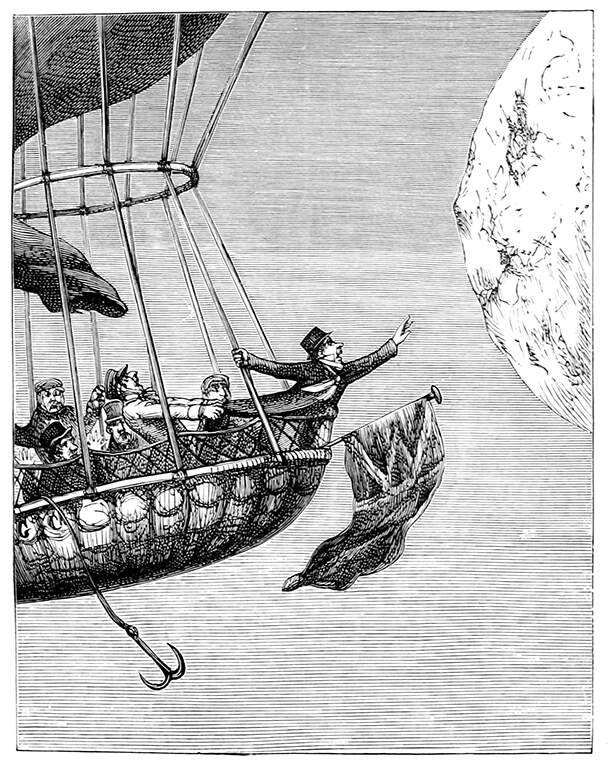
Needless to say, before the development and widespread use of photography in mass publications, illustrations provided the only visual accompaniment to religious texts, novels, books of poetry, scientific studies, and magazines literary, lifestyle, and otherwise. The development of techniques like etching, engraving, and lithography enabled artists and printers to better collaborate on more detailed and colorful plates. But whatever the media, behind each of the millions of illustrations to appear in manuscript and print—before and after Gutenberg—there was an artist. And many of those artists’ names are now well known to us as exemplars of graphic art styles.
It was in the 19th century that book and magazine illustration began its golden age. Illustrations by artists like George Cruikshank (see his “’Monstre’ Balloon” above”) were so distinctive as to make their creators famous. The hugely influential English satire magazine Punch, founded in 1841, became the first to use the word “cartoon” to mean a humorous illustration, usually accompanied by a humorous caption. The drawings of Punch cartoons were generally more visually sophisticated than the average New Yorker cartoon, but their humor was often as pithy and oblique. And at times, it was narrative, as in the cartoon below by French artist George Du Maurier.
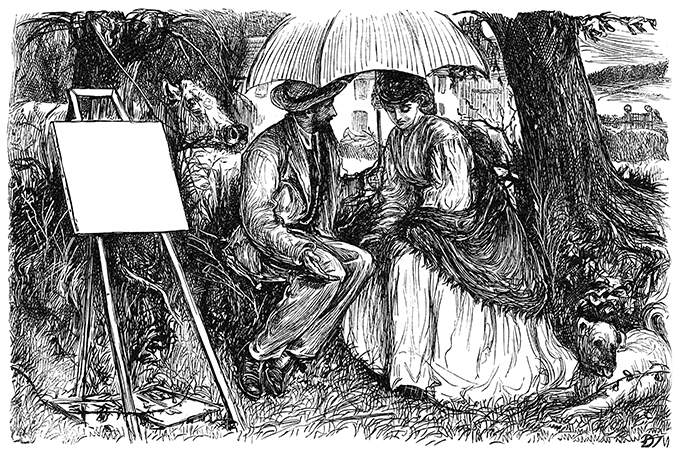
The lengthy caption beneath Du Maurier’s illustration, “Punch’s physiology of courtship,” introduces Edwin, a landscape painter, who “is now persuading Angelina to share with him the honours and profits of his glorious career, proposing they should marry on the proceeds of his first picture, now in progress (and which we have faithfully represented above).” The humor is representative of Punch’s brand, as is the work of Du Maurier, a frequent contributor until his death. You can find much more of Cruikshank and Du Maurier’s work at Old Book Illustrations, a public domain archive of illustrations from artists famous and not-so-famous. You’ll find there many other resources as well, such as biographical essays and a still-expanding online edition of William Savage’s 1832 compendium of printing terminology, A Dictionary of the Art of Printing.
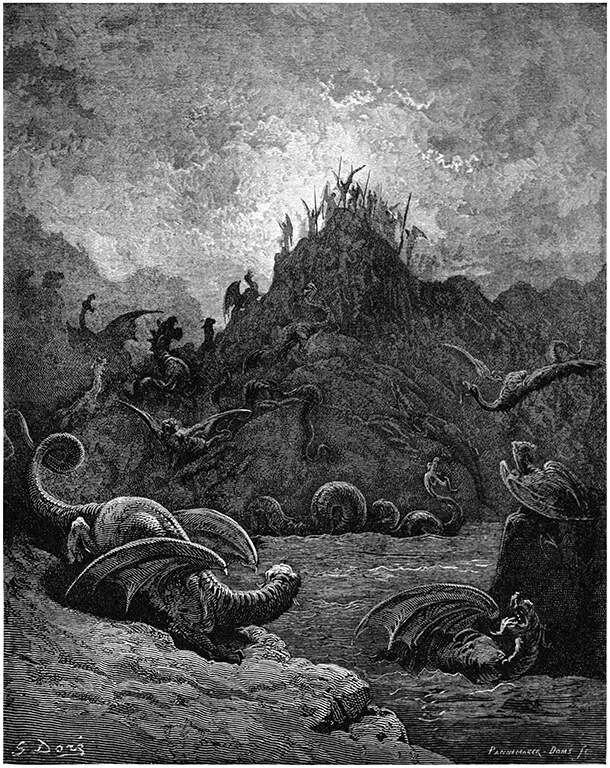
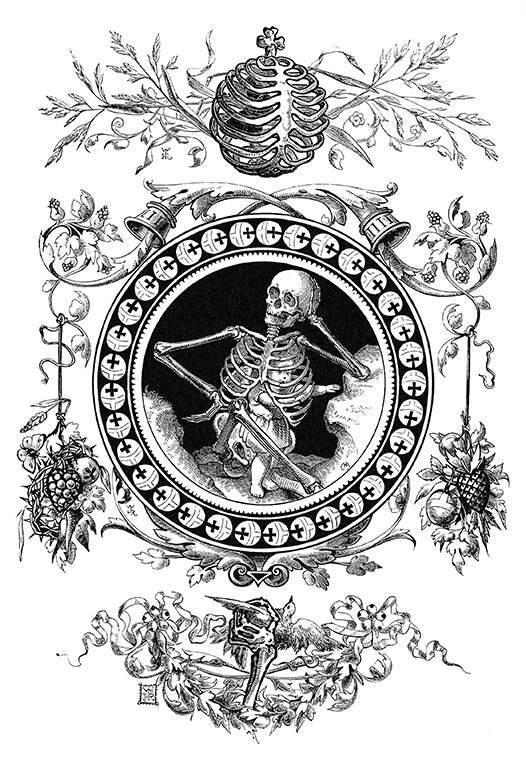
Old Book Illustrations allows you to download high resolution images of its hundreds of featured scans, “though it appears,” writes Boing Boing, “the scans are sometimes worse-for-wear.” Most of the illustrations also “come with lots of details about their original creation and printing.” You’ll find there many illustrations from an artist we’ve featured here several times before, Gustave Doré (see “Gorgons and Hydras” from his Paradise Lost edition, above). As much as artists like Cruikshank and Du Maurier can be said to have dominated the illustration of periodicals in the 19th century, Doré dominated the field of book illustration. In a laudatory biographical essay on the French artist, Elbert Hubbard writes, “He stands alone: he had no predecessors, and he left no successors.” You’ll find a beautifully, and morbidly, 19th century illustrated edition of 17th century poet Francis Quarles’ Emblems, with pages like that below, illustrating “The Body of This Death.”
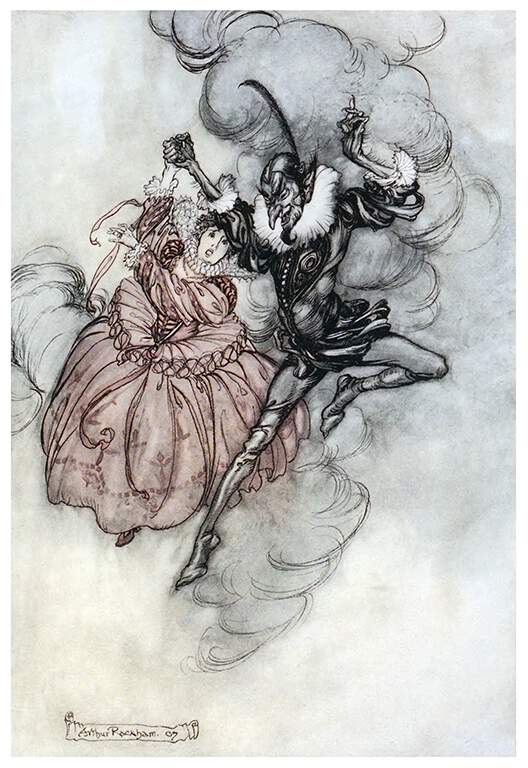
Not all of the illustrations at Old Book Illustrations date from the Victorian era, though most do. Some of the more striking exceptions come from Arthur Rackham, known primarily as an early 20th century illustrator of fantasies and folk tales. See his “Pas de Deux” below from his edition of The Ingoldsby Legends. These are but a very few of the many hundreds of illustrations available, and not all of them literary or topical (see, for example, the “Science & Technology” category). Be sure also to check out the OBI Scrapbook Blog, a running log of illustrations from other collections and libraries.
via Boing Boing
Related Content:
Gustave Doré’s Dramatic Illustrations of Dante’s Divine Comedy
An Illustration of Every Page of Herman Melville’s Moby Dick
Harry Clarke’s 1926 Illustrations of Goethe’s Faust: Art That Inspired the Psychedelic 60s
William Blake’s Hallucinatory Illustrations of John Milton’s Paradise Lost
Aubrey Beardsley’s Macabre Illustrations of Edgar Allan Poe’s Short Stories (1894)
Josh Jones is a writer and musician based in Durham, NC. Follow him at @jdmagness
Read More...What Does Sound Look Like?: The Audible Rendered Visible Through Clever Technology
How can you make the invisible, visible? One way to do it is through a nineteenth century photography technique called Schlieren Flow Visualization. Better demonstrated than explained, the NPR video above shows Schlieren Flow Visualization in action, rendering visible (after the 2:00 minute mark) the sounds of hands clapping, a towel snapping, a firecracker cracking, and an AK-47 firing off a round. The images, which capture changes in air density, were provided by Michael Hargather, a professor who leads the Shock and Gas Dynamics Laboratory at New Mexico Tech.
Follow Open Culture on Facebook and Twitter and share intelligent media with your friends. Or better yet, sign up for our daily email and get a daily dose of Open Culture in your inbox. And if you want to make sure that our posts definitely appear in your Facebook newsfeed, just follow these simple steps.
Related Content:
Visualizing WiFi Signals with Light
The Neuroscience of Bass: New Study Explains Why Bass Instruments Are Fundamental to Music
Read More...William S. Burroughs Narrates a Claymation of His Grim Holiday Story “The Junky’s Christmas”
Let’s face it, the holidays are a miserable time of year for many people. Writers have mined this fact for pathos and much dark humor in stories featuring low-rent mall Santas, squabbling family dinners, inept home invaders, and King of the Hill’s resident sad sack, Bill Dauterive. Most narratives of unhappy holidays end with some kind of redemption—someone discovers a Christmas miracle, the real Santa shows up, the Grinch’s heart grows to nearly bursting from his chest, Ebenezer Scrooge repents….
What if the redemption is one down-and-out junky sharing his only fix with a man suffering from kidney stones—that is, after the junky spends the day trying to steal enough to buy heroin, finds a suitcase containing two severed human legs, and finally scores a little morphine by goldbricking at a crooked doctor’s house? That’s the plot of William S. Burroughs’ story “The Junky’s Christmas,” which appeared in the 1989 collection Interzone and thereafter achieved some notoriety in two adaptations from 1993.
The first (above)—produced by Francis Ford Coppola and directed by Nick Donkin and Melodie McDaniel—-animates a reading by Burroughs in Claymation, with appearances from the man himself at the beginning and end. The story ends with a Christmas miracle of sorts, the “immaculate fix” the main character Danny receives as if from heaven after his unselfish act. It ain’t Frank Capra, but it’s a lot closer to some people’s real lives than It’s a Wonderful Life’s angelic visitation.
Also in 1993, Burroughs collaborated with another artist plagued by addiction, entering a studio in Lawrence, Kansas with Kurt Cobain to read an earlier version of “The Junky’s Christmas” titled “The ‘Priest’ They Called Him.” (Hear it in the fan-made video above.) This version of the story also has the suitcase full of severed legs, but this time the recipient of the junky’s charity is a disabled Mexican fellow addict suffering from withdrawal. Underneath Burroughs’ deadpan, Cobain plays bars of “Silent Night” on a guitar that sounds like it’s being strangled to death. You can read Burroughs’ earlier unhappy Christmas story in full here. And if you’re still not bummed out enough, check out Nerve’s “Ten Most Depressing Christmas Songs Ever Recorded.”
Related Content:
William S. Burroughs Reads Naked Lunch, His Controversial 1959 Novel
Watch William S. Burroughs’ Ah Pook is Here as an Animated Film, with Music By John Cale
William S. Burroughs’ “The Thanksgiving Prayer,” Shot by Gus Van Sant
Josh Jones is a writer and musician based in Durham, NC. Follow him at @jdmagness
Read More...What Makes Yasujirō Ozu a Great Filmmaker? New Video Essay Explains His Long-Admired Cinematic Style
If you can rank the work of a filmmaker by the number of video essays it inspires, then Yasujirō Ozu must have made some of the greatest motion pictures of all time. Wes Anderson, despite having got his start 65 years later than Ozu, would also place well — and naturally, as we posted back in July, one video essay even examines the two men’s films (on most levels so seemingly different) in parallel. But today, let’s take a closer look at the midcentury Japanese auteur of Tokyo Story, Floating Weeds, Late Spring and many more in isolation, through Lewis Bond’s new video essay “The Depth of Simplicity.”
At first glance, most of Ozu’s more than thirty films — domestic dramas which, as critic Donald Richie wrote in his study of the director, “had but one major subject, the Japanese family, and but one major theme, its dissolution” — might seem similar to each other. But that first glance only reveals the parameters within which Ozu decided to work, the strictures that engaged his genius. “Although I may seem the same to other people,” he said in the quote that opens “The Depth of Simplicity,” “to me each thing I produce is a new expression and I always make each work from a new interest. It’s like a painter who always paints the same rose.” (Or maybe the same tea kettle?)
“Ozu wanted to capture the cinematic quality of everyday life,” says Bond, “and doing so required a very specific style.” Rather than adding techniques on to his cinematic vocabulary, Ozu eliminated them, making complete and meaningful use of those that remained: rigorous, painting-like compositions using frames within frames; a low-placed camera (set, legend has it, around the height of someone sitting on a traditional tatami mat) that hardly ever moves and always uses a human eyesight-like 50-millimeter lens; dialogue that cuts between straight-on close-ups of each speaker (breaking filmmaking’s sacred “180-degree rule” every time).
These techniques and others, which “seem false at first glance but begin to weave their way into the texture of his films,” give Ozu’s work what Bond calls its “radiantly calm tone,” its ability to “straddle the line of subjectivity and objectivity,” and its expression of mono no aware, one of those not-especially-translatable Japanese concepts having to do with the distinctive emotion felt upon recognition of the transience of all things. Of course, Ozu himself, who compared himself to a humble tofu-maker, would never have made such claims. “I just want to make good tofu,” he said, and cinephiles the world over continue to eat it up today.
Related Content:
An Introduction to Yasujiro Ozu, “the Most Japanese of All Film Directors”
Watch 7 New Video Essays on Wes Anderson’s Films: Rushmore, The Royal Tenenbaums & More
Based in Seoul, Colin Marshall writes and broadcasts on cities and culture. He’s at work on a book about Los Angeles, A Los Angeles Primer, the video series The City in Cinema, the crowdfunded journalism project Where Is the City of the Future?, and the Los Angeles Review of Books’ Korea Blog. Follow him on Twitter at @colinmarshall or on Facebook.
Read More...Religious Songs That Secular People Can Love: Bob Dylan, The Byrds, Sam Cooke, Johnny Cash & Your Favorites
There are good reasons to find the onslaught of religious music this time of year objectionable. And yet—though I want to do my part in the War on Christmas—I don’t so much object to the content of Christmas songs. It’s the music! It’s hackneyed and tired and grossly overplayed and a lot of it was never very good to begin with. I’d make the same distinction with any kind of music, religious or otherwise. I grew up in churches full of Christian music, and a lot of it was just terrible: the worst of kind of soft rock or adult contemporary paired with lyrics so insipid they would make the gospel writers—whoever they were—cringe. Updates with the slick production of alt-rock, hip-hop, or pop-country styles have only made things worse. On the other hand, some of the most powerful and moving music I’ve ever heard comes from the church, whether Handel, The Staples Singers, the Louvin Brothers, or so many other classical and gospel artists and composers.
Anyone with a deep affection for Western classical music probably has their share of favorite Christian music, whatever their personal beliefs. So, too, do fans of American folk, blues, and country. Some artists have covered the odd religious tune as part of a broad roots repertoire, like the Byrds’ cover of Bluegrass gospel legends the Louvin Brothers’ cornball “The Christian Life,” above, from 1968’s Sweetheart of the Rodeo. Though Gram Parsons, with the band for the recording of this album, had his traditional leanings, his musical religion was more “Cosmic American” than Christian. But before Parsons joined the band and turned ‘em full country rock for a time, the Byrds recorded another religious song, one of their biggest hits—Pete Seeger’s “Turn, Turn, Turn” (below), which cribs all of its lyrics verbatim from Chapter 3 of the Book of Ecclesiastes (easily the non-religious person’s favorite book of the Bible).
Other American legends have turned to faith in dramatic conversions and have written earnest, original religious music. Most famously, we have the case of Bob Dylan, whose conversion to evangelical Christianity saw him proselytizing from the stage. He also wrote some beautiful songs like “Precious Angel,” at the top of the post, which he claimed was for the woman who brought him to Christianity (and which supposedly contains a dig at his ex-wife Sara for not converting him). Though it features some of the more disturbing lyrical turns Dylan has taken in his career, it’s one of my favorite tunes of his from this strange period, not least because of the brilliant guitar work of Mark Knopfler.
Whatever beliefs he’s claimed over the decades, Dylan’s music has always been religious in some sense, partly because of the American folk traditions he draws on. Almost all of the early R&B and rock and roll artists came from the folk gospel world, from Elvis to Little Richard to Jerry Lee Lewis. Notably, the golden-voiced Sam Cooke got his start as a gospel singer with several vocal groups, including his own The Soul Stirrers. The harmonies in their rendition of gospel classic “Farther Along” (above) give me chills every time I hear it, even though I don’t credit the song’s beliefs.
It’s a common feeling I get with American soul, blues, and country singers who moved in and out of the popular and gospel worlds. Then there are those artists who left gospel for outlaw stardom, then returned to the fold and embraced their church roots later in life. A prime example of this kind of spiritual, and musical, renewal is that of Johnny Cash. There are many sides of gospel Cash. Perhaps the most poignant of his religious recordings come from his final years. Though it suffers from some commercial overuse, Cash’s recording of blues classic “God’s Gonna Cut You Down” (often titled “Run On”), above, is equal parts menacing and haunting, a Christian-themed memento mori that caught on big with lots of secular music fans.
The list of religious music that non-religious people love could go on and on. Though the examples here are explicitly Christian, they certainly don’t have to be. There’s Yusef Islam, formerly Cat Stevens, who came back to record stirring original music after his conversion to Islam, and whose powerful “Morning has Broken” moves believers and non-believers alike. There’s Bob Marley, or any number of popular Rastafarian reggae artists. Then there are more contemporary artists making religious music for largely secular audiences. One could reference indie darling Sufjan Stevens, whose religious beliefs are central to his songwriting. And there’s a favorite of mine, Mark Lanegan, former Screaming Trees singer and current rock and roll journeyman who often works with religious themes and imagery, most notably in the glorious “Revival,” above, with the Soulsavers project.
The love many non-religious people have for some religious music often comes from a religious upbringing, something singer/songwriter Iris Dement discussed in a recent interview on NPR’s Fresh Air. Dement has recorded one of the most moving renditions of a hymn I remember fondly from childhood church days: a powerfully spare version of “Leaning on the Everlasting Arms” from the 2010 True Grit soundtrack. She’s also written what may be one of the best religious songs for secular (or non-religious, or post-religious, whatever…) people. In “Let the Mystery Be,” above, Dement’s agnostic refrain expresses a very sensible attitude, in my view: “But no one knows for certain and so it’s all the same to me / I think I’ll just let the mystery be.”
These are but a few of the religious songs that move this mostly secular person. Whether you’re religious or not, what are some of your favorite religious songs that have broad crossover appeal? Feel free to name your favorites in the comments below.
Related Content:
Guitar Stories: Mark Knopfler on the Six Guitars That Shaped His Career
Atheist Ira Glass Believes Christians Get the Short End of the Media Stick
Josh Jones is a writer and musician based in Durham, NC. Follow him at @jdmagness
Read More...Support Us
We're hoping to rely on loyal readers, rather than erratic ads. Please click the Donate button and support Open Culture. You can use Paypal, Venmo, Patreon, even Crypto! We thank you!

About Us

Open Culture scours the web for the best educational media. We find the free courses and audio books you need, the language lessons & educational videos you want, and plenty of enlightenment in between.
Advertise With Us

FREE UPDATES!
GET OUR DAILY EMAIL
Get the best cultural and educational resources on the web curated for you in a daily email. We never spam. Unsubscribe at any time.
FOLLOW ON SOCIAL MEDIA

Open Culture editor Dan Colman scours the web for the best educational media. He finds the free courses and audio books you need, the language lessons & movies you want, and plenty of enlightenment in between.
Advertise With Us


