Buster Keaton: The Wonderful Gags of the Founding Father of Visual Comedy
Tony Zhou’s video essay series, Every Frame a Painting, returns with “Buster Keaton: The Art of the Gag.” Although his series never disappoints, this particular installment may be one of Tony’s best, taking you inside the comedic gags of Buster Keaton, a founding father of visual comedy. If you’ve ever found it hard to appreciate the artistry of filmmakers from the silent era, then you will definitely want to give this a watch. And once you’ve taken it all in, you’ll likely want to spend time with our previous post: The General, “Perhaps the Greatest Film Ever Made,” and 20 Other Buster Keaton Classics Free Online. Also don’t miss this collection featuring another founding father of visual comedy: 65 Free Charlie Chaplin Films.
If you would like to support the mission of Open Culture, consider making a donation to our site. It’s hard to rely 100% on ads, and your contributions will help us continue providing the best free cultural and educational materials to learners everywhere. You can contribute through PayPal, Patreon, and Venmo (@openculture). Thanks!
Related Content:
The Art of Making Intelligent Comedy Movies: 8 Take-Aways from the Films of Edgar Wright
The Geometric Beauty of Akira Kurosawa and Wes Anderson’s Films
The Filmmaking Craft of David Fincher Demystified in Two Video Essays
The Power of Silent Movies, with The ArtistDirector Michel Hazanavicius
Read More...New Wave Music–DEVO, Talking Heads, Blondie, Elvis Costello–Gets Introduced to America by ABC’s TV Show, 20/20 (1979)
Given the efforts of people like Malcolm McLaren to turn punk rock into a viable commercial product—or at least a quick cash grab—it’s a little surprising it took as long as it did for “pop punk” to find its profitable 90s/oughties teenage niche. Always a catch-all term for an eclectic variety of styles, punk instead further diversified in the eighties into various kinds of post-punk, hardcore, and new wave. The latter development, however, quickly found a commercial audience, with its successful fusion of 70s pop, reggae, and disco elements with punk’s wry, arty-outsider sensibility. Artists like Gary Numan, Blondie, DEVO, Talking Heads, and even The Clash emerged from the 70s with highly danceable hits that set the tone for the sound of the next decade.
But first the public had to learn what new wave was, and many of them did in a surprisingly mainstream way, in the 1979 special produced by ABC’s 20/20 in two parts here. By comparison with the number of awkwardly clueless or blatantly sensationalistic news reports on emerging youth cultures over the decades, the show is “impressively astute,” writes Dangerous Minds, “for a news segment on new music from one of the major TV networks.” It features a number of the above-named artists—DEVO, Blondie, Talking Heads—and makes an interesting attempt to situate the music on a continuum with Chuck Berry, Buddy Holly, and the Rolling Stones.
The segment claims that new wave both satirized and updated rock and pop—with DEVO’s cover of “(I Can’t Get No) Satisfaction” as Exhibit A. And while new wave would eventually glam it up with the best of the 70s disco acts—think Duran Duran or the bubblegum pop of Flock of Seagulls or Kajagoogoo—in its first, post-punk phase, the music stripped things down to 50s simplicity. Elvis Costello gets called in to represent the revivalism inherent in the nascent form, heralding a “rediscovery of the rock and roll audience.”
There are problems with the history: punk gets labeled “an extreme element of new wave” and “a British phenomenon,” where it makes more sense to call it a precursor with roots in Detroit and New York. It’s a nitpicky point, and one shouldn’t expect too much accuracy in a top-down network news report. The real treat here is the performance clips and rare interviews. Even with the poor video quality, they’re all well worth watching, especially the extended focus on the Talking Heads in the second part above. As Dangerous Minds writes, “it takes an effort of will to remember how weird David Byrne… must have seemed to a mainstream audience in 1979.” Or not. He still comes off as pretty odd to me, and the music still fresh and inventive.
Note: Elvis Costello has just published a new autobiography, Unfaithful Music & Disappearing Ink. And he narrates the audiobook version, which you can download for free (along with another audiobook) if you join Audible.com’s 30-day Free Trial program. Get details on the 30-day trial here. And get Elvis Costello’s audiobook, by clicking here and then clicking the “Try Audible Free” button in the upper right.
Related Content:
Take a Virtual Tour of CBGB, the Early Home of Punk and New Wave
See Very Early Concert Footage of the B‑52s, When New Wave Music Was Actually New (1978)
The Talking Heads Play CBGB, the New York Club that Shaped Their Sound (1975)
Josh Jones is a writer and musician based in Durham, NC. Follow him at @jdmagness
Read More...Picasso Makes Wonderful Abstract Art
Pablo Picasso, as you may know, produced a fair few memorable works in his long lifetime. He also came up with a number of quotable quotes. “Every act of creation is first an act of destruction” has particularly stuck with me, but one does wonder what an artist who thinks this way actually does when he creates — or, rather, when he first destroys, then creates. Luckily for us, we can watch Picasso in action, in vintage footage from several different films–first, at the top of the post, in a clip from 1950’s Visite à Picasso by Belgian artist and filmmaker Paul Haesaerts (which you can watch online: part one, part two).
In it, Picasso paints on glass in front of the camera, thus enabling us to see the painter at work from, in some sense, the painting’s perspective. Just above, you can watch another, similarly filmed clip from Visite à Picasso.
Both of them show how Picasso could, without much in the way of apparent advance planning or thought, simply begin creating art, literally at a stroke — on which would follow another stroke, and another, and another. “Action is the foundational key to all success,” he once said, words even more widely applicable than the observation about creation as destruction, and here we can see his actions becoming art before our eyes.
It also happens in the clip above, though this time captured from a more standard over-the-shoulder perspective. “The purpose of art is washing the dust of daily life off our souls,” Picasso also said, and one senses something of that ablutionary ritual (and not just because of how little clothing the man has chosen to wear) in the footage below, wherein he lays down lines on a canvas the size of an entire wall. It comes from Henri-Georges Clouzot’s 1956 documentary The Mystery of Picasso, which offers a wealth of close looks at Picasso’s process.
You can watch the film online here, or see a few Picasso paintings come together in time-lapse in the trailer above. “The paintings created by Picasso in this film cannot be seen anywhere else,” the crawl at the end of the trailer informs us. “They were destroyed upon completion of the film.” So it seems that at least some acts of creation, for Picasso himself, not only began with an act of destruction, but ended with one too.
Related Content:
Vintage Footage of Picasso and Jackson Pollock Painting … Through Glass
The Postcards That Picasso Illustrated and Sent to Jean Cocteau, Apollinaire & Gertrude Stein
Behold Pablo Picasso’s Illustrations of Balzac’s Short Story “The Hidden Masterpiece” (1931)
Pablo Picasso’s Tender Illustrations For Aristophanes’ Lysistrata (1934)
Based in Seoul, Colin Marshall writes and broadcasts on cities and culture. He’s at work on a book about Los Angeles, A Los Angeles Primer, the video series The City in Cinema, and the crowdfunded journalism project Where Is the City of the Future? Follow him on Twitter at @colinmarshall or on Facebook.
Read More...Artist Turns a Crop Field Into a Van Gogh Painting, Seen Only From Airplanes
Formally Trained as an avant-garde, abstract expressionist painter, Stan Herd went on to become something a little different — an earthworks artist who takes fields where crops are grown and turns them into sprawling canvases on which he makes art of his own. It has been said about him: “Herd is an unusual artist. His medium is the earth itself; his palette consists of soil, wheat, sunflowers, and corn; his brush is a tractor; and his images can be seen only from an airplane.”

Image by The Minneapolis Institute of Art
Many of his early creations can be revisited in his 1994 book Crop Art and Other Earthworks. To see his latest work, just click play on the video above. Commissioned by the Minneapolis Institute of Art, this earthwork features a rendering of an “Olive Tree” painting that Van Gogh completed as part of a larger series of Olive Tree paintings created while living in an asylum in Saint-Rémy in 1889.

Mr. Herd started work on the project last spring, planting different crops in a field owned by Thomson Reuters. By fall, passengers flying into Minneapolis could catch a view of Herd’s Van Gogh–like the one you see above.
Related Content:
Van Gogh’s 1888 Painting, “The Night Cafe,” Animated with Oculus Virtual Reality Software
The Unexpected Math Behind Van Gogh’s “Starry Night”
Read More...Mœbius & Jodorowsky’s Sci-Fi Masterpiece, The Incal, Brought to Life in a Tantalizing Animation
Last year we featured artwork from the Dune movie that never was, a collaboration between Alejandro Jodorowsky, the mysticism-minded Chilean director of such oft-described-as-mind-blowing pictures as El Topo and The Holy Mountain, and the artist Jean Giraud, better known as Mœbius, creator of oft-described-as-mind-blowing comics as Arzach, Blueberry, and The Airtight Garage. If ever a meeting of two creative minds made more sense, I haven’t heard about it. Alas, Jodorowsky and Mœbius’ work didn’t lead to their own Dune movie, but it didn’t mark the end of their artistic partnership, as anyone who’s read The Incal knows full well.
Telling a metaphysical, satirical, space-operatic story in the form of comic books originally published throughout the 1980s (with sequel and prequel series to come over the following 25 years), The Incal on the page became the fullest realization of Jodorowsky and Mœbius’ combined vision.
Its success made it a logical candidate for film adaptation, and so director Pascal Blais brought together artists from Heavy Metal magazine (in which Mœbius first published some of his best known work) to make it happen. It resulted in nothing more than a trailer, but what a trailer; you can watch a recently revamped edition of the one Blais and his collaborators put together in the 1980s at the top of the post.
Any Incal fan who watches this spruced-up trailer will immediately want nothing more in this life than to see a feature-film version of dissolute private investigator John DiFool, his concrete seagull Deepo, and the titular all-powerful crystal that sets the story in motion. And anyone not yet initiated into the science-fiction “Jodoverse” for which The Incal forms the basis will want to plunge into the comic books at the earliest opportunity. Perhaps Blais will one day fully revive the project; until then, we’ll have to content ourselves with Luc Besson’s The Fifth Element (with its Mœbius-developed production design, similar enough to The Incal’s to have sparked a lawsuit) and maybe, just maybe, a live-action adaptation from Drive director Nicholas Winding Refn.
Related Content:
Moebius’ Storyboards & Concept Art for Jodorowsky’s Dune
The Inscrutable Imagination of the Late Comic Artist Mœbius
Moebius Gives 18 Wisdom-Filled Tips to Aspiring Artists (1996)
Mœbius Illustrates Paulo Coelho’s Inspirational Novel The Alchemist (1998)
Mœbius Illustrates Dante’s Paradiso
Based in Seoul, Colin Marshall writes and broadcasts on cities and culture. He’s at work on a book about Los Angeles, A Los Angeles Primer, the video series The City in Cinema, and the crowdfunded journalism project Where Is the City of the Future? Follow him on Twitter at @colinmarshall or on Facebook.
Read More...Great Depression Cooking: Get Budget-Minded Meals from the Online Cooking Show Created by 93-Year-Old Clara Cannucciari
“The Depression was not fun,” the late YouTube star, Clara Cannucciari, states in the very first episode of her Great Depression Cooking web series, above. Her first recipe—Pasta with Peas—would likely give your average urbane foodie hives, as would her knife skills, but Clara, who started making these videos when she was 93, takes obvious satisfaction in the outcome.
Her filmmaker grandson Christopher Cannucciari wisely kept Clara in her own kitchen, rather than relocating her to a more sanitized kitchen set. Her plastic paper towel holder, linoleum lined cabinets, and teapot-shaped spoon rest kept things real for several years worth of step-by-step, low budget, mostly vegetarian recipes.
Her fruit-and-gingham ceramic salt and pepper shakers remained consistent throughout.
How many television chefs can you name who would allow the camera crew to film the stained tinfoil lining the bottom of their ovens?
Nonagenarian Clara apparently had nothing to hide. Each episode includes a couple of anecdotes about life during the Great Depression, the period in which she learned to cook from her thrifty Italian mother.
She initially disliked being filmed, agreeing to the first episode only because that was grandson Christopher’s price for shooting a pre-need funeral portrait she desired. She turned out to be a natural. Her celebrity eventually led to a cookbook (Clara’s Kitchen: Wisdom, Memories, and Recipes from the Great Depression), as well as a video wherein she answered viewer questions with characteristic frankness.
To what did she attribute her youthful appearance?
Clean living and large quantities of olive oil (poured from a vessel the size and shape of a coffee pot).
How to avoid another Great Depression?
“At my age, I don’t really care,” Clara admitted, “But for the younger generation it’s bad.” In the worst case scenario, she counsels sticking together, and not wishing for too much. The Depression, as we’ve mentioned, was not fun, but she got through it, and so, she implies, would you.
The series can be enjoyed on the strength of Clara’s personality alone, but Great Depression Cooking has a lot to offer college students, undiscovered artists, and other fledgling chefs.
Her recipes may not be professionally styled, but they’re simple, nutritious, and undeniably cheap (especially Dandelion Salad).
Homemade Pizza—Clara’s favorite—is the antithesis of a 99¢ slice.
The tight belts of the Great Depression did not preclude the occasional treat like holiday biscotti or Italian Ice.
Those on a lean Thanksgiving budget might consider making Clara’s Poor Man’s Feast: lentils and rice, thinly sliced fried steak, plain salad and bread.
Right up until her final, touching appearance below at the age of 96, her hands were nimble enough to shell almonds, purchased that way to save money, though cracking also put her in a holiday mood. Foodies who shudder at Pasta with Peas should find no fault with her wholesome recipe for her mother’s homemade tomato sauce (and by extension, paste).
You can watch all of Clara’s video’s on the Great Depression Cooking channel. Or find Seasons 1 and 2 below.
Season 1:
Season 2:
Season 3:
Related Content:
Science & Cooking: Harvard’s Free Course on Making Cakes, Paella & Other Delicious Food
MIT Teaches You How to Speak Italian & Cook Italian Food All at Once (Free Online Course)
Ayun Halliday is an author, illustrator, and Chief Primatologist of the East Village Inky zine. She recently co-authored a comic about epilepsy with her 18-year-old daughter. Follow her @AyunHalliday
Read More...Rita Hayworth, 1940s Hollywood Icon, Dances Disco to the Tune of The Bee Gees Stayin’ Alive: A Mashup
Disco’s been dead for decades, yet disco bashing never seems to go out of style. The sleazy fashions, the soulless music, the lumpenproletariat streaming ‘cross bridge and tunnel to shake their sweaty, polyester-clad booties like cut rate Travoltas… it’s over, and yet it isn’t.
But even the most savagely anti-disco rocker should allow that its lead practitioners were possessed of a certain glamour and grace, their highly refined dance moves executed with the precision of Fred Astaire.
It’s a point a German film buff known on YouTube as “et7waage1” drives home by setting a mix of screen siren Rita Hayworth’s most memorable dance scenes from the ‘40s and ‘50s to one of disco’s best known anthems, ’ “Stayin’ Alive.”
It’s easy to imagine Rita and any of her co-stars (including Astaire) would have parted the crowds at Brooklyn’s legendary 2001 Odyssey, the scene of Saturday Night Fever’s famous lighted Plexiglass floor. Her celebrated stems are well suited to the demands of disco, even when her twirly skirt is traded in for pjs and fuzzy slippers or a dowdy turn-of-the-century swimming costume.
Here, for comparison’s sake are the stars of Saturday Night Fever, John Travolta and Karen Lynn Gomey, cutting the rug, urm, flashing floor in 1977 to the Bee Gees’ much more sedate “More Than a Woman.”
Hayworth films featured in the disco-scored revamp are:
“Down to Earth”: 0:00 / 1:03 / 2:46 / 4:20
“You’ll Never Get Rich”: 0:14 / 0:24 / 0:28 / 0:46 / 2:35 / 3:16 / 3:49
“Tonight and Every Night”: 0:20 / 1:11 / 1:22 / 1:36 / 1:54 / 1:55
“Cover Girl”: 0:34 / 0:38 / 1:13 / 1:48 / 2:13 / 3:07 / 3:29 / 3:31 / 3:54 / 4:06 / 4:31
“You Were Never Lovelier”: 0:50 / 2:20 / 2:42 / 3:00 / 4:10 / 4:38
“Gilda”: 1:17 / 2:04
“Miss Sadie Thompson”: 1:38 / 1:46 / 4:28
“My Gal Sal”: 1:42 / 3:23 / 3:35
“Pal Joey”: 2:00 / 3:20 / 3:41
“Affair in Trinidad”: 2:05 / 2:52 / 3:04
Related Content:
Disco Saves Lives: Give CPR to the The Beat of Bee Gees “Stayin’ Alive”
James Brown Gives You Dancing Lessons: From The Funky Chicken to The Boogaloo
Ayun Halliday is an author, illustrator, and Chief Primatologist of the East Village Inky zine. Her play, Fawnbook, is now playing New York City. Follow her @AyunHalliday
Read More...Nietzsche’s Concept of Superman Explained with Monty Python-Style Animation
Friedrich Nietzsche first introduced the concept of the Übermensch — often translated in English as “The Superman” — in his influential philosophical work, Thus Spake Zarathustra (1883), writing:
I TEACH YOU THE SUPERMAN. Man is something that is to be surpassed. What have ye done to surpass man?
All beings hitherto have created something beyond themselves: and ye want to be the ebb of that great tide, and would rather go back to the beast than surpass man?…
Lo, I teach you the Superman!
The Superman is the meaning of the earth. Let your will say: The Superman SHALL BE the meaning of the earth!
I conjure you, my brethren, REMAIN TRUE TO THE EARTH, and believe not those who speak unto you of superearthly hopes! Poisoners are they, whether they know it or not.
Despisers of life are they, decaying ones and poisoned ones themselves, of whom the earth is weary: so away with them!
Once blasphemy against God was the greatest blasphemy; but God died, and therewith also those blasphemers. To blaspheme the earth is now the dreadfulest sin, and to rate the heart of the unknowable higher than the meaning of the earth!
As Eva Cybulska observes in an article on Philosophy Now, Nietzsche never quite spelled out what he meant by Übermensch/The Superman, leaving it to later interpreters to fill in the blanks. She notes: “RJ Hollingdale (in Nietzsche) saw in Übermensch a man who had organised the chaos within; [Walter] Kaufmann (Nietzsche) a symbol of a man that created his own values, and Carl Jung (Zarathustra’s Seminars) a new ‘God’. For Heidegger it represented humanity that surpassed itself, whilst for the Nazis it became an emblem of the master race.”
You can now add to the list of interpretations another by Alain de Botton’s School of Life. In a newly-released animated video, de Botton treats The Superman as the incarnation of human perfection. Embodying characteristics possessed by Goethe, Montaigne, Voltaire and Napoleon (people who came closest to achieving perfection in Nietzsche’s mind), the Übermenschen/Supermen will live by their own values (Pagan in nature); delight in their superiority and take pity on the weak; perhaps hurt people in the name of achieving great things; accept that suffering can be a necessary evil; use culture to raise the mentality of the society around them; and beyond.
Whether you see The Superman differently is another question. You can download Thus Spake Zarathustra from our Digital Nietzsche collection and come up with your own take.
And, tangentially, you can watch The Original 1940s Superman Cartoon Free Online.
Related Content:
Download 100 Free Philosophy Courses and Start Living the Examined Life
Free Online Philosophy Courses
The Digital Nietzsche: Download Nietzsche’s Major Works as Free eBooks
Hear Classical Music Composed by Friedrich Nietzsche: 43 Original Tracks
How Martin Luther King, Jr. Used Hegel, Kant & Nietzsche to Overturn Segregation in America
Read More...Mark Twain’s Adventures of Huckleberry Finn as a Free eBook & Audio Book
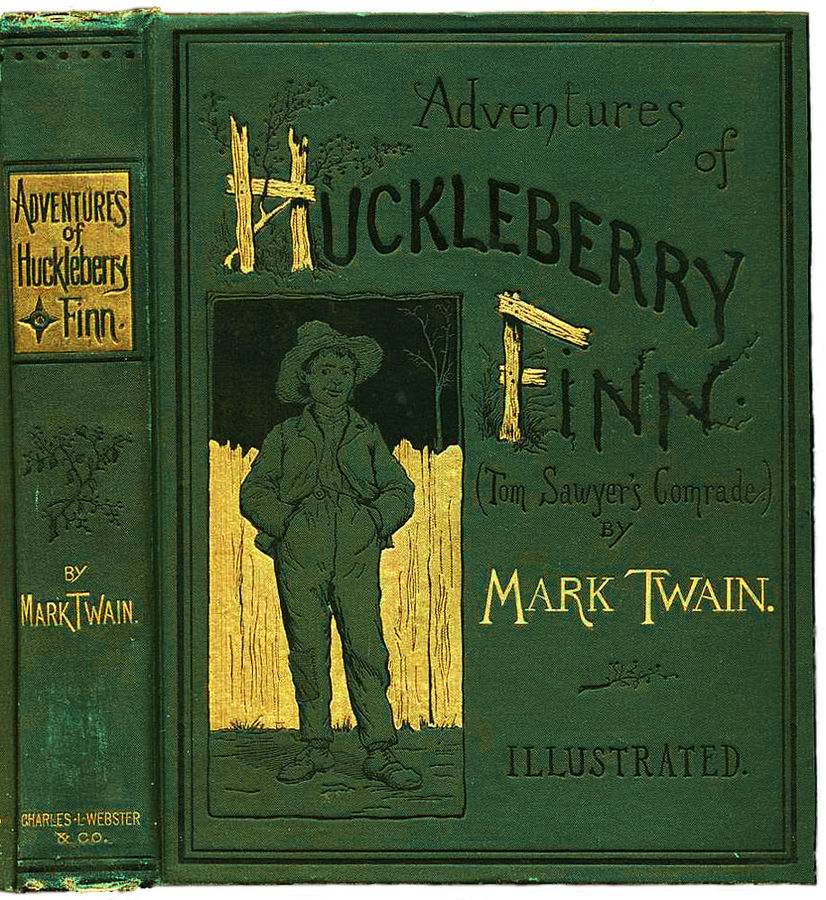
“All modern American literature comes from one book by Mark Twain called Huckleberry Finn. American writing comes from that. There was nothing before. There has been nothing as good since.” That’s what Ernest Hemingway, had to say about Mark Twain’s 1885 novel, The Adventures of Huckleberry Finn. The book, now in the public domain, can be download for free in ebook and audiobooks formats. Find them here:
eBooks: iPad/iPhone — Kindle + Other Formats — Read Online Now
Audio Books: Free MP3 — Free MP3 Zip File — Free iTunes — Spotify version
Find many more great classics in our twin collections: 800 Free eBooks for iPad, Kindle & Other Devices and 1,000 Free Audio Books: Download Great Books for Free. And if you are looking for a professionally read version of Huckleberry Finn, you might also want to explore downloading one for free from Audible.com. They have a great, no-strings-attached deal. If you start a 30 day free trial with Audible.com, you can download two free audio books of your choice. Get more details on the offer here.
Follow Open Culture on Facebook, Twitter, Google Plus and LinkedIn and share intelligent media with your friends. And if you want to make sure that our posts definitely appear in your Facebook newsfeed, just follow these simple steps.
Related Content:
Free Online Literature Courses
Bill Murray Gives a Delightful Reading of Twain’s Huckleberry Finn (1996)
Norman Rockwell Illustrates Mark Twain’s Tom Sawyer & Huckleberry Finn (1936–1940)
Read More...Hear Ray Bradbury’s Classic Sci-Fi Story Fahrenheit 451 as a Radio Drama
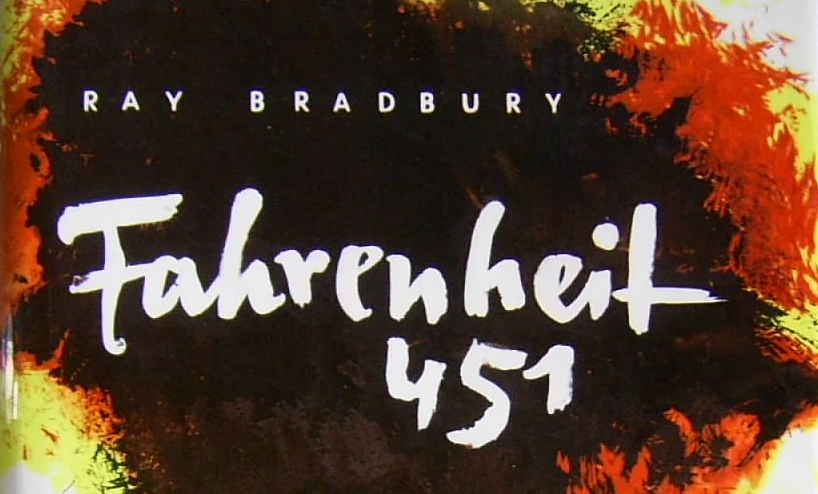
Last week we featured a list of 100 novels all kids should read before graduating from high school. Chosen by 500 English teachers from all over Britain, the list happens to have a lot of overlap with many others like it. Invariably, these kinds of young adult reading lists include Ray Bradbury’s novel of dystopian censorship and anti-intellectualism, Fahrenheit 451. Why, I’ve always wondered, should this novel be pitched almost exclusively at teenagers, so much so that it seems like one of those books many of us read in high school, then never read again, even if we are fans of Bradbury’s work?
A strange disconnect emerges when we look at the history of Bradbury’s novel as a teaching tool. Although most high school students are presented with freethinking as an ideal, and given cautionary tales of its suppression, their own educations are just as often highly circumscribed by adults who fret about the effects of various bad influences.
Whether, as a student, you read the bowdlerized or the “adult” version of Bradbury’s novel, perhaps it’s time to revisit Fahrenheit 451, particularly now that freedoms of thought, belief, and expression have again come under intense scrutiny. And in addition to re-reading Bradbury’s novel, you can listen to the 1971 radio play above. Produced in Vancouver by the CBC (and re-broadcast in recent years by the Radio Enthusiasts of Puget Sound podcast), the abridged, one-hour adaptation by necessity changes the source material, though for dramatic purposes, not to expressly soften the message. Ray Bradbury’s reputation may have been tamed over the decades. He became late in life an avuncular sci-fi master, primarily known as a writer of books for high school students. But at one time, his work—and science fiction in general—were so subversive that the FBI kept close tabs on them.
If you like the Fahrenheit 451 adaptation, you can hear many more Bradbury stories adapted into classic radio plays at our previous post.
Also note: Tim Robbins has narrated a new, unabridged audio version of Fahrenheit 451. It’s available via Audible.com. You can get it for free with Audible’s 30-day free trial. Get more details on that here.
via SFF
Related Content:
Who Was Afraid of Ray Bradbury & Science Fiction? The FBI, It Turns Out (1959)
Sci-Fi Legend Ray Bradbury Creates a Visionary Plan to Redesign Los Angeles
Ray Bradbury: “The Things That You Love Should Be Things That You Do.” “Books Teach Us That”
1,000 Free Audio Books: Download Great Books for Free
Josh Jones is a writer and musician based in Durham, NC. Follow him at @jdmagness
Read More...Support Us
We're hoping to rely on loyal readers, rather than erratic ads. Please click the Donate button and support Open Culture. You can use Paypal, Venmo, Patreon, even Crypto! We thank you!

About Us

Open Culture scours the web for the best educational media. We find the free courses and audio books you need, the language lessons & educational videos you want, and plenty of enlightenment in between.
Advertise With Us

FREE UPDATES!
GET OUR DAILY EMAIL
Get the best cultural and educational resources on the web curated for you in a daily email. We never spam. Unsubscribe at any time.
FOLLOW ON SOCIAL MEDIA

Open Culture editor Dan Colman scours the web for the best educational media. He finds the free courses and audio books you need, the language lessons & movies you want, and plenty of enlightenment in between.
Advertise With Us

