Stream a Free 65-Hour Playlist of John Cage Music and Discover the Full Scope of His Avant-Garde Compositions
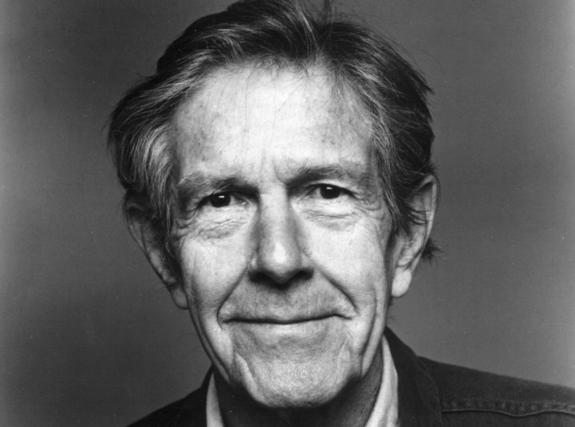
Creative Commons image via Wiki Art
We might as well get the self-writing joke about a 65-hour John Cage playlist out of the way up front: that’s a whole lot of silence! But of course, such a joke about the work of John Cage inevitably ends up as a joke about how little so many of us know about the work of John Cage. Most of us learn, at one time or another, of “4’33”,” his famous 1952 composition — or perhaps anti-composition — which instructs its players to, for the length of time reflected by its title, play nothing at all. But dig a little deeper into Cage’s motivations, and you find that he wanted the audience of “4’33”” to listen not to the silence, but to whatever sounds happen to remain in the absence of music — so that those incidental noises, in effect, become the music.
Many more such unconventional compositional ideas and resulting listening experiences await you in John Cage: A Chronological Collection, this decidedly non-silent Spotify playlist above (and if you don’t have Spotify’s free software yet, download it here) by Ulysses Classical, author of several of our favorite playlists, including this 50-hour classical compilation we featured in August.
If you find yourself still in need of more of Cage’s salutary effect on your perception of not just music and art but of the world itself, you can hear Ulysses Classical’s playlist of only Cage’s “Number Pieces” below, which “has a cleansing effect on the mind, as if it paints the walls of the room I’m sitting in with soothing colors.”
Ulysses Classical’s background post on the big chronological playlist opens with a quote from Cage that neatly incapsulates what we might call his philosophy of composition, or maybe of life itself: “What I’m proposing, to myself and other people, is what I often call the tourist attitude — that you act as though you’ve never been there before. So that you’re not supposed to know anything about it. If you really get down to brass tacks, we have never been anywhere before.” This playlist, which spans Cage’s six-decade career from 1932 to 1992, showcases just what rich musical places Cage found when he acted as though he’d never been there before. Listening to it will certainly take you to musical places you’ve never been before — and, assuming you’ve been to “4’33”,” it doesn’t take you there, but I suppose you can go to that particular patch of musical territory any time you like.
Related Content:
The Music of Avant-Garde Composer John Cage Now Available in a Free Online Archive
John Cage Performs Water Walk on US Game Show I’ve Got a Secret (1960)
10 Rules for Students and Teachers Popularized by John Cage
Hear Joey Ramone Sing a Piece by John Cage Adapted from James Joyce’s Finnegans Wake
Watch a Surprisingly Moving Performance of John Cage’s 1948 “Suite for Toy Piano”
10 Rules for Students and Teachers Popularized by John Cage
See the Curious Score for John Cage’s “Silent” Zen Composition 4’33”
Based in Seoul, Colin Marshall writes and broadcasts on cities and culture. He’s at work on a book about Los Angeles, A Los Angeles Primer, the video series The City in Cinema, and the crowdfunded journalism project Where Is the City of the Future? Follow him on Twitter at @colinmarshall or on Facebook.
Read More...
People of Nowhere: Short, Powerful Film Captures the Human Dimension of the Syrian Refugee Crisis
“The propagandist’s purpose is to make one set of people forget that certain other sets of people are human.”
–Aldous Huxley (1936)
Lior Sperandeo, who has previously directed short films called People of Mumbai, People of Nepal, and People of Senegal, returns with a film that resists focusing on a sense of place. People of Nowhere captures the plight of Syrian refugees, fleeing their worn-torn country for a safer life in Europe. Explaining how he came to make the dramatic film, Sperandeo writes:
I have heard and read different opinions about the wave of Syrian refugees who try to make their way in to the EU. Then I went to Lesvos. 7 days on the Greek Island gave me a healthier, human perspective on the situation. Seeing the people behind the headlines with my own eyes, and feeling their deep struggle, broke my heart. Are they the ‘threat’ people talk about? All I saw were courageous people in a time of crisis, looking for hope. I also got to meet brave volunteers from all over the world who reach out to help all people regardless of their religion, race or background. That inspired me. My hope is that this video might tear down some of the walls of bad ideas and opinions we have built around ourselves.
You can watch Lior’s film, a reminder that real lives are stake in the slow-moving genocide in Syria, on Vimeo here. And visit his Vimeo Channel here.
Follow Open Culture on Facebook and Twitter and share intelligent media with your friends. Or better yet, sign up for our daily email and get a daily dose of Open Culture in your inbox. And if you want to make sure that our posts definitely appear in your Facebook newsfeed, just follow these simple steps.
Read More...300 Kate Bush Impersonators Pay Tribute to Kate Bush’s Iconic “Wuthering Heights” Video
Heathcliff, it’s me–Cathy.
(and 300 Kate Bush impersonators…)
Let (us) in-a-your windo-o-ow!
I will never forget my first hearing of singer-songwriter Kate Bush’s “ Wuthering Heights.” My college boyfriend was a fan, but nothing he told me in advance prepared me for the shocking lunatic squeak of that voice.
Was that how Emily Brontë conceived of her otherworldly Gothic heroine, Catherine Earnshaw?
Surely no.
Had such an unholy screech issued from the lips of Merle Oberon in the 1939 film adaptation, Lawrence Olivier would have bolted for the moors…
It’s an acquired taste, but a lasting one. Bush’s debut single, written on a full moon night at the tender age of 18, has become a classic in its own right. (SPOILER: its life span has proved longer than Heathcliff’s).
It’s weird, tragic, compelling… just like the novel that inspired it.
It’s also perennially ripe for parody. Not just because of the voice. Two music videos Bush released seal that deal.
The UK version, above, features the sort of over-the-top theatrics rarely displayed outside the privacy of bedroom mirrors, as Bush pirouettes, cartwheels, and emotes in a gauzy white frock.
(Some young teens of my acquaintance nailed that one at summer camp, with little more than white bed sheets and fifteen minutes of advance preparation.)
When it came time for the American release, below, Bush painted her nails, rouged her lips, and took to the great outdoors in a bright red gown and tights, below.
Comedian Noel Fielding camped his way through that version in 2011, raising money for charity with a nearly 30-year-old reference.
But for sheer numbers, nothing trumps the Shambush! stunt at the top of the page. In May, 2013, the self-proclaimed “ludicrous performance troupe” invited all interested Bush fans to join them in a Brighton park to recreate the famous video en masse. (Gowns and wigs were available onsite.)
More than 300 participants heeded the call, allowing Shambush! to achieve its goal of setting the world’s record for the most number of people dressed as Kate Bush. (As one of the organizers pointed out, they would’ve set the world’s record even if it had only been the three of them.)
What a wonderful, ridiculous moment in music history to be a part of!
For those inspired to recreate the madness with their own crew, Shambush! breaks down (and names) some of the most iconic moves in an instructional video, below.
Related Content:
2009 Kate Bush Documentary Dubs Her “Queen of British Pop”
Ai Weiwei’s Parody of ‘Gangnam Style’
Ayun Halliday is an author, illustrator, and Chief Primatologist of the East Village Inky zine. Follow her @AyunHalliday
Read More...Albert Einstein On God: “Nothing More Than the Expression and Product of Human Weakness”
With dependable frequency, the religious views of Albert Einstein get revised and re-revised according to some re-discovered or re-interpreted quotation from his scientific work or personal correspondence. It’s not especially surprising that Einstein had a few things to say on the subject. As the pre-eminent theoretical physicist of his age, he spent his days pondering the mysteries of the universe. As one of the most famous public intellectuals in history, and an immigrant to a country as highly religious as the United States, Einstein was often called on to voice his religious opinions. Like any one of us over the course of a lifetime, those statements do not harmonize into a neat and tidy confession of belief, or unbelief. Instead, at times, Einstein explicitly aligns himself with the pantheism of Baruch Spinoza; at other times, he expresses a much more skeptical attitude. Often he seems to stand in awe of a vague deist notion of God; Often, he seems maximally agnostic.
Einstein rejected the atheist label, it’s true. At no point in his adult life, however, did he express anything at all like a belief in traditional religion. On the contrary, he made a particular point of distancing himself from the theologies of Judaism and Christianity especially. Though he did admit to a brief period of “deep religiousness” as a child, this phase, he wrote “reached an abrupt end at the age of twelve.” As he writes in his Autobiographical Notes, after a “fanatic orgy of freethinking,” brought on by his exposure to scientific literature, he developed a “mistrust of every kind of authority… a skeptical attitude toward the convictions that were alive in any specific social environment—an attitude that has never left me, even though, later on, it has been tempered by a better insight into the causal connections.” In contrast to the “religious paradise” of his youth, Einstein wrote that he had come to find another kind of faith—in the “huge world… out yonder… which stands before us like a great riddle.”
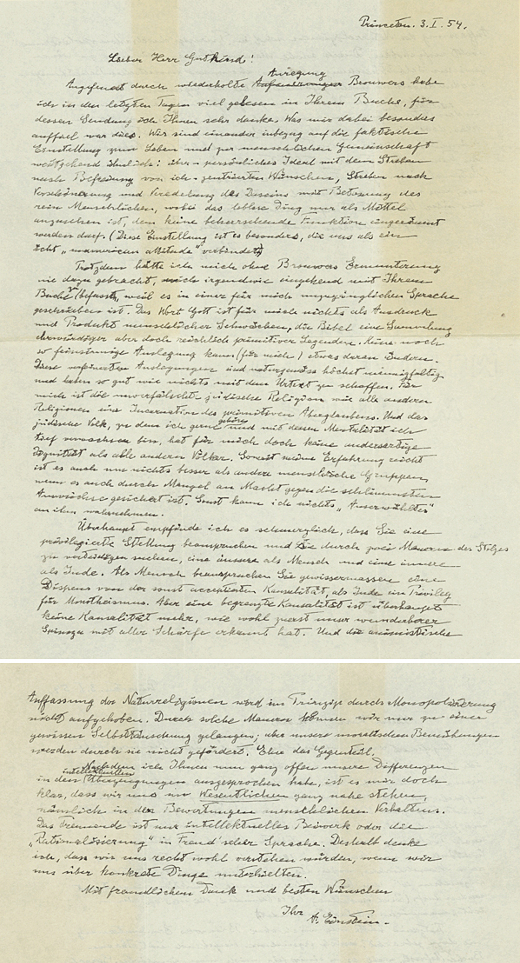
Einstein’s rejection of a personal God was undeniably final, such that in 1954, a year before his death, he would write the letter above to philosopher Erik Gutkind after reading Gutkind’s book Choose Life: The Biblical Call to Revolt on the recommendation of a mutual friend. The book, Einstein tells its author, is “written in a language inaccessible to me.” He goes on to disparage all religion as “the most childish superstition”:
The word God is for me nothing more than the expression and product of human weakness, the Bible a collection of honorable, but still purely primitive, legends which are nevertheless pretty childish. No interpretation, no matter how subtle, can change this for me. For me the Jewish religion like all other religions is an incarnation of the most childish superstition. And the Jewish people to whom I gladly belong, and whose thinking I have a deep affinity for, have no different quality for me than all other people. As far as my experience goes, they are also no better than other human groups, although they are protected from the worst cancers by a lack of power…
You can read a full transcript at Letters of Note, who include the letter in their second volume of fascinating correspondence from famous figures, More Letters of Note. The letter went up for auction in May of 2008, and a much more dogmatically anti-religious scientist had a keen interest in acquiring it: “Unsurprisingly,” Letters of Note point out, “one of the unsuccessful bidders was Richard Dawkins.”
Related Content:
“Do Scientists Pray?”: A Young Girl Asks Albert Einstein in 1936. Einstein Then Responds
Albert Einstein Reads ‘The Common Language of Science’ (1941)
Einstein for the Masses: Yale Presents a Primer on the Great Physicist’s Thinking
50 Famous Academics & Scientists Talk About God
Josh Jones is a writer and musician based in Durham, NC. Follow him at @jdmagness
Read More...A Rollicking French Animation on the Perils of Drinking a Little Too Much Coffee
Moderate coffee consumption may decrease your risk of dying prematurely from cardiovascular disease, reduce your risk of letting colon cancer take you to the grave, possibly help you stave off dementia, and maybe, writes The New York Times, dodge a number of other bullets–“Type 2 diabetes, basal cell carcinoma (the most common skin cancer), prostate cancer, oral cancer and breast cancer recurrence.” Pour me a cup, please.
These days, I’m feeling pretty good about my last remaining vice. But, as always, too much of anything is not a good thing. And that includes coffee too. Just ask Honoré de Balzac, who, according to legend, met an untimely death by drinking 50 cups per day. Or ask the fellow featured in the French animation called Le café–or simply Coffee in English. Up top, you can find a subtitled version of the riotous film directed by Stephanie Marguerite and Emilie Tarascou. Beneath, we have a non-subtitled but higher resolution version. Enjoy, and remember to drink coffee responsibly.
More creative shorts can be found in the Animation section of our collection, 4,000+ Free Movies Online: Great Classics, Indies, Noir, Westerns, Documentaries & More.
Related Content:
Philosophers Drinking Coffee: The Excessive Habits of Kant, Voltaire & Kierkegaard
David Lynch Directs a Mini-Season of Twin Peaks in the Form of Japanese Coffee Commercials
“The Virtues of Coffee” Explained in 1690 Ad: The Cure for Lethargy, Scurvy, Dropsy, Gout & More
Read More...Terry Gilliam on the Difference Between Kubrick & Spielberg: Kubrick Makes You Think, Spielberg Wraps Everything Up with Neat Little Bows
Fitting, I suppose, that the only creative meeting of the minds between two of the twentieth century’s best-known film directors took place on a project about the problem of nonhuman intelligence and the dangerous excesses of human ingenuity. For both Stanley Kubrick and Steven Spielberg, these were conflicts rich with inherent dramatic possibility. One of the many important differences between their approaches, however, is a stark one. As many critics of AI: Artificial Intelligence—the film Kubrick had in development since the 70s, then handed off to Spielberg before he died—have pointed out, Kubrick mined conflict for philosophical insights that can leave viewers intriguingly puzzled, if emotionally chilled; Spielberg pushes his drama for maximum emotional impact, which either warms audiences’ hearts or turns their stomachs, depending on their disposition.
In the latter camp, we can firmly place Monty Python alumnus and cult director Terry Gilliam. In the short clip at the top of the post, Gilliam explicates “the main difference” as he sees it between Spielberg and Kubrick. Spielberg’s films are “comforting,” they “give you answers, always, the films are… answers, and I don’t they’re very clever answers.” Kubrick’s movies, on the other hand, always leave us with unanswerable questions—riddles that linger indefinitely and that no one viewer can satisfactorily solve. So says Gilliam, an infamously quixotic director whose pursuit of a vision uniquely his own has always trumped any commercial appeal his work might have. Most successful films, he argues, “tie things up in neat little bows.” For Gilliam, this is a cardinal sin: “the Kubricks of this world, and the great filmmakers, make you go home and think about it.” Certainly every fan of Kubrick will admit as much—as will those who don’t like his films, often for the very same reasons.
To make his point, Gilliam quotes Kubrick himself, who issued an incisive critique of Spielberg’s Nazi drama Schindler’s List, saying that the movie “is about success. The Holocaust was about failure”—the “complete failure,” Gilliam adds, “of civilization.” Not a subject one can, or should, even attempt to spin positively, one would think. As an example of a Kubrick film that leaves us with an epistemological and emotional vortex, Gilliam cites the artificial intelligence picture the great director did finish, 2001: A Space Odyssey. To see in action how these two directors’ approaches greatly diverge, watch the endings of both Schindler’s List and 2001, above. Of course the genre and subject matter couldn’t be more different—but that aside, you’ll note that neither could Kubrick and Spielberg’s visual languages and cinematic attitudes, in any of their films.
Despite this vast divide—between Spielberg’s “neat little bows” and Kubrick’s headtrips—it might be argued that their one collaboration, albeit a posthumous one for Kubrick, shows them working more closely together than seems possible. Or so argues Noel Murray in a fascinating critical take on AI, a film that perhaps deserves greater appreciation as an “unnerving,” existentialist, and Kubrick-ian turn for Spielberg, that master of happy endings.
Related Content:
Terry Gilliam Reveals the Secrets of Monty Python Animations: A 1974 How-To Guide
Stanley Kubrick’s Rare 1965 Interview with The New Yorker
Josh Jones is a writer and musician based in Durham, NC. Follow him at @jdmagness
Read More...French Vending Machines Fill Your Mind with Nourishing Short Stories, Not Your Body with Junk Food
If you’re thirsty, a vending machine is usually close by. (Especially if you’re in Japan. You’re probably standing right next to one right now!) But what if you have time to kill and you’re thirsty for literature? Then the Short Édition vending machine might be for you. Choose one of three buttons—one minutes, three minutes, or five minutes—and the cylindrical machine, currently available in France, will print out an appropriately-long short story to read on a receipt-like piece of paper.
Short Édition co-founder Quentin Pleple says the idea came to him, where else, at a vending machine, while on break with co-workers.“We thought it would be cool to have it for short stories. Then, a couple of days later we decided to hack a prototype.”
Though people spend a lot of their free time on their pocket devices, the Short Édition is another attempt–like the short stories Chipotle printed on the side of its drinking cups–to free us from a life of staring at glowing rectangles. It’s tangible yet disposable at the same time.
At the turn of the 20th century automation and vending machines looked to be the wave of the future, where everything would be done for us on command. And that has happened in a totally different way, through the microprocessor. It just didn’t happen through the vending machine, at least not in America, where they mostly dispense food, drink, and cigarettes. Like high speed rail, Japan has picked up the slack and made the world rethink the machine’s possibilities all over again. It now looks like France and Poland (where you can find Haruki Murakami novels being sold in vending machines) are catching on.
The Short Édition vending machines, currently only available in eight locations in Grenoble, France, draw from a database of 600 stories chosen by the community at Short Édition’s website, which counts 1,100 authors as members. Presumably, all these stories are in French.
While new, the machines have gathered enough media attention to attract inquiries from Italy and the United States. So look out, you might find one in your area soon.
Related Content:
Haruki Murakami Novels Sold in Polish Vending Machines
Isaac Asimov Predicts in 1964 What the World Will Look Like Today
Kurt Vonnegut’s 8 Tips on How to Write a Good Short Story
Ted Mills is a freelance writer on the arts who currently hosts the FunkZone Podcast. You can also follow him on Twitter at @tedmills, read his other arts writing at tedmills.com and/or watch his films here.
Read More...Jimi Hendrix Plays the Delta Blues on a 12-String Acoustic Guitar in 1968, and Jams with His Blues Idols, Buddy Guy & B.B. King
“I started playing the guitar about 6 or 7, maybe 7 or 8 years ago. I was influenced by everything at the same time, that’s why I can’t get it together now.”
When you listen to Jimi Hendrix, one of the last things you’re ever likely to think is that he couldn’t “get it together” as a guitarist. Hendrix made the characteristically modest statement in 1968, in a free form discussion about his influences with Rolling Stone’s Jann Wenner and Baron Wolman. “I used to like Buddy Holly,” he said, “and Eddie Cochran and Muddy Waters and Elvin James… B.B. King and so forth.” But his great love was Albert King, who “plays completely and strictly in one way, just straight funk blues.”
Since Hendrix’s death and subsequent enshrinement in pop culture as the undisputed master of psychedelic rock guitar, a number of posthumous releases have performed a kind of revisionism that situates him not strictly in the context of the hippie scene but rather in the blues tradition he so admired and that, in a sense, he came of age within as a session and backing guitarist for dozens of blues and R&B artists in the early 60s.
In 1994 came the straightforwardly-titled compilation album Blues, which celebrated the fact that “more than a third of [Hendrix’s] recordings were blues-oriented,” writes Allmusic’s Richie Unterberger, whether originals like “Red House” and “Hear My Train a Comin’” or covers of his heroes Muddy Waters and Albert King. Martin Scorsese devoted a segment of his documentary series The Blues to Hendrix, and an ensuing 2003 album release featured even more Hendrix blues originals (with “pretty cool” liner notes about his blues record collecting habits). Prolific director Alex Gibney has a documentary forthcoming on Hendrix on the Blues.
It’s safe to say that Hendrix’s blues legacy is in safe hands, and it may be safe to say he would approve, or at least that he would have preferred to be linked to the blues, or classical music, than to what he called “freak-out psychedelic” music, as a Guardian review of Hendrix autobiography Starting at Zero quotes; “I don’t want anybody to stick a psychedelic label around my neck. Sooner Bach and Beethoven.” Or sooner, I’d imagine, blues legends like Albert King, Buddy Guy, and B.B. King, of whom Hendrix sat in awe. At the top of the post, you can see Hendrix flex his Delta blues muscles on a 12-string acoustic guitar. Then in the video below it from 1968, Hendrix gets the chance to jam with Buddy Guy, after watching Guy work his magic from the audience. (Hendrix joins Guy onstage to jam at 6:24.) Beneath, see Guy and King reminiscing a few years ago about those days of meeting and playing with Hendrix.
During their conversation, you’ll learn where Hendrix picked up one of his stage tricks, playing the guitar behind his head—and learn how little Guy knew about Hendrix the rock star, coming to know him instead as a great blues guitarist.
Related Content:
Jimi Hendrix Unplugged: Two Great Recordings of Hendrix Playing Acoustic Guitar
Jimi Hendrix’s Final Interview on September 11, 1970: Listen to the Complete Audio
B.B. King Changes Broken Guitar String Mid-Song at Farm Aid, 1985 and Doesn’t Miss a Beat
Josh Jones is a writer and musician based in Durham, NC. Follow him at @jdmagness
Read More...Free Speech Bites: Nigel Warburton, Host of Philosophy Bites, Creates a Spin Off Podcast Dedicated to Freedom of Expression

In ostensibly liberal democracies in the West, attitudes towards free speech vary widely given different historical contexts, and can shift dramatically over time. We’re living in the midst of a generational shift on the issue in the U.S.; a recent Pew survey found that 40 percent of millennials—18–34 year olds—favor government bans on offensive speech. The usual caveats apply when reading this data; New York magazine’s Science of Us blog breaks down the demographics and points out problems with definitions, particularly with that of the word “offensive.” They write, “plenty of folks freak out about anti-cop sentiments but are fine with racially loaded language—or insert your own examples.” As commentators note almost daily, various free speech advocates show all manner of partiality when it comes to whose speech they choose to defend and whose they, unwittingly perhaps, suppress.
European countries, of course, already have all sorts of laws that curb offensive speech and impose harsh penalties, from large fines to jail time. Those laws are extending to the internet as well, a speech domain long censored by Chinese authorities.
Whether European measures against racist and xenophobic speech actually lessen racism and xenophobia is an open question, as is the problem of exceptions to the laws that seem to allow certain kinds of prejudices as they strongly censor others. Much more extreme examples of the suppression of free speech have recently come to light under autocratic regimes in the Middle East. In Syria, software developer and free speech advocate Bassel Khartabil has been held in prison since 2012 for his activism. In Saudi Arabia, artist, poet, and Palestinian refugee Ashraf Fayadh has been sentenced to death for “renouncing Islam.”
We could add to all of these examples hundreds of others, from all over the world, but in addition to the statistics and the disturbing individual cases, it is worth asking broader, more philosophical questions about free speech as we draw our own conclusions about the issues. What exactly do we mean by “free speech”? Should all speech be protected, even that meant to libel individuals or whole groups or to deliberately incite violence? Should we tolerate a public discourse made up of lies, misinformation, prejudicial invective, and personal attacks? Should citizens and the press have the right to question official government narratives and to demand transparency?
To help us think through these politically and emotionally fraught discussions, we could listen to Free Speech Bites, a podcast sponsored by the Index on Censorship and hosted by freelance philosopher Nigel Warburton, who also hosts the popular podcast Philosophy Bites. The format is identical to that long-standing show, but instead of short conversations with philosophers, Warburton has brief, lively discussions with free speech advocates, including authors, artists, politicians, journalists, comedians, cartoonists, and academics. In the episode above, Warburton talks with DJ Taylor, biographer of the man considered almost a saint of free speech, George Orwell.
Of his subject, Taylor remarks, “I think it’s true to say that most of Orwell’s professional life, large amounts of the things that he wrote, are to do with the suppression of the individual voice.” At the same time, he points out that Orwell’s “view of free speech is by no means clear cut.” The “whole free speech issue became much more delicately shaded than it would otherwise have been” during the extraordinary times of the Spanish Civil War and World War II. Taylor refers to the “classic liberal dilemma: how far do we tolerate something that, if tolerated, will cease to tolerate us…. If you are living in a democracy and somebody’s putting out fascist pamphlets encouraging the end of that democracy, how much rope do you give them?”
In another episode, Irshad Manji—feminist, self-described “Muslim refusenik,” and author of The Trouble with Islam Today—talks free speech and religion, and offers a very different perspective than what we’re used to hearing reported from Islamic thinkers. When Warburton says that Islam and free expression sound “like two incompatible things,” Manji counters that as a “person of faith” she believes “free expression is as much a religious obligation as it is a human right.” In her estimation, “no human being can legitimately behave as if he or she owns a monopoly on truth.” Anything less than a society that tolerates civil disagreement, she says, means that “we’re playing God with one another.” In her religious perspective, “devoting yourself to one god means that you must defend human liberty.” Manji sounds much more like Enlightenment Christian reformers like John Locke than she does many interpreters of Islam, and she is well aware of the unpopularity of her point of view in much of the Islamic world.
Addressing the question of why free speech matters, broadcaster and writer Jonathan Dimbleby—former chair of the Index on Censorship—inaugurated the podcast in 2012 with a more classically philosophical discussion of John Stuart Mill’s On Liberty and the liberal argument against censorship Mill and others articulated. For Dimbleby, “freedom of expression [is] not only a right but a defining characteristic of what it means to be a civilized individual.” It’s a view he holds “very strongly,” but he admits that the valid exceptions to the rule are “where the difficult territory starts.” Dimbleby points to “very obvious circumstances when you don’t have freedom of expression and should not have freedom of expression.” One of the exceptions involves “laws that say that if you express yourself freely, you are directly putting someone else’s life at risk.” This is not as clear-cut as it seems. The “dangerous territory,” he argues, begins with circumscribing language that incites anger or offense in others. We are back to the question of offense, and it is not a uncomplicated one. Although activists very often need to be uncivil to be heard at all, there’s also a necessary place for public discussions that are as thoughtful and careful as we can manage. And for that reason, I’m grateful for the intervention of Free Speech Bites and the international variety of views it represents.
For more of those views, see the Index on Censorship’s website to stream or download seven more Free Speech Bites podcasts.
Related Content:
What “Orwellian” Really Means: An Animated Lesson About the Use & Abuse of the Term
George Orwell’s Final Warning: Don’t Let This Nightmare Situation Happen. It Depends on You!
Introduction to Political Philosophy: A Free Yale Course
Great Writers on Free Speech and the Environment
Josh Jones is a writer and musician based in Durham, NC. Follow him at @jdmagness
Read More...
William S. Burroughs Reads His Sarcastic “Thanksgiving Prayer” in a 1988 Film By Gus Van Sant
Having moved to Korea a couple weeks ago, I won’t have the chance to partake this year in the beloved institution of American culture known as Thanksgiving. (Korea has its own Thanksgiving, but it happened two months ago.) Maybe you live in the United States and thus almost certainly have a Thanksgiving dinner of some kind, big or small, coming soon. Or maybe you, like me, live elsewhere in the world, and thus in a place without the same tradition. Either way, you can surely partake this Thanksgiving in the beloved institution of American culture known as the work of William S. Burroughs.
Here we have a short film of Burroughs, best known as the author of a body of controversial and experimental literature, including books like Junky and Naked Lunch, shot by Gus Van Sant, best known as the director of films like Good Will Hunting, My Own Private Idaho, and Drugstore Cowboy, the last of which includes a memorable appearance by Burroughs himself.
It captures Burroughs reading his poem “Thanksgiving Day, Nov. 28, 1986,” also known as his “Thanksgiving Prayer.” Van Sant shot it two Thanksgivings after that one, in 1988, the year before Drugstore Cowboy (and six years after adapting Burrough’s story “The Discipline of D.E.” into an early short film).
Burroughs, a lifelong critic of America, fills his prayer with bitterly sarcastic “thanks” for things like “a continent to despoil and poison,” “Indians to provide a modicum of challenge and danger,” “the KKK,” and “Prohibition and the war against drugs” (about which his character in Drugstore Cowboy had some particularly choice words). He ends by expressing ironic, Great Gatsby-quoting gratitude for “the last and greatest betrayal of the last and greatest of human dreams.”
Like him — like most everybody — I have my own, if less deep-seated, frustrations with our homeland, and perhaps in leaving I subconsciously emulated his stretches of expatriatism in Mexico, England, France, and Morocco. But I sincerely doubt that I’ve had my last Thanksgiving on U.S. soil; for all its failings, America remains too interesting to stay away from entirely. After all, what other country could possibly produce a writer, a personality, or a critic like William S. Burroughs?
Related Content:
The Making of Drugstore Cowboy, Gus Van Sant’s First Major Film (1989)
William S. Burroughs Teaches a Free Course on Creative Reading and Writing (1979)
The Discipline of D.E.: Gus Van Sant Adapts a Story by William S. Burroughs
William S. Burroughs Reads His First Novel, Junky
Based in Seoul, Colin Marshall writes and broadcasts on cities and culture. He’s at work on a book about Los Angeles, A Los Angeles Primer, the video series The City in Cinema, and the crowdfunded journalism project Where Is the City of the Future? Follow him on Twitter at @colinmarshall or on Facebook.
Read More...Support Us
We're hoping to rely on loyal readers, rather than erratic ads. Please click the Donate button and support Open Culture. You can use Paypal, Venmo, Patreon, even Crypto! We thank you!

About Us

Open Culture scours the web for the best educational media. We find the free courses and audio books you need, the language lessons & educational videos you want, and plenty of enlightenment in between.
Advertise With Us

FREE UPDATES!
GET OUR DAILY EMAIL
Get the best cultural and educational resources on the web curated for you in a daily email. We never spam. Unsubscribe at any time.
FOLLOW ON SOCIAL MEDIA

Open Culture editor Dan Colman scours the web for the best educational media. He finds the free courses and audio books you need, the language lessons & movies you want, and plenty of enlightenment in between.
Advertise With Us

