Watch a New Nina Simone Animation Based on an Interview Never Aired in the U.S. Before
Blank on Blank has worked their magic again, this time animating a 1968 interview with the singer-songwriter and civil rights activist, Nina Simone. As always, Blank on Blank’s visual work is a treat. But what stands out for me here is the audio recording. Taken from a 1960s radio show hosted by Lilian Terry, the audio originally aired in Italy in the 1960s. And, until now, it has never been heard in the United States. Terry is nowadays working on an audiobook project called Voices from the Jazz Dimension that “chronicles her remarkable collection of interviews with jazz legends from Nina to Duke Ellington.” We can hardly wait for that project to take final shape. You can find more Blank on Blank animations, all of which revive vintage audio clips, in our archive.
Related Content:
Nina Simone Sings Her Breakthrough Song, ‘I Loves You Porgy,’ in 1962
Free Archive of Audio Interviews with Rock, Jazz & Folk Legends Now on iTunes
Jazz on the Tube: An Archive of 2,000 Classic Jazz Videos (and Much More)
Read More...
15-Year-Old French Guitar Prodigy Flawlessly Rips Through Solos by Eddie Van Halen, David Gilmour, Yngwie Malmsteen & Steve Vai
I’ve been playing guitar off and on for most of my life, and I’d be the first to admit that I’m not the most spectacular musician. I do it for joy and don’t sweat my musical limitations too much. This is a good thing; otherwise I might find myself seething with mad envy—like F. Murray Abraham’s Salieri—upon realizing that in 15 lifetimes I’d never be as good as young French prodigy Tina S is at 15 years of age. Tina has sent guitar nerds everywhere fleeing to their bedrooms, working their fingers bloody in furious efforts to match her speed and accuracy. Watch her flawlessly rip through Yngwie Malmsteen’s “Arpeggios from Hell” above, ye mighty shredders, and despair. See her destroy Steve Vai’s “Paganini 5th Caprice (Crossroads)” below, ye monsters of rock, and rend your denim vests asunder with grief.
The baroque speed metal of Malmsteen and Vai aren’t really my bag, but I have to say, there’s maybe a little Salieri voice cackling into the void in the back of my mind when I watch Tina’s videos. Maybe she’s a one-trick-pony, it tells me, playing arpeggios all day like a few hundred other guitarists in the audition line for a hundred metal bands in a hundred cities a day—players who couldn’t slow down and play the blues if they were heavily medicated.
So says my inner Salieri. But no, there she is below, flawlessly pulling off the “Comfortably Numb” solo, her bends and slides so impeccably timed I could close my eyes and almost swear it’s David Gilmour. Sigh and alas.
But can she do Van Halen, you rightly ask? Because, you know, anyone can play Malmsteen, Vai, and Gilmour, but Eddie Van Halen, c’mon…. Yet there she is below, with a searing rendition of “Eruption,” a song guitarists who learn Van Halen often avoid for reasons that will likely become evident when you see Tina play it. Is she too much technique, too little soul, you say? Yeah, well, she’s 15, and better than most of us are at twice that age. Comments on her videos include the following: “I want to throw my guitar out the window” and “This makes me want to kill myself.” In all seriousness, I hope anyone who genuinely feels this way seeks help. Also in all seriousness, don’t despair. Do what you do and enjoy it. And maybe after many long lifetimes you’ll be reborn as a Parisian guitar prodigy.
That Tina S has obvious natural ability in no way means she hasn’t had to work hard for this level of skill. On the contrary, anyone this good gets there through endless regular practice and the guidance of a talented teacher (in this case, French guitarist Renaud Louis-Servais). Tina posted her first video in 2008 at the tender age of 8, playing a composition by guitarist Maria Linnemann. You can see her below honing the classical chops that she later put to ludicrously fast use on a metal tribute to Vivaldi.
But does she do Mozart? Not so far on her Youtube channel, where you’ll find more early acoustic performances, like “Let it Be” and “Hotel California,” and more recent shredfests like Jason Becker’s “Altitudes.” To learn just how Tina views her own musicianship and sees her future as a guitarist, read this interview with her on the Guitar Channel. “I have not yet started my career as a guitarist,” she deadpans. Many would-be Salieris have already sworn to end theirs after watching her videos.
Related Content:
Fourteen-Year-Old Girl’s Blistering Heavy Metal Performance of Vivaldi
Great Violinists Playing as Kids: Itzhak Perlman, Anne-Sophie Mutter, & More
The Guitar Prodigy from Karachi
Josh Jones is a writer and musician based in Durham, NC. Follow him at @jdmagness
Read More...Learn to Code with Harvard’s Popular Intro to Computer Science Course: The 2015 Edition
Briefly noted: This fall, Harvard has been rolling out videos from the 2015 edition of Computer Science 50 (CS50), the university’s introductory coding course designed for majors and non-majors alike. Taught by David Malan, a perennially popular professor (you’ll immediately see why), the one-semester course (taught mostly in C) combines courses typically known elsewhere as “CS1” and “CS2.”
Even if you’re not a Harvard student, you’re welcome to follow CS50 online by heading over to the This is CS50 website, or this alternative site here. There you will find video lectures (stream them all above or access them individually here), problem sets, quizzes, and other useful course materials. Once you’ve mastered the material covered in CS50, you can start branching out into new areas of coding by perusing our big collection of Free Online Computer Science Courses, a subset of our larger collection, 1,700 Free Online Courses from Top Universities.
If you would like to support the mission of Open Culture, consider making a donation to our site. It’s hard to rely 100% on ads, and your contributions will help us continue providing the best free cultural and educational materials to learners everywhere. You can contribute through PayPal, Patreon, and Venmo (@openculture). Thanks!
Read More...Immanuel Kant’s Life & Philosophy Introduced in a Short Monty Python-Style Animation
Philosopher Immanuel Kant (1724–1804) is perhaps best known for his systematic philosophical ethics, conceived of as a post-religious framework for secular morality. His primary ethical mandate, which he called the “categorical imperative,” enables us—Alain de Botton tells us in his short School of Life video above—to “shift our perspective, to get us to see our own behavior in less immediately personal terms.” It’s a philosophical version, de Botton says, of the Golden Rule. “Act only according to that maxim,” Kant famously wrote of the imperative in his Groundwork of the Metaphysics of Morals, “by which you can at the same time will that it should become a universal law.”
This guide to moral behavior seems on its face a simple one. It asks us to imagine the consequences of behavior should everyone act in the same way. However, “almost every conceivable analysis of the Groundwork has been tried out over the past two centuries,” writes Harvard professor Michael Rosen, “yet all have been found wanting in some way or other.” Friedrich Nietzsche alluded to a serious problem with what Rosen calls Kant’s “rule-utilitarianism.” How, Nietzsche asks in On the Genealogy of Morals, are we to determine whether an action will have good or bad consequences unless we have “learned to separate necessary events from chance events, to think in terms of cause and effect, to see distant events as if they were present, to anticipate them….”
Can we ever have that kind of foresight? Can we formulate rules such that everyone who acts on them will predict the same positive or negative outcomes in every situation? The questions did not seem to personally disturb Kant, who lived his life in a highly predictable, rule-bound way—even, de Botton tells us, when it came to structuring his dinner parties. But while the categorical imperative has seemed unworkably abstract and too divorced from particular circumstances and contingencies, an elaboration of the maxim has had much more appeal to contemporary ethicists. We should also, Kant wrote, “act so as to treat people always as ends in themselves, never as mere means.” De Botton provides some helpful context for why Kant felt the need to create these ethical principles.
Kant lived in a time when “the identifying feature of his age was its growing secularism.” De Botton contends that while Kant welcomed the decline of traditional religion, he also feared the consequences; as “a pessimist about human character,” Kant “believed that we are by nature intensely prone to corruption.” His solution was to “replace religious authority with the authority of reason.” The project occupied all of Kant’s career, from his work on political philosophy to that on aesthetics in the Critique of Pure Judgment. And though philosophers have for centuries had difficulty making Kant’s ethics work, his dense, difficult writing has nevertheless occupied a central place in Western thought. In his defense of the authority of reason, Kant provided us with one of the most comprehensive means for understanding how exactly human reason works—and for recognizing its many limitations.
To read Kant’s work for yourself, download free versions of his major texts in a variety of digital formats from our archive of Free Philosophy eBooks. Kant is no easy read, and it helps to have a guide. To learn how his work has been interpreted over the past two hundred years, and how he arrived at many of his conclusions, consider taking one of many online classes on Kant we have listed in our archive of Free Philosophy Courses.
Related Content:
Philosophers Drinking Coffee: The Excessive Habits of Kant, Voltaire & Kierkegaard
Man Shot in Fight Over Immanuel Kant’s Philosophy in Russia
Philosophers Drinking Coffee: The Excessive Habits of Kant, Voltaire & Kierkegaard
Josh Jones is a writer and musician based in Durham, NC. Follow him at @jdmagness
Read More...45,000 Works of Art from Stanford University’s Cantor Arts Center Now Freely Viewable Online
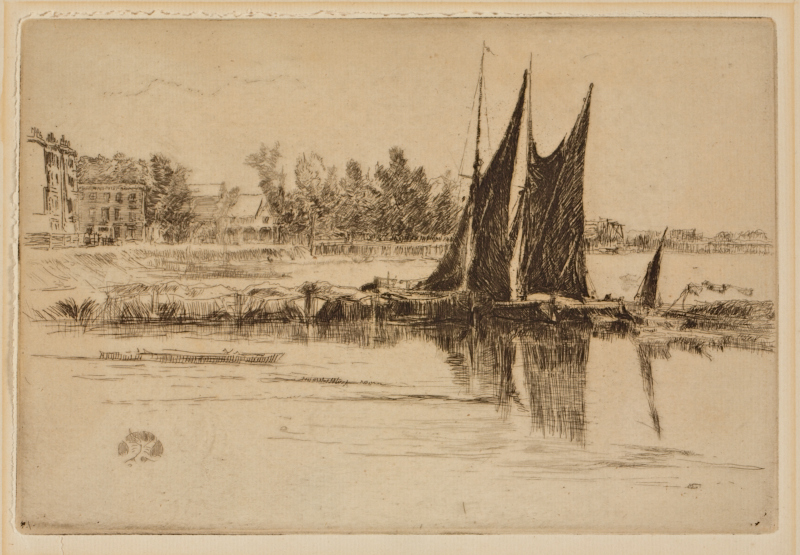
Just last month, Stanford University’s Iris and B. Gerald Cantor Center for Visual Arts made its collection accessible online, digitizing and uploading over 45,000 of its works of art in forms freely viewable by all. These include, if you navigate through the collections highlighted on the browse page, works of American and European art; African, Native American, and Oceanic art; Asian art; modern and contemporary art; prints, drawings, and photographs; and Stanford family collections as well as works currently on display.
But this hardly happened at a stroke. The short video above gives a look behind the scenes — or rather, museum walls, or perhaps digital museum walls — to reveal some of the effort that went into the six-year project that has culminated in the opening of the Cantor Arts Center’s online collections.
The endeavor required no small amount of physical work, not just to re-photograph everything in their collections (only five percent of which goes on display at any one time), but to perform a whole new inventory, the first complete one the museum had done since 1916. (As a recent move reminded me, there’s nothing like having to move all your stuff from one place to another to give you the clearest possible sense of exactly what you have.)
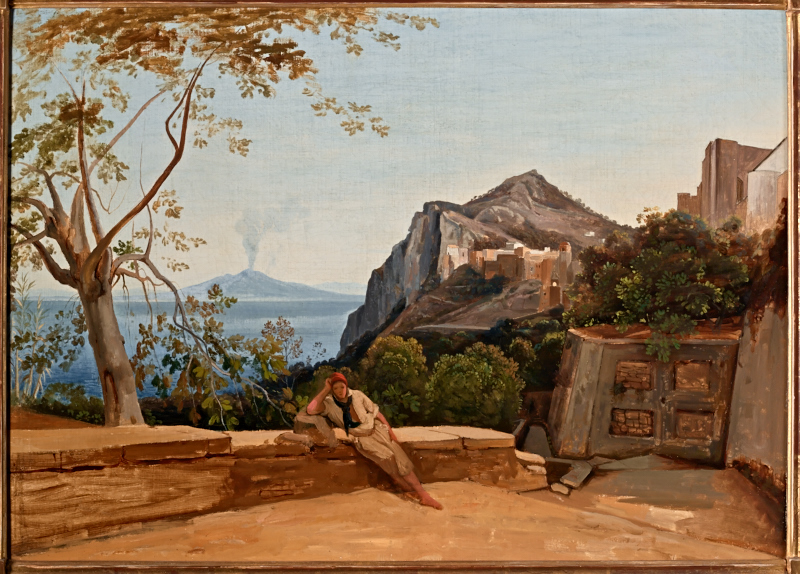
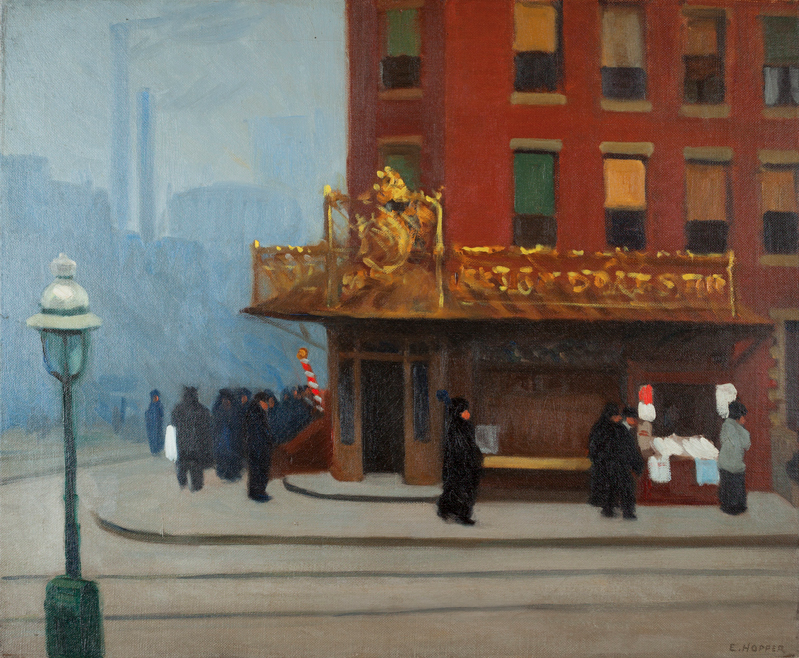
Here we’ve posted a few paintings from the Cantor: James McNeill Whistler’s Hurlingham (well, an etching, if you want to get technical), Théodore Caruelle d’Aligny’s View of the Bay of Naples, Nakabayashi Chikkei’s Autumn Landscape and Edward Hopper’s New York Corner. (You can also find a whole different set of scenes rendered in pen and ink at the Cantor’s dedicated digital collection of the sketchbooks of San Francisco Bay Area abstract expressionist painter Richard Diebenkorn.)
But to get a sense of the full scope of the geographic, historical, aesthetic, and formal variety of the art the Cantor has made viewable anywhere and any time, you’ll want to follow the instructions provided by one of our readers, Robin L: “Go to this search gateway. If you enter in an artist (I tried Whistler), you will get a list of all of the collections’ images with small images and some basic information. Then click on the specific piece that you want. And that one will open up with a small-medium image and some description of the piece. If you click on the image again, it will enlarge.”

Related Content:
Whitney Museum Puts Online 21,000 Works of American Art, By 3,000 Artists
The Metropolitan Museum of Art Puts 400,000 High-Res Images Online & Makes Them Free to Use
LA County Museum Makes 20,000 Artistic Images Available for Free Download
The Rijksmuseum Puts 125,000 Dutch Masterpieces Online, and Lets You Remix Its Art
The National Gallery Makes 25,000 Images of Artwork Freely Available Online
The Getty Puts 4600 Art Images Into the Public Domain (and There’s More to Come)
40,000 Artworks from 250 Museums, Now Viewable for Free at the Redesigned Google Art Project
Based in Seoul, Colin Marshall writes and broadcasts on cities and culture. He’s at work on a book about Los Angeles, A Los Angeles Primer, the video series The City in Cinema, and the crowdfunded journalism project Where Is the City of the Future? Follow him on Twitter at @colinmarshall or on Facebook.
Read More...The Dresser: The Contraption That Makes Getting Dressed an Adventure
Joseph Herscher — kinetic artist extraordinaire and creator of the great “Page Turner” Rube Goldberg machine — returns with a new contraption: “The Dresser”.
Originally, “The Dresser” was a live performance piece that Herscher performed in Charlotte, NC. He spent a year building the contraption, then 2 months testing it, before staging it for audiences. (Watch a short documentary on the live performance here.) Now, thankfully, he brings the quirky device to the web, for the rest of us to see. Somewhere Rube Goldberg is smiling.
Follow Open Culture on Facebook and Twitter and share intelligent media with your friends. Or better yet, sign up for our daily email and get a daily dose of Open Culture in your inbox. And if you want to make sure that our posts definitely appear in your Facebook newsfeed, just follow these simple steps.
Related Content:
The Page Turner: A Fabulous Rube Goldberg Machine for Readers
The Falling Water: A Rube Goldberg Machine That Makes a Fine Cocktail
Students Tells the Passover Story with a Rube Goldberg Machine
Read More...Prince (RIP) Performs Early Hits in a 1982 Concert: “Controversy,” “I Wanna Be Your Lover” & More
Update: Neil deGrasse Tyson just put it right. Now we know what it sounds like when doves cry.
We’re just getting the sad news that the artist Prince Rogers Nelson–otherwise simply known as Prince–has apparently died at the age of 57. Here you can watch him perform some of his earliest hits, back in 1982. In the hours to come, we’ll have more on Prince and his influential career.
The empire of Prince is a tightly controlled kingdom, ruled by an enigmatic and eccentric musical genius with a legendarily contentious relationship with the music industry. For most of the nineties, he was referred to as “the artist formerly known as Prince,” having changed his name to an unpronounceable symbol to spite his label Warner Bros. “During that time,” writes Rolling Stone, “sales of his new music slowed down significantly, but he still managed to get his point across.”
You have to admire an artist—even one as wealthy and successful as Prince—willing to take a financial hit for the sake of principle. In his most recent stand (though it probably won’t cost him anything worth mentioning in streaming revenue), Prince removed all of his music this past summer from every streaming service except Jay‑Z’s Tidal. So we’re very lucky to have the black-and-white taped live performance here from 1982 at New Jersey’s Capitol Theatre (released by The Music Vault), two years before he hit his 80s peak with the release of Purple Rain the film and album.
Whatever you think of Purple Rain the movie (actress Apollonia Kotero was nominated for a Razzie for worst new star, and her Prince-penned song “Sex Shooter” for worst original song), no one can deny the absolute pop brilliance of the album. It’s hard to pick a favorite; most of us can sing the choruses to “Let’s Go Crazy,” “When Doves Cry,” or “I Would Die 4 U” in our sleep. That said, Prince had already released some of the finest music of his career by the time he appeared at this New Jersey concert, including one of my personal favorites, “Controversy” (top) from the 1981 album of the same name and “I Wanna Be Your Lover” (above) from 1979’s Prince.
We don’t get anything from the year’s groundbreaking 1999, the first album to feature the Revolution, but we do get classics of the sleazy sex-god first phase of the Purple One’s career, including “Jack U Off,” above, in which Prince pulls out some classic male-stripper-does-jazzersize dance moves while the band rips through the raucous stomper of a tune at almost punk tempo and volume. These three songs represent three of facets Prince as an artist: There’s the agitated social commentator, the sensitive, pining lover, and the unrepentant horndog. He’s emphasized one or another of these persona over the course of his career, modulating them with the funked-up futurist character he evolved into as the decade progressed.
Prince’s attempts at film stardom mostly fall into the so-bad-they’re-good category, beginning with rock opera Purple Rain. But few know that he intended to release his first celluloid effort around the time of this concert. It was to be called The Second Coming, to accompany a scrapped album of the same name. Hear him sing the unreleased, gospel-inspired title song above, whose lyrics recall one of Michael Jackson’s socially conscious anthems and include the line “How many more good men must die before there’s gun control.” To learn more about that ill-fated film project, read this interview with the proposed director Chuck Statler, the “godfather of the music video,” here. And to see the full Capitol Theatre show, check it out on Youtube here, or right down below.
Related Content:
35 Years of Prince’s Hairstyles in 15 Glorious Seconds!
The Clash Live in Tokyo, 1982: Watch the Complete Concert
Josh Jones is a writer and musician based in Durham, NC. Follow him at @jdmagness
Read More...Slavoj Zizek Explains What’s Wrong with Online Dating & What Unconventional Technology Can Actually Improve Your Love Life
I once read a book by Larry King called How to Talk to Anyone, Anytime, Anywhere. Slavoj Zizek might well consider writing a book of his own called How to Make Intellectual Pronouncements About Anything, Anytime, Anywhere. From Beethoven’s “Ode to Joy” to political correctness to the Criterion Collection to Starbucks (and those just among the topics we’ve featured here on Open Culture) the Slovenian philosopher-provocateur has for decades demonstrated a willingness to expound on the widest possible variety of subjects, to the point where his career has begun to look like one continuous, free-associative analytical monologue, which in the Big Think video above reaches the inevitable subject: your love life.
Perhaps you’ve tried online dating — a practice that, given the increasingly thorough integration of the internet and daily life, we’ll probably soon just call “dating.” Perhaps you’ve had positive experiences with it, perhaps you’ve had negative ones, and most probably you’ve had a mixture of both, but how often can you take your mind off the awkward fact that you have to first “meet” the other person through an electronic medium, creating a version of yourself to suit that medium? Zizek calls this online dating’s problematic “aspect of self-commodification or self-manipulation.”
“When you date online,” he says, “you have to present yourself there in a certain way, putting forward certain qualities. You focus on your idea of how other people should perceive you. But I think that’s not how love functions, even at the very simple level. I think the English term is ‘endearing foibles’ — an elementary ingredient in love. You cannot ever fall in love with the perfect person. There must be some tiny small disturbing element, and it is only through noticing this element that you say, ‘But in spite of that imperfection, I love him or her.’ ”
Fair enough. But what to do about it? Zizek thinks that the way forward for romantic technologies lies not in a less technological approach, but a more technological approach — or at least a stranger technological approach. He imagines a world of “ideal sexual attraction” where “I meet a lady; we are attracted to each other; we say all the usual stuff — your place, my place, whatever, we meet there. What happens then? She comes with her plastic penis, electric dildo. I come with some horrible thing — I saw it, it’s called something like stimulating training unit — it’s basically a plastic vagina, a hole.”
Dare we examine where this scenario goes? The outcome may surprise you. They simply insert her electric dildo into his stimulating training unit, and voilà, “the machines are doing it for us, buzzing in the background, and I’m free to do whatever I want, and she.” With full tribute paid to the superego by their vulgar devices, “we have a nice talk; we have tea; we talk about movies. I talk with a lady because we really like each other. And, you know, when I’m pouring her tea, or she to me, quite by chance our hands touch. We go on touching. Maybe we even end up in bed. But it’s not the usual oppressive sex where you worry about performance. No, all that is taken care of by the stupid machines. That would be ideal sex for me today.”
Related Content:
Slavoj Žižek Examines the Perverse Ideology of Beethoven’s Ode to Joy
Slavoj Žižek Names His Favorite Films from The Criterion Collection
Slavoj Žižek Calls Political Correctness a Form of “Modern Totalitarianism”
Slavoj Žižek on the Feel-Good Ideology of Starbucks
Based in Seoul, Colin Marshall writes and broadcasts on cities and culture. He’s at work on a book about Los Angeles, A Los Angeles Primer, the video series The City in Cinema, and the crowdfunded journalism project Where Is the City of the Future? Follow him on Twitter at @colinmarshall or on Facebook.
Read More...Lynda Barry’s Illustrated Syllabus & Homework Assignments from Her New UW-Madison Course, “Making Comics”
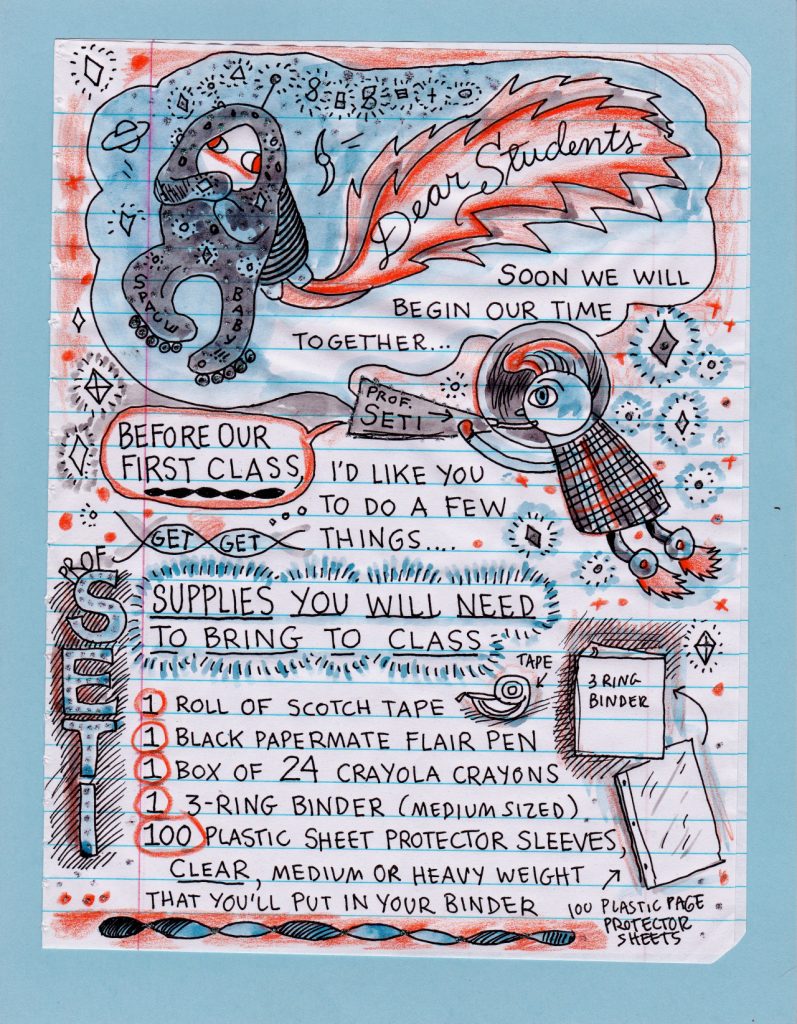
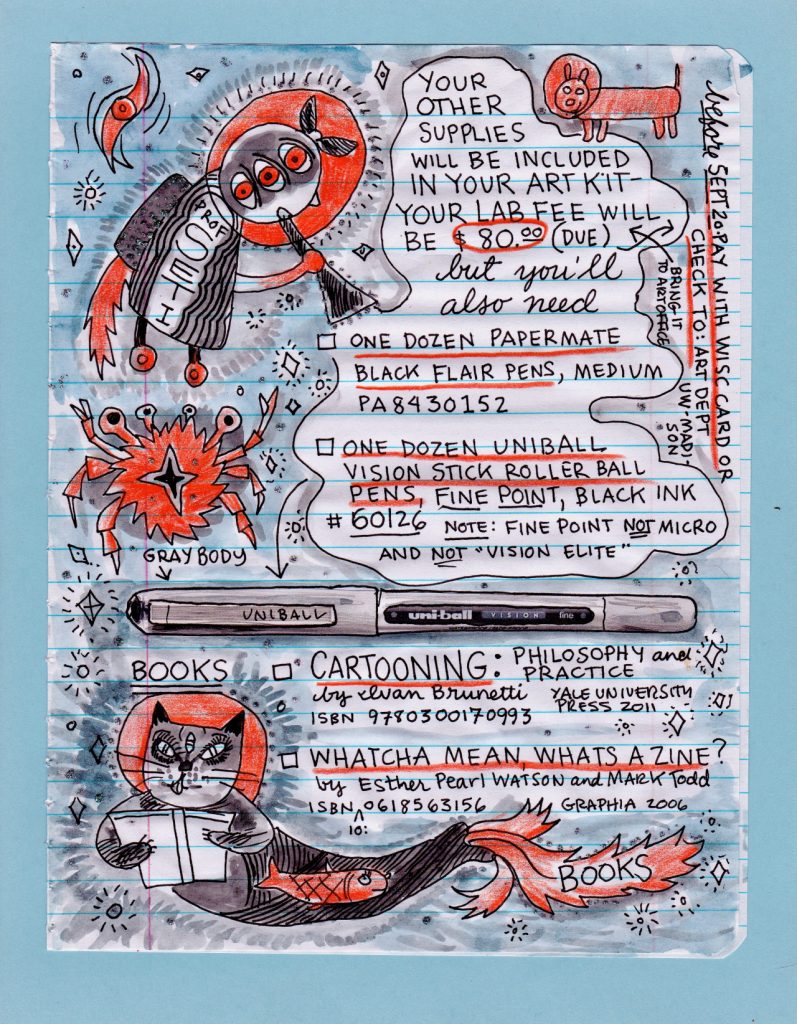
Cartoonist turned educator Lynda Barry is again permitting the world at large to freely audit one of her fascinating University of Wisconsin-Madison classes via her Tumblr. (To get to the start of the class, click here and then scroll down the page until you reach the syllabus, then start working your way backwards.)
The topic this fall is “Graphic Vices, Graphic Virtues: Making Comics,” a subject with which Barry is intimately acquainted. In the professor’s own words, this class is “a(n academically rigorous) blast!”
As in previous classes, the syllabus, above, spells out a highly specialized set of required supplies, including a number of items rarely called for at the college level.
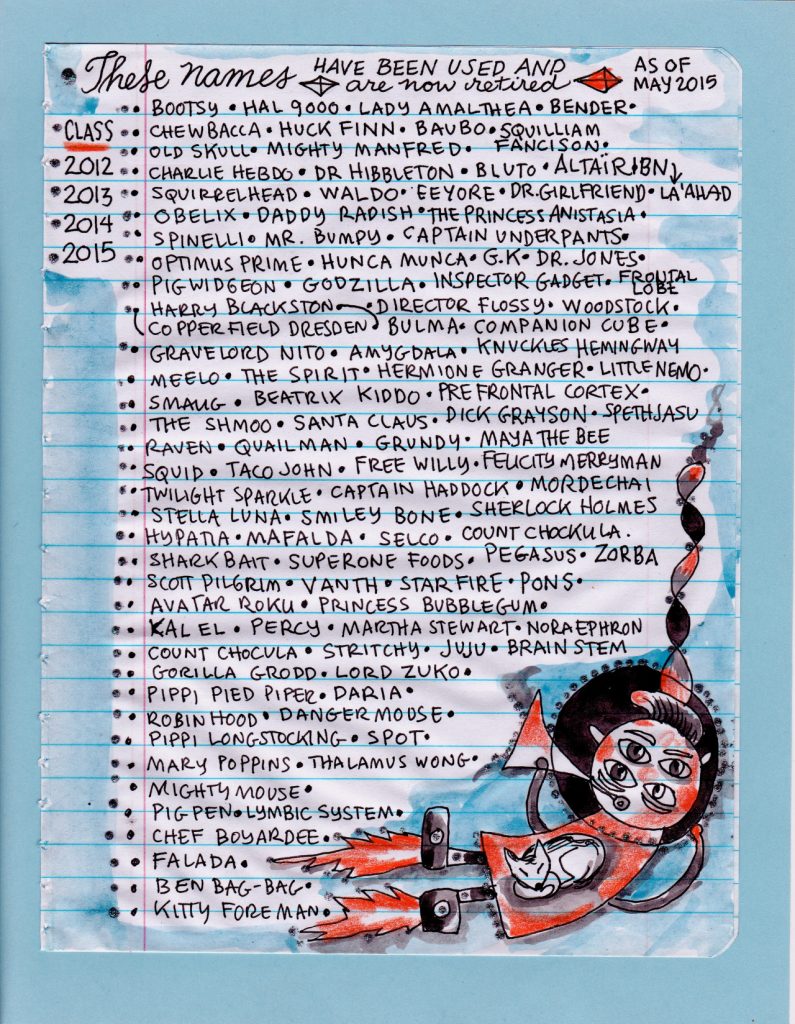
It’s become a time honored tradition for Barry’s students to adopt new names by which to refer to each other in-class, something they’ll enjoy hearing spoken aloud. For “Making Comics,” Barry is flying under the handle Professor SETI (as in “search for extraterrestrial intelligence”), telling the class that “images are the ETI in SETI.”
The students have responded with the following handles: Chef Boyardee, Ginger, Lois Lane, Rosie the Riveter, Regina Phalange, Arabella, Snoopy, Skeeter, Tigger, Arya Stark, Nala, Nostalgia, Akira, Lapus Lazuli, The Buffalo,Mr. November, The Short Giraffe, Nicki Minaj, Neko, Vincent Brooks, Regular Sized Rudy, and Zef.
(Sounds like a rough and ready crew. What name would you choose, and why?)

As usual, Barry draws inspiration from the dizzying bounty of images available on the net, bombarding her pupils with findings such as the lobed teeth of the crab-eater seal, above.
Science and music remain pet subjects–Afrofuturist bandleader Sun Ra serves as class oracle this go round.


Professor SETI keeps the “graphic vice” of the class’ official title front and center with assignments pertaining to the 7 deadly sins, asking students to examine modern equivalents of the horrors depicted by Heronimus Bosch above and 16th-century engraver Pieter van der Heyden, below.
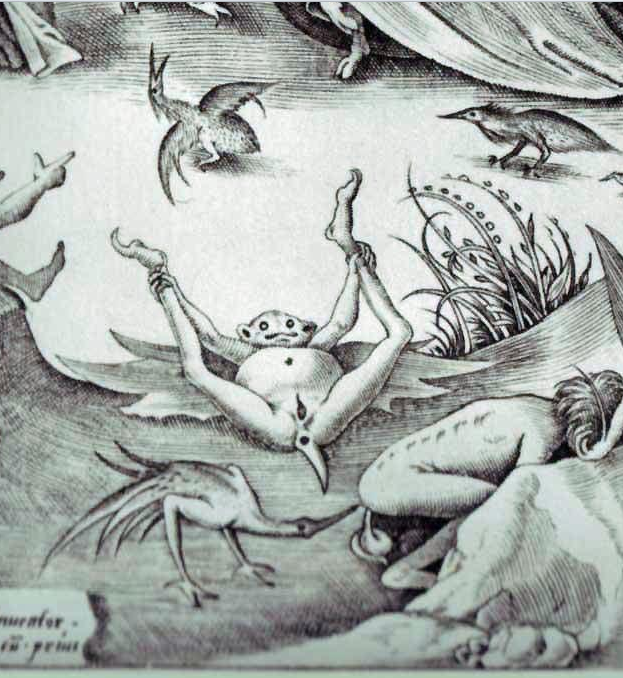
What to do with all of these images? Draw them, of course! As Barry tells her students:
Drawing is a language. It’s hard to understand what that really means until you’ve ‘spoken’ and ‘listened’ to it enough in a reliable regular way like the reliable regular way we will have together this semester.
That’s an important definition for those lacking confidence in their drawing abilities to keep in mind. Barry may revere the inky blacks of comics legend Jaime Hernandez, but she’s also a devotee of the wild, unbridled line that may be a beginner’s truest expression. (Stick figures, however, “don’t cut it.”) To her way of thinking, everyone is capable of communicating fluently in visual language. The current crop of student work reveals a range of training and natural talent, but all are worthy when viewed through Barry’s lens.
The teacher’s philosophy is the binding element here, but don’t fret if you are unable to take the class in person:
We rarely speak directly about the work we do in our class though we look at it together. We stare at it and sometimes it makes us laugh or we silently point out some part of it to the classmate beside us. To be able to speak this unspoken language we need to practice seeing (hearing) the way it talks.
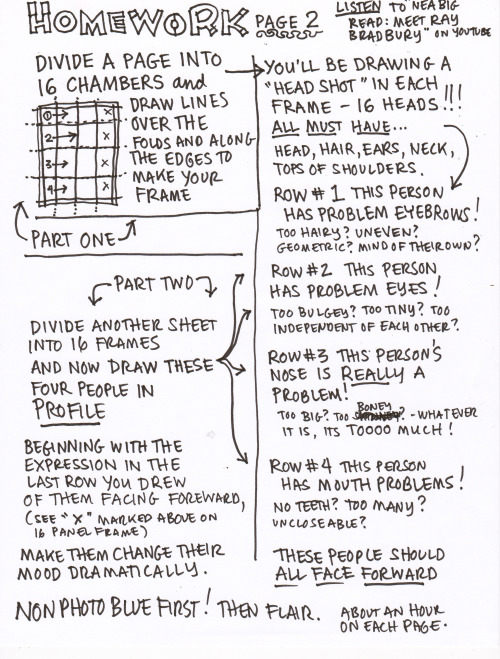
That earlier-alluded-to rigor is no joke. Daily diary comics, 3 minute self portraits on index cards, pages folded to yield 16 frames in need of filling, and found images copied while listening to prescribed music, lectures, and readings are a constant, non-negotiable expectation of all participants. Her methodology may sound goose‑y but it’s far from loose‑y.
In other words, if you want to play along, prepare to set aside a large chunk of time to complete her weekly assignments with the vigor demanded of non-virtual students.

Those who aren’t able to commit to going the distance at this time can reconstruct the class later. Barry leaves both the assignments and examples of student work on her Tumblr for perpetuity. (You can see an example here.) For now, try completing the 20 minute exercise using the assigned image above, or by choosing from one of her “extra credit” images, below:
Set timer for three minutes and begin this drawing using a yellow color pencil. Try to draw as much of the drawing as you can in three minutes. You can draw fast, and in a messy way, The important thing is to get as much covered as you can in three minutes. You can color things in if you like. Look for the darkest areas of the photo and color those in.
Set a timer for another three minutes and using your non-dominant hand, draw with orange or color pencil to draw the entire drawing again, drawing right on top of the first drawing layer. The lines don’t have to match or be right on top of each other, you can change your mind as you add this layer. You can move a bit to the right rather than try to draw directly onto the first set of lines.
Set a timer for another 3 minutes and use a red pencil and draw it again, using you dominant hand, adding another layer to the drawing. Again, you don’t have to follow your original lines. Just draw on top of them.
Set a timer for another 3 minutes and use a dark green pencil to draw the entire drawing one more time on top of all the others.
Set a timer for 8 minutes and use a dark blue pencil to draw it one more time.
Spend the last 8 minutes inking the image in with your uniball pen. Remember that solid black is the very last thing you’d do given your time limit. You want to make sure to draw all the parts of the picture first.





Related Content:
Cartoonist Lynda Barry Shows You How to Draw Batman in Her UW-Madison Course, “Making Comics”
Watch Lynda Barry’s Graduation Speech; Give a Shout Out to the Teachers Who Changed Your Life
1,700 Free Online Courses from Top Universities
Ayun Halliday is an author, illustrator, and Chief Primatologist of the East Village Inky zine. Follow her @AyunHalliday
Read More...Classic Blues Songs By John Lee Hooker, B.B. King & Muddy Waters Played on the Gayageum, a Traditional Korean Instrument
To say that most political discussions on social media lack nuance seems tantamount to pointing out that most pornography lacks romance. The thrusts, parries, and asides of the Facebook comment skirmish and the Twitterfight generally constitute performative acts rather than thoughtful interpersonal engagement. It’s more the nature of the medium than the fault of the participants; ever-churning controversy keeps the machines running. One controversial subject now trending on a network near you is the issue of Cultural Appropriation—broadly defined as the use of the symbols, language, dress, hairstyles, music, art, and other signifiers of one culture by another.
A problem arises when we leave the subject broadly defined. Power dynamics are key, but to condemn all acts of cultural appropriation as theft leaves us in a bind. How do we generate culture without it? Not all acts of borrowing are equally respectful, but without them, we could not have had the musical revolutions of rock and roll—with its appropriation of the blues—or of hip-hop, with its appropriation of disco, pop, Kung Fu movies, and everything else in a DJ’s record and video collection. Negative and positive examples can easily get jumbled together under these rubrics. To avoid getting tangled in analytical brambles, why don’t we turn instead to what I would consider a positive example of cultural appropriation: the pieces you hear in the videos here, interpretations of blues songs performed by musician Luna Lee on a Gayageum, a traditional Korean zither-like instrument.
We’ve featured Luna’s Gayageum covers before—of Jimi Hendrix’s “Voodoo Chile” and Stevie Ray Vaughan’s take on Hendrix’s “Little Wing.” Both Hendrix songs demonstrate the degree to which the rock guitarist borrowed heavily from blues idioms. Traditional blues artists themselves, of course, created and innovated through borrowing from each other and from myriad traditional sources. Are Luna’s blues performances any different? She clearly demonstrates a love and respect for the source material, and she plays it with deftness and skill, taking pleasure in musicianship, not salesmanship. Her blues covers don’t seem to have much commercial appeal, but they greatly appeal to listeners judging by the number of people her videos reach.
At the top of the post, you can hear her play John Lee Hooker’s “Boom Boom.” Below it, we have Albert King’s “Born Under a Bad Sign,” and above, B.B. King’s “The Thrill is Gone.” Lower down, hear Muddy Waters “Rollin’ and Tumblin’” (first recorded by Hambone Willie Newborn) and Elmore James’ “Dust My Broom.” Each interpretation relies on multitrack recording—Luna is either accompanied by a generic backing track or accompanies herself with a rhythm track that she plays over. Her covers of American blues classics on a traditional Korean instrument bring to the fore the intercultural accessibility of the songs and their adaptability to an instrumental context we might also consider “roots.” But as you can see from Luna’s Youtube channel, she doesn’t only adapt “roots” music. She also covers Radiohead, Frank Sinatra, Led Zeppelin, and AC/DC.
It’s likely my own bias for the blues—and for more traditional blues in particular—that makes me say so, but I think the covers represented here are her most successful. (Whether Messrs Hooker, King, King, Waters, and James would approve, I cannot say.) There’s something about hearing the Gayageum in dialogue with these songs that feels… well, if not exactly authentic at least less gimmicky than than a cover of One Republic. But ultimately, whatever your preference, if you can appreciate Luna’s instrumental skill and devotion to her source material, you’ll find something to love on her page.
She’s not in it for the money, but like every struggling artist, Luna has dreams and bills to pay. To support her work, visit her Patreon page and help contribute to her goal of playing music full time and hiring additional collaborators. In the pitch video below, Luna gives us some of her musical background and explains how she adapted the traditionally acoustic Gayageum for more rocking contemporary tunes.
Related Content:
Watch Jimi Hendrix’s ‘Voodoo Chile’ Performed on a Gayageum, a Traditional Korean Instrument
Led Zeppelin, Rolling Stones & The Beatles Played on a 3‑String Electric Mountain Dulcimer
Josh Jones is a writer and musician based in Durham, NC. Follow him at @jdmagness
Read More...Support Us
We're hoping to rely on loyal readers, rather than erratic ads. Please click the Donate button and support Open Culture. You can use Paypal, Venmo, Patreon, even Crypto! We thank you!

About Us

Open Culture scours the web for the best educational media. We find the free courses and audio books you need, the language lessons & educational videos you want, and plenty of enlightenment in between.
Advertise With Us

FREE UPDATES!
GET OUR DAILY EMAIL
Get the best cultural and educational resources on the web curated for you in a daily email. We never spam. Unsubscribe at any time.
FOLLOW ON SOCIAL MEDIA

Open Culture editor Dan Colman scours the web for the best educational media. He finds the free courses and audio books you need, the language lessons & movies you want, and plenty of enlightenment in between.
Advertise With Us

