Edvard Munch’s Famous Painting The Scream Animated to the Sound of Pink Floyd’s Primal Music
In this short video, Romanian animator Sebastian Cosor brings together two haunting works from different times and different media: The Scream, by Norwegian Expressionist painter Edvard Munch, and “The Great Gig in the Sky,” by the British rock band Pink Floyd.
Munch painted the first of four versions of The Scream in 1893. He later wrote a poem describing the apocalyptic vision behind it:
I was walking along the road with two Friends
the Sun was setting — the Sky turned a bloody red
And I felt a whiff of Melancholy — I stood
Still, deathly tired — over the blue-black
Fjord and City hung Blood and Tongues of Fire
My Friends walked on — I remained behind
– shivering with anxiety — I felt the Great Scream in Nature
Munch’s horrific Great Scream in Nature is combined in the video with Floyd’s otherworldly “The Great Gig in the Sky,” one of the signature pieces from the band’s 1973 masterpiece, Dark Side of the Moon. The vocals on “The Great Gig” were performed by an unknown young songwriter and session singer named Clare Torry.
Torry had been invited by producer Alan Parsons to come to Abbey Road Studios and improvise over a haunting piano chord progression by Richard Wright, on a track that was tentatively called “The Mortality Sequence.” The 25-year-old singer was given very little direction from the band. “Clare came into the studio one day,” said bassist Roger Waters in a 2003 Rolling Stone interview, “and we said, ‘There’s no lyrics. It’s about dying — have a bit of a sing on that, girl.’ ”
Forty-two years later, that “bit of a sing” can still send a shiver down anyone’s spine. For more on the making of “The Great Gig in the Sky,” and Torry’s amazing contribution, see the clip below to hear Torry’s story in her own words.
Follow Open Culture on Facebook and Twitter and share intelligent media with your friends. Or better yet, sign up for our daily email and get a daily dose of Open Culture in your inbox. And if you want to make sure that our posts definitely appear in your Facebook newsfeed, just follow these simple steps.
Related Content:
Pink Floyd’s David Gilmour Sings Shakespeare’s Sonnet 18
The Night Frank Zappa Jammed With Pink Floyd … and Captain Beefheart Too (Belgium, 1969)
Read More...Edgar Allan Poe Animated: Watch Four Animations of Classic Poe Stories
I can well imagine that the insertion of modern technology into many of Edgar Allan Poe’s stories would have a tremendous benefit for those stories’ victims, and a deleterious effect on their monomaniacal plots. In one of the ironies of cultural transmission, the timeless quality of Poe’s work seems to depend upon its use of deliberately ancient methods of surveillance and torture. In a further paradox of sorts, Poe’s work never suffers, but only seems to shine, when technology is applied to it.
Filmmakers as esteemed as Roger Vadim, Louis Malle, and Federico Fellini have adapted him; singular dramatic talents like James Earl Jones, Christopher Walken, Vincent Price, and Christopher Lee, and Lou Reed and Willem Dafoe have made fine recordings of his most famous poem; The Alan Parsons Project recorded a pretty amazing prog rock version of “The Raven,” the first rock song to feature a digital vocoder.
Poe also appears as an animated puppet, alongside Dickens and Dostoevsky, in a successful Frank Capra-directed science education film. This role belongs to a rich tradition of Poe in animated film. “The Raven” inspired one of Tim Burton’s first animated films, Vincent, at the top, about a boy who wants to be Vincent Price (narrated of course by Vincent Price). The poem was also adapted by The Simpsons (above). South Park has featured the morbid 19th century writer, and Poe’s “The Pit and the Pendulum” birthed an award-winning animated short, as well as an interactive digital comic book.
Even before his screen time in Capra’s film, shared with famous actor Eddie Albert, Poe appeared in animated film with movie stars. In the 1953 adaptation of “The Tell Tale Heart” above, a menacingly suave James Mason narrates the story. This take on Poe’s tale of madness perfectly captures its nearly giddy air of dread. The film, we wrote in 2011, “was given a bizarre reception” upon release, garnering an “X” rating—the first animated film to do so—in the UK. The British Board of Film Censors deemed the film “unsuitable for adult audiences.” That said, it was nominated for the Academy Award for Best Animated Short Film.
Above (with Spanish subtitles) in a much later work, a less famous but no less menacing, actor, Billy Drago, narrates a stark retelling of “The Raven,” with a central character drawn like one of the homicidal creeps Drago typically plays on screen. Argentinian filmmaker Mariano Cattaneo remarks that he and fellow director Nic Loreti focused on the idea that the speaker’s mysteriously lost love Lenore “might have been murdered and wants to come back,” citing their influences as “German expressionist films” and filmmakers like “Sam Raimi, George A. Romero, Tim Burton, Robert Rodriguez, John Carpenter and even Stephen King.” If not all of these creators’ work is evident, the influence of German Expressionist film, particularly The Cabinet of Dr. Caligari, certainly is.
In another international adaptation, acclaimed Czech stop-motion animator Jan Svankmajer uses high-contrast, dramatic lighting to very different, impressionist effect to recreate the chilling despair of Poe’s The Fall of the House of Usher. It is interesting that Poe’s work—obsessed with isolation and bookishness and history—should have the effect it has on modern media, particularly on animation. But then again, Poe himself was a technician, interested not in the past for its own sake but in its usefulness in achieving a vivid “unity of effect.” That his almost clockwork tales would make such excellent material for such technical means of storytelling as animated film makes perfect sense. But should you wish to return to the source of these humorous and grim adaptations, visit our list of the complete works of Edgar Allan Poe, in free eBook and audio book form.
Related Content:
Download The Complete Works of Edgar Allan Poe: Macabre Stories as Free eBooks & Audio Books
Seven Tips from Edgar Allan Poe on How to Write Vivid Stories and Poems
Gustave Doré’s Splendid Illustrations of Edgar Allan Poe’s “The Raven” (1884)
Josh Jones is a writer and musician based in Durham, NC. Follow him at @jdmagness
Read More...Charles Darwin Creates a Handwritten List of Arguments for and Against Marriage (1838)
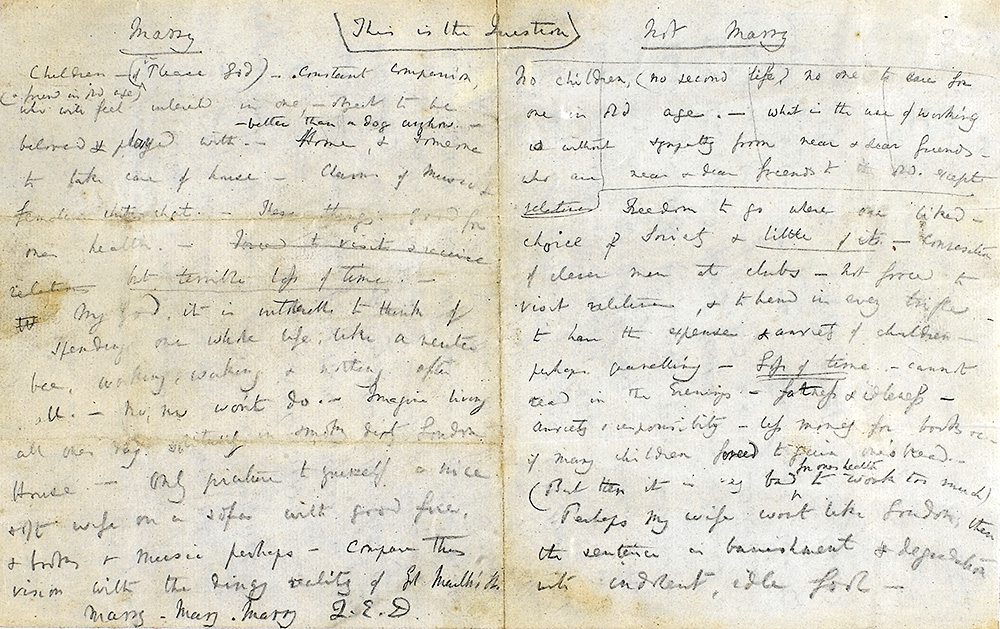
Plenty of us struggle, in the age when so many traditions in so many parts of the world now seem perpetually up for revision, with the choice of whether to get married. It even confounded no less a mind than that from which On the Origin of Species by Means of Natural Selection flowed. This happened back in 1838, over twenty years before the publication of that most important book in biology. And, for a moment, it must have seemed almost as vexing as the question of how all the species came about.
Lists of Note tells us that the “29-year-old naturalist Charles Darwin found himself facing a difficult decision: whether or not to propose to the love of his life, Emma Wedgwood. This was his handwritten solution — a list of the pros and cons of marriage that includes such gems as ‘better than a dog anyhow’ and ‘not forced to visit relatives.’ ” (See original document above. Or click here to view it in a larger format, and read a complete transcription.)
Of the tantalizing claims of the single life, Darwin also includes “freedom to go where one liked,” “conversation of clever men at clubs,” freedom from the “expense & anxiety of children,” and no risk of the awful possibility that “perhaps my wife won’t like London.” But matrimony presents a strong case of its own, in the form of a “constant companion, (& friend in old age) who will feel interested in one,” “someone to take care of house,” “charms of music & female chit-chat.” (And note his writing of “Children — (if it Please God)” under the pros, an interesting phrasing given the sorts of debates his name gets hauled into today.)
And so Darwin reaches his conclusion: “My God, it is intolerable to think of spending ones whole life, like a neuter bee, working, working, & nothing after all. — No, no won’t do. — Imagine living all one’s day solitarily in smoky dirty London House. — Only picture to yourself a nice soft wife on a sofa with good fire, & books & music perhaps.” He would indeed marry and spend the rest of his life with Wedgwood, a union that produced ten children (one of whom, Francis, would go on to informally illustrate On the Origin of Species manuscript pages).
You can peruse the full list, even in Darwin’s own handwriting (if you can decipher it), at Darwin Online. If he went on to write a list of his secrets of a successful marriage, Darwin scholars haven’t yet discovered it, but I think we can safely say that it would include at least this recommendation: think the decision through, but don’t let it keep you from your life’s work.
Related Content:
Charles Darwin’s Son Draws Cute Pictures on the Manuscript of On the Origin of Species
Watch Darwin, a 1993 Film by Peter Greenaway
Read the Original Letters Where Charles Darwin Worked Out His Theory of Evolution
The Genius of Charles Darwin Revealed in Three-Part Series by Richard Dawkins
Darwin’s Personal Library Goes Digital: 330 Books Online
16,000 Pages of Charles Darwin’s Writing on Evolution Now Digitized and Available Online
Colin Marshall hosts and produces Notebook on Cities and Culture as well as the video series The City in Cinema and writes essays on cities, language, Asia, and men’s style. He’s at work on a book about Los Angeles, A Los Angeles Primer. Follow him on Twitter at @colinmarshall or on Facebook.
Read More...Paper Animation Tells Curious Story of How a Meteorologist Theorized Pangaea & Continental Drift (1910)
Over a century ago, the German meteorologist Alfred Wegener (1880–1930) put forth a theory that changed how we look at an entirely different scientific discipline — geology. He argued that the continents once formed a single landmass called “Pangaea,” and that continental drift moved them apart slowly but ever so surely. The story of how a meteorologist changed the face of geology gets told in a nice paper animation created by The New York Times. It comes narrated by Mott Greene (author of the forthcoming book Alfred Wegener: Science, Exploration and the Theory of Continental Drift) and Naomi Oreskes, Professor of the History of Science at Harvard. You can read the NYTimes article associated with the educational video here. Courses on geology can be found in our collection, 1,700 Free Online Courses from Top Universities.
If you would like to support the mission of Open Culture, consider making a donation to our site. It’s hard to rely 100% on ads, and your contributions will help us continue providing the best free cultural and educational materials to learners everywhere. You can contribute through PayPal, Patreon, and Venmo (@openculture). Thanks!
Read More...Notebook on Cities and Culture’s Yearlong Podcast Exploration of Seattle Is Kickstarting Now
Just about as long as I’ve written here at Open Culture, I’ve also hosted and produced Notebook on Cities and Culture, a world-traveling podcast dedicated to in-depth conversations with interesting people about the work they do and the world cities they do it in. Over five seasons so far, I’ve recorded each and every interview “on location,” from Los Angeles to Kyoto to London to Portland to Mexico City to Copenhagen to Vancouver to Seoul. Next comes the show’s sixth and most in-depth season yet: A Year in Seattle.
Think of that name, and you think of the city of rain, of grunge, of Microsoft and Amazon, of the Space Needle, of Frasier Crane, of Buddy Bradley, of Archie McPhee, of sleeplessness, of Starbucks. But having spent my own adolescence hanging out there, I know Seattle as even more than that, and it’s only grown more interesting since I’ve grown up. Now to explore the Notebook on Cities and Culture way, through a year of in-depth conversations with Seattle’s novelists, journalists, comic artists, filmmakers, broadcasters, explorers, gourmets, academics, architects, planners, cultural creators, internationalists, observers of the urban scene, and more.
As with every season, I’m raising the budget for Notebook on Cities and Culture’s Year in Seattle on Kickstarter. If feel so inclined, you can have a look at its Kickstarter page and find out how you can help make it a happen, receive postcards from Seattle, or even get your project or message mentioned at the top of every show.
And as a special preview, I’ve just posted an interview with comic artist Peter Bagge, creator of the legendary alt-comic series Hate, author of the graphic novels Apocalypse Nerd, Other Lives, Reset, Woman Rebel: The Margaret Sanger Story, and just about as Seattle a figure as they come. There are 51 more where that came from — but only if we can successfully Kickstart the season by this Saturday morning at 10:00, Pacific time.
Colin Marshall hosts and produces Notebook on Cities and Culture as well as the video series The City in Cinema and writes essays on cities, language, Asia, and men’s style. He’s at work on a book about Los Angeles, A Los Angeles Primer. Follow him on Twitter at @colinmarshall or on Facebook.
Read More...Artists Illustrate Dante’s Divine Comedy Through the Ages: Doré, Blake, Botticelli, Mœbius & More
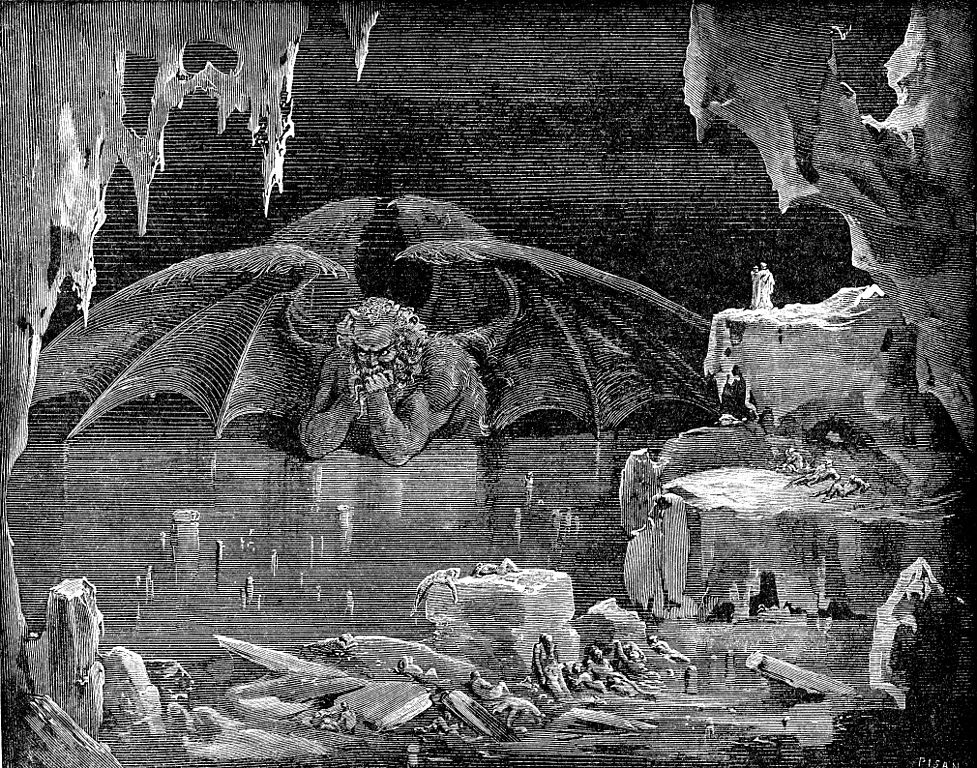
For a book about medieval theology and torture, filled with learned classical allusions and obscure characters from 13th century Florentine society, Dante Alighieri’s Inferno, first book of three in his Divine Comedy, has had considerable staying power, working its way into pop culture with a video game, several films, and a baleful appearance on Mad Men. While the Mad Men reference may be the more literary, the former two may hint at the more prominent reason the Inferno has captivated readers, players, and viewers for ages: the lengthy poem’s intensely visual representation of human extremity makes for some unforgettable images. Like Achilles dragging Hector behind his chariot in Homer, who can forget the lake of ice Dante encounters in the ninth circle of Hell, in which (in John Ciardi’s modern translation), he finds “souls of the last class,” which “shone below the ice like straws in glass,” and, frozen to his chest, “the Emperor of the Universe of Pain,” almost too enormous for description and as hideous as he once was beautiful.
Like the rest of us, artists have been drawn to Dante’s extraordinary images and extensive fantasy geography since the Divine Comedy first appeared (1308–1320). In prolific French artist Gustave Doré’s rendering of the ninth circle scene, above, Satan is a huge, bearded grump with wings and horns. Doré so desperately wanted to illustrate the Divine Comedy (find in our collection of 700 Free eBooks) that he financed the first book in 1861 with his own money.
Afterwards, as Mike Springer wrote in a previous post on Dore’s illustrations, his publisher Louis Hachette agreed to put out the next two books with the telegram, “Success! Come quickly! I am an ass!” Doré’s eerie, beautiful drawings are just one such set of famous illustrations we’ve featured on the site previously.
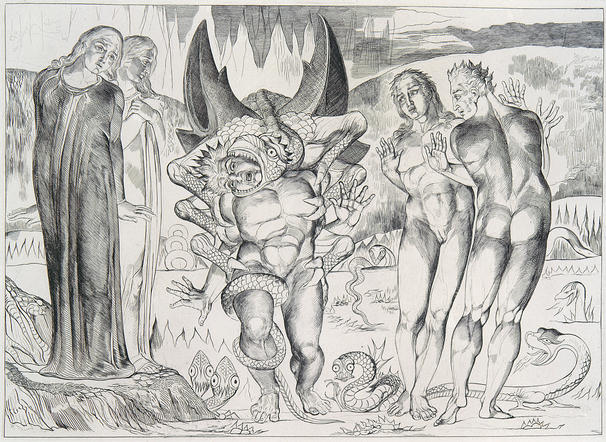
Another artist perfectly suited to the task, William Blake, whose own poetry braved similar heights and depths as Dante’s, took on the Inferno at the end of his life. While he didn’t live to complete the engravings, his unsettling, yet highly classical, renderings of the poet the Italians call il Sommo Poeta—“The Supreme Poet”—certainly do justice to the vividness and horror of Dante’s descriptions. Above, see Blake’s 1827 interpretation of the thief Agnolo Brunelleschi attacked by a six-footed serpent in Canto twenty-five, a scene reprinted many times in color.
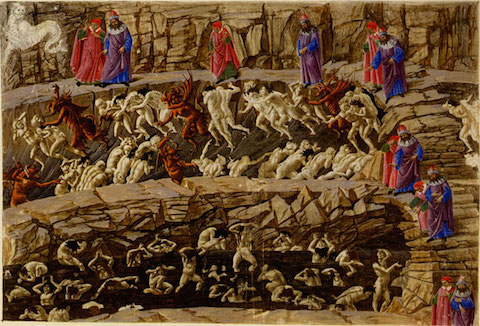
Centuries earlier, Renaissance master Sandro Botticelli made an attempt at all three books, though he fell short of finishing them. See his “Panderers, Flatterers” above, the only drawing he made in color, and more black and white illustrations here.
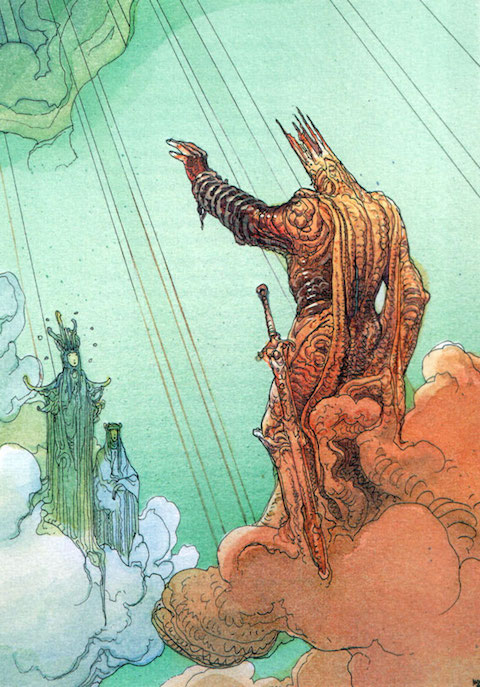
Like the makers of films and video games, artists have mainly chosen to focus on the most bizarre and harrowing of the three books, the Inferno. One modern artist who undoubtedly would have had a fascinating take on Dante’s hell instead illustrated his heaven, being chosen to imagine Paradiso by the Milan’s Nuages Gallery in 1999. I refer to graphic artist Jean Giraud, known in the world of fantasy, sci-fi, and comics as Mœbius. Despite some arguable artistic miscasting (Mœbius did after all make films like Alien and Tron “even weirder”), the French artist took what may be the least visually interesting of Dante’s three Divine Comedy books and created some incredibly striking images. See one above, and more at our previous post.
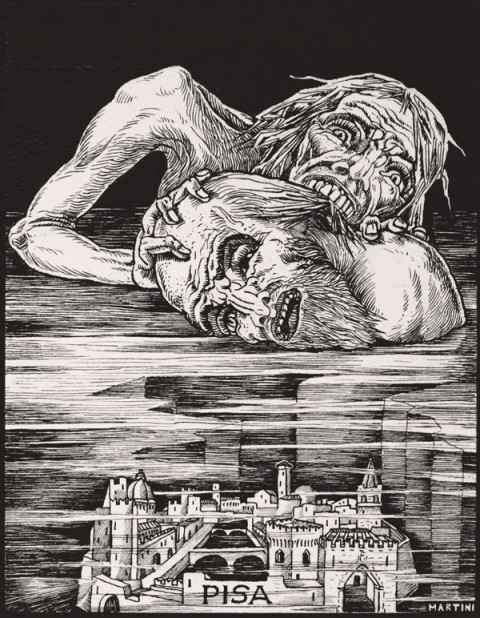
Other artists, like Alberto Martini, who worked on his Divine Comedy for over forty years, have produced terrifying images (above) and highly stylized ones—like these medieval illuminations from a 1450 manuscript. The range of interpretations all have one thing in common—their subject matter seems to allow artists almost unlimited freedom to imagine Dante’s weird cosmography. No vision of the Inferno or the loftier realms above it can go too far, it seems, even in the absurd video game finale you really have to see to believe. Somehow, I think Dante would approve… well… mostly.
Related Content:
Gustave Doré’s Exquisite Engravings of Cervantes’ Don Quixote
William Blake’s Hallucinatory Illustrations of John Milton’s Paradise Lost
Josh Jones is a writer and musician based in Durham, NC. Follow him at @jdmagness
Read More...Langston Hughes Reveals the Rhythms in Art & Life in a Wonderful Illustrated Book for Kids (1954)
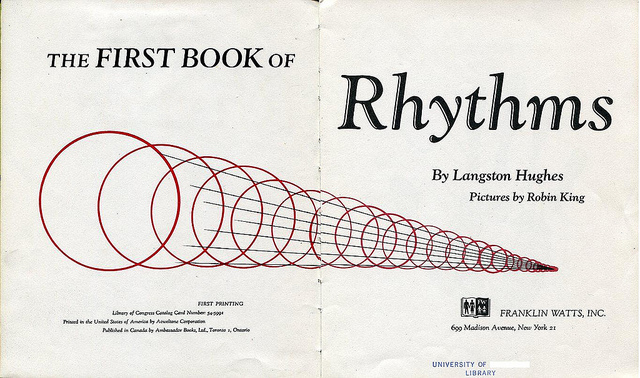
If you have to ask what jazz is, Louis Armstrong supposedly said, you’ll never know. But the poet Langston Hughes, who in his 1955 First Book of Jazz reveals himself as a great enthusiast of Armstrong indeed, seems to have operated on a very different premise. Hughes pitched that book, which we featured last month, toward children, an audience that, at their best, embodies inquisitiveness: they have to ask what everything is. And before Hughes could explain jazz to them, he had to explain rhythm.
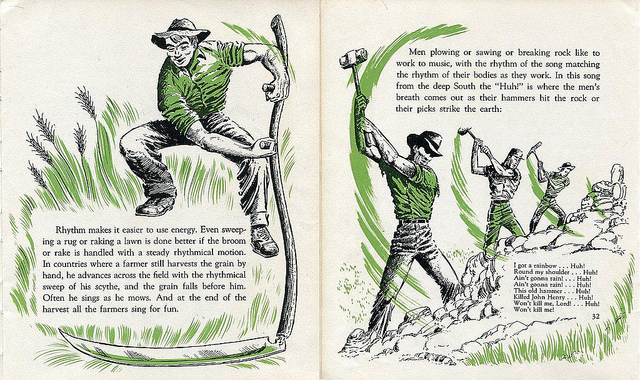
“Rhythm is something we share in common, you and I,” Hughes writes in 1954’s The First Book of Rhythm, “with all the plants and animals and people in the world, and with the stars and moon and sun, and all the whole vast wonderful universe beyond this wonderful earth which is our home.” It doesn’t just belong in music, he says; it belongs pretty much everywhere, from the realm of nature to those of athletics, machines, furniture — everything in “this wonderful world,” in his view, has its own rhythm.
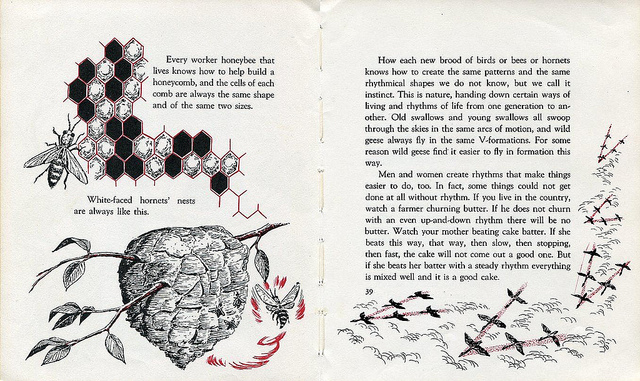
If explaining jazz to kids strikes you as a daunting task, then just imagine explaining this more abstract foundational quality of jazz, finding it in a host of different domains, and then laying it all out in terms that will engage an elementary schooler. But only such a master of language and lover of sound like Hughes could do it with such overall vitality and concision, even if the subject, as Ariel S. Winter writes at We Too Were Children, Mr. Barrie, moves Hughes to get “too lyrical, too abstract, caught up in his song of the world,” somehow drifting from an observation of the rhythm of knitting needles to the conclusion that everyone “should arrange her hair to suit the shape of her face.”
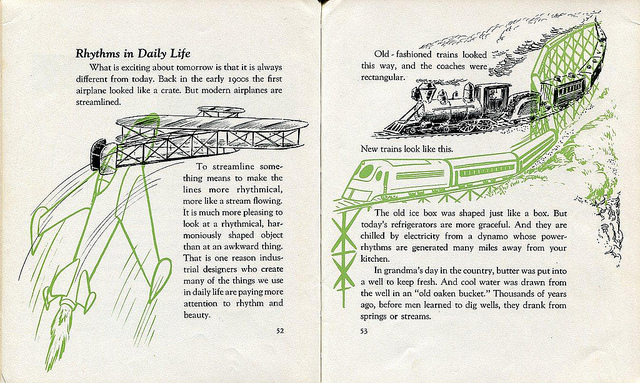
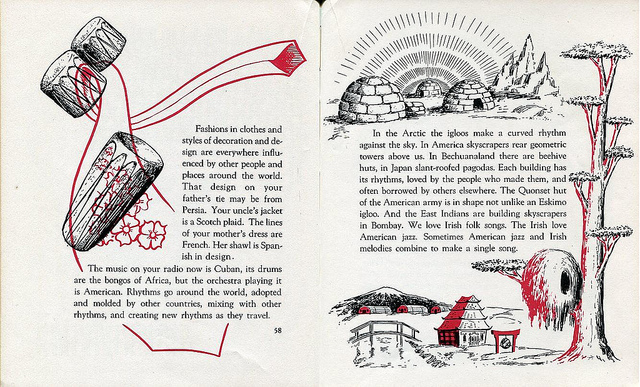
You can read The First Book of Rhythm in its entirety, and gaze upon Robin King’s detailed and well-integrated illustrations, in this Flickr photo set. (You can also buy old copies on Amazon.) Perhaps you once wrote yourself off as hopelessly rhythmless, unable even to say for sure that you know what rhythm is. If so, Langston Hughes has written the book for you — no matter your age, just your curiosity.
Related Content:
Langston Hughes Presents the History of Jazz in an Illustrated Children’s Book (1955)
Watch Langston Hughes Read Poetry from His First Collection, The Weary Blues (1958)
Charles Mingus Explains in His Grammy-Winning Essay “What is a Jazz Composer?”
Colin Marshall hosts and produces Notebook on Cities and Culture as well as the video series The City in Cinema and writes essays on cities, language, Asia, and men’s style. He’s at work on a book about Los Angeles, A Los Angeles Primer. Follow him on Twitter at @colinmarshall or on Facebook.
Read More...Watch Four Iconic Live Performances by Billie Holiday
Billie Holiday’s name has been in the news lately for some reasons that remind us of the tragedies she sang about and those she endured. First, there was the story of the rather appallingly tone-deaf PR firm who thought one of Holiday’s most well-known recordings, “Strange Fruit”—a song about lynching—would make a great name for their brand. Then there were the new details in Johann Hari’s book Chasing the Scream of how Holiday was hunted, haunted, and possibly framed by Federal Bureau of Narcotics head Harry Anslinger. These stories compound the image of Holiday as a tragic figure, a casualty of societal ills and personal demons.
Holiday may have documented her troubled life in her autobiography, but she would have preferred to be remembered for her music. Born 100 years ago today, the jazz songstress transmuted her personal pain into beauty; her interpretations of songs became standards in their own right, and became uniquely hers.
“God Bless the Child,” above, resonates with Holiday’s own difficult childhood, shadowed by neglect and loss, but she delivers it as though all had been forgiven and redeemed. She sang through abusive relationships and addiction and some pretty shabby treatment by a racist industry.
For example, Bret Primack tells the story in a JazzTimes article of the Fox Theatre in Detroit forcing Holiday to wear blackface in order to appear on stage with Count Basie’s Orchestra. As Lady Day herself remarked of the humiliating episode, “There’s no damn business like show business. You have to smile to keep from throwing up.” Toward the end of her life, in 1956, she gave one of her last of 22 concerts at Carnegie Hall (see her do her own composition “Fine and Mellow” above). The rehearsals—wrote New York Times critic Gilbert Millstein in the album liner notes—“had been desultory,” her voice “tinny and trailed off.” But at showtime, she appeared “poised and smiling,” singing “with strength undiminished.” In his liner remarks, Nat Hentoff described Holiday’s “assurance of phrasing and intonation” and “an outgoing warmth, a palpable eagerness to reach out and touch the audience,” a smile “often lightly evident on her lips and her eyes.”
In a retrospective essay, Hentoff refers to the sad fact that “Billie is most remembered as a victim—of herself, of society” as well as “the myth that, toward the end, Lady invariably sounded like a cracked husk of what she had been years before.” While it’s certainly true that she fell victim to others’ designs and her own bad judgment, she had her share of triumphs as well, most of them on the stage. Even in 1959, the year of her death, when her problems with alcohol had worsened to a soon-to-be fatal degree, and her voice had lost some of its vitality, she performed with swagger and grace. See her above sing “Please Don’t Talk About Me When I’m Gone” in one of her final live appearances. Holiday’s short, tragic life may have given us plenty to talk about, but her memory is best preserved by listening to her sing.
Related Content:
How “America’s First Drug Czar” Waged War Against Billie Holiday and Other Jazz Legends
Billie Holiday — The Life and Artistry of Lady Day: The Complete Film
Duke Ellington’s Symphony in Black, Starring a 19-Year-old Billie Holiday
Josh Jones is a writer and musician based in Durham, NC. Follow him at @jdmagness
Read More...Rijksmuseum Digitizes & Makes Free Online 361,000 Works of Art, Masterpieces by Rembrandt Included!

We all found it impressive when Amsterdam’s Rijksmuseum put up 125,000 Dutch works of art online. “Users can explore the entire collection, which is handily sorted by artist, subject, style and even by events in Dutch history,” explained Kate Rix in our first post announcing it. ” “Not only can users create their own online galleries from selected works in the museum’s collection, they can download Rijksmuseum artwork for free to decorate new products.”
But we posted that almost two and a half years ago, and you can hardly call the Rijksmuseum an institution that sits idly by while time passes, or indeed does anything at all by half measures: think of their creation of Rembrandt’s Facebook timeline, their commissioning of late Rembrandt canvases brought to life, or of their accommodation of terminally ill patients visiting one last time.
And so they’ve kept hard at work adding to their digital archive, which, as of this writing, offers nearly 361,000 works of art. This brings them within shouting distance of having doubled the collection in size since we first wrote about it.
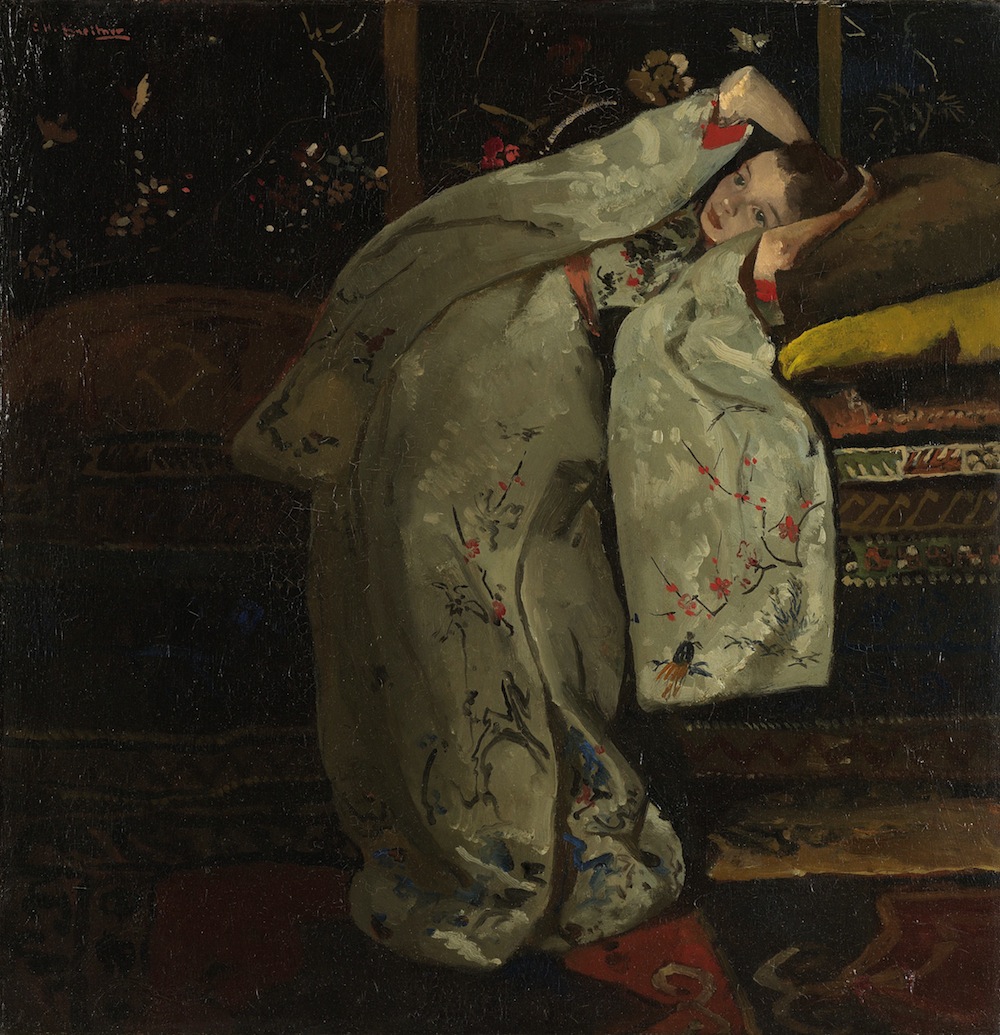
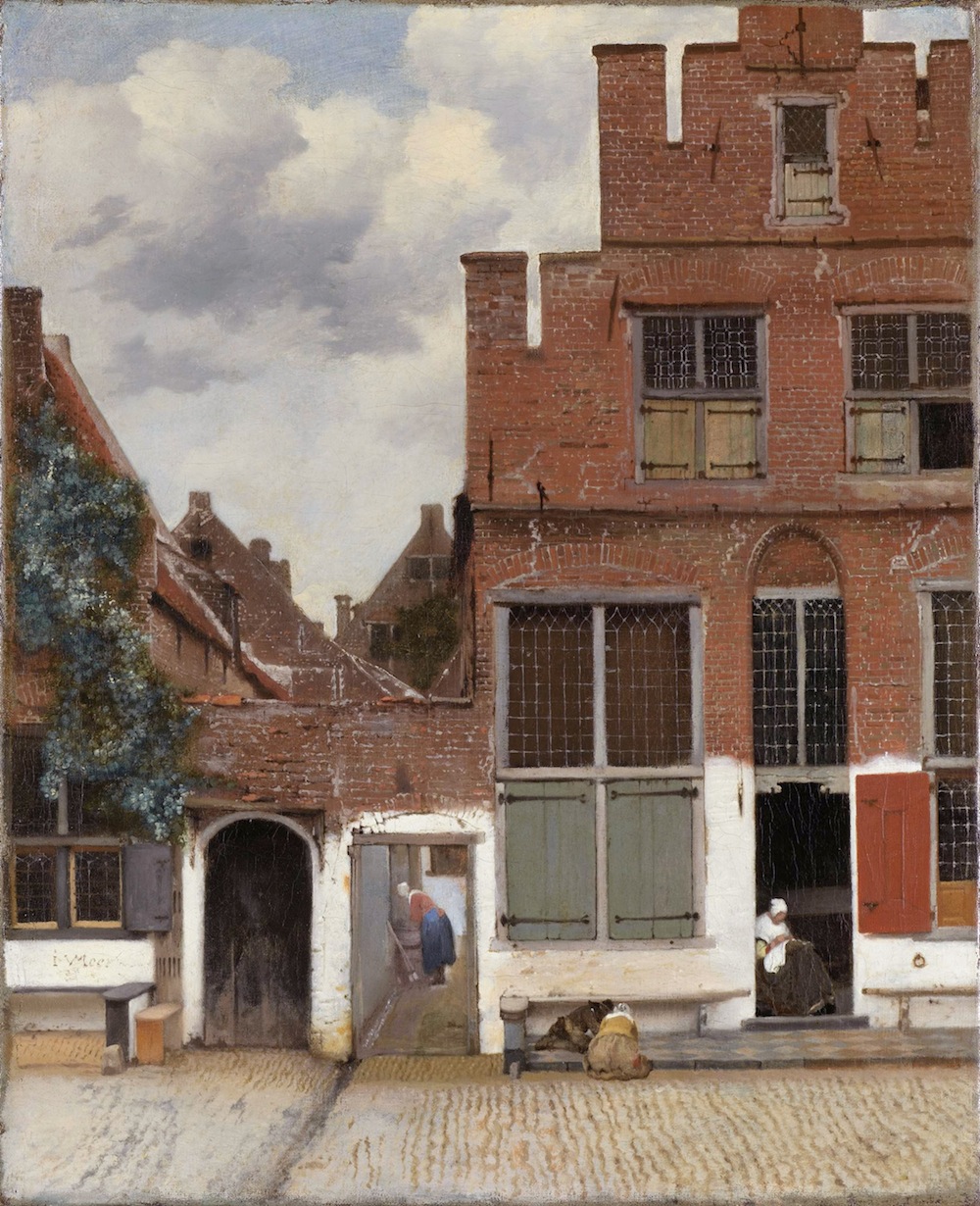
You want the Dutch Masters? You got ’em. You want Rembrandt’s Self-portrait as the Apostle Paul? It’s in the archive, right alongside Night Watch. You want Vermeer’s View of Houses in Delft, better known as The Little Street? It’s in there too. But don’t stop now; the Rijksmuseum has put up a much greater breadth of Dutch art than that. You’ll also find important Dutch painters you may not have heard so much about before, such as the impressionist George Hendrik Breitner, whose Girl in a White Kimono appears just above. And it even includes high-resolution images of works of art and design in other media, such as Michel de Klerk’s 1918 suite of furniture for ‘t Woonhuys, whose armchair you see below. Looks almost good enough to sit in, doesn’t it? You can enter the collection here, or search the collection here.

Related Content:
The Rijksmuseum Puts 125,000 Dutch Masterpieces Online, and Lets You Remix Its Art
Rembrandt’s Facebook Timeline
16th-Century Amsterdam Stunningly Visualized with 3D Animation
Flashmob Recreates Rembrandt’s “The Night Watch” in a Dutch Shopping Mall
Colin Marshall hosts and produces Notebook on Cities and Culture as well as the video series The City in Cinema and writes essays on cities, language, Asia, and men’s style. He’s at work on a book about Los Angeles, A Los Angeles Primer. Follow him on Twitter at @colinmarshall or on Facebook.
Read More...
Every Literary Reference Made by Sterling Archer in One Supercut
Serena Bramble, the mastermind behind this supercut writes, “Sterling Archer, the modern take-down of James Bond on Adam Reed’s cult animated show Archer, is many things,” including a book nerd, “but that last detail has always been a quirk in the show, with literary references spouted out almost as often as jokes about oral sex.” If you’ve watched the show, you may have caught the references to Chekhov, Tolkien and Orwell, just to name a few. But, in case you didn’t, Bramble’s supercut gathers them together and shows proof that Archer’s creator indeed had a “tenure as a frustrated English major.” Check it out.
Read More...Support Us
We're hoping to rely on loyal readers, rather than erratic ads. Please click the Donate button and support Open Culture. You can use Paypal, Venmo, Patreon, even Crypto! We thank you!

About Us

Open Culture scours the web for the best educational media. We find the free courses and audio books you need, the language lessons & educational videos you want, and plenty of enlightenment in between.
Advertise With Us

FREE UPDATES!
GET OUR DAILY EMAIL
Get the best cultural and educational resources on the web curated for you in a daily email. We never spam. Unsubscribe at any time.
FOLLOW ON SOCIAL MEDIA

Open Culture editor Dan Colman scours the web for the best educational media. He finds the free courses and audio books you need, the language lessons & movies you want, and plenty of enlightenment in between.
Advertise With Us

