David Fincher’s Five Finest Music Videos: From Madonna to Aerosmith
A whole generation of filmmakers who came to prominence in the late 90s and early 00s got their start in music videos. Spike Jonze, for instance, went from making the Beastie Boys’ best video, “Sabotage,” to making Being John Malkovich, the greatest film ever about being John Malkovich. Simon West has the dubious distinction of making Rick Astley’s “Never Gonna Give You Up,” making him the handmaiden to that loathsome of internet meme’s, rickrolling. He then went on to make the overstuffed spectacle Con Air, making him the handmaiden of Nicolas Cage’s dreadful action career. And Michael Bay, Mr. Death-Of-Cinema himself, made slick videos for the Divinyls before branching off into explosion porn with the Transformers franchise.
Yet the most celebrated filmmaker to come out of music videos is David Fincher. Even before he made his green-tinted feel-bad masterpieces like Zodiac and The Social Network, he already made a deep impact on American popular consciousness – especially if you were watching a lot of MTV during the waning days of the Cold War. Here are five of his most famous and finely-crafted vids.
“Vogue,” Madonna (1990)
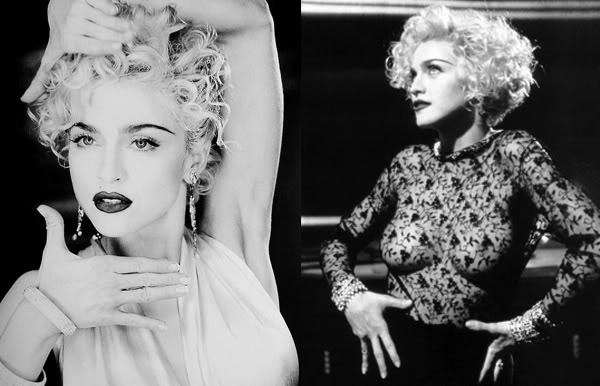
Shot in gorgeous black and white, Fincher makes Madonna look like a Hollywood icon of yore while spinning one dazzling image after another of well-appointed, and remarkably limber, men voguing. The video was reportedly shot at a breakneck pace, just 16 hours, to accommodate Madonna’s tour schedule.
“Straight Up,” Paula Abdul (1989)
Fincher captures Paula Abdul’s sass and her considerable dancing prowess in this stark, graphic video that is almost completely devoid of grey.
“Freedom! ’90,” George Michael (1990)
George Michael refused to participate in the shoot for this video. So Fincher did what I wish I could do — call up a bunch of supermodels including Naomi Campbell, Linda Evangelista and Cindy Crawford and get them to help out. The result feels like a Victoria’s Secret catalogue come to life.
“Janie’s Got a Gun,” Aerosmith (1989)
The song might be catchy but the lyrics are about murder and child abuse. Fincher shoots Aerosmith’s likely arena rock anthem as a crime story, complete with lush colors and moody, expressionistic depictions of the deeds. The video proved to be great training for his subsequent films.
“Express Yourself,” Madonna (1989)
Madonna’s “Express Yourself” was the most expensive music video made up to that point, costing $5 million. A riff off the German Expressionist masterpiece, Metropolis, this work features far more corsets, naked men and crotch grabs than Fritz Lang’s film. Madonna had a great deal of say over the final product. “I oversaw everything — the building of the sets, everyone’s costumes, I had meetings with make-up and hair and the cinematographer, everybody,” she told Rolling Stone magazine. “Casting, finding the right cat — just every aspect.” The success of this video landed Fincher his first feature film, the troubled Alien3.
Related Content:
The Filmmaking Craft of David Fincher Demystified in Two Video Essays
David Lynch’s Music Videos: Nine Inch Nails, Moby, Chris Isaak & More
Jim Jarmusch’s Anti-MTV Music Videos for Talking Heads, Neil Young, Tom Waits & Big Audio Dynamite
Michel Gondry’s Finest Music Videos for Björk, Radiohead & More: The Last of the Music Video Gods
Jonathan Crow is a Los Angeles-based writer and filmmaker whose work has appeared in Yahoo!, The Hollywood Reporter, and other publications. You can follow him at @jonccrow. And check out his blog Veeptopus, featuring lots of pictures of badgers and even more pictures of vice presidents with octopuses on their heads. The Veeptopus store is here.
Read More...Watch The Hitch: An Indie-Documentary on The Life & Times of Christopher Hitchens
A quick note: Kristoffer Seland Hellesmark was looking for a documentary on Christopher Hitchens to watch, but could never find one. So, after waiting a while, he said to himself, “Why don’t I just make one?” The result is the 80-minute documentary about Hitchens, lovingly entitled The Hitch, which features clips from his speeches and interviews. We’ve added it to our collection of 200+ Free Documentaries, a subset of our larger collection, 4,000+ Free Movies Online: Great Classics, Indies, Noir, Westerns, Documentaries & More.
If you would like to support the mission of Open Culture, consider making a donation to our site. It’s hard to rely 100% on ads, and your contributions will help us continue providing the best free cultural and educational materials to learners everywhere. You can contribute through PayPal, Patreon, and Venmo (@openculture). Thanks!
Related Content:
Christopher Hitchens Revises the 10 Commandments for the 21st Century
Christopher Hitchens: No Deathbed Conversion for Me, Thanks, But it was Good of You to Ask
Christopher Hitchens Creates a Reading List for Eight-Year-Old Girl
Read More...Mike Leigh’s Five-Minute Films: A Revealing Look at the Director’s Early Cinematic Work (1975)
Mike Leigh works like few other directors. While most movies start with the script, Leigh develops a story and characters with his actors during long rehearsals. Leigh then assembles these exercises into a script. He will shoot some of that script and then rehearse some more. The result of this unusual style is that the actors know their characters down to the marrow. The film feels alive.
Back in 1975, just as Leigh was beginning to develop his famed method, the BBC commissioned him to make a series of five-minute movies. Leigh described the concept of the assignment to writer Sean O’Sullivan:
I thought it was a cracking idea, and I would have done forty of them or fifty – so you’d see them all the time, and sometimes you might see a character you never saw again, sometimes you might see somebody popping up for a moment and then be a main character in another one, or there’d be a couple of ones that would run on to a narrative. It would be a whole microcosm of the world. There was debate about whether they should be shown at the same time or they should be dotted around the channel, like currants in the pudding, as Tony Garnett, the producer, called it.
The project, sadly, was canceled before it even aired and only five movies were made. Those five were not broadcast until 1982 when Leigh had already become a big name in British television.
In some of his best works like Life is Sweet and Naked, Leigh focused on the small dramas of working class life, mining the unarticulated sadness and anger simmering just beneath the surface of modern Britain. His Five-Minute Films show early glimmers of his later greatness.
The plot of the first film, The Birth of the Goalie of the 2001 F.A. Cup Final, is simple to an extreme. The short, which consists of ten vignettes spanning a half-dozen years, is about a couple deciding whether or not to have a baby. The nameless bloke repeatedly asks his reluctant partner, “Wouldn’t it be great to have a kid?” At the end of the movie, he’s kicking the ball around with his young son. The end. It is almost as if Leigh wanted to see how little backstory and character psychology he could get away with.
The second film, Old Chums, is the diametrical opposite to the first – it’s all about character. The story, which unfolds in real-time, shows Brian, who is disabled and in crutches, walking to the car as he parries the conversational onslaught of a boorish ex-schoolmate, Terry. The movie buries you in names and long past events that have little bearing on the story, but leaves central questions like “what does Terry actually want?” tantalizingly vague.
A third film, Probation, appears above. You can watch the remainder of Leigh’s Five-Minute Shorts here. We’ll also add them to our collection, 4,000+ Free Movies Online: Great Classics, Indies, Noir, Westerns, Documentaries & More.
Related Content:
Tim Burton’s Early Student Films:King and Octopus & Stalk of the Celery Monster
Martin Scorsese’s Very First Films: Three Imaginative Short Works
Jonathan Crow is a Los Angeles-based writer and filmmaker whose work has appeared in Yahoo!, The Hollywood Reporter, and other publications. You can follow him at @jonccrow. And check out his blog Veeptopus, featuring lots of pictures of badgers and even more pictures of vice presidents with octopuses on their heads. The Veeptopus store is here.
Read More...Brian May Shows You How to Play Licks & Solos from 18 Queen Songs, and Reveals the Joy of the Guitar Riff
In the world of rock guitar, gear is king. And technique, one might say, is queen. Both rule, but the equipment can receive an unfair share of royal treatment. There is good reason for this. Electrified instruments playing electric music require heaps of wires, circuits, specialized effects, and amplifiers to make the sounds we’ve come to associate with hard rock and heavy metal. But those sounds didn’t come about by accident. They were designed at particular times by particular guitarists and engineers—serious gearheads. Perhaps the most obsessive of them all is Brian May, whose flashy but tasteful playing with Queen set the bar for pyrotechnics artists and fellow gearheads like Eddie Van Halen. Maybe it’s his work as an astrophysicist (no, really!) that inspired his scientific approach to making music. Wherever it comes from, no one plays, and sounds, quite like Brian May.
In the video above from 1984, May gives lessons on how to play his famous licks and solos from eighteen Queen songs. But first, he gets into the technical specs of his amplifiers, effects, and his guitar, “Red Special,” an instrument of his own design and build that functioned like no other at the time. Even today, no guitar but a Brian May signature guitar—now mass-produced—sounds like a Brian May guitar. At one point, May says, “I’ve had this guitar for 20 years, and it’s pretty much the only thing I can play to get the right sound.” He still feels the same way, as you can see in his much more recent “Rig Rundown,” that periodic delight of guitar geeks everywhere in which famous guitarists showcase the gear that gets them “the right sound.”
May’s full immersion in the technical details of electric guitars and amplifiers is rivaled only by his complex and intricate guitar lines. If you can keep up with him in the instructional video at the top, you might just learn a thing or two about the so-called “lick.” Just above, however, May helps guide us through an exploration of a much more direct and primitive means of expression—the riff. The BBC special also features such masters of this repetitive, rhythmic motif as Joan Jett, Wayne Kramer, Nile Rodgers, Tony Iommi, and Dave Davies, as well as—in archival footage—riff pioneers Chuck Berry and Link Wray, each of them demonstrating the earworms they’re known for. Brian May’s riffs—in “Bohemian Rhapsody” for example—may be more classical than most, but they’re no less memorable. And after watching his extended lesson, you now know exactly how he built them, piece by piece.
Related Content:
Brian May’s Homemade Guitar, Made From Old Tables, Bike and Motorcycle Parts & More
Guitarist Brian May Explains the Making of Queen’s Classic Song, ‘Bohemian Rhapsody’
Queen Documentary Pays Tribute to the Rock Band That Conquered the World
Josh Jones is a writer and musician based in Durham, NC. Follow him at @jdmagness
Read More...The Contributions of Women Philosophers Recovered by the New Project Vox Website

“If I am condemned, I shall be annihilated to nothing: but my ambition is such, as I would either be a world, or nothing.” — Margaret Cavendish (1623–1673)
A philosophy candidate or feminist scholar venturing into Duke University’s new Project Vox website may experience a sensation akin to discovering King Tut’s tomb.
Such treasures! Not just a scrap here and a morsel there, but a serious trove of information about philosophy writ by females!
Lady Damaris Masham (1658–1708), Margaret Cavendish (1623–1673), Viscountess Anne Conway (1631–1679), and Émilie Du Châtelet were highly thought of in their day, and praised by male contemporaries including John Locke.
Project Vox seeks to resurrect their overlooked-to-the-point-of-undiscovered contributions by publishing their long out of print texts, some translated into English for the first time. Biographical information and secondary resources will provide a sense of each philosopher as well as her philosophy.
Eventually, the site will include a forum where teachers can share lesson plans and articles. Male philosophy doctorates currently outnumber their female counterparts by an overwhelming number, but that may change as young women begin to see themselves reflected in the curriculum.
Educators! Educate thyselves! Project Vox is the Guerrilla Girl of early modern philosophy!
Related Content:
Take First-Class Philosophy Courses Anywhere with Free Oxford Podcasts
Download 110 Free Philosophy eBooks: From Aristotle to Nietzsche & Wittgenstein
44 Essential Movies for the Student of Philosophy
Hannah Arendt Discusses Philosophy, Politics & Eichmann in Rare 1964 TV Interview
Ayun Halliday is an author, illustrator, and Chief Primatologist of the East Village Inky zine. Follow her @AyunHalliday
Read More...The Shortest-Known Paper Published in a Serious Math Journal: Two Succinct Sentences
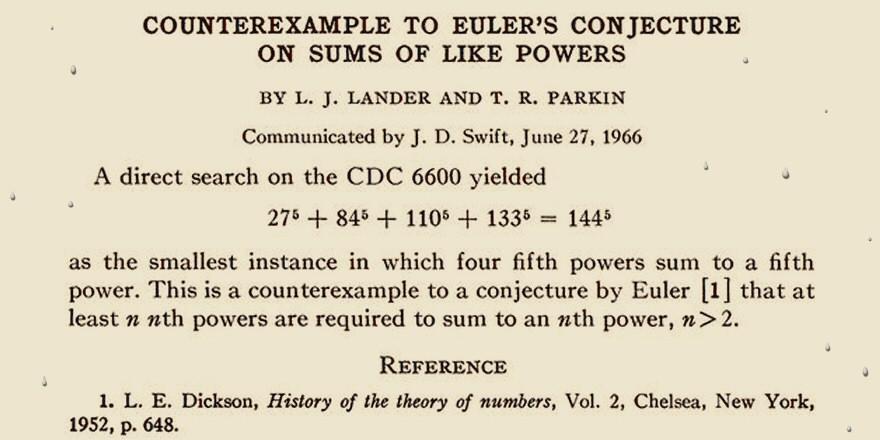
Euler’s conjecture, a theory proposed by Leonhard Euler in 1769, hung in there for 200 years. Then L.J. Lander and T.R. Parkin came along in 1966, and debunked the conjecture in two swift sentences. Their article — which is now open access and can be downloaded here — appeared in the Bulletin of the American Mathematical Society. If you’re wondering what the conjecture and its refutation are all about, you might want to ask Cliff Pickover, the author of 45 books on math and science. He brought this curious document to the web last week.
Related Content:
The Math in Good Will Hunting is Easy: How Do You Like Them Apples?
Read More...
T.S. Eliot, Edith Wharton & Gertrude Stein Tell F. Scott Fitzgerald That Gatsby is Great, While Critics Called It a Dud (1925)
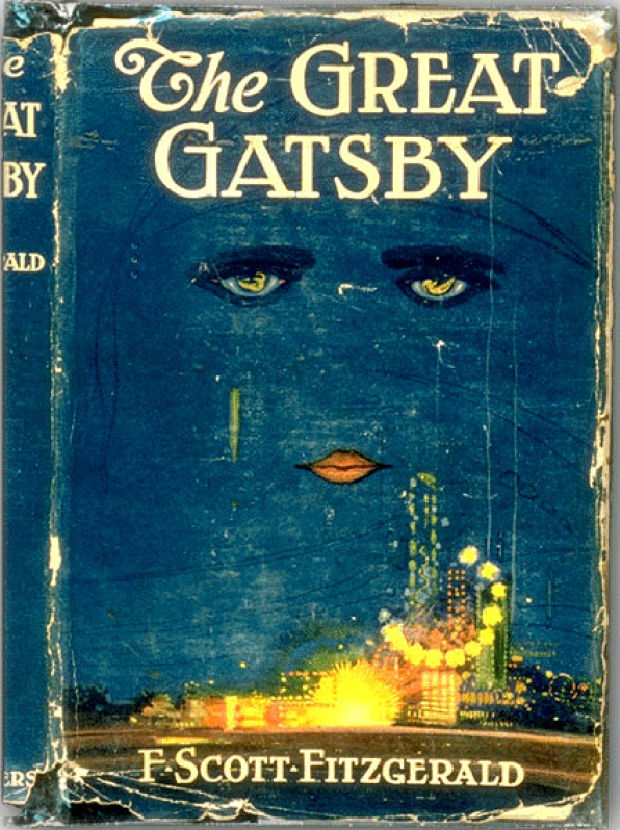
This month marks the 90th anniversary of the publication of F. Scott Fitzgerald’s masterpiece, The Great Gatsby. Perhaps no other book so embodies the ideal of the Great American Novel as Gatsby — and yet, when it first came out 90 years ago, it was regarded as a flop. As a headline writer for the New York World put it, “F. SCOTT FITZGERALD’S LATEST A DUD.”
Fitzgerald had a lot riding on Gatsby. He and his wife Zelda were living beyond their means, and he was desperately hoping the book would bring financial security as well as critical respect. On April 10, 1925 he wrote a letter to his editor, Maxwell Perkins:
Dear Max
The book comes out today and I am overcome with fears and forebodings. Supposing women didn’t like the book because it has no important woman in it, and critics didn’t like it because it dealt with the rich and and contained no peasants borrowed out of Tess in it and set to work in Idaho? Suppose it didn’t even wipe out my debt to you — why it’ll have to sell 20,000 copies even to do that!
The author’s fears and forebodings were more or less realized. The first print run of 20,870 copies sold slowly. A second run of 3,000 was ordered a few months later, but many of those copies were still gathering dust on the warehouse shelves when Fitzgerald died in 1940. And while a few critics recognized Gatsby’s brilliance, many missed it. H.L. Mencken, for example, praised Fitzgerald’s maturing craftsmanship as a prose stylist but savaged the story itself, calling it “no more than a glorified anecdote.”
It must have cheered the author up, then, to receive letters of praise from several of the most influential writers of his time. Fitzgerald had sent inscribed copies of the book to Edith Wharton, Gertrude Stein and T.S. Eliot — all of whom responded. Of the three, Wharton was the most tepid in her praise, with echoes of Mencken running through her comments:
Dear Mr. Fitzgerald,
I have been wandering for the last weeks and found your novel — with it’s friendly dedication — awaiting me here on my arrival, a few days ago.
I am touched at your sending me a copy, for I feel that to your generation, which has taken such a flying leap into the future, I must represent the literary equivalent of tufted furniture and gas chandeliers. So you will understand that it is in the spirit of sincere deprecation that I shall venture, in a few days, to offer you in return the last product of my manufactory.
Meanwhile, let me say at once how much I like Gatsby, or rather His Book, & how great a leap I think you have taken this time — in advance upon your previous work. My present quarrel with you is only this: that to make Gatsby really Great, you ought to have given us his early career (not from the cradle — but from his visit to the yacht, if not before) instead of a short résumé of it. That would have situated him, and made his final tragedy a tragedy instead of a “fate divers” for the morning papers.
But you’ll tell me that’s the old way, and consequently not your way…
Wharton made it clear she thought of Gatsby as a literary advance only in respect to Fitzgerald’s own earlier work. Gertrude Stein allowed only that the new book was “different and older”:
My dear Fitzgerald:
Here we are and have read your book and it is a good book. I like the melody of your dedication and it shows that you have a background of beauty and tenderness and that is a comfort. The next good thing is that you write naturally in sentences and that too is a comfort. You write naturally in sentences and one can read all of them and that among other things is a comfort. You are creating the contemporary world much as Thackeray did his in Pendennis and Vanity Fair and this isn’t a bad compliment. You make a modern world and a modern orgy strangely enough it was never done until you did it in This Side of Paradise. My belief in This Side of Paradise was alright. This is as good a book and different and older and that is what one does, one does not get better but different and older and that is always a pleasure. Best of luck to you always, and thanks so much for the very genuine pleasure you have given me.
The strongest and least equivocal praise came from Eliot:
Dear Mr. Scott Fitzgerald,
The Great Gatsby with your charming and overpowering inscription arrived the very morning I was leaving in some haste for a sea voyage advised by my doctor. I therefore left it behind and only read it on my return a few days ago. I have, however, now read it three times. I am not in the least influenced by your remark about myself when I say that it has interested and excited me more than any new novel I have seen, either English or American, for a number of years.
When I have more time I should like to write to you more fully and tell you exactly why it seems to me such a remarkable book. In fact it seems to me to be the first step that American fiction has taken since Henry James.
Fitzgerald was especially pleased with that last line. “I can’t express just how good your letter made me feel,” he wrote back to Eliot “– it was easily the nicest thing that’s happened to me in connection with Gatsby.”
Related Content:
Sylvia Plath Annotates Her Copy of The Great Gatsby
Haruki Murakami Translates The Great Gatsby, the Novel That Influenced Him Most
83 Years of Great Gatsby Book Cover Designs: A Photo Gallery
Download 55 Free Online Literature Courses: From Dante and Milton to Kerouac and Tolkien
Read More...Teacher Calls Jacques Derrida’s College Admission Essay on Shakespeare “Quite Incomprehensible” (1951)
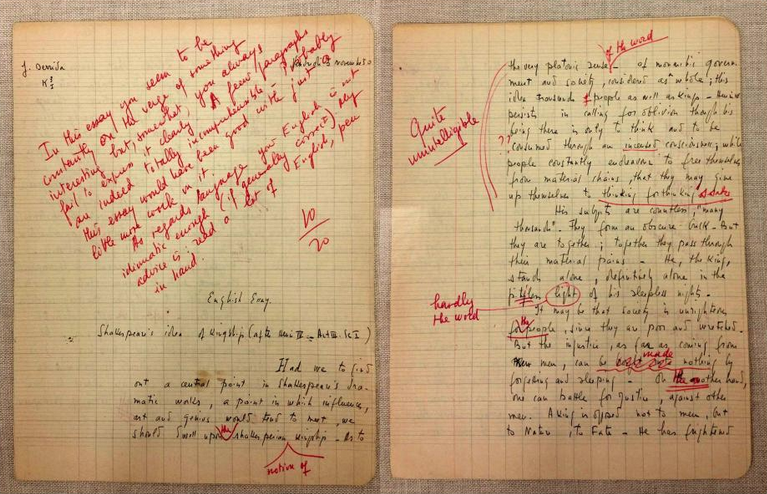
Click here for larger image, then click again to zoom in.
Backstories of famously accomplished people seem incomplete without some past difficulty or failure to be overcome. In narrative terms, these incidents provide biographies with their dramatic tension. We see Abraham Lincoln rise to the highest office in the land despite the humblest of origins; Albert Einstein rewrites theoretical physics against all academic odds, given his supposed early childhood handicaps. In many cases, these stories are apocryphal, or exaggerated for effect. But whatever their accuracy, they always seem to reflect undeniable character traits of the person in question.
In the case of influential philosopher Jacques Derrida, progenitor of the both beloved and reviled critical theory known as “Deconstruction,” the stories of academic struggle and great mental suffering are well-documented. Furthermore, their details accord perfectly well with the mature thinker who, remarks the site Critical Theory, “can’t answer a simple god-damned question.” The good-natured snark on display in this description more or less sums up the feedback Derrida received during some formative years of schooling while he prepared for his entrance exams to France’s university system in 1951 at the age of 20.
Derrida may have “left as big a mark on humanities departments as any single thinker of the past forty years,” writes The New York Review of Books, but during this period of his life, he failed his exams twice before finally gaining admittance. Once, he “choked and turned in a blank sheet of paper. The same month, he was awarded a dismal 5 out of 20 on his qualifying exam for a license in philosophy.” One essay he submitted on Shakespeare, written in English (above), received a 10 out of 20. The feedback from Derrida’s instructor will sound very familiar to perplexed readers of his work. “Quite unintelligible,” writes the evaluator in one marginal comment. The main comment at the top of the paper reads in part:
In this essay you seem to be constantly on the verge of something interesting but, somewhat, you always fail to explain it clearly. A few paragraphs are indeed totally incomprehensible.
Another examiner—points out the NYRB—left a comment on his work “that has since become a commonplace”:
An exercise in virtuosity, with undeniable intelligence, but with no particular relation to the history of philosophy… Can come back when he is prepared to accept the rules and not invent where he needs to be better informed.
As it turns out, Derrida was not particularly interested in the rules, but in inventing a new method. Even if his “apostasy” caused him great mental anguish—“nausea, insomnia, exhaustion, and despair” (all normal features of any higher educational experience)—it’s probably fair to say he could not do otherwise. Although his intellectual biography, like the history of any revered figure, is unlikely to offer a blueprint for success, there is perhaps at least one lesson we may draw: Whatever the difficulties, you’re probably better off just being yourself.
Related Content:
130+ Free Online Philosophy Courses
8‑Bit Philosophy: Plato, Sartre, Derrida & Other Thinkers Explained With Vintage Video Games
Jacques Derrida Deconstructs American Attitudes
Josh Jones is a writer and musician based in Durham, NC. Follow him at @jdmagness
Read More...The Rolling Stones Release a Soulful, Never-Heard Acoustic Version of “Wild Horses”
By the time Charlie Watts’ snare drum cracks into the recently unearthed alternate acoustic take of “Wild Horses,” above, the song has already gathered as much momentum as the album version, its soulful minor chords filling whatever room you happen to be listening to it in. Released with the video above as a teaser for the extras-packed reissue of 1971’s Sticky Fingers, due out this May, the track replaces Mick Taylor’s electric guitar with well-placed acoustic plucking and almost jaunty rhythm playing by Keith. As Jagger belts them out, the lyrics “unzip” across the screen in a tasteful homage to Andy Warhol’s expertly sleazy Sticky Fingers cover art.
Part boast, part lament, it’s no wonder “Wild Horses” is one of the Stones’ most popular tunes. It seems that no matter what gets added, or taken away, from it, the song remains a completely transporting statement of loss and defiance. The song, stripped down to just vocals and acoustic guitars above, is utterly captivating with or without its electric slide swells, honky-tonk piano, and vocal harmonies, a testament to Richards’ skill with country songwriting, much of which he’d picked up while hanging out with former Byrd Gram Parsons.
The song owes much to Parsons’ 1968 “Hickory Wind,” and Parsons even covered “Wild Horses” as a mostly acoustic country ballad in 1970, the year before Sticky Fingers’ release. The Stones recorded the song in 1969, and clearly knew they had something special on their hands immediately afterward. Just above—starting at 0:40—see the band listen back to another stripped down version of the album take at Mussel Shoals studio in footage from the Maysles brothers’ Gimme Shelter.
The sing-along choruses and overall campfire vibe of The Glimmer Twins’ ballad makes it an ideal candidate for unplugged sessions, and the newly-debuted version at the top isn’t the only time The Stones have re-released an alternate acoustic take. Just above, see them live in the studio recording a new version of “Wild Horses” for 1995’s Stripped, an album of mostly-live, often acoustic reworkings of songs like “Street Fighting Man” and “Let It Bleed” and covers of Buddy Holly’s “Not Fade Away” and Dylan’s “Like a Rolling Stone.” Stripped may be an uneven album (hear on Youtube here), but Jagger and Richards’ brilliant imitations of country music—like “Dead Flowers” and, especially, “Wild Horses”—shine as brightly as ever.
Related Content:
The Rolling Stones Sing the Beatles’ “Eight Days a Week” in a Hotel Room (1965)
Josh Jones is a writer and musician based in Durham, NC. Follow him at @jdmagness
Read More...Kurt Vonnegut’s 8 Tips on How to Write a Good Short Story
When it came to giving advice to writers, Kurt Vonnegut was never dull. He once tried to warn people away from using semicolons by characterizing them as “transvestite hermaphrodites representing absolutely nothing.” And, in a master’s thesis rejected by The University of Chicago, he made the tantalizing argument that “stories have shapes which can be drawn on graph paper, and that the shape of a given society’s stories is at least as interesting as the shape of its pots or spearheads.” In this brief video, Vonnegut offers eight essential tips on how to write a short story:
- Use the time of a total stranger in such a way that he or she will not feel the time was wasted.
- Give the reader at least one character he or she can root for.
- Every character should want something, even if it is only a glass of water.
- Every sentence must do one of two things–reveal character or advance the action.
- Start as close to the end as possible.
- Be a sadist. No matter how sweet and innocent your leading characters, make awful things happen to them–in order that the reader may see what they are made of.
- Write to please just one person. If you open a window and make love to the world, so to speak, your story will get pneumonia.
- Give your readers as much information as possible as soon as possible. To heck with suspense. Readers should have such complete understanding of what is going on, where and why, that they could finish the story themselves, should cockroaches eat the last few pages.
Vonnegut put down his advice in the introduction to his 1999 collection of magazine stories, Bagombo Snuff Box. But for every rule (well, almost every rule) there is an exception. “The greatest American short story writer of my generation was Flannery O’Connor,” writes Vonnegut. “She broke practically every one of my rules but the first. Great writers tend to do that.”
Now if you want to learn to write with style, that’s another story. And Vonnegut has advice on that too here.
via BrainPickings
If you would like to support the mission of Open Culture, consider making a donation to our site. It’s hard to rely 100% on ads, and your contributions will help us continue providing the best free cultural and educational materials to learners everywhere. You can contribute through PayPal, Patreon, and Venmo (@openculture). Thanks!
Related Content:
“Wear Sunscreen”: The Story Behind the Commencement Speech That Kurt Vonnegut Never Gave
Kurt Vonnegut Diagrams the Shape of All Stories in a Master’s Thesis Rejected by U. Chicago
Kurt Vonnegut Explains “How to Write With Style”
22-Year-Old P.O.W. Kurt Vonnegut Writes Home from World War II: “I’ll Be Damned If It Was Worth It”
Read More...Support Us
We're hoping to rely on loyal readers, rather than erratic ads. Please click the Donate button and support Open Culture. You can use Paypal, Venmo, Patreon, even Crypto! We thank you!

About Us

Open Culture scours the web for the best educational media. We find the free courses and audio books you need, the language lessons & educational videos you want, and plenty of enlightenment in between.
Advertise With Us

FREE UPDATES!
GET OUR DAILY EMAIL
Get the best cultural and educational resources on the web curated for you in a daily email. We never spam. Unsubscribe at any time.
FOLLOW ON SOCIAL MEDIA

Open Culture editor Dan Colman scours the web for the best educational media. He finds the free courses and audio books you need, the language lessons & movies you want, and plenty of enlightenment in between.
Advertise With Us


