Henry Miller Makes a List of “The 100 Books That Influenced Me Most”

Image licensed under Public Domain via Wikimedia Commons
Take a survey of a hundred writers from the mid- to late-twentieth century about the books that influenced them most and you’re bound to find plenty of Henry Miller tucked in with the Victorians, the Russians, and the Beats. The Brooklyn-raised author of such notoriously banned novels as Tropic of Capricorn and Tropic of Cancer has long appealed to contemporary writers not only because of his frank explorations of sexuality and other taboo subjects but also because—like so many avant-garde and not so avant-garde writers after him—he had the audacity to present his own life and loves as literary material. Long before the memoir became the dominant force in American letters, with all of the attendant controversies about truth-telling in the form, Miller blended fact and fiction in ways that made it hard to tell where one ended and the other began.
Miller’s reputation for living his fiction—or fictionalizing his life—may have led many readers with only a passing familiarity with his books to regard him as a kind of shameless self-mythologizer. The characterization isn’t necessarily wrong, but it only captures part of the story. Like every serious writer, Miller was also a serious reader, and his work is as much informed by the books he loved as by the women he loved.
Miller freely acknowledged the literary relationships in his life, the authors who exerted influence on his work and whose styles and ideas he borrowed and made his own. He wrote an entire book on the subject, The Books in My Life, which Maria Popova at Brain Pickings describes as “a singular lens on his approach to reading.” In the book, Miller’s “central concern is a kind of anatomy of influence,” Popova writes, taking a phrase from literary critic Harold Bloom.
In his meditation on “his sources of creative spark,” Miller discusses at length his ideas about education, and its many failings. And in the book’s appendix—as if anticipating our current mania for lists—he makes a comprehensive record of “The 100 Books that Influenced Me Most.” See Miller’s complete list below, and read The Books in My Life free at the Open Library. A fair number of the books on Miller’s list can be found in our collection, 800 Free eBooks for iPad, Kindle & Other Devices.
1 Ancient Greek Dramatists
2 Arabian Nights (for children)
3 Elizabethan Playwrights (excepting Shakespeare)
4 European Playwrights of 19th Century
5 Greek Myths and Legends
6 Knights of King Arthur’s Court
7 Abèlard, Pierre, The Story of My Misfortunes
8 Alain-Fournier, The Wanderer
9 Andersen, Hans Christian, Fairy Tales
10 Anonymous, Diary of a Lost One
11 Balzac, Honoré de, Seraphita
12 Balzac, Honoré de, Louis Lambert
13 Bellamy, Edward, Looking Backward
14 Belloc, Hilaire, The Path to Rome
15 Blavatsky, Mme. H. P., The Secret Doctrine
16 Boccaccio, Giovanni, The Decameron
17 Breton, André, Nadja
18 Bronte, Emily, Wuthering Heights
19 Bulwyer-Lytton, Edward, Last Days of Pompeii
20 Carroll, Lewis, Alice in Wonderland
21 Céline, Louis-Ferdinand, Journey to the End of the Night
22 Cellini, Benvenuto, Autobiography
23 Cendrars, Blaise, Virtually the complete works
24 Chesterton, G.K., Saint Francis of Assisi
25 Conrad, Joseph, His works in general
26 Cooper James Fenimore, Leatherstocking Tales
27 Defoe, Daniel, Robinson Crusoe
28 De Nerval, Gérard, His works in general
29 Dostoievsky, Feodor, His works in general
30 Dreiser, Theodore, His works in general
31 Duhamel, Geoges, Salavin Series
32 Du Maurier, George, Trilby
33 Dumas, Alexander, The Three Musketeers
34 Eckermann, Johann, Conversations with Goethe
35 Eltzbacher, Paul, Anarchism
36 Emerson, Ralph Waldo, Representative Men
37 Fabre, Henri, His works in general
38 Faure, Elie, The History of Art
39 Fenollosa, Ernest, The Chinese Written Character as a Medium for Poetry
40 Gide, André, Dostoievski
41 Giono, Jean, Refus d’Obéissance
42 Giono, Jean, Que ma joie domeure
43 Giono, Jean, Jean le Bleu
44 Grimm Brothers, Fairy Tales
45 Gutkind, Erich, The Absolute Collective
46 Haggard, Rider, She
47 Hamsun, Knut, His works in general
48 Henty, G. A., His works in general
49 Hesse, Hermann, Siddhartha
50 Hudson, W. H., His works in general
51 Hugo, Victor, Les Misérables
52 Huysmans, Joris Karl, Against the Grain
53 Joyce, James, Ulysses
54 Keyserling, Hermann, South American Meditations
55 Kropotkin, Peter, Mutual Aid
56 Lao-tse, Tao Teh Ch’ing
57 Latzko, Andreas, Men in War
58 Long, Haniel, Interlinear to Cabeza de Vaca
59 M, Gospel of Ramakrishna
60 Machen, Arthur, The Hill of Dreams
61 Maeterlinck, Maurice, His works in general
62 Mann, Thomas, The Magic Mountain
63 Mencken, H. L., Prejudices
64 Nietzsche, His works in general
65 Nijinsky, Diary
66 Nordhoff & Hall, Pitcairn Island
67 Nostradamus, The Centuries
68 Peck, George Wilbur, Peck’s Bad Boy
69 Percival, W. O., William Blake’s Circle of Destiny
70 Petronius, The Satyricon
71 Plutarch, Lives
72 Powys, John Cowper, Visions and Revisions
73 Prescott, William H., Conquest of Mexico
74 Prescott, William H., Conquest of Peru
75 Proust, Marcel, Remembrance of Things Past
76 Rabelais, Gargantua and Pantagruel
77 Rimbaud, Jean-Arthur, His works in general
78 Rolland, Romain, Jean-Christophe
79 Rolland, Romain, Prophets of the New India
80 Rudhyar, Dane, Astrology of Personality
81 Saltus, Edgar, The Imperial Purple
82 Scott, Sir Walter, Ivanhoe
83 Sienkiewicz, Henry, Quo Vadis
84 Sikelianos, Anghelos, Proanakrousma
85 Sinnett, A. P., Esoteric Buddhism
86 Spencer, Herbert, Autobiography
87 Spengler, Oswald, The Decline of the West
88 Strindberg, August, The Inferno
89 Suarès, Carlo, Krishnamurti
90 Suzuki, Daisetz Teitaro, Zen Buddhism
91 Swift, Jonathan, Guilliver’s Travels
92 Tennyson, Alfred, Idylls of the King
93 Thoreau, Henry David, Civil Disobedience & Other Essays
94 Twain, Mark, Adventures of Huckleberry Finn
95 Van Gogh, Vincent, Letters to Theo
96 Wassermann, Jacob, The Maurizius Case (Trilogy)
97 Weigall, Arthur, Akhnaton
98 Welch, Galbraith, The Unveiling of Timbuctoo
99 Werfel, Franz, Star of the Unborn
100 Whitman, Walt, Leaves of Grass
If you would like to support the mission of Open Culture, consider making a donation to our site. It’s hard to rely 100% on ads, and your contributions will help us continue providing the best free cultural and educational materials to learners everywhere. You can contribute through PayPal, Patreon, and Venmo (@openculture). Thanks!
Related Content:
Leo Tolstoy Creates a List of the 50+ Books That Influenced Him Most (1891)
28 Important Philosophers List the Books That Influenced Them Most During Their College Days
Stephen King Creates a List of 96 Books for Aspiring Writers to Read
Josh Jones is a writer and musician based in Durham, NC. Follow him at @jdmagness
Read More...Yoda’s Long Lost Twin Found in a 14th Century Illuminated Manuscript
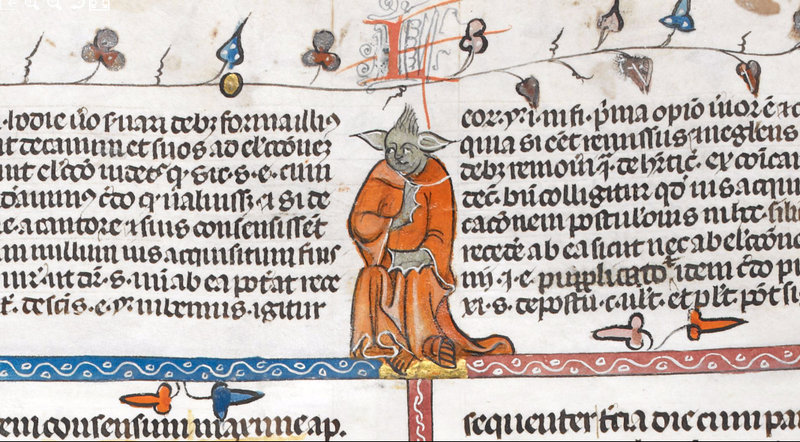
In a new picture book called Medieval Monsters, published by the British Library, historian Damien Kempf and art historian Maria L. Gilbert have gathered together illustrations that highlight the great monsters of the medieval world. Monsters were everywhere, including “on the edges of manuscript pages” and on “the fringes of maps.” The successor to Medieval Cats and Medieval Dogs, Medieval Monsters contains no shortage of fascinating illustrations, including the one above. It looks remarkably like Yoda, doesn’t it?
A British Library curator told NPR, “The Yoda image comes from a 14th-century manuscript known as the Smithfield Decretals.” “I’d love to say that it really was Yoda, or was drawn by a medieval time traveler.” But “it’s actually an illustration to the biblical story of Samson — the artist clearly had a vivid imagination!”
See more monsters at the British Library’s Medieval Manuscripts blog.
Related Content:
Wearable Books: In Medieval Times, They Took Old Manuscripts & Turned Them into Clothes
Wonderfully Weird & Ingenious Medieval Books
Read More...The Making of Star Wars As Told by C‑3PO & R2-D2: The First-Ever Documentary on the Film (1977)
The Earth, it seems, has only one truly unlimited resource: enthusiasm for Star Wars. Not even The Phantom Menace, the derision magnet that opened the film series’ newer trilogy, made a serious dent in our reserves. But did everyone who got together in the 1970s to make the very first Star Wars movie, from George Lucas on down the chain of command, understand how deep a vein of fandom they had drilled into? The Making of Star Wars, a 1977 documentary on that beloved space opera-turned-cultural phenomenon, will give you some idea.
Now that Star Wars has generated such a universe, if you like, of supplementary content, one more 50-minute behind-the-scenes special might strike you as no great shakes. But when The Making of Star Wars appeared in ’77, it appeared as the first documentary about Star Wars ever. And it has much higher ambitions than the average promotional short of the day, featuring not only cast and crew interviews but segments on the (decidedly pre-CGI) effects technology employed in the production.
Even the most dedicated Star Wars buffs will still find material of interest here, including footage that never made it into the picture’s theatrical cut, and footage reintroduced into 1997’s revamped “Special Edition” of the original trilogy but altered with CGI (another drain on several generation’s Star Wars love). But many of us will watch The Making of Star Wars on one of its strengths alone: C‑3PO and R2-D2 host the whole thing. Could even those precision-engineered droids have foreseen the thunderous reception that has met this year’s brand new teasers for Star Wars: The Force Awakens?
The Making of Star Wars is a candidate for our list of Free Online Documentaries, a subset of our collection, 285 Free Documentaries Online.
via Mental Floss
Related Content:
How Star Wars Borrowed From Akira Kurosawa’s Great Samurai Films
Watch the Very First Trailers for Star Wars, The Empire Strikes Back & Return of the Jedi (1976–83)
Joseph Campbell and Bill Moyers Break Down Star Wars as an Epic, Universal Myth
Hundreds of Fans Collectively Remade Star Wars; Now They Remake The Empire Strikes Back
Fans Reconstruct Authentic Version of Star Wars, As It Was Shown in Theaters in 1977
Colin Marshall writes on cities, language, Asia, and men’s style. He’s at work on a book about Los Angeles, A Los Angeles Primer, and the video series The City in Cinema. Follow him on Twitter at @colinmarshall or on Facebook.
Read More...Interactive Music Video Lets You Explore the Apartments on the Cover of Led Zeppelin’s Physical Graffiti
Dig that heavy metal / Underneath your hood / Baby I can work all night / Believe I got the perfect tools / Talkin’ bout love
Last February, Led Zeppelin released a deluxe, re-mastered version of their sprawling 1975 double album Physical Graffiti, a record perhaps best known for the epic, orchestral grandeur of the 8 1/2 minute “Kashmir” (not to be outdone by the 11-minute “In My Time of Dying”). In an album full of stylistic departures and solid returns to form, one track, “Trampled Under Foot,” manages to be both, driven by down-and-dirty blues and uptown 70s funk, courtesy of John Paul Jones’ Stevie Wonder-inspired organ groove. With lyrics Robert Plant himself described as “raunchy,” the song—one of Plant’s favorites—may be the band’s most 70s-sounding. That’s not to say it’s dated, only that it most perfectly captures the sound of the American street represented on the album cover, a shot of two adjacent tenements on New York City’s St. Mark’s Place.

Now, listeners can enter those buildings and tool around the apartments, courtesy of the interactive video at the top of the post (view it in a larger format here), which features a previously unreleased rough mix of the track called “Brandy & Coke.” Conceived and directed by Hal Kirkland, the video pulls together some of my favorite things—the period design and styling of That ‘70s Show, the most inventive tricks of the music video age, a la Tom Petty or Peter Gabriel, and of course, Zep—with the added 21st century technology of online interactivity. Click the arrow keys while the video plays and you’re transported from one vivid tableaux to another, some representing funky apartment scenes, others something else entirely. The video also integrates footage from Zeppelin’s performance of the song at Earl’s Court in ’75.
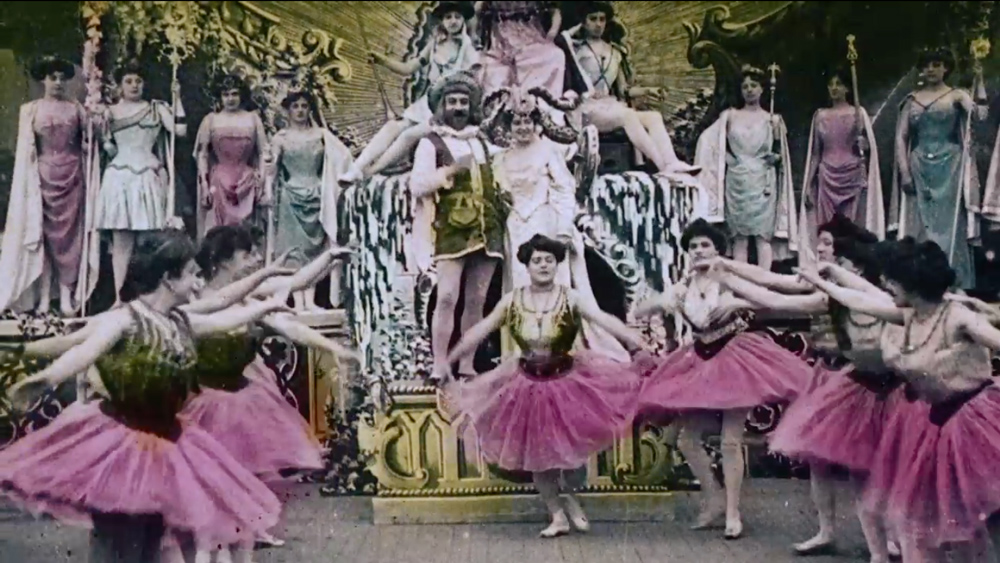
Clever references abound, like the nod to godfather of fantasy cinema Georges Méliès (above) and an allusion to the classic MTV moon landing intro (below). Overall, it’s an astonishing visual feast that hearkens back to the very best in music video technology, a seemingly lost art that Kirkland and company may singlehandedly resurrect. See Kirkland’s site for more of his internet age music video creations, including “Sour—Hibi No Neiro,” shot entirely on webcams.

Related Content:
Led Zeppelin Plays One of Its Earliest Concerts (Danish TV, 1969)
Hear Led Zeppelin’s Mind-Blowing First Recorded Concert Ever (1968)
Jimmy Page Describes the Creation of Led Zeppelin’s “Whole Lotta Love”
Josh Jones is a writer and musician based in Durham, NC. Follow him at @jdmagness
Read More...Watch Björk’s 6 Favorite TED Talks, From the Mushroom Death Suit to the Virtual Choir

Image by Zach Klein
Singer-songwriter Björk, currently enjoying a career retrospective at the Museum of Modern Art, celebrated TED’s billionth video view with a playlist of six treasured TED Talks. What do her choices say about her?
In this talk, artist Jae Rhim Lee models her Mushroom Death Suit, a kicky little snuggy designed to decompose and remediate toxins from corpses before they leech back into the soil or sky. Despite Björk’s fondness for outré fashion, I’m pretty sure this choice goes beyond the merely sartorial.
For more information, or to get in line for a mushroom suit of your own, see the Infinity Burial Project.
Continuing with the mushroom / fashion theme, Björk next turns to designer Suzanne Lee, who demonstrates how she grows sustainable textiles from kombucha mushrooms. The resulting material may variously resemble paper or flexible vegetable leather. It is extremely receptive to natural dyes, but not water repellent, so bring a non-kombucha-based change of clothes in case you get caught in the rain.
For more information on Lee’s homegrown, super green fabric, visit BioCouture.
Björk’s clearly got a soft spot for things that grow: mushrooms, mushroom-based fabric, and now…building materials? Professor of Experimental Architecture Rachel Armstrong’s plan for self-regenerating buildings involves protocols, or “little fatty bags” that behave like living things despite an absence of DNA. I’m still not sure how it works, but as long as the little fatty bags are not added to my own ever-growing edifice, I’m down.
For more information on what Dr. Armstrong refers to as bottom up construction (including a scheme to keep Venice from sinking) see Black Sky Thinking.
Björk’s next choice takes a turn for the serious… with games. Game Designer Brenda Romero began exploring the heavy duty emotional possibilities of the medium when her 9‑year-old daughter returned from school with a less than nuanced understanding of the Middle Passage. The success of that experiment inspired her to create games that spur players to engage on a deeper level with thorny historical subjects. (The Trail of Tears required 50,000 individual reddish-brown pieces).
Learn more about Romero’s analog games at The Mechanic is the Message.
Remember those 50,000 individual pieces? As photographer Aaron Huey documented life on Pine Ridge Reservation, he was humbled by hearing himself referred to as “wasichu,” a Lakota word that can be translated as “non-Indian.” Huey decided not to shy away from its more pointed translation: “the one who takes the best meat for himself.” His TED Talk is an impassioned history lesson that begins in 1824 with the creation of the Bureau of Indian Affairs and ends in an activist challenge.
Proof that Björk is not entirely about the quirk.
See Huey’s photos from the National Geographic cover story, “In the Spirit of Crazy Horse.”
Björk opts to close things on a musical note with excerpts from composer Eric Whitacre’s “Lux Aurumque” and “Sleep” performed by a crowdsourced virtual choir. Its members—they swell to 1999 for “Sleep”—record their parts alone at home, then upload them to be mixed into something sonically and spiritually greater than the sum of its parts.
Listen to “Sleep” in its entirety here.
Related Content:
Hear the Album Björk Recorded as an 11-Year-Old: Features Cover Art Provided By Her Mom (1977)
Björk and Sir David Attenborough Team Up in a New Documentary About Music and Technology
Ayun Halliday is an author, illustrator, and Chief Primatologist of the East Village Inky zine. Follow her @AyunHalliday
Read More...Enter the Church of the SubGenius, the Parody Religion Backed by R. Crumb, David Byrne & Other Alt-Icons
You may not know much about the Church of the SubGenius, but you’ve definitely seen its prophet. The intensively groomed, Ward Cleaveresque J. R. “Bob” Dobbs (below) began as a humble piece of 1950s clip art and went on to become “a way of life to millions… yet half of them don’t even know it.” Or so claims the sweeping, absurdity-laced, sonically (and perhaps intellectually) twisted narration of Arise! The SubGenius, an “instructional barrage video” put out by the Church in 1992 as the most potent distillation of its religion-satirizing sensibility.

The obsession with worldwide conspiracies, the importance granted to voracious consumption and “remixing” of pop culture (visible everywhere in Arise!), the hardline opposition to work, the all-important and never-defined quality of “Slack,” the askew eschatology: how much of the Church of the Subgenius’ doctrine has remained mere parody religion, and how much, since its founding in the late 1970s, have its “followers”—a group that includes such alt-icons as David Byrne, Robert Crumb, and Mark Mothersbaugh—come to consider as good as the real thing?
But whatever legitimacy this surprisingly long-running postmodern joke has attained, we can also view it, like all religions, as a cultural movement. This approach raises its own questions: how, exactly, did Dobbs’ pipe-clenching, fatherly yet sinister visage become one of the most recognizable subcultural emblems of the 1980s and 1990s? You may never learn the answer, just as you may never get a handle on the entirety of the Church’s ever more labyrinthine and aggressively preposterous mythology, but you’ll certainly find it all strangely compelling in the attempt.
And even if Arise! The SubGenius doesn’t recruit you into the Church of the SubGenius’ ranks, you’ve got to respect what they’ve predicted: not the end of the world, as much as they talk about it, but our currently thriving 21st-century culture of media appropriation, recontextualization, and absurdification. If ever there were a religion for the Youtube era, here it is. And if you find nothing novel in its characteristic ambivalence about what counts as serious and what doesn’t, maybe the Church of the SubGenius’ teachings have penetrated even deeper into the zeitgeist than all those “Bob” stickers made us suspect.
Related Content:
Watch 8 Classic Cult Films for Free: Night of the Living Dead, Plan 9 from Outer Space & More
When William S. Burroughs Joined Scientology (and His 1971 Book Denouncing It)
Monty Python’s Life of Brian: Religious Satire, Political Satire, or Blasphemy?
Colin Marshall hosts and produces Notebook on Cities and Culture as well as the video series The City in Cinema and writes essays on cities, language, Asia, and men’s style. He’s at work on a book about Los Angeles, A Los Angeles Primer. Follow him on Twitter at @colinmarshall or on Facebook.
Read More...Hear Ursula K. Le Guin’s Pioneering Sci-Fi Novel, The Left Hand of Darkness, as a BBC Radio Play
Whether they consider it one of her most or least important works, fans of science-fiction writer Ursula K. Le Guin usually have a great deal to say about her best-known novel, 1969’s The Left Hand of Darkness. But it doesn’t matter to me whether a book has won a Hugo or a Nebula — and The Left Hand of Darkness has won both — or how many readers — and The Left Hand of Darkness has many — have slapped on it the label of “masterpiece.” No, I only get intrigued by descriptions like the one Wikipedia puts in its opening paragraph on the novel, which calls it “the most famous examination of sexless androgyny in science fiction.”
Among its many other fascinating qualities, The Left Hand of Darkness takes place on an alien world with no fixed sexes, performing a narrative “thought experiment” about what kind of society you might get when, depending on the circumstances, anyone might reproduce with anyone else. This unusual concept has drawn the attention of not only generations of readers but several different adaptors, most recently the BBC. They’ve always done a redoubtable job converting imaginative literature into radio drama — take their recent version of Neil Gaiman’s Neverwhere, or their classic one of Douglas Adams’ The Hitchhiker’s Guide to the Galaxy, considered by many fans better than the book. Now they’ve set their sights on Le Guin’s award-winner.
The first episode of the BBC’s Left Hand of Darkness has already aired, and you can hear it free online for about a month at the show’s site. (It runs almost an hour.) Episode two is now online here. You can get a taste of the production from the promotional video at the top of the post; the one just above gives a scrap of insight as to how Le Guin came to envision the novel’s world. Personally, I need no further incentive to tune in than that the series features Toby Jones, whose presence (usually in film) reliably indicates a just-askew-enough cultural experience. And if you still feel wary about engaging with any kind of science fiction, know that even Harold Bloom really, really liked the book.
Related Content:
Hear Inventive Stories from Ursula Le Guin & J.G. Ballard Turned Into CBC Radio Dramas
BBC Radio Adaptation of Neil Gaiman’s Neverwhere Begins Saturday: A Preview
Free: Isaac Asimov’s Epic Foundation Trilogy Dramatized in Classic Audio
1,000 Free Audio Books: Download Great Books for FreeColin Marshall writes on cities, language, Asia, and men’s style. He’s at work on a book about Los Angeles, A Los Angeles Primer, and the video series The City in Cinema. Follow him on Twitter at @colinmarshall or on Facebook.
Read More...F. Scott Fitzgerald Has a Strange Dinner with James Joyce & Draws a Cute Sketch of It (1928)
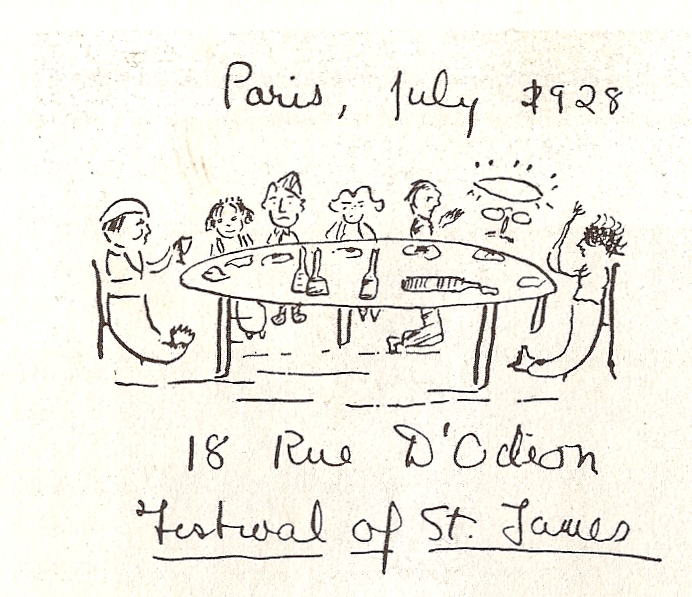
The characters in many of F. Scott Fitzgerald’s stories—rakish, drunken undergraduates and overeducated gadabouts—so resemble their creator that it’s tempting to read into all of his work some autobiographical intent. One episode in the writer’s life that didn’t make it into his fiction, Fitzgerald’s meeting with James Joyce in Paris, nevertheless makes a fascinating anecdote all its own, and seems so perfectly in character that it could have inspired an amusing short story for The Saturday Evening Post.
According to Sylvia Beach, doyenne of the expat American literary scene in Paris, founder of Shakespeare and Company Books, and publisher of Ulysses, Fitzgerald “worshipped James Joyce, but was afraid to approach him.” In her memoir, Shakespeare and Company, Beach relates how in 1928 she and her friend, lover, and fellow bookseller Adrienne Monnier, “cooked a nice dinner and invited the Joyces, the Fitzgeralds, and André Chamson and his wife Lucie.”
Scott drew a picture in my copy of The Great Gatsby of the guests—with Joyce seated at the table wearing a halo, Scott kneeling beside him, and Adrienne and myself, at the head and foot, depicted as mermaids (or sirens).
You can see Fitzgerald’s quirky little sketch above. Beach’s telling, it seems, omits many of the colorful details of the meeting. According to Herbert Gorman, another guest at the dinner and Joyce’s first biographer, Fitzgerald—so overawed by the Irish author that he referred to the evening as the “Festival of St. James”—“sank down on one knee before Joyce”—as in his drawing—“kissed his hand, and declared: ‘How does it feel to be a great genius, Sir? I am so excited at seeing you, Sir, that I could weep.’”
Most likely very drunk on champagne, Fitzgerald’s antics apparently quite alarmed Joyce. In her literary history, Noel Riley Fitch tells us that the American “offered to show his esteem for the Irish writer… by jumping out of the window. An amazed Joyce is supposed to have prohibited the display and exclaimed, ‘That young man must be mad—I’m afraid he’ll do himself some injury.’” The bizarre incident did not prevent Fitzgerald from obtaining Joyce’s autograph in his copy of Ulysses. Nor did it prevent him, on a later occasion, from threatening to jump from his apartment balcony onto the street, “drunk and depressed by his failing marriage.” This time, he was stopped by French novelist André Chamson, with whom he had struck up a friendship at the Joyce dinner.
Beach’s memoir contains many other charming, and somewhat dismaying, stories about the Fitzgeralds, most involving profligate spending and drinking of champagne. We may not have the pleasure of hearing these tales from the Gatsby author himself—save through his essays, letters, and many fictionalizations of his life. But the genial Beach, who outlived Joyce, Fitzgerald, Hemingway, and most every other author of the “Lost Generation,” appeared in several filmed interviews, in French and English, and told stories of 1920s Paris. In one such interview, above, hear her describe the founding of Shakespeare and Company, that Parisian literary hub without which some of the greatest literature of the 20th century may never have reached the reading public.
via Austin Kleon
Related Content:
F. Scott Fitzgerald in Drag (1916)
Ernest Hemingway to F. Scott Fitzgerald: “Kiss My Ass”
Beginnings Profiles Shakespeare and Company’s Sylvia Beach Whitman
Josh Jones is a writer and musician based in Durham, NC. Follow him at @jdmagness
Read More...Take a Virtual Tour of Abbey Road Studios, Courtesy of the New Google Site “Inside Abbey Road”
Once again, Google quietly drops a nifty piece of interactive webbery and acts like it ain’t no big deal.
Google’s new web site, Inside Abbey Road, lets viewers walk inside Abbey Road Studios, check out the famous recording studio (home to most of the Beatles’ songs, birthplace of Dark Side of the Moon, Radiohead’s The Bends, Kanye West’s Late Registration, the list goes on) inspect the rooms, and watch interviews and mini-docs. It also matches up iconic photos (including the one shot outside of the famous crosswalk) with the studio today. The site is a collaboration between Google and the studio to celebrate over 80 years of music history.
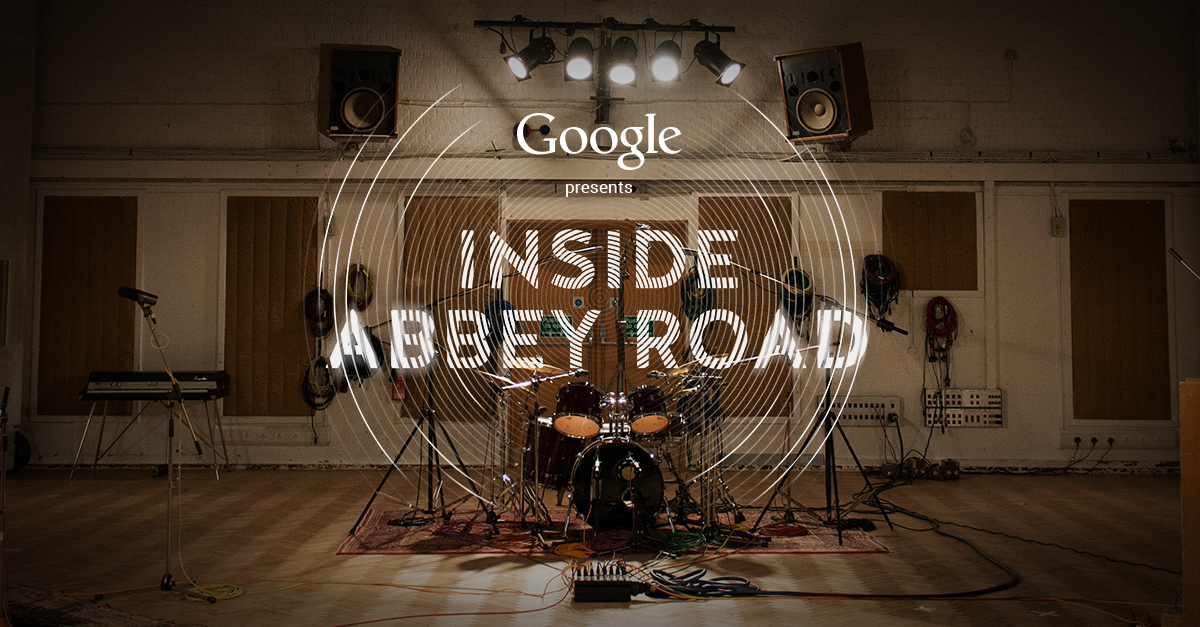
Abbey Road existed before the Fab Four and Cliff Richard, of course, and the new site includes footage of composer Sir Edward Elgar opening the studio in 1931 and conducting a recording of “Land of Hope and Glory.”
There’s plenty of modern footage too, from Kylie Minogue and Robbie Williams to Take That and Sigur Rós. You have to poke around a little bit to find everything, but the site includes a map in case you get lost.
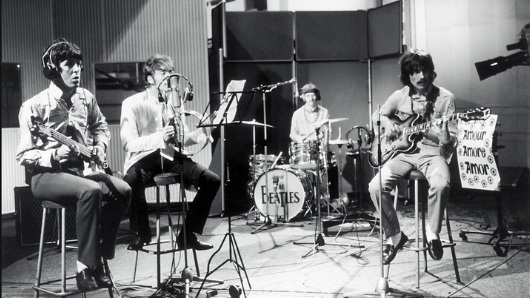
You can also have a go at mixing a four-track recording in the control booth, fool around on the J37 tape deck that was the height of tech during the time of Sgt. Pepper, and try to find the rumored echo chamber. (Trust me, it’s there.)

If you want to take a break outside and watch a real-time version of this digital location, there’s always the Abbey Road traffic cam, where you watch a whole bunch of tourists try to get their Beatles on without getting hit by an irate lorry driver.
Take your virtual tour of Abbey Road here.
Related Content:
Paul McCartney’s Conceptual Drawings For the Abbey Road Cover and Magical Mystery Tour Film
A Short Film on the Famous Crosswalk From the Beatles’ Abbey Road Album Cover
Watch Documentaries on the Making of Pink Floyd’s Dark Side of the Moon and Wish You Were Here
Chaos & Creation at Abbey Road: Paul McCartney Revisits The Beatles’ Fabled Recording Studio
Ted Mills is a freelance writer on the arts who currently hosts the FunkZone Podcast. You can also follow him on Twitter at @tedmills and/or watch his films here.
Read More...Günter Grass Takes On Facebook: “Someone Who Has 500 Friends, Has No Friends.”
Incisive social critic, novelist, poet, sculptor, and inspiration to such trenchant fabulists as John Irving and Salman Rushdie, German writer Günter Grass passed away this week with a well-defined legacy as “his country’s moral conscience.” Winner of the Nobel Prize in 1999, the author did not shy away from controversial political stances—despite his own once-hidden past as a teenage member of the Hitler Youth and Waffen-SS. In 2012, Grass caused an international stir with the publication of his poem “What Must Be Said,” a fierce critique of Israel’s militarism. The poem drew some rather predictable charges, and its publication, wrote Der Spiegel, broached what many considered a taboo subject. The incident represents only one of Grass’s many public statements, woven throughout his art and life, against nationalism and war.
Which brings us to the video interview above from 2013. While not exactly addressing a matter of dire geopolitical significance, Grass nonetheless levies his characteristic critical wit against a corporate entity that threatens to swallow the globe, virtually—Facebook. Remarking on his children and grandchildren’s experience with the social network, Grass says he told one of them, “Someone who has 500 friends, has no friends.” It’s something of a familiar sentiment by now—we’ve all read numerous think-pieces more or less saying the same thing. But Grass goes on to define the value of what he calls “direct experiences” in specific terms—with the admission that he feels like “a dinosaur” for writing his manuscripts by hand and typing them on an old Olivetti typewriter.
The idea of owning a mobile phone and being accessible at all times—and as I know now, under surveillance, is abhorrent to me. With the latest findings in mind, it surprises me—that millions of people do not distance themselves from Facebook and all that—and say “I want no part of it.”
Grass’ aversion to Facebook—and the online world in general—isn’t strictly political, but literary as well. He acknowledges the ease and speed of the internet as a research tool, and yet… “literature… You can’t speed it up when you work with it. If you do, you do so at the expense of quality.” To hear more from Grass about the writing process and his attitudes toward literature and activism, read his interview in the Paris Review.
via Bibliokept
Related Content:
The Problem with Facebook: “It’s Keeping Things From You”
Wittgenstein Day-by-Day: Facebook Page Tracks the Philosopher’s Wartime Experience 100 Years Ago
Josh Jones is a writer and musician based in Durham, NC. Follow him at @jdmagness
Read More...Support Us
We're hoping to rely on loyal readers, rather than erratic ads. Please click the Donate button and support Open Culture. You can use Paypal, Venmo, Patreon, even Crypto! We thank you!

About Us

Open Culture scours the web for the best educational media. We find the free courses and audio books you need, the language lessons & educational videos you want, and plenty of enlightenment in between.
Advertise With Us

FREE UPDATES!
GET OUR DAILY EMAIL
Get the best cultural and educational resources on the web curated for you in a daily email. We never spam. Unsubscribe at any time.
FOLLOW ON SOCIAL MEDIA

Open Culture editor Dan Colman scours the web for the best educational media. He finds the free courses and audio books you need, the language lessons & movies you want, and plenty of enlightenment in between.
Advertise With Us


