Hear 46 Versions of Stravinsky’s Rite of Spring in 3 Minutes: A Classic Mashup
In 2013, New York’s most popular classical music station WQXR celebrated the centennial of Igor Stravinksy’s The Rite of Spring, with a series of events that culminated in Rite of Spring Fever, 24 hours of different performances of the work and a live solo interpretation by Bang on a Can pianist Vicky Chow.
As a promotional posting, WQXR also created this mashup of 46 recordings in 3 minutes, showing the varying approaches to Stravinsky’s score, and the wildly different dynamics of interpretation.
Sixteen years after the work’s tumultuous live premiere in 1913, both Stravinsky and conductor Pierre Monteux competed to record the first version in 1929 in Paris. That was followed in 1930 by Leopold Stokowski and the Philadelphia Orchestra, whose re-recorded version would become the most famous when it appeared in Walt Disney’s Fantasia. That film did more to bring Stravinsky to wide swathes of society, from kids to grandparents, than any other performance. Plus it had frickin’ dinosaurs:
Phil Kline, the composer and curator of WQXR’s event, notes that it was high-fidelity LPs, not 78s, that really brought the dynamics of Rites into its own. “Few other classics so desperately need to be heard with a wide dynamic range, especially on that big bottom end,” he writes.
This mashup is pretty schizoid, but shows the personalities and influences of each conductor: Leonard Bernstein creates a colorful and sparkling Rite; Pierre Boulez is like a machine; Karajan is thunderous. The various piano interpretations lose none of their bite after being resigned to the keyboard. And Stravinsky’s 1960 recording with the Columbia Symphony Orchestra (aka the New York Philharmonic, renamed for contractual reasons) is also here, sounding just that little bit sweeter than the rest.
Related Content
Stravinsky’s The Rite of Spring, Visualized in a Computer Animation for Its 100th Anniversary
Vi Hart Uses Her Video Magic to Demystify Stravinsky and Schoenberg’s 12-Tone Compositions
Ted Mills is a freelance writer on the arts who currently hosts the FunkZone Podcast. You can also follow him on Twitter at @tedmills, read his other arts writing at tedmills.com and/or watch his films here.
Read More...A Harrowing Test Drive of Buckminster Fuller’s 1933 Dymaxion Car: Art That Is Scary to Ride
In the 1930s, the systems theorist, designer and inventor Buckminster Fuller created the Dymaxion car — an aerodynamic concept car that managed to get 30 miles per gallon while topping out at 90 miles per hour, and transporting 11 passengers. Like Fuller’s Dymaxion house, the three-wheel Dymaxion car could be disassembled and re-assembled with ease. You can see vintage videos of both here.
The concept car didn’t get much beyond the concept stage. Only three original versions were built, one of which rolled over at the 1933 World’s Fair, leaving the driver dead, three passengers injured, and investors reluctant to bring the car to market. In 2010, the British architect Sir Norman Foster built a replica of the Dymaxion. You can see Dan Neil, of The Wall Street Journal, take the car on a harrowing test drive above. And if you’re intrigued enough to learn more, you can hunt down the 2012 documentary called The Last Dymaxion (watch a trailer of the film here).
If you would like to support the mission of Open Culture, consider making a donation to our site. It’s hard to rely 100% on ads, and your contributions will help us continue providing the best free cultural and educational materials to learners everywhere. You can contribute through PayPal, Patreon, and Venmo (@openculture). Thanks!
Related Content:
Everything I Know: 42 Hours of Buckminster Fuller’s Visionary Lectures Free Online (1975)
Watch an Animated Buckminster Fuller Tell Studs Terkel All About “the Geodesic Life”
Read More...Martin Scorsese Introduces Filmmaker Hong Sangsoo, “The Woody Allen of Korea”
In the clip above, Martin Scorsese talks about a group of films that, in his words, have “enriched me, educated me, disturbed me, moved me in a way that have awakened me to new possibilities in cinema.” Those words will remind many of us of our experiences with Scorsese’s own pictures, which raises a big question: what movement could possibly have enough power to enrich, educate, disturb, move, and cinematically awaken a man who has done so much enriching, educating, disturbing, moving, and cinematic awakening himself?
Scorsese speaks of the cinema of South Korea, especially the wave that, over the past twenty years, has brought the global film scene such auteurs as Park Chan-wook (Joint Security Area, Oldboy, Stoker), Lee Chang-dong (Oasis, Secret Sunshine, Poetry), and Kim Ki-duk (Spring, Summer, Fall, Winter… and Spring, 3‑Iron, Pietà). But he adds that, “for me, there’s something especially interesting about the films of Hong Sangsoo. It’s got to do with his masterful sense of storytelling. In each of his films that I’ve managed to see, everything kind of starts unassumingly” — but then things “unpeel like an orange.”
Only in one respect can I compare myself to Martin Scorsese: a love of Hong Sangsoo movies. I even wrote an essay for The Quarterly Conversation a few years back trying to explain the artistry of this most prolific Korean director, who has put out sixteen alcohol-soaked, cigarette-clouded, social and sexual awkwardness-saturated features to date. Some call Hong “the Korean Woody Allen,” which gets at the fact that his many comedies of manners pass through more moods than comedy and deal with more than manners, but that doesn’t capture his penchant for rich formal and structural experimentation — stories told multiple times, through different perspectives, using clashing sets of facts, and so on — which delights cinephiles everywhere.
This has made Hong a big name on the festival circuit — he usually has a project or two making the rounds at any given time — on which his latest movie Hill of Freedom received much critical acclaim. Telling of a Japanese man’s trip to Seoul to track down his Korean ex-girlfriend through a disordered pile of letters he sent her all at once, the mostly English-language movie shows the internationalization of not just Hong’s appeal, but of his work itself. It allows few of its characters to speak their native language, resulting in the kind of meaningful inarticulacy that he’d previously had to get his all-Korean casts drunk to achieve.
You can take the plunge into Hong’s cut-up and meticulously rearranged cinematic world of inept, jealously idealistic men, women that I’ve elsewhere described as “eerily unrepentant studies in blank calculation and frigid pliability,” and the catastrophes into which they lead themselves by starting with his debut The Day the Pig Fell into a Well, available free on the Korean Film Archive’s Youtube channel.
I recently went to Korea to record a podcast interview with Seoul-based film scholar Marc Raymond about how Hong’s films reflect modern Korean life. It turns out they reflect it pretty well, something I’ll see for myself later this year when, after having studied the Korean language for nearly a decade, I move to Korea — all out of an interest first stoked by Hong Sangsoo.
Related Content:
Watch 98 Korean Feature Films Free Online, Thanks to the Korean Film Archive
The Five Best North Korean Movies: Watch Them Free Online
Martin Scorsese Creates a List of 39 Essential Foreign Films for a Young Filmmaker
Colin Marshall writes on cities, language, Asia, and men’s style. He’s at work on a book about Los Angeles, A Los Angeles Primer, and the video series The City in Cinema. Follow him on Twitter at @colinmarshall or on Facebook.
Read More...Baudelaire, Balzac, Dumas, Delacroix & Hugo Get a Little Baked at Their Hash Club (1844–1849)
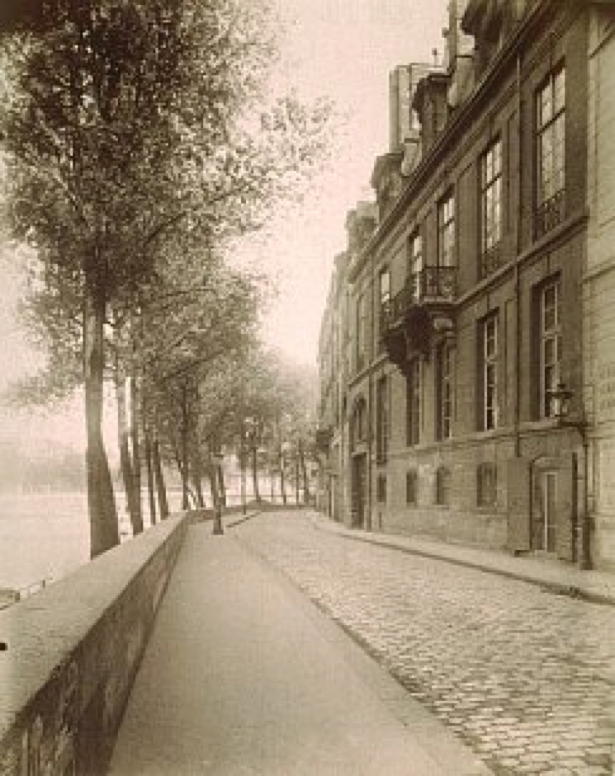
Hôtel de Lauzun, the meeting place of the Club des Hachichins
It may be cliché to say so, but there does seem to be a strong correlation between experiments with mind-altering chemicals and some of the most intriguing experiments in literary style. Samuel Taylor Coleridge, Arthur Rimbaud, William S. Burroughs, Hunter S. Thompson…. Of course, it is necessary to point out that these talented writers were already that—talented writers—substances or no. As one of Rimbaud’s modern children, Patti Smith, declares, drugs are “not really how one accesses the imagination. It can be a tool, but when that tool starts to master you, you’ll lose touch with your craft.”
This seems to have happened to Smith’s literary idol. One of Rimbaud’s literary heroes, Charles Baudelaire, also eventually succumbed to his excessive use of laudanum, alcohol, and opium. But at one time, Baudelaire dabbled with a much less destructive drug, hashish, along with a coterie of other artists, including Alexandre Dumas, Gérard de Nerval, Victor Hugo, Honoré de Balzac, and painter Eugène Delacroix. The French greats gathered in a gothic house, from 1844–1849, under the moniker Club des Hachichins and partook of the drug, introduced to it by medical doctor Jacques-Joseph Moreau and writer and journalist Théophile Gautier. Writes The Guardian:
…ritualistically garbed in Arab clothing, they drank strong coffee, liberally laced with hashish, which Moreau called dawamesk, in the Arabic manner. It looked, reported the members, like a greenish preserve, its ingredients a mixture of hashish, cinnamon, cloves, nutmeg, pistachio, sugar, orange juice, butter and cantharides. Some of them would write of their “stoned” experiences, although not all. Balzac attended the club but preferred not to indulge, though some time in 1845 the great man cracked and ate some. He told fellow members he had heard celestial voices and seen visions of divine paintings.
Baudelaire declared the hash admixture “the playground of the seraphim” and “a little green sweetmeat.” And yet, like Balzac, he “rarely, if indeed ever, indulged.” Gautier would write of the poet, “It is possible and even probable that Baudelaire did try hascheesh once or twice by way of physiological experiment, but he never made continuous use of it. Besides, he felt much repugnance for that sort of happiness, bought at the chemist’s and taken away in the vest-pocket.”
This “repugnance” did not keep Baudelaire from other drugs. And it did not keep him from writing a short book in 1860 on hash and opium, Artificial Paradises (Les Paradis Artificiels). The Paris Review reprints an excerpt of one section, “The Poem of Hashish”—not in fact a poem, but a descriptive essay. Translated by Aleister Crowley—another writer whose experiments with chemical excess contributed to some of the strangest books written in English—Baudelaire’s prose is almost medical in its precision. In part a response to Thomas de Quincy’s 1821 drug memoir Confession’s of an English Opium Eater, the symbolist poet’s treatise does not draw the conclusions one might expect.
Though he writes stunningly vivid, almost seductive, descriptions of hash intoxication, instead of praising the creative effects of drugs, Baudelaire disparages their use and warns of addiction, especially for the artist. At one point, he writes, “He who would resort to a poison in order to think would soon be incapable of thinking without the poison. Can you imagine this awful sort of man whose paralyzed imagination can no longer function without the benefit of hashish or opium?” Baudelaire recognized these stifling effects even as he lapsed into addiction himself, describing in withering terms the search “in pharmacy” for an escape from “his habitaculum of mire.”
You can read an excerpt of the Crowley-translated “The Poem of Hashish” at The Paris Review’s site and the full translation here. Those who have indulged in their own cannabis experiments—legally or otherwise—will surely recognize the poetic accuracy of his hash portrait, so perfect that it’s hard to believe he didn’t partake at least once or twice at the all-star Club des Hachichins:
Hashish often brings about a voracious hunger, nearly always an excessive thirst … Such a state would not be supportable if it lasted too long, and if it did not soon give place to another phase of intoxication, which in the case above cited interprets itself by splendid visions, tenderly terrifying, and at the same time full of consolations. This new state is what the Easterns call Kaif. It is no longer the whirlwind or the tempest; it is a calm and motionless bliss, a glorious resignèdness. Since long you have not been your own master; but you trouble yourself no longer about that. Pain, and the sense of time, have disappeared; or if sometimes they dare to show their heads, it is only as transfigured by the master feeling, and they are then, as compared with their ordinary form, what poetic melancholy is to prosaic grief.
via The Paris Review
Related Content:
Carl Sagan Extols the Virtues of Cannabis (1969)
The Coffee Pot That Fueled Honoré de Balzac’s Coffee Addiction
Josh Jones is a writer and musician based in Durham, NC. Follow him at @jdmagness
Read More...Shakespearean Actor Brian Cox Teaches Hamlet’s Soliloquy to a 2‑Year-Old Child
Perhaps you’ve seen Scottish actor Brian Cox in blockbuster films like Braveheart, The Bourne Identity, or Troy. Or, if you’re lucky enough, you’ve seen him perform with the Royal Shakespeare Company in critically-acclaimed performances of The Taming of The Shrew and Titus Andronicus. But there’s perhaps another role you haven’t seen him in: tutor of toddlers. Several years back, Cox taught Theo, then only 30 months old, the famous soliloquy from Hamlet, hoping to show there’s a Shakespearean actor in all of us. Later, Cox talked to the BBC about his “masterclass” with Theo and what he took away from the experience. Watch him muse right below:
Related Content:
Orson Welles’ Radio Performances of 10 Shakespeare Plays
Pink Floyd’s David Gilmour Sings Shakespeare’s Sonnet 18
Free Online Shakespeare Courses: Primers on the Bard from Oxford, Harvard, Berkeley & More
Read More...Quentin Tarantino Supercuts Explore the Director’s Stylized Use of Sound, Close Ups & Cars in His Films
It’s not surprising perhaps that we are in a film nerd supercut golden age. After all, all film students have access to video editing software, almost all movies are available digitally, and websites, like this one, are perpetually hungry for new content. Great supercuts reveal something new or unnoticed about a great director, like how Yasujiro Ozu uses hallways or Kubrick favors one-point perspective. Editor Jacob T. Swinney, who won the internet last month with his video “First and Final Frames,” just released the third out of a promised four-part supercut on Quentin Tarantino.
The director of Pulp Fiction and Death Proof is, of course, known for his dialogue – razor-sharp, obscenity-laden repartee crammed with references to pop culture or obscure movies. What is a Tarantino movie without a rant about the true meaning of “Like a Virgin,” say, or a lengthy discourse on the difference between McDonald’s menus in American and in Europe? Swinney strips away all that dialogue to explore some of the recurring visual and audial motifs that lard Tarantino’s films. What you realize after watching these is just how stylized his movies are. Tarantino loves expressionistic sound effects, flashy insert shots, generally aping the look and feel of his cinematic heroes like Sergio Leone or King Hu. You can watch the first film above and the next two below.
The first film called “Hearing Tarantino” is about all the pungent, stylized sounds the QT has used. As you can imagine, there are lots of gurgling of blood and clanking of swords. What you might not have noticed is how many cartoony whooshes and zings he has folded into the sound mix.
The second vid, “Tarantino’s Extreme Close Ups,” shows lots of eyes bearing expressions somewhere along the terrified-pissed off spectrum.
And the third piece, “Tarantino: Driving Shots,” shows just how much of his movies take place in cars.
The fourth film has yet to come out, but I hope it’s on Tarantino’s not-at-all creepy obsession with women’s feet. You can probably fill a couple minutes just on Uma Thurman’s alone.
Related Content:
Watch Free Online My Best Friend’s Birthday, Quentin Tarantino’s 1987 Debut Film
Jonathan Crow is a Los Angeles-based writer and filmmaker whose work has appeared in Yahoo!, The Hollywood Reporter, and other publications. You can follow him at @jonccrow. And check out his blog Veeptopus, featuring lots of pictures of badgers and even more pictures of vice presidents with octopuses on their heads. The Veeptopus store is here.
Read More...Hear Orson Welles Read Edgar Allan Poe on a Cult Classic Album by The Alan Parsons Project
If someone asks whether you like Tales of Mystery and Imagination, you’d better clarify which Tales of Mystery and Imagination they mean: the first complete collection of horror and suspense stories by master of psychological unease Edgar Allan Poe, or the first album by progressive rock band The Alan Parsons Project? But if you like one, you might well like the other, given that Parsons based his group’s debut, which contains such tracks as “The Raven,” “The Cask of Amontillado,” and “The Fall of the House of Usher,” directly on Poe’s work.
Not only do Parsons’ compositions use Poe’s themes, they use Poe’s words. “How important the Poe concept is is questionable,” declared the contemporary Billboard review, “but the LP as a whole holds up well as a viable musical work.” It having been 1976, the writer does note its “strong FM potential,” but time has much increased Tales of Mystery and Imagination’s status in rock, progressive or otherwise. All Music Guide’s Mike DeGagne more recently called the album “an extremely mesmerizing aural journey” and “a vivid picture of one of the most alluring literary figures in history.”
Of course, those two reviews don’t evaluate quite the same production, since, in 1987, Parsons, a born studio tinkerer, went back and remixed Tales of Mystery and Imagination. He added a good deal of not just 1980s-style reverb, but new guitar bits and pieces of Poe recital, this time performed by no less an ideal reader than Orson Welles, who’d sent Parsons a tape of his Poe performance shortly after the original album appeared. You can hear his contribution on the tracks “A Dream Within a Dream” and “Fall of the House of Usher.” Both above. The complete album is available below on Spotify.
You might wonder what work of Poe’s, exactly, you hear Welles reading from, since none of it sounds like the writer’s best-known passages. The words spoken in “A Dream Within a Dream” come from a reflection Poe wrote in his Marginalia, and those in “The Fall of the House of Usher” perform something of a remix themselves, combining more nonfiction from the Marginalia with the introduction to his Poems of Youth. Only a dedicated Poe enthusiast indeed would recognize all these passages, but surely such a person would love both Tales of Mystery and Imagination and Tales of Mystery and Imagination. If you, personally, don’t go in for Poe in the prog-rock treatment, might I suggest Parsons’ take on Asimov?
Related Content:
Lou Reed Rewrites Edgar Allan Poe’s “The Raven.” See Readings by Reed and Willem Dafoe
James Earl Jones Reads Edgar Allan Poe’s “The Raven” and Walt Whitman’s “Song of Myself”
Iggy Pop, Debbie Harry, Jeff Buckley & Other Celebs Read Tales by Edgar Allan Poe
Edgar Allan Poe’s “The Raven,” Read by Christopher Walken, Vincent Price, and Christopher Lee
Watch the 1953 Animation of Edgar Allan Poe’s “The Tell-Tale Heart,” Narrated by James Mason
Download The Complete Works of Edgar Allan Poe: Macabre Stories as Free eBooks & Audio Books
Colin Marshall writes on cities, language, Asia, and men’s style. He’s at work on a book about Los Angeles, A Los Angeles Primer, and the video series The City in Cinema. Follow him on Twitter at @colinmarshall or on Facebook.
Read More...Library of Congress Launches New Online Poetry Archive, Featuring 75 Years of Classic Poetry Readings
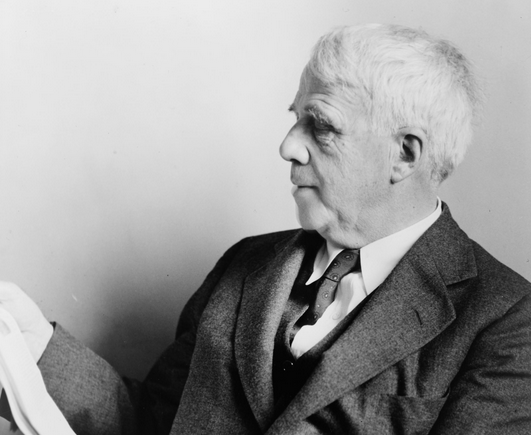
Image by Fred Palumbo, made available by the Library of Congress.
Put THIS in your pocket. The Library of Congress is celebrating National Poetry Month by launching its new Archive of Recorded Poetry and Literature. It debuts with 50 choice poetry recordings, spanning 75 years of time. In the past, you’d have had to visit the library in person to listen to these goodies on reel-to-reel tape. Now you can take them to the gym, plug in as you wash dishes, post online links for your minions to enjoy.
Newly ensconced Consultant in Poetry Gwendolyn Brooks (was there ever a more recognizable voice?) prefaces her reading by pledging her intention to register “on the public consciousness and conscience the generally neglected richness of ‘minority poetry.’”
Robert Frost tells Randall Jarrell of his desire to identify American antiquity — to feature in his poetry a woodchopper’s hut that looks “as old as Babylon.”
Paul Muldoon shares the story of how he came to own the eelskin bag that is the star of “The Briefcase.”
Armchair travelers who still yearn to make that trip to DC in their minds will enjoy Elizabeth Bishop’s “View of the Capitol from the Library of Congress” (at the 4:02 mark), read at the Library of Congress’s own Coolidge Auditorium. Visitors can also stream readings by Ray Bradbury (below), Margaret Atwood, and Kurt Vonnegut.
As part of its ongoing commitment to the form, the Library will be adding to the online archive on a monthly basis. Let every month be Poetry Month! You can stream the complete collection here.
Related Content:
Penn Sound: Fantastic Audio Archive of Modern & Contemporary Poets
Stream Classic Poetry Readings from Harvard’s Rich Audio Archive: From W.H. Auden to Dylan Thomas
Listen to 90 Famous Authors & Celebrities Read Great Stories & Poems
Ayun Halliday is an author, illustrator, and Chief Primatologist of the East Village Inky zine. Follow her @AyunHalliday
Read More...Milton Glaser Draws Shakespeare & Explains Why Drawing is the Key to Understanding Life
In this fascinating over-the-shoulder film of the artist/designer Milton Glaser, we watch as the man behind the “I Heart NY” logo, the Bob Dylan psychedelic silhouette, and the Brooklyn Brewery logo draws Shakespeare and delivers his thoughts about drawing.
He only talks for five minutes–and before you know it, he’s produced a sketch of The Bard. We wish it was more, but his observations make for some good inspirational quotes, whether you dabble in art or not. He critiques art schools for dropping drawing from their curriculums because drawing doesn’t jibe with their computer-based, career focus. “While people have what they need, perhaps, for their professional life, what they don’t have is a fundamental instrument for understanding the reality of that life,” he opines.
Drawing is how Glaser understands the world, and how it keeps him present in reality. It’s the basis for all art that is to come, no matter if the student goes on to abstraction. It’s also essential, he says, for child development, and any child not given the tools to make art is being done a disservice.
For those wondering about that book Glaser mentions writing, Drawing Is Thinking, you can get it here.
And if you’re curious about Frank R. Wilson’s The Hand, which Glaser compliments, it’s here.
And finally, if you need a quick primer on the man, here’s a quick overview of Milton Glaser by the New York Times. “Drawing is my greatest pleasure,” he says, and it shows.
Related Content:
World-Renowned Graphic Designer Milton Glaser Has a Laugh on Old Jews Telling Jokes
Sketches of Artists by the Late New Media Designer Hillman Curtis
Mickey Mouse In Vietnam: The Lost Anti-War Animation from 1968
Ted Mills is a freelance writer on the arts who currently hosts the FunkZone Podcast. You can also follow him on Twitter at @tedmills, read his other arts writing at tedmills.com and/or watch his films here.
Read More...Discover Haruki Murakami’s Advertorial Short Stories: Rare Short-Short Fiction from the 1980s
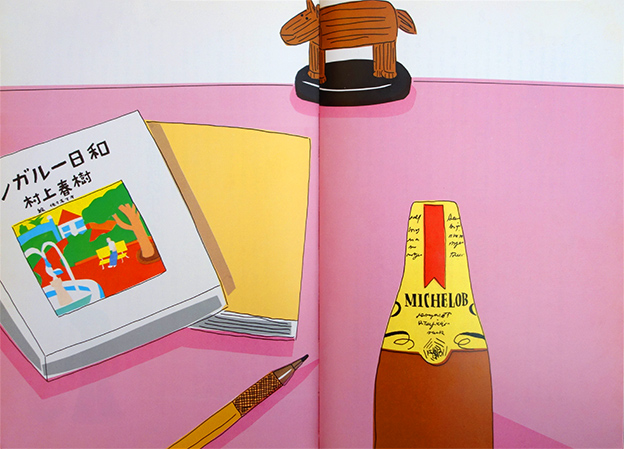
No profile of Haruki Murakami, the most globally popular novelist alive, fails to refer to the high number of languages (as of this writing, the count has reached 50) in which his 14 Japanese-language novels have appeared in translation. But outside Japan, monoglot Murakamists (especially readers of only English) have a problem: they still can’t read a wealth of Murakami’s other, non-novelistic writing, including the full-length, two-volume version of Underground, his study of the 1995 Tokyo sarin gas attack; his Portrait in Jazz books on his favorite music; and most of his many essays and movie reviews.
Even some of Murakami’s fiction has remained more or less off-limits to global readers. I discovered this when I came across a collection of his I’d never even heard of while book-shopping in Seoul. Realizing that of course more Murakami material would find its way into Korean, a grammatically similar language to Japanese, than English, I set about checking every bookstore in the city I knew for other unknown volumes. One book of short stories, titled in Korean 밤의 원숭이 (Spider Monkey of the Night), particularly delighted me with its strange and extremely brief tales, each accompanied by charming illustrations.

But where did these stories, with their titles like “Hotel Lobby Oysters,” “Julio Iglesias,” and “Takayama Noriko and My Libido,” come from? They came, as Neojaponisme’s post on them explains, from the world of advertising, and specifically from a company called “Onward,” which marketed the American Ivy League fashion label J. Press in Japan:
In the late 1970s and early 1980s, Onward spent massive sums on advertising J. Press in the print media. The classic ad format, often seen on the back cover of lifestyle magazine Popeye, showed a Japanese or American man telling a colorful story about their favorite trad clothing item. In 1985, as Japanese pop culture went in more avant-garde directions, Onward came up with a new idea — asking up-and-coming novelist Murakami Haruki to write a very short story inside each month’s advertisement for magazines Popeye, Box, and Men’s Club.
“So once a month from April 1985 to February 1987, Murakami wrote a ‘short short’ (短い短編), which was set on its own page with an illustration by famed artist Anzai Mizumaru at the top and a small J. Press logo in the lower left corner.” During that time, out came Murakami’s hit novel Norwegian Wood, which rocketed him to a level of fame that effectively put him in exile from his homeland. But the advertorial short-short form still appealed to him, and in 1993 he got famous penmaker Parker to sponsor 24 new ones.
To give you a flavor of all this, below is one of the English-language translations floating around of “Hotel Lobby Oysters,” Murakami’s first J. Press story. (You can also read “Miss Noriko Takayama and My Libido,” another J. Press story here):
At the time I was sitting on the hotel lobby sofa and vaguely thinking about oysters. Not lemon soufflé, not pencil sharpeners – oysters. I don’t know why. I just suddenly realized that I was thinking about oysters.
The oysters I was thinking about on the hotel lobby sofa were different from oysters thought about anywhere else. They were shaped differently, they smelled differently, and their color was different, too. They weren’t oysters harvested in some cove. They were pure oysters harvested in a hotel lobby.
After thinking about oysters for a while, I went to the sink to wash my face, then retied my tie and returned to the sofa. When I got back, the oysters had already disappeared from inside my head. Again, I don’t know why. Maybe it was because I washed my faced or because I retied my tie. Or maybe the hotel oyster season is extremely short.
When the girl came 17 minutes after our appointed time, I told her about the hotel lobby oysters. The image was so distinct I felt like I had to tell someone about them.
“You want to eat oysters?” she asked.
“No, these oysters, they were purely oysters as a concept, unrelated to my appetite,” I explained. “The oysters came into being as the very essence of oys—“
“But you do want to eat some, right?” she said.
When she mentioned it and I settled down to think about it, I certainly had developed an incredible desire to eat oysters. We went to the hotel restaurant and ate 25 oysters while drinking wine. Sometimes I think my appetite originates from a really strange place.
And, for Parker, Murakami wrote, “Spider Monkey of the Night”:
I was sitting at my desk at 2:00 in the morning and writing. I pushed my window open and a spider monkey came in.
“Oh, hey, who are you?” I asked.
“Oh, hey, who are you,” the spider monkey said.
“Don’t copy me,” I said.
“Don’t copy me,” the monkey said.
“Don’t copy me,” I copied him.
“Don’t copy me,” he copied me in italics.
Man, this is really annoying, I thought. If I get caught up with this copycat-crazed night monkey, who knows when this will end. I’ll just have to trip him up somewhere. I had a job that I had to finish by morning, and I couldn’t very well keep doing this all night.
“Heppoku rakurashi manga totemuya, kurini kamasu tokimi wakoru, pacopaco,” I said quickly.
“Heppoku rakurashi manga totemuya, kurini kamasu tokimi wakoru, pacopaco,” the spider monkey said.
Since I had said something completely random, I couldn’t actually tell if the monkey had copied me correctly or not. Well, that was pointless.
“Leave me alone,” I said.
“Leave me alone,” the monkey said.
“You got it wrong, I didn’t say it in italics that time.”
“You got it wrong, I didn’t say it in ītalics that time.”
“I didn’t put a macron over the i.”
“I didn’t put a macron over the eye.”
I sighed. No matter what I said, the spider monkey wouldn’t understand. I decided to not say anything and just keep doing my work. Still, when I pressed a key on my word processor, the monkey silently pressed the copy key. Click. Still, when I pressed a key on my word processor, the monkey silently pressed the copy key. Click. Leave me alone. Leave me alone.
via Neojaponisme
Related Content:
Read 3 Stories from Haruki Murakami’s Short Story Collection Published in Japan Last Year
Read 6 Stories By Haruki Murakami Free Online
Haruki Murakami Lists the Three Essential Qualities For All Serious Novelists (And Runners)
Haruki Murakami’s Passion for Jazz: Discover the Novelist’s Jazz Playlist, Jazz Essay & Jazz Bar
Colin Marshall writes on cities, language, Asia, and men’s style. He’s at work on a book about Los Angeles, A Los Angeles Primer, and the video series The City in Cinema. Follow him on Twitter at @colinmarshall or on Facebook.
Read More...Support Us
We're hoping to rely on loyal readers, rather than erratic ads. Please click the Donate button and support Open Culture. You can use Paypal, Venmo, Patreon, even Crypto! We thank you!

About Us

Open Culture scours the web for the best educational media. We find the free courses and audio books you need, the language lessons & educational videos you want, and plenty of enlightenment in between.
Advertise With Us

FREE UPDATES!
GET OUR DAILY EMAIL
Get the best cultural and educational resources on the web curated for you in a daily email. We never spam. Unsubscribe at any time.
FOLLOW ON SOCIAL MEDIA

Open Culture editor Dan Colman scours the web for the best educational media. He finds the free courses and audio books you need, the language lessons & movies you want, and plenty of enlightenment in between.
Advertise With Us