Hear What is Jazz?: Leonard Bernstein’s Introduction to the Great American Art Form (1956)
By 1956, jazz was entering its hard bop phase, far from its New Orleans birthplace. At the same time, it was fracturing into several international genres, with the influence of Latin rhythms and the south sea breezes of lounge.
Rock and Roll was just about to displace this music as a public menace du jour (or a passing fad as some thought). This fascinating Columbia release from 1956 finds the composer and conductor Leonard Bernstein setting down his thoughts on the art form of jazz. A spoken word record with samples from ragtime to Miles Davis, Bernstein’s defense-as-lecture is a window on the culture wars at the time.
He’s here to defend jazz against its critics, and argues against their opinions: jazz has low-class origins, it’s loud, and it’s not art — the same critiques to be leveled decades later against hip hop.
In 1956, Bernstein was already known to the general public as an educator on classical music. He gave lectures on CBS’ Omnibus TV program on the great symphonies, while he had already dabbled in the instrumentation and textures of jazz in his score to On the Waterfront, and was busy working on West Side Story. So he was in a perfect position to introduce a conservative mind to jazz. “I love it because it’s an original kind of emotional expression, in that it is never wholly sad or wholly happy,” he says.
Appearing on the album is Buck Clayton, Louis Armstrong, Buster Bailey, Bessie Smith, Teo Macero, and Miles Davis. Davis, who had just been signed by Columbia’s George Avakian, plays “Sweet Sue,” making this track his first recording for the label. Bernstein illustrates jazz music theory, “blue notes,” dissonance, rhythm and explores the African origins of the music for 42 fascinating minutes. Did this LP turn a lot of classical musos on to jazz? Did this influence the children whose parents had this in their collection? Was it all forgotten several years later with Beatlemania? Whatever the answer, it’s an intriguing remnant of a transitional time.
Related content:
Leonard Bernstein’s First “Young People’s Concert” at Carnegie Hall Asks, “What Does Music Mean?”
Leonard Bernstein Demystifies the Rock Revolution for Curious (if Square) Grown-Ups in 1967
Ted Mills is a freelance writer on the arts who currently hosts the FunkZone Podcast. You can also follow him on Twitter at @tedmills, read his other arts writing at tedmills.com and/or watch his films here.
Read More...The Poetry of the Cherry Blossoms Comes to Life in a One Minute Time Lapse Video
Are we to look at cherry blossoms only in full bloom, the moon only when it is cloudless? To long for the moon while looking on the rain, to lower the blinds and be unaware of the passing of spring—these are even more deeply moving. Branches about to blossom or gardens strewn with faded flowers are worthier of our admiration.
-Yoshida Kenko, Essays in Idleness (1330–1332)
Depending on your coordinates, cherry blossom season is either approaching, over, or in full riotous bloom. Every year, the Brooklyn Botanic Garden schedules its annual Sakura Matsuri festival in ignorance of what the weather may hold. Will lingering winter temperatures delay the blossoms, or will spring come early, causing the trees to erupt way earlier than anticipated?
The only thing one can be certain of is a mob scene, as ardent flower-viewers of all ages stampede toward the cotton candy-colored trees, devices in hand. Modern hanami practice would surely confound the elite of the 8th Century Imperial Court. They wouldn’t have understood the concept of “selfie” if it bit ‘em in the shakuhachi.
Of course, for every determined 21st-century soul who makes a point of admiring the blossoms during their brief appearance, there are thousands more who, in the words of bureaucrat-turned-monk, Kenko, “lower the blinds…unaware of the passing of spring.”
Perhaps this latter group is who Dave Allen, the Brooklyn Botanic Garden’s former webmaster, had in mind when he installed a camera in a weatherproof box near the Cherry Esplanade. Every 3 minutes, the shutter snapped, capturing not just the glorious Prunus ‘Kanzan’ (aka Sekiyama) that line the walkways, but also a wide range of visitors who flocked to the garden between April 18 to April 26, 2008, seeking respite from the pressures of urban living.
The time lapse video Allen assembled from 3000 captured moments takes slightly more than a minute to view. I think we have time to spare…
Watch it once for the main attraction…
And then again for the (pixillated) people. Randomly press “pause” to catch a kissing couple, a Hasidic man in a shtreimel, and a little girl in pink who somehow found herself the sole human on the path…
Then one more time for the shadows of the clouds. Ah… That’s likely the time-strapped virtual viewer’s best chance for achieving the sort of mindset one might ascribe to The Tale of Genji.
(Though perhaps a calm and contemplative mood was never the goal. As ninth century aristocratic poet Ariwara no Narihira wrote (in translation by Hiroaki Sato & Burton Watson):
If there were no such thing
as cherry blossoms
in this world,
in springtime how untroubled
our hearts would be!
There is a modern scholar on Tumblr whose research supports this take on the pink blooms’ blood quickening effects.)
In a week or two it will all be over.
As the petals fall, take refuge in Toi Derricotte’s recent poem. Its setting should feel familiar…
I went down to
mingle my breath
with the breath
of the cherry blossoms.
There were photographers:
Mothers arranging their
children against
gnarled old trees;
a couple, hugging,
asks a passerby
to snap them
like that,
so that their love
will always be caught
between two friendships:
ours & the friendship
of the cherry trees.
Oh Cherry,
why can’t my poems
be as beautiful?
A young woman in a fur-trimmed
coat sets a card table
with linens, candles,
a picnic basket & wine.
A father tips
a boy’s wheelchair back
so he can gaze
up at a branched
heaven.
All around us
the blossoms
flurry down
whispering,
Be patient
you have an ancient beauty.
Be patient,
you have an ancient beauty.
Related Content:
Spring: A Short Film Based on Hemingway’s Memoir
Venice in a Day: From Daybreak to Sunset in Timelapse
The Beauty of Namibian Nights in Timelapse Motion
Ayun Halliday will be releasing the 55th issue of her zine, the East Village Inky at the Brooklyn Zine Fest this Sunday. Follow her @AyunHalliday
Read More...John Cleese Explores the Health Benefits of Laughter
If you live in a big city like Los Angeles or San Francisco, you’ll discover that there are just a bewildering variety of yoga styles out there — there’s Ashtanga Yoga if you want a real work out, there’s Yin Yoga if you want to chill out and there’s Bikram Hot Yoga if you want heat stroke. Add to this list Laughter Yoga. Yes, Laughter Yoga.
For a segment of the 2001 BBC series The Human Face, John Cleese, a man who knows something about laughter, ventured to Mumbai, India to see what Laughter Yoga is all about. He interviews the man behind it all, Dr. Madan Kataria, who argues that laughter is brilliant at lowering stress and improving the immune system. And best of all, you don’t even need mats or unflattering pants to do it. You just need a group of like-minded people and a willingness to look silly. In the video, which you can see above, Cleese yuks it up with a group of Mumbai locals.
“We all know what a good laugh feels like,” he tells the camera. “But what struck me was how easy it was to get started. When you have a lot of warm, friendly, funny faces coming at you, you respond very naturally…I’m struck by how laughter connects you to people. It’s almost impossible to maintain any kind of distance or any sense of social hierarchy when you’re just howling with laughter. Laughter is a force for democracy”
Apparently, you don’t even have to be in an especially jolly mood to reap the health benefits of Laughter Yoga. Forced laughter tricks the body into releasing endorphins too. In Laughter Yoga, as with life, the motto is “fake it til you make it.”
So if you are interested in laughing like a madman in the privacy of your own home, Dr. Kataria has an instructional video for you, which you can see right above. There are a surprising number of laughing exercises available — from the milkshake move, where you pantomime guzzling a drink, to the argument laughter, where you wag a finger, to the Visa laughter where you pretend to laugh through the tears as you open your credit card statement. So go ahead and try it. You’ll feel better.
Related Content:
John Cleese’s Philosophy of Creativity: Creating Oases for Childlike Play
Sonny Rollins Describes How 50 Years of Practicing Yoga Made Him a Better Musician
Free Guided Meditations From UCLA: Boost Your Awareness & Ease Your Stress
Jonathan Crow is a Los Angeles-based writer and filmmaker whose work has appeared in Yahoo!, The Hollywood Reporter, and other publications. You can follow him at @jonccrow. And check out his blog Veeptopus, featuring lots of pictures of badgers and even more pictures of vice presidents with octopuses on their heads. The Veeptopus store is here.
Read More...An Animated Ray Bradbury Explains Why It Takes Being a “Dedicated Madman” to Be a Writer
The good folks at Blank on Blank have been breathing new life into long-lost recorded interviews with cultural icons by turning them into animated shorts. In the past, they have made films featuring the likes of Janis Joplin, David Foster Wallace, Jim Morrison and Dave Brubeck. For their most recent release, they do Ray Bradbury, the beloved sci-fi author and monorail enthusiast. You can watch it above.
In 2012, Lisa Potts found a cassette tape wedged behind a dresser. It contained an interview she did with Bradbury back in 1972 when she was a student journalist. Potts and fellow student Chadd Coates talked to the author in the back of a car while they were making their way from Bradbury’s West L.A. home to Chapman College in Orange County where he was slated to give a lecture.
In the interview, Bradbury expounds on a wide range of topics – from the importance of friends – “That’s what friends are, the people who share your crazy outlook and protect you from the world” – to his fear of driving – “The whole activity is stupid.”
But the area where he seems to get the most passionate is, not surprisingly, about the act of creating. According to Bradbury, you don’t need a fancy, overpriced MFA to write. He never went to college after all. His school was his local public library. What you really need to be a writer is an obsessive love of writing, friends who are willing to nourish your obsession and a willingness to be a little crazy.
I am a dedicated madman, and that becomes its own training. If you can’t resist, if the typewriter is like candy to you, you train yourself for a lifetime. Every single day of your life, some wild new thing to be done. You write to please yourself. You write for the joy of writing. Then your public reads you and it begins to gather around your selling a potato peeler in an alley, you know. The enthusiasm, the joy itself draws me. So that means every day of my life I’ve written. When the joy stops, I’ll stop writing.
For anyone sweating blood in a coffee shop over a stubborn screenplay or novel, lines like that are balm for the soul. The whole interview has this same infectious joy of creating. Bradbury, by the way, wrote up until he died at the age of 91.
Related Content:
Ray Bradbury Gives 12 Pieces of Writing Advice to Young Authors (2001)
A Day in the Afterlife: Revisiting the Life & Times of Philip K. Dick
Animations Revive Lost Interviews with David Foster Wallace, Jim Morrison & Dave Brubeck
Jonathan Crow is a Los Angeles-based writer and filmmaker whose work has appeared in Yahoo!, The Hollywood Reporter, and other publications. You can follow him at @jonccrow. And check out his blog Veeptopus, featuring lots of pictures of badgers and even more pictures of vice presidents with octopuses on their heads. The Veeptopus store is here.
Read More...Hear Dziga Vertov’s Revolutionary Experiments in Sound: From His Radio Broadcasts to His First Sound Film
The documentary form, like every other kind of onscreen storytelling, is a very recent development in human history. Yet we tend to take for granted the way in which it constructs our sense of reality—from not only much-maligned reality TV, but also endless loops of cable news and Netflix channels. But the man widely credited with the invention of documentary film, Dziga Vertov, made decidedly anti-story movies, particularly his Man With a Movie Camera (watch it online here)—a film that jars contemporary sensibilities. With no narrative to speak of, the movie contains roughly 1,775 separate shots from three cities, shot over four years time, and edited together by his wife. Its viewing is indeed a dizzying experience, and its director Vertov—born David Kaufman—truly illustrates the aesthetic of his pseudonym, which means “spinning top.”
Vertov’s radical experimentation did not begin and end with Man With a Movie Camera or his other avant-garde documentaries and animations. (Find eight of Vertov’s films here.) Once a psychology student in Petrograd, the future filmmaker started his artistic career as a writer of futurist poetry and science fiction. Entranced by emerging recording technology and committed to disrupting traditional forms, in 1916 Vertov began, writes Monoskop, “experimenting with the perception and arrangement of sound.”
He created “sound poems,” and produced “verbal montage structures.” Of his audio art, Vertov remarked, “I had an idea about the need to enlarge our ability for organized hearing. Not limiting this ability to the boundaries of usual music. I decided to include the entire audible world into the concept of ‘Hearing.’”
After the Russian Revolution, Vertov embraced Bolshevist agit-prop; his “Kino-Pravda,” or “truth films,” celebrated industrialization and the Russian worker. His first sound film, Enthusiasm! The Donbass Symphony (1930)—a “paean to coal and steel workers”—integrates his experiments with sound recording in an entirely novel way. Ubuweb describes the film and its accompanying soundtrack as “Vertov’s most revolutionary achievement: a symphony of abstract industrial noise for which a specially designed giant mobile recoding system was constructed (it weighed over a ton) in order to capture the din of mines, furnaces and factories. For Vertov, the introduction of sound film didn’t mean talkies, but the opportunity to collage, montage and splice together constructions of pure environmental noise.”
You can hear three excerpts of this industrial sound collage above and the remaining seven at Ubuweb. Listen to them first as examples of “sound poems,” then watch Enthusiasm: The Donbass Symphony at the top for a better understanding of why Vertov remains such an influential, indeed essential, film—and audio—artist widely credited with freeing new media from the aesthetic confines of the stage and the page. Just below, listen to one of Vertov’s early experiments with documentary sound art, from 1916. Just as he sought to create an international worker’s visual language through film, “Through radio, he attempted to establish auditory communication across the whole of the world’s proletariat by way of recording the sounds of workplaces and of life itself.”
Related Content:
Free: Dziga Vertov’s A Man with a Movie Camera, the 8th Best Film Ever Made
Watch Dziga Vertov’s Unsettling Soviet Toys: The First Soviet Animated Movie Ever (1924)
Eight Free Films by Dziga Vertov, Creator of Soviet Avant-Garde Documentaries
Josh Jones is a writer and musician based in Durham, NC. Follow him at @jdmagness
Read More...Fritz Lang Tells the Riveting Story of the Day He Met Joseph Goebbels and Then High-Tailed It Out of Germany
“I was uncomfortable & I felt the sweat roll down my back.”
— Fritz Lang,
on his meeting with Joseph Goebbels in Berlin, 1933. pic.twitter.com/08mbiy46ww
— DepressedBergman (@DannyDrinksWine) November 4, 2023
The more World War II history you read, the more you understand not just the evil of the Nazis, but their incompetence. Sometimes you hear variations on the observation that “in Nazi Germany, at least the trains ran on time,” but even that has gone up for debate. It seems more and more that the Holocaust-perpetrating political party got by primarily on their way with propaganda — and in that, they did have a truly formidable apparatus.
Much of the dubious credit there goes to Hitler’s close associate Joseph Goebbels, Reich Minister of Propaganda and an anti-semite even by Nazi standards. “Power based on guns may be a good thing,” he said in a 1934 Nuremberg Party Convention speech. “It is, however, better and more gratifying to win the heart of a people and keep it.” He understood the power of film in pursuit of this end, providing not only essential assistance for productions like Leni Riefenstahl’s Triumph of the Will, but also attempting to recruit no less a leading light of German cinema than Fritz Lang, director of three Doctor Mabuse pictures, the proto-noir M, and the expressionist epic Metropolis.
Goebbels loved Metropolis, but had rather less appreciation for The Testament of Dr. Mabuse, going so far as to ban it for its supposed potential to instill in its viewers a distrust of their leaders. And so, on one fateful day in 1933 when Goebbels called Lang to his office, the filmmaker wondered if he might find a way to get the ban lifted. But Goebbels preferred to talk, at great length, about another proposal: Lang’s employment in artistic service of the Nazi cause.
“The Fuhrer and I have seen your films,” Lang quotes Goebbels as saying, “and the Fuhrer made clear that ‘this is the man who will give us the national socialist film.’ ” Feeling no choice but to thank Goebbels for the honor and ostensibly accept the offered (or perhaps insisted-upon) position as the head of state film production, Lang went home and immediately told his servant to prepare luggage “for a one- or two-week trip to Paris,” leaving Germany that same evening, never to return until the late 1950s. You can hear Lang tell this story in German in the clip at the top of the post, and again in English, and in more detail, in the 1974 interview with William Friedkin above.
But did it it really happen as he says? In his Film Quarterly article “Fritz Lang and Goebbels: Myth and Facts,” Gösta Werner casts doubt, noting that “even though it is highly probable that Goebbels did offer Lang the post as head of the entire German film production, there is not a word about it in Goebbels’s usually meticulous diary for the year 1933. Lang is not mentioned there at all.” For Lang’s part, his passport’s “foreign currency stamps from Berlin testify, as do the various entry and exit stamps, that between the journeys abroad in the summer of 1933 Lang returned to Berlin, which city he left finally only on 31 July 1933 — four months after his legendary meeting with Goebbels and supposed dramatic escape.”
But then, you expect a certain amount of drama from a storyteller of Lang’s caliber, onscreen as well as off. And despite holding the views of, in Werner’s words, a “fierce nationalist,” Lang clearly made the right choice in reality by not getting caught up in the offices of the Third Reich, whenever and however he made that choice. To this day, cinephiles respect and admire the power of Lang’s filmmaking — a power that we can only feel relieved didn’t fall into the wrong hands.
via Biblioklept/Dangerous Minds
Related Content:
Watch Lambeth Walk—Nazi Style: The Early Propaganda Mash Up That Enraged Joseph Goebbels
Metropolis: Watch a Restored Version of Fritz Lang’s Masterpiece (1927)
Fritz Lang’s M: The Restored Version of the Classic 1931 Film
Fritz Lang’s “Licentious, Profane, Obscure” Noir Film, Scarlet Street (1945)
Colin Marshall writes on cities, language, Asia, and men’s style. He’s at work on a book about Los Angeles, A Los Angeles Primer, and the video series The City in Cinema. Follow him on Twitter at @colinmarshall or on Facebook.
Read More...David Lynch Creates a Very Surreal Plug for Transcendental Meditation
While fans wait with increasing dour moods on the future of the Twin Peaks reboot, David Lynch is busy doing…something. When the Tribeca Disruptive Innovation Awards honored the director for his work as founder and chairman of the David Lynch Foundation, it turned out Lynch couldn’t make the evening.
Instead of the usual apology email, the man who once turned some test footage into a weird short film made a quick video to screen at the award show. It’s…Lynchian.
The video features a Barbie doll—-renamed Trixie for this short—-lying on a purple blanket and taking a call from Lynch, who is out shopping for Trixie’s makeup. Hearing Lynch’s version of a woman’s voice is strange enough, but he goes on to chastise the young girl when she suggests sunbathing nude is a form of meditation. Then follows Lynch’s pitch for Transcendental Meditation, which he’s been using as a creative boon since before Eraserhead. See our previous post: David Lynch Explains How Meditation Enhances Our Creativity. And also: David Lynch Talks Meditation with Paul McCartney.
The video ends with some mechanical birds singing. Possibly they’re from a place where there’s always music in the air, or, most probably, from Digi Birds.
Incidentally, this isn’t Lynch’s first Barbie video. In 2011 he promoted his new coffee line with a similar video which you can check out here.
Until the Showtime/Twin Peaks negotiations are finally solved, any new Lynch is worth checking out.
Related Content:
David Lynch’s Surreal Commercials
David Lynch Teaches You to Cook His Quinoa Recipe in a Weird, Surrealist Video
David Lynch Takes Aspiring Filmmakers Inside the Art & Craft of Making Indie Films
Ted Mills is a freelance writer on the arts who currently hosts the FunkZone Podcast. You can also follow him on Twitter at @tedmills, read his other arts writing at tedmills.com and/or watch his films here.
Read More...Kickstart the Theatrical Release of the First Comprehensive Black Panther Party Documentary
I grew up with a simplistic, moralizing official history of the Civil Rights movement, one full of platitudes and false dichotomies: a sanitized version of Martin Luther King, Jr. stood as the model of a “good” Civil Rights leader; Malcolm X, the Black Panthers, and other radicals were vilified as “bad” Civil Rights leaders—or Anti-American terrorists. We read “Letter From a Birmingham Jail,” but nothing from Angela Davis, Huey Newton, Eldridge Cleaver, or Stokely Carmichael. This is how most histories go, official narratives being what they are. There are heroes and villains, and little in-between. However, there is much more ambiguity surrounding events than most of us choose to accept. I came to see things much differently regarding the Black Panther Party, though not in a way that makes me feel like trading insults with strangers on the internet. I reserve the right to make up my own mind. You must also make up yours.
But one must be informed. Which is why projects like The Black Panthers: Vanguard of the Revolution—whose Kickstarter campaign video you can see above—are so important. It weighs heavily to be writing this now, as tragedies all too familiar to the figures in the film still play out tonight and nearly every night across the U.S. We owe it to ourselves to know the histories of the current struggle, both official and unofficial. I overheard someone say recently that getting a genuine education requires taking “two sets of notes.” For those raised with a one-dimensional textbook history of the Civil Rights movement, The Black Panthers: Vanguard of the Revolution is like another set of notes, along with other films like Goran Olsson’s The Black Power Mixtape: 1967–1975, Lee Lew-Lee’s All Power to the People! The Black Panther Party and Beyond, and Mario and Melvin Van Peebles’ fictionalized history Panther.
These films provide interesting and excellent introductions to the subject, but Stanley Nelson’s documentary offers, as he puts it, “the first comprehensive look at the rise and fall of the Black Panther Party.” Nelson is an award-winning veteran documentarian whose films include Freedom Riders, Freedom Summer, Jonestown: The Life and Death of People’s Temple, and The Murder of Emmett Till. He began The Black Panthers seven years ago, and its current release, audiences have told him, “could not have come at a better time.” The film has already premiered for “a select audience” at Sundance, New York’s Museum of Modern Art, and L.A.‘s Pan African Film Festival. With eight days to go, the Kickstarter to fund the doc’s multi-city theatrical release has almost reached its goal of $50,000. See their page to help them get all the way there.
Then consider reading, and re-reading, “Letter From a Birmingham Jail.”
Related Content:
Wattstax Documents the “Black Woodstock” Concert Held 7 Years After the Watts Riots (1973)
Josh Jones is a writer and musician based in Durham, NC. Follow him at @jdmagness
Read More...Visit The Online Library of Babel: New Web Site Turns Borges’ “Library of Babel” Into a Virtual Reality
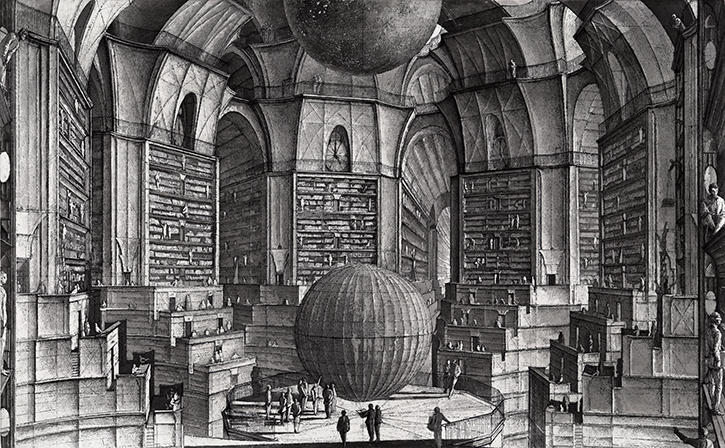
Jorge Luis Borges specialized in envisioning the unenvisionable: a map the same size as the land it depicts, an event whose possible outcomes all occur simultaneously, a single point in space containing all other points in space, a vast library containing all possible books. That last, the setting, subject, and title of his short story “The Library of Babel,” has given readers much to think about since its first publication in 1941, and in recent decades has done more than its part to bolster Borges’ posthumous reputation as a seer of our unprecedentedly rich but often difficult-to-navigate new media landscape.
Borges imagined the Library of Babel comprising a huge number of connected hexagonal rooms lined by bookshelves. “Each shelf contains thirty-five books of uniform format; each book is of four hundred and ten pages; each page, of forty lines, each line, of some eighty letters which are black in color.” Each book contains a different combination of letters, and in total they contain all possible combinations of letters, with the result that the Library as a whole contains
Everything: the minutely detailed history of the future, the archangels’ autobiographies, the faithful catalogues of the Library, thousands and thousands of false catalogues, the demonstration of the fallacy of those catalogues, the demonstration of the fallacy of the true catalogue, the Gnostic gospel of Basilides, the commentary on that gospel, the commentary on the commentary on that gospel, the true story of your death, the translation of every book in all languages, the interpolations of every book in all books.
This vision has inspired a fair few thinkers, including most recently Brooklyn author and programmer Jonathan Basile. “I was lying in bed one night and the idea of an online Library of Babel popped into my head,” he says in an interview with Flavorwire. “My first thought was — it must exist already. It seems like such a natural extension of the capabilities of a computer that I was sure someone would have made it. The next day I looked for it, a bit excitedly, and was disappointed. From then on, it’s kind of been a reluctant destiny for me.”
As the fruit of that destiny, we have libraryofbabel.info, a new web site that will theoretically come to contain exactly what Borges’ Library of Babel contains: the text of every possible 410-page book. You can start looking through them by searching for text, viewing a random book, or browsing by hexagonal chamber. You’ll notice that the vast, vast majority of Basile’s Library of Babel offers nothing but nonsense — the very same thing, in other words, that Borges’ does, which in his telling causes great frustration among the luckless librarians charged with maintaining the place.
But a visit to the online Library of Babel should bring you to the same question the original story does: to what extent does meaning reside in the physical world, and to what extent does it reside in our minds? And what would Borges himself make of all this? “He was never one to take the border between reality and fiction too seriously,” says Basile. “Reading his story is already, in its own way, entering the world of the library. In a sense it’s a horror story, but it feels to me more like a black comedy. Perhaps he would just laugh.”
Enter the online Library of Babel here.
via Flavorwire
Related Content:
Jorge Luis Borges Selects 74 Books for Your Personal Library
Jorge Luis Borges’ 1967–8 Norton Lectures On Poetry (And Everything Else Literary)
Jorge Luis Borges’ Favorite Short Stories (Read 7 Free Online)
Colin Marshall writes on cities, language, Asia, and men’s style. He’s at work on a book about Los Angeles, A Los Angeles Primer, and the video series The City in Cinema. Follow him on Twitter at @colinmarshall or on Facebook.
Read More...Animated Philosophers Presents a Rocking Introduction to Socrates, the Father of Greek Philosophy
Would there be such a thing as philosophy had there been no such person—or literary character, at least—as Socrates? Surely people the world over have always asked questions about the nature of reality, and come up with all sorts of speculative answers. But the particular form of inquiry known as the Socratic method—a blanket presumption of ignorance—would not have become the dominant force in Western intellectual history without its namesake. And that is, of course, not all. In the work of Socrates’ highly imaginative student, interpreter, and biographer Plato, we find, as Alfred North Whitehead suggested, a “wealth of general ideas” that have made for “an inexhaustible mine of suggestion” for philosophers since antiquity.
As bluesman Robert Johnson did for rock and roll, Socrates more or less single-handedly invented the formulas of Western thought. He might be called the first philosophical rock star—and judging by the Guns N’ Roses soundtrack to the animated video above, the producers of the Greek Public Television series Animated Philosophers seem to feel the same. Dubbed into English, and with character animation that owes more than a little to South Park, this episode makes the case for Socrates’ importance to philosophy as tantamount to Christ’s in Christianity. Overstated? Perhaps, but the argument is by no means a thin one.
To make the point, writer, editor, and host George Chatzivasileiou interviews Greek philosophers like Vasilis Karamanis and Vasilis Kalfas, who basically agree with Roman orator Cicero’s characterization of Socrates bringing “philosophy down from the heavens to the earth”… as well as, says Kalfas, “into the city” as a “teacher of the citizen” in a modern democratic city-state. A key part of Socrates’ appeal is that he “did not take anything for granted, no matter how obvious it may have seemed.” Though this attitude is as much a performance as it is a genuine admission of ignorance, the Socratic approach nonetheless set the standards of intellectual integrity in the West.
The comparison with Christ is relevant in more ways than one. The fathers of the Christian church relied as much on Plato and his student Aristotle—sometimes it seems even more so—as they did on the Bible. Perhaps chief among early theologians, Bishop Augustine of Hippo receives the animated rock star treatment above in another episode of Animated Philosophers, this one subtitled in English. The many other episodes in the series—on Plato, Aristotle, Democritus, Empedocles, Parmenides, Plotinus, Epicurus, Heraclitus, and Pythagoras—are all available on Youtube, but only in the original Greek with no titles or dubbing. It’s no great surprise the series focuses almost exclusively on Greek philosophers. And yet, national pride notwithstanding, the ancient civilization does have legitimate claim to the origins of the discipline, especially in that most influential figure of them all, Socrates.
Related Content:
140 Free Online Philosophy Courses
The History of Philosophy … Without Any Gaps
Allan Bloom’s Lectures on Socrates (Boston College, 1983)
Josh Jones is a writer and musician based in Durham, NC. Follow him at @jdmagness
Read More...Support Us
We're hoping to rely on loyal readers, rather than erratic ads. Please click the Donate button and support Open Culture. You can use Paypal, Venmo, Patreon, even Crypto! We thank you!

About Us

Open Culture scours the web for the best educational media. We find the free courses and audio books you need, the language lessons & educational videos you want, and plenty of enlightenment in between.
Advertise With Us

FREE UPDATES!
GET OUR DAILY EMAIL
Get the best cultural and educational resources on the web curated for you in a daily email. We never spam. Unsubscribe at any time.
FOLLOW ON SOCIAL MEDIA

Open Culture editor Dan Colman scours the web for the best educational media. He finds the free courses and audio books you need, the language lessons & movies you want, and plenty of enlightenment in between.
Advertise With Us

