Making Turkish Sand Coffee: Culinary Alchemy on the Streets of Jordan
There’s a little culinary alchemy happening in this video shot in Aqaba, Jordan. It involves coffee and sand. And “Brother Gantry” on Reddit has it all figured out. He explains:
He’s brewing coffee using techniques traditionally used to make Turkish Coffee...
Filling each of those vessels (called a cezve) partway is water, very finely ground coffee, and possibly sugar. Because this is happening in Jordan there might also be a little cardamon in there and/or no sugar.
Normally to make proper Turkish coffee you heat it to a point where it just begins to bubble, but under a rolling boil, so it begins to foam up into the neck of the cezve before reducing the heat and allowing the foam to die, repeating the process 3 or 4 times before the mixture is poured into small cups (fincan) and you’re left with a wonderfully strong, thick coffee with suspended grounds which quickly settle to the bottom. Sand over a flame traditionally used in the process as a sort of “adjustable double boiler” cups left on the surface stay warm and the heat used for brewing can be adjusted by the depth of the cezve in the sand without having to worry about the temperature of the heat source itself.
The guy in this video seems to be modifying a lot of the steps to make something like a “regular strength” coffee more theatrically using traditional equipment (e.g. he starts with much less ground coffee in the pot, judging from the color to begin with, overfilling it, not taking time to let the foam die down but pouring out some the brewing coffee into a cup to reduce the level, and pouring the results of a cezve made for several cups into a normal sized coffee cup instead).
Find more information on making Turkish Sand Coffee at Secret Coffee Drinks.
Follow us on Facebook, Twitter, Google Plus and LinkedIn and share intelligent media with your friends. Or better yet, sign up for our daily email and get a daily dose of Open Culture in your inbox.
Related Content:
Philosophers Drinking Coffee: The Excessive Habits of Kant, Voltaire & Kierkegaard
“The Vertue of the COFFEE Drink”: An Ad for London’s First Cafe Printed Circa 1652
Read More...An Animated Louis CK on How the Colonists Came to America and Screwed It All Up (NSFW)
I suspect parents of school-aged children will find much to relate to in the Lord’s frustration with mankind, above, whether or not they’re prone to venting in comedian Louis CK’s patented NSFW language.
Who among us has not turned our back for a few moments, only to discover upon our return the house in shambles, the nutritious snack we set out passed over in favor of junk.
(“Just eat the shit on the floor! I left shit all over the floor! Fuckin’ corn and wheat and shit, grind it up and make some bread—what are you doing!?”)
It’s no wonder animators are drawn to CK. His distinctive voice and impeccable timing have earned him a starring role as a talking dog in a CGI feature to be released in 2016. Prior to striking it big with the series Louie, he was a frequent visitor on “Dr” Jonathan Katz’s couch. His over-the-top standup spiels provide the unauthorized flash animator with an embarrassment of riches.
Canadian film student John Roney, whose YouTube channel boasts spoofs of Game of Thrones and the Magic Schoolbus, keeps his visuals understated, mining CK’s 2011 performance at New York City’s Beacon Theater for the 2‑dimensional realm.
It could have been so much grosser.
Turn down the sound and Roney’s adaptation could be high quality children’s programming, the kind most of us godlike parents eventually accept as a necessary evil. Well, maybe not the part where those Aztec kids bowl Louis’ head down the pyramids (right above)…though they, like Roney’s other mildly observed human and animal characters, add to the funny. Here’s the original clip from the Beacon Theater show:
Related Content:
The Surreal Short Films of Louis C.K., 1993–1999
Louis CK Crashes Zach Galifianakis & Brad Pitt’s Very Awkward Interview
Jerry Seinfeld and Louis CK in Small Cars and Big Yachts, Getting Coffee
Ayun Halliday is an author, homeschooler, and Chief Primatologist of the East Village Inky zine. Follow her @AyunHalliday
Read More...A Beautiful Drone’s Eye View of Antarctica
If you haven’t seen it already, check it out. When Stockholm-based filmmaker Kalle Ljung spent 16 days in the Antarctic earlier this year, he “got to experience the most amazing scenery and wildlife” and captured some beautiful footage with a DJI Phantom 2 drone camera. Ready for some goosebumps? Catch the scene (around the 6 minute mark) where Ljung drives the camera straight through a hole in an iceberg. Pretty amazing to watch.
If you would like to support the mission of Open Culture, consider making a donation to our site. It’s hard to rely 100% on ads, and your contributions will help us continue providing the best free cultural and educational materials to learners everywhere. You can contribute through PayPal, Patreon, and Venmo (@openculture). Thanks!
Related Content:
Auschwitz Captured in Haunting Drone Footage
A Eery Drone’s‑Eye View of Chernobyl
Drones over Los Angeles, New York, London, Bangkok & Mexico City
Read More...Read Noam Chomsky & Sam Harris’ “Unpleasant” Email Exchange
In 2013, we documented the acrimonious exchange between Noam Chomsky and Slavoj Žižek, which all started when Chomsky accused Žižek of “posturing–using fancy terms like polysyllables and pretending [to] have a theory when you have no theory whatsoever.” To which Žižek responded: “Chomsky, … always emphasizes how one has to be empirical, accurate… well I don’t think I know a guy who was so often empirically wrong in his descriptions…” And so it continued.
Two years later, Chomsky now finds himself in another fraught exchange — this time, with Sam Harris, author of The End of Faith and Letter to a Christian Nation. It’s a little hard to pin down when the dust-up first began. But, it at least goes back to January, when Harris took Chomsky to task (hear an excerpt of a longer podcast above) for drawing a moral equivalence between U.S. military action and the violence committed by some of America’s historical foes (e.g., the Nazis during WWII and later Al-Qaeda).
Over the past week, Chomsky and Harris continued the debate, trading emails back and forth. Their correspondence runs some 10,000 words, but it only amounts to what Harris ultimately calls “an unpleasant and fruitless encounter” that demonstrates the “limits of discourse.” It’s an exchange that Chomsky seemingly preferred to keep private (his permission to print the emails was grudging at best), and Harris saw some virtue in making public. The final email by Harris reads:
May 1, 2015
From: Sam Harris
To: Noam ChomskyNoam—
I’ve now read our correspondence through and have decided to publish it (www.samharris.org). I understand your point about “exhibitionism,” but I disagree in this case.
You and I probably share a million readers who would have found a genuine conversation between us extremely useful. And I trust that they will be disappointed by our failure to produce one, as I am. However, if publishing this exchange helps anyone to better communicate about these topics in the future, our time won’t have been entirely wasted.
Sam
Whether Sam is right about that (is there something particularly instructive here?), you can decide. Here’s the entire exchange.
If you would like to support the mission of Open Culture, consider making a donation to our site. It’s hard to rely 100% on ads, and your contributions will help us continue providing the best free cultural and educational materials to learners everywhere. You can contribute through PayPal, Patreon, and Venmo (@openculture). Thanks!
Related Content:
Noam Chomsky Slams Žižek and Lacan: Empty ‘Posturing’
Slavoj Žižek Responds to Noam Chomsky: ‘I Don’t Know a Guy Who Was So Often Empirically Wrong’
Clash of the Titans: Noam Chomsky & Michel Foucault Debate Human Nature & Power on Dutch TV, 1971
Read 9 Free Books By Noam Chomsky Online
Read More...Hear the “Seikilos Epitaph,” the Oldest Complete Song in the World: An Inspiring Tune from 100 BC
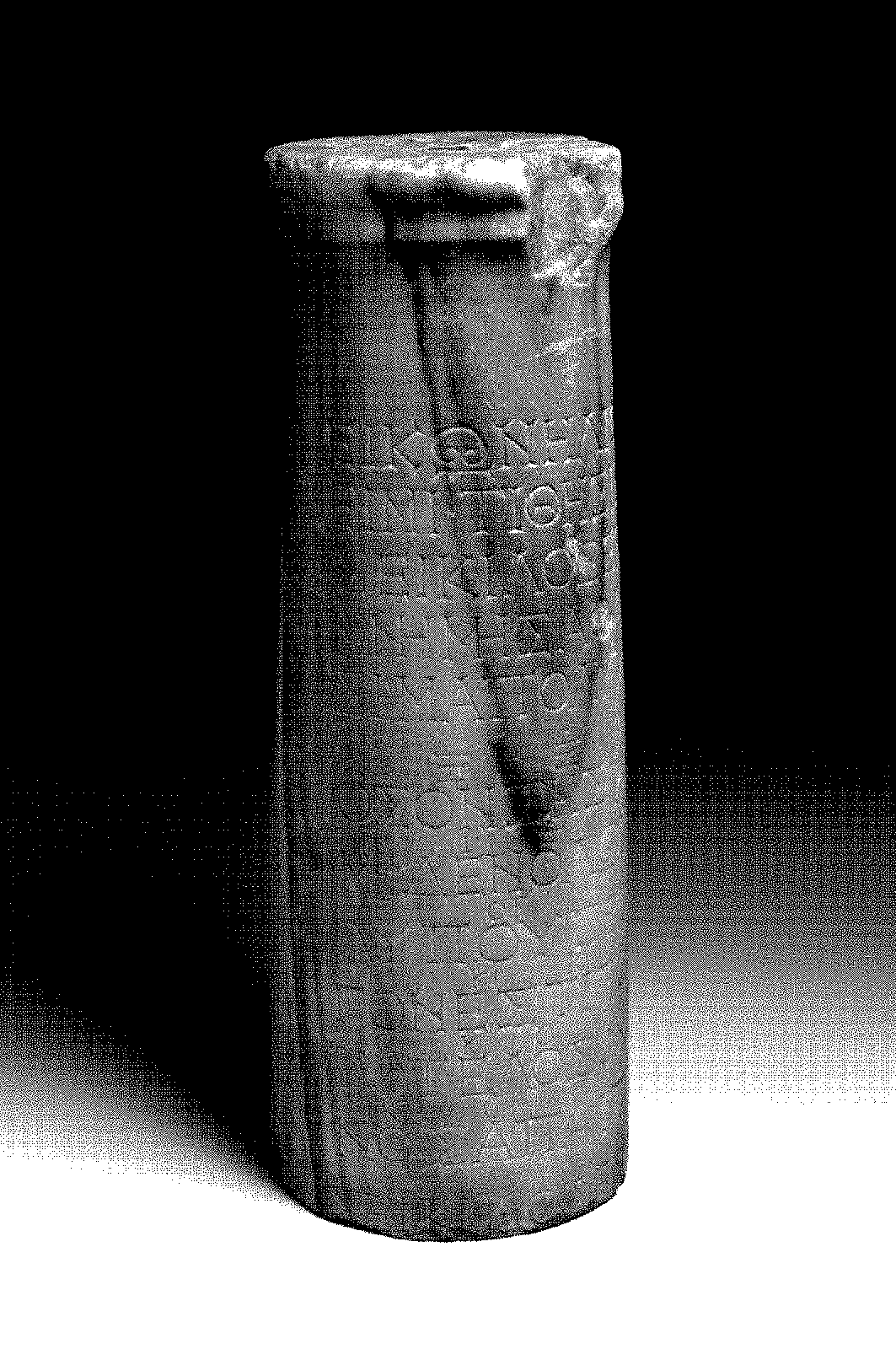
Last summer, we featured a Sumerian hymn considered the oldest known song in the world. Given the popularity of that post, it seems we may have long underestimated the number of ancient-musicophiles on the internet. Therefore, we submit today for your approval the Seikilos epitaph, the oldest known complete musical composition — that is to say, a song that our 21st-century selves can still play and hear in its intended entirety, more or less as did the ancient Greeks who lived during the first-century (or thereabouts) era of its composition.
The Seikilos epitaph’s survival in one piece, as it were, no doubt owes something to its shortness. The Greeks could carve the entire thing onto the surface of a tombstone, exactly the medium on which the modern world rediscovered it in 1885 near Aidin, Turkey. Its lyrics, liberally brought into English, exhort us as follows:
While you live, shine
have no grief at all
life exists only for a short while
and time demands its toll.
The surface also bears an explanatory inscription about — and written in the voice of — the artifact itself: “I am a tombstone, an image. Seikilos placed me here as an everlasting sign of deathless remembrance.” The Greeks, like many peoples in the ancient world of unvarnished mortality, relished a good memento mori, and this oldest complete song in the world offers one whose message still holds today, and which we can trace all the way to more recent words, like those of William Saroyan, when he said, “In the time of your life, live — so that in that good time there shall be no ugliness or death for yourself or for any life your life touches.”
Or for another interpretation, you can hear a modern, guitar-driven cover of the Seikilos epitaph by Vlogbrother and famous internet teacher Hank Green, in a truly striking example of two eras colliding. But of course, the Youtube era has also made everyone a critic. As one commenter perfectly put it, “I prefer his earlier stuff.”
Related Content:
Listen to the Oldest Song in the World: A Sumerian Hymn Written 3,400 Years Ago
What Ancient Greek Music Sounded Like: Hear a Reconstruction That is ‘100% Accurate’
Hear The Epic of Gilgamesh Read in the Original Akkadian and Enjoy the Sounds of Mesopotamia
Learn Latin, Old English, Sanskrit, Classical Greek & Other Ancient Languages in 10 Lessons
Colin Marshall writes on cities, language, Asia, and men’s style. He’s at work on a book about Los Angeles, A Los Angeles Primer, and the video series The City in Cinema. Follow him on Twitter at @colinmarshall or on Facebook.
Read More...Do Not Track: Interactive Film Series Reveals the Personal Information You’re Giving Away on the Web
If Facebook knows everything about you, it’s because you handed it the keys to your kingdom. You posted a photo, liked a favorite childhood TV show, and willingly volunteered your birthday. In other words, you handed it all the data it needs to annoy you with targeted advertising.
(In my case, it’s an ancient secret that helped a middle aged mom shave 5 inches off her waistline. Let me save you a click: acai berries.)
Filmmaker Brett Gaylor (a “lefty Canadian dad who reads science fiction) seeks to set the record straight regarding the web economy’s impact on personal privacy.
Watching his interactive documentary web series, Do Not Track, you’ll inevitably arrive at a crossroads where you must decide whether or not to share your personal information. No biggie, right? It’s what happens every time you consent to “log in with Facebook.”
Every time you choose this convenience, you’re allowing Google and other big time trackers to stick a harpoon (aka cookie) in your side. Swim all you want, little fishy. You’re not exactly getting away, particularly if you’re logged in with a mobile device with a compulsion to reveal your whereabouts.
You say you have nothing to hide? Bully for you! What you may not have considered is the impact your digital easy-breeziness has on friends. Your network. And vice versa. Tag away!
In this arena, every “like”—from an acquaintance’s recently launched organic skincare line to Star Trek—helps trackers build a surprisingly accurate portrait, one that can be used to determine how insurable you are, how worthy of a loan. Gender and age aren’t the only factors that matter here. So does your demonstrated extraversion, your degree of openness.
(Ha ha, and you thought it cost you nothing to “like” that acquaintance’s smelly strawberry-scented moisturizer!)
To get the most out of Do Not Track, you’ll want to supply its producers with your email address on your first visit. It’s a little counter-intuitive, given the subject matter, but doing so will provide you with a unique configuration that promises to lift the veil on what the trackers know about you.
What does it say about me that I couldn’t get my Facebook log-in to work? How disappointing that this failure meant I would be viewing results tailored to Episode 3’s star, German journalist Richard Gutjahr?
(Your profile… says that your age is 42 and your gender is male. But the real gold mine is your Facebook data over time. By analyzing the at least 129 things you have liked on Facebook, we have used our advanced algorithm techniques to assess your personality and have found you scored highest in Openness which indicates you are creative, imaginative, and adventurous. Our personality evaluation system uses Psycho-demographic trait predictions powered by the Apply Magic Sauce API developed at the University of Cambridge Psychometrics Centre.)
I think the takeaway is that I am not too on top of my privacy settings. And why would I be? I’m an extrovert with nothing to hide, except my spending habits, browsing history, race, age, marital status…
Should we take a tip from our high school brethren, who evade the scrutiny of college admissions counselors by adopting some ridiculous, evocative pseudonym? Expect upcoming episodes of Do Not Track to help us navigate these and other digital issues.
Tune in to Do Not Track here. You can find episodes 1, 2 and 3 currently online. Episodes 4–6 will roll out between May 12 and June 9.
Related Content:
The Internet’s Own Boy: New Documentary About Aaron Swartz Now Free Online
How Brewster Kahle and the Internet Archive Will Preserve the Infinite Information on the Web
Ayun Halliday an author, illustrator, and Chief Primatologist of the East Village Inky zine invites you to look into her very soul @AyunHalliday
Read More...Klingon for English Speakers: Sign Up for a Free Course Coming Soon

Duolingo provides free educational resources that will help you learn a whole host of terrestrial languages — languages like Spanish, French, German, and Italian. But now they’re expanding into extraterrestrial languages too, like Klingon. That’s, of course, “the constructed language spoken by the fictional extraterrestrial Klingon species in the Star Trek universe. Created by Marc Okrand, the language itself is centered around spacecraft, warfare, and weaponry — but it also reflects the directness and sense of humor of the Klingon culture.”
Duolingo’s Klingon course — Klingon for English Speakers — is currently under development. But, so far, almost 18,000 people have requested to be notified when the course is ready to go. You can add your name to the list here, too.
And before you go, make sure you check out our meta list of Free Language Lessons, where you can find free lessons covering 48 different languages. The list includes terrestrial lessons from Duolingo too.
Related Content:
Learn 48 Languages Online for Free: Spanish, Chinese, English & More
Animated Video Explores the Invented Languages of Lord of the Rings, Game of Thrones & Star Trek
French in Action: Cult Classic French Lessons from Yale (52 Episodes)
Take Free Online Courses at Hogwarts: Charms, Potions, Defense Against the Dark Arts & More
1100 Free Online Courses from Top Universities
Read More...
George Orwell & Christopher Hitchens’ Ironclad Rules for Making a Good Cup of Tea

Images via Wikimedia Commons
It’s not that I don’t appreciate good coffee—I consider it a delicacy. But at the end and the beginning of the day, coffee mostly functions as a caffeine delivery system. But not tea. Tea must be savored, and it must be good. Americans’ enthusiasm for tea does not come naturally. What passes for tea in the U.S. is best described by Christopher Hitchens as “a cup or pot of water, well off the boil, with the tea bags lying on an adjacent cold plate.” (See his January 2011 piece in Slate called “How to Make a Decent Cup of Tea.”) If this doesn’t sound wrong, he elaborates, setting up his endorsement of George Orwell’s methodical instructions for proper tea:
Then comes the ridiculous business of pouring the tepid water, dunking the bag until some change in color occurs, and eventually finding some way of disposing of the resulting and dispiriting tampon surrogate. The drink itself is then best thrown away, though if swallowed it will have about the same effect on morale as a reading of the memoirs of President James Earl Carter.
I like Jimmy Carter. I haven’t read his memoirs, and this does indeed sound awful. And before I had learned anything at all about drinking tea, it was all I knew. I tried. I cribbed a few notes here and there, wrote in tea shops, read the rough-hewn formalism of Sen no Rikyu, and looked to the East. I did not look to Britain and her former Commonwealth.
Perhaps I should. George Orwell would probably say so. Hitchens as well, though they don’t perfectly agree with each other. “Tea,” wrote Orwell in his famous 1946 essay “A Nice Cup of Tea,” “is one of the mainstays of civilization in this country, as well as in Eire, Australia and New Zealand, but… the manner of making it is the subject of violent disputes.” The only disagreement Hitchens musters against Orwell is that some of his rules, “(always use Indian or Ceylonese—i.e. Sri Lankan—tea; make tea only in small quantities; avoid silverware pots) may be considered optional or outmoded.”
Many old restraints may be loosened. But make no mistake, for Hitchens, as for Orwell, making a good cup of tea is not about mindfulness, patience, impermanence, or meditation. It is about rules. Orwell had 11. The “essential ones are easily committed to memory, and they are simple to put into practice.” What are they? Hitchens has his own succinct paraphrase, which you can read over at Slate. Orwell’s rather baroque list we reprint, in part, below for your edification. Read the complete essay here. Hitchens recommends you straighten out your next barista on some tea essentials. Imagine, however, presenting such an unfortunate person with this list of demands:
- First of all, one should use Indian or Ceylonese tea. China tea has virtues which are not to be despised nowadays — it is economical, and one can drink it without milk — but there is not much stimulation in it.…
- Secondly, tea should be made in small quantities — that is, in a teapot.… The teapot should be made of china or earthenware. Silver or Britanniaware teapots produce inferior tea and enamel pots are worse.…
- Thirdly, the pot should be warmed beforehand. This is better done by placing it on the hob than by the usual method of swilling it out with hot water.
- Fourthly, the tea should be strong. For a pot holding a quart, if you are going to fill it nearly to the brim, six heaped teaspoons would be about right.… I maintain that one strong cup of tea is better than twenty weak ones. All true tea lovers not only like their tea strong, but like it a little stronger with each year that passes.…
- Fifthly, the tea should be put straight into the pot. No strainers, muslin bags or other devices to imprison the tea.…
- Sixthly, one should take the teapot to the kettle and not the other way about. The water should be actually boiling at the moment of impact, which means that one should keep it on the flame while one pours.…
- Seventhly, after making the tea, one should stir it, or better, give the pot a good shake, afterwards allowing the leaves to settle.
- Eighthly, one should drink out of a good breakfast cup — that is, the cylindrical type of cup, not the flat, shallow type.…
- Ninthly, one should pour the cream off the milk before using it for tea. Milk that is too creamy always gives tea a sickly taste.
- Tenthly, one should pour tea into the cup first. This is one of the most controversial points of all; indeed in every family in Britain there are probably two schools of thought on the subject. The milk-first school can bring forward some fairly strong arguments, but I maintain that my own argument is unanswerable. This is that, by putting the tea in first and stirring as one pours, one can exactly regulate the amount of milk…
- Lastly, tea — unless one is drinking it in the Russian style — should be drunk without sugar. I know very well that I am in a minority here. But still, how can you call yourself a true tealover if you destroy the flavour of your tea by putting sugar in it? It would be equally reasonable to put in pepper or salt.…
Related Content
10 Golden Rules for Making the Perfect Cup of Tea (1941)
10 Essential Tips for Making Great Coffee at Home
Josh Jones is a writer and musician based in Durham, NC. Follow him at @jdmagness
Read More...Take a Virtual Tour of Robben Island Where Nelson Mandela and Other Apartheid Opponents Were Jailed
Ted Mills recently told you all about the Google-powered virtual tour of Abbey Road Studios. What shouldn’t go without mention is the new, Google-powered virtual tour of Robben Island — “the island where Nelson Mandela and many of South Africa’s freedom fighters were imprisoned during their quest for equality.” Along with over 3,000 political prisoners, Nelson Mandela spent 18 years imprisoned here, much of the time confined to a 8 x 7 foot prison cell. (Don’t forget Mandela also spent another nine years in Pollsmoor Prison and Victor Verster Prison.)
All of the Robben Island tours are conducted by ex-prisoners. On the new virtual tour, you will encounter Vusumsi Mcongo (see above), a member of the anti-Apartheid movement who was jailed on Robben Island from 1978 to 1990.
You can start the tour of the maximum security prison and UNESCO World Heritage Site here.
Read More...John Green’s Crash Course in U.S. History: From Colonialism to Obama in 47 Videos
Those who cannot remember the past, said George Santayana, are condemned to repeat it. Luckily, if you learn about the past from John Green’s Crash Course video series, you can play them on repeat as many times as you like until you do remember it. We’ve previously featured the acclaimed young-adult novelist, pioneering vlogger, internet educator, and apparent history buff Green’s Crash Course in Big History and Crash Course in World History, and today we have for you his much more narrowly-focused Crash Course in U.S. History.
The history of the United States of America — an entity much younger than not just the universe and the world but than most other countries — would seem entirely manageable by comparison, one Green and his team could knock off in a few weeks and move on to grander subjects. But as anyone in the nonfiction publishing industry knows, when American history sells, it sells, not just because of the country’s prominent place on the world stage, but because American history connects to so many other not just historical but social, political, economic, and even technological themes.
Green and company (a group that includes his onetime high school history teacher) thus have more than enough to work with for all 47 episodes of Crash Course U.S. History, from the natives and the Spaniards to the American Revolution to the Civil War to the Great Depression to the 60s to the Clinton years to what the series calls Obamanation — with plenty in between. Green tells the story with his usual mixture of well-selected detail, copious visual aids, and dizzying speed (enough of all of them so that you really do need to re-watch the videos, or at least pause them frequently), resulting in a breezy yet surprisingly comprehensive long-form primer on just what made the United States so big, so powerful, so innovative, so self-regarding, so frustrating — and, ultimately, so fascinating.
Related Content:
A Crash Course in World History
Crash Course Big History: John Green Teaches Life, the Universe & Everything
Download 78 Free Online History Courses: From Ancient Greece to The Modern World
A Short History of America, According to the Irreverent Comic Satirist Robert Crumb
Colin Marshall writes on cities, language, Asia, and men’s style. He’s at work on a book about Los Angeles, A Los Angeles Primer, and the video series The City in Cinema. Follow him on Twitter at @colinmarshall or on Facebook.
Read More...Support Us
We're hoping to rely on loyal readers, rather than erratic ads. Please click the Donate button and support Open Culture. You can use Paypal, Venmo, Patreon, even Crypto! We thank you!

About Us

Open Culture scours the web for the best educational media. We find the free courses and audio books you need, the language lessons & educational videos you want, and plenty of enlightenment in between.
Advertise With Us

FREE UPDATES!
GET OUR DAILY EMAIL
Get the best cultural and educational resources on the web curated for you in a daily email. We never spam. Unsubscribe at any time.
FOLLOW ON SOCIAL MEDIA

Open Culture editor Dan Colman scours the web for the best educational media. He finds the free courses and audio books you need, the language lessons & movies you want, and plenty of enlightenment in between.
Advertise With Us


