Discover the Life & Work of Stanley Kubrick in a Sweeping Three-Hour Video Essay
For at least fifty years, the work of Stanley Kubrick has constituted an ideal object of study for serious cinephiles. Now that the technological democratization of the past decade has allowed some of the most serious cinephiles to become video essayists, that study has flowered into a host of mini-documentaries closely examining the techniques of all of film history’s most scrutinizable auteurs. The subfield of Kubrick-themed video essayism recently reached a new high watermark with filmmaker Cameron Beyl’s five-part, three-hour Directors Series study of the man’s life and work.
“Every living filmmaker today works under the shadow of Stanley Kubrick,” says Beyl in his narration toward the end of the series. “His roller-coaster ride of a career lasted 45 years and spanned two continents, leaving fourteen features and countless innovations in its wake.
In making his films, Kubrick ultimately wanted to change the form of cinema itself. His exploration of alternative story structures and new forms of expression resulted in several groundbreaking contributions to the development of the craft itself.”
If you want to find out much more about the nature of those groundbreaking contributions, block out the time and watch Beyl’s analyses of each period of Kubrick’s career: the time of his early independent features (Fear & Desire, Killer’s Kiss, The Killing), the Kirk Douglas years (Paths of Glory and Spartacus), the Peter Sellers comedies (Lolita and Dr. Strangelove or: How I Learned to Stop Worrying and Love the Bomb), the masterworks (2001: A Space Odyssey, A Clockwork Orange, Barry Lyndon, and The Shining), and the final features (Full Metal Jacket and Eyes Wide Shut.)
The project leaves no aspect of Kubrick’s mastery unmentioned: his painstaking research habits, his much-discussed take-after-take-after-take shooting method on set, his careful method of discovering each film’s form in the editing room, his eagerness to incorporate new technology into his productions, and his finished pictures’ simultaneous embodiment and subversion of genre. It makes us ask the obvious but seemingly unanswerable question: who’s the next Stanley Kubrick? But Beyl actually has an answer, and one that has become the subject of his next series, already in progress: David Fincher. The director of The Game, Fight Club, and The Social Network has big shoes to fill — or so he’ll realize even more clearly if he watches the Kubrick series himself.
Related Content:
Signature Shots from the Films of Stanley Kubrick: One-Point Perspective
The Shining and Other Complex Stanley Kubrick Films Recut as Simple Hollywood Movies
Lost Kubrick: A Short Documentary on Stanley Kubrick’s Unfinished Films
Napoleon: The Greatest Movie Stanley Kubrick Never Made
Explore the Massive Stanley Kubrick Exhibit at the Los Angeles County Museum of Art
The Making of Stanley Kubrick’s A Clockwork Orange
Terry Gilliam: The Difference Between Kubrick (Great Filmmaker) and Spielberg (Less So)
Colin Marshall hosts and produces Notebook on Cities and Culture as well as the video series The City in Cinema and writes essays on cities, language, Asia, and men’s style. He’s at work on a book about Los Angeles, A Los Angeles Primer. Follow him on Twitter at @colinmarshall or on Facebook.
Read More...Read An Illustrated Book of Bad Arguments: A Fun Primer on How to Strengthen, Not Weaken, Your Arguments
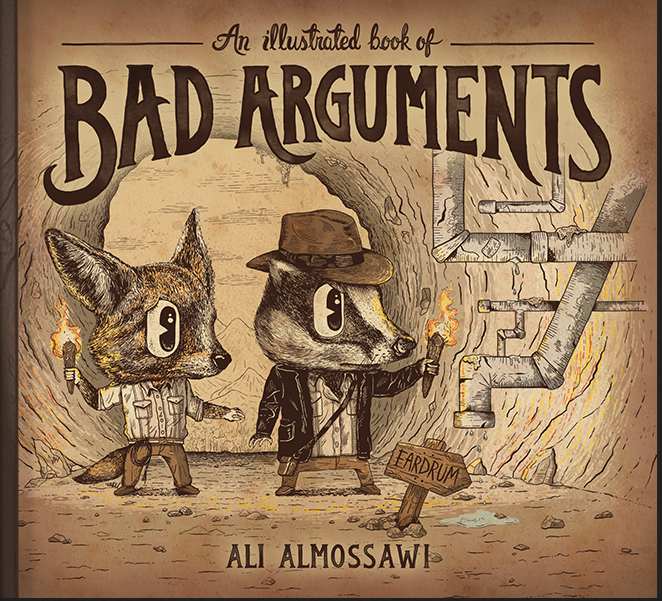
The science of argumentation can seem complicated, but in day-to-day terms, it quite often comes down to competing emotions. Political disagreements thrive on disgust and fear; we shut down our reasoning when we feel stressed or angry; and it is difficult to get opponents to hear us, whether they agree or not, if we do not exhibit any sympathy for their position, hard as that may be.
However, subjects in tests told not to feel anything about an issue before viewing media about it tend to be more supportive. They’ve had some opportunity to access higher order thinking skills and to override knee-jerk reactions. Most arguments take place in the fray—family dinners, online forum wars—but even in these cases, applying the best of our reasoning, before, during, or after, can put us in better stead. As Ali Almossawi, author of An Illustrated Book of Bad Arguments (read online version here) puts it in his preface:
… formalizing one’s reasoning [can] lead to useful benefits such as clarity of thought and expression, objectivity and greater confidence. The ability to analyze arguments also help[s] provide a yardstick for knowing when to withdraw from discussions that would most likely be futile.
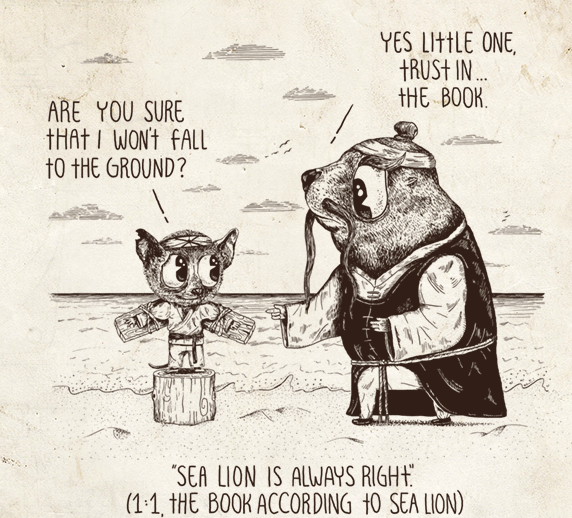
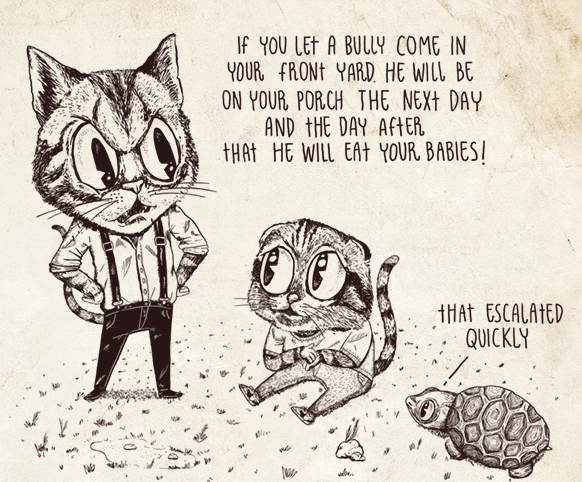
Almossawi’s strategy to mitigate bad, or wasted, thinking comes in the form of an inoculation. He quotes Stephen King, who “describes his experience of reading a particularly terrible novel as, ‘the literary equivalent of a smallpox vaccination.’” Rather than a Ciceronian treatise on what makes a good argument, Almossawi presents us with nineteen examples of the bad: informal logical fallacies we may be familiar with—Appeal to Authority (below), Circular Reasoning (further down), Slippery Slope (bottom)—as well as many we may not be.
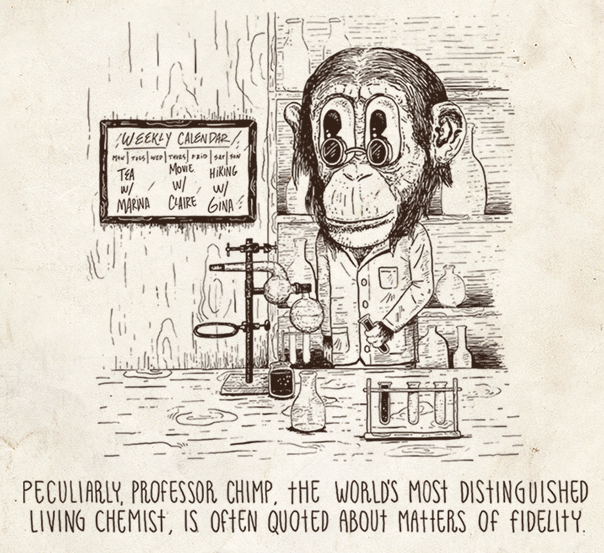
The twist here is in Alejandro Giraldo’s playful illustrations, and the memorable examples that follow Almossawi’s descriptions. Inspired partly by “allegories such as Orwell’s Animal Farm and partly by the humorous nonsense of works such as Lewis Carroll’s stories and poems,” the drawings are also highly reminiscent, if not very much inspired by, the baroque cartoons of Tony Millionaire. The art is rich and full of surprises; the sample arguments silly but effective at making the point.
The next time you find yourself melting down over a disagreement, it will likely help to take a time out and refresh yourself with this useful primer. If nothing else, it will give you some insight into the shortcomings of your own arguments, and maybe some measure of when to drop the subject altogether. As Richard Feynman—quoted in an epilogue to the book—once remarked, “The first principle is that you must not fool yourself and you are the easiest person to fool.” Find the book online here, or purchase a copy here.
Related Content:
130+ Free Online Philosophy Courses
Philosopher Daniel Dennett Presents Seven Tools For Critical Thinking
Josh Jones is a writer and musician based in Durham, NC. Follow him at @jdmagness
Read More...George R. R. Martin Puts Online a New Chapter from His Highly Anticipated Book, The Winds of Winter

Image created by Yulia Nikolaeva
Just a very quick heads up: Late last week, George R. R. Martin published on his web site a new chapter from his upcoming book, The Winds of Winter. The chapter tells us about Alyne (depicted above) and it contains a few spoilers. Read it here.
Follow us on Facebook, Twitter, Google Plus and LinkedIn and share intelligent media with your friends. Or better yet, sign up for our daily email and get a daily dose of Open Culture in your inbox.
Read More...Do You See Marilyn Monroe or Albert Einstein in This Photo? An Amazing Eye Test Based on MIT Research
This visual curiosity beats the black/gold dress craze of last month. The video above asks you to look at a photo and decide whether you see Albert Einstein or Marilyn Monroe — two 20th century icons who look pretty much nothing alike. If you say Albert, your eyes are in good shape. If you say Marilyn, it’s apparently time to pay a visit to the optometrist.

The science discussed here is based on the research of Aude Oliva, who works on Computational Perception and Cognition at MIT. You can see the original “Marylin Einstein” hybrid image above, which Aude created for the March 31st 2007 issue of New Scientist magazine. More background info on hybrid images can be found on this MIT page. Plus find a gallery of hybrid images here.
If you would like to support the mission of Open Culture, consider making a donation to our site. It’s hard to rely 100% on ads, and your contributions will help us continue providing the best free cultural and educational materials to learners everywhere. You can contribute through PayPal, Patreon, and Venmo (@openculture). Thanks!
Related Content:
The 430 Books in Marilyn Monroe’s Library: How Many Have You Read?
Albert Einstein Reads ‘The Common Language of Science’ (1941)
Read More...Listen to Bill Murray Lead a Guided Meditation on How It Feels to Be Bill Murray

Photo by Gage Skidmore, via Wikimedia Commons
How does it feel to be Bill Murray?
Wonderful, presumably. You’re wealthy, well respected, and highly sought. Your random real world cameos bring joy to scores of unsuspecting mortals.
Murray’s St. Vincent director Ted Melfi cites his ability to inhabit the present moment:
He doesn’t care about what just happened. He doesn’t think about what’s going to happen. He doesn’t even book round-trip tickets. Bill buys one-ways and then decides when he wants to go home.
A stunningly good use of wealth and power. If he were anyone but the inimitable Bill Murray, I bet we’d be seething with envious class rage.
He devises the rules by which he plays, from the way he rubs shoulders with the common man to the toll free number that serves as his agent to indulging in creative acts of rebellion that could get a younger, less nuanced star labelled bratty, if not mentally ill, and desperately in need of rehab.
As if Murray needs anyone else to determine when he needs a break. When his 1984 film adaptation of Somerset Maugham’s The Razor’s Edge failed at the box office, he granted himself a four year sabbatical. He studied history and philosophy at the Sorbonne, became fascinated with the Greco-Armenian mystic George Gurdjeff…and learned how to avoid spooking the public by putting a light spin on a clearly transformative experience:
I’ve retired a couple of times. It’s great, because you can just say, “Oh, I’m sorry. I’m retired.” And people will actually believe that you’ve retired. There are nutters out there that will go, “Oh, okay!” and then leave you alone.
But how does it really feel to be Bill Murray?
…someone told me some secrets early on about living, and that you just have to remind yourself … you can do the very best you can when you’re very very relaxed. No matter what it is, whatever your job is, the more relaxed you are the better you are. That’s sort of why I got into acting. I realized the more fun I had the better I did it and I thought, that’s a job I can be proud of. If I had to go to work and no matter what my condition, no matter what my mood is, no matter how I feel … if I can relax myself and enjoy what I’m doing and have fun with it, I can do my job really well. It has changed my life, learning that.
When the question was put to him at the 2014 Toronto International Film Festival, Murray led a guided meditation, below, to help the audience get a feel for what it feels like to be as relaxed and in the moment as Bill Murray. Putting all joking to the side, he shares his formula as sincerely as Mr. Rogers addressing his young television audience. Don’t forget that this is a man who read the poetry of Emily Dickinson to a roomful of rapt construction workers with a straight and confident face. Complete text is below.
Let’s all ask ourselves that question right now: What does it feel like to be you? What does it feel like to be you? Yeah. It feels good to be you, doesn’t it? It feels good, because there’s one thing that you are — you’re the only one that’s you, right?
So you’re the only one that’s you, and we get confused sometimes — or I do, I think everyone does — you try to compete. You think, damn it, someone else is trying to be me. Someone else is trying to be me. But I don’t have to armor myself against those people; I don’t have to armor myself against that idea if I can really just relax and feel content in this way and this regard.
If I can just feel… Just think now: How much do you weigh? This is a thing I like to do with myself when I get lost and I get feeling funny. How much do you weigh? Think about how much each person here weighs and try to feel that weight in your seat right now, in your bottom right now. Parts in your feet and parts in your bum. Just try to feel your own weight, in your own seat, in your own feet. Okay? So if you can feel that weight in your body, if you can come back into the most personal identification, a very personal identification, which is: I am. This is me now. Here I am, right now. This is me now. Then you don’t feel like you have to leave, and be over there, or look over there. You don’t feel like you have to rush off and be somewhere. There’s just a wonderful sense of well-being that begins to circulate up and down, from your top to your bottom. Up and down from your top to your spine. And you feel something that makes you almost want to smile, that makes you want to feel good, that makes you want to feel like you could embrace yourself.
So, what’s it like to be me? You can ask yourself, “What’s it like to be me?” You know, the only way we’ll ever know what it’s like to be you is if you work your best at being you as often as you can, and keep reminding yourself: That’s where home is.
Related Content:
Bill Murray Reads Great Poetry by Billy Collins, Cole Porter, and Sarah Manguso
Bill Murray Gives a Delightful Dramatic Reading of Twain’s Huckleberry Finn (1996)
Bill Murray Sings the Poetry of Bob Dylan: Shelter From the Storm
Ayun Halliday is an author, illustrator, and Chief Primatologist of the East Village Inky zine. Follow her @AyunHalliday
Read More...
Jack Kerouac Was a Secret, Obsessive Fan of Fantasy Baseball
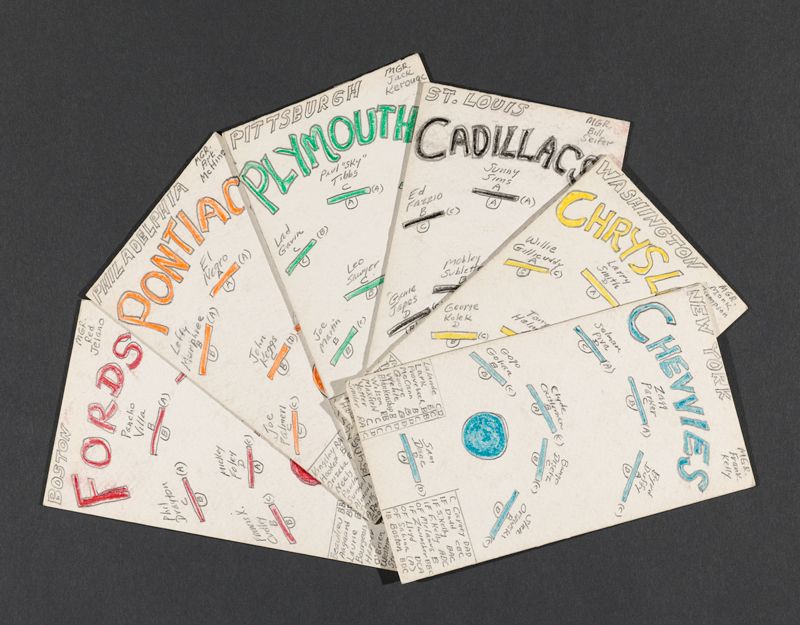
Bear in mind, fantasy baseball fans, that with the season about to start up again, you shouldn’t feel like you have to take any grief for enjoying the game. It counts among its enthusiasts no less a luminary than Jack Kerouac, author of On The Road and The Dharma Bums, and he didn’t just enjoy it, he arguably invented it. The New York Public library devoted an exhibition to Kerouac’s near-lifelong hobby called “Fantasy Sports and the King of the Beats,” revealing how the writer invented an elaborate means of experiencing the joys of America’s National Pastime all on his own.
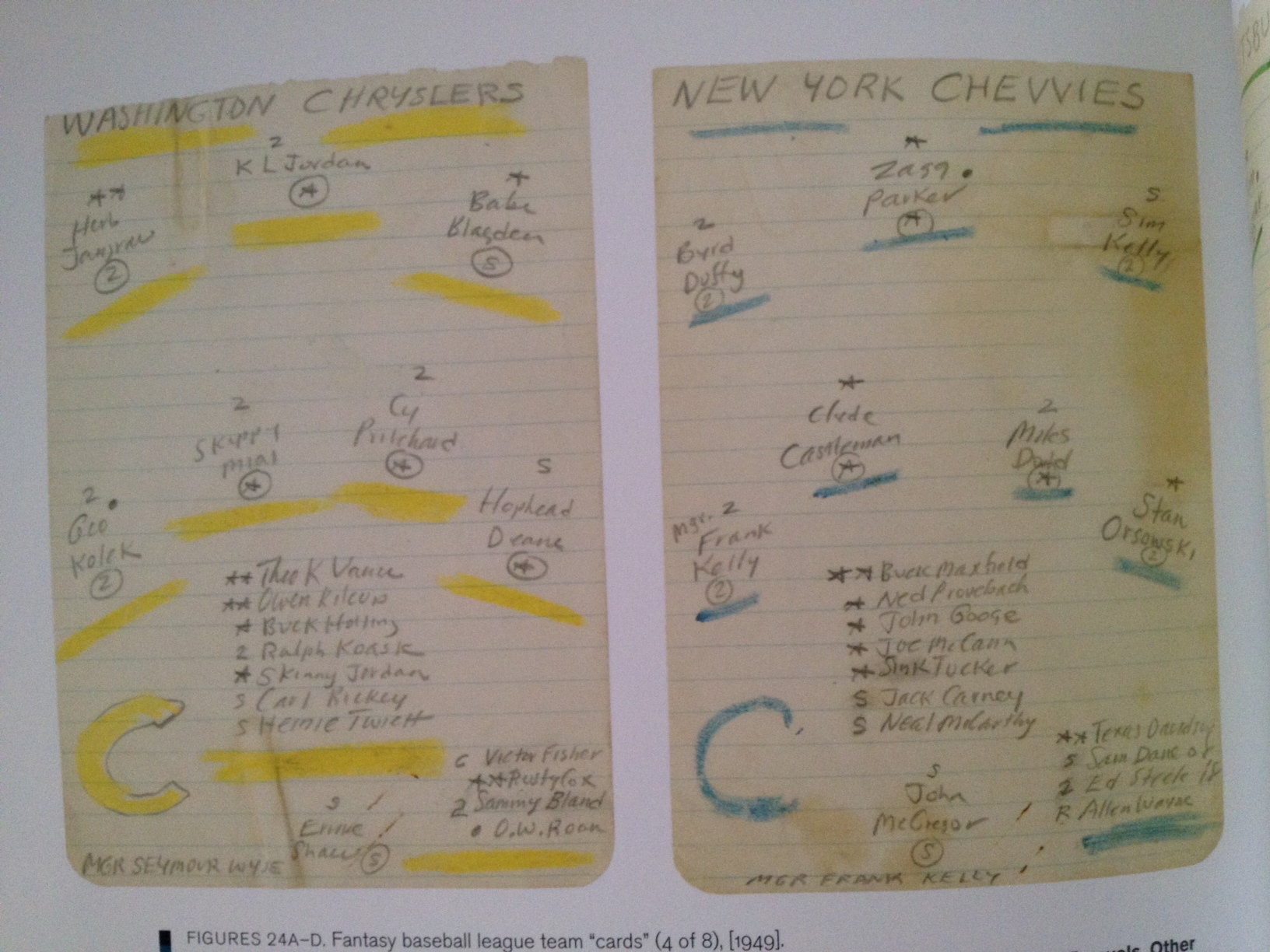
He also created an entire world of imagined teams, imagined players, and imagined athletic and financial dramas as well. The New York Times’ Charles McGrath writes that Kerouac “obsessively played a fantasy baseball game of his own invention, charting the exploits of made-up players like Wino Love, Warby Pepper, Heinie Twiett, Phegus Cody and Zagg Parker, who toiled on imaginary teams named either for cars (the Pittsburgh Plymouths and New York Chevvies, for example) or for colors (the Boston Grays and Cincinnati Blacks).”
Rather than a distraction from his writing, all this proved to be “ideal training for a would-be author,” since his version of fantasy baseball also required him come up with voluminous coverage of the action which “imitates the overheated, epithet-studded sportswriting of the day.” Fantasy baseball has since turned into a national (and, to an extent, even international) phenomenon, but the game that thousands of baseball nuts play today, which uses the real statistics of non-made-up baseball players on actual teams, doesn’t demand nearly as much creativity as did the one Kerouac played by himself.

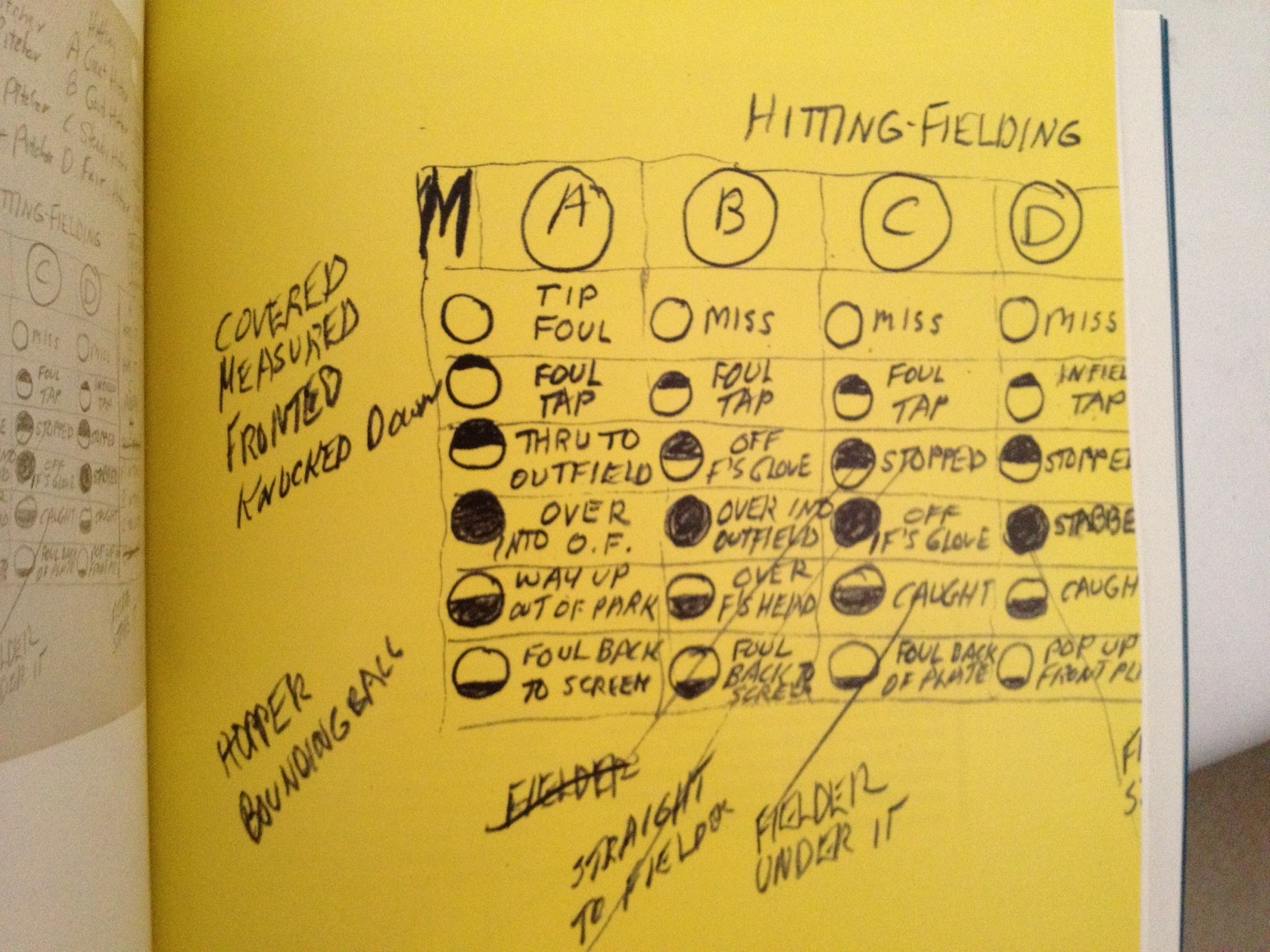
Kerouac’s fantasy baseball even achieved a kind of prescience, not just in terms of prefiguring fantasy baseball as we now know it, but events in baseball proper: “As befitting the author of On the Road, the narrator of which journeys three times to California with a pilgrim’s zeal,” says the NYPL’s site, Kerouac “brought his fantasy baseball league to California. In this instance, fantasy trumped reality, since Kerouac’s California teams are established at least one year before the Dodgers and Giants abandoned New York for California.” One wonders what the victories and tribulations of the Plymouths and the Chevvies, the Grays and the Blacks, their fates decided with marbles, sticks, complex diagrams, and cards full of now-indecipherable symbols, might foretell about the fate of Major League Baseball’s teams this coming season.
Related Content:
Jack Kerouac’s Hand-Drawn Map of the Hitchhiking Trip Narrated in On the Road
Jack Kerouac Lists 9 Essentials for Writing Spontaneous Prose
Jack Kerouac Reads from On the Road (1959)
Jack Kerouac’s Naval Reserve Enlistment Mugshot, 1943
Colin Marshall hosts and produces Notebook on Cities and Culture as well as the video series The City in Cinema and writes essays on cities, language, Asia, and men’s style. He’s at work on a book about Los Angeles, A Los Angeles Primer. Follow him on Twitter at @colinmarshall or on Facebook.
Read More...All of Bach Is Putting Videos of 1,080 Bach Performances Online: Watch the First 53 Recordings and the St. Matthew Passion
Last year we featured All of Bach, a site that, in the fullness of time, will allow you to watch the Netherlands Bach Society perform each and every one of Bach’s compositions, completely for free. Back when we first posted about it, the site offered only five performances to watch, but now you’ll find a full 53 waiting there, ready for you to enjoy. Just above, we have BWV 565, “Toccata And Fugue In D Minor,” one of Bach’s most famous organ works, thanks in no small part to the frequency with which it appears on television, video game and movie soundtracks.
Every Friday brings a new performance of another Bach piece — until, that is, the Netherlands Bach Society gets through all 1080 of them. But between now and then, they’ve also got special musical events planned, such as a special performance of the whole of the St. Matthew Passion scheduled for this Friday, April 3. (You can now find it online here.) It will mark the probable 288th anniversary of the piece’s debut, an event which musical historians think happened in Leipzig’s St. Thomas Church, where Bach served as cantor and chorus director.
“Lutherian severity lies at the core of Bach’s St. Matthew Passion,” writes New Yorker music critic Alex Ross. “The immensity of Bach’s design — his use of a double chorus and a double orchestra; his interweaving of New Testament storytelling and latter-day meditations; the dramatic, almost operatic quality of the choral writing; the invasive beauty of the lamenting arias, which give the sense that Christ’s death is the acutest of personal losses — has the effect of pulling all of modern life into the Passion scene. By forcing the singers to enact both the arrogance of the tormentors and the helplessness of the victims, Bach underlines Luther’s point about the inescapability of guilt. A great rendition of the St. Matthew Passion should have the feeling of an eclipse, of a massive body throwing the world into shadow.”
In order to prepare yourself for this momentous musical event, have a look at the teaser for it in the middle of the post, and the behind-the-scenes documentary Closer to Bach in Naarden just above, which reveals the relationship the musicians of the Netherlands Bach Society have to the St. Matthew Passion. As you can see, they’ve taken pains to make sure that this Good Friday will, for music-lovers, prove to be a very good Friday indeed.
Find the Matthew Passion on All of Bach this Friday — the same place where you can find new recordings each week.
Update: The Matthew Passion is now online here.
Related Content:
All of Bach for Free! New Site Will Put Performances of 1080 Bach Compositions Online
A Big Bach Download: All of Bach’s Organ Works for Free
The Genius of J.S. Bach’s “Crab Canon” Visualized on a Möbius Strip
Video: Glenn Gould Plays the Goldberg Variations by J.S. Bach
Colin Marshall hosts and produces Notebook on Cities and Culture as well as the video series The City in Cinema and writes essays on cities, language, Asia, and men’s style. He’s at work on a book about Los Angeles, A Los Angeles Primer. Follow him on Twitter at @colinmarshall or on Facebook.
Read More...Christopher Hitchens Creates a Revised List of The 10 Commandments for the 21st Century
Christopher Hitchens was there, railing against religion and war criminals one minute, and the next, it seems, he was gone, a victim to esophageal cancer in 2011. In the 2010 video above, Hitchens takes on one of the hoariest precepts of the Bible (and the Torah) and reimagines an updated, secular version. I mean, it’s not like the Ten Commandments are set in stone, right? (Rimshot!)
The first two-thirds of the video features Hitchens making his way through the original commandments one by one, pulling them apart for inconsistencies and hypocrisy. For example Moses, having told his followers Thou Shalt Not Kill, encouraged them to then kill all the Midianites and save the virgin girls as chattel/prizes, which they then did.
Now, Hitchens does like the 8th Commandment (“Thou Shalt Not Steal”) because, hey, what society isn’t against stealing, and he saves his true admiration for the example of “rare nuance and sophistication” in the 9th Commandment (“Thou Shalt Not Bear False Witness”) because it looks ahead to a truth-based judgement system (and the Magna Carta.)
But for the rest, Hitchens suggests ripping it up and starting again. With a few snarky asides, the list, originally printed in Vanity Fair, presents rules for living as an empathetic, rational human being in the 21st century. He wraps it up with an anti-fundamentalist bow at the end.
I: Do not condemn people on the basis of their ethnicity or color.
II: Do not ever use people as private property.
III: Despise those who use violence or the threat of it in sexual relations.
IV: Hide your face and weep if you dare to harm a child.
V: Do not condemn people for their inborn nature.
VI: Be aware that you too are an animal and dependent on the web of nature, and think and act accordingly.
VII: Do not imagine that you can escape judgment if you rob people with a false prospectus rather than with a knife.
VIII: Turn off that fucking cell phone.
IX: Denounce all jihadists and crusaders for what they are: psychopathic criminals with ugly delusions.
X: Be willing to renounce any god or any religion if any holy commandments should contradict any of the above.
While we’re talking about rethinking the Commandments, George Carlin had some similar thoughts on the subject.
Related Content:
Christopher Hitchens: No Deathbed Conversion for Me, Thanks, But it was Good of You to Ask
Christopher Hitchens Creates a Reading List for Eight-Year-Old Girl
Bertrand Russell’s Ten Commandments for Living in a Healthy Democracy
Ted Mills is a freelance writer on the arts who currently hosts the FunkZone Podcast. You can also follow him on Twitter at @tedmills and/or watch his films here.
Read More...Students Tells the Passover Story with a Rube Goldberg Machine
Passover starts this Friday. And you might ask: why is this Passover different from all other Passovers? Because this Passover is getting ushered in by a Rube Goldberg Machine that tells highlights of the Passover story. Designed by students from Technion — Israel Institute of Technology, the device features falling matzah dominoes, baby Moses getting blown across the water by a fan, and a text message telling the Pharaoh to “let my people go.” How it all came together? You can find out by watching this “behind-the-scenes” video.
Follow us on Facebook, Twitter, Google Plus and LinkedIn and share intelligent media with your friends. Or better yet, sign up for our daily email and get a daily dose of Open Culture in your inbox.
Read More...Listen to Nick Cave’s Lecture on the Art of Writing Sublime Love Songs (1999)
Let’s take a love song—let’s take Huey Lewis and the News’ “Power of Love,” why not? Catchy, right? And that video? Back to the Future! That takes you back, doesn’t it? Yeah…. Now let’s ask some hard questions. Is this song an accurate representation of the human emotion we call “love”? All upbeat synths and blaring horns? Really? But then, there’s Lewis, who, right out of the gate, acknowledges that love, “a curious thing,” can “make one man weep” and “another man sing.” I imagine that love can make a woman feel the same. A curious thing. Huey Lewis’ 80s anthem may not sound like love, necessarily, but he’s a smart enough songwriter to know that love often uses its power for ill—“it’s strong and sudden and it’s cruel sometimes.”
Let’s take another songwriter, one with a darker vision, a more literary bent, Nick Cave. The Australian post-punk crooner and former leader of chaotic punk band The Birthday Party wrote a song called “People Ain’t No Good,” the most universal of laments, after a breakup. See him, in the live version in Poland at the top, declare in a mournful, soulful baritone accompanied only by a piano, the truth of no-goodness. Unlike Huey Lewis, this song allows for no quality, power of love or otherwise, to “change a hawk into a little white dove.” It’s Nietzschean in its tragic disappointment. And yet, such is the power of Nick Cave, to write a song of no goodness that sounds like a hymn of praise. The duality Cave embraces gets a part autobiographical, part gospel treatment in the lecture above (“The Secret Life of the Love Song”), which Cave delivered at the Vienna Poetry Festival in 1999.
Cave, the son of a literature professor and himself an accomplished novelist and poet, knows his craft well. The ballads that dominate pop music have deeper roots in a harsher world, one that produced the “murder ballad,” not coincidentally the title of a Nick Cave and the Bad Seeds record — one Allmusic writes Cave “was waiting to make his entire career.” Cave recognizes, as he says in his talk above “an uncaring world—a world that fucks everybody over.” And yet… and yet, he says again and again, there is love, or rather, love songs. Quoting W.H. Auden and Federico Garcia Lorca, he goes on to describe the form as “a howl in the void, for Love and for comfort.” The love song “lives on the lips of the child crying for its mother. It is the song of the lover in need of her loved one, the raving of the lunatic supplicant petitioning his God.”
The love song, then, must contain a quality Garcia Lorca called Duende, an “eerie and inexplicable sadness.” Bob Dylan, Leonard Cohen, Van Morrison, Tom Waits, and Neil Young have it. “It haunts,” he says, his ex P.J. Harvey. “All love songs must contain duende. For the love song is never truly happy. It must first embrace the potential for pain.” Cave draws on Lou Reed’s “Perfect Day,” the “brutal prose” of the Old Testament, and the most innocuous-sounding pop songs, which can disguise “messages to God that cry out into the yawning void, in anguish and self-loathing, for deliverance.”
He also references, and reads, his own song, “Far From Me,” from 1997’s The Boatman’s Call, the post-breakup record that contains “People Ain’t No Good.” (Cave begins the lecture with a rendition of “West Country Girl” from that same record.) It’s an album that brought Cave’s “morbidity to near-parodic levels,” stripping the Bad Seeds stumbling lounge punk down to mostly piano and voice. This reference is not a matter of vanity but of the most well chosen illustration. Cave admits he is “happy to be sad,” to live in “divine discontent.” His religious existentialism is ultimately relieved by the power of love songs, by his “crooked brood of sad eyed children” which “rally round and in their way, protect me, comfort me and keep me alive.” Maybe Huey Lewis had something similar to say, but there’s no way he could ever say it the way that Nick Cave does. Read a partial transcript of Cave’s talk here.
Related Content:
Leonard Cohen and U2 Perform ‘Tower of Song,’ a Meditation on Aging, Loss & Survival
Tom Waits and Keith Richards Sing Sea Song “Shenandoah” for New Pirate-Themed CD: Listen Online
See Neil Young Perform Classic Songs in 1971 BBC Concert: “Old Man,” “Heart of Gold” & More
Josh Jones is a writer and musician based in Durham, NC. Follow him at @jdmagness
Read More...Support Us
We're hoping to rely on loyal readers, rather than erratic ads. Please click the Donate button and support Open Culture. You can use Paypal, Venmo, Patreon, even Crypto! We thank you!

About Us

Open Culture scours the web for the best educational media. We find the free courses and audio books you need, the language lessons & educational videos you want, and plenty of enlightenment in between.
Advertise With Us

FREE UPDATES!
GET OUR DAILY EMAIL
Get the best cultural and educational resources on the web curated for you in a daily email. We never spam. Unsubscribe at any time.
FOLLOW ON SOCIAL MEDIA

Open Culture editor Dan Colman scours the web for the best educational media. He finds the free courses and audio books you need, the language lessons & movies you want, and plenty of enlightenment in between.
Advertise With Us


