Hunter S. Thompson’s Ballsy & Hilarious Job Application Letter (1958)
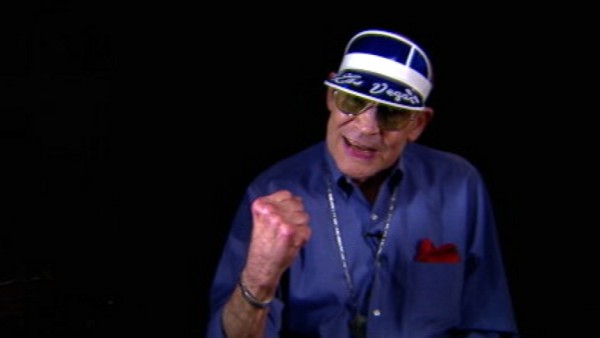
Image by Steve Anderson, via Wikimedia Commons
In 1958, Hunter S. Thompson applied for a job with the Vancouver Sun. He was fresh out of the Air Force and struggling to make a living in New York City, though from the tone of the letter you wouldn’t know it.
People who are experts in such things say that good cover letters should match the employer’s needs with the applicant’s abilities, should be tailored specifically to the job in question and should show some personality. By those yardsticks, Thompson’s letter to the Vancouver Sun is a model to be followed. He lays out his eagerness to work: “I can work 25 hours a day if necessary, live on any reasonable salary.” Any HR manager would be tickled with lines like that. He succinctly describes his work experience: “most of my experience has been in sports writing, but I can write everything from warmongering propaganda to learned book reviews.” And for any other fault you might find with the letter, it definitely doesn’t lack in personality.
Yet the letter somehow failed to charm his would-be employer; Thompson never moved to Vancouver. Perhaps they were given pause by Thompson’s steady stream of insults directed towards his former editor — “It was as if the Marquis De Sade had suddenly found himself working for Billy Graham” — and towards journalism in general: “It’s a damned shame that a field as potentially dynamic and vital as journalism should be overrun with dullards, bums, and hacks, hag-ridden with myopia, apathy, and complacence, and generally stuck in a bog of stagnant mediocrity.” Or perhaps it was his intentionally off-putting arrogance, “I’d rather offend you now than after I started working for you.” In any case, it’s a hoot to read. More people should write job application letters like this.
Read the full letter below.
Vancouver Sun
TO JACK SCOTT, VANCOUVER SUN
October 1, 1958 57 Perry Street New York CitySir,
I got a hell of a kick reading the piece Time magazine did this week on The Sun. In addition to wishing you the best of luck, I’d also like to offer my services.Since I haven’t seen a copy of the “new” Sun yet, I’ll have to make this a tentative offer. I stepped into a dung-hole the last time I took a job with a paper I didn’t know anything about (see enclosed clippings) and I’m not quite ready to go charging up another blind alley.
By the time you get this letter, I’ll have gotten hold of some of the recent issues of The Sun. Unless it looks totally worthless, I’ll let my offer stand. And don’t think that my arrogance is unintentional: it’s just that I’d rather offend you now than after I started working for you.
I didn’t make myself clear to the last man I worked for until after I took the job. It was as if the Marquis de Sade had suddenly found himself working for Billy Graham. The man despised me, of course, and I had nothing but contempt for him and everything he stood for. If you asked him, he’d tell you that I’m “not very likable, (that I) hate people, (that I) just want to be left alone, and (that I) feel too superior to mingle with the average person.” (That’s a direct quote from a memo he sent to the publisher.)
Nothing beats having good references.
Of course if you asked some of the other people I’ve worked for, you’d get a different set of answers. If you’re interested enough to answer this letter, I’ll be glad to furnish you with a list of references — including the lad I work for now.
The enclosed clippings should give you a rough idea of who I am. It’s a year old, however, and I’ve changed a bit since it was written. I’ve taken some writing courses from Columbia in my spare time, learned a hell of a lot about the newspaper business, and developed a healthy contempt for journalism as a profession.
As far as I’m concerned, it’s a damned shame that a field as potentially dynamic and vital as journalism should be overrun with dullards, bums, and hacks, hag-ridden with myopia, apathy, and complacence, and generally stuck in a bog of stagnant mediocrity. If this is what you’re trying to get The Sun away from, then I think I’d like to work for you.
Most of my experience has been in sports writing, but I can write everything from warmongering propaganda to learned book reviews.
I can work 25 hours a day if necessary, live on any reasonable salary, and don’t give a black damn for job security, office politics, or adverse public relations.
I would rather be on the dole than work for a paper I was ashamed of.
It’s a long way from here to British Columbia, but I think I’d enjoy the trip.If you think you can use me, drop me a line.
If not, good luck anyway.
Sincerely,
Hunter S. Thompson
via Boing Boing
Related Content:
Read 10 Free Articles by Hunter S. Thompson That Span His Gonzo Journalist Career (1965–2005)
Hunter S. Thompson Interviews Keith Richards
Johnny Depp Reads Letters from Hunter S. Thompson
Hunter S. Thompson Gets Confronted by The Hell’s Angels
Jonathan Crow is a Los Angeles-based writer and filmmaker whose work has appeared in Yahoo!, The Hollywood Reporter, and other publications. You can follow him at @jonccrow. And check out his blog Veeptopus, featuring lots of pictures of badgers and even more pictures of vice presidents with octopuses on their heads. The Veeptopus store is here.
Read More...Download the Major Works of Jane Austen as Free eBooks & Audio Books
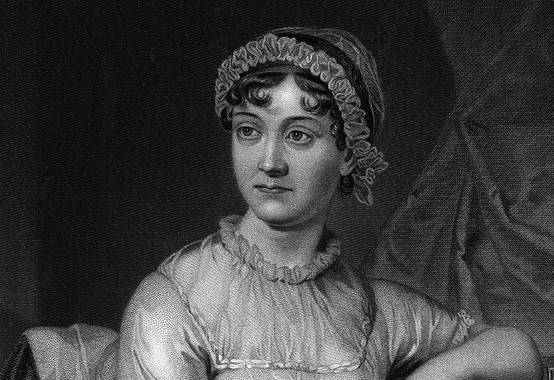
Why does Jane Austen feel so much like our contemporary? Is it the way she has been appropriated by popular culture, turned into a vampish, modern consumer icon in adaptations like From Prada to Nada, Clueless, and Bridget Jones’ Diary? Do these candy-colored updates of Austen truly represent the spirit of the late 18th/early 19th century novelist’s world? Or do we gravitate toward Austen because of nostalgia for a simpler, almost pre-industrial time, when—as in the rather reactionary world of Downton Abbey—the comings and goings in a single household constituted an entire human society?
Why not both? As the writers and artists in the video above from the Morgan Library assert, Austen, like Shakespeare, is a writer for every age. “The Divine Jane” as the title dubs her, had an insight into human behavior that transcends the particulars of her historical moment. But of course, the context of Austen’s fiction—a time of great English country houses and an emerging class-consciousness based on rapidly changing social arrangements—is no mere backdrop. Like Shakespeare, we need to understand Austen on her own terms as much as we enjoy her wit transposed into our own.
The Morgan Library’s “A Woman’s Wit” exhibit, moved online since its debut in the physical space in 2009, offers an excellent collection of resources for scholars and lay readers to discover Austen’s world through her correspondence and manuscripts. You’ll also find there drawings by Austen and her contemporaries and commentary from a number of twentieth century writers inspired by her work. Much of the Austen-mania of the past several years treats the novelist as a more-or-less postmodern ironist—“hotter,” wrote Martin Amis in 1996, “than Quentin Tarantino.” That she has become such fodder for films, both good and frankly terrible, can obscure her obsession with language, one represented by her novels, of course, as well as by her letters—so lively and immediate so as to have inspired a “Perfect Love Letter” competition among Austen enthusiasts.
As for the novels, well, there really is no substitute. Dressing Austen up in Prada and Gucci and recasting her bumbling suitors and impish heroines as mall-savvy teenage Americans has—one hopes—been done enough. Let not Austen’s appeal to our age eclipse the rich, fine-grained observations she made of hers. Whether you’re new to Austen or a lifelong reader, her work is always available, as she intended it to be experienced, on the page—or, er… the screen… thanks to internet publishing and organizations like Project Gutenberg and Librivox. At the links below, you can find all of Austen’s major works in various eBook and audio formats.
So by all means, enjoy the modern classic Clueless, that hilarious rendition of Austen’s Emma. And by all means, read Emma, and Pride and Prejudice, and Mansfield Park, and… well, you get the idea….
- Lady Susan (1794)
- eBooks: iPad/iPhone — Kindle Format + Other Formats
- Audio Book: Free iTunes — Free MP3 — Free Zip File
- Northanger Abbey (1798)
- eBook: iPad/iPhone – Kindle + Other Formats
- Audio Book: Free iTunes — Free MP3
- Sense and Sensibility (1811)
- eBook: iPad/iPhone – Kindle + Other Formats
- Audio Book: Free iTunes — Free MP3 Stream — Free MP3 Zip File
- Pride and Prejudice (1813)
- eBook: iPad/iPhone – Kindle + Other Formats
- Audio Book: Free iTunes — Free MP3
- Mansfield Park (1814)
- eBook: iPad/iPhone – Kindle + Other Formats
- Audio Book: — Free iTunes — Free MP3 Stream
- Emma (1816)
- eBook: iPad/iPhone – Kindle + Other Formats
- Audio Book: Free iTunes — Free MP3
- Persuasion (1817)
- eBook: iPad/iPhone – Kindle + Other Formats
- Audio Book: Free iTunes — Free MP3
- The Letters of Jane Austen
- eBook: Kindle + other formats
Related Content:
1,000 Free Audio Books: Download Great Books for FreeJane Austen Used Pins to Edit Her Abandoned Manuscript, The Watsons
800 Free eBooks for iPad, Kindle & Other DevicesJosh Jones is a writer and musician based in Washington, DC. Follow him at @jdmagness
Read More...Marshall McLuhan’s Strange Reading Habit: “I Read Only the Right-Hand Page of Serious Books”
No doubt about it, Marshall McLuhan was a cryptic thinker and a bit of an odd duck. Earlier this week, Colin Marshall brought you an Introduction to Marshall McLuhan, presented by Tom Wolfe (best known for The Electric Kool-Aid Acid Test and The Bonfire of the Vanities). In putting together that post, we stumbled upon another gem of a video, a testament to McLuhan’s quirkiness — and we mean that in the best possible way. Above McLuhan, kicking back on a couch, reveals his “peculiar reading habit,” admitting: “If it’s a frivolous, relaxing book, I read every word. But serious books I read on the right-hand side only because I’ve discovered enormous redundancy in any well-written book, and I find that by reading only the right-hand page this keeps me very wide awake, filling in the other page out of my own noodle.” There’s a bit of hubris in that approach, but also a certain amount of creativity too. Perhaps you’ll want to give it a try.
If you would like to support the mission of Open Culture, consider making a donation to our site. It’s hard to rely 100% on ads, and your contributions will help us continue providing the best free cultural and educational materials to learners everywhere. You can contribute through PayPal, Patreon, and Venmo (@openculture). Thanks!
Related Content:
The Visionary Thought of Marshall McLuhan, Introduced and Demystified by Tom Wolfe
McLuhan Said “The Medium Is The Message”; Two Pieces Of Media Decode the Famous Phrase
Marshall McLuhan: The World is a Global Village
Read More...Guernica: Alain Resnais’ Haunting Film on Picasso’s Painting & the Crimes of the Spanish Civil War
Note: You will hear sound 37 seconds into the film.
Humanity has endured a great many wartime atrocities since 1937, but to this day, if you think of an artwork born of one such event, you’ll more than likely still think of Guernica. Pablo Picasso’s large black-and-white canvas, which he began painting less than a month after the aerial bombing during the Spanish Civil War of the small Basque town which gave it its name, renders the horror of sudden, thorough destruction in a way nobody had ever seen before, or has seen again since.
“When I visited the town the whole of it was a horrible sight, flaming from end to end. The reflection of the flames could be seen in the clouds of smoke above the mountains from 10 miles away,” wrote The Times’ war correspondent George Steer, in the report that moved Picasso to take on the subject of Guernica for the mural the Spanish Republican government had commissioned for the 1937 World’s Fair. “Throughout the night houses were falling until the streets became long heaps of red impenetrable debris.”
In 1950, both Guernica and Guernica inspired an equally haunting short film of the same name [part one, part two] by Alain Resnais and Robert Hessens. In black and white just like Picasso’s painting, the picture uses nightmarish cutting to combine imagery from Guernica and other artistic sources, a score by Guy Bernard, and the poem “Victory of Guernica” by Paul Éluard. “You hold the flame between your fingers and paint like a fire,” said the poet to the painter during their close friendship in the years after the bombing.
Resnais, who would go on to direct such classics of French cinema as Hiroshima mon amour (another study of an aftermath) and Last Year at Marienbad, only just ended his long and distinguished filmmaking career when he died last year. But in 1950, his career had only just begun, his first forays into film having come in the form of short documentaries on working artists in the mid-1940s. Those led to a commission to do one on the paintings of Van Gogh for a Paris exhibition, which led to one on Gauguin, which led to Guernica. Clearly, Resnais had the tendency to unite the arts in his work from the very beginning, and many of his fans would say it served him well to the end.
Related Content:
A 3D Tour of Picasso’s Guernica
Watch Alain Resnais’ Short, Evocative Film Toute la mémoire du monde (1956)
Photos of Hiroshima by Hiroshima mon amour Star Emmanuelle Riva (1958)
Colin Marshall hosts and produces Notebook on Cities and Culture as well as the video series The City in Cinema and writes essays on cities, language, Asia, and men’s style. He’s at work on a book about Los Angeles, A Los Angeles Primer. Follow him on Twitter at @colinmarshall or on Facebook.
Read More...Langston Hughes Presents the History of Jazz in an Illustrated Children’s Book (1955)
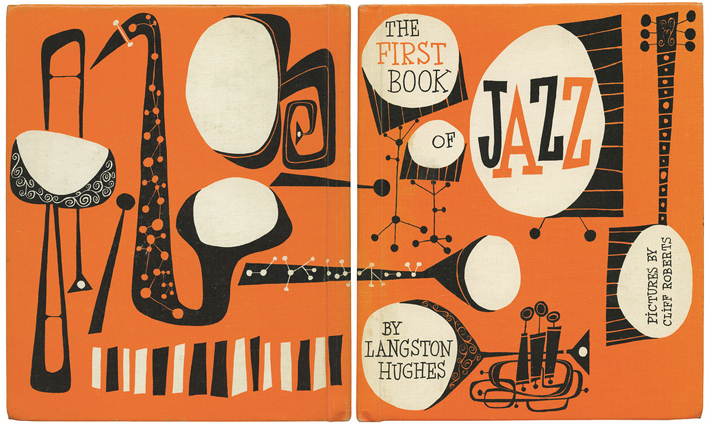
I can imagine no better guide through the history and variety of jazz than Langston Hughes, voice of the Harlem Renaissance and poetic interpreter of 20th century black American culture. Hughes’ 1955 First Book of Jazz is just that, a short primer with a surprisingly high degree of sophistication for a children’s book. I would, in fact, recommend it as an introduction to jazz for any reader.
Hughes thoroughly covers the musical context of jazz in brief chapters like “African Drums,” “Old New Orleans,” “Work Songs,” “The Blues,” and “Ragtime.” He then “discusses the mechanics of jazz,” writes author and blogger Ariel S. Winter, including “improvisation, syncopation, percussion, rhythm, blue notes, tone color, harmony, break, riff….” Through it all runs the life and career of Louis Armstrong, whose story, Hughes states “is almost the whole story of orchestral jazz in America.”
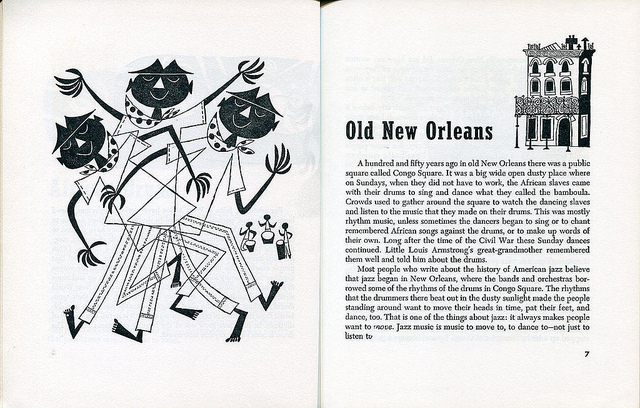
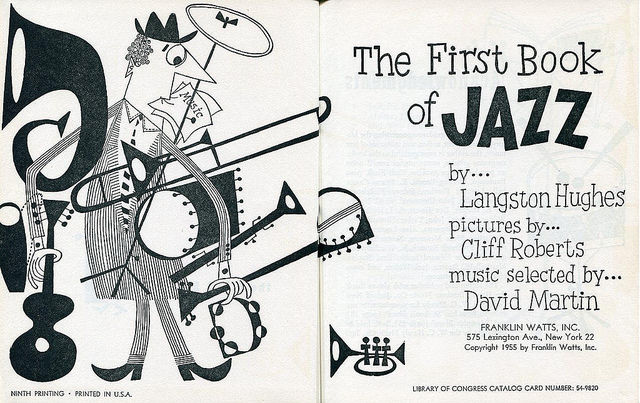
The book is very patriotic in tone, a fact dictated by Hughes’ recent appearance before Senator McCarthy’s Subcommittee, which exonerated him on the condition that he renounce his earlier sympathies for the Communist Party and get with a patriotic program. Having fallen out of favor with the public, Hughes began the nonfiction children’s series to win back readers, also writing the quaintly named cultural history First Book of Negroes and the Whitmanesque First Book of Rhythms. All of the books were illustrated by different artists. The First Book of Jazz received special treatment from popular illustrator Cliff Roberts, who made its pages closely resemble classic album covers by artists like Jim Flora.
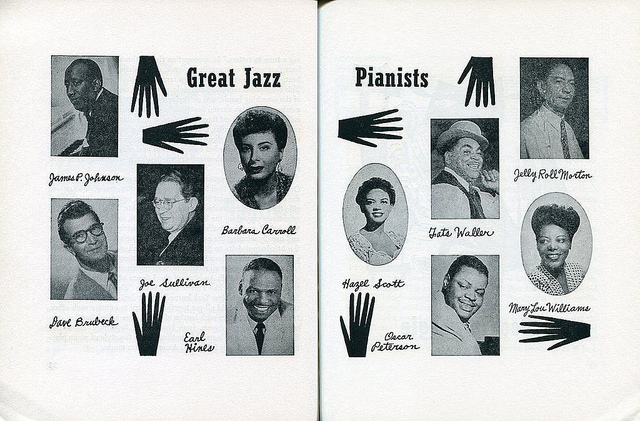
Although Hughes may have been somewhat conciliatory in his attitude toward inequality, he nonetheless makes the origins and importance of jazz clear:
A part of American music is jazz, born in the South. Woven into it in the Deep South were the rhythms of African drums that today make jazz music different from any other music in the world. Nobody else ever made jazz before we did. Jazz is American music.
“The particular Americans in question,” writes Winter, “are undeniably black,” and “when Hughes covers the vast array of American styles that went into jazz, they tend to be (as they should be) black interpretations of each musical form.” But as he had always done, whether under pressure from McCarthyism or not, he proudly declares jazz yet another invaluable contribution African-Americans, as well as European immigrants, made to the national culture. However far left his political sympathies, Hughes was always a patriot, in the best sense, an admirer of his country’s achievements and genuine lover of its people.
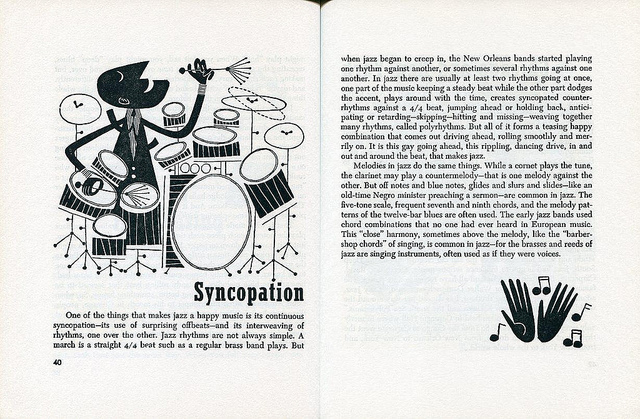
Although it is a children’s book, Hughes’ First Book of Jazz is still a scholarly one, with a host of references in the Acknowledgements, and a list of famous jazz musicians, and their instruments, at the end. Also rounding out the short course on jazz history and musicianship is a two-part list of “Suggested Records for Study” and one called “100 of My Favorite Recordings.” Hughes even convinced Folkways records to release The Story of Jazz, an LP Hughes narrated with examples of each style of jazz he discusses. You can read the full First Book of Jazz at Winter’s Flickr, where he has posted scans of every page. Vintage copies can be purchased online. See a gallery of Roberts’ full page illustrations here.
Related Content:
Watch Langston Hughes Read Poetry from His First Collection, The Weary Blues (1958)
Charles Mingus Explains in His Grammy-Winning Essay “What is a Jazz Composer?”
Josh Jones is a writer and musician based in Washington, DC. Follow him at @jdmagness
Read More...President Obama Chats with David Simon About Drugs, The Wire & Omar
Back in 2012, President Obama, already on record as being a fan of The Wire, was asked by ESPN to name his favorite character on the show, to which he replied “It’s got to be Omar, right? I mean, that guy is unbelievable, right?” Fast forward to 2015, and we find Mr. Obama hosting David Simon (the creator of The Wire) at the White House, and having a frank conversation about the TV show and the war on drugs, and what lessons we’ve learned along the way. Of course, the conversation doesn’t end without Omar getting a mention … or without us getting to see Obama as TV host. A sign of what’s to come after 2016?
Follow us on Facebook, Twitter, Google Plus and LinkedIn and share intelligent media with your friends. Or better yet, sign up for our daily email and get a daily dose of Open Culture in your inbox.
Read More...The Visionary Thought of Marshall McLuhan, Introduced and Demystified by Tom Wolfe
Marshall McLuhan and Tom Wolfe: both writers, both astute observers of modern humanity, and both public figures whose work has, over the years, enjoyed high fashionability and endured high unfashionability. You might think the connection between them ends there. But when the 100th anniversary of McLuhan’s birth and the centennial-celebrating site Marshall McLuhan Speaks came about, whose eloquent introduction to the thinker (who famously declared the world a “global village” where “the medium is the message”) got used there? Why, the man in white’s.
In the 20-minute video above, Wolfe lays out not just a précis of the insights that made McLuhan “the first seer of cyberspace,” but gets into his biography as well: his humbly respectable origins in Edmonton, his background as a literary scholar, his conversion to Catholicism, the beginnings of his teaching career in Cambridge and Wisconsin, his “extracurricular gatherings devoted to the folklore of industrial man,” his struggle to reconcile his interest in the writings of philosopher-paleontologist Pierre Teilhard de Chardin with his own religious convictions, and the considerable fame he accrued making pronouncements on the media in the media.
“No doubt the internet would have delighted him,” says Wolfe. “He would have seen it as a fulfillment of prophecies he had made thirty years before it was born, as an instrument for the realization of his dream of the mystical unity of all mankind. [Watch him predict the world would be knitted into a global village by digital technology in some vintage video.] Here, in a specific, physical, electronic form, was the seamless web of which he had so often spoken. Today thousands of young internet apostles are familiar with Marshall McLuhan, and are convinced his light shines round about them. From the editors of Wired magazine to the most miserable dot-com lizards of the chat room, they have made him their patron saint.”
To get an even deeper sense of how much Wolfe has thought about McLuhan, have a look at his first annual Marshall McLuhan Lecture, delivered at Fordham University in 1999. And unlike many intellectuals who only turned back to re-examine McLuhan after the age of the internet had retroactively validated even some of his wildest-sounding speculations, Wolfe has been tuned in to McLuhan’s frequency since way back. In 1970, the two even got together for a televised chat in McLuhan’s back yard (a clip of which you can watch just above), which revealed that, for all the fascination Wolfe had with McLuhan, the interest was mutual.
Related Content:
McLuhan Said “The Medium Is The Message”; Two Pieces Of Media Decode the Famous Phrase
Marshall McLuhan: The World is a Global Village
Colin Marshall hosts and produces Notebook on Cities and Culture as well as the video series The City in Cinema and writes essays on cities, language, Asia, and men’s style. He’s at work on a book about Los Angeles, A Los Angeles Primer. Follow him on Twitter at @colinmarshall or on Facebook.
Read More...Leo Tolstoy’s 17 “Rules of Life:” Wake at 5am, Help the Poor, & Only Two Brothel Visits Per Month
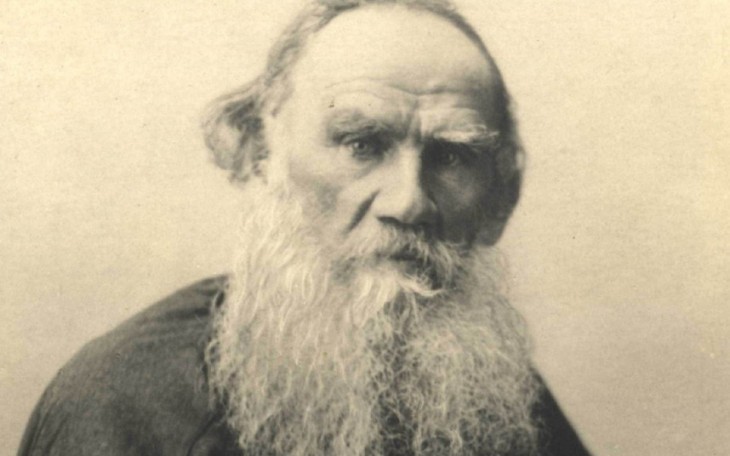
Many aspiring epic novelists surely wouldn’t mind writing like Leo Tolstoy. But can you write like the writer you admire without living like the writer you admire? Biographies reveal plenty of facts about how the author of such immortal volumes as War and Peace and Anna Karenina passed his 82 years, none more telling than that even Leo Tolstoy struggled to live like Leo Tolstoy. “I must get used to the idea, once and for all, that I am an exceptional human being,” he wrote in 1853, at age 25, underscoring that “I have not met one man who is morally as good as I am, or ready to sacrifice everything for his ideal, as I am.”
Clearly, excessive modesty didn’t count among Tolstoy’s faults. Seven years before making that declaration, he had already envisioned for himself a life of virtue and industry, laying out what he called his “rules of life,” perhaps a foreshadowing of his search for a rigorously religious life without belief in a higher being. The website Tolstoy Therapy has posted a selection of these rules, which commanded him as follows:
- Wake at five o’clock
- Go to bed no later than ten o’clock
- Two hours permissible for sleeping during the day
- Eat moderately
- Avoid sweet foods
- Walk for an hour every day
- Visit a brothel only twice a month
- Love those to whom I could be of service
- Disregard all public opinion not based on reason
- Only do one thing at a time
- Disallow flights of imagination unless necessary
To this list of precepts drawn up at the dawn of his adult life, most of which wouldn’t seem out of place as any of our 21st-century new year’s resolutions, Tolstoy later added these:
- Never to show emotion
- Stop caring about other people’s opinion of myself
- Do good things inconspicuously
- Keep away from women
- Suppress lust by working hard
- Help those less fortunate
Even if you haven’t read much about Tolstoy’s life, you may sense in some of these general principles evidence of battles with particular impulses: observe, for instance, how his twice-monthly limit on brothel visits becomes the much more stringent and much less realistic forbiddance of women entirely. But perhaps his technique of working hard, however well or poorly it suppressed his lust (the man did father fourteen children, after all), benefited him in the end, given the vast and (often literally) weighty body of work he left behind.
“Between ‘rules of life’ and life itself, what a chasm!” exclaims biographer Henri Troyat in Tolstoy. But as rich with interest as we find books like that, we ultimately care about writers not because of how they live, but because of how they write. The young Tolstoy knew that, too; “the publication of Childhood and ‘The Raid’ having made him, in his own eyes, a genuine man of letters,” writes Troyat, “he soon added no less peremptory ‘Rules of Writing’ to his ‘Rules of Life’:”
- When you criticize your work, always put yourself in the position of the most limited reader, who is looking only for entertainment in a book.
- The most interesting books are those in which the author pretends to hide his own opinion and yet remains faithful to it.
- When rereading and revising, do not think about what should be added (no matter how admirable the thoughts that come to mind) … but about how much can be taken away without distorting the overall meaning.
Then again, War and Peace has in the modern day become a byword for sheer length, and few readers not already steeped in 19th-century Russian literature would turn to Tolstoy for pure entertainment. Perhaps the writer’s life implicitly adds one caveat atop all the ever-stricter rules he made for himself while living it: nobody’s perfect.
Related content:
Leo Tolstoy Creates a List of the 50+ Books That Influenced Him Most (1891)
Rare Recording: Leo Tolstoy Reads From His Last Major Work in Four Languages, 1909
Vintage Footage of Leo Tolstoy: Video Captures the Great Novelist During His Final Days
Leo Tolstoy’s Family Recipe for Macaroni and Cheese
Stephen King’s Top 20 Rules for Writers
Colin Marshall hosts and produces Notebook on Cities and Culture as well as the video series The City in Cinema and writes essays on cities, language, Asia, and men’s style. He’s at work on a book about Los Angeles, A Los Angeles Primer. Follow him on Twitter at @colinmarshall or on Facebook.
Read More...Download Images From Rad American Women A‑Z: A New Picture Book on the History of Feminism
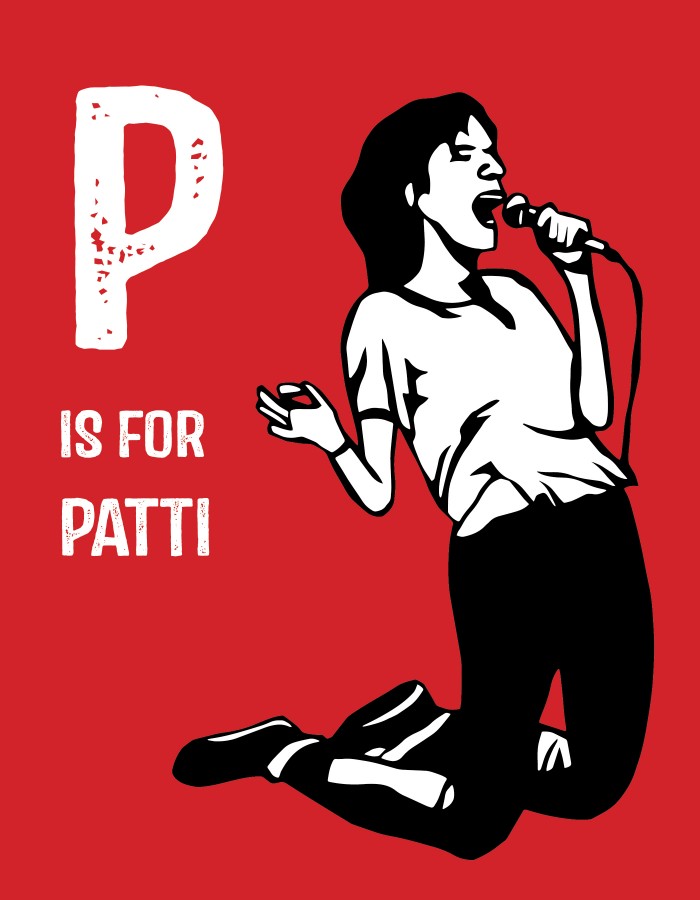
The next time story hour rolls around, you can give a mouse a cookie or you can awaken pre-readers (and yourself) to some key figures in women’s history. 26 of them, to be precise. It’s no accident that that number corresponds to the exact number of letters in the alphabet.
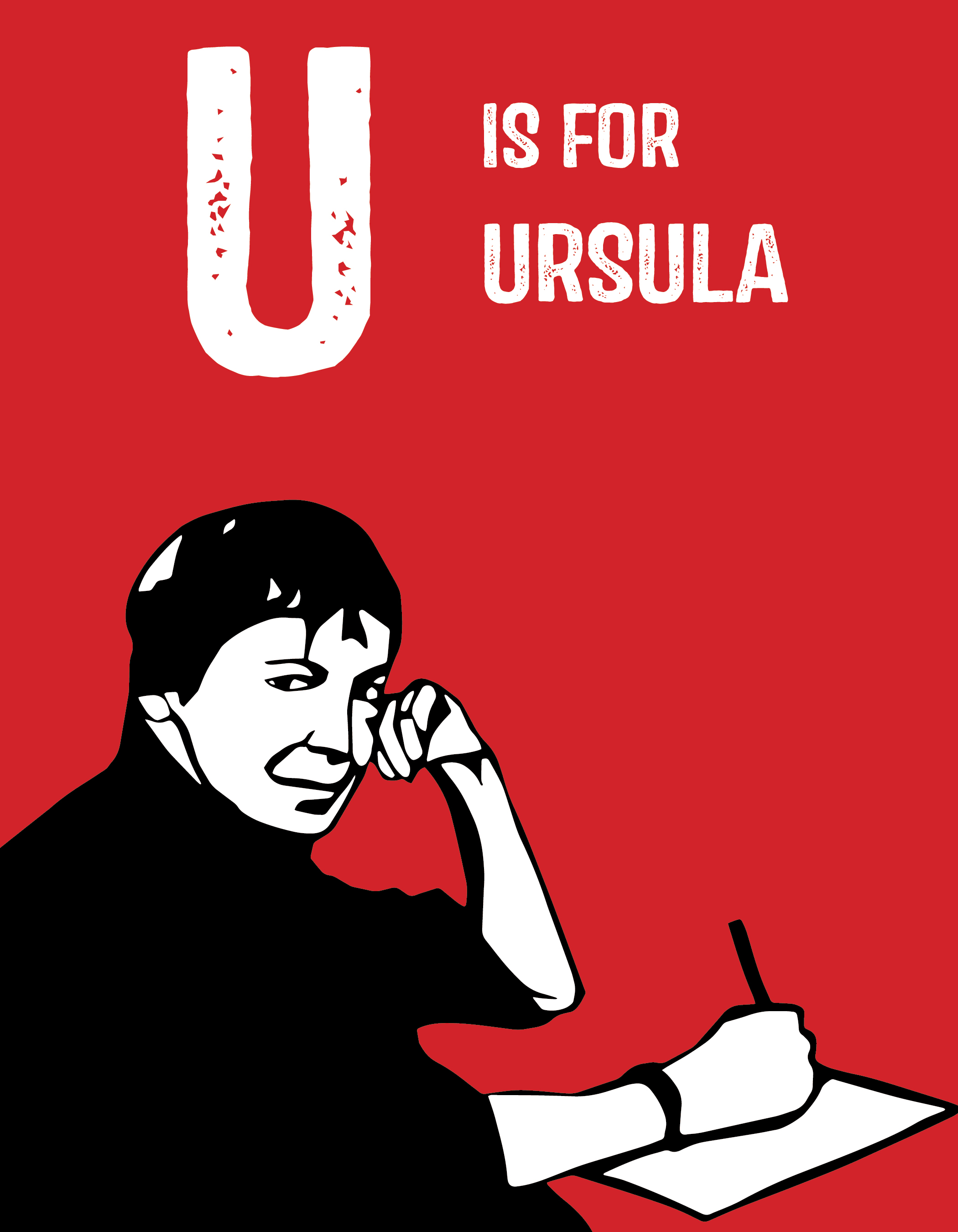
Author Kate Schatz and illustrator Miriam Klein Stahl actively sought to include women of color and a variety of sexual orientations when choosing whom to feature in Rad American Women A To Z, a progressive feminist text cum ABC primer. (Illustrations from the book, like the ones featured on this page, can be downloaded here for free.)

Hopefully Gloria Steinem was not too upset to learn that G is for the Grimke sisters. Actually, I suspect that the second wave’s most recognizable superstar would be pleased if readers are moved to educate themselves as to some of the book’s more obscure references.
B is for Billie Jean King who whooped male chauvinist pig Bobby Riggs on the court in 1973’s Battle of the Sexes. I remember her! A Billie and Bobby-themed pumpkin took top honors in my school’s Halloween carving contest that year.
It’s funny how when a woman does something they always think we only affect half of the population, and people will come up to me and say thanks for what you did for women’s tennis all the time, and I know they’d never say that to a guy.
E is for civil rights activist Ella Baker, a secretary who rose through the ranks of the NAACP to become director of branches. She recognized the press often overlooked her role, as did history.
You didn’t see me on television, you didn’t see news stories about me. The kind of role that I tried to play was to pick up pieces or put together pieces out of which I hoped organization might come. My theory is, strong people don’t need strong leaders.
J is for Jovita Idar, educator and cofounder of the Mexican Feminist League.
Mexican children in Texas need an education…. There is no other means to do it but ourselves, so that we are not devalued and humiliated by the strangers who surround us.
Godmother of Punk Patti Smith, author Ursula K. La Guin, and Odetta, legendary blues singer and “Voice of the Civil Rights Movement,” are among the marquee names to be canonized. See their illustrations above.
To get all 26 illustrations in a downloadable format, click here. To order your own copy of the book, go here.
Related Content:
74 Essential Books for Your Personal Library: A List Curated by Female Creatives
Simone de Beauvoir Explains “Why I’m a Feminist” in a Rare TV Interview (1975)
Chrissie Hynde’s 10 Pieces of Advice for “Chick Rockers” (1994)
Simone de Beauvoir Tells Studs Terkel How She Became an Intellectual and Feminist (1960)
Ayun Halliday is an author, illustrator, and Chief Primatologist of the East Village Inky zine. Follow her @AyunHalliday
Read More...George Mason Students Create Revolutionary Fire Extinguisher That Uses Sound Waves to Blow Out Fires
If you haven’t seen it already: two George Mason University engineering students — Viet Tran and Seth Robertson — have created a potentially revolutionary device, a new-fangled fire extinguisher, that uses low-frequency sound waves to snuff out fires. According to TechExplore, Tran (a computer engineering major) and Seth Robertson (double e major) “started with the simple idea that sound waves are also mechanical or pressure waves (due to the back and forth motion of the medium in which they pass through), which can cause an impact on objects.” Through trial and error, the students figured out that ultra-high frequencies didn’t do very much, but lower frequencies (in the 30 to 60 Hertz range) can blow a small fire right out. Just watch above.
Related Content:
Free Online Computer Science Courses
Free Online Engineering Courses
Read More...Support Us
We're hoping to rely on loyal readers, rather than erratic ads. Please click the Donate button and support Open Culture. You can use Paypal, Venmo, Patreon, even Crypto! We thank you!

About Us

Open Culture scours the web for the best educational media. We find the free courses and audio books you need, the language lessons & educational videos you want, and plenty of enlightenment in between.
Advertise With Us

FREE UPDATES!
GET OUR DAILY EMAIL
Get the best cultural and educational resources on the web curated for you in a daily email. We never spam. Unsubscribe at any time.
FOLLOW ON SOCIAL MEDIA

Open Culture editor Dan Colman scours the web for the best educational media. He finds the free courses and audio books you need, the language lessons & movies you want, and plenty of enlightenment in between.
Advertise With Us


