Hear a “DNA-Based Prediction of Nietzsche’s Voice:” First Attempt at Simulating Voice of a Dead Person
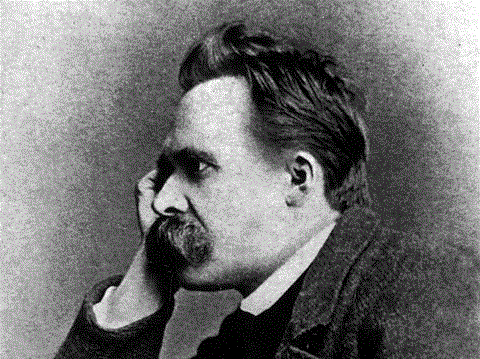
Whether they submit to his mighty philosophical influence, resist it with all their own might, or fall somewhere in between, everyone who’s read the pronouncements of Friedrich Nietzsche (find his ebooks here) recognizes his voice — well, his textual voice, that is. Having died in 1900 after spending the last decade of his life in a mental breakdown, the author of Thus Spake Zarathustra and Beyond Good and Evil has an excuse for not leaving behind much in the way of audio material. But love Nietzsche or hate him, a reader has to wonder: what did the guy actually sound like?
Here to satiate our curiosity come Flavia Montaggio, Patricia Montaggio, and Imp Kerr, authors of the Investigative Genetics paper “DNA-based prediction of Nietzsche’s voice,” which supposedly offers a scientific means of doing just that. “We collected trace amounts of cellular material (Touch DNA) from books that belonged to the philosopher Friedrich Nietzsche,” reads the abstract, which goes on to describe the gathering of Nietzsche-related data eventually “converted into bio-measures that were used to 3D-print a vocal tract and larynx through which phonation was organically generated.” The result, after running everything through a series of text-to-speech simulations: “the first attempt at simulating the voice of a deceased person”:
It all seems legit, right? Or maybe you German-speakers out there will suspect something fishy, starting with the unlikely name of Imp Kerr. It actually belongs to “a Swedish-French artist living in New York City, mostly known for her fake American Apparel advertisement campaign,” or so reads the Wikipedia page quoted by a Language Log post on the project. “I have no idea whether anything in the Wikipedia article about Imp Kerr is true,” writes author Mark Liberman, “but it’s clear from internal evidence that the alleged Investigative Genetics article is a piece of performance art.”
Liberman breaks down the paper’s humorous elements, from its “many segments that display quasi-scientific terminology in meaningless or contradictory ways” to its simple inability to “restrain a certain telltale playfulness” (as when it deals with a resonance “lower than expected in regards of Nietzsche’s robust mandibles”). All this may remind you of the famous hoax wherein physicist Alan Sokal published a paperful of sheer nonsense in a respected cultural-studies journal. Or you may think of the film above, which purports, questionably, to show Nietzsche’s last days. It just goes to show that, if your ideas live on, you live on — or your readers will try to make you do so.
via The New Inquiry/Leiter Reports
Related Content:
The Digital Nietzsche: Download Nietzsche’s Major Works as Free eBooks
Download Walter Kaufmann’s Lectures on Nietzsche, Kierkegaard, Sartre & Modern Thought (1960)
Human, All Too Human: 3‑Part Documentary Profiles Nietzsche, Heidegger & Sartre
Free Online Philosophy Courses
Colin Marshall hosts and produces Notebook on Cities and Culture as well as the video series The City in Cinema and writes essays on cities, language, Asia, and men’s style. He’s at work on a book about Los Angeles, A Los Angeles Primer. Follow him on Twitter at @colinmarshall or on Facebook.
Read More...What Happens When a Cheap Ikea Print Gets Presented as Fine Art in a Museum
The entity to whom Dutch group, Lifehunters, attributes the museum quality artwork in the video prank above doesn’t exist. The “famous” Swedish artist’s handle –IKE Andrews –is but a puckish reference to IKEA, the purveyor of the 10€ print (oh snap, it’s not even an original!) various unnamed “art experts” are asked to evaluate, having been led to believe it’s something rare and wonderful. IKE Andrews’ fellow fictional entity, Borat, would be gratified by how readily these experts accept presenter Boris Lange’s suggestions as to the value of this work.
So how bad is this “painting”? Walter Keane bad? Margaret Keane bad? Is it a Velvis? A sad clown? The sort of crummy landscape artist Wayne White might snap up in a thrift store?
Only if you think IKEA achieved global dominance by choosing designs, patterns, and images in order for snotty hipsters to buy them ironically…
As several YouTube, Twitter, and blog commenters have mentioned, the print itself is pretty cool.
It’s a media frenzy, but interestingly, the artist is not coming forward to herald his or her role in the hoax.
Make that artists. Turns out IKE Andrews is a pair of Swiss street artists, Christian Rebecchi and Pablo Togni, who collaborate as NEVERCREW.
They have a fascination with cross sections. As their website somewhat murkily explains [all sic]:
These models, as such, from time to time actually contain more or less extensive realities, represented as autonomous systems of which the reality of the viewer becomes a part. This then the rapport becomes the very subject, mainly highlighted as the relationship between man and nature (between human being and its nature), but automatically extended to a vision of total and inevitable relationship between everything, between every part, where it is only the point of view, the position within a system, to define a selection.
IKEA streamlines the artists’ philosophy for the masses thusly:
We call the theme “living structures” and we like to see them as models of living systems. We would like our art to generate interest and curiosity, and the viewer to become a part of the mechanism with his or her thoughts, perspective and emotions.
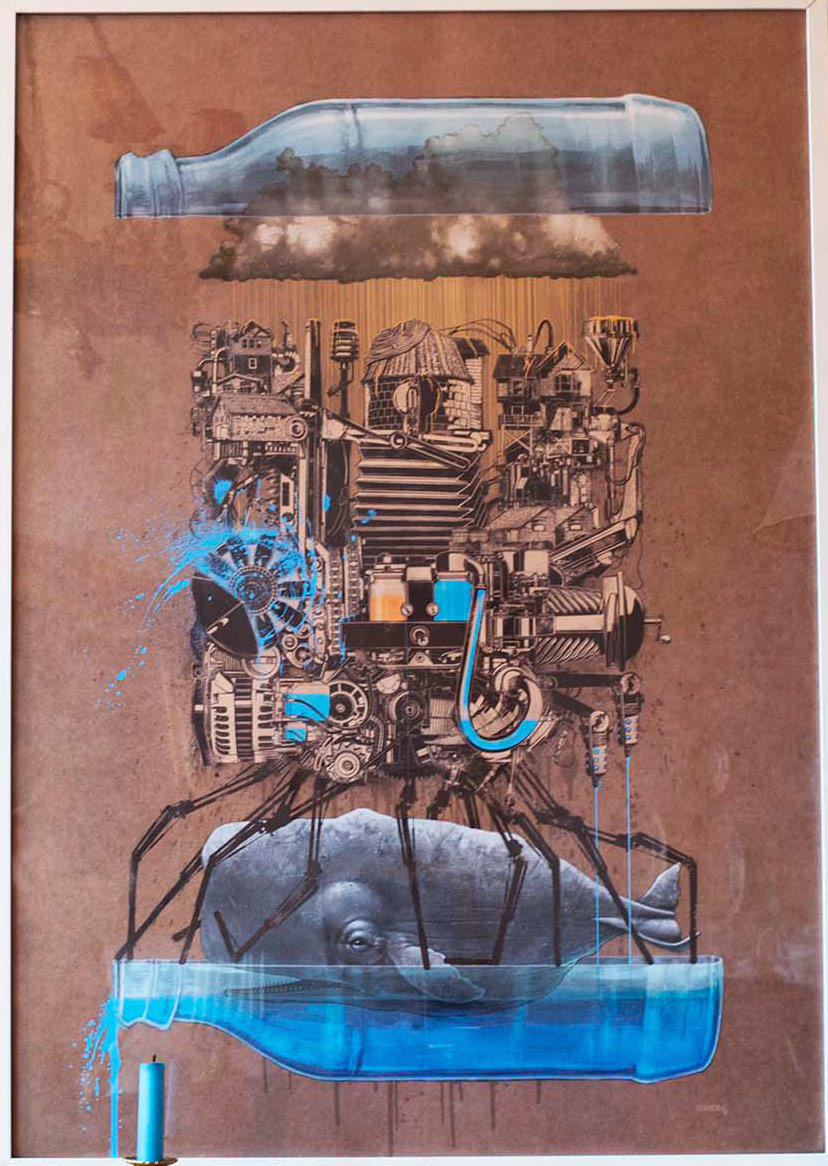
Philosophy’s all well and good, but what’s it actually look like, this “Message in a Bottle”?
Well, it seems to me to be a bottle, implausibly halved lengthwise to reveal a bunch of steampunk stuff balanced atop robot spider legs, forming a cage around an ancient-looking whale. Also, a cloud raining yellow liquid, or possibly light. (Hopefully the latter). Oh! And it appears to have been painted on a brown paper bag.
I can think of plenty of people who’d not only like it, but find meaning in it, as the experts do. The only difference is the experts do so on camera, a fact not all of them are willing to laugh at, when host Lange informs them they’ve been punked.
The artists aren’t the only ones playing it cool. The internet may be exploding, but so far, neither IKEA, nor the Netherlands’ Arnhem Museum, where the prank was staged, have made mention of this business.
via Hyperallergic
Related Content:
F for Fake: Orson Welles’ Short Film & Trailer That Was Never Released in America
The Great Dr. Fox Lecture: A Vintage Academic Hoax (1970)
Ayun Halliday is an author, illustrator, and mother of a teen filmmaker whose best known work was shot guerrilla style in a Red Hook, Brooklyn Ikea. Follow her @AyunHalliday
Read More...The Touching Story Behind Paraguay’s Landfill Orchestra: Now Told in Film, and Soon a Book
Back in 2012, I first told you about the amazing youth chamber orchestra from Cateura, Paraguay. The families from this small impoverished town, located alongside a vast landfill, can’t afford many luxuries — like buying instruments for their kids. But what they lack in money, they make up for in ingenuity and good spirit. The short documentary above gives you a glimpse of their touching story, showing how creative leaders in the community fashioned instruments with their own hands, turning oil cans into cellos, and aluminum bowls into violins. Watch them in action:
But why stop with the short story, when you can get the longer story. Last week, a full blown film called Landfill Harmonic premiered at the SXSW Film Festival 2015. And now the film (see a short trailer here) will be screened at selected film festivals while the producers try to find a distributor who can bring the production to a wider audience. And, in another piece of good news, Simon & Schuster announced that it plans to publish a picture book about the Recycled Orchestra. Look for Ada’s Violin: The Story of the Recycled Orchestra of Paraguay in March 2016.
You can watch Landfill Harmonic at the festivals mentioned below. To keep tabs on future showings, follow this Facebook page.
- New York Children’s Film Festival March 21, 2015
- Environmental Film Festival DC March 25, 2015
- TIFF Kid’s Film Festival April 10 – 17, 2015
Google Puts Online 10,000 Works of Street Art from Across the Globe

Circling Birdies by Cheko, Granada Spain
Since last we wrote, Google Street Art has doubled its online archive by adding some 5,000 images, bringing the tally to 10,000, with coordinates pinpointing exact locations on all five continents (though as of this writing, things are a bit thin on the ground in Africa). Given the temporal realities of outdoor, guerrilla art, pilgrims may arrive to find a blank canvas where graffiti once flourished. (RIP New York City’s 5 Pointz, the “Institute of Higher Burning.”)
A major aim of the project is virtual preservation. As with performance art, documentation is key. Not all of the work can be attributed, but click on an image to see what is known. Guided tours to neighborhoods rich with street art allow armchair travelers to experience the work, and interviews with the artists dispel any number of stereotypes.
Cultural institutions like Turkey’s Pera Museum and Hong Kong’s Art Research Institute, and street art projects based in such hubs as Rome, Paris, Sydney, and Bangkok, have pulled together official collections of photos and videos, but you can play curator too.
It’s easy to add images to a collection of your own making that can be shared with the public at large or saved for private inspiration. Careful, you could lose hours…it’s like Pinterest for people who gravitate toward spray paint and rubbish strewn vacant lots over gingham wrapped Mason jars.
It’s been a long and brutal winter here on the east coast, so for my first foray, I prowled for Signs of Spring. One of my first hits was “Circling Birdies” by Cheko, above. Located in Granada, Spain, it’s one of the existing works Google has turned into a GIF with some light, logical animation.
Behold a bit of what typing “flower,” “baby animals,” “plants,” and “trees” into a search box can yield! You can enter Google Street Art here.

Artist: Walter Kershaw
London UK

Artists: Thrashbird and Renee Gagnon
Los Angeles, California.

Artist: unknown
Rochester, NY

Icy and Sot
Rochester NY

Artist: Kristy Sandoval
Los Angeles, CA

Artists: Regg and Violant
Alfragide Portugal

Artist: Klit
Alfragide, Portugal
A giant colorful beetle tries to fly between the ceiling and the floor of this parking lot. His wings seem filled with flower petals. So, the “Living Nature” project brought a set of huge insects that carry a note of living spirit to the space.

Artist: Rai Cruz
Manila, Philippines

Artist: Christiaan Nagel
London, England
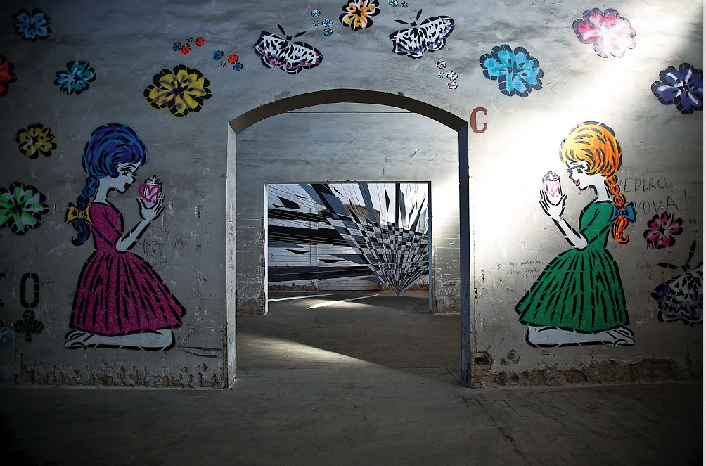
Artist: Lady Aiko
Rome, Italy

Artist: Andrew Kentish
Nepal
Related Content:
Tour the World’s Street Art with Google Street Art
Obey the Giant: Short Film Presents the True Story of Shepard Fairey’s First Act of Street Art
Big Bang Big Boom: Graffiti Stop-Motion Animation Creatively Depicts the Evolution of Life
Ayun Halliday is an author, illustrator, and Chief Primatologist of the East Village Inky zine. Follow her @AyunHalliday
Read More...Watch the “Youngest String Quartet Ever” Perform Vivaldi, Michael Jackson & Katy Perry
They’re billed as “the youngest string quartet ever.” The kids began playing in The Joyous String Quartet when they were four years old. Now, fast forward four more years, and they find themselves performing 20 concerts a year around the globe — in places like South Korea and China, and on the Ellen DeGeneres Show. Above you can watch them perform Summer “Presto” by Vivaldi. Below, they give you a classical version of Katy Perry’s “Firework:
And finally Michael Jackson’s “Smooth Criminal.” In case you’re wondering, the students come out of The Joyous Music School in Hicksville, NY.
Related Content:
Fourteen-Year-Old Girl’s Blistering Heavy Metal Performance of Vivaldi
Elementary School Students Perform in a Play Inspired by David Lynch’s Twin Peaks
Follow us on Facebook, Twitter, Google Plus and LinkedIn and share intelligent media with your friends. Or better yet, sign up for our daily email and get a daily dose of Open Culture in your inbox.
Read More...Watch Rock Pioneer Sister Rosetta Tharpe Wow Audiences With Her Gospel Guitar
The “British Invasion” as a historical phenomenon, has achieved a status almost like that of Paul Revere’s ride, a watershed moment condensed to a singular image: The Stones, or—if you’re more inclined, The Beatles—step onto the tarmac, young girls scream, cameras flash, microphones jostle… suits abound. We remember the scenery, and the haircuts, but the history disappears. The all important context when the British landed in the mid sixties has to do with another invasion at the same time on England’s shores, of black American blues artists who toured the UK and performed on British TV, beginning in 1963: Howlin’ Wolf, Big Joe Williams, Muddy Waters, Lightnin’ Hopkins… and Sister Rosetta Tharpe.
If Keith Richards has credited Chuck Berry for his chops, saying he “listened to every lick he played and picked it up,” he could perhaps say something similar about Sister Tharpe, as could dozens of other guitarists who watched her strut across the stage, picking out hot, countrified blues licks on her Gibson SG. “Nobody—not Chuck Berry, not Scotty Moore, not James Burton, not Keith Richards—played wilder or more primal rock ‘n’ roll guitar than this woman who gave her life to God and would have celebrated her 100th birthday on 20 March,” writes The Guardian.
And yet, perhaps because of her religiosity, or her race, or her gender, Sister Tharpe has long remained unsung as a hero of both early rock ‘n’ roll and country.
A pioneering crossover artist from the gospel world, Tharpe came from Cotton Plant, Arkansas, a town on the banks of the Mississippi. Born to musical parents, she toured the country with her mother in revival performances across the south and made her first record at the age of 23. By the time she took the Manchester stage to sing “Didn’t it Rain” in the video at the top of the post, Tharpe was 49 years old and a highly seasoned, confident performer who could captivate any audience with her powerful voice and phenomenal playing. Just above, see a younger Tharpe play some jazz-inflected blues in “That’s All,” a sexy-sounding song about tolerance for sinful men. Sister Tharpe worked clean, but she could get down with the best of ‘em.
Like most rock pioneers, Rosetta didn’t have an easy road to stardom, and like many women in the music business, her story involves a fair amount of exploitation and abuse. But Tharpe rose above it, moved to the big city, and pitched her southern gospel tent in the heart of electric blues territory. Learn about Rosetta Tharpe’s life and career in the 2014 documentary above, The Godmother of Rock & Roll. It’s a title Tharpe well deserves, as well as some long overdue recognition from the Rock and Roll Hall of Fame.
Related Content:
New Web Project Immortalizes the Overlooked Women Who Helped Create Rock and Roll in the 1950s
Hail! Hail! Chuck Berry, the Father of Rock & Roll, Is 85
Josh Jones is a writer and musician based in Durham, NC. Follow him at @jdmagness
Read More...Rome Reborn: Take a Virtual Tour of Ancient Rome, Circa 320 C.E.
A few years ago, we featured Rome Reborn, which is essentially “a 3D digital model of the Eternal City at a time when Ancient Rome’s population had reached its peak (about one million) and the first Christian churches were being built.” Rome Reborn offers, declared Matthias Rascher, “a truly stunning bird’s‑eye view of ancient Rome that makes you feel as if you were actually there.” You may also remember our posts on video analyses of great works of art by Khan Academy’s Smarthistory. Today, the two come together in the video above, “A Tour Through Ancient Rome in 320 C.E.”
In it, we not only see and move through ancient Rome reconstructed, we have our extended tour guided by renowned “virtual archaeologist” and overseer of the Rome Reborn project Dr. Bernard Frischer, professor emeritus at the University of Virginia. He picks 320 C.E. as the year of the tour, “the peak of Rome’s development, certainly in terms of public architecture, for the simple reason that the Emperor at this time was Constantine the Great.” Shortly after this year, Constantine would move the capital from Rome to his city, Constantinople.
We hear Frischer in dialogue with Dr. Steven Zucker, whose voice you may recognize from previous Smarthistory videos. Zucker’s questions ensure that, while we take in the spectacle of Rome’s impressive architecture (to say nothing of its equally impressive aqueducts) as it looked back in 320, we also think about what the real flesh-and-blood people who once lived there actually did there: the jobs they did, the chariot races they watched. “When I was studying ancient Rome,” admits Zucker, “one of the most difficult things for me to understand was how all these ancient ruins fit together.” Now, with Frischer’s expertise, he and we can finally understand how the Forum, the Basilica, the Coliseum, the Pantheon and more all fit onto this early but still majestic urban fabric.
Related Content:
Free Courses in Ancient History, Literature & Philosophy
Rome Reborn – An Amazing Digital Model of Ancient Rome
How the Egyptian Pyramids Were Built: A New Theory in 3D Animation
Visit Pompeii (also Stonehenge & Versailles) with Google Street View
Animation Gives You a Glimpse of What Life Was Like for Teenagers in Ancient Rome
The History of Rome in 179 Podcasts
Discover 100 Great Works of Art with Videos Created by Khan Academy & Google Art Project
Colin Marshall hosts and produces Notebook on Cities and Culture as well as the video series The City in Cinema and writes essays on cities, language, Asia, and men’s style. He’s at work on a book about Los Angeles, A Los Angeles Primer. Follow him on Twitter at @colinmarshall or on Facebook.
Read More...A Mesmerizing Supercut of the First and Final Frames of 55 Movies, Played Side by Side
On his Vimeo page, Jacob T. Swinney frames his pretty remarkable supercut with these words:
What can we learn by examining only the first and final shot of a film? This video plays the opening and closing shots of 55 films side-by-side. Some of the opening shots are strikingly similar to the final shots, while others are vastly different–both serving a purpose in communicating various themes. Some show progress, some show decline, and some are simply impactful images used to begin and end a film.
Below the jump, you can find a complete list of the films used in the supercut, some released long ago (Dr. Strangelove), some more recently (Birdman). It was while watching Gone Girl in the cinema that Swinney first came up with the idea for the clip. He started “by choosing movies that possessed either very similar or very contrasting opening/closing shots.” Then, he adds, “I decided to expand a bit to include films that show a story of sorts with just the first and final shots. Basically, if an opening and closing shot stuck with me, I included it.” You can find more videos by Swinney over on Vimeo.
Read More...Robert Reich Debunks Three Economic Myths by Drawing Cartoons
Robert Reich met Bill Clinton when they were both Rhodes Scholars during the 1960s. In the 70s, Reich attended Yale Law School with Hill and Bill. And then, decades later, he served in the Clinton administration as Secretary of Labor. Somewhere along the line, the political economist picked up some drawing skills (putting him in good company with Winston Churchill and George Bush) that work nicely in our age of whiteboard animated videos. Now a professor at UC Berkeley, Reich visually debunks three economic mythologies in two minutes. This clip follows a rapidfire 2012 video, again featuring his cartooning skills, called The Truth About the Economy.
ht @sheerly
Related Content:
Free Online Economics Courses
The History of Economics & Economic Theory Explained with Comics, Starting with Adam Smith
Reading Marx’s Capital with David Harvey (Free Course)
Read More...Sigmund Freud’s Psychoanalytic Drawings Show How He First Visualized the Ego, Superego, Id & More
It’s easy to think we know all there is to know about Sigmund Freud. His name, after all, has become an adjective, a sure sign that someone’s legacy has embedded itself in the cultural consciousness. But did you know that the German neurologist we credit with the invention of psychoanalysis, the diagnoses of hysteria, dream interpretation, and the death drive began his career patiently dissecting eels in search of… eel testicles? Perhaps you did know that. Perhaps you only suspected it. There are few things about Freud—who also pioneered both the medical and recreational use of cocaine, joined the august British Royal Society, and unwittingly re-engineered philosophy and literary criticism—that surprise me anymore. Freud was a peculiarly talented individual.
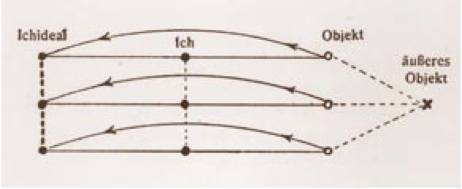
One area in which he excelled may seem modest next to his roster of publications and celebrity acquaintances, and yet, the doctor’s skill as a medical draughtsman and maker of diagrams to illustrate his theories surely deserves some appreciation. Freud’s drawing received a book length treatment in 2006’s From Neurology to Psychoanalysis: Sigmund Freud’s Neurological Drawings and Diagrams of the Mind by Lynn Gamwell and Mark Solms. These are but a small sampling of the many works of medical art found within its covers, taken from a 2006 exhibit at the New York Academy of Medicine of the largest collection of Freud’s drawings ever assembled, in commemoration of his 150th birthday.
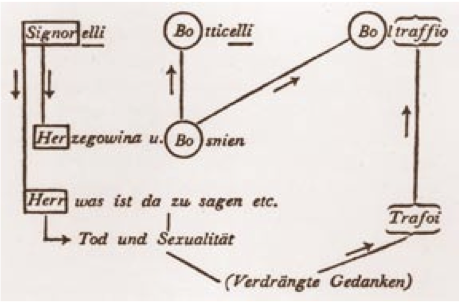
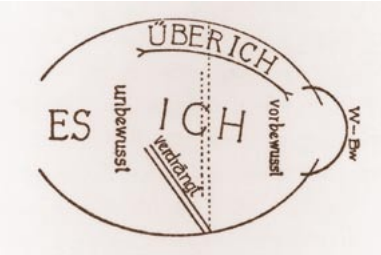
As the title of the book indicates, the drawings literally illustrate the radical shift Freud made from the hard science of neurology to a practice of his own invention. Curator Gamwell writes, “as Freud focused on increasingly complex mental functions such as disorders of language and memory, he put aside any attempt to diagram the underlying physiological structure, such as neurological pathways, and he began making schematic images of hypothetical psychological structures,” i.e. the Ego, Superego, and Id, as represented at the top in a 1933 diagram. Below it, from 1921, see “Group Psychology and the Analysis of the Ego,” a schematic that “attempts to represent relations between the major mental systems (or agencies) in a group of human minds.” And just above, see Freud’s diagram for “The Psychical Mechanism of Forgetfulness” from 1898, depicting “associative links between various conscious, preconscious and unconscious word presentations.”
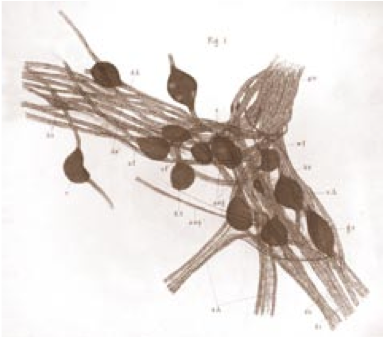
It is in these late nineteenth-century diagrams that we see Freud make the definitive move from empirically observed illustrations of physical structures—like the 1878 “Spinal Ganglia and Spinal Chord of Petromyzom” above—to relations between ideas and “conceptual entities that have no tangible existence in the physical world.” That shift, generally marked by the publication of Studies in Hysteria in 1895, caused Freud some unease. “Looking back over his career 30 years later,” writes Mark Solms, “ his longing for the comfortable respectability of his earlier career is still evident.” Even at the time, Freud would write in Studies in Hysteria that his case histories “lack the serious stamp of science.” Though his studies of eel, lamprey, and human brains involved tangible, observable phenomena, he approached the new discipline of psychoanalysis with no less rigor, stating only that the “the nature of the subject” had changed, not his method.
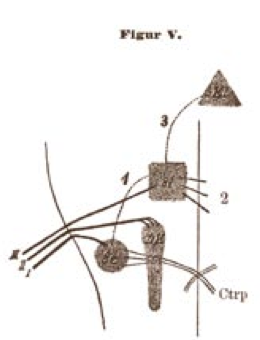
The drawings, writes Benedict Carey in the New York Times, “tell a story in three acts, from biology to psychology, from the microscope to the couch.” As Freud makes the transition, his meticulously detailed medical work, copied from glass slides, gives way to loose outlines. One drawing of the brain’s auditory system from 1886 (above) “is as spare and geometric as a Calder sculpture.” Just a few years later, Freud sketched out the diagram below in 1894, a schematic, writes Solms, of “the relationship between various normal and pathological mood states and sexual physiology.” It’s his first purely psychoanalytic drawing, sketched in a letter to a colleague, Dr. Wilhelm Fleiss.
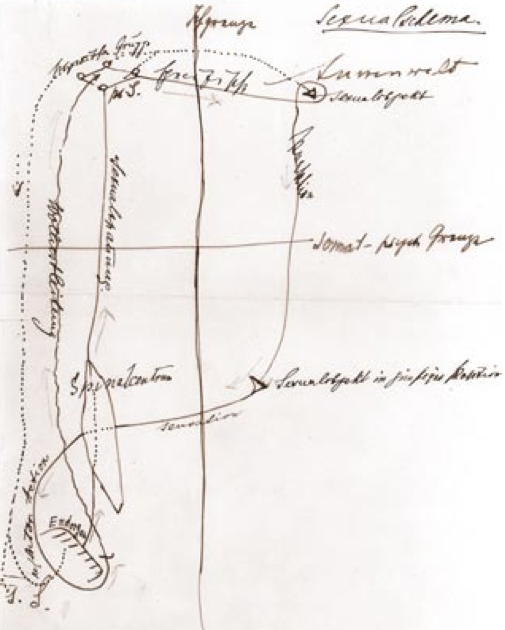
In the later diagrams, as we see above, his tentative freehand gave way to typescript and a technical draughtsman’s precision, with some drawings resembling, in Carey’s words, “the schematic for an air-conditioning system.” Freud seems to comment on the architectural nature of these diagrams when he writes in The Interpretation of Dreams in 1900, “We are justified, in my view, in giving free reign to our speculations so long as we retain the coolness of our judgment, and do not mistake the scaffolding for the building.” It’s a warning many of Freud’s disciples may not have heeded carefully enough.
Related Content:
How a Young Sigmund Freud Researched & Got Addicted to Cocaine, the New “Miracle Drug,” in 1894
Sigmund Freud Appears in Rare, Surviving Video & Audio Recorded During the 1930s
Free Online Psychology Courses
Josh Jones is a writer and musician based in Durham, NC. Follow him at @jdmagness
Read More...Support Us
We're hoping to rely on loyal readers, rather than erratic ads. Please click the Donate button and support Open Culture. You can use Paypal, Venmo, Patreon, even Crypto! We thank you!

About Us

Open Culture scours the web for the best educational media. We find the free courses and audio books you need, the language lessons & educational videos you want, and plenty of enlightenment in between.
Advertise With Us

FREE UPDATES!
GET OUR DAILY EMAIL
Get the best cultural and educational resources on the web curated for you in a daily email. We never spam. Unsubscribe at any time.
FOLLOW ON SOCIAL MEDIA

Open Culture editor Dan Colman scours the web for the best educational media. He finds the free courses and audio books you need, the language lessons & movies you want, and plenty of enlightenment in between.
Advertise With Us

