Hear Gandhi’s Famous Speech on the Existence of God (1931)
A perfect symbol of the mechanisms of British rule over India, the Salt Acts prohibited Indians from access and trade of their own resources, forcing them to buy salt from British monopolies, who taxed the mineral heavily. In 1930, in one of the defining acts of his Satyagraha movement, Mohandas Gandhi decided to defy the Salt Act with a very grand gesture—a march, with thousands of his supporters, over a distance of over 200 miles, to the Arabian Sea. Once there, following Gandhi’s lead, the crowd proceeded to collect sea salt, prompting British colonial police to arrest over 60,000 people, including Gandhi himself.
The 1930 action, the first organized act of civil disobedience after the Indian National Congress’ declaration of independence, got the attention of the Viceroy, Lord Irwin, who had been directing harsh repressive measures against the growing independence movement, and in January of 1931, after his release, Gandhi and Irwin signed a pact. Gandhi agreed to end the movement; Irwin agreed to allow the Indians to make their own salt, and the Indians would have an equal role in negotiating India’s future. British officials were outraged and disgusted. Winston Churchill, for example, staunchly opposed to independence, called the meeting of the two leaders a “nauseating and humiliating spectacle,” saying “Gandhi-ism and everything it stands for will have to be grappled with and crushed.” (Churchill favored letting Gandhi die if he went on hunger strike.)
The terms of the pact, of course, did not hold, and the movement would continue until eventual independence in 1947. But Gandhi had not only succeeded in incurring the wrath of the British colonialists; he had also won many supporters in England. One of them, Muriel Lester, invited the Indian leader to stay with her in London at a community center she had founded called Kingsley Hall. “He enjoyed his stay here,” says the current Kingsley Hall manager David Baker, “and it was wise because if he had stayed in the West End the press would have lampooned him. He wouldn’t have had a life, but here he was left alone and walked around in the streets. He wanted to stay with the people that he lived with in India, i.e. the poor.” However, Gandhi wasn’t totally ignored by the press. While at Kingsley, he delivered a short speech, which you can hear above, and the BBC was there to record it.
In the speech, Gandhi says absolutely nothing about Indian independence, British oppression, or the aims and tactics of the movement. He says nothing at all about politics or any worldly affairs whatsoever. Instead, he lectures on the existence of God, “an indefinable mysterious power that pervades everything,” and which “defies all proof.” Gandhi testifies to “an unalterable law governing everything and every being that exists or lives,” though he also confesses “that I have no argument to convince through reason.” Instead relies on analogies, on things he “dimly perceives,” on the “marvelous researches of [Indian engineer and scientist] Sir J.C. Bose,” and on “the experiences of an unbroken line of prophets and sages in all countries and climes.” It’s not a speech likely to persuade anyone who isn’t already some sort of a believer, I think, but it’s of much interest to anyone interested in the history of Indian independence and in Gandhi’s life and message.
You can read the full text of the speech here, and see footage of Kingsley Hall and a filmed interview with Muriel Lester, discussing Gandhi’s stay, here.
Related Content:
Mahatma Gandhi’s List of the 7 Social Sins; or Tips on How to Avoid Living the Bad Life
Mahatma Gandhi Talks (in First Recorded Video)
Albert Einstein Expresses His Admiration for Mahatma Gandhi, in Letter and Audio
Josh Jones is a writer and musician based in Durham, NC. Follow him at @jdmagness
Read More...Confusion Through Sand: A Short, Hand-Drawn Animation on the Terror & Confusion of War
Back in October 2012, Ornana Films raised $30,000 through a Kickstarter campaign to produce Confusion Through Sand, an animation that “explores the spectrum of haze experienced by today’s soldiers in the desert.” It’s an interpretation, Ornana tells us, “of what happens when top training encounters circumstances beyond the realm of human control, in both interior and exterior conflicts.” The action takes place “on the ground, under the helmet of a 19 year-old infantryman.” Once completed, the film premiered at the 2013 SXSW film festival and took home the Jury Award. Now, a year later, it’s free online. And even better, it comes accompanied by a behind-the-scenes film that takes you inside the filmmakers’ artistic process, showing how they hand-animated the film with markers on recycled paper. Enjoy both.
If you would like to support the mission of Open Culture, consider making a donation to our site. It’s hard to rely 100% on ads, and your contributions will help us continue providing the best free cultural and educational materials to learners everywhere. You can contribute through PayPal, Patreon, and Venmo (@openculture). Thanks!
Read More...The Cahiers du Cinéma Names the 10 Best Films of the Year, from 1951 to 2014
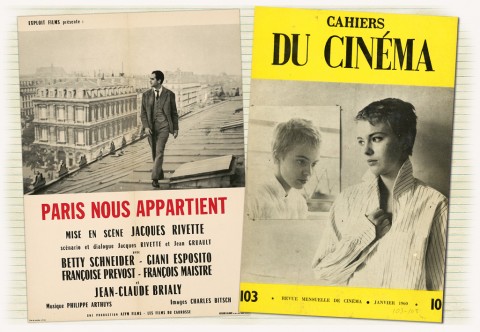
It’s hard to overstate the impact of Cahiers du cinéma on film history.
In the early ‘50s, the great critic André Bazin led a small coterie of film fanatics – guys with names like Jean-Luc Godard, François Truffaut, Eric Rohmer and Jacques Rivette — who hung out at the Cinémathèque française. Theaters were flooded with Hollywood movies, really for the first time since the beginning of World War II, and this group took the opportunity to watch anything they could get their hands on, from high brow art films to cut rate Westerns. They would watch anything.
In 1951, Bazin founded Cahiers and this band of cinematic outsiders became famously brutal and uncompromising iconoclasts. They praised lowly genre films – film noir especially – as masterpieces while slamming the middlebrow flicks the French film industry was cranking out at the time. Truffaut was famous for being particularly harsh, earning the moniker “The Gravedigger of French Cinema.” His reviews were so acerbic that he was the only French film critic not invited to cover the 1958 Cannes Film Festival. (The fact that he then turned around and won the fest’s top prize the next year for his masterpiece 400 Blows might be one of the greatest feats of badassery in cinema history.)
Perhaps the Cahiers’ greatest contribution was an article, written by Truffaut in 1954, called “A Certain Tendency of the French Cinema,” which was a manifesto for what would later be called auteur theory – an idea that certain directors have such a command of the medium that they impress their individual vision on a film, in the same way an author does to a book. This idea has been so completely absorbed into popular consciousness that it’s hard to see just how revolutionary it was at the time. Before Cahiers, people generally thought about movies in terms of the stars, not the director. Most would refer to Rear Window, say, as a Jimmy Stewart movie, not an Alfred Hitchcock film. The concept resulted in a basic reordering in the way filmmakers thought about their art.
Truffaut and company obsessed with filmmakers they considered auteurs. Their top 10 list for 1955, the year after “A Certain Tendency” was published, shows who in particular they considered auteurs – art house icons (Carl Dreyer and Roberto Rossellini), Hollywood renegades (Robert Aldrich and Nicholas Ray) and, of course, Hitchcock.
1955
1. Voyage To Italy (Roberto Rossellini)
2. Ordet (Carl Dreyer)
3. The Big Knife (Robert Aldrich)
4. Lola Montes (Max Ophuls)
5. Rear Window (Alfred Hitchcock)
6. Les Mauvais Recontres (Alexandre Astruc)
7. La Strada (Federico Fellini)
8. The Barefoot Contessa (Joseph L. Mankiewicz)
9. Johnny Guitar (Nicholas Ray)
10. Kiss Me Deadly (Robert Aldrich)
1960 was the year that seemingly the entire editorial staff at Cahiers du cinéma took camera in hand and became filmmakers, launching the French New Wave. Truffaut’s 400 Blows in 1959 was followed up by Chabrol’s Les Bonnes Femmes and Godard’s groundbreaking assault on cinematic form, Breathless. Yet for their top 10 list, Cahiers put Japanese master Kenji Mizoguchi’s Sansho the Bailiff at the top. Hitchcock also makes the list, number 9, with a little film called Psycho.
1960
1. Sansho The Bailiff (Kenji Mizoguchi)
2. L’avventura (Michaelangelo Antonioni)
3. Breathless (Jean-Luc Godard)
4. Shoot The Piano Player (François Truffaut)
5. Poem Of The Sea (Alexander Dovzhenko/Julia Solntesva)
6. Les Bonnes Femmes (Claude Chabrol)
7. Nazarin (Luis Buñuel)
8. Moonfleet (Fritz Lang)
9. Psycho (Alfred Hitchcock)
10. Le Trou (Jacques Becker)
Starting from 1968 until the late-70s, the journal became a Maoist collective and renounced bourgeois concepts like “best of” lists, narrative cinema and, y’know, fun. But in the early ‘80s, Cahiers shifted its editorial focus back to the world of commercial film. They lauded movies by Nouvelle Vague veterans like Godard and Rohmer, film festival darlings like Hou Hsiao Hsien and, to a perverse degree, Clint Eastwood. You can see all of Cahiers du cinéma’s top 10 lists here, including the most recent list for 2014 here.
Related content:
Alfred Hitchcock on the Filmmaker’s Essential Tool: ‘The Kuleshov Effect’
Jefferson Airplane Wakes Up New York; Jean-Luc Godard Captures It (1968)
Jonathan Crow is a Los Angeles-based writer and filmmaker whose work has appeared in Yahoo!, The Hollywood Reporter, and other publications. You can follow him at @jonccrow. And check out his blog Veeptopus, featuring lots of pictures of badgers and even more pictures of vice presidents with octopuses on their heads. The Veeptopus store is here.
Read More...Kubrick’s 2001: A Space Odyssey Gets Turned Into “The Weirdest Sci-Fi Comic Ever Made” by Jack Kirby
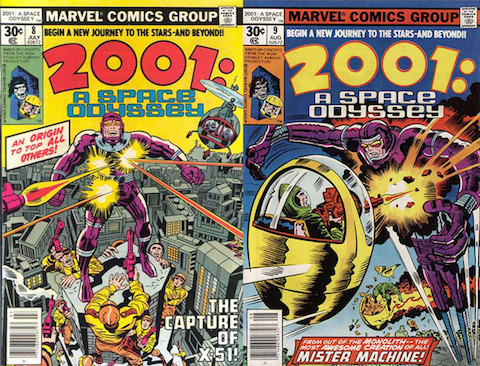
Sure, we all enjoyed the adaptation of 2001: A Space Odyssey presented on the Howard Johnson’s children’s menu from 1968 that we featured last May. But would you believe that, when you swap out the name Howard Johnson for that of Jack Kirby, you get a work of higher artistic merit? In his long career, the widely respected comic book artist, writer, and editor put in time on both the DC and Marvel sides of the fence. 1976’s 2001: A Space Odyssey comic book, a meeting of Kirby’s mind with those of Stanley Kubrick and Arthur C. Clarke, marked his return to Marvel after spending the early 70s at DC.
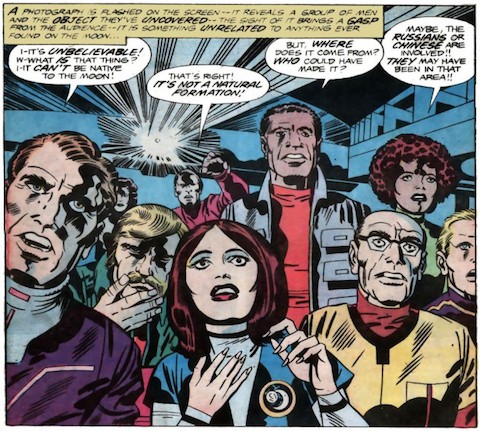
Kubrickonia, which calls the commission “a match made in bizarro world heaven,” describes the product: “The adaptation was written & penciled by Kirby with inking duties carried out by Frank Giacoia. The almost 2 times larger than the regular comic-book format suited Kirby’s outlandish pop style, but this was a great talent merely going through the motions.” The Sequart Organization’s Julian Darius calls it “surely one of the strangest sci-fi franchise comics ever published,” a stuffy marriage between Kirby’s “bombastic,” “action-oriented,” “in-your-face” art and the style of Kubrick’s film, one “all about the subtle. No one ever accused Kirby of being subtle. Indeed, his almost complete lack of subtlety is part of his charm, but it’s not a charm one could possibly imagine fitting 2001.”
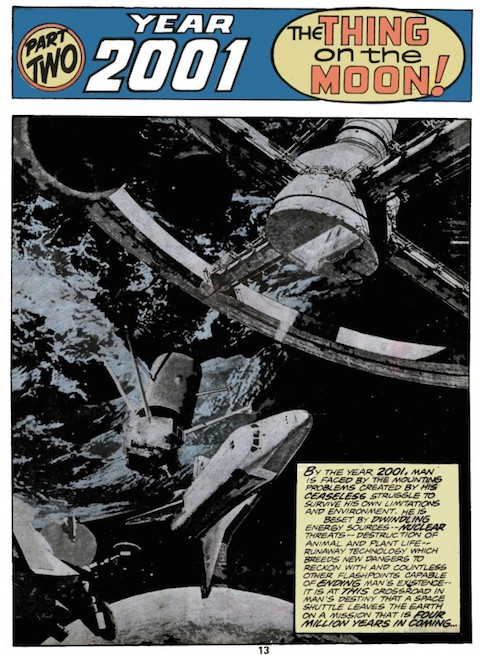
At The Dissolve, Noel Murray includes an examination of Kirby’s 2001 in the site’s “Adventures in Licensing” column. Kirby’s description of Kubrick’s immortal millennia-spanning match cut, which the article quotes as an opener, tells you everything you need to know:
As the surge of elation sweeps through him, Moonwatcher shouts in victory and throws his weapon at the sky!! Higher and higher, it sails — aimed at the infinite where the countless stars wait for the coming of man… And, man comes to space!! Across the agonizing ages he follows the destiny bequeathed to him by the monolith.
2001: A Space Odyssey in comics, which comprises not just the oversized book but ten monthly issues that expanded upon the film — taking it in, shall we say, a different direction than either Kubrick or Clarke might have envisioned — has, as you can see, inspired no small amount of discussion among science fiction and comic book enthusiasts. Darius wrote a whole book called The Weirdest Sci-Fi Comic Ever Made. At SciFiDimensons, Robert L. Bryant Jr. and Robert B. Cooke offer two more analyses of this unusual chapter in the history of American sequential art. Whatever its merits as reading material, it shows us that genius plus genius doesn’t always produce genius — but it never fails to produce something fascinating.
You can check out scans of the first issue of 2001: A Space Odyssey over on this web site.
Related Content:
Howard Johnson’s Presents a Children’s Menu Featuring Kubrick’s 2001: A Space Odyssey (1968)
Isaac Asimov Predicts in 1964 What the World Will Look Like Today — in 2014
Arthur C. Clarke Predicts the Future in 1964 … And Kind of Nails It
Colin Marshall hosts and produces Notebook on Cities and Culture as well as the video series The City in Cinema and writes essays on cities, language, Asia, and men’s style. He’s at work on a book about Los Angeles, A Los Angeles Primer. Follow him on Twitter at @colinmarshall or on Facebook.
Read More...NASA Puts Online a Big Collection of Space Sounds, and They’re Free to Download and Use
When we envision the fruits of the research of the United States’ National Aeronautics and Space Administration (aka NASA), we tend to think of images. I think I exaggerate not at all when I say that the never-before-seen view of the Earth from space gave humanity a whole new perspective, no pun intended, on our very existence. But you don’t have to strain too hard to think of historically momentous NASA sounds, either: “Houston we’ve had a problem,” “One giant leap for mankind.”
If you can’t think of more than those two, why not spend some listening time with NASA’s new Soundcloud account, or alternatively perusing the NASA Sounds web site, which features a larger number of downloadable mp3s. “There are rocket sounds, the chirps of satellites and equipment, lightning on Jupiter, interstellar plasma and radio emissions,” writes Create Digital Music’s Peter Kirn. “And in one nod to humanity, and not just American humanity, there’s the Soviet satellite Sputnik (among many projects that are international in nature).” Better still, “you’re free to use all of these sounds as you wish, because NASA’s own audio isn’t copyrighted.”
We’ve included here three of NASA’s Soundcloud playlists: space shuttle mission sounds, solar system and beyond sounds, and President Kennedy sounds. When you’ve listened through all NASA themselves have uploaded, you can find more sound clips of outer-space interest in NASA’s liked sounds, a collection of the ambient sounds of space exploration that include those of a space suit’s internal pump, a Japanese experiment module, and, of course, a space toilet — a constant sonic companion on any trip to the final frontier.
Please note that you can download the Soundcloud files by following these instructions. From the NASA Sounds web page, you can download files by right clicking on them and then saving them to your hard drive.
Related Content:
Free NASA eBook Theorizes How We Will Communicate with Aliens
NASA Archive Collects Great Time-Lapse Videos of our Planet
Ray Bradbury Reads Moving Poem on the Eve of NASA’s 1971 Mars Mission
Great Cities at Night: Views from the International Space Station
NASA Presents “The Earth as Art” in a Free eBook and Free iPad App
Colin Marshall hosts and produces Notebook on Cities and Culture as well as the video series The City in Cinema and writes essays on cities, language, Asia, and men’s style. He’s at work on a book about Los Angeles, A Los Angeles Primer. Follow him on Twitter at @colinmarshall or on Facebook.
Read More...Hear the Only Recording of Raymond Carver Reading “What We Talk About When We Talk About Love”
This is surely worth a quick mention: Today we have a recording of Raymond Carver reading his most famous story, “What We Talk About When We Talk About Love.” Taped in a Palo Alto hotel room in 1983 for a new radio series called Tell Me a Story, it’s the only known recording of Carver reading his signature story. The reading itself starts at the 6:00 mark. Start listening here (or stream it above).
In 2009, Stephen King called Raymond Carver “surely the most influential writer of American short stories in the second half of the 20th century.” If you’d like to get deeper into his literary world — a literary world that explores “the dim ache in the nondescript lives of aspiring students, down-and-outers, diner waitresses, salesmen, and unhappily hitched blue-collar couples,” as Josh Jones once put it — you can refer back to a previous post where we featured Richard Ford, Anne Enright, and David Means reading several other Carver stories.
If you would like to support the mission of Open Culture, consider making a donation to our site. It’s hard to rely 100% on ads, and your contributions will help us continue providing the best free cultural and educational materials to learners everywhere. You can contribute through PayPal, Patreon, and Venmo (@openculture). Thanks!
Read More...115 Books on Lena Dunham & Miranda July’s Bookshelves at Home (Plus a Bonus Short Play)
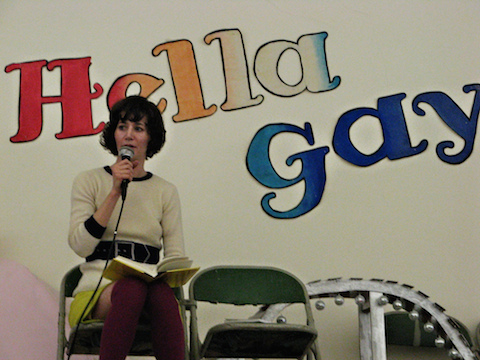
“Miranda-july-reading” by Alexis Barrera / Licensed under CC BY 2.5 via Wikimedia Commons.
Ah, the joys of dining at a new friend’s home, knowing sooner or later, one’s hostess’ bladder or some bit of last minute meal preparation will dictate that one will be left alone to rifle the titles on her bookshelf with abandon. No medicine cabinet can compete with this peek into the psyche.
Pity that some of the people whose bookshelves I’d be most curious to see are the least likely to open their homes to me. That’s why I’d like to thank The Strand bookstore for providing a virtual peek at the shelves of filmmakers-cum-authors Miranda July and Lena Dunham. (Previous participants in the Authors Bookshelf series include just-plain-regular authors George Saunders, Edwidge Danticat and the late David Foster Wallace whose contributions were selected by biographer D.T. Max.)

“Lena Dunham” by David Shankbone — Licensed under CC BY 3.0 via Wikimedia Commons.
I wish Dunham and July had offered up some personal commentary to explain their hand-picked titles. (Surely their homes are lined with books. Surely each list is but a representative sampling, one shelf from hundreds. Hmm. Interesting. Did they run back and forth between various rooms, curating with a vengeance, or is this a case of whatever happened to be in the case closest at hand when deadline loomed?)
Which book’s a longtime favorite?
Which the literary equivalent of comfort food?
Are there things that only made the cut because the author is a friend?
Both women are celebrated storytellers. Surely, there are stories here beyond the ones contained between two covers.
But no matter. The lack of accompanying anecdotes means we now have the fun of inventing imaginary dinner parties:
ME: (standing in the living room, calling through the kitchen door, a glass of wine in hand) Whoa, Lena, I can’t believe you’ve got Important Artifacts and Personal Property from the Collection of Lenore Doolan and Harold Morris, Including Books, Street Fashion, and Jewelry!
LENA DUNHAM: (polite, but distracted by a pot of red sauce) I know, isn’t that one great?
ME: So great! Where’d you buy it?
LENA DUNHAM: Uh, The Strand, I think.
ME: Me too! Such a great conceit, that book. Wish I’d come up with it!
LENA DUNHAM: I know what you mean.
ME: Ooh, you’ve got Was She Pretty?
LENA DUNHAM: Hmm? Oh, yeah, my friend Miranda gave me that.
ME: (glancing between the two books.) Wait! Leanne Sharpton. Leanne Sharpton. I didn’t realize it’s the same author.
LENA DUNHAM: As what?
ME: The person who wrote Was She Pretty? also wrote Important Artifacts and Personal Property-
ME & LENA DUNHAM IN UNISON: — from the Collection of Lenore Doolan and Harold Morris, Including Books, Street Fashion, and Jewelry!
LENA DUNHAM: Gotta love that title.
ME: Why do you have all these kids’ books?
LENA DUNHAM: Those are from my childhood.
ME: (sliding an unnamed title off the shelf, eyes widening as I read the shockingly graphic personal inscription on the flyleaf) Oh?
LENA DUNHAM: I really relate to Eloise.
ME: (hastily sliding the volume back onto the shelf before Lena can catch me snooping) Oh yeah…ha ha.
LENA DUNHAM: Are you the one who likes graphic novels?
ME: Me? Yes!!!
LENA DUNHAM: Yeah. My friend Miranda does too.
ME: That’s funny - Sex and the Single Girl right next to Of Human Bondage.
LENA DUNHAM: (cursing under her breath)
ME: Need help?
LENA DUNHAM: No, it’s just this damn …arrrggh. I hate this cookbook!
ME: (brightly) Smells good!
LENA DUNHAM: … crap.
ME: So, is Adam Driver coming? Or Ray or anybody?
LENA DUNHAM: (testily) You mean Alex Karpovsky?
ME: (flustered) Oh, ha ha, yes! Alex! … I sent him a Facebook request and he accepted.
LENA DUNHAM: (mutters under her breath)
ME: Design Sponge? Really? What’s someone in your shoes doing with a bunch of DIY decorating books?
LENA DUNHAM: (coldly) Research.
Actually, maybe it is better to admire one’s idols’ bookshelves from afar.
I’m chagrined that I don’t recognize more of their modern fiction picks. That wasn’t such a problem when I was measuring myself against the 430 books on Marilyn Monroe’s reading list.
Thank heaven for old standbys like Madame Bovary.
In all sincerity, I was glad that Dunham didn’t try to mask her love of home decor blog books.
And that July included her husband’s monograph, Our Bodies, Ourselves and a handbook to raising self-confident babies.
One’s shelves, after all, are a matter of taste. So, celebrate the similarities, take their recommendations under advisement, see below and read what you like!
A Time for Everything — Karl Ove Knausgaard
A Very Young Dancer — Jill Krementz
Alice James: A Biography — Jean Strouse
Animacies: Biopolitics, Racial Mattering, and Queer Affect — Mel Y. Chen
Arthur Tress: The Dream Collector — John Minahan
Building Stories — Chris Ware
Cruddy: An Illustrated Novel — Lynda Barry
Diaries, 1910–1923 — Franz Kafka
Do the Windows Open? — Julie Hecht
Dorothy Iannone: Seek The Extremes! (v.1) — Barbara Vinken, Sabine Folie
Edgewise: A Picture of Cookie Mueller — Chloe Griffin
Embryogenesis — Richard Grossinger
Friedl Kubelka Vom Groller — Melanie Ohnemus
American War — Harrell Fletcher
Hannah Höch: Album (English and German Edition) — Hannah Höch
How to Build a Girl — Caitlin Moran
Humiliation — Wayne Koestenbaum
It’s OK Not to Share and Other Renegade Rules for Raising Competent and Compassionate Kids — Heather Shumaker
King Kong Theory — Virginie Despentes
Leaving the Atocha Station — Ben Lerner
Lightning Rods — Helen DeWitt
Lost at Sea: The Jon Ronson Mysteries — Jon Ronson
Maidenhead — Tamara Faith Berger
Man V. Nature: Stories — Diane Cook
Mike Mills: Graphics Films — Mike Mills
Napa Valley Historical Ecology Atlas: Exploring a Hidden Landscape of Transformation and Resilience — Robin Grossinger
Need More Love — Aline Kominsky Crumb
Our Bodies, Ourselves (Completely Revised and Updated Version) — Boston Women’s Health Book Collective
Jim Goldberg: Rich and Poor — Jim Goldberg
Sanja Ivekovic: Sweet Violence — Roxana Marcoci
Sophie Calle: The Address Book — Sophie Calle
Staring Back — Chris Marker
Taryn Simon: A Living Man Declared Dead and Other Chapters, I‑XVIII — Homi Bhabha, Geoffrey Batchen
Tete-a-Tete: The Tumultuous Lives & Loves of Simone De Beauvoir and Jean-Paul Sartre — Hazel Rowley
The Hour of the Star — Clarice Lispector
The Illustrated I Ching — R.L. Wing
Two Kinds of Decay: A Memoir — Sarah Manguso
Traffic — Kenneth Goldsmith
Two Serious Ladies — Jane Bowles
Was She Pretty? — Leanne Shapton
What is the What: The Autobiography of Valentino Achak Deng: A Novel — Dave Eggers
Why Did I Ever — Mary Robison
Women in Clothes — Sheila Heti
Working: People Talk About What They Do All Day and How They Feel About What They Do — Studs Terkel
Your Self-Confident Baby: How to Encourage Your Child’s Natural Abilities — From the Very Start — Magda Gerber
Far from the Tree — Andrew Solomon
How Should a Person Be? — Sheila Heti
The Girls’ Guide to Hunting and Fishing — Melissa Bank
A Little History of the World — E. H. Gombrich
Anne of Green Gables — L.M. Montgomery
Apartment Therapy Presents: Real Homes, Real People, Hundreds of Real Design Solutions — Maxwell Gillingham-Ryan
Ariel: The Restored Edition — Sylvia Plath
Bad Feminist: Essays — Roxane Gay
Bastard Out of Carolina (20th Anniversary Edition) — Dorothy Allison
Blue is the Warmest Color — Julie Maroh
Brighton Rock — Graham Greene
Cavedweller - Dorothy Allison
Country Girl: A Memoir — Edna O’Brien
Crazy Salad and Scribble Scribble: Some Things About Women and Notes on Media — Nora Ephron
Design Sponge at Home — Grace Bonney
Dinner: A Love Story: It All Begins at the Family Table — Jenny Rosenstrach
Eleanor & Park — Rainbow Rowell
Eloise — Kay Thompson
Eloise In Moscow — Kay Thompson
Eloise In Paris — Kay Thompson
Fanny At Chez Panisse — Alice Waters
Goodbye, Columbus and Five Short Stories — Philip Roth
Holidays on Ice — David Sedaris
Important Artifacts and Personal Property from the Collection of Lenore Doolan and Harold Morris, Including Books, Street Fashion, and Jewelry — Leanne Shapton
Lentil — Robert McCloskey
Love Poems — Nikki Giovanni
Love, an Index (McSweeney’s Poetry Series) — Rebecca Lindenberg
Love, Nina: A Nanny Writes Home - Nina Stibbe
Madame Bovary: Provincial Ways — Gustave Flaubert
NW: A Novel — Zadie Smith
Of Human Bondage — W. Somerset Maugham
Random Family: Love, Drugs, Trouble, and Coming of Age in the Bronx — Adrian Nicole LeBlanc
Rebecca — Daphne Du Maurier
Remodelista — Julie Carlson
Selected Stories, 1968–1994 - Alice Munro
Sex and the Single Girl — Helen Gurley Brown
She’s Come Undone — Wally Lamb
Somewhere Towards the End: A Memoir — Diana Athill
Stet: An Editor’s Life - Diana Athill
Sula — Toni Morrison
Summer Blonde — Adrian Tomine
Super Natural Every Day: Well-Loved Recipes from My Natural Foods Kitchen — Heidi Swanson
Tenth of December - George Saunders
Tess of the D’Urbervilles — Thomas Hardy
The Boys of My Youth - Jo Ann Beard
The Collected Stories of Lydia Davis — Lydia Davis
The Dud Avocado — Elaine Dundy
The Important Book — Margaret Wise Brown
The Journalist and the Murderer — Janet Malcolm
The Liars’ Club: A Memoir — Mary Karr
The Love Affairs of Nathaniel P.: A Novel — Adelle Waldman
The Marriage Plot — Jeffrey Eugenides
The Philosophy of Andy Warhol (From A to B and Back Again) - Andy Warhol
The Story of Ferdinand — Munro Leaf
The Woman in White - Wilkie Collins
The Writing Class — Jincy Willett
This Is My Life - Meg Wolitzer
Tiny Beautiful Things: Advice on Love and Life from ‘Dear Sugar’ - Cheryl Strayed
Wallflower At the Orgy — Nora Ephron
Was She Pretty? — Leanne Shapton
We Have Always Lived In the Castle — Shirley Jackson
What Lips My Lips Have Kissed: The Loves and Love Poems of Edna St. Vincent Millay — Daniel Mark Epstein
What She Saw… — Lucinda Rosenfeld
What the Living Do: Poems — Marie Howe
While I Was Gone - Sue Miller
With or Without You: A Memoir — Domenica Rut
Women in Clothes — Sheila Heti
Related Content:
David Foster Wallace’s Love of Language Revealed by the Books in His Personal Library
The 430 Books in Marilyn Monroe’s Library: How Many Have You Read?
- Ayun Halliday is an author, illustrator, and Chief Primatologist of the East Village Inky zine. Follow her @AyunHalliday
Read More...Dostoevsky Draws a Picture of Shakespeare: A New Discovery in an Old Manuscript
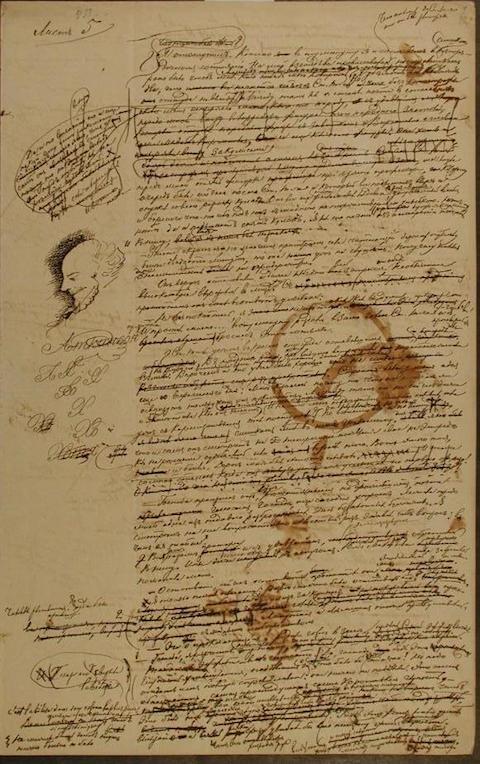
Dostoevsky, a doodler? Surely not! Great Russian brow furrowed over the meaning of love and hate and faith and crime, diving into squalid hells, ascending to the heights of spiritual ecstasy, taking a gasp of heavenly air, then back down to the depths again to churn out the pages and hundreds of character arcs—that’s Dostoevsky’s style. Doodles? No. And yet, even Dostoevsky, the acme of literary seriousness, made time for the odd pen and ink caricature amidst his bouts of existential angst, poverty, and ill health. We’ve shown you some of them before—indeed, some very well rendered portraits and architectural drawings in the pages of his manuscripts. Now, just above, see yet another, a recently discovered tiny portrait of Shakespeare in profile, etched in the margins of a page from one of his angstiest novels, The Possessed, available in our collection, 800 Free eBooks for iPad, Kindle & Other Devices.
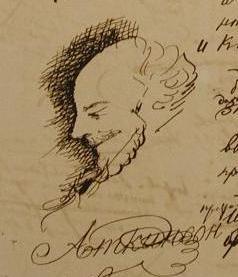
Annie Martirosyan in The Huffington Post points out some family resemblance between the Shakespeare doodle and the famous brooding oil portrait of Dostoevsky himself, by Vasily Perov. She also notes the ring stain and sundry drips over the “hardly legible… scribbles” and “marginalia… scattered naughtily across the page” is from the author’s tea. “Feodor Mikhailovich was an avid tea drinker,” and he would consume his favorite beverage while walking “to and fro in the room and mak[ing] up his characters’ speeches out loud….” Can’t you just see it? Under the drawing (see it closer in the inset)—in one of the many examples of the author’s painstaking handwriting practice—is the name “Atkinson.”
Martirosyan sums up a somewhat complicated academic discussion between Dostoevsky experts Vladimir Zakharov and Boris Tikhomirov about the source of this name. This may be of interest to literary specialists. But perhaps it suffices to say that both scholars “have now confirmed the authenticity of the image as Dostoevsky’s drawing of Shakespeare,” and that the name and drawing may have no conceptual connection. It’s also further proof that Dostoevsky, like many of us, turned to making pictures when, says scholar Konstantin Barsht—whom Colin Marshall quoted in our previous post—“the words came slowest.” In fact, some of the author’s character descriptions, Barsht claims, “are actually the descriptions of doodled portraits he kept reworking until they were right.”
So why Shakespeare? Perhaps it’s simply that the great psychological novelist felt a kinship with the “inventor of the human.” After all, Dostoevsky has been called, in those memorable words from Count Melchoir de Vogue, “the Shakespeare of the lunatic asylum.”
h/t OC reader Nick
Related Content:
Fyodor Dostoevsky Draws Elaborate Doodles In His Manuscripts
Watch a Hand-Painted Animation of Dostoevsky’s “The Dream of a Ridiculous Man”
Josh Jones is a writer and musician based in Durham, NC. Follow him at @jdmagness
Read More...Flannery O’Connor to Lit Professor: “My Tone Is Not Meant to Be Obnoxious. I’m in a State of Shock”

When Flannery O’Connor started writing in the middle of the 20th century, short stories — or at least fashionable short stories that were published in The New Yorker –unfolded delicately revealing gossamer-like layers of experience. O’Connor’s stories, in contrast, were pungent, grotesque, often violent moral tales dealing with unabashedly Christian themes. They definitely weren’t fashionable at the time. Yet since her untimely death at age 39 in 1964, O’Connor’s reputation has only increased. Even for readers who aren’t immersed in Catholic theology, her stories — which pair outlandish, often comic characters with harrowing, existential situations — have a way of burrowing into your consciousness and staying there. For O’Connor, the gothic tales were a means to an end: “To the hard of hearing you shout, and for the almost-blind you draw large and startling figures.”
In 1961, an English professor wrote to O’Connor hoping to help his students understand “A Good Man is Hard to Find.” The story, perhaps the author’s most famous, is a slippery, troubling work about a family of six casually murdered by an escaped convict called the Misfit in the backwoods of Georgia. The story’s main character is clearly the Grandmother. The story is seen through her eyes, and she is the one who ultimately dooms the family. Yet the professor didn’t quite see it that way:
We have debated at length several possible interpretations, none of which fully satisfies us. In general we believe that the appearance of the Misfit is not ‘real’ in the same sense that the incidents of the first half of the story are real. Bailey, we believe, imagines the appearance of the Misfit, whose activities have been called to his attention on the night before the trip and again during the stopover at the roadside restaurant. Bailey, we further believe, identifies himself with the Misfit and so plays two roles in the imaginary last half of the story. But we cannot, after great effort, determine the point at which reality fades into illusion or reverie. Does the accident literally occur, or is it part of Bailey’s dream? Please believe me when I say we are not seeking an easy way out of our difficulty. We admire your story and have examined it with great care, but we are not convinced that we are missing something important which you intended us to grasp. We will all be very grateful if you comment on the interpretation which I have outlined above and if you will give us further comments about your intention in writing ‘A Good Man is Hard to Find.’
O’Connor was understandably baffled by this reading. Her response:
28 March 1961
The interpretation of your ninety students and three teachers is fantastic and about as far from my intentions as it could get to be. If it were a legitimate interpretation, the story would be little more than a trick and its interest would be simply for abnormal psychology. I am not interested in abnormal psychology.
There is a change of tension from the first part of the story to the second where the Misfit enters, but this is no lessening of reality. This story is, of course, not meant to be realistic in the sense that it portrays the everyday doings of people in Georgia. It is stylized and its conventions are comic even though its meaning is serious.
Bailey’s only importance is as the Grandmother’s boy and the driver of the car. It is the Grandmother who first recognized the Misfit and who is most concerned with him throughout. The story is a duel of sorts between the Grandmother and her superficial beliefs and the Misfit’s more profoundly felt involvement with Christ’s action which set the world off balance for him.
The meaning of a story should go on expanding for the reader the more he thinks about it, but meaning cannot be captured in an interpretation. If teachers are in the habit of approaching a story as if it were a research problem for which any answer is believable so long as it is not obvious, then I think students will never learn to enjoy fiction. Too much interpretation is certainly worse than too little, and where feeling for a story is absent, theory will not supply it.
My tone is not meant to be obnoxious. I am in a state of shock.
Flannery O’Connor
You can hear O’Connor read “A Good Man is Hard to Find” below. We have more information on the 1959 reading here:
Via Letters of Note
Related Content:
Flannery O’Connor: Friends Don’t Let Friends Read Ayn Rand (1960)
Flannery O’Connor Reads ‘Some Aspects of the Grotesque in Southern Fiction’ (c. 1960)
Flannery O’Connor’s Satirical Cartoons: 1942–1945
Jonathan Crow is a Los Angeles-based writer and filmmaker whose work has appeared in Yahoo!, The Hollywood Reporter, and other publications. You can follow him at @jonccrow. And check out his blog Veeptopus, featuring lots of pictures of badgers and even more pictures of vice presidents with octopuses on their heads. The Veeptopus store is here.
Read More...Read The Very First Comic Book: The Adventures of Obadiah Oldbuck (1837)
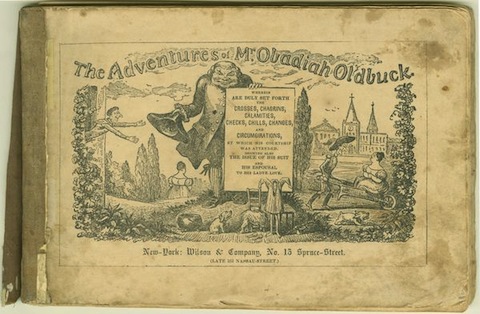
Comic books, as any enthusiast of comics books won’t hesitate to tell you, have a long and robust history, one that extends far wider and deeper than the 20th-century caped musclemen, carousing teenagers, and wisecracking animals so many associate with the medium. The scholarship on comic-book history — still a relatively young field, you understand — has more than once revised its conclusions on exactly how far back its roots go, but as of now, the earliest acknowledged comic book dates to 1837.
The Adventures of Obadiah Oldbuck, according to thecomicbooks.com’s page on early comic-book history, “was done by Switzerland’s Rudolphe Töpffer, who has been considered in Europe (and starting to become here in America) as the creator of the picture story. He created the comic strip in 1827,” going on to create comic books “that were extremely successful and reprinted in many different languages; several of them had English versions in America in 1846. The books remained in print in America until 1877.”
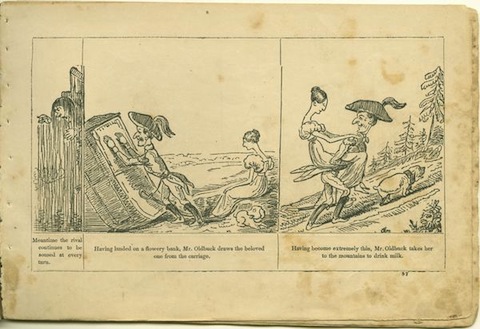
Also known as Histoire de M. Vieux Bois, Les amours de Mr. Vieux Bois, or simply Monsieur Vieuxbois, the original 1837 Adventures of Obadiah Oldbuck earned Töpffer the designation of “the father of the modern comic” from no less an authority on the matter than Understanding Comics author Scott McCloud, who cites the series’ pioneering use of bordered panels and “the interdependent combination of words and pictures.” You can see for yourself at the web site of Dartmouth College’s Library.
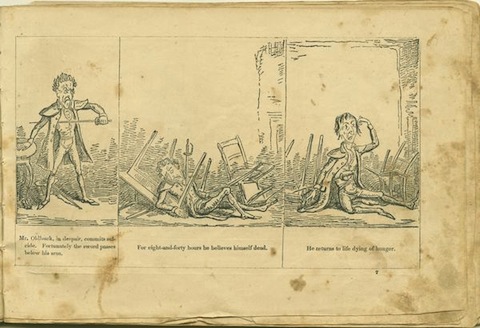
Alas, contemporary critics — and to an extent Töpffer himself, who considered it a work targeted at children and “the lower classes” — couldn’t see the innovation in all this. They wrote off Obadiah Oldbuck’s harrowing yet strangely lighthearted pictorial stories of failed courtship, dueling, attempted suicide, robbery, drag, elopement, ghosts, stray bullets, attack dogs, double-crossing, and the threat of execution as mere trifles by an otherwise capable artist. So the next time anyone gets on your case about reading comic books, just tell ’em they said the same thing about Obadiah Oldbuck. Then send them this way so they can figure out what you mean. You can read The Adventures of Obadiah Oldbuck in its totality here.
Related Content:
Download Over 22,000 Golden & Silver Age Comic Books from the Comic Book Plus Archive
Download 15,000+ Free Golden Age Comics from the Digital Comic Museum
The Religious Affiliation of Comic Book Heroes
Colin Marshall hosts and produces Notebook on Cities and Culture as well as the video series The City in Cinema and writes essays on cities, language, Asia, and men’s style. He’s at work on a book about Los Angeles, A Los Angeles Primer. Follow him on Twitter at @colinmarshall or on Facebook.
Read More...Support Us
We're hoping to rely on loyal readers, rather than erratic ads. Please click the Donate button and support Open Culture. You can use Paypal, Venmo, Patreon, even Crypto! We thank you!

About Us

Open Culture scours the web for the best educational media. We find the free courses and audio books you need, the language lessons & educational videos you want, and plenty of enlightenment in between.
Advertise With Us

FREE UPDATES!
GET OUR DAILY EMAIL
Get the best cultural and educational resources on the web curated for you in a daily email. We never spam. Unsubscribe at any time.
FOLLOW ON SOCIAL MEDIA

Open Culture editor Dan Colman scours the web for the best educational media. He finds the free courses and audio books you need, the language lessons & movies you want, and plenty of enlightenment in between.
Advertise With Us


