How Did Everything Begin?: Animations on the Origins of the Universe Narrated by X‑Files Star Gillian Anderson
Back in November, we brought you the BBC series of short animated videos, A History of Ideas. Produced in collaboration with the UK’s Open University and narrated by Harry Shearer, these fun introductions to such philosophers as Simone de Beauvoir and Edmund Burke, and such weighty philosophical topics as free will and the problem of evil, make challenging, abstract concepts accessible to non-philosophers. Now the series is back with a new chapter, “How Did Everything Begin?,” a survey of several theories of the origins of the universe, from Thomas Aquinas’ philosophical speculations, to Hindu cosmology; and from theologian William Paley’s design argument (below), and the theory of the Big Bang (above).
The two videos here present an interesting counterpoint between the origin theories of astrophysics and theology. Though current day intelligent design proponents deny it, there is still much of William Paley’s argument, at least in style, in their explanations of creation. First propounded in his 1802 work Natural Theology, the theologian’s famous watchmaker analogy—which he extended to the design of the eye, and everything else—gave Charles Darwin much to puzzle over, though David Hume had supposedly refuted Paley’s arguments 50 years earlier. The Big Bang theory—a term created by its foremost critic Fred Hoyle as a pejorative—offers an entirely naturalistic account of the universe’s origins, one that presupposes no inherent purpose or design.
As with the previous videos, these are scripted by former Open University professor and host of the Philosophy Bites podcast, Nigel Warburton. This time around the videos are narrated by Gillian Anderson, whose voice you may not immediately recognize. Rather than sounding like Dana Scully, her famous X‑Files character, Anderson speaks in a British accent, which she slips into easily, having lived in the UK for much of her childhood and now again as an adult. (You may have seen Anderson in many of the English period dramas she has appeared in, or in British crime drama The Fall or Michael Winterbottom’s uproarious adaptation of Tristram Shandy.)
These fascinating speculative theories—whether scientific or mythological—are sure to appeal to fans of the X‑Files, who can perhaps begin to believe again, or remain skeptical, thanks to news that Anderson may reteam with Chris Carter and David Duchovny for a reboot of the classic sci-fi series.
Watch the remaining videos in the series below:
Thomas Aquinas and the First Mover Argument
Hindu Creation Stories
Related Content:
The History of Philosophy Without Any Gaps – Peter Adamson’s Podcast Still Going Strong
Free Online Philosophy Courses (130 in Total)
Josh Jones is a writer and musician based in Durham, NC. Follow him at @jdmagness
Read More...Whitney Museum Puts Online 21,000 Works of American Art, By 3,000 Artists
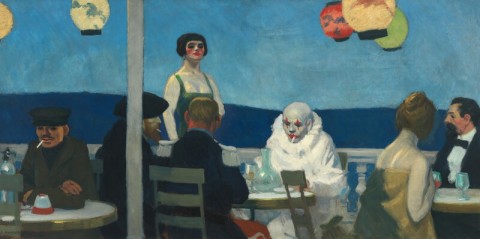
Soir Bleu by Edward Hopper, 1914.
The trend has now become delightfully clear: the world’s best-known art institutions have got around to the important business of making their collections freely viewable online. We’ve already featured the Metropolitan Museum of Art, the Los Angeles County Museum of Art, the Rijksmuseum, and the National Gallery (as well as new, internet-based institutions such as the Google Art Project and Art.sy). Today, we bring news that the Whitney Museum of American Art has joined in as well.
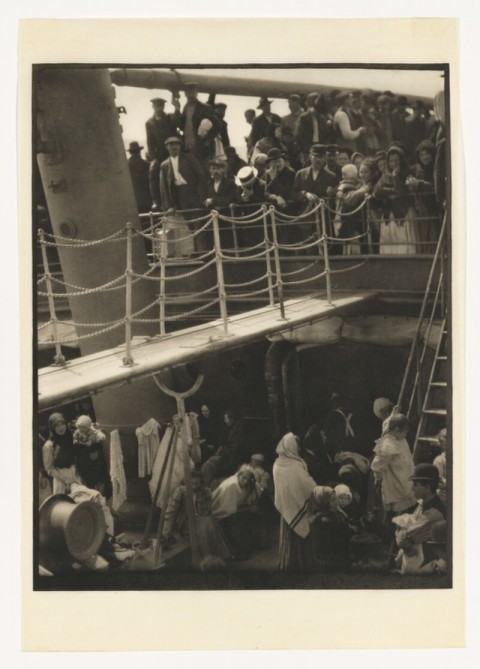
The Steerage by Alfred Stieglitz, 1907.
“Last week, the Whitney Museum massively overhauled its online database,” writes Hyperallergic’s Becca Rothfeld. “The museum of American art expanded its online collection from a paltry 700 works to around 21,000. The digital reserve now includes over 3,000 pieces by Edward Hopper, in addition to offerings from a wide swathe of art from the United States, including the likes of Mike Kelley and Martin Wong.” Rothfeld also notes that all this digitization has happened during the museum’s physical move, currently underway, to a building in the Meatpacking District with 63,000 combined square feet of indoor and outdoor gallery space.

Morning Sky by Georgia O’Keeffe, 1916.
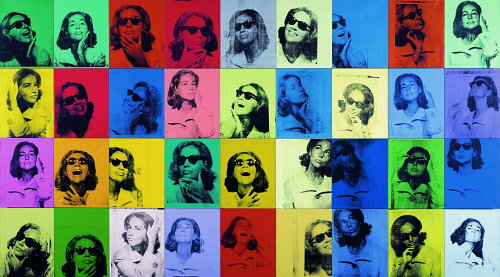
We non-New Yorkers have, of course, already booked our flights to experience the Whitney’s new digs. But since the building won’t actually open to the public until May, all of us, no matter where we live, will have to content ourselves for the moment with what the museum has put online so far. Fortunately, it has put a lot online: you can browse their digital collections by artist here; you’ll notice a great deal of Jackson Pollock, Georgia O’Keeffe, Edward Hopper, and Andy Warhol already available for your browsing pleasure.
via Hyperallergic
Related Content:
The Metropolitan Museum of Art Puts 400,000 High-Res Images Online & Makes Them Free to Use
LA County Museum Makes 20,000 Artistic Images Available for Free Download
The Rijksmuseum Puts 125,000 Dutch Masterpieces Online, and Lets You Remix Its Art
The National Gallery Makes 25,000 Images of Artwork Freely Available Online
The Getty Puts 4600 Art Images Into the Public Domain (and There’s More to Come)
40,000 Artworks from 250 Museums, Now Viewable for Free at the Redesigned Google Art Project
Colin Marshall hosts and produces Notebook on Cities and Culture as well as the video series The City in Cinema and writes essays on cities, language, Asia, and men’s style. He’s at work on a book about Los Angeles, A Los Angeles Primer. Follow him on Twitter at @colinmarshall or on Facebook.
Read More...Dominic West, Stephen Fry & Benedict Cumberbatch Read From a Guantánamo Prisoner’s Diary
For more than a decade, Mohamedou Ould Slahi has remained locked up in Guantánamo, despite never being charged with a crime. He’s just one of many prisoners trapped in a Kafkian state of legal limbo. Confined to a single cell, Slahi has written a haunting, 466 page account of his experience. And, after years of litigation, and some 2,500 redactions by the US government, his diary is finally being published. You can read the declassified manuscript online over at The Guardian. To get some context on the whole affair, you can watch a short documentary above, which features readings by Dominic West (McNulty in The Wire). Below, we have more readings by Stephen Fry, Benedict Cumberbatch and Colin Firth. Yet more readings can be found on SoundCloud.
Stephen Fry
Benedict Cumberbatch
Colin Firth
If you would like to support the mission of Open Culture, consider making a donation to our site. It’s hard to rely 100% on ads, and your contributions will help us continue providing the best free cultural and educational materials to learners everywhere. You can contribute through PayPal, Patreon, and Venmo (@openculture). Thanks!
Read More...How “America’s First Drug Czar” Waged War Against Billie Holiday and Other Jazz Legends
The U.S. government’s so-called “War on Drugs” predates Richard Nixon’s coinage of the term in 1971 by many decades, though it is under his administration that it assumed its current scope and character. Before Woodstock and Vietnam, before the creation of the DEA in 1973, the Federal Bureau of Narcotics—headed by “America’s first drug czar,” Commissioner Harry J. Anslinger, from 1930 to 1962—waged its own war, at first primarily on marijuana, and, to a great degree, on jazz musicians and jazz culture. Anslinger came to power in the era of Reefer Madness, the title of a rather ridiculous 1938 anti-drug film that has come to stand in for hyperbolic anti-pot paranoia of the ’30s and ’40s more generally. Much of that madness was the Commissioner’s special creation.
Like so much of the post-Nixon drug war, Anslinger staged his campaign as a moral crusade against certain kinds of users: dissidents, the counterculture, and especially immigrants and blacks. According to Alexander Cockburn’s Whiteout: The CIA, Drugs, and the Press, Anslinger’s “first major campaign was to criminalize the drug commonly known as hemp. But Anslinger renamed it ‘marijuana’ to associate it with Mexican laborers,” and claimed that the drug “can arouse in blacks and Hispanics a state of menacing fury or homicidal attack.” Anslinger “became the prime shaper of American attitudes to drug addiction.” And like later despisers of rock ‘n’ roll and hip-hop, Anslinger’s hatred of jazz motivated many of his targeted attacks.
Ansligner linked marijuana with jazz and persecuted many black musicians, including Thelonious Monk, Dizzy Gillespie and Duke Ellington. Louis Armstrong was also arrested on drug charges, and Anslinger made sure his name was smeared in the press. In Congress he testified that “[c]oloreds with big lips lure white women with jazz and marijuana.”
“Marijuana is taken by… musicians,” he told Congress in 1937, “And I’m not speaking about good musicians, but the jazz type.” Although the La Guardia Committee would refute almost everything Anslinger testified to about the effects of smoking pot, the damage was already done. (Anslinger’s prosecution of jazz musicians, particularly Louis Armstrong—paralleled that of another power-mad, paranoid bureaucrat, J. Edgar Hoover.)
Anslinger did not simply dislike jazz. He feared it. “It sounded,” he wrote, “like the jungles in the dead of night.” In jazz, “unbelievably ancient indecent rites of the East Indies are resurrected.” And the lives of jazz musicians “reek of filth.” And yet, writes Johann Hari in his book Chasing the Scream (excerpted in Politico), his campaign largely failed because of the jazz world’s “absolute solidarity” in opposition to it. “In the end,” writes Hari, “the Treasury Department told Anslinger he was wasting his time.” And so, “he scaled down his focus until it settled like a laser on one single target—perhaps the greatest female jazz vocalist there ever was,” Billie Holiday.
Anyone with even the most cursory knowledge about Holiday knows she had a drug problem in desperate need of treatment. And, of course, Holiday wasn’t addicted to a relatively harmless substance like marijuana, but to heroin, which—along with alcohol abuse—eventually lead to her death. Yet, as Cockburn writes, Anslinger had “hammer[ed] home his view that [drug addiction] was not… treatable,” but “could only be suppressed by harsh criminal sanctions.” Accordingly, he “hunted” Holiday—in Hari’s apt description—sending agents after her when he heard “whispers that she was using heroin, and—after she flatly refused to be silent about racism.”
Recruiting a black agent, Jimmy Fletcher, for the job, Anslinger began his attacks on Holiday in 1939. Fletcher shadowed Holiday for years, and became protective, eventually, “it seems,” writes Hari, “fall[ing] in love with her.” But Anslinger broke the case through Holliday’s viciously abusive husband, Louis McKay, who agreed to inform on her—something no fellow musician would do. In May of 1947, Holiday was arrested and put on trial for possession of narcotics. “Sick and alone,” writes Hettie Jones in Big Star Fallin’ Mama: Five Women in Black Music, “she signed away her right to a lawyer and no one advised her to do otherwise.” Promised a “hospital cure in return for a plea of guilty,” she was instead “convicted as a ‘criminal defendant,’ and a ‘wrongdoer,’ and sentenced to a year and a day in the Federal Women’s Reformatory at Alderson, West Virginia.”
After her release, Holiday was stripped of her cabaret license, restricted from singing in “all the jazz clubs in the United States… on the grounds,” writes Hari, “that listening to her might harm the morals of the public.” Two years after her first conviction, Anslinger recruited another agent, a sadist named George White, who was all too happy take Holiday down. He did so in 1949 at the Mark Twain Hotel in San Francisco—“one of the few places she could still perform”—arresting her without a warrant and with what were very likely planted drugs. White apparently “had a long history of planting drugs on women” and “may well have been high when he busted Billie for getting high.” (See the declassified case against her here. Her manager John Levy is erroneously referred to as her “husband” and called “Joseph Levy.”)
A jury refused to convict, but Anslinger gloried in the toll his campaign had taken. “She had slipped from the peak of her fame,” he wrote, “her voice was cracking.” After her death in 1959, he wrote callously, “for her, there would be no more ‘Good Morning Heartache.’” For her part, though Holiday “didn’t blame Anslinger’s agents as individuals; she blamed the drug war,” writing in her autobiography, “Imagine if the government chased sick people with diabetes, put a tax on insulin and drove it into the black market… then sent them to jail…. We do practically the same thing every day in the week to sick people hooked on drugs.”
Many jazz musicians, but especially Holiday, paid dearly for Anslinger and the Federal Bureau of Narcotics’ “war on drugs.” Hari documents the “race panic” that underlay most of Anslinger’s actions and the egregious double standard he applied, including a “friendly chat” he had with Judy Garland over her heroin addiction and kid gloves treatment of a “Washington society hostess,” in contrast to his relentless prosecution of Holiday. His persecution of Holliday and others was accompanied by a propaganda campaign that demonized “the Negro population” as dangerous addicts. As Hari points out, Anslinger “did not create these underlying trends,” but he promoted racist fictions and manipulated them to his advantage. And his singling out of cultures and groups he personally disliked and feared as special targets for vigorous, prejudicial prosecution helped set the agenda for anti-drug legislation and cultural attitudes in every decade since he decided to go after jazz and Billie Holiday.
Hari’s book, Chasing the Scream, is now available on Amazon.
Related Content:
Billie Holiday — The Life and Artistry of Lady Day: The Complete Film
Duke Ellington’s Symphony in Black, Starring a 19-Year-old Billie Holiday
Louis Armstrong Plays Historic Cold War Concerts in East Berlin & Budapest (1965)
Josh Jones is a writer and musician based in Durham, NC. Follow him at @jdmagness
Read More...The Public Domain Project Makes 10,000 Film Clips, 64,000 Images & 100s of Audio Files Free to Use
Sure, we love the internet for how it makes freely available so many cultural artifacts. And sure, we also love the internet for how it allows us to disseminate our own work. But the internet gets the most interesting, I would submit, when it makes freely available cultural artifacts with the express purpose of letting creators use them in their own work — which we then all get to experience through the internet. The new Public Domain Project will soon become an important resource for many such creators, offering as it does “thousands of historic media files for your creative projects, completely free and made available by Pond5,” an entity that brands itself as “the world’s most vibrant marketplace for creativity.”
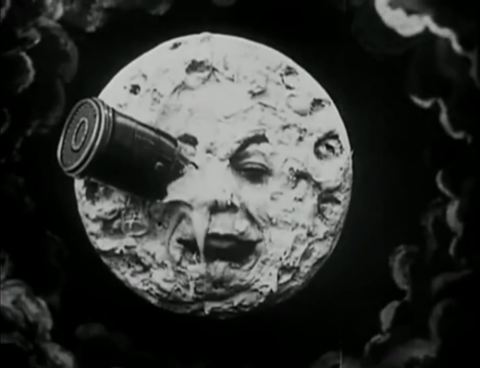
So what can you find to use in the Public Domain Project? As of this writing, it offers 9715 pieces of footage, 473 audio files, 64,535 images, and 121 3D models. “The project includes digital models of NASA tools and satellites, Georges Méliès’ 1902 film, A Trip To The Moon, speeches by political figures like Winston Churchill and Martin Luther King, Jr., recordings of performances from composers like Beethoven, and a laid-back picture of President Obama playing pool,” says a post at The Creators Project explaining the site’s background.
In the Public Domain Project’s expanding archives you will also find clips of everything, from rocket launches to film of old New York to very, very early cat videos, to, of course, mushroom clouds. I imagine that some future Chris Marker could make creative use of this stuff indeed, and if they need a score, they could use a concerto for pizzicato and ten instruments, Chopin’s “Nocturne in E Flat Major,” or maybe “Johnny Get Your Gun.” Alternatively, they could part out the very first documentary and use the Public Domain Project’s bits and pieces of Dziga Vertov’s Man With a Movie Camera. Whatever you want to create, the usable public domain can only grow more fruitful, so you might as well get mixing, remixing, and sharing, as Pond5 puts it, right away. Visit The Public Domain Project here.
Related Content:
Sherlock Holmes Is Now in the Public Domain, Declares US Judge
A Cabinet of Curiosities: Discover The Public Domain Review’s New Book of Essays
Colin Marshall hosts and produces Notebook on Cities and Culture as well as the video series The City in Cinema and writes essays on cities, language, Asia, and men’s style. He’s at work on a book about Los Angeles, A Los Angeles Primer. Follow him on Twitter at @colinmarshall or on Facebook.
Read More...Jean Cocteau Delivers a Speech to the Year 2000 in 1962: “I Hope You Have Not Become Robots”
Jean Cocteau was a great many things to a great many people—writer, filmmaker, painter, friend, and lover. In the latter two categories he could count among his acquaintances such modernist giants as Pablo Picasso, Kenneth Anger, Erik Satie, Marlene Dietrich, Edith Piaf, Jean Marais, Marcel Proust, André Gide, and a number of other famous names. But Cocteau himself had little use for fame and its blandishments. As you’ll see in the short film above, “Cocteau Addresses the Year 2000,” the great 20th century artist considered the many awards bestowed upon him naught but “transcendent punishment.” What Cocteau cared for most was poetry; for him it was the “basis of all art, a ‘religion without hope.’ ”
Cocteau began his career as a poet, publishing his first collection, Aladdin’s Lamp, at the age of 19. By 1963, at the age of 73, he had lived one of the richest artistic lives imaginable, transforming every genre he touched.
Deciding to leave one last artifact to posterity, Cocteau sat down and recorded the film above, a message to the year 2000, intending it as a time capsule only to be opened in that year (though it was discovered, and viewed a few years earlier). Biographer James S. Williams describes the documentary testament as “Cocteau’s final gift to his fellow human beings.”
He reiterates some of his long-standing artistic themes and principles: death is a form of life; poetry is beyond time and a kind of superior mathematics; we are all a procession of others who inhabit us; errors are the true expression of an individual, and so on. The tone is at once speculative and uncompromising…
Portraying himself as “a living anachronism” in a “phantom-like state,” Cocteau, seated before his own artwork, quotes St. Augustine, makes parables of events in his life, and addresses, primarily, the youth of the future. The uses and misuses of technology comprise a central theme of his discourse: “I certainly hope that you have not become robots,” Cocteau says, “but on the contrary that you have become very humanized: that’s my hope.” The people of his time, he claims, “remain apprentice robots.”
Among Cocteau’s concerns is the dominance of an “architectural Esperanto, which remains our time’s great mistake.” By this phrase he means that “the same house is being built everywhere and no attention is paid to climate, atmospherical conditions or landscape.” Whether we take this as a literal statement or a metaphor for social engineering, or both, Cocteau sees the condition as one in which these monotonous repeating houses are “prisons which lock you up or barracks which fence you in.” The modern condition, as he frames it, is one “straddling contradictions” between humanity and machinery. Nonetheless, he is impressed with scientific advancement, a realm of “men who do extraordinary things.”
And yet, “the real man of genius,” for Cocteau, is the poet, and he hopes for us that the genius of poetry “hasn’t become something like a shameful and contagious sickness against which you wish to be immunized.” He has very much more of interest to communicate, about his own time, and his hopes for ours. Cocteau recorded this transmission from the past in August of 1963. On October 11 of that same year, he died of a heart attack, supposedly shocked to death by news of his friend Edith Piaf’s death that same day in the same manner.
His final film, and final communication to a public yet to be born, accords with one of the great themes of his life’s work—“the tug of war between the old and the new and the paradoxical disparities that surface because of that tension.” Should we attend to his messages to our time, we may find that he anticipated many of our 21st century dilemmas between technology and humanity, and between history and myth. It’s interesting to imagine how we might describe our own age to a later generation, and, like Cocteau, what we might hope for them.
Related Content:
Jean Cocteau’s Avante-Garde Film From 1930, The Blood of a Poet
The Postcards That Picasso Illustrated and Sent to Jean Cocteau, Apollinaire & Gertrude Stein
David Lynch Presents the History of Surrealist Film (1987)
Josh Jones is a writer and musician based in Durham, NC. Follow him at @jdmagness
Read More...Visit “Mariobatalivoice,” the Cooking Blog by Steve Albini, Musician & Record Producer

Image by Wikimedia Commons by Freekorps
You know Steve Albini as the pioneering founder and frontman of such disturbing post-hardcore punk bands as Big Black, Rapeman, and Shellac. You also know him as the in-demand producer of albums by such excellent artists as the Pixies, Nirvana, Cheap Trick, Mogwai, The Dirty Three, The Breeders, P.J. Harvey… the list goes ever on… Albini’s role as a producer—of bands both high profile and totally obscure—is legendary in rock circles, as is his curmudgeonliness, exacting personal standards, highly opinionated commentary, and exceptional musical taste.
You may not know, however, about Albini’s exceptional culinary tastes, as documented on his food blog, “Mariobatalivoice: What I made Heather for dinner.” Maintained between 2011 and 2013, the running commentary chronicles Albini’s attempts at dishes such as “Li-hing-rubbed torpedo with weird huauzontle and diced peppers” and “aged short ribs with fennel on saffron potato puree.” From the looks of things, Albini is a fine cook, as well as decent food photographer—if those are his photos. His blog description suggests they may be the work of Heather (that is, his wife, Heather Whinna).

A photo of Saffron Potato Cashew Pancakes from mariobatalivoice.
Albini’s also a very entertaining writer. No surprise there, “as anyone who’s seen his back-in-the-day fanzine rants can attest,” wrote Tom Breihan at Pitchfork in 2011. Typically understated and idiosyncratic, Albini writes, “I don’t give quantities or exact recipes because I eyeball and taste everything like anybody who cooks a lot…. We’re not ninjas. Also, some of this food may not turn out that great, so replicating it would be pointless. I have also successfully cooked for our cats.” Nonetheless, even without proportions and exact steps spelled out, “if you cook, you should be able to figure out how to make any of these meals.”
The name, he tells us, “comes from the way I bring [Heather] food in bed and present it to her using an imitation of Mario Batali’s voice from TV.” You’ll probably find your own brand of presentation, but all of the dishes look both challenging and totally worth the effort. To read about Albini’s adventures in the culinary exotic, check out the archives of his now-dormant food blog here.
Related Content:
Read Steve Albini’s Uncompromising Proposal to Produce Nirvana’s In Utero (1993)
1967 Cookbook Features Recipes by the Rolling Stones, Simon & Garfunkel, Barbra Streisand & More
Josh Jones is a writer and musician based in Durham, NC. Follow him at @jdmagness
Read More...Leo Tolstoy’s Masochistic Diary: I Am Guilty of “Sloth,” “Cowardice” & “Sissiness” (1851)
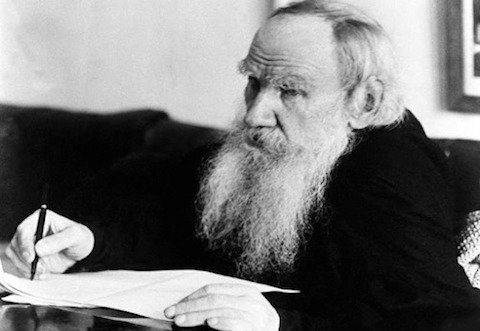
1850 was a tough year for Leo Tolstoy. It was a time when his future successes were impossible to see while his past failures were all too obvious. A few years prior, he had been thrown out of the University of Kazan. His teachers wrote him off as “both unable and unwilling to learn.” Thereafter, he went into a spiral of dissolution, first in St. Petersburg and then in Moscow, where he drank, caroused and racked up some serious gambling debts.
Yet Tolstoy had ambitions beyond being just another debauched scion of the upper class. He struggled to improve himself. So he started a journal in 1847 while recovering in a hospital ward from venereal disease. Influenced by Jean-Jacques Rousseau, the future author of War and Peace sought to use the diary as a tool for self-exploration. For the first few years, he was an intermittent diarist. Then, in 1850, he took this tool to new lacerating levels. Part psychotherapy, part literary exploration, part inquiry into the limits of narrative and part straight up masochism, Tolstoy set out to account for his every action during the day in what he called the “Journal of Daily Occupations.”
He divided his page into two columns. In “The Future” column, he listed the things he planned to do the next day. In “The Past” column, he judges himself (harshly) on how well he followed through on those plans, labeling each one of his failures with the appropriate sin – sloth, avarice etc. There was no column for “The Present.”
You can see a selection from his journal, courtesy of scholar Irina Paperno, who wrote a nice piece on Tolstoy’s diary over at Salon. The diary entries below date from March, 1851:
24. Arose somewhat late and read, but did not have time to write. Poiret came, I fenced, and did not send him away (sloth and cowardice). Ivanov came, I spoke with him for too long (cowardice). Koloshin (Sergei) came to drink vodka, I did not escort him out (cowardice). At Ozerov’s argued about nothing (habit of arguing) and did not talk about what I should have talked about (cowardice). Did not go to Beklemishev’s (weakness of energy). During gymnastics did not walk the rope (cowardice), and did not do one thing because it hurt (sissiness).—At Gorchakov’s lied (lying). Went to the Novotroitsk tavern (lack of fierté). At home did not study English (insufficient firmness). At the Volkonskys’ was unnatural and distracted, and stayed until one in the morning (distractedness, desire to show off, and weakness of character).
25. [This is a plan for the next day, the 25th, written on the 24th—I.P.] From 10 to 11 yesterday’s diary and to read. From 11 to 12—gymnastics. From 12 to 1—English. Beklemishev and Beyer from 1 to 2. From 2 to 4—on horseback. From 4 to 6—dinner. From 6 to 8—to read. From 8 to 10—to write.—To translate something from a foreign language into Russian to develop memory and style.—To write today with all the impressions and thoughts it gives rise to.—25. Awoke late out of sloth. Wrote my diary and did gymnastics, hurrying. Did not study English out of sloth. With Begichev and with Islavin was vain. At Beklemishev’s was cowardly and lack of fierté. On Tver Boulevard wanted to show off. I did not walk on foot to the Kalymazhnyi Dvor (sissiness). Rode with a desire to show off. For the same reason rode to Ozerov’s.—Did not return to Kalymazhnyi, thoughtlessness. At the Gorchakovs’ dissembled and did not call things by their names, fooling myself. Went to L’vov’s out of insufficient energy and the habit of doing nothing. Sat around at home out of absentmindedness and read Werther inattentively, hurrying.
26 [This is a plan for the next day, the 26th, written on the 25th—I.P.] To get up at 5. Until 10—to write the history of this day. From 10 to 12—fencing and to read. From 12 to 1—English, and if something interferes, then in the evening. From 1 to 3—walking, until 4—gymnastics. From 4 to 6, dinner—to read and write.— (46:55).
Tolstoy’s regime of self-improvement wasn’t restricted to this punishing daily accounting of failures. He also kept a “Journal for Weaknesses,” which tallied up all of his moral failures, arranged in columns for laziness, indecision, sensuality etc., not to mention a series of notebooks for rules: “Rules for life,” “Rules for developing will,” and “Rules for playing cards in Moscow until January 1.”
One gets the sense that there’s a real opportunity for a line of Tolstoyan self-help books. Six Pillars of Self-Flagellation, perhaps? 7 Habits of Highly Effective Moral Failures? The Power of Spiritual Angst?
Read more about Tolstoy’s journaling over at Salon.
Related Content:
Find great works by Tolstoy in our collection, 800 Free eBooks for iPad, Kindle & Other Devices
Rare Recording: Leo Tolstoy Reads From His Last Major Work in Four Languages, 1909
Vintage Footage of Leo Tolstoy: Video Captures the Great Novelist During His Final Days
Leo Tolstoy’s Family Recipe for Macaroni and Cheese
Jonathan Crow is a Los Angeles-based writer and filmmaker whose work has appeared in Yahoo!, The Hollywood Reporter, and other publications. You can follow him at @jonccrow. And check out his blog Veeptopus, featuring lots of pictures of badgers and even more pictures of vice presidents with octopuses on their heads. The Veeptopus store is here.
Read More...Haruki Murakami’s Advice Column (“Mr. Murakami’s Place”) Is Now Online: Read English Translations

Earlier this month, the reading world thrilled to the news that Haruki Murakami would, in a new column on his official site, take on the role of agony uncle. I, for one, had to look up the term “agony uncle,” a term out of British English, a language that surprises me even more often than does Murakami’s native Japanese. It means an advice columnist, or more specifically an avuncular type of writer to whom readers can pour out their agonies.
Despite his rare public appearances and few first-person pieces available in translation, readers around the globe have surely sensed the writer’s calm manner and sympathetic ear. And when he gives advice straight-up, as when he talks about what makes a good runner or writer (almost the same thing, to his mind) he does it with succinctness and wisdom. And so we have 村上さんのところ, or “Mr. Murakami’s Place,” where Murakami will, over the next few months, briefly address all manner of reader queries submitted in January.
(Which means that, if you have anything to ask him you’ve still got a few days left to do so. Though you’ll notice that the site appears almost entirely in Japanese, the English-speaking Murakami also answers questions submitted in that language; just consult James Smyth’s translation of the question submission form if you want to go that route.)
“Do you think cats can understand how humans feel?” asks a fan named Vivian. “My cat Bobo ran away when she saw me crying.” And despite, or because of, having spent a good deal of time rendering cats as literary presences, Murakami feels a bit dubious about the issue: “I suspect that either you or your cat is extremely sensitive. I have had many cats, but no cat has ever been so sympathetic. They were just as egoistic as they could be.” “Do you have some places you always stay for a while?” asks a 20-year-old student. “An easy question. In the bed with someone I love. Where else?”
Not only do the Japanese-language questions and answers get slightly more expansive, they sometimes even take the traditional advice-column form. Take, for example, “On the Cusp of 30”:
30 is right around the corner for me, but there isn’t a single thing that I feel like I’ve accomplished. When I was young, I thought to be an ‘adult’ must be so wonderful, but my current reality is so far away from what I imagined. And when faced with that reality, I get very disheartened. What should I do with myself?
(Jo & Maca, Female, 28)
I don’t mean to be rude, but I think “to be an ‘adult’ must be so wonderful,” is just wrong. ‘Adult’ is nothing more than an empty form. What you fill that form with is your own responsibility. Accomplishments don’t come easily. When you start to fill your ‘adult’ form little by little, then everything will begin. But 28 is not really ‘adult.’ You’re only just beginning.
That translation comes from an anonymous translator and Murakami fan writing their own English companion blog to the column. It presents another urgent query from a desperate reader as follows:
My wife quite frequently belches right near the back of my head when she passes behind me. When I say to her, “Stop burping behind me all the time,” she says, “It’s not on purpose. It just comes out.” I don’t think I’m bringing it upon myself in any way. Is there something I can do to stop my wife’s belching?
(ukuleleKazu, Male, 61, Self-Employed)
I hope you’ll pardon me for saying so, but I think belching is far better than farting. Perhaps you should think of it that way.
Murakami has so far weighed in on such other matters of import as disappearing cats [translation], how to deal with rising marathon times [translation], his plans for further non-fiction writing [translation], what to do at age nineteen [translation], waning libido [translation], and his love of Iceland [translation]. Even if you don’t care about the novelist’s thoughts on these matters, do take a look at the site and its abundance of bipedal cats and sheep, jazz albums, Johnnie Walker figures, and Yakult Swallows memorabilia — in any language, a Murakami fan’s delight.
Related Content:
Haruki Murakami Lists the Three Essential Qualities For All Serious Novelists (And Runners)
A Photographic Tour of Haruki Murakami’s Tokyo, Where Dream, Memory, and Reality Meet
Haruki Murakami’s Passion for Jazz: Discover the Novelist’s Jazz Playlist, Jazz Essay & Jazz Bar
Haruki Murakami Translates The Great Gatsby, the Novel That Influenced Him Most
Colin Marshall hosts and produces Notebook on Cities and Culture as well as the video series The City in Cinema and writes essays on cities, language, Asia, and men’s style. He’s at work on a book about Los Angeles, A Los Angeles Primer. Follow him on Twitter at @colinmarshall or on Facebook.
Read More...Batman & Other Super Friends Sit for 17th Century Flemish Style Portraits
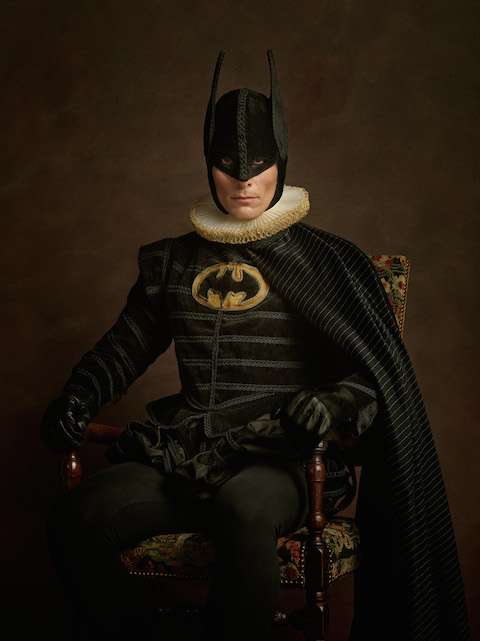
Portraits taken by Sacha Goldberger at Super Flemish
Superheroes, as you may have noticed, are serious moneymakers these days. It started when Tim Burton rescued Batman from Adam West’s campy clutches, pouring him into a butch black rubber suit that is of a piece with a leaner, meaner Batmobile. Previously unthinkable digital special effects quickly replaced all trace of Biff! Pow!! Whammo!!! Franchise opportunities abounded as the entire Justice League went on the block.
Having looked at it from both sides now, I can only conclude that something’s lost…
…but something’s gained in the portraits of Sacha Goldberger, a photographer who harnesses the power of 17th century Flemish school portraiture to restore, nay, reveal these icons’ humanity.
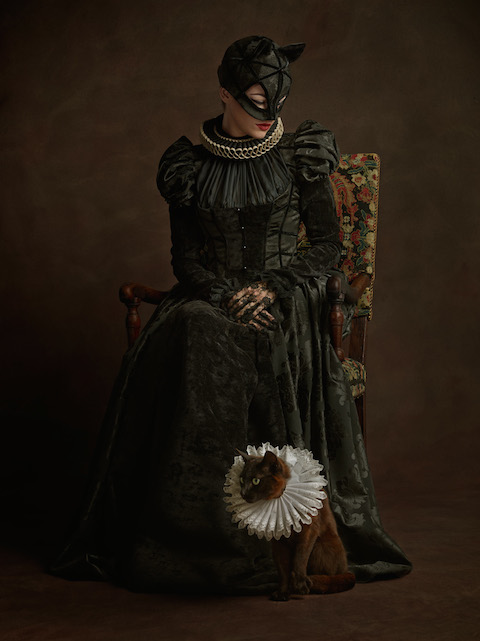
The softer fabrics and Vermeer-worthy lighting of his Super Flemish project give his powerful subjects room to breathe and reflect.
Same goes for us, the viewers.
It’s much easier to dwell on the existential nature of these mythic beings when the White House isn’t exploding in the background. There are times when tights need the ballast that only a pair of pumpkin pants can provide.
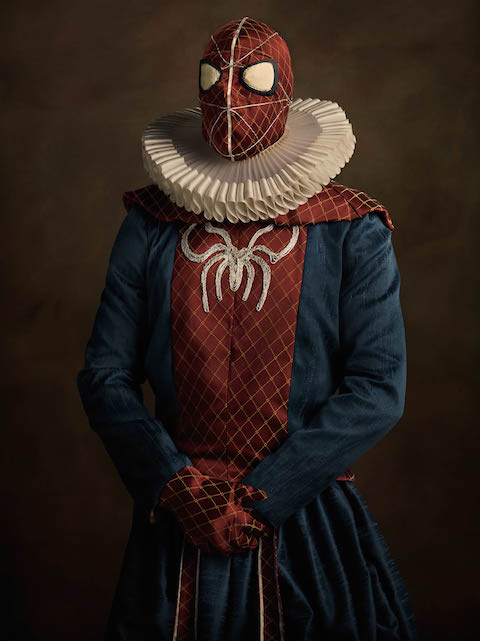
Goldberger — whose previous forays into both superheroes and Flemish portraiture feature his ever-game granny — helps things along by casting models who closely resemble their cinematic counterparts. But it’s not just the bone structure. All of his sitters display a knack for looking thoughtful in a ruff. In the artist’s vision, they are “tired of having to save the world without respite, promised to a destiny of endless immortality, forever trapped in their character.”
Find more portraits over at Super Flemish.
Related Content:
Artist Nina Katchadourian Creates Flemish Style Self-Portraits in Airplane Lavatory
Typed Portraits of Literary Legends: Kerouac, Saramago, Bukowski & More
The Genius of Albrecht Dürer Revealed in Four Self-Portraits
Ayun Halliday is an author, homeschooler, and Chief Primatologist of the East Village Inky zine. Follow her @AyunHalliday
Read More...Support Us
We're hoping to rely on loyal readers, rather than erratic ads. Please click the Donate button and support Open Culture. You can use Paypal, Venmo, Patreon, even Crypto! We thank you!

About Us

Open Culture scours the web for the best educational media. We find the free courses and audio books you need, the language lessons & educational videos you want, and plenty of enlightenment in between.
Advertise With Us

FREE UPDATES!
GET OUR DAILY EMAIL
Get the best cultural and educational resources on the web curated for you in a daily email. We never spam. Unsubscribe at any time.
FOLLOW ON SOCIAL MEDIA

Open Culture editor Dan Colman scours the web for the best educational media. He finds the free courses and audio books you need, the language lessons & movies you want, and plenty of enlightenment in between.
Advertise With Us