Ayn Rand Writes a Harsh Letter To Her 17-Year-Old Niece: “I Will Write You Off As a Rotten Person” (1949)
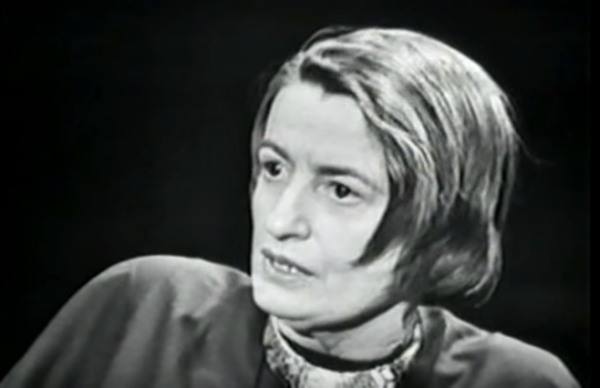
Image via YouTube, 1959 interview with Mike Wallace
I recently happened upon the Modern Library’s “100 Best Novels” list and noticed something interesting. The list divides into two columns—the “Board’s List” on the left and “Reader’s List” on the right. The “Board’s List” contains in its top ten such expected “great books” as Joyce’s Ulysses (#1) and William Faulkner’s The Sound and the Fury (#6). These are indeed worthy titles, but not the most accessible of books, to be sure, though Ulysses does appear at number eleven on the “Reader’s List.” At the very top of that more popular ranking, however, is a book the literati could not find more worthy of contempt: Ayn Rand’s Atlas Shrugged. Just below it is Rand’s The Fountainhead, and at numbers seven and eight, respectively, her Anthem and We the Living. (Also in the top ten on the “Reader’s List,” three novels by L. Ron Hubbard.)
One obvious takeaway… masses of ordinary people really like Ayn Rand. Which is odd, because Ayn Rand seemed to positively hate the masses of ordinary people. As Michael O’Donnell writes in Washington Monthly, “Rand… lived a life of contempt: for people, for ideas, for government, and for the very concept of human kindness.”
Perhaps her most sympathetic reader, economist Ludwig von Mises, summed up the overarching theme of her life’s work in one very tidy sentence: “You have the courage to tell the masses what no politician told them: you are inferior and all the improvements in your conditions which you simply take for granted you owe to the effort of men who are better than you.” This is apparently a message that a great many people are eager to hear. (And if any fiction is “message driven,” it is Rand’s.)
But imagine, if you will, that you are not a reader of Ayn Rand, but a family member. Not by blood, but marriage, but connected, nonetheless. You are Ayn Rand’s niece—Rand’s husband Frank O’Connor’s sister’s daughter, to be precise. Your name is Connie Papurt, you are 17, and you have written Auntie Ayn to ask for $25 for a new dress. Have you done this simply to be cheeky? You do know, Connie, how deeply your Aunt Ayn despises moochers, do you not? No matter—we have neither Connie’s letter, nor a window into her motivations. We do have, however, Rand’s replies, plural, from May 22, 1949, then again—in response to Connie’s follow-up—from June 4 of that same year. The initial request prompted some earnest sermonizing from Rand on the value of hard work, and of being a “self-respecting, self-supporting, responsible, capitalistic person.” Etcetera.
Now, to Rand’s credit, the first reply letter contains some common sense advice, and describes some situations in which other close connections apparently took advantage of her generosity. She seems to have cause for leeriness, as, granted, do we all in these situations. Borrowing from family is very often a tricky business. As was her wont, however, Rand seized upon the occasion not only to dispense wisdom on personal responsibility, but also to moralize on the worthlessness of people who fail her test of character. As The Toast comments, the letter is “30% very good advice, 50% unnecessary yelling, and 20% nonsense.” First, Rand lays out for Connie an installment plan:
Here are my conditions: If I send you the $25, I will give you a year to repay it. I will give you six months after your graduation to get settled in a job. Then, you will start repaying the money in installments: you will send me $5 on January 15, 1950, and $4 on the 15th of every month after that; the last installment will be on June 15, 1950—and that will repay the total.
Are you willing to do that?
Notice, Rand assesses no interest—a kindness, indeed. And yet,
I want you to understand right now that I will not accept any excuse—except a serious illness. If you become ill, then I will give you an extension of time—but for no other reason. If, when the debt becomes due, you tell me that you can’t pay me because you needed a new pair of shoes or a new coat or you gave the money to somebody in the family who needed it more than I do—then I will consider you as an embezzler. No, I won’t send a policeman after you, but I will write you off as a rotten person and I will never speak or write to you again.
According to her 2012 obituary, Connie went on to became a local Cleveland actress and nurse, a person “dedicated to making the lives of others better.” According to her aunt, she should have nothing better to do—for anyone—but to pay back her debt, should she wish to remain in the good graces of the great Objectivist. We do not know if Connie accepted the terms, but she apparently wrote back in such a way as to leave quite an impression on Rand, whose June 4 reply is “damn charming!”
I must tell you that I was very impressed with the intelligent attitude of your letter. If you really understood, all by yourself, that my long lecture to you was a sign of real interest on my part, much more so than if I had sent you a check with some hypocritical gush note, and if you understood that my letter was intended to treat you as an equal—then you have just the kind of mind that can achieve anything you choose to achieve in life.
The letter goes on in very kindly, even sentimental, terms. In fact, it may convince you that O’Donnell is dead wrong to single out contempt as Rand’s defining quality. And yet, he argues, her biographers show that “she happily accepted help from others while denouncing altruistic kindness” (and those who accept it), espousing “an individualism so extreme that it does not merely ignore others, but actually spits in their faces.” While Connie managed to escape her wrath, such as it was, most others, through their own failings of true capitalistic character or the cruelty of circumstances beyond their control, did not.
Read both of Rand’s letters here.
Related Content:
Ayn Rand Helped the FBI Identify It’s A Wonderful Life as Communist Propaganda
In Her Final Speech, Ayn Rand Denounces Ronald Reagan, the Moral Majority & Anti-Choicers (1981)
A Free Cartoon Biography of Ayn Rand: Her Life & Thought
Josh Jones is a writer and musician based in Durham, NC. Follow him at @jdmagness
Read More...31 Rolls of Film Taken by a World War II Soldier Get Discovered & Developed Before Your Eyes
Levi Bettwieser runs the Rescued Film Project, which salvages undeveloped rolls of film from around the world, all shot somewhere between the 1930s and the late 1990s. They have the ability “to process film from all eras. Even film that has been degraded by heat, moisture, and age. Or is no longer manufactured.” And why do they take on these projects? Because, at some point, every image was special for someone. “Each frame captured, reflects a moment that was intended to be remembered.”
Above you can watch Bettwieser processing 31 rolls of film shot by an American soldier during World War II. According to Petapixel, the rolls were found at an Ohio auction in late 2014, and they “were labeled with various location names (i.e. Boston Harbor, Lucky Strike Beach, LaHavre Harbor).” But other than that, Bettwieser knows nothing more about the vet who took these shots.
The rescue operation and the photographs it yielded are all featured in a nicely crafted, 10-minute video.
Follow us on Facebook, Twitter and Google Plus and share intelligent media with your friends. Or better yet, sign up for our daily email and get a daily dose of Open Culture in your inbox.
Read More...Rolling Stones Drummer Charlie Watts Writes a Children’s Book Celebrating Charlie Parker (1964)
Charlie Watts’s first love has always been jazz. While his Rolling Stones band mates spent their youth listening to the Blues, Watts listened to Miles Davis and John Coltrane. And something about that seems to have stuck. Mick Jagger and Keith Richards defined what a rock star should look like in the late 60s – disheveled and flamboyant. Watts always seemed to carry himself with a jazzman’s sense of cool.
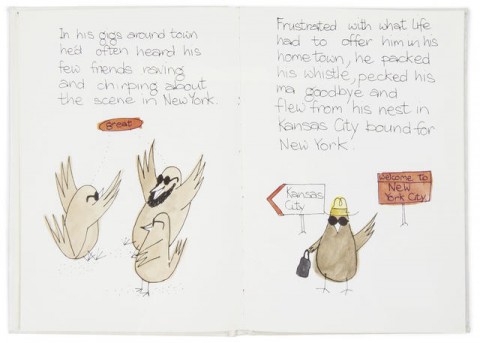
Back in 1960, when he was working as a graphic designer and doing drumming gigs on the side, Watts found another way to show off his love for jazz. He wrote a children’s book. Ode to a Highflying Bird is about alt sax legend Charlie Parker, rendered in doodle-like fashion as a bird in shades. The hand-drawn text details Parker’s life story: “Frustrated with what life had to offer him in his hometown, he packed his whistle, pecked his ma goodbye and flew from his nest in Kansas City bound for New York.”
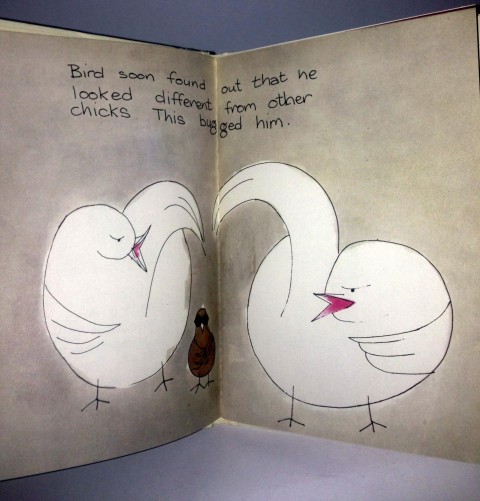
The book was originally done as a portfolio piece but, in 1964, after Watts became a member of the Stones, the book was published. As Watts recalled, “This guy who published ‘Rolling Stones Monthly’ saw my book and said ‘Ah, there’s a few bob in this!’”
This wasn’t the only ode to Bird that Watts made over his long career. In 1992, his jazz band, The Charlie Watts Quintet, released an album called From One Charlie… which, as the title suggests, pays homage to Parker and his other bee-bop gods. “I don’t really love rock & roll,” as he told Rolling Stone magazine. “I love jazz. But I love playing rock & roll with the Stones.”
A few old copies of Ode to a Highflying Bird can be found on Amazon and on Abe Books.
Related Content:
Jonathan Crow is a Los Angeles-based writer and filmmaker whose work has appeared in Yahoo!, The Hollywood Reporter, and other publications. You can follow him at @jonccrow. And check out his blog Veeptopus, featuring lots of pictures of badgers and even more pictures of vice presidents with octopuses on their heads. The Veeptopus store is here.
Read More...Nirvana’s Last Concert: Audio/ Video Recorded on March 1, 1994
Yes, it’s been over 20 years now since Nirvana played their last show, and if you’re old enough to have been there, go ahead and take a moment of silence to mourn your lost youth. Given the relative paucity of raw, authentic-sounding guitar rock these days, it’s tempting to romanticize the nineties as halcyon days, but that kind of nostalgia should be tempered by an honest accounting of the tedious flood of grunge-like also-rans the corporate labels released upon us after Nirvana’s mainstream success. In a certain sense, the demise of that band and death of its leader marks the end of so-called “alternative” rock (whatever that meant) as a genuine alternative. After Nirvana, a deluge of growly, angsty, and not especially listenable bands took over the airwaves and festival circuits. Before them—well, if you don’t know, ask your once-hip aunts and uncles.
And yet, there is another narrative—one that holds up the band as rock redeemers who broke through the corporate mold and, like the Stooges or the Ramones twenty years earlier, brought back authentic anger, danger, and intensity to rock ‘n’ roll. That Nirvana became the corporate mold is not necessarily their doing, and not a turn of events that sat at all well with the band. Their last show, in Munich, 1994 (see it in part above), “was anything but immaculate,” writes Consequence of Sound, a fact “almost tragically fitting.” As if presaging its leader’s decline, Nirvana’s final concert went from strained to worse, as Cobain’s voice faltered due to bronchitis, and the venue temporarily lost power. “Undeterred, they continued acoustically, but ended up cutting what would’ve been the seventh song, ‘Smells Like Teen Spirit,’” the track that launched a million grunge garage bands three years earlier. With tongues in cheeks, they open—at the top—with The Cars’ “My Best Friend’s Girl” (and a few bars of their “Moving in Stereo”). Surely both an homage to a great ‘80s band and a punk deconstruction of major label radio rock of the previous decade.
In a foreboding remark after the power went out, bassist Krist Noveselic quips, “We’re not playing the Munich Enormodome tonight. ‘Cos our careers are on the wane. We’re on the way out. Grunge is dead. Nirvana’s over.” The remainder of the tour was canceled, and Cobain went to Rome, where he overdosed on Rohypnol and champagne and temporarily fell into a coma. One month later, after a failed rehab stint, he was dead. Almost immediately afterward, a cult of Cobain sprung up around his memory—as much a triumph of marketing as an act of mourning. T‑shirts, posters, tribute albums… the usual mass culture wake when a rock star dies young. What saddened me as a child of the era is not that the band’s last tour petered out, or even that Cobain fell apart under the familiar pressures of fame and addiction, but that in death he was turned into what he hated most—an idol. But if the worshipful merch of twenty years ago seemed tacky, it was nothing compared to t‑shirts selling just weeks ago with Cobain’s suicide note printed on them. (These have since been pulled due to complaints.) And while we may someday hear the demos of Cobain’s planned solo record, we might also have been treated to something else—“our next record’s going to be a hip-hop record,” joked Noveselic. Now that would have been a novelty. Instead we got these guys.
Related Content:
Watch The Last 48 Hours of Kurt Cobain on the 20th Anniversary of the Musician’s Suicide
Kurt Cobain’s Home Demos: Early Versions of Nirvana Hits, and Never-Released Songs
The First Live Performance of Nirvana’s “Smells Like Teen Spirit” (1991)
Josh Jones is a writer and musician based in Durham, NC. Follow him at @jdmagness
Read More...William Blake Illustrates Dante’s Divine Comedy (1827)
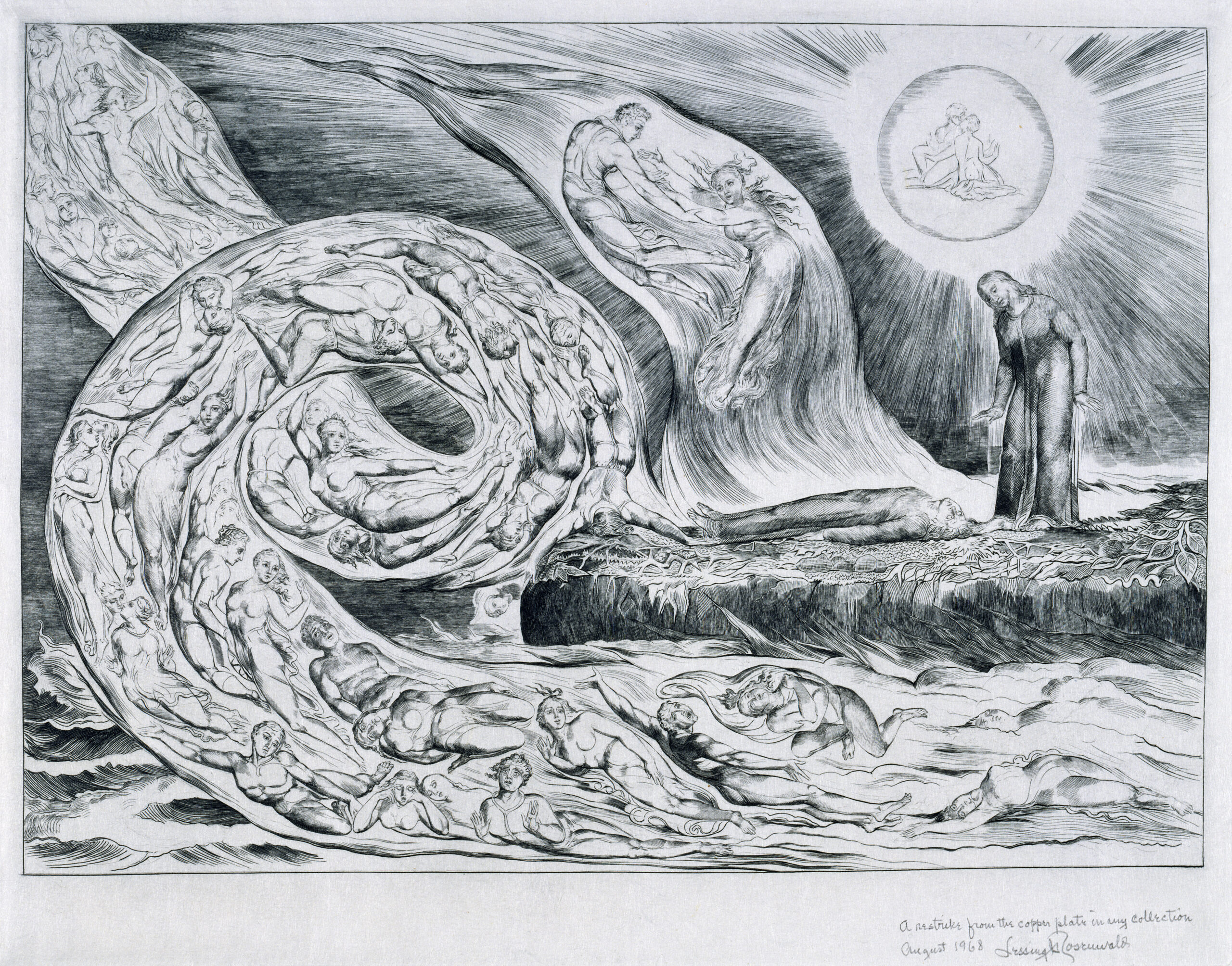
Just over a year ago, we featured John Milton’s Paradise Lost as illustrated by William Blake, the 18th- and 19th-century English poet, painter, and printmaker who made uncommonly full use of his already rare combination of once-a-generation literary and visual aptitude. Blake may have had an obsession with Paradise Lost, as Josh Jones pointed out in that post, but it hardly kept him from illustrating other texts. Today we have his artistic accompaniment to that text that has gone under the hands of Salvador Dalí, Gustave Doré, Alberto Martini, Sandro Botticelli, and Mœbius, to name a few: Dante Alighieri’s Divine Comedy.
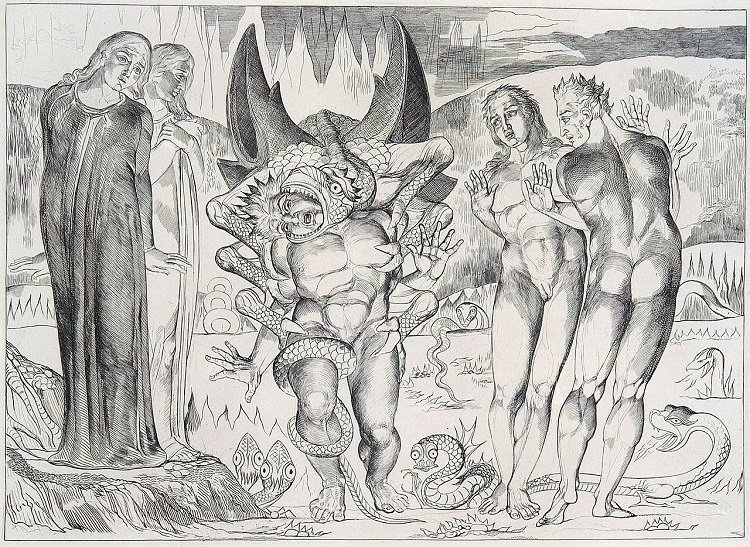
Blake never completed the full set of engravings commissioned, but only because death itself cut the project short. Still, he managed to complete several watercolors and a handful of engraving proofs, all of which have drawn praise not just for the way they evoke the different environments of the Inferno, Purgatorio, and Paradiso, but for how they cast a sometimes critical eye on the theological and moral sensibilities of Dante’s original work.
(“Every thing in Dantes Comedia shews That for Tyrannical Purposes he has made This World the Foundation of All & the Goddess Nature & not the Holy Ghost,” Blake once wrote to himself in a piece of marginalia often cited by scholars of this particular project.)
Yet Blake and Dante had common ground. “Blake was drawn to the project because, despite the five centuries that separated them, he resonated with Dante’s contempt for materialism and the way power warps morality — the opportunity to represent these ideas pictorially no doubt sang to him,” writes Maria Popova at Brain Pickings, who tells more of the story surrounding Blake’s Divine Comedy. He stopped only when just about to step off this mortal coil, a moment in which history has remembered him saying to his wife, “Keep just as you are — I will draw your portrait — for you have ever been an angel to me.” That portrait didn’t survive, but what he completed of his Dante illustrations did, granting them the status of William Blake’s final work — and, given the post-life nature of its subject matter, a suitable status indeed.
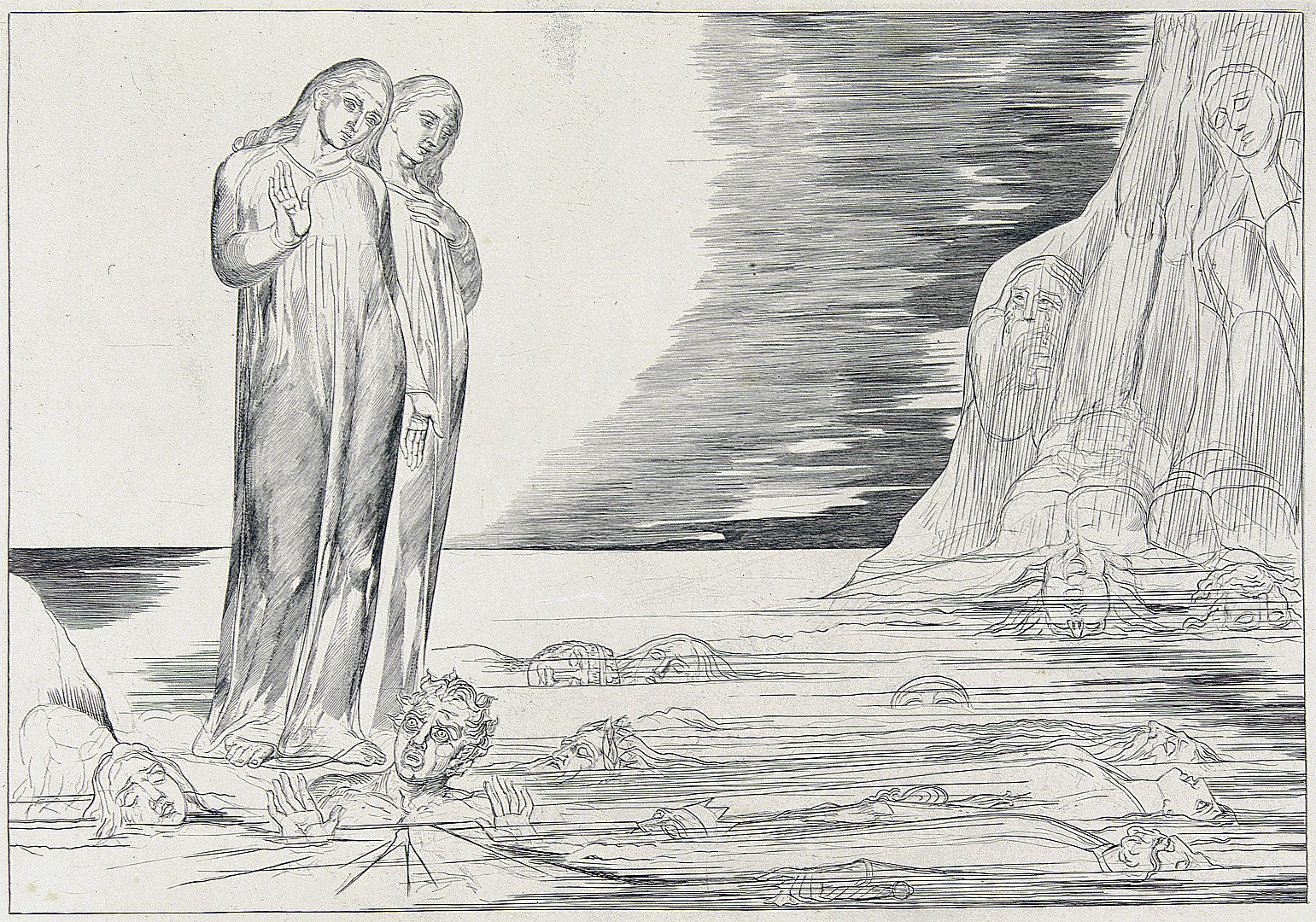
via Brain Pickings
Related Content:
A Free Course on Dante’s Divine Comedy from Yale University
William Blake’s Hallucinatory Illustrations of John Milton’s Paradise Lost
Mœbius Illustrates Dante’s Paradiso
Botticelli’s 92 Illustrations of Dante’s Divine Comedy
Gustave Doré’s Dramatic Illustrations of Dante’s Divine Comedy
Alberto Martini’s Haunting Illustrations of Dante’s Divine Comedy (1901–1944)
Salvador Dalí’s 100 Illustrations of Dante’s The Divine Comedy
Colin Marshall hosts and produces Notebook on Cities and Culture as well as the video series The City in Cinema and writes essays on cities, language, Asia, and men’s style. He’s at work on a book about Los Angeles, A Los Angeles Primer. Follow him on Twitter at @colinmarshall or on Facebook.
Read More...Edward Said Recalls His Depressing Meeting With Sartre, de Beauvoir & Foucault (1979)

Image via Wikimedia Commons
I have not had the occasion to meet my intellectual or literary heroes, those still alive, of course. And from most of the accounts of those who have, it’s probably for the best. I’ve heard stories from mentors and friends—of drunken indiscretions, boorish rudeness, unforgiveable utterances, arrogance, pettiness, petulance, and every other kind of offputting behavior. Our idols, after all, are only human.
Such disappointment was the experience of Palestinian American scholar and writer Edward Said when he met three intellectual French giants—Jean Paul Sartre, Simone de Beauvoir, and Michel Foucault—in 1979. Invited to France by Sartre and de Beauvoir for a conference on Middle East peace after the end of the war between Egypt and Israel, Said leapt at the chance, although not before ensuring that the telegram he had received was genuine.
“At first I thought the cable was a joke of some sort,” wrote Said in the London Review of Books in 2000, “It might just as well have been an invitation from Cosima and Richard Wagner to come to Bayreuth, or from T.S. Eliot and Virginia Woolf to spend an afternoon at the offices of the Dial.”
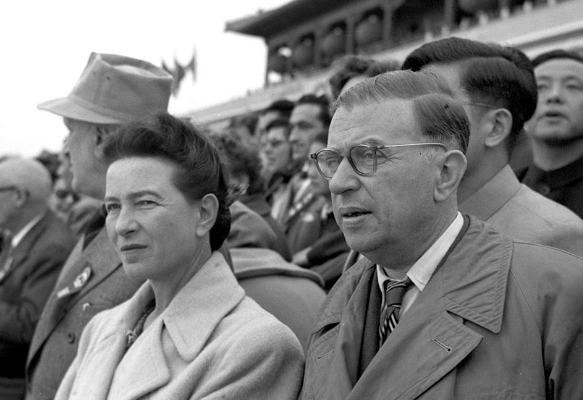
Image via Wikimedia Commons
The invitation was for real, and weeks later, Said was off to Paris. Upon arrival, he learned that for undefined “security reasons,” the conference had been moved to Foucault’s apartment, and once there, he encountered de Beauvoir, who quickly left an unfavorable impression on him, then disappeared.
Beauvoir was already there in her famous turban, lecturing anyone who would listen about her forthcoming trip to Teheran with Kate Millett, where they were planning to demonstrate against the chador; the whole idea struck me as patronising and silly, and although I was eager to hear what Beauvoir had to say, I also realised that she was quite vain and quite beyond arguing with at that moment. Besides, she left an hour or so later (just before Sartre’s arrival) and was never seen again.
Not long afterwards, Said writes, Foucault informed him he would be leaving as well, “for his daily bout of research at the Bibliothèque Nationale.” Said describes Foucault as a “solitary philosopher” and “rigorous thinker” but also “unwilling to say anything to me about Middle Eastern politics”—with the exception of the Iranian Revolution (for which he was partly present). Foucault described his time in Iran as “very exciting, very strange, crazy.” “I think (perhaps mistakenly) I heard him say that in Teheran he had disguised himself in a wig,” Said writes, “although a short while after his articles appeared, he rapidly distanced himself from all things Iranian.” Foucault also, apparently, distanced himself from the discussion at hand because, Said surmises, of his support for Israel.
Sartre, it appears from Said’s account, was very much at the center of the event. And yet, he seemed “old and frail,” and “was constantly surrounded, supported, prompted by a small retinue of people on whom he was totally dependent.” At lunch, Said finds the “great man” almost as absent mentally as his partner was physically. Where “Beauvoir had been a serious disappointment,” he was later “convinced she would have livened things up.”
Sartre’s presence, what there was of it, was strangely passive, unimpressive, affectless. He said absolutely nothing for hours on end. At lunch he sat across from me, looking disconsolate and remaining totally uncommunicative, egg and mayonnaise streaming haplessly down his face. I tried to make conversation with him, but got nowhere. He may have been deaf, but I’m not sure. In any case, he seemed to me like a haunted version of his earlier self, his proverbial ugliness, his pipe and his nondescript clothing hanging about him like so many props on a deserted stage.
In his sole discourse at the event, Said tells us, Sartre read “a prepared text of about two typed pages” full of “the most banal platitudes imaginable” and “about as informative as a Reuters dispatch.” Afterwards, “Sartre resumed his silence, and the proceedings continued as before.” The politics of the conference were by nature complicated and sensitive, to say the least. Relationships—such as that between Foucault and Gilles Deleuze, it seems (or so Deleuze told Said)—have broken off after disagreements over Israel and Palestine.
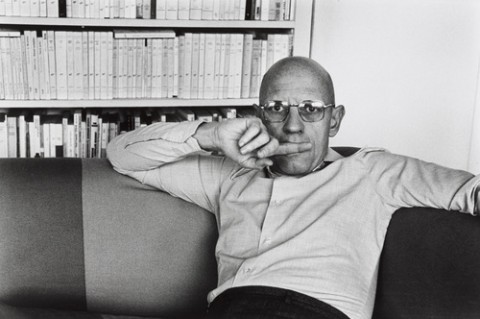
Image by Wikimedia Commons
Nevertheless, on the basis of Sartre’s former anti-colonial, anti-war stance and passionate defense of Algerian independence—a position “which as a Frenchman must have been harder to hold than a position critical of Israel”—Said had hoped Sartre would have at least some sympathy for the Palestinian cause. He was mistaken. “Gone forever, he writes, “was that Sartre.” In a concluding rumination, he attempts to explain what he observed:
I guess we need to understand why great old men are liable to succumb either to the wiles of younger ones, or to the grip of an unmodifiable political belief. It’s a dispiriting thought, but it’s what happened to Sartre. With the exception of Algeria, the justice of the Arab cause simply could not make an impression on him, and whether it was entirely because of Israel or because of a basic lack of sympathy – cultural or perhaps religious – it’s impossible for me to say.
For all its unpleasantness, however, the encounter did not lessen Said’s fondness for Sartre. The author of Orientalism and The Question of Palestine (who is not without his own fierce critics) begins his recollection of the meeting with a glowing appraisal of Sartre’s work, which had fallen far out of favor at the time of the meeting. “A year after our brief and disappointing Paris encounter Sartre died,” he concludes, “I vividly remember how much I mourned his death.”
You can read Said’s complete diary entry here.
Related Content:
Jean-Paul Sartre Breaks Down the Bad Faith of Intellectuals
Josh Jones is a writer and musician based in Durham, NC. Follow him at @jdmagness
Read More...John Landis Deconstructs Trailers of Great 20th Century Films: Citizen Kane, Sunset Boulevard, 2001 & More
If you call yourself a film fan, you may have heard of Trailers from Hell, a video series wherein famous directors introduce and provide commentary on trailers of the films they love, the films they’ve made, or both. You’ve definitely heard of it if you call yourself a fan of schlock film, since some of the Trailers from Hell include that of The Giant Claw with commentary by Joe Dante, that of Teen Wolf with commentary by Ti West, and that of One Million Years B.C. with commentary by John Landis.
Landis, director of comedies like Animal House, The Blues Brothers, and (somehow, his favorite of the bunch) Coming to America, has recorded a great many episodes, and no surprise, since he enjoys schlock so much that he actually made a film of that name at the age of 21 — and then did a Trailer from Hell on it at the age of 63. But as one of those filmmakers possessed of a cinephilia as strong as his mastery of the craft itself, his love for movies extends to the widest possible spectrum of theme and sensibility: hence his episodes here on the decidedly non-schlocky Citizen Kane, Sunset Boulevard, 2001: A Space Odyssey, and La Strada.
Much about Landis makes him exactly the kind of guy you want to hear talking about movies, be they movies like Fellini Satyricon or movies like King Kong vs. Godzilla. Not only does his sheer enthusiasm for filmgoing come through in his every observation, but he brings to bear plenty of experience with the nuts and bolts of filmmaking. He discusses, in the brief time these trailers allow, not just the qualities of the features but of the trailers themselves. He also throws in, when relevant, fascinating anecdotes from his life as a moviegoer and moviemaker. And above it all, he does it with a wonkily cinephilic sense of humor, as you’ll understand right when you hear him introduce himself in each episode — and as you’d probably expect from the guy who directed Kentucky Fried Movie.
You can watch all the Trailers from Hell from Landis, Dante, West, Karyn Kusama, Mick Garris, John Badham, and others on their Youtube channel.
Related Content:
Moviedrome: Filmmaker Alex Cox Provides Video Introductions to 100+ Classic Cult Films
Watch Orson Welles’ Trailer for Citizen Kane: As Innovative as the Film Itself
Kubrick’s 2001: A Space Odyssey Gets a Brand New Trailer to Celebrate Its Digital Re-Release
Watch 25 Alfred Hitchcock Trailers, Exciting Films in Their Own Right
700 Free Movies Online: Great Classics, Indies, Noir, Westerns, etc.
Colin Marshall hosts and produces Notebook on Cities and Culture as well as the video series The City in Cinema and writes essays on cities, language, Asia, and men’s style. He’s at work on a book about Los Angeles, A Los Angeles Primer. Follow him on Twitter at @colinmarshall or on Facebook.
Read More...Hear Hemingway Read Hemingway, and Faulkner Read Faulkner (90 Minutes of Classic Audio)
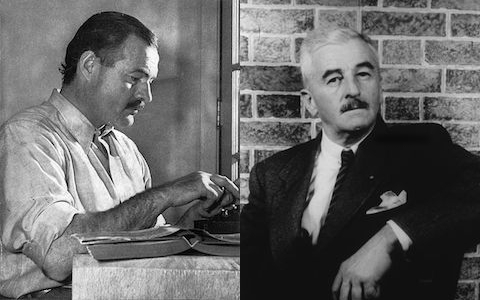
Images via Wikimedia Commons
Hemingway and Faulkner, Faulkner and Hemingway…. The American literary canon has expanded so much in the past thirty years or so that it almost spans the globe, like American business, drawing in writers from every possible corner. With greater inclusion comes the passing out of fashion of many a former icon (does anyone read Dreiser or Dos Passos anymore?). And yet, no matter how much critical tastes and scholarly measures change, it seems we’ll never be able to do without our Hemingway and Faulkner.
Perhaps it’s their deep takes on history—Hemingway’s sentimental war correspondence and tragic sense of a changing Europe; Faulkner’s sense of a South held in thrall to squalid delusions of grandeur and epic colonial violence. Geopolitically relevant they still may be, but there’s much more to both than geopolitics. Perhaps it’s the timeless stylistic dialectic, or the Nobels, or the traded insults, or that the names themselves, like Roosevelt and Kennedy, trigger instant recall of the “American century.” Of course, devotees of Faulkner (I am one), of Hemingway, or of Faulkner and Hemingway need no rationale, and it is to such people principally that today’s post is addressed.
For today, we bring you Hemingway and Faulkner, reading Hemingway and Faulkner. In the Spotify playlists above (download Spotify here), we have both authors reading from their Nobel acceptance speeches, then excerpts from their literary works. These recordings were originally released as vinyl albums by Caedmon Records, that pre-audiobook phenomenon founded by Barbara Holdridge and Marianne Roney in 1952. Caedmon released albums of readings by dozens of major writers, like Dylan Thomas and Eudora Welty, and we have featured many of them here before—such as those from T.S. Eliot, Sylvia Plath, W.H. Auden, and Tennessee Williams (reading Hart Crane). But today, it’s Hemingway and Faulkner, who despite—or because of—their differences, belong together forever as great American literary patriarchs, even if patriarchy is terminally passé.
If you need the Spotify software, please download it here.
Related Content:
Download 55 Free Online Literature Courses: From Dante and Milton to Kerouac and Tolkien
William Faulkner’s Review of Hemingway’s The Old Man and the Sea (1952)
18 (Free) Books Ernest Hemingway Wished He Could Read Again for the First Time
Rare Audio: William Faulkner Names His Best Novel, And the First Faulkner Novel You Should Read
Josh Jones is a writer and musician based in Durham, NC. Follow him at @jdmagness
Read More...Federico Fellini’s List of His 10 Favorite Films … Including One of His Own
Film fans have few stronger vices, I would submit, than the making of lists. But we can take some small measure of consolation from the fact that certain auteurs have occasionally done it too. Yes they make their own lists of favorite films. Quentin Tarantino has done it. So have Stanley Kubrick and Woody Allen. Same with Andrei Tarkovsky, Susan Sontag and Akira Kurosawa. And then there’s one of the most interesting lists — that of Federico Fellini, which originally appeared in Sight and Sound. It runs as follows:
- The Circus/City Lights/Monsieur Verdoux (1928,31,47, Charles Chaplin)
- Any Marx Brothers or Laurel and Hardy
- Stagecoach (1939, John Ford)
- Rashomon (1950, Akira Kurosawa)
- The Discreet Charm of the Bourgeoisie (1972, Luis Bunuel)
- 2001: A Space Odyssey (1968, Stanley Kubrick)
- Paisan (1946, Roberto Rossellini)
- The Birds (1963, Alfred Hitchcock)
- Wild Strawberries (1957, Ingmar Bergman)
- 8 1/2 (1963, Federico Fellini)
Never a slave to restraint, Fellini bends the tacit rules of list-making in a few different ways here. He includes not one but three films, all by Charlie Chaplin, in the top spot, ranks the complete comedic works of both the Marx Brothers (whose 1928 The Circus you can watch above) and Laurel and Hardy in third place, and, in the most audacious act of all, adds a movie of his own to the list. Maybe the fact that he puts it at number ten scores him a humility point?
Then again, the director of La Dolce Vita, Satyricon, and Juliet of the Spirits could have found his distinctively grotesque and celebratory worldview realized nowhere but in his own work. And upon reflection, putting 8 1/2 in last place looks overmodest. “I have seen 8 1/2 over and over again, and my appreciation only deepens,” wrote Roger Ebert in a piece on the film. “It does what is almost impossible: Fellini is a magician who discusses, reveals, explains and deconstructs his tricks, while still fooling us with them. He claims he doesn’t know what he wants or how to achieve it, and the film proves he knows exactly, and rejoices in his knowledge.” And he knew he was damn good.
If you would like to support the mission of Open Culture, consider making a donation to our site. It’s hard to rely 100% on ads, and your contributions will help us continue providing the best free cultural and educational materials to learners everywhere. You can contribute through PayPal, Patreon, and Venmo (@openculture). Thanks!
Related Content:
Andrei Tarkovsky Creates a List of His 10 Favorite Films (1972)
Martin Scorsese Reveals His 12 Favorite Movies (and Writes a New Essay on Film Preservation)
Stanley Kubrick’s List of Top 10 Films (The First and Only List He Ever Created)
Roger Ebert’s Final List of His Top 10 Favorite Films (2012)
Colin Marshall hosts and produces Notebook on Cities and Culture as well as the video series The City in Cinema and writes essays on cities, language, Asia, and men’s style. He’s at work on a book about Los Angeles, A Los Angeles Primer. Follow him on Twitter at @colinmarshall or on Facebook.
Read More...Neil Gaiman Reads “The Man Who Forgot Ray Bradbury”
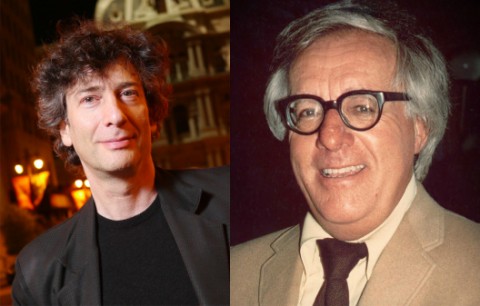
Neil Gaiman sent Ray Bradbury a gift for what turned out to be his last birthday, his 91st. It was a story called “The Man Who Forgot Ray Bradbury.” And when Bradbury’s editor read it to the bed-ridden author, he reportedly took great pleasure in it.
What could have been better? I guess only hearing Neil Gaiman read the story himself. Which is precisely what you can do with the audio below.
Gaiman’s reading was taped at the Aladdin Theater in Portland, Oregon. You can read the text of the story over at i09. We have many more instances of Gaiman reading Gaiman in our collection of Free Neil Gaiman Stories.
If you would like to support the mission of Open Culture, consider making a donation to our site. It’s hard to rely 100% on ads, and your contributions will help us continue providing the best free cultural and educational materials to learners everywhere. You can contribute through PayPal, Patreon, and Venmo (@openculture). Thanks!
Related Content:
Neil Gaiman’s Free Short Stories
Neil Gaiman Reads Dr. Seuss’ Green Eggs and Ham
Read More...Support Us
We're hoping to rely on loyal readers, rather than erratic ads. Please click the Donate button and support Open Culture. You can use Paypal, Venmo, Patreon, even Crypto! We thank you!

About Us

Open Culture scours the web for the best educational media. We find the free courses and audio books you need, the language lessons & educational videos you want, and plenty of enlightenment in between.
Advertise With Us

FREE UPDATES!
GET OUR DAILY EMAIL
Get the best cultural and educational resources on the web curated for you in a daily email. We never spam. Unsubscribe at any time.
FOLLOW ON SOCIAL MEDIA

Open Culture editor Dan Colman scours the web for the best educational media. He finds the free courses and audio books you need, the language lessons & movies you want, and plenty of enlightenment in between.
Advertise With Us


