The Avant-Garde Project: An Archive of Music by 200 Cutting-Edge Composers, Including Stravinsky, Schoenberg, Cage & More
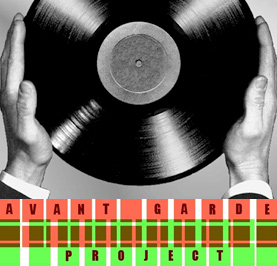 Every sphere of recorded music, from late-1960s folk to Philadelphia hip-hop to Japanese jazz (a personal pursuit of mine), has its crate-diggers, those happy to flip through hundreds — nay, hundreds of thousands — of obscure, forgotten vinyl albums in search of their subgenre’s even obscurer, more forgotten gems. This holds especially true, if not in number than in avidity, for enthusiasts of the 20th-century classical-experimental-electroacoustic tradition that The Avant-Garde Project takes as its preservation mandate. The site offers material “digitized from LPs whose music has in most cases never been released on CD, and so is effectively inaccessible to the vast majority of music listeners today.” To the best of the Archive’s knowledge, the LPs are all currently out of print, and all the music is extracted with an analog rig that ranks as “near state-of-the-art, producing almost none of the tracking distortion or surface noise normally associated with LPs.”
The Avant-Garde Project’s efforts, the archive of which you can browse here (or alphabetically by composer, or through choice samplers, or through the “AGP top twenty,” or through the founder’s personal favorites), has borne a great deal of fruit so far, especially from such music-history class favorites as Arnold Schoenberg, whose String Trio performed by the Los Angeles String Trio you can hear above, and Igor Stravinsky, whose Symphony of Psalms you’ll find below. Everything in the Avant-Garde Project’s archive comes downloadable as torrents of Free Lossless Audio Codec (FLAC) files. This audiophile’s compression format of choice requires a bit of special but easily obtained software to play or burn to CDs, all of which you can get explained here (with even more information here). Those who’d like to keep it simple (if not quite as aurally pristine) can listen through a smaller version of the archive at Ubuweb. Either way, you’ll enjoy all the artistic richness of rare 20th-century classical-experimental-electroacoustic music with none of the digging.
Related Content:
Extensive Archive of Avant-Garde & Modernist Magazines (1890–1939) Now Available Online
Vi Hart Uses Her Video Magic to Demystify Stravinsky and Schoenberg’s 12-Tone Compositions
Stravinsky’s The Rite of Spring, Visualized in a Computer Animation for Its 100th Anniversary
Interviews with Schoenberg and Bartók
Hear Theodor Adorno’s Avant-Garde Musical Compositions
Colin Marshall hosts and produces Notebook on Cities and Culture and writes essays on cities, language, Asia, and men’s style. He’s at work on a book about Los Angeles, A Los Angeles Primer. Follow him on Twitter at @colinmarshall or on Facebook.
Read More...Literary Critic Northrop Frye Teaches “The Bible and English Literature”: All 25 Lectures Free Online
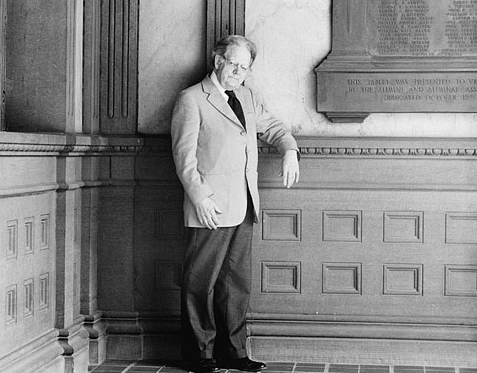
Image by Harry Palmer, via Wikimedia Commons
One reason I’m glad for having had a childhood religious education: it has made me conversant in even some of the most obscure stories and ideas in the Christian Bible, which is everywhere in English literature. Not only was the King James translation formative for early modern English, but stories like that of King David and his son Absalom have furnished material for great works from John Dryden’s dense political allegory “Absalom and Achitophel” to William Faulkner’s dense modernist fable Absalom, Absalom! Then, of course, there’s so much of the work of Blake, Shakespeare, and Milton to account for. Without a fairly solid grounding in Biblical literature, it can be doubly difficult to make headway in a study of the secular variety.
The students of highly regarded Canadian literary critic Northrop Frye found this to be true. As a junior instructor, Frye had difficulty getting his class to understand what was going on in John Milton’s Paradise Lost because so many of the Biblical allusions were lost on them. (It’s a hard enough poem to grasp when you get the references.) “How do you expect to teach Paradise Lost,” said the chair of Frye’s department, “to people who don’t know the difference between a Philistine and a Pharisee?” Responding to this gap in cultural literacy, Frye designed and taught “The Bible and English Literature.” The entire, videotaped course from a 1981 session at the University of Toronto is available online in 25 lectures.
It’s very much a treat to sit in on these lectures. Frye’s work on myth and folktale in English literature is still nearly definitive; his 1957 Anatomy of Criticism, though picked apart many times over through the decades, retains an authoritative place in studies of literary archetypes and rhetoric. Frye’s lectures on the Bible focus on what he sees as its “narrative unity,” due in part to “a number of recurring images: mountain, sheep, river, hill, pasture, bride, bread, wine and so on.” He also spends a good deal of time, at least in his first lecture above, discussing church history, theological and critical conflicts, and the history of various translations. The UToronto site includes full transcripts of each lecture, and the entire course promises to be enlightening for students of literature, of the Bible and church history, or both.
The Bible and English Literature will be added to our list of Free Online Literature Courses and Free Online Religion Courses, part of our larger collection, 1,700 Free Online Courses from Top Universities.
Related Content:
Harvard Presents Two Free Online Courses on the Old Testament
Oxford University Presents the 550-Year-Old Gutenberg Bible in Spectacular, High-Res Detail
Josh Jones is a writer and musician based in Durham, NC. Follow him at @jdmagness.
Read More...Why We Love Repetition in Music: Explained in a New TED-Ed Animation
Our favorite pop songs have a repeating chorus. You can pretty much bank on that. But, as it turns out, repetition isn’t just a phenomenon in Western music. You’ll find it in many forms of music across the globe. Why is this the case? What makes repetition a fairly universal feature in music? In a new TED-Ed video, Elizabeth Hellmuth Margulis, Professor and Director of the Music Cognition Lab at the University of Arkansas, “walks us through the basic principles of the ‘exposure effect,’ detailing how repetition invites us into music as active participants, rather than [as] passive listeners.” The animation was done by Andrew Zimbelman.
Don’t forget to sign up for our daily email. Once a day, we bundle all of our daily posts and drop them in your inbox, in an easy-to-read format.
Related Content:
Leonard Bernstein’s Masterful Lectures on Music (11+ Hours of Video Recorded in 1973)
Listen to the Oldest Song in the World: A Sumerian Hymn Written 3,400 Years Ago
Read More...“The Civil War and Reconstruction,” a New MOOC by Pulitzer-Prize Winning Historian Eric Foner
It ended in early April 149 years ago. But it begins again on Wednesday. Columbia University’s “The Civil War and Reconstruction,” the latest salvo in the MOOC wars, opens Wednesday, September 17, for free to the world – a 27-week series of three courses on the nonprofit edX platform taught by Eric Foner, the university’s Pulitzer-Prize winning history professor and one of the world’s leading experts on 19th-century America. You can enroll for free here.
“If you want to know where the world you’re living in today comes from,” Foner says in the series promotional trailer, “you need to know about the Civil War era.“ Headline issues of the moment – black-white race relations first among them, but also more general issues of equal justice under law, the power and proper role of government, and how lawmakers should deal with extremism, terror, and violence – all find roots in this conflict and its aftermath, a four-year war that saw approximately 700,000 Americans killed, and scores more injured, at the hands of their countrymen.
Foner’s general history books on the subject have sold thousands of copies – his new work on the underground railroad publishes in January – and he’s the author of the leading American history textbook taught in U.S. high schools. He’s crossed over from academe into mainstream media in other ways – with appearances on The Daily Show with John Stewart, The Colbert Report, The Charlie Rose Show, Bill Moyers’s Journal, and more.
Columbia’s effort in free history education on screen dates back decades – as Foner makes clear in the promo video. Columbia’s history professors Richard Hofstadter and James Patrick Shenton reached thousands of people in their books and lectures, with Shenton even teaching a 76-part survey course on WNET Public Television called “The Rise of the American Nation” – which premiered in 1963! But many of the great lecturers from this university – literary critics and scholars Jacques Barzun and Lionel Trilling, art historian Meyer Shapiro, and others – were never filmed systematically, and Foner, who will formally retire from teaching in a few years, was determined to ensure his courses were recorded, well-produced, and preserved for posterity – and available as educational resources to all.
The series, generously supported by Columbia’s provost, historian John Coatsworth, is produced by the Columbia Center for New Media Teaching and Learning (CCNMTL), coincidentally celebrating its 15th anniversary this year. It’s the university’s first set of online courses on edX, after more than a dozen MOOCs on Coursera – and with more to come on both. The course promises some tantalizing new perspectives on the world then and now – as the two highlights reels show above.
Come & enlist – oops! — that is, enroll – today!
Peter B. Kaufman works at the Columbia Center for New Media Teaching and Learning and is Executive Producer of Intelligent Television and YouTube’s Intelligent Channel.
Related Content:
The History of the World in 46 Lectures From Columbia University
Download 78 Free Online History Courses: From Ancient Greece to The Modern World
Read More...Partisan Review Now Free Online: Read All 70 Years of the Preeminent Literary Journal (1934–2003)
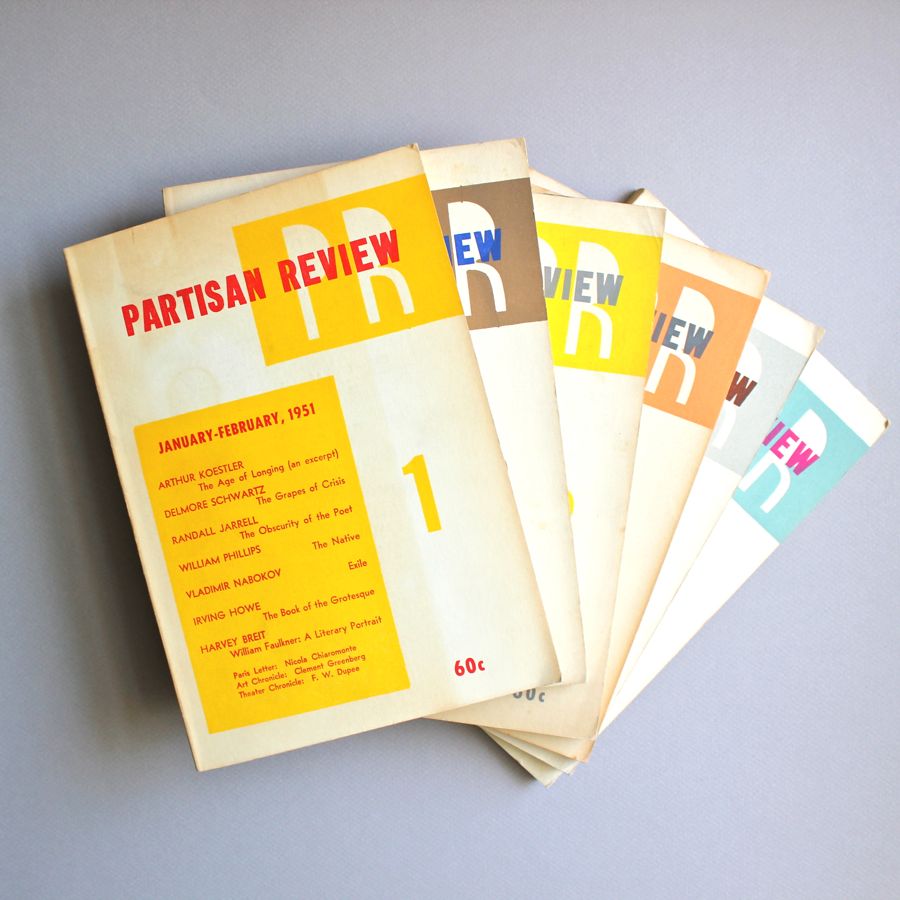
Founded by William Phillips and Philip Rahv in February of 1934, leftist arts and politics magazine Partisan Review came about initially as an alternative to the American Communist Party’s publication, New Masses. While Partisan Review (PR) published many a Marxist writer, its politics diverged sharply from communism with the rise of Stalin. Perhaps this turn ensured the magazine’s almost 70-year run from ’34 to 2003, while New Masses folded in 1948. Partisan Review nonetheless remained a venue for some very heated political conversations (see more on which below), yet it has equally, if not more so, been known as one of the foremost literary journals of the 20th century.
PR first published James Baldwin’s “Sonny’s Blues” in Summer 1957 and two of T.S. Eliot’s Four Quartets in 1940, for example, as well as Delmore Schwartz’s brilliant story “In Dreams Begin Responsibilities” in a 1937 issue that also featured Wallace Stevens, Edmund Wilson, Pablo Picasso (writing on Franco), James Agee, and Mary McCarthy. “More a literary event,” writes Robin Hemley at The Believer, “than a literary magazine,” even issues sixty or more years old can still carry “the punch of revelation.”
Now you can assess the impact of that punch by accessing all 70-years’ worth of issues online at Boston University’s Howard Gotlieb Archival Research Center. BU began hosting the magazine in 1978 after it moved from Rutgers, where founding editor William Phillips taught. Now the university has finished digitizing the entire collection, in handsome scans of vintage copies that readers can page through like an actual magazine. The collection is searchable, though this function is a little clunky (all links here direct you to the front cover of the issue. You’ll have to navigate to the actual pages yourself.)
In a post on the Gotlieb Center project, Hyperallergic points us toward a few more highlights:
In art, Partisan Review is perhaps best known as the publisher of Clement Greenberg, who contributed over 30 articles from 1939 to 1981, most notably his Summer 1939 essay entitled “Avant-Garde and Kitsch.” (Greenberg even made a posthumous appearance in the Spring 1999 issue.) Beyond Greenberg’s voluble legacy we encounter such landmark texts as Dwight Macdonald’s “Masscult and Midcult,” from the Spring 1960 issue, and Susan Sontag’s “Notes on ‘Camp’” from Winter 1964, as well as the seminal popular-culture criticism of Robert Warshow (his essay on the Krazy Kat comic strip in the November-December 1946 issue is especially great) and the work of Hilton Kramer, the conservative iconoclast who went on to found The New Criterion.
Partisan Review also served as an outlet for George Orwell, who lambasted leftist pacifists—calling them, more or less, fascist sympathizers—in his series of articles between January 1941 and the summer of 1946, which he called “London Letters.” Orwell did not hesitate to name names; he also reported in 1945 of the “most enormous crimes and disasters” committed by the Soviets, including “purges, deportations, massacres, famines, imprisonment without trial, aggressive wars, broken treaties….” These things, Orwell remarked “not only fail to excite the big public, but can actually escape notice altogether.”
Partisan Review, however, was not aimed at “the big public.” Its “rarified principles,” writes Sam Tanenhaus of Slate—who calls PR “Trotskyist” for its interventionist boosterism—“attracted only 15,000 subscribers at its peak.”PR began in the age of the “little magazine,” a “term of honor” for the small journals that nurtured the high culture of their day, and which seem now so antiquated even as beleaguered publishers keep pushing them out to preciously small cliques of devoted readers. But charges of elitism can ring hollow, and given all we have to thank “little magazines” like Partisan Review for, it would probably behoove to pay attention to their successors. Enter the archive here.
h/t Hyperallergic
Image via Book/Shop
Related Content:
Extensive Archive of Avant-Garde & Modernist Magazines (1890–1939) Now Available Online
Josh Jones is a writer and musician based in Durham, NC. Follow him at @jdmagness.
Read More...20 Free Essays & Stories by David Sedaris: A Sampling of His Inimitable Humor
My first exposure to the writing of David Sedaris came fifteen years ago, at a reading he gave in Seattle. I couldn’t remember laughing at anything before quite so hard as I laughed at the stories of the author and his fellow French-learners struggling for a grasp on the language. I fought hardest for oxygen when he got to the part about his classmates, a veritable United Nations of a group, straining in this non-native language of theirs to discuss various holidays. One particular line has always stuck with me, after a Moroccan student demands an explanation of Easter:
The Poles led the charge to the best of their ability. “It is,” said one, “a party for the little boy of God who call his self Jesus and… oh, shit.”
She faltered, and her fellow countryman came to her aid.
“He call his self Jesus, and then he be die one day on two… morsels of… lumber.”
The scene eventually ended up in print in “Jesus Shaves,” a story in Sedaris’ third collection, Me Talk Pretty One Day. You can read it free online in a selection of three of his pieces rounded up by Esquire. Sedaris’ observational humor does tend to come out in full force on holidays (see also his reading of the Saint Nicholas-themed story “Six to Eight Black Men” on Dutch television above), and indeed the holidays provided him the material that first launched him into the mainstream.
When Ira Glass, the soon-to-be mastermind of This American Life, happened to hear him reading his diary aloud at a Chicago club, Glass knew he simply had to put this man on the radio. This led up to the big break of a National Public Radio broadcast of “The Santaland Diaries,” Sedaris’ rich account of a season spent as a Macy’s elf. You can still hear This American Life’s full broadcast of it on the show’s site.
True Sedarians, of course, know him for not just his inimitably askew perspective on the holidays, but for his accounts of life in New York, Paris (the reason he enrolled in those French classes in the first place), Normandy, London, the English countryside, and growing up amid his large Greek-American family. Many of Sedaris’ stories — 20 in fact — have been collected at the web site, The Electric Typewriter, giving you an overview of Sedaris’ world: his time in the elfin trenches, his rare moments of ease among siblings and parents, his futile father-mandated guitar lessons, his less futile language lessons, his relinquishment of his signature smoking habit (the easy indulgence of which took him, so he’d said at that Seattle reading, to France in the first place). Among the collected stories, you will find:
- “The Santaland Diaries” (audio)
- “The Youth in Asia,” “Jesus Shaves,” and “Giant Dreams, Midget Abilities”
- “Our Perfect Summer”
- “Letting Go”
- “Now We Are Five”
For the complete list, visit: 20 Great Essays and Short Stories by David Sedaris. And, just to be clear, you can read these stories, for free, online.
Note: If you would like to download a free audiobook narrated by David Sedaris, you might want to check out Audible’s 30 Day Free Trial. We have details on the program here. If you click this link, you will see the books narrated by Sedaris. If one intrigues, click on the “Learn how to get this Free” link next to each book.
Related Content:
Be His Guest: David Sedaris at Home in Rural West Sussex, England
David Sedaris Reads You a Story By Miranda July
David Sedaris and Ian Falconer Introduce “Squirrel Seeks Chipmunk”
David Sedaris Sings the Oscar Mayer Theme Song in the Voice of Billie Holiday
Colin Marshall hosts and produces Notebook on Cities and Culture and writes essays on cities, language, Asia, and men’s style. He’s at work on a book about Los Angeles, A Los Angeles Primer. Follow him on Twitter at @colinmarshall or on Facebook.
Read More...Hear Demo Recordings of David Bowie’s “Ziggy Stardust,” “Space Oddity” & “Changes”
These days “demo tapes” are often radio-ready recordings, and bands often record one before they’ve even played their first gig. It’s a recent development, a byproduct of the revolution in affordable home recording technology. For most of the history of rock and pop music, demos were raw sketches, preserving ideas, tempos, changes, moods, but not at all ready to air. Listening back to demo versions of songs we already know well can be like excavating strata underneath a site like Stonehenge. Sometimes you find nothing but sediment. Sometimes you find another Stonehenge. Take for example John Lennon’s hypnotic demo recordings of “Strawberry Fields Forever,” the Beatles’ acoustic White Album demos, or Roger Waters’ early demos of The Wall. Intriguingly rough gems all.
Today we bring you demo recordings of another artist whose work typically bespeaks polish and studio panache. As in the past, songwriters today still push play on cheap voice recorders—or expensive iphones—and capture new songs on the fly. But nobody today writes like Bowie did in his “Ziggy Stardust” phase. At the top of the post, hear Bowie’s solo acoustic demo recording of that song. You’ll find it on the second CD of the 30th Anniversary edition of Ziggy Stardust and the Spiders from Mars, which also includes a demo version of “Lady Stardust” and two versions of “Moonage Daydream” and “Hang on to Yourself” by “Arnold Corns,” the original name of Ziggy. I’ve heard more solo acoustic versions of “Ziggy” than I’d care to remember, played by earnest coffee-shop crooners and guitar-bearing party guests. But Bowie’s original demo I could listen to again and again.
While the “Arnold Corns” incarnations of Ziggy Stardust songs definitely fall into the category of not-Stonehenge, the 1969 demo recording of “Space Oddity” has a very monumental feel indeed—if that monument were 2001’s enigmatic Monolith. Set here to clips from that film, it seems like the perfect accompaniment to the glossy foreboding of Kubrick’s space vision. This drumless arrangement sounds somehow more contemporary than the recording we’ve heard countless times. It also sounds much closer to the psychedelic folk on the rest of the Space Oddity album, a collection of songs many Bowie fans, myself included, greatly admire, but which his first audience didn’t take to so readily. “Space Oddity” went through at least one more iteration before landing on the album. Hear the slightly more funked-up version, and see its awkward video, below.
Perhaps no song other than “Ashes to Ashes” so well articulates the creative destruction of Bowie’s many rock star personae—and the toll those metamorphoses take—than 1971’s “Changes.” But it’s a song written and recorded early in his career, before Ziggy Stardust, the character that first broke him into superstardom. The song appears on Hunky Dory in a recording with the Stardust band—Mick Ronson, Trevor Bolder, and Mick Woodmansey—but it’s such a Bowie-centric lyric that it outlasted hundreds of costume changes and served as the obvious choice of title for the 1990 compilation Changesbowie.
Does the piano demo above reveal an alternate pre-history? Not really. The handclaps and odd vocalizations are half-formed ideas at best, and the poor audio quality is not a feature. But what it does demonstrate, as do all of the rough recordings above, is that Bowie is Bowie—a stellar songwriter and vocal performer—whether captured on a cheap home tape machine or the best studio equipment money can buy. Studio wizardry of the present can do things producers forty years ago could only dream about, but no amount of technology can substitute for raw musical talent, nor for the long years of practice Bowie endured.
Related Content:
David Bowie Recalls the Strange Experience of Inventing the Character Ziggy Stardust (1977)
The Story of Ziggy Stardust: How David Bowie Created the Character that Made Him Famous
A 17-Year-Old David Bowie Defends “Long-Haired Men” in His First TV Interview (1964)
Josh Jones is a writer and musician based in Durham, NC. Follow him at @jdmagness.
Read More...Young Joni Mitchell Performs a Hit-Filled Concert in London (1970)
It’s hard to imagine the young lady seen performing her own songs on the BBC in the video above twerking or even tweeting, for that matter. The utterly unadorned quality of this performance suits the now-legendary purity of her youthful voice.
Woe, the deleterious effects of her longtime cigarette habit.
Now, back to 1970, when just shy of 27, Joni Mitchell played a hit-filled set to a British studio audience, despite a “little London flu” she alludes to more than once.
If it seemed unpretentious at the time, it’s even more so now, nary a laser beam or back up dancer in sight. No costume changes. Barely any makeup. Just Joni, her guitar, her piano, and a nifty custom dulcimer made by “a dynamite girl who lives in California.”
Passing the time as she tunes this last instrument, she mentions that the upcoming song, “California,”concerns an adventure to which she’d recently treated herself. She’d written it before her return, as a sort of postcard home. Meaning that that park bench in Paris, France was barely cold! This is way more exciting to me than a bevy of hair extensions, served with a practiced snarl and a side of auto tune.
A girlish giggle and dignified bow seal the deal. Classy!
If you would like to support the mission of Open Culture, consider making a donation to our site. It’s hard to rely 100% on ads, and your contributions will help us continue providing the best free cultural and educational materials to learners everywhere. You can contribute through PayPal, Patreon, and Venmo (@openculture). Thanks!
Related Content:
Watch Classic Performances of Joni Mitchell’s “Both Sides Now” & “The Circle Game” (1968)
The Music, Art, and Life of Joni Mitchell Presented in a Superb 2003 Documentary
James Taylor and Joni Mitchell, Live and Together (1970)
Ayun Halliday is an author, homeschooler, and Chief Primatologist of the East Village Inky zine. Follow her @AyunHalliday
Read More...How to Jump the Paris Metro: A Witty, Rebellious Primer from New Wave Director Luc Moullet (1984)
Luc Moullet, a French New Wave filmmaker and long-time critic for the Cahiers du cinéma, makes films “known for their humor, anti-authoritarian leanings and rigorously primitive aesthetic.” Case in point, the 1984 short film Barres, which comically documents the best ways to jump the Paris metro. It’s something of a sport in Paris. Arguably the sport most Parisians really take part in. Unlike other versions of the film on the web, this one has English subtitles. Enjoy.
h/t ubuweb
Related Content:
Tuileries: A Short, Slightly Twisted Film by Joel and Ethan Coen
Illustrated Etiquette Guide Explains How to Ride the Paris Metro in a Civilized Way
Names of Paris Métro Stops Acted Out: Photos by Janol Apin
Read More...
81-Year-Old Professor Charlie Warner Goes to Burning Man: A Short Documentary (NSFW)
Charlie Warner. He’s an 81-year-old media professor and former media executive from New York. He’s had bone marrow cancer. (It’s now in remission.) He had open-heart surgery. He still has diabetes. And yet he made the journey to the Burning Man festival, in Nevada’s Black Rock Desert, to experience something transcendent. And the festival didn’t disappoint. Filmmaker Jan Beddegenoodts documented Warner’s experience in a short film called Charlie Goes to Burning Man. You can watch the touching short in an embedded format above. But it’s even better to go to the film’s website, where you can view it in a visually-appealing, full-screen format. Be warned: It’s Burning Man, so there are some Not Safe for Work (NSFW) moments in the film.
Don’t forget to sign up for our daily email. Once a day, we bundle all of our daily posts and drop them in your inbox, in an easy-to-read format.
Read More...Support Us
We're hoping to rely on loyal readers, rather than erratic ads. Please click the Donate button and support Open Culture. You can use Paypal, Venmo, Patreon, even Crypto! We thank you!

About Us

Open Culture scours the web for the best educational media. We find the free courses and audio books you need, the language lessons & educational videos you want, and plenty of enlightenment in between.
Advertise With Us

FREE UPDATES!
GET OUR DAILY EMAIL
Get the best cultural and educational resources on the web curated for you in a daily email. We never spam. Unsubscribe at any time.
FOLLOW ON SOCIAL MEDIA

Open Culture editor Dan Colman scours the web for the best educational media. He finds the free courses and audio books you need, the language lessons & movies you want, and plenty of enlightenment in between.
Advertise With Us


