Novelist Michael Chabon Sang in a Punk Band During the ’80s: Newly Released Audio Gives Proof
The bio on Michael Chabon’s website is one of the most punk rock author bios I’ve ever seen. Clearly, the task of writing it was not left to chance or some publicist.
Where other authors might limit themselves to the strictly professional, Chabon spices things up with details on his bar mitzvah, his failed first marriage, and the births of his children.
Where others’ timelines grow weighty with evidence of increasing fame, his reads more like a diary, written in the third person.
Breaking of Hank Aaron’s pure record of 755 home runs amid the now-commonplace American congeries of hypocrisy, excess, bad faith, racism and lies finally proves too much, and the wrong kind, of baseball sadness; turns his back on the game (8/07)
Penetrates to the secret nighttime heart of Disneyland (9/11)
Given his zest for personal milestones, it’s surprising he didn’t see fit to share that he was once the lead singer in a Pittsburgh punk band. It would have fit nicely between the photo in which he and novelist Jon Armstrong are garbed as strolling Renaissance Festival players and the moment he enters an Oakland crawlspace to begin work on The Mysteries of Pittsburgh.
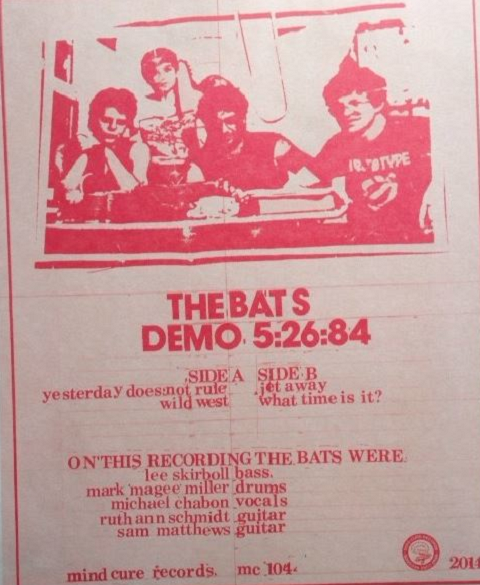
He might rethink this omission, now that Mindcure Records has released the four-track demo that is his band, the Bats’ only studio recording. Also preserved on vinyl is the author’s sole live outing with the band, a 21st birthday gig at the Electric Banana, shortly before he graduated from the University of Pittsburgh and disappeared into that crawlspace. The label describes his vocals as “snotty.” It’s a compliment in context.
Meanwhile in the Pittsburgh Post Gazette, Chabon recalled the Bats as “a fine little band, a unique assemblage of diverse strengths and quirks, anchored by one of the most rock-solid drummers ever to grace the Pittsburgh scene, and hampered only by the weakness of their goofball frontman.”
Thanks to Mindcure Records, Open Culture readers can sample the self-effacing Pulitzer Prize winner’s vintage vocal stylings, above. In the clip away, we have him singing “Jet Away.” Chabon may think he sounds “awful,” but I don’t hear any cause for shame. You can pick up your own copy of The Bats’ album, ‘Demo 5:26:84,′ with Chabon on vocals, here.
Related Content:
Patti Smith’s Cover of Nirvana’s “Smells Like Teen Spirit” Strips the Song Down to its Heart
The Ramones, a New Punk Band, Play One of Their Very First Shows at CBGB (1974)
Never Mind the Bollocks, Here’s … John Lydon in a Butter Commercial?
Ayun Halliday’s bio is also a bit outside the mold. Follow her @AyunHalliday
Read More...Listen to the Long-Lost Freddie Mercury & Michael Jackson Duet
Some 33 years ago, Queen started work on a track called “There Must Be More to Life Than This,” which featured vocals by Freddie Mercury and Michael Jackson. Written during the Hot Space sessions (circa 1981), the song was eventually abandoned and put on a shelf until Freddie Mercury released his own version on a 1985 solo album. Now, with the upcoming release of a Queen compilation called Queen Forever, you can hear the original. No longer do you have to wonder what a Mercury-Jackson duet might sound like. In fact, you only have to click play above and the suspense will be over.
I should note that the Hot Space sessions also produced perhaps our favorite rock duet ever — Freddie Mercury and David Bowie singing “Under Pressure.” Don’t miss hearing their vocals on this amazing isolated track.
How about signing up for our daily email? Once a day, we bundle all of our daily posts and drop them in your inbox, in an easy-to-read format. You don’t have to come to us; we’ll come to you!
via Rolling Stone
Related Content:
Brian May’s Homemade Guitar, Made From Old Tables, Bike and Motorcycle Parts & More
Guitarist Brian May Explains the Making of Queen’s Classic Song, ‘Bohemian Rhapsody’
Read More...The Guggenheim Puts 109 Free Modern Art Books Online
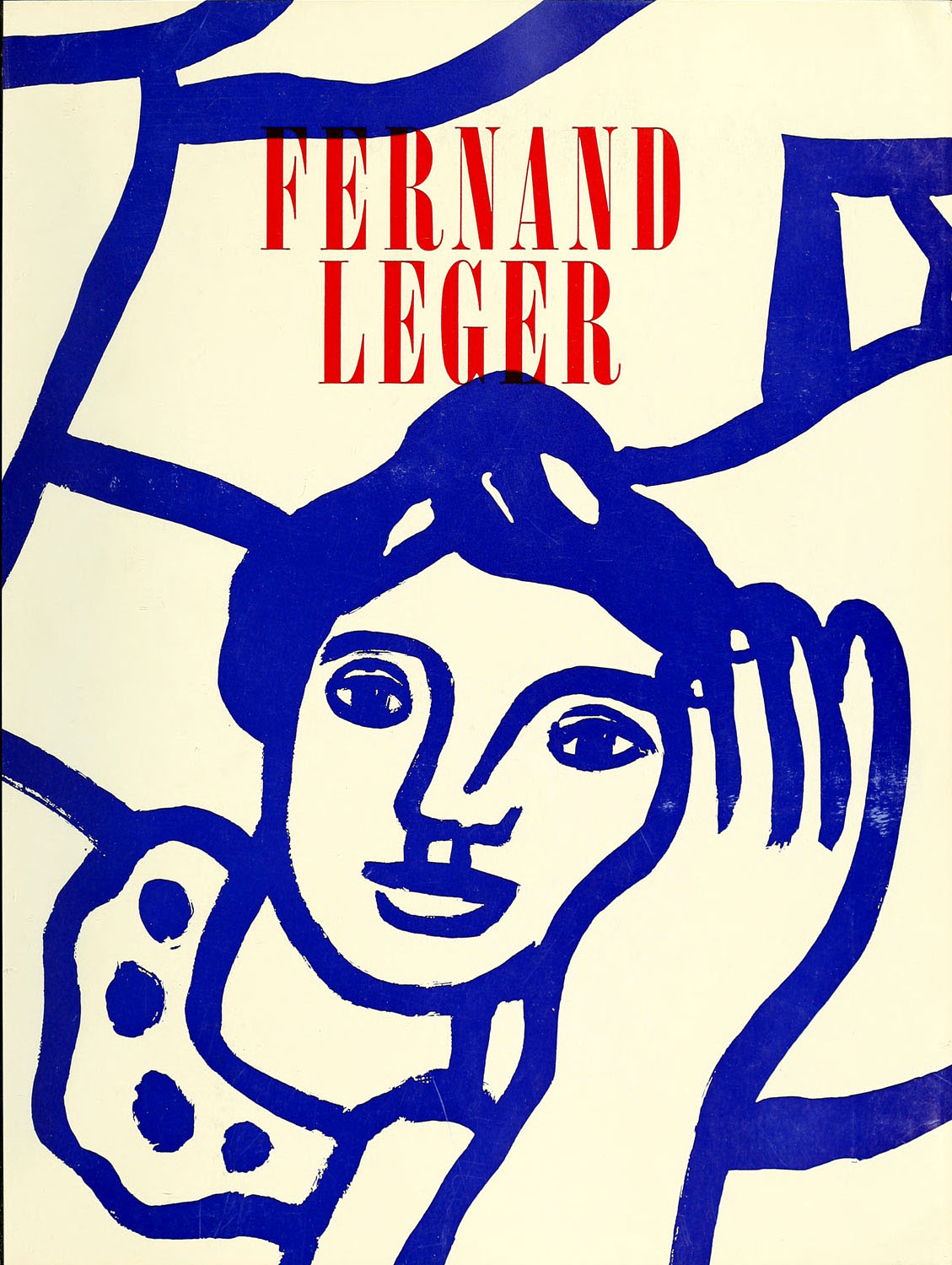
Back in January, 2012, we mentioned that the Guggenheim (the Frank Lloyd Wright-designed modern art museum in NYC) had put 65 art catalogues on the web, all free of charge.
We’re happy to report that, between then and now, the number of free texts has grown to 109. Published between 1937 and 1999, the art books/catalogues offer an intellectual and visual introduction to the work of Alexander Calder, Edvard Munch, Francis Bacon, Gustav Klimt & Egon Schiele, Fernand Léger, and Kandinsky. Plus there are other texts (e.g., Masterpieces of Modern Art and Abstract Expressionists Imagists) that tackle meta movements and themes.
Anyone interested in the history of the Guggenheim will want to spend time with a collection called “The Syllabus.” It contains five books by Hilla Rebay, the museum’s first director and curator. Together, they let you take a close look at the art originally housed in the Guggenheim when the museum first opened its doors in 1939.
To read any of these 109 free art books, you will just need to follow these simple instructions. 1.) Select a text from the collection. 2.) Click the “Read Catalogue Online” button. 3.) Start reading the book in the pop-up browser, and use the controls at the very bottom of the pop-up browser to move through the book. 4.) If you have any problems accessing these texts, you can find alternate versions on Archive.org.
You can find many more free art books from the Getty and the Met below.
Related Content:
Download Over 250 Free Art Books From the Getty Museum
Download 397 Free Art Catalogs from The Metropolitan Museum of Art
800 Free eBooks for iPad, Kindle & Other Devices
Read More...
Leonard Cohen’s New Album, Popular Problems, Is Now Streaming Free for a Limited Time
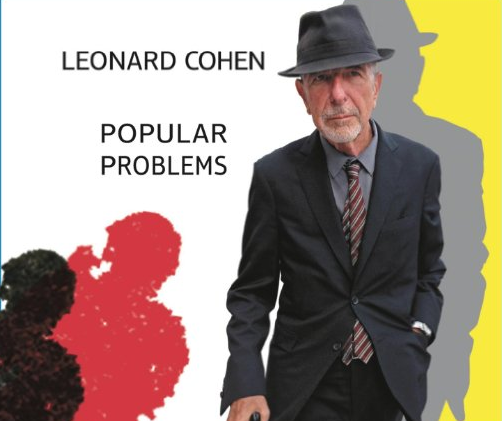
Just thought you’d like to know: NPR’s First Listen site is now streaming Leonard Cohen’s new album Popular Problems. But it will only be available for a limited time. So don’t waste time getting your listening party started.
In its review of the album, The Guardian notes that “financial worries may be driving his comeback, but Leonard Cohen’s songs of despair have never sounded so full of life.” Listen to the free stream at NPR and see what they mean. (Also find a free stream at The Guardian.) Or pre-order your own copy on Amazon or iTunes.
Related Content:
Ladies and Gentlemen… Mr. Leonard Cohen: The Poet-Musician Featured in a 1965 Documentary
Leonard Cohen Plays a Spellbinding Set at the 1970 Isle of Wight Festival
Street Artist Plays Leonard Cohen’s “Hallelujah” With Crystal Glasses
Leonard Cohen Recounts “How I Got My Song,” or When His Love Affair with Music Began
Read More...Photos of Jean-Paul Sartre & Simone de Beauvoir Hanging with Che Guevara in Cuba (1960)
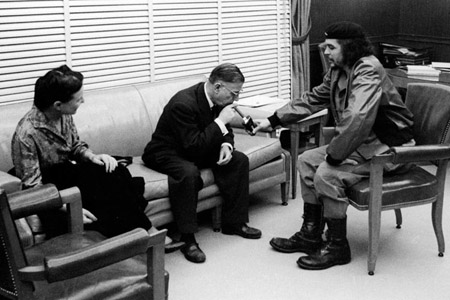
In 1960, Jean-Paul Sartre and Simone de Beauvoir ventured to Cuba during, as he wrote, the “honeymoon of the revolution.” Military strongman Fulgencio Batista’s regime had fallen to Fidel Castro’s guerilla army and the whole country was alight with revolutionary zeal. As Beauvoir wrote, “after Paris, the gaiety of the place exploded like a miracle under the blue sky.”
At the time, Sartre and de Beauvoir were internationally renown, the intellectual power couple of the 20th century. Beauvoir’s book, The Second Sex (1949), laid the groundwork for the feminism movement, and her book The Mandarins won France’s highest literary award in 1954. Sartre’s name had become a household word. The philosophy he championed – Existentialism – was being read and debated around the world. And his political activism — loudly condemning France’s war in Algeria, for instance — had given him real moral authority. When Sartre was arrested in 1968 for civil disobedience, Charles de Gaulle pardoned him, noting, “You don’t arrest Voltaire.” As Deirdre Bair notes in her biography of Beauvoir, “Sartre became the one intellectual whose presence and commentary emerging governments clamored for, as if he alone could validate their revolutions.” So it’s not terribly surprising that Fidel Castro wined and dined the two during their month in Cuba.
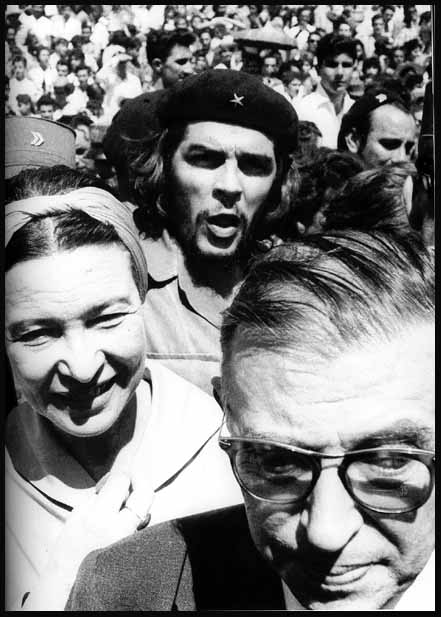
Cuban photographer Alberto Korda captured the couple as they met with Castro, Che Guevara and other leaders of the revolution. One picture (above) is of Guevara in his combat boots and trademark beret, lighting a cigar for the French philosopher. Sartre looks small and unhealthy compared to the strapping, magnetic revolutionary. Sartre was apparently impressed by the time he spent with the guerilla leader. When Che died in Bolivia seven years later, Sartre famously wrote that Guevara was “not only an intellectual but also the most complete human being of our age.”
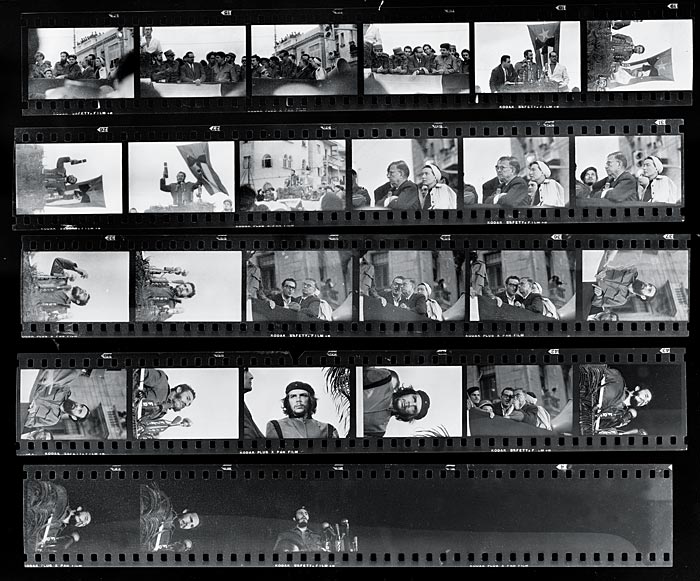
Later, Korda caught them as they were guided through the streets of Havana. And as you can see (below), that iconic image of Guevara, later plastered on T‑shirts and Rage Against the Machine album covers, is on that same role of film.
When the couple returned to Paris, Sartre wrote article after article extolling the revolution. Beauvoir, who was equally impressed, wrote, “For the first time in our lives, we were witnessing happiness that had been attained by violence.”
Yet their enthusiasm for the regime cooled when they returned to Cuba a year later. The streets of Havana had little of the joy as the previous year. When they talked to factory workers, they heard little but parroting of the official party line. Beauvoir and Sartre ultimately denounced Castro (along with a bunch of other intellectual luminaries like Gabriel Garcia Marquez and Octavio Paz) in an open letter that criticized him for the arrest of Cuban poet Herberto Padillo.
You can read more about the life and photography of Alberto Korda in the 2006 book, Cuba: by Korda.
Photos above by Alberto Korda.
Related Content:
Jean-Paul Sartre Breaks Down the Bad Faith of Intellectuals
Walter Kaufmann’s Classic Lectures on Nietzsche, Kierkegaard and Sartre (1960)
Jonathan Crow is a Los Angeles-based writer and filmmaker whose work has appeared in Yahoo!, The Hollywood Reporter, and other publications. You can follow him at @jonccrow. And check out his blog Veeptopus, featuring one new drawing of a vice president with an octopus on his head daily. The Veeptopus store is here.
Read More...Allen Ginsberg Talks About Coming Out to His Family & Fellow Poets on 1978 Radio Show (NSFW)
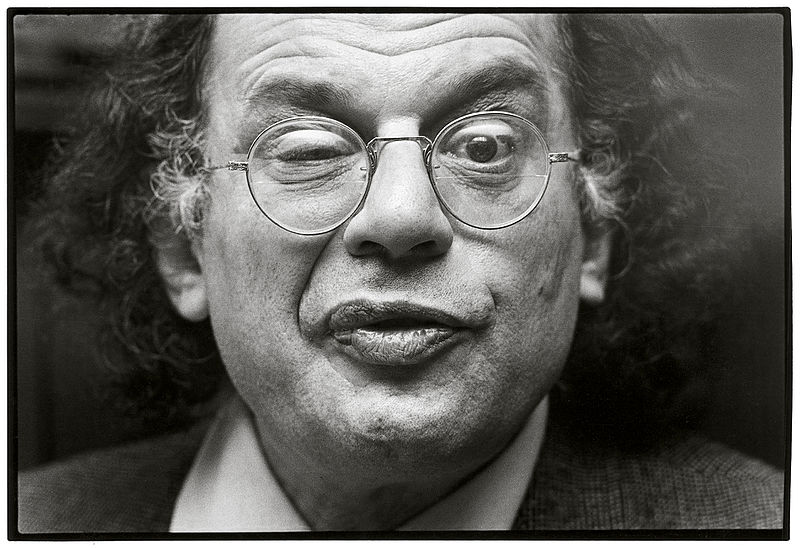
Image by Michiel Hendryckx, via Wikimedia Commons
Recent MacArthur Fellow and poet Terrence Hayes appeared on NPR yesterday to read and discuss his work; he was asked if he found “being defined as an African-American poet” to be limiting in some way. Hayes replied,
I think it’s a bonus. It’s a thing that makes me additionally interesting, is what I would say. So, black poet, Southern poet, male poet — many of those identities I try to fold into the poems and hope that they enrich them.
It seemed to me an odd question to ask a MacArthur-winning American poet. Issues of both personal and national identity have been central to American poetry at least since Walt Whitman or Langston Hughes, but especially since the 1950s with the emergence of confessional and beat poets like Allen Ginsberg. Without the celebration of personal identity, one might say that it’s hard to imagine American poetry.
Like Hayes, Ginsberg enfolded his various identities—Jew, Buddhist, gay man—into his poetry in enriching ways. Thirty-six years ago, he gave a radio interview to “Stonewall Nation,” one of a handful of specifically gay radio programs broadcast in 1970s Western New York. In an occasionally NSFW conversation, he discussed the experience of coming out to his fellow Beats and to his family.
- Introduction (5:21):
 MP3
- On being closeted (2:09): MP3
- Excerpts from “Don’t Grow Old” (2:32): MP3
- On coming out to his family (3:01): MP3
- On desire and compassion (1:41): MP3
- On the Briggs amendment (8:54): MP3
- On the Beats and nature (3:24): MP3
- On Rocky Flats (2:19): MP3
- Ginsberg sings “Everybody Sing” (2:37): MP3
 MP3
During the interview Ginsberg talks about being closeted and having a crush on Jack Kerouac, who was “very tolerant, friendly,” after Ginsberg confessed it. Above he tells a funny story about coming out to his father, then reads a moving untitled poem about his father’s eventual acceptance after their mutual “timidity and fear.” He also recalls how the rest of his family, particularly his brother, reacted.
The interview moves to broader topics. Ginsberg discusses his views on desire and compassion, defining the latter as “benevolent and indifferent attentiveness,” rather than “heart-love.” Buddhism pervades Ginsberg’s conversation as does a roguish vaudevillian sensibility mixed with sober reflection. He opens with a long, boozy sing-along whose first four lines concisely sum up core Buddhist doctrines; he ends with a funny, bawdy song that then becomes a dark exploration of homophobic and misogynistic violence.
Ginsberg and host also discuss the Briggs Initiative (above) a piece of legislation that would have been an effective purge in the California school system of gay teachers, their supporters, even those who might “take a neutral attitude which could be interpreted as approval.” This would preclude even the teaching of Whitman’s “Song of Myself” (or one particular section of it), which, Ginsberg says, “would make the teacher liable for encouraging homosexual activity.” The amendment—one that, apparently, former governor Ronald Reagan strongly opposed—failed to pass. These days such proposals target Ginsberg’s poetry as well, and we still have conversations about the value of things like “benevolent and indifferent attentiveness” in the classroom, or whether poets should feel limited by being who they are.
In the photo above, taken by Herbert Rusche in 1978, you can see Ginsberg (left) with his long-time partner, the poet Peter Orlovsky (right).
via PennSound
Related Content:
The First Recording of Allen Ginsberg Reading “Howl” (1956)
“Expansive Poetics” by Allen Ginsberg: A Free Course from 1981
Josh Jones is a writer and musician based in Durham, NC. Follow him at @jdmagness.
Read More...A Crash Course on Psychology: A 30-Part Video Series from Hank Green
Novelist, educator, and vlogger John Green has drawn a lot of press lately, including but not limited to a New Yorker profile by Margaret Talbot, in the wake of the film version of his popular young-adult novel The Fault in Our Stars. But we here at Open Culture can say we featured him before that magazine of cultural record did: in 2012 we posted his Crash Course in World History, and last October, his Crash Course on Literature. If you keep up with this site, you probably know Green less as a coming-of-age-tragedy-writing “teen whisperer” (in the words of the New Yorker) than as the mile-a-minute, constantly wisecracking, but nevertheless wholesome teacher you never had. You may not know that he has an equally educational brother named Hank, who first came to internet prominence in a back-and-forth video series of John’s devising called Vlogbrothers, which Talbot describes as “less a conversation than an extended form of parallel play.”
Now you can find Hank, possessed of a similarly fast and funny delivery style, prepared to inform you on a whole range of other subjects, teaching crash courses just like John does. At the top of the post, we have his 30-part Crash Course in Psychology, in which he covers everything about the study of the human mind from sensation and perception to the theory of the homunculus to remembering and forgetting to language to depression. (You can watch the series from start to finish above.) Psychology has long ranked among the most popular undergraduate majors in American universities, and given humanity’s ever-increasing curiosity (and gradually accumulating knowledge) about the workings of its brains, that shouldn’t come as a surprise. But those of us who felt compelled to pick a more “practical” course of study back in college, can now turn to Hank Green, who offers us a surprisingly thorough psychological grounding with only about five hours of “lecturing” — much less than the major would have taken us, and with many more corny jokes. Perhaps the course will help you understand why we laugh at them anyway.
Related Content:
Free Online Psychology Courses
A Crash Course in World History
How To Think Like a Psychologist: A Free Online Course from Stanford
Colin Marshall hosts and produces Notebook on Cities and Culture and writes essays on cities, language, Asia, and men’s style. He’s at work on a book about Los Angeles, A Los Angeles Primer. Follow him on Twitter at @colinmarshall or on Facebook.
Read More...The Last Saturday: A New Graphic Novel by Chris Ware Now Being Serialized at The Guardian (Free)
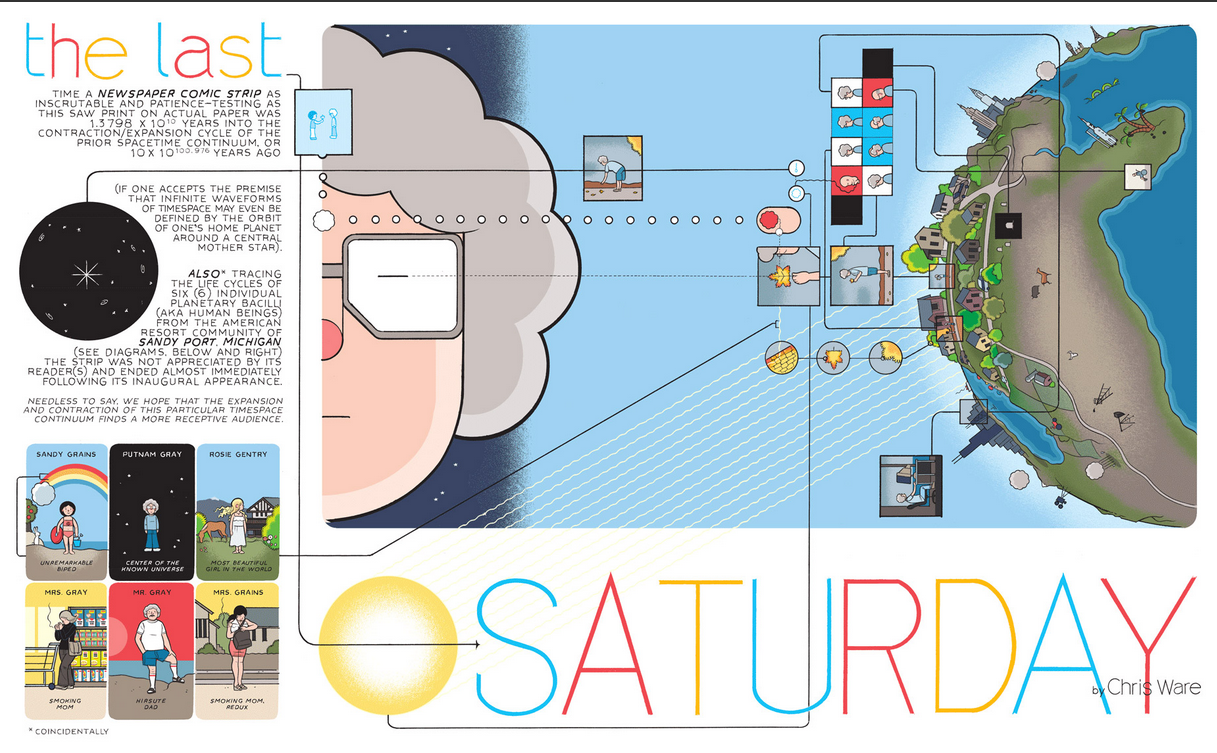 Thought you might like a heads up that The Guardian has started publishing on its web site The Last Saturday, “a brand new graphic novella by the award-winning cartoonist Chris Ware, tracing the lives of six individuals from Sandy Port, Michigan.” It will be published in weekly episodes, with a new installment appearing on this page every Saturday. The innovative comic book artist, known for his graphic novels Jimmy Corrigan, the Smartest Kid on Earth and Building Stories, will be getting some good support from the Guardian Interactive team, which should make it quite the visual experience.
via Kottke
Related Content:
Read Ulysses Seen, A Graphic Novel Adaptation of James Joyce’s Classic
Greek Myth Comix Presents Homer’s Iliad & Odyssey Using Stick-Man Drawings
The History of Economics & Economic Theory Explained with Comics, Starting with Adam Smith
Download 15,000+ Free Golden Age Comics from the Digital Comic Museum
Read More...Hear Bob Dylan’s Unedited & Bewildering Interview With Nat Hentoff for Playboy Magazine (1965)
In the fall of 1965, six months after Bob Dylan freaked out the folkies at Newport, he sat down with Village Voice music critic and columnist Nat Hentoff for an interview for Playboy. Like Dylan himself, the resulting conversation, as published in February, 1966, is by turns illuminating and completely confounding. Topics shift abruptly, words take on unfamiliar meanings, and for all of the many strong opinions Dylan seems to express, it’s remarkable how little he actually seems to say, since he takes back almost everything as soon as he says it.
The verbal tangles of his answers take many philosophical turns. Dylan defines the contemporary art scene, saying “Art, if there is such a thing, is in the bathrooms; everybody knows that. […] I spend a lot of time in the bathroom. I think museums are vulgar. They’re all against sex.” Asked “why rock ‘n’ roll has become such an international phenomenon,” Dylan waxes ontological: “I can’t really think that there is any rock ’n’ roll. Actually, when you think about it, anything that has no real existence is bound to become an international phenomenon.”
The bizarre nature of the published exchange is classic, comically aloof, mid-sixties Dylan—so much in character we can imagine Cate Blanchett’s serpentine Dylan in I’m Not There saying the lines. But the print version of the conversation is streamlined and lucid compared to the unedited, taped conversation Dylan and Hentoff had the year prior before an editor pared it down. As music site All Dylan has it, “to call them versions ignores the fact that they are totally different interviews.”
The original take, which you can hear above in two parts, was much messier, and stranger. Dylan often sounds like he’s not answering questions so much as putting words together in sentence-like forms. His speech takes on the qualities of abstract expressionism—recursive, and pointedly vague. We might assume he’s really stoned, except for a long-winded speech about how passé it is to smoke pot.
Well, I never felt as if there’s an answer through pot. I don’t want to make this, kind of, a drug interview or anything, like. LSD like… once you take LSD a few times… I mean, LSD is a medicine. You know, you take it and you know… you don’t really have to keep taking it all the time. It’s nothing like that. It’s not that kind of thing, you know, whereas pot, you know, nobody’s got any answers through pot. Pot’s, you know, not that kind of thing. I’m sure that the people that say that the people who figure they got their answers through pot, first of all, those people who say that, they’re just inventing something. And the people that really actually think that they got their answers through pot, probably never even smoked pot, you know. I mean, it’s like… pot is, you know…who smokes pot any more, you know, anyway?
Ever noncommittal, Dylan deflects a question about his relationship with Johnny Cash, saying “I can’t really talk about it too much,” but assuring Hentoff that he likes Cash “a lot. I like everything he does really.” If Dylan gives as much as he takes away in the published interview, he does so doubly in this unedited version, and it’s oddly fascinating, even—and especially—when he decides to stop making words make sense. The taped interview was, in fact, the second interview Hentoff conducted with Dylan. After seeing an edited transcript of the first attempt, Dylan insisted that Hentoff interview him again over the phone. Hentoff turned on his tape recorder and immediately “realized I was going to be the straight guy,” he tells John Whitehead, “Dylan was improvising surrealistically and very funny.”
Vulture ranks the Playboy interview at number one in their list of “The 10 Most Incomprehensible Bob Dylan Interviews of All Time.” It must have been a tough call. At number 10, they have the Time magazine interview from that same year, which you can see in the clip above from 1967’s Don’t Look Back. Dylan is confrontational, almost theatrically angry, but he is mostly clear on the details. He ends the interview with a cryptic joke, comparing himself to opera singer Enrico Caruso: “I happen to be just as good as him—a good singer. You have to listen closely, but I hit all those notes.”
via All Dylan
Related Content:
Bob Dylan Reads From T.S. Eliot’s Great Modernist Poem The Waste Land
Two Legends Together: A Young Bob Dylan Talks and Plays on The Studs Terkel Program, 1963
Bob Dylan Finally Makes a Video for His 1965 Hit, “Like a Rolling Stone”
Josh Jones is a writer and musician based in Durham, NC. Follow him at @jdmagness.
Read More...Drunk Shakespeare: The Trendy Way to Stage the Bard’s Plays in the US & the UK
You might be familiar with Drunk History, the web series turned Comedy Central show that reenacts the ramblings of inebriated hipsters trying to recount events like the Watergate scandal or the Burr-Hamilton duel. Well, apparently, a growing number of theater troupes have decided that the best way to stage Shakespeare in this age of social media and shortening attention spans is to get everyone involved drunk. The audience and the actors. One such group is called, aptly, Drunk Shakespeare, which describes itself as “a company of professional drinkers with a serious Shakespeare problem.” Each audience member is given a shot of whiskey at the beginning of each performance. The actors reportedly drink much more and actually have to get breathalyzed before the show. You wouldn’t want Henry V to pass out before the Battle of Agincourt, would you? The Wall Street Journal did a short video piece about the group. You can watch it above.
Another group, the New York Shakespeare Exchange, dispenses with the stage altogether. Instead, they host a regular pub crawl/ theatrical performance called ShakesBEER. In one of the many drinking establishments in New York, actors in contemporary dress do scenes from Hamlet and Othello amid patrons clutching pints of lager. You can watch some of their shows above.
Another example is The Inis Nua Company, which took the basic idea of Drunk History and swapped out the history with Romeo and Juliet. Check out below. Or, maybe if you’re across the pond, you will want to check out Sh*t- Faced Shakespeare at the Edinburgh Festival Fringe. It features “An entirely serious Shakespeare play… with an entirely shit-faced actor.”
But the real question is where will all this crazed mixing of high culture and mind altering substances end? Will someone do Inebriated Ibsen? Stoned Chekhov? Moliere on Molly? Tripping balls Beckett? It’s a slippery slope.
Related Content:
Free Online Shakespeare Courses: Primers on the Bard from Oxford, Harvard, Berkeley & More
Read All of Shakespeare’s Plays Free Online, Courtesy of the Folger Shakespeare Library
Take a Virtual Tour of Shakespeare’s Globe Theatre
Jonathan Crow is a Los Angeles-based writer and filmmaker whose work has appeared in Yahoo!, The Hollywood Reporter, and other publications. You can follow him at @jonccrow. And check out his blog Veeptopus, featuring one new drawing of a vice president with an octopus on his head daily. The Veeptopus store is here.
Read More...Support Us
We're hoping to rely on loyal readers, rather than erratic ads. Please click the Donate button and support Open Culture. You can use Paypal, Venmo, Patreon, even Crypto! We thank you!

About Us

Open Culture scours the web for the best educational media. We find the free courses and audio books you need, the language lessons & educational videos you want, and plenty of enlightenment in between.
Advertise With Us

FREE UPDATES!
GET OUR DAILY EMAIL
Get the best cultural and educational resources on the web curated for you in a daily email. We never spam. Unsubscribe at any time.
FOLLOW ON SOCIAL MEDIA

Open Culture editor Dan Colman scours the web for the best educational media. He finds the free courses and audio books you need, the language lessons & movies you want, and plenty of enlightenment in between.
Advertise With Us


