Eight Free Films by Dziga Vertov, Creator of Soviet Avant-Garde Documentaries
Has any filmmaker, of any era, had more influence on documentaries than Dziga Vertov? We know the early 20th-century Soviet cinema theorist and director of avant-garde non-fiction films has a place high in the documentary pantheon by virtue of his 1929 Man with a Movie Camera alone.
We’ve previously featured that motion picture’s rise to Sight and Sound’s designation of the eighth greatest of all time, and if you didn’t watch it free online then, you can do so above now. Just after that, we featured his unsettling Soviet Toys, the first animated film ever made in that then-nation. But given that the age of Vertov’s work — not that time has diminished its aesthetic relevance or excitement — has brought it into the public domain, why stop there?
Today we offer a roundup of all the Dziga Vertov movies currently viewable free online, a collection that allows you to watch and judge for yourself whether he and his collaborators succeeded in making a dent in what he called “the film drama, the Opium of the people.” Despite the thoroughly low-tech nature of these pictures, even by documentary standards, you may find yourself moved after having watched them — not necessarily by the Soviet causes he sometimes extolled, but by his cinematic rallying cry: “Down with bourgeois fairy-tale scenarios. Long live life as it is!”
- Kino Eye (1924) Vertov’s first documentary not made from found footage journeys, according to a contemporary newspaper, “from the Pioneer camp, through the peasant courtyards, through the fields, through the markets and slums of the town, with an ambulance car to a dying man, from there to workers’ sports grounds, and so on and so forth, peering into all the little corners of social life.”
- Soviet Toys (1924) A “cartoon” that, in the words of our own Jonathan Crow, “displays [Vertov’s] knack for making striking, pungent images,” “yet those who don’t have an intimate knowledge of Soviet policy of the 1920s might find the movie — which is laden with Marxist allegories — really odd.”
- Kino-Pravda #21 (1925) Also known as Lenin Kino-Pravda, “a special, longer-than-usual issue of [newsreel] Kino-Pravda,” as the Harvard Film Archive describes it, “in which Vertov jumps with boldness and ease between newsreel and drawn animation to illustrate Soviet Russia’s way up under Lenin’s leadership, the decline in Lenin’s health, and the year elapsed since his death.”
- A Sixth Part Of The World (1926) A mixture of newsreel and found footage that, according to the Internet Archive, the film depicted “through the travelogue format [ … ] the multitude of Soviet peoples in remote areas of USSR and detailed the entirety of the wealth of the Soviet land,” making “a call for unification in order to build a ‘complete socialist society.’ ”
- Stride, Soviet! (1926) “What began as a commission by the sitting Moscow Soviet for a promotional movie,” says the Harvard Film Archive, “was transformed by Vertov into something else entirely: a film experiment, an emotional film – anything but a picture that would help the Mossovet be reelected.”
- The Eleventh Year (1928) A celebration of “the tenth anniversary of the October Revolution” which, according to the Harvard Film Archive, presents that decade of socialism “in the eyes of a left-wing artist of the twenties” as “a radical social experiment [ … ] required to be presented in a radically experimental way.”
- Man with a Movie Camera (1929) “Made up as it is of ‘bits and pieces’ of cities from Moscow to the Ukraine,” writes Senses of Cinema’s Jonathan Dawson, it “remains a perfect distillation of the sense of a modern city life that looks fresh and true still,” “the strongest reminder that, in spite of the extraordinary pressures on his personal and working life, Vertov was one of the greatest of all the pioneer filmmakers.”
- Three Songs About Lenin (1934) Also known as Three Songs of Lenin and Three Songs Dedicated to Lenin, a delivery of exactly what the title promises — but with a Vertovian stylistic slant.
Related Content:
200 Free Documentaries Online, part of our collection: 4,000+ Free Movies Online: Great Classics, Indies, Noir, Westerns, Documentaries & More
65 Free Charlie Chaplin Films Online
35 Free Oscar Winning Films Available on the Web
Colin Marshall hosts and produces Notebook on Cities and Culture and writes essays on cities, language, Asia, and men’s style. He’s at work on a book about Los Angeles, A Los Angeles Primer. Follow him on Twitter at @colinmarshall or on Facebook.
Read More...Sound Effects Genius Michael Winslow Sings Zeppelin’s “Whole Lotta Love”: Vocal & Guitar Parts
Ladies and gentlemen, we present Michael Winslow, the Man of 10,000 Sound Effects, singing Led Zeppelin’s “Whole Lotta Love.” And by sing, we mean that he performs the lead vocals, and the distortion-filled sounds of the electric guitar, all with his voice. The performance took place one night, back in November, 2011, on Norway’s TV show Senkveld med Thomas og Harald (aka Late Night with Thomas and Harold). Winslow is joined by folk pop-musician Odd Nordstoga on the acoustic guitar. When you’re done picking up your jaw, you’ll want to watch Winslow perform the Sounds of 32 Typewriters (1898–1983). It’s quite magnificent. Or watch an old re-run of Police Academy. That’s never hurts, either.
via Metafilter
Related Content:
Jimmy Page Describes the Creation of Led Zeppelin’s “Whole Lotta Love”
Isolated Drum Tracks From Six of Rock’s Greatest: Bonham, Moon, Peart, Copeland, Grohl & Starr
Sound Effects Genius Michael Winslow Performs the Sounds of 32 Typewriters (1898–1983)
Read More...Portraits of Vice Presidents with Octopuses on Their Heads — the Ones You’ve Always Wanted To See
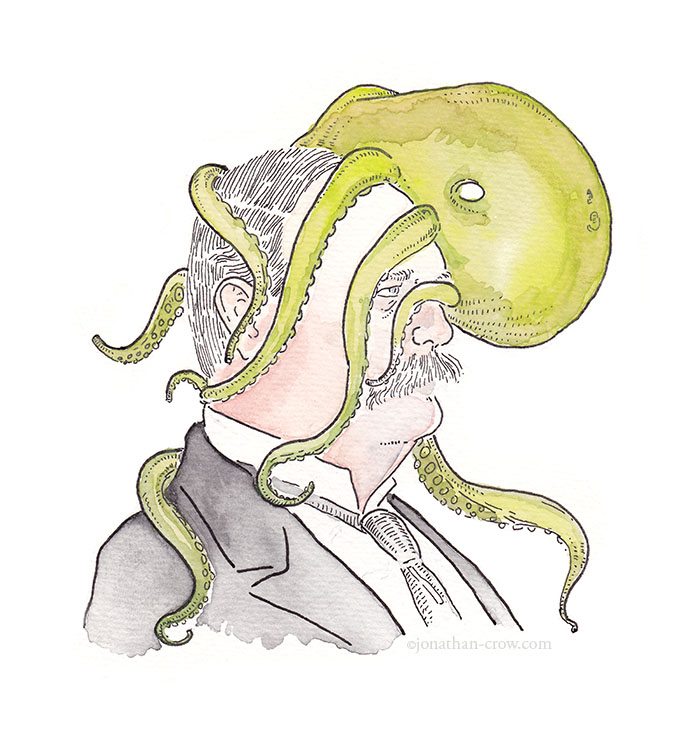
Last year, after parting ways with a punishing, thankless corporate job but before my wife gave birth to my first child, my friend invited me to participate in the From Dusk til Drawn fundraiser at the Museum of Contemporary Art in Santa Barbara. Basically, it involved drawing for 24 straight hours. At that point in my life – i.e. before children – sleep deprivation was a novelty. It sounded insane. I was in.
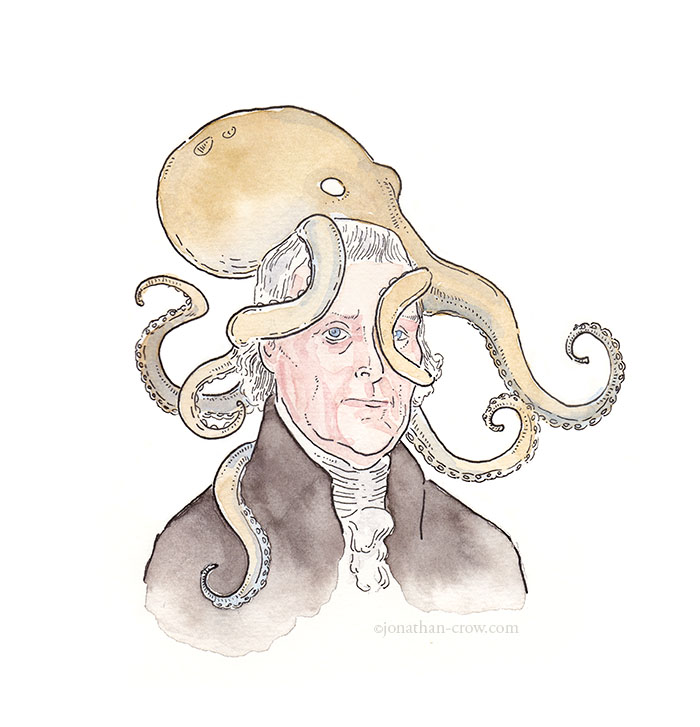
I knew I needed a system. The last thing I wanted was to be struggling for ideas of something to draw at four in the morning. So after some debate, I decided to draw portraits of all 47 vice presidents of the United States. With octopuses on their heads. Why?
It probably started with Walter Mondale. I was on the couch with my mother watching the returns for the 1984 election. When it became clear that he was not going to become America’s next chief executive, my mother, who spent her formative years in Berkeley during the thick of the ‘60s, stood up, proclaimed “Well, shit!” and stormed upstairs. I was in seventh grade. This was the first election I cared about. Mondale had reached for glory and failed spectacularly. Starting that night, I became fascinated with those who aspired to history but ended up a footnote. So obviously, I became interested in vice presidents.
The Constitution is surprisingly vague on the veep. Vice President Charles Dawes — a man who won a Nobel Peace Prize and who wrote a tune that would later become a pop hit, all before becoming Calvin Coolidge’s number two guy — summed up the job while talking with senator and future VP Alben W. Barkley like this: “I can do only two things here. One of them is to sit up here on this rostrum [in the Senate] and listen to you birds talk without the ability to reply. The other is to look at the newspapers every morning to see how the President’s health is.”
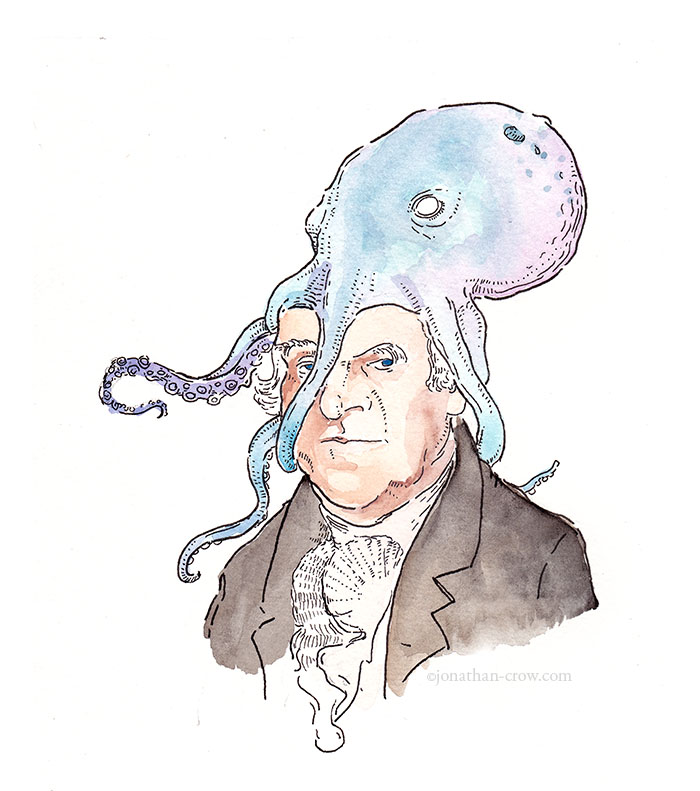
Though the position bestows on it all of the authority and pomp of the U.S. Government, vice presidents throughout history have struggled to find purpose in a poorly defined role, all the while waiting for death. It’s a bit like life itself. A few, through ambition, talent and a lot of luck, ascended to the top job. Most moldered in obscurity. No wonder then that John Nance Garner, one of FDR’s three VPs, called the job “not worth a bucket of warm piss.” I added the octopuses because I thought they were funny. It takes a rare person to pull off an air of dignity with a cephalopod on his head. It seems to fit with the absurdity of the job.
During From Dusk til Drawn, I was a machine. I cranked out 22 portraits of vice presidents in 24 hours. That’s one an hour, excluding a 2am jaunt to get a rice bowl and a handful of bathroom breaks. Over the next year, I drew and redrew them all from John Adams to Joe Biden and then, starting this past July, I began posting one picture a day on my site Veeptopus. I’m up to Hubert H. Humphrey now. During this time, I learned a lot about formerly important people who are now almost entirely unknown. People like William R. King, who died of tuberculosis three weeks after getting sworn in as VP, or John Breckinridge, who fled to Cuba to avoid getting arrested for treason. You can see the fruits of my crazy scheme here. I hope you enjoy.
Above, in descending order, you can find portraits of 1) Garret Hobart (1897–1899), the 24th Veep under William McKinley; 2) Thomas Jefferson, who bucked the VP trend and made something of himself; and 3) George Clinton who served under Jefferson and Madison. Don’t confuse him with the guy from Parliament Funkadelic.
Related Content:
Watch a Witty, Gritty, Hardboiled Retelling of the Famous Aaron Burr-Alexander Hamilton Duel
Jonathan Crow is a Los Angeles-based writer and filmmaker whose work has appeared in Yahoo!, The Hollywood Reporter, and other publications. You can follow him at @jonccrow. And you can check out his online Veeptopus store here.
Read More...John Lennon’s Ice Bucket Challenge
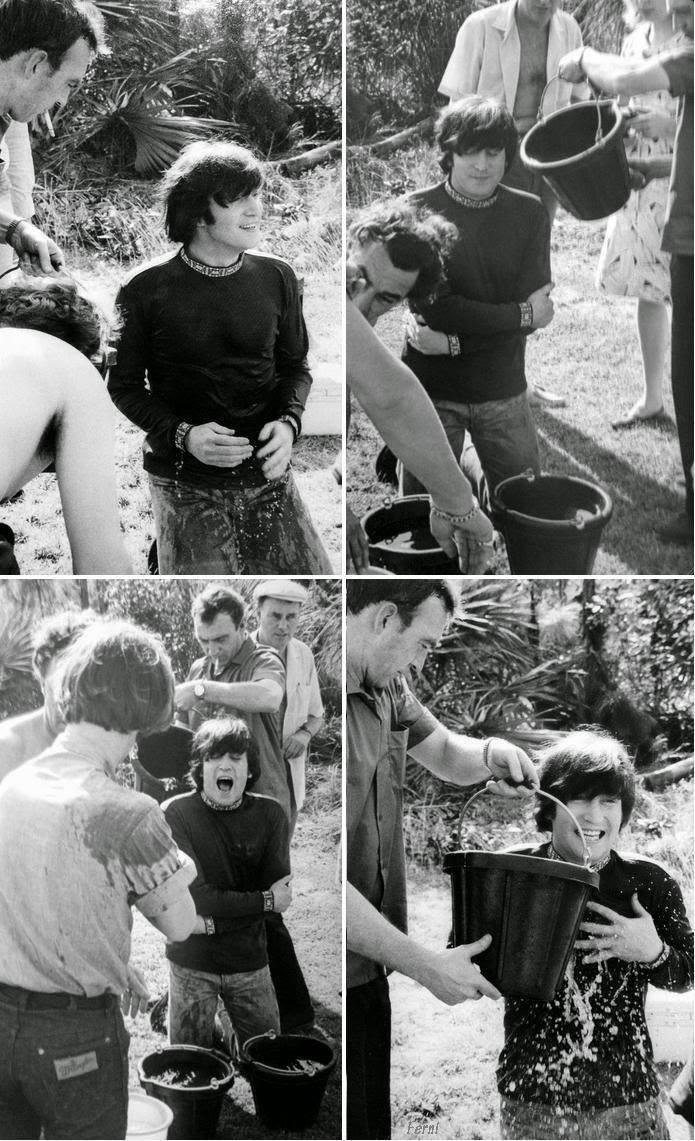
The ice bucket challenge is pretty played out. So why post this photo? Quite simply because I can find scant little information about this curious Beatles pic. One Beatles blog dates the picture back to 1965. After that, bupkis. No information. So, for once, I’m throwing up my hands and asking for a little help from our friends. Somewhere out there, an ardent Beatles fan knows the story, and we’re hoping that you can give us the lowdown, either by email, or in the comments section below. We thank you in advance…
Update: We got an email from a former radio exec who offers more details. Jon tells us: “These shots were done in the Bahamas back in 1965 while the Beatles traveled the world to film their second movie Help! This sequence most likely came as a result of set close up shots that director Richard Lester needed of each Beatle during a pool sequence since John is wearing that same shirt during several of those water sequences shot in the Bahamas. Ringo has always said it was cold during the shoot as they filmed it during a cooler time (Jan.?) that year. That would explain John’s look after being doused.” And there you have it!
Related Content:
Hear the Isolated Vocal Tracks for The Beatles’ Climactic 16-Minute Medley on Abbey Road
The 10-Minute, Never-Released, Experimental Demo of The Beatles’ “Revolution” (1968)
Read More...Bill Murray Gives a Delightful Reading of Twain’s Huckleberry Finn (1996)
George Bernard Shaw once called Mark Twain “the American Voltaire,” and like the inspired French satirist, Twain seems to have something to say to every age, from his own to ours. But if Twain is Voltaire, to whom do we compare Bill Murray? Only posterity can properly assess Murray’s considerable impact on our culture, but his current role as everyone’s favorite pleasant surprise will surely figure largely in his historical portrait. Of Murray’s many random acts of kindness—which include “popping in on random karaoke nights, or doing dishes at other people’s house parties, or crashing wedding photo shoots”—he has also taken to surprising us with readings from American literary greats: from Cole Porter, to Wallace Stevens, to Emily Dickinson.
Just above see Murray read an excerpt from American great Mark Twain’s The Adventures of Huckleberry Finn. Murray’s appearance at the 1996 Barnes & Noble event apparently came as a surprise to the audience—and to himself. The excerpt he reads might also surprise many readers of Twain’s classic, who probably won’t find it in their copies of the novel. These passages were originally published in Life on the Mississippi but reinserted—“correctly, I guess,” Murray shrugs—into Huck Finn in Random House’s 1996 republication of the novel, marketed as “the only comprehensive edition.” (Read a publication history and summary of the changes in this brief, unsympathetic review of the re-edited text.)
1996 was an interesting year for Twain’s novel. Long at the center of debates over racial sensitivity in public education, and banned many times over, the book figured prominently that year in a tense but fruitful meeting between parents and teachers in Cherry Hill, New Jersey. These discussions produced a new curricular approach that PBS outlines in its teaching guide “Huck Finn in Context,” which offers a variety of responses to the thorny pedagogy of “the ‘n’ word,” racial stereotyping, and reading satire. Beyond the issue of derogatory language, there also arose that year a pugnacious challenge to the book’s place in the American literary canon from novelist Jane Smiley. Smiley’s polemic prompted a lengthy rebuttal in The New York Times from Twain scholar Justin Kaplan.
Revisiting these debates reminds us of just how much we can take for granted a literary work’s social and cultural value. Smiley reminds us of the breadth of American literature by women writers that was pushed aside by critics to give male writers like Twain, Melville, and Poe pride of place. The various controversies surrounding the novel’s place in the classroom should remind us—as Toni Morrison has explained in depth—that racialized language does not strike all readers equally, and that this is a problem to be discussed openly, not ignored or banned out of sight. And Murray’s excellent dramatic reading of these re-inserted passages should remind us, over all, of the first reason we care about Huck Finn—not because of its political correctness or incorrectness, but because of its richness of character and dialogue.
After Murray’s reading above, New York Times writer Brent Staples introduces a distinguished panel of Shelby Foote, William Styron, Roy Blount, Jr., and Justin Kaplan. The five go on to discuss the “literary and historical significance” of the novel, confronting the controversies head-on. I think it’s a shame Jane Smiley wasn’t invited, or chose not to appear. In any case, you might be tempted to bolt after Bill Murray, but stick around for the writers. You won’t be disappointed.
You can find copies of Huck Finn in our Free eBooks and Free Audio Books collections.
Related Content:
Bill Murray Reads Great Poetry by Billy Collins, Cole Porter, and Sarah Manguso
Mark Twain Drafts the Ultimate Letter of Complaint (1905)
Mark Twain Wrote the First Book Ever Written With a Typewriter
Josh Jones is a writer and musician based in Durham, NC. Follow him at @jdmagness
Read More...Iraqi Artist Turns Saddam Hussein’s Propaganda Music into Pop, Jazz & Lounge-Style Love Songs
As ISIS carries out its reign of terror in Syria and Iraq, many diplomats probably wouldn’t mind rolling the calendar back to 2003 — to what now look like simpler times. If you’re feeling strangely nostalgic for the Saddam era, you’ll want to check out videos from “Three Love Songs,” an art installation staged in Doha (2010) and London (2013) by the Iraqi visual artist Adel Abidin. Here is how he describes the exhibition:
This piece examines terror and love, and how façades are played through song, specifically Iraqi songs that were commissioned by Saddam Hussein, used to glorify the regime during the decades of his rule. The installation syncs three stylized music videos (lounge, jazz and pop) that each features an archetypal western chanteuse: young, blonde, and seductive. Each video’s dramatic “look” creates a different atmosphere but the songs dedicated to Saddam Hussein tie them together. The lyrics are sung by the performers in Arabic (Iraqi dialect) and are subtitled in English and Arabic. The singers do not know what they are singing about, but they are directed to perform (though voice and gesture) as though the songs were traditional, passionate love songs. It is this uncomfortable juxtaposition — between the lush visual romanticism and the harsh meaning of the lyrics, between the seduction of the performer and comprehension of the viewer — that forms the main conceptual element of this work.
Above and below, you can see outtakes from the video installations in “Three Love Songs.” You’ve got your lounge tune up top. Jazz and Pop below.
Jazz:
Pop:
via Hyperallergic
Related Content:
How the CIA Turned Doctor Zhivago into a Propaganda Weapon Against the Soviet Union
Winsor McCay Animates the Sinking of the Lusitania in a Beautiful Propaganda Film (1918)
Donald Duck’s Bad Nazi Dream and Four Other Disney Propaganda Cartoons from World War II
Read More...Hear Antonin Artaud’s Censored, Never-Aired Radio Play: To Have Done With The Judgment of God (1947)
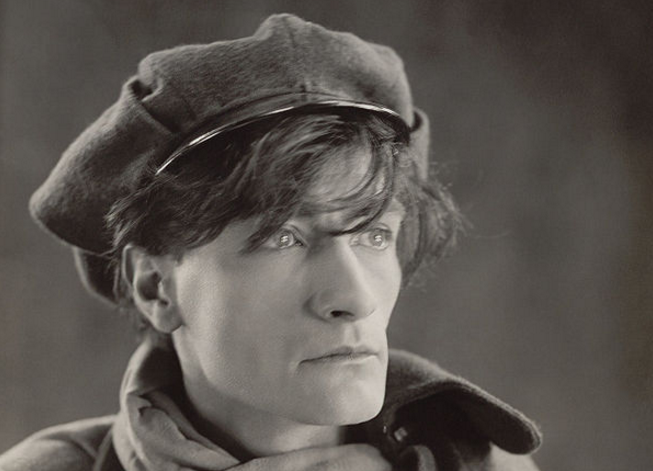
Antonin Artaud had his first mental breakdown at the age of 16 and, from there on out, spent much of his life in and out of asylums. Diagnosed with “incurable paranoid delirium,” Artaud suffered from hallucinations, glossolalia, and bouts of violent rage. And his treatment probably did about as much harm as it did good. He was prescribed laudanum, which gave him a lifelong addiction to opiates. He endured some truly horrific procedures like electric shock treatment along with the highly dubious insulin therapy, which put him in a coma for a while.
In spite of this, Artaud proved to be a hugely influential theorist and playwright, famous for coining the term, “Theater of Cruelty.” His performances were designed to assault the senses and sensibilities of the audience and awaken them to the base realities of life — sex, torture, murder and bodily fluids. Artaud wanted to break down the boundary between actor and audience and create an event that was ecstatic, uncontained and even dangerous. His ideas revolutionized the stage. As the late great Susan Sontag once wrote, “no one who works in the theater now is untouched by the impact of Artaud’s specific ideas.”
But generally speaking, his ideas about theater were more popular than his actual productions. One of his most famous plays, first staged in 1935, was Les Cenci, about a father who rapes his daughter and then gets brutally killed by his daughter’s hired thugs. The play was a flop when it debuted, running for a mere 17 performances. Even Sontag conceded that Les Cenci was “not a very good play.”
Artaud’s last work was an audio piece called To Have Done With The Judgment Of God (Pour en Finir avec le Jugement de dieu), and it proved to be equally unpopular, at least with some very important people. Commissioned by Ferdinand Pouey, head of the dramatic and literary broadcasts for French Radio in 1947, the work was written by Artaud after he spent the better part of WWII interned in an asylum where he endured the worst of his treatment. The piece is as raw and emotionally naked as you might expect –an anguished rant against society. A raving screed filled with scatological imagery, screams, nonsense words, anti-American invectives and anti-Catholic pronouncements.
The piece (above) was slated to air on January 2, 1948 but station director Vladimir Porché yanked it at the last moment. Apparently, he wasn’t terribly fond of the copious references to poop and semen nor the anti-American vitriol. Porché’s rejection caused a cause célèbre among Parisian intellectuals. René Clair, Jean Cocteau and Paul Éluard among others loudly protested the decision, and Pouey even resigned from his job in protest, but to no avail. It never aired. Artaud, who reportedly took the rejection very personally, died a month later. You can listen to the broadcast above. And, in case your French isn’t up to snuff, you can still appreciate its theatrical elements, maybe while reading an English translation of the radio play script here.
If you can’t get enough of Artaud’s final work, you can watch this staged version of To Have Done With the Judgment of God below starring Billy Barnum and John Voigt (no, not Angelina Jolie’s father, the avant-garde musician).
Via WFMU
Related Content:
Extensive Archive of Avant-Garde & Modernist Magazines (1890–1939) Now Available Online
Un Chien Andalou: Revisiting Buñuel and Dalí’s Surrealist Film
The Hearts of Age: Orson Welles’ Surrealist First Film (1934)
The Seashell and the Clergyman: The World’s First Surrealist Film
Man Ray and the Cinéma Pur: Four Surrealist Films From the 1920s
Jonathan Crow is a Los Angeles-based writer and filmmaker whose work has appeared in Yahoo!, The Hollywood Reporter, and other publications. You can follow him at @jonccrow. And check out his blog Veeptopus, featuring one new drawing of a vice president with an octopus on his head daily.
Read More...Watch Karlheinz Stockhausen’s Great Helicopter String Quartet, Starring 4 Musicians, 4 Cameras & 4 Copters
Here in Los Angeles, we learn to live with helicopters. Whether police, news, or unidentifiable, these great mechanical hummingbirds buzz over the city in a kind of omnipresence that can drive new arrivals nuts. The movies have turned helicopters into a visual icon of Los Angeles, but in real life they’ve become more like the city’s sonic signature, to the point where the distinctively rapid, repetitive thump of their rotor blades sometimes bleeds into our dreams. Whether or not innovative German composer Karlheinz Stockhausen spent much time here I don’t know, but he, too, dreamt of helicopters, and the inspiration this vision granted him led to his 1993 Helikopter-Streichquartett, also known as the Helicopter String Quartet. You can see a 2012 Birmingham performance by the Elysian String Quartet above. And no, the piece doesn’t mean “Helicopter” as any kind of metaphor; you’ve got to have not just one but four of the things to properly play it.
Stockhausen, writing about the origins of the Helicopter String Quartet, described the dream as follows:
I heard and saw the four string players in four helicopters flying in the air and playing. At the same time I saw people on the ground seated in an audio-visual hall, others were standing outdoors on a large public plaza. In front of them, four towers of television screens and loudspeakers had been set up: at the left, half-left, half-right, right. At each of the four positions one of the four string players could be heard and seen in close-up.
Most of the time, the string players played tremoli which blended so well with the timbres and the rhythms of the rotor blades that the helicopters sounded like musical instruments.
When I woke up, I strongly felt that something had been communicated to me which I never would have thought of on my own. I did not tell anyone anything about it.
An actual performance, which gets even more complicated than you’d imagine, involves not just separate helicopters for each string player but separate video cameras to capture and send (“possibly via satellite relay”) their images and those of the Earth behind them. It also requires precision-timed and music-synchronized ascents and descents, “blending” of the sounds of the strings with the sounds of the rotors (via three distinct microphones per chopper), an active mixer to keep the signals in balance, and a moderator to explain it all. At Ubuweb, Frank Scheffer’s 1995 German documentary has more to show and tell about what it took to bring the literal dream of the Helikopter-Streichquartett into reality, a painstaking effort which must surely count as one of the 20th century’s largest-scale sublimations of annoyance into art.
Related Content:
Hollywood by Helicopter, 1958
MIT LED Helicopters: The Early Smart Pixels
Colin Marshall hosts and produces Notebook on Cities and Culture and writes essays on cities, language, Asia, and men’s style. He’s at work on a book about Los Angeles, A Los Angeles Primer. Follow him on Twitter at @colinmarshall or on Facebook.
Read More...Derek Jarman’s Jubilee: “It’s the Best Film about Punk” (1978)
Derek Jarman was too old and too accomplished to be a punk. By 1977, the openly gay filmmaker and artist was already 36 and had an impressive CV that included doing set design for Ken Russell’s The Devils and directing Sebastiane, a landmark in gay cinema, notable for not only its frank depiction of the male body but also for its dialogue which was entirely in Latin. Nonetheless, Jarman gathered together notables from London’s burgeoning punk scene, including a young, lithe Adam Ant, to create Jubilee –the first and, arguably best, punk movie ever.
The plot, as such, centers on Queen Elizabeth I who, with the help of court occultist John Dee (played by Rocky Horror Picture Show’s Richard O’Brien), sees her land 400 years into the future. It’s a Britain filled with garbage and plagued with crime. Queen Elizabeth II, for instance, was killed in a mugging. As Queen Elizabeth I wanders around the wreckage of the British Empire, she encounters a bunch of leather-clad toughs including Amyl Nitrite (played by Malcolm McLaren protégé Jordan), Crabs (Little Nell, also from Rocky Horror) and Mad (Toyah Willcox, who would later go on to delight a generation of toddlers by voicing The Teletubbies). The highpoint of the movie is, without a doubt, is when Jordan performs a risqué dance to a glammed up version of Rule Britannia.
Jarman tapped into the same feelings of anger, disillusionment, and nihilism that the Sex Pistols articulated. As Jarman told The Guardian in 1978, “We have now seen all established authority, all political systems, fail to provide any solution — they no longer ring true.” Jubilee feels like a John Waters movie without the gross-out gags. A Paul Morrissey movie but with a clear sense of political purpose. It’s giddy, uninhibited, violent and occasionally quite disturbing.
Reactions to the movie were, not surprisingly, mixed. Yet the people who really despised the flick weren’t cultural conservatives as you might expect. They would fret over the film when it finally aired on late night TV in 1986. But in 1978, when the film came out, the very people the film was about hated it. Souxsie Sioux, of Souxsie and the Banshees fame, had a bit part in the film but nonetheless thought that it was “hippy trash.” Punk fashionista Vivienne Westwood hated the movie so much she made an insulting T‑shirt about it. And Adam Ant, who went to the premiere with his mother, initially thought the film was terrible. Jarman didn’t give a toss. “I don’t particularly want people to like the film or what it depicts,” he once told a reporter. “I simply hope that it makes them feel that something is going on.”
Yet over the years, the film’s reputation has steadily improved. Ant, for instance, has changed his opinion of Jubilee. “Today I think it’s an amazing achievement and testament to Derek Jarman’s persistence and ingenuity.” And historian Jon Savage, who literally wrote the book on punk, declared that “it’s the best film about punk, for all its failings.” British critic Julian Upton went one step further:
Jubilee is the most important British film of the late ’70s. Okay, it faced little competition at the time — just a weak trickle of ill-conceived co-productions, third-rate softcore, and the usual heritage and nostalgia. Next to those, Jubilee, then as now, stands out like a sore thumb.
via Network Awesome/ The Guardian
Related Content:
Four Female Punk Bands That Changed Women’s Role in Rock
Wittgenstein: Watch Derek Jarman’s Tribute to the Philosopher, Featuring Tilda Swinton (1993)
Jonathan Crow is a Los Angeles-based writer and filmmaker whose work has appeared in Yahoo!, The Hollywood Reporter, and other publications. You can follow him at @jonccrow. And check out his blog Veeptopus, featuring one new drawing of a vice president with an octopus on his head daily.
Read More...Dripped: An Animated Tribute to Jackson Pollock’s Signature Painting Technique
To make an exciting movie, do you really need much more than an art thief and his capers? With Dripped, animator Léo Verrier sees that can’t-miss premise and raises it in an exploration of art history. In its 1940s New York City setting, painting-swiping protagonist Jack lives not just to make world-renowned canvasses his own, but a part of him. When he gets these works of art back to his apartment, he doesn’t even consider selling them; instead, he chews and swallows them, thus enabling him to assume in body the forms and colors famously expressed in paint on their surfaces. We are what we eat, and Jack eats art, but even becoming the art of others ultimately leaves him unsatisfied. Determined to paint and eat a canvas of his own, he finds his stomach can’t handle his work in progress. Thrown into a bout of frustration, an angered Jack tosses one of his paintings to the ground, randomly splattering it with every color at hand. And thus he discovers, in this animated fantasy, the technique that Jackson Pollock would pioneer in reality.
To see the real artist — one not known for his eating, though his drinking did gain a reputation of its own — in action have a look at Hans Namuth’s 1951 footage of Pollock painting with his signature “drip” method above. To learn more about the how and the why of it, see also the 1987 documentary Portrait of an Artist: Jackson Pollock, which we featured in 2012; and below, see the Museum of Modern Art’s short examination and re-creation of Pollock’s “action painting” technique. Chance may have led him to discover this practice, but it hardly means he gave up control. Filmmaker Stan Brakhage liked to tell the following illustrative story, which came out of hanging out with various artists and composers in Pollock’s studio in the late 40s:
They were, like, commenting, and they used the words “chance operations” — which was no bother to me because I was hearing it regularly from John Cage — and the power and the wonder of it and so forth. This really angered Pollock very deeply and he said, “Don’t give me any of your ‘chance operations.’ ” He said, “You see that doorknob?” and there was a doorknob about fifty feet from where he was sitting that was, in fact, the door that everyone was going to have to exit. Drunk as he was, he just with one swirl of his brush picked up a glob of paint, hurled it, and hit that doorknob smack-on with very little paint over the edges. And then he said, “And that’s the way out.”
via Juxtapoz
Related Content:
Watch Portrait of an Artist: Jackson Pollock, the 1987 Documentary Narrated by Melvyn Bragg
Jackson Pollock 51: Short Film Captures the Painter Creating Abstract Expressionist Art
MoMA Puts Pollock, Rothko & de Kooning on Your iPad
Colin Marshall hosts and produces Notebook on Cities and Culture and writes essays on cities, language, Asia, and men’s style. He’s at work on a book about Los Angeles, A Los Angeles Primer. Follow him on Twitter at @colinmarshall or on Facebook.
Read More...Support Us
We're hoping to rely on loyal readers, rather than erratic ads. Please click the Donate button and support Open Culture. You can use Paypal, Venmo, Patreon, even Crypto! We thank you!

About Us

Open Culture scours the web for the best educational media. We find the free courses and audio books you need, the language lessons & educational videos you want, and plenty of enlightenment in between.
Advertise With Us

FREE UPDATES!
GET OUR DAILY EMAIL
Get the best cultural and educational resources on the web curated for you in a daily email. We never spam. Unsubscribe at any time.
FOLLOW ON SOCIAL MEDIA

Open Culture editor Dan Colman scours the web for the best educational media. He finds the free courses and audio books you need, the language lessons & movies you want, and plenty of enlightenment in between.
Advertise With Us

