Learn to Make Buttons with Filmmaker Miranda July
We humans have relied on the deceptively humble button since its first appearance in the Indus Valley some 5000 years ago.
In the pre-zipper era, what better way to show off your shapely arms or calves than a row of gorgeous and functional buttons?
Need to pay a debt, or bestow a love token on a fetching suitor? Pluck a button from your garment, and consider the matter closed.
The first campaign buttons? Actual buttons! Thanks, George Washington!
It is, as Charles Dickens noted, following a visit to a Birmingham button factory, “a serious thing to attempt to learn about buttons.” It should come as no surprise that the great champion of the oppressed not only did his homework, but wound up having rather a lot to say on the subject.
Judging by his account of what he witnessed in Birmingham, most would assume that the button-making process requires specialized machinery, a number of specialized materials, and a large, nimble-fingered workforce.
Not so, as filmmaker Miranda July demonstrates in the extremely illuminating how-to video, above.
Yes, certain steps will require a high degree of concentration. Don’t expect to successfully Ferberize—or in layman’s terms, put holes in—your buttons on the first attempt. Stick with it, though. Even an experienced fabricant de bouton like July will occasionally have trouble with things like granular compounds and high voltage hardeners.
As a newcomer to the exciting world of button-making, I really appreciated July’s clear, step-by-step instruction, as well as her encouraging vibe. The project requires a degree of skill and patience that may elude younger viewers, but I can attest that my 13-year-old son was absolutely riveted throughout. He may never produce any buttons, but he can’t wait to share his newfound knowledge with all his friends!
In closing, let us revisit Dickens, whose enthusiasm lives on in July, a fellow writer and Aquarian, 162 years his junior:
It is wonderful, is it not? that on that small pivot turns the fortune of such multitudes of men, women, and children, in so many parts of the world; that such industry, and so many fine faculties, should be brought out and exercised by so small a thing as the Button.
Related Content:
Watch Miranda July’s Short Film on Avoiding the Pitfalls of Procrastination
David Sedaris Reads You a Story By Miranda July
Ayun Halliday is the author of seven books, and creator of the award winning East Village Inky zine. Follow her @AyunHalliday
Read More...Music That Helps You Write: A Free Spotify Playlist of Your Selections
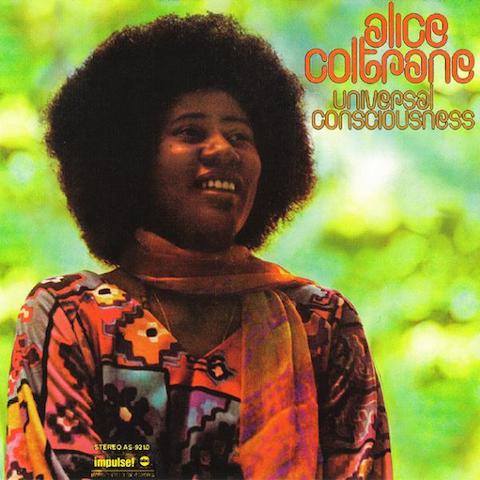
What music puts you in the mood to write? At the moment, I have on Alice Coltrane’s “Battle at Armageddon” from her 1971 Universal Consciousness, a work of psychedelic free jazz that makes my fingers skitter over the keyboard and sends thoughts racing through my mind. Should Coltrane’s mystic jazz counter the mood I want to summon, I might find something less syncopated, more lugubrious, ominous, melancholy, serene, etc. (Perhaps Grouper’s atmospheric suite of reverb-drenched tone-poems The Man Who Died in His Boat.)
This interaction between the ears, the fingers, and the writing mind struck our interest back in 2012, and we put out a call to readers to suggest the best pieces of music to write by. Some readers found that silence made for the best—or only—accompaniment. Many more made recommendations ranging from Miles Davis, to minimalist composer Steve Reich, sitar maestro Ravi Shankar, the classic Krautrock sound of Neu!, the dub reggae of King Tubby, the violin Sonatas of Bach, and the ambient soundscapes of Brian Eno. We took it upon ourselves to compile a sampling of your suggestions with Youtube videos at the time. Now we offer above a more portable Spotify version of our “music to write by” playlist—over 13 hours of music. (Stream it above. Or find it online here. If you need to download Spotify, grab the software here.) I’ve added Alice Coltrane, Grouper, and the beautiful …Until We Felt Red (2006) from one of my favorite guitarists, Kaki King.
I hope this playlist inspires you, or at least inspires you to make your own. While it could go on indefinitely, the key to a good mixtape is the art of judicious selection. Please tell us in the comments, what would you absolutely have to add? What artists, composers, and musicians get you in the mood to write, help you shift tempos, or move you from major to minor keys while you compose, whether you write nonfiction, poetry, technical manuals, or the Great American Whatever? We’ll add many of your suggestions to the playlist over the next few days.
Related Contents:
The Best Music to Write By: Give Us Your Recommendations
The Best Music to Write By, Part II: Your Favorites Brought Together in a Special Playlist
Listen to Philip K. Dick’s Favorite Classical Music: A Free, 11-Hour Playlist
62 Psychedelic Classics: A Free Playlist Created by Sean Lennon
Josh Jones is a writer and musician based in Durham, NC. Follow him at @jdmagness.
Read More...Read 4,500 Unpublished Pages of Flaubert’s Madame Bovary
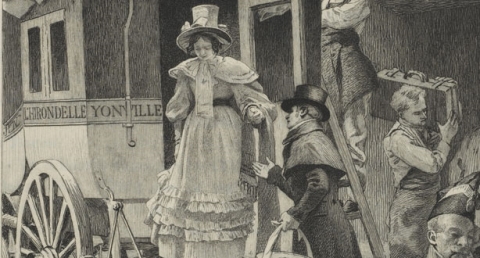
Why study a language like French? For the unparalleled pleasure, of course, of reading a beloved, respected, and enduring novel like Madame Bovary in the original — or so literarily inclined Francophiles might argue. After all, they’d rhetorically ask, can you really say you’ve read the book if you haven’t actually read the very same words Gustave Flaubert wrote? But now, literarily inclined Francophiles who also have an enthusiasm for the web (not an overwhelmingly large group, wags may point out) can insist that you haven’t really read Madame Bovary unless you’ve read it all in the original: all 4,500 pages of it. Yes, the French do tend to write longer sentences than most, but that impressive length has less to do with a national literary style than with thoroughgoing completism, an impulse that brings together all of the 1856 novel’s originally published pages as well as all of those cut, censored, or revised, free to read online at bovary.fr.
“After a marathon effort of transcription by 130 volunteers from all over the world, including a cleaning lady, an oil prospector and several teenagers,” writes the Independent’s John Lichfield, “all the variants of Gustave Flaubert’s masterpiece can be consulted on a new website. This is believed to be the first time that the complete process of creation, and publication, of a classic novel has been made available on the internet,” much less on a site that “contains not only the published text and images of the barely legible manuscripts but interactive controls which allow the reader to re-instate passages corrected or cut by Flaubert or his publishers.” Despite this unprecedentedly vast and accessible trove of Madame Bovary resources, struggles over the proper interpretation of the once-scandalous novel will doubtless only continue, not only at the level of just which word Flaubert intended to write on the fourth draft of a particularly crucial paragraph, but at the level of whether to consider the whole book tragedy, comedy, or something in between. Enter the Madame Bovary Archive here.
Related Content:
As Pride and Prejudice Turns 200, Read Jane Austen’s Manuscripts Online
The Online Emily Dickinson Archive Makes Thousands of the Poet’s Manuscripts Freely Available
James Joyce Manuscripts Online, Free Courtesy of The National Library of Ireland
Mary Shelley’s Handwritten Manuscripts of Frankenstein Now Online for the First Time
Colin Marshall hosts and produces Notebook on Cities and Culture and writes essays on cities, language, Asia, and men’s style. He’s at work on a book about Los Angeles, A Los Angeles Primer. Follow him on Twitter at @colinmarshall or on Facebook.
Read More...Audio: The Beatles Play Their Final Concert at Candlestick Park, 1966
Aside from a surprise send-off performance on the roof of their own Apple building in 1969 (which you can see here), The Beatles played their last official concert on August 29th, 1966 at Candlestick Park in San Francisco before moving on to make their most iconic studio albums, then splitting up three years later. Knowing it would be their final show, the band brought a camera onstage to take photos of the crowd and themselves. Paul McCartney asked the band’s press officer Tony Barrow to record the concert on a hand-held tape recorder. Barrow described the atmosphere as an “end of term spirit,” even if “it wasn’t a spectacular occasion […] nothing like Shea Stadium.” His recollection might seem strange, but we should keep in mind that the band had been touring incessantly, playing massive shows to arenas packed with screaming fans. The Candlestick Park concert by contrast had large sections of empty seats, with only 25,000 tickets sold in a stadium with a 42,500 seat capacity.
Barrow recorded the show, then, as he recalls, made one copy and locked the other away:
Back in London I kept the concert cassette under lock and key in a drawer of my office desk, making a single copy for my personal collection and passing the original to Paul for him to keep. Years later my Candlestick Park recording re-appeared in public as a bootleg album. If you hear a bootleg version of the final concert that finishes during Long Tall Sally it must have come either from Paul’s copy or mine, but we never did identify the music thief!
Whoever it was, we have that person to thank for the recording above. The audio quality is what might be expected from a handheld recorder in a huge stadium concert, but the historic value of the document is inestimable. See the complete tracklist below and read more about that final show at The Beatles Bible.
01 — Rock And Roll Music [0:00]
02 — She’s A Woman [1:40]
03 — If I Needed Someone [4:53]
04 — Day Tripper [7:50]
05 — Baby’s In Black [10:58]
06 — I Feel Fine [13:43]
07 — Yesterday [16:24]
08 — I Wanna Be Your Man [19:10]
09 — Nowhere Man [21:48]
10 — Paperback Writer [24:36]
11 — Long Tall Sally [27:20]
Related Content:
The Beatles’ Rooftop Concert: The Last Gig Filmed in January 1969
The Beatles: Live at Shea Stadium, 1965
Watch All of The Beatles’ Historic Appearances on The Ed Sullivan Show, 50 Years Ago
Josh Jones is a writer and musician based in Durham, NC. Follow him at @jdmagness.
Read More...
NPR Launches Database of Best Commencement Speeches Ever
NPR has created a brand new commencement speech database, “an inspiration machine full of wise and funny words going back to 1774.” You can search the database by name, school, date or theme. Take a spin and you will find speeches by Adrienne Rich at Douglass College (1977), the Dalai Lama at Tulane (2013), David Foster Wallace at Kenyon College (2005), J.K. Rowling at Harvard (2008), Jill Abramson at Wake Forest (2014), Joseph Brodsky at U. of Michigan (1988), Ray Bradbury at Caltech (2000) and much more. Most of the speeches are presented in text format, some in video.
On NPR’s blog, they’ve highlighted some of the key takeaways from the long history of commencement speeches: Be kind, dream, remember history, embrace failure, don’t give up, etc. Right above, you can see NPR’s new animation featuring former Clinton and Obama speechwriter Jon Lovett at Pitzer College’s commencement.
Related Content:
“Wear Sunscreen”: The Story Behind the Commencement Speech That Kurt Vonnegut Never Gave
Dissident Poet Joseph Brodsky Gives Six Life Tips to College Grads (1988)
‘This Is Water’: Complete Audio of David Foster Wallace’s Kenyon Graduation Speech (2005)
Meryl Streep Gives Graduation Speech at Barnard
Neil Gaiman Gives Graduates 10 Essential Tips for Working in the Arts
Read More...Edgy Bible Study: Jim Jarmusch & Neil Young Read The Old Testament
Jim Jarmusch, that gorgeously coiffed doyen of cinematic cool, made movies slow and understated at a time when Hollywood increasingly cranked out flicks that were quick, slick and vacuous.
From his groundbreaking, hugely influential second feature Stranger Than Paradise (1984), Jarmusch made a string of movies filled with laconic down-and-out hipster, clever narrative elisions and great music. Jarmusch was a vocalist for the No Wave band The Del Byzanteens and his affinity for musicians is clear in his movies. Tom Waits played lead in Down By Law, Clash frontman Joe Strummer had a major role in Mystery Train and his omnibus movie Coffee and Cigarettes featured Iggy Pop, the White Stripes and a good chunk of the Wu Tang Clan. (See our previous post: Jim Jarmusch: The Art of the Music in His Films.)
So it surprised pretty much nobody when Jarmusch came out with the concert documentary Year of the Horse in 1997, about rock god Neil Young and his perennial band Crazy Horse. Young previously recorded the haunting soundtrack for Jarmusch’s psychedelic Western masterpiece Dead Man (1995) and apparently they hit it off. Jarmusch followed Crazy Horse on their 1996 tour and the result was a messy, rambling work that mirrored the rough, rambling music of Crazy Horse. Jarmusch shot much of it in Super 8mm film stock and then blew it up to 35mm. For much of the film, especially during the concert sequences, you get the sense of watching a Seurat painting in the middle of a jam session.
The movie didn’t do well commercially. Roger Ebert, for one, hated the movie with a white-hot passion. But there were moments in the film that are pretty great. One, which you can see above, shows Jarmusch and Young having a deadpan conversation about the Bible.
The clip opens in 1978 when Young has been buttonholed by some kook who says that he’s Jesus. Just before he ducks out of the conversation Young quips to the would-be prophet, “hope you make it this time. Last time was rough.” Cut to 1996; Jarmusch and Young are in the back of a tour bus and may or may not be high. Their conversation, however, is definitely stony. It wouldn’t be out of place in one of Jarmusch’s fiction films either. Young states, “The Bible is quite a book… What’s the old testament?” The filmmaker responds, “The Old Testament is before Christ… It’s Moses and all that. And it’s when God is really pissed all the time.” Jarmusch then reads a particularly gory passage from the Book of Ezekiel to illustrate his point.
Below you can watch a video of Young and Jarmusch talking about how they came to collaborate with each other.
Related Content:
Jim Jarmusch: The Art of the Music in His Films
Unseen Scenes from Jim Jarmusch’s 1986 Jailbreak Movie Down By Law
Harvard Presents Two Free Online Courses on the Old Testament
Free Online Religion Courses
Jonathan Crow is a Los Angeles-based writer and filmmaker whose work has appeared in Yahoo!, The Hollywood Reporter, and other publications. You can follow him at @jonccrow.
Read More...The First Children’s Picture Book, 1658’s Orbis Sensualium Pictus
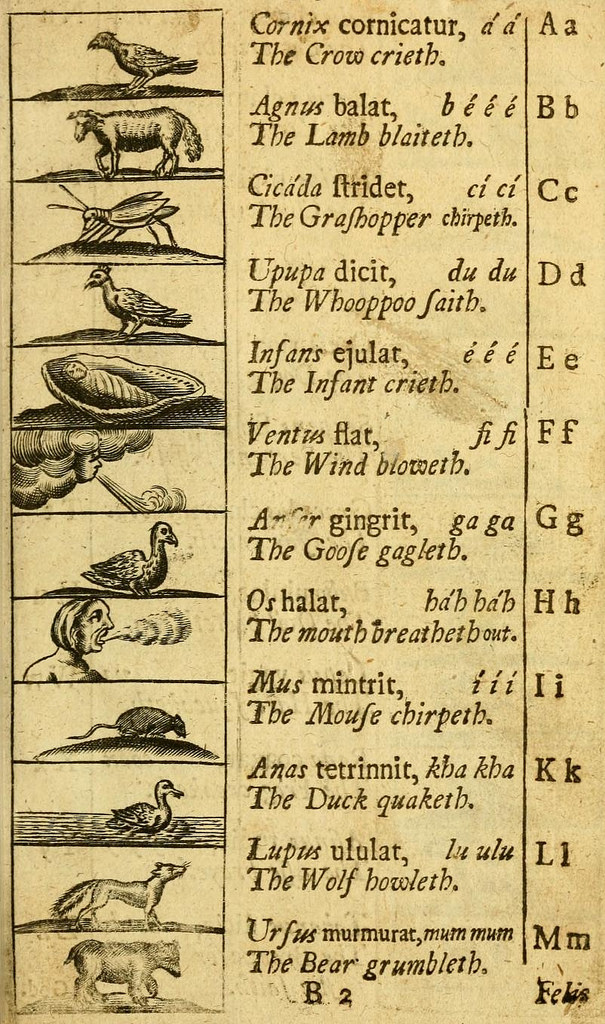
I’ve heard a fair few new parents agonizing about what children’s books to admit into the family canon. Many of the same names keep coming up: 1947’s Goodnight Moon, 1969’s The Very Hungry Caterpillar, 1977’s Everyone Poops — classics, all. Oddly, I’ve never heard any of them mention the earliest known children’s book, 1658’s Orbis Sensualium Pictus, or The World of Things Obvious to the Senses Drawn in Pictures. “With its 150 pictures showing everyday activities like brewing beer, tending gardens, and slaughtering animals,” writes Charles McNamara at The Public Domain review, the Orbis looks “immediately familiar as an ancestor of today’s children’s literature. This approach centered on the visual was a breakthrough in education for the young. [ … ] Unlike treatises on education and grammatical handbooks, it is aimed directly at the young and attempts to engage on their level.” In other words, its author, Czech-born school reformer John Comenius, accomplishes that still-rare feat of writing not down to children, but straight at them — albeit in Latin.
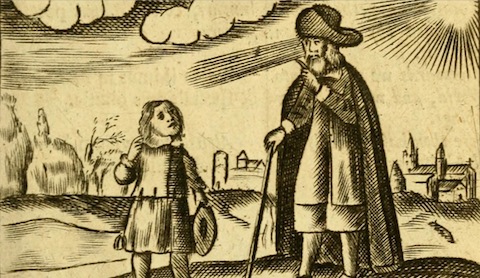
The Orbis holds not just the status of the first children’s book, but the first megahit in children’s publishing, receiving translations in a great many languages and becoming the most popular elementary textbook in Europe. It opens with a sentence that, in McNamara’s words, “would seem peculiar in today’s children’s books: ‘Come, boy, learn to be wise.’ We see above a teacher and student in dialogue, the former holding up his finger and sporting a cane and large hat, the latter listening in an emotional state somewhere between awe and anxiety. The student asks, ‘What doth this mean, to be wise?’ His teacher answers, ‘To understand rightly, to do rightly, and to speak out rightly all that are necessary.’ ” This leads into something like “an early version of ‘Old MacDonald Had a Farm,’ ” lessons on “the philosophical and the invisible,” “thirty-five chapters on theology, elements, plants, and animals,” and finally, an “extensive discussion” of religion which ends with “an admonition not to go out into the world at all.” After reading the Orbis, embedded in full at the top of this post, you can judge for yourself whether it belongs on the shelf. Perhaps you could file it alongside Richard Scarry’s Busytown books?
Related Content:
The International Children’s Digital Library Offers Free eBooks for Kids in Over 40 Languages
The Epistemology of Dr. Seuss & More Philosophy Lessons from Great Children’s Stories
Colin Marshall hosts and produces Notebook on Cities and Culture and writes essays on cities, language, Asia, and men’s style. He’s at work on a book about Los Angeles, A Los Angeles Primer. Follow him on Twitter at @colinmarshall or on Facebook.
Read More...Neil deGrasse Tyson Puts Bill Gates’ Wealth into Funny Perspective
Astrophysicist Neil deGrasse Tyson has a way of putting things into perspective. Usually he’s looking at where we — our planet, our civilization — sit in relationship to the larger cosmos. But, in this clip recorded at the University of Washington in 2011, he’s helping us wrap our head around something equally unfathomable and seemingly infinite: Bill Gates’ big pile of money.
via Reddit
Related Content:
Neil deGrasse Tyson Lists 8 (Free) Books Every Intelligent Person Should Read
Carl Sagan Writes a Letter to 17-Year-Old Neil deGrasse Tyson (1975)
Neil deGrasse Tyson Explains Why He’s Uncomfortable Being Labeled an ‘Atheist’
Read More...William S. Burrough’s Avant-Garde Movie ‘The Cut Ups’ (1966)
In 1920, Dadaist extraordinaire Tristian Tzara described in his manifesto how to write a poem, Dada-style. It involved cutting up the words from a text, dumping them into a bag and then pulling out the words randomly. “And there you are,” he wrote. “An infinitely original author of charming sensibility, even though unappreciated by the vulgar herd.” Who would have thought that Tzara’s avant-garde methods would be adapted into a successful line of refrigerator magnets?
In 1959, William S. Burroughs had just published his notorious non-linear masterpiece Naked Lunch (heard him read it here) when he came across the “cut-up” methods of British artist Brion Gysin, which were influenced by Tzara. Soon the author started using cut-up techniques explicitly in his own work, particularly in his The Nova Trilogy. Unlike Tzara, who believed that cut-ups would reveal the utter absurdity of the world, Burroughs argued that language was a means of control that locked us into traditional ways of thinking. The cut-up was one way of blunting that control with new, unexpected juxtapositions. Excited by the possibilities of the cut-up, he experimented with it in a number of different media.
The 1966 short The Cut-Ups is probably Burrough’s best-known foray into experimental film, which he made with filmmaker and renowned smut/horror distributor Antony Balch. The film features random, repetitive shots of Burroughs in New York, London and Tangiers spliced together in precise lengths but with little regard for the content of the image. The audio is a cut-up conversation with the words “Yes” and “Hello,” getting looped over and over and over again.
The film is a trippy, mesmerizing experience. The mind struggles to make sense of the chaos. It feels like you’re watching a dream that has somehow short-circuited. When the film first premiered, film audiences were reportedly freaked out. Some declared that the movie made them feel ill while others demanded their money back. You can watch it for free above. Don’t say you weren’t warned.
And if you’re in the mood for some more avant-garde cinematic goodness then you can check out Burroughs and Balch’s first collaboration Towers Open Fire below. It’s NSFW. More avant-garde films can be found in our collection, 4,000+ Free Movies Online: Great Classics, Indies, Noir, Westerns, Documentaries & More.
Related Content:
William S. Burroughs on the Art of Cut-up Writing
William S. Burroughs Reads His Controversial 1959 Novel Naked Lunch
Jonathan Crow is a Los Angeles-based writer and filmmaker whose work has appeared in Yahoo!, The Hollywood Reporter, and other publications. You can follow him at @jonccrow.
Read More...Support Metafilter
A couple of years ago, I was asked to name the first five sites I visit each day. Without pause, I rattled off Metafilter, a crowdsourced blog where intelligent contributors highlight interesting things and answer each other’s questions. Metafilter has been around since 1999, and it’s been the source of countless posts on Open Culture over the years. Do a search for “via Metafilter” on our site, and you will see what I mean.
Two days ago, Metafilter’s founder Matt Haughey (see him talk about the history of Metafilter above) stunned readers when he published a post about his site’s financial situation. His post begins: “Today I need to share some unfortunate news: because of serious financial downturn, MetaFilter will be losing three of its moderators to layoffs at the end of this month.” And it ends: “We may have to make hard choices in the future as they come up, but the goal will always be towards having the best place online to share neat stuff, to ask and answer questions, and to have the kinds of thoughtful conversations that make this place what it is.”
Encouraged by its readers, Metafilter launched a fundraising campaign today. Through Paypal you can subscribe to Metafilter for $1, $2, $3, $5, $10, or $20 per month or you can make a one-time contribution. If you’re a fan of Metafilter, definitely consider giving them your support. If you’re not yet a fan, then spend some time at Metafilter and consider giving a hand once you’re hooked.
Read More...Support Us
We're hoping to rely on loyal readers, rather than erratic ads. Please click the Donate button and support Open Culture. You can use Paypal, Venmo, Patreon, even Crypto! We thank you!

About Us

Open Culture scours the web for the best educational media. We find the free courses and audio books you need, the language lessons & educational videos you want, and plenty of enlightenment in between.
Advertise With Us

FREE UPDATES!
GET OUR DAILY EMAIL
Get the best cultural and educational resources on the web curated for you in a daily email. We never spam. Unsubscribe at any time.
FOLLOW ON SOCIAL MEDIA

Open Culture editor Dan Colman scours the web for the best educational media. He finds the free courses and audio books you need, the language lessons & movies you want, and plenty of enlightenment in between.
Advertise With Us

