Jonathan Safran Foer, Toni Morrison & Steven Pinker Cultivate Thought on Chipotle’s Cups and Bags
If you walk into Chipotle, order a drink, and look at the cup, you might see the following literary text:
TWO-MINUTE SEDUCTION
by TONI MORRISONI took my heart out and gave it to a writer made heartless by fame, someone who needed it to pump blood into veins desiccated by the suck and roar of crowds slobbering or poisoning or licking up the red froth they mistake for happiness because happiness looks just like a heart painted on a valentine cup or tattooed on an arm that has never held a victim or comforted a hurt friend. I took it out and the space it left in my chest was sutured tight like the skin of a drum.
As my own pulse failed, I fell along with a soft shower of rain typical in this place.
Lying there, collapsed under trees bordering the mansion of the famous one I saw a butterfly broken by the slam of a single raindrop on its wings fold and flutter as it hit a pool of water still fighting for the lift that is its nature. I closed my eyes expecting to dissolve into stars or lava or a brutal sequoia when the famous writer appeared and leaned down over me. Lifting my head he put his lips on mine and breathed into my mouth one word and then another, and another words upon words then numbers, then notes. I swallowed it all while my mind filled with language, measure, music, knowledge.
These gifts from the famous writer were so seductive, so all encompassing they seemed to make a heart irrelevant.
Other cups and brown paper bags feature short thoughts by Malcolm Gladwell, George Saunders, Steven Pinker, Michael Lewis, and Sheri Fink, among others. The initiative, dubbed Cultivating Thought, was actually the brainchild of novelist Jonathan Safran Foer (Everything Is Illuminated and Extremely Loud and Incredibly Close). Years ago, he met with Chipotle’s CEO and posed the question: why not give people a little food for thought on your cups and brown paper bags? Just last week, the Cultivating Thought Author series was launched, with Safran Foer serving as its “curator.”
Read More...Revisit the Golden Age of Max’s Kansas City With Film & Audio From The Velvet Underground, The Ramones, Devo & Talking Heads
You know the old joke: “if you don’t like the neighborhood, wait ten minutes.” New Yorkers know it the other way around, too. If you like the neighborhood, wait ten minutes; your local haunts will disappear. But while the physical markers of my own New York era shutter one by one, during said era all I ever wanted was for it to be the late 70s again, when you could catch such upstarts as the Talking Heads, Devo, the Ramones, Television, or Patti Smith at Max’s Kansas City. Or even earlier in the decade, when Max’s served as the NYC home base for David Bowie, Iggy Pop, Lou Reed, and even a young Bruce Springsteen.
Despite Max’s hallowed status in the New York rock scene, precious little footage survives from its heyday. The film at the top shows us what producer David Weisman says in voice-over narration is to his knowledge the only 35mm, motion picture-quality film of “the renowned, legendary, unforgettable Max’s Kansas City,” where Andy Warhol “held court every night from midnight till dawn.” Weisman points out local stars of the Warholian scene in the vintage film, reminisces about his own time there, and describes a lighting situation that made filming in the club very difficult. Just above, hear what those denizens in the footage heard: live audio of the Velvet Underground playing “I’m Waiting for the Man” and “Sweet Jane” live at Max’s in 1972.
Filming at Max’s may have been challenging, but clearly, as you see above, one could get it right, even in lesser formats. Here we have classic 1976 film of the Ramones playing “Havana Affair” and “Listen to My Heart” at Max’s during its post-Warhol second phase, when the club became second only to CBGBs as the home of New York punk rock and new wave.
The Ramones film may not be 35mm, but the quality of sound and image surely excels that of every other document from the period, like the short, blurry film above of Devo playing their bizarro take on “Satisfaction” in 1977.
Yet another precious artifact from the late-70s Max’s scene comes to us without any moving images at all, but the audio is quite good and represents a formative moment in the evolution of the Talking Heads, only a trio at the time. Hear them do “Artists Only” above in 1976.
Max’s didn’t only shelter punks and strung-out art rockers. In the early seventies, booker Sam Hood also secured sixties folk mainstays like Dave Van Ronk and newcomers like soon-to-be wildly famous Bruce Springsteen. See the young Boss open for Van Ronk above with an acoustic version of “Growing Up” in 1972.
Max’s closed down in 1981 with a headlining performance by DC hardcore punks Bad Brains, but it has since reopened in another location (1998). The new (gasp!—Midtown) Max’s isn’t Max’s Kansas City in anything but name, but its website at least preserves the memory of the old club’s heady 70s days with more live audio and memorabilia from The Velvets, Sid Vicious, Johnny Thunders & The Heartbreakers, and many more “Max’s Icons.” Also don’t miss this Flavorwire gallery of classic photographs from 70s-era Max’s.
Related Content:
The Talking Heads Play CBGB, the New York Club that Shaped Their Sound (1975)
Josh Jones is a writer and musician based in Durham, NC. Follow him at @jdmagness.
Read More...Jack Kerouac’s Poems Read by Patti Smith, John Cale & Other Icons (with Music by Joe Strummer)
Jack Kerouac was cool before it was cool.
Kerouac’s breakout novel, On the Road, influenced generations of artists, writers and musicians. His prose was vital and messy and new. He wrote frankly about sex, drugs and spiritual yearning. He was young and movie star good looking. And he was a friend with just about every other literary rock star of the era – William S. Burroughs, Allen Ginsberg, Gary Snyder and Neal Cassady — many of whom ended up characters in his books.
Though Kerouac was best known for his novels — Dharma Bums happens to be my personal fave — he also wrote poetry. His poems read like distilled versions of his prose – freeform, flowing and musical, laced with themes of death, drinking and Buddhism. He once wrote that he wanted his poetry “to be considered as a jazz poet blowing a long blues in an afternoon jazz session on Sunday.”
So it isn’t surprising perhaps that back in 1997 some very cool people like Hunter S. Thompson, John Cale, Joe Strummer and Michael Stipe got together to record the spoken word tribute album Kerouac: Kicks Joy Darkness (download on Amazon or iTunes), which sets his poems to music. Or hear it below on Spotify.
Patti Smith, the godmother of punk, reads his poem “The Last Hotel” accompanied by music from Thurston Moore and Lenny Kaye. You can listen in the video above and read along below.
The last hotel
I can see the black wall
I can see the silhouette on the window
He’s talking, at a rhythm
He’s talking, at a rhythm
But, I don’t care
I’m not interested in what he’s saying
I’m only interested in the last hotel
I’m only interested in the fact that it’s the last hotel
Deep, discordant, dark, sweet
The last hotel
The last hotel
Ghosts in my bed
The goats I bled
The last hotel
Perhaps Kerouac’s best-known poem is “Bowery Blues,” which combines Buddhist notions of “sansgara” (aka samsara), the karmic cycles of birth and death, with a very Beat-like disgust of contemporary American culture. You can imagine this being absolutely spellbinding when read out loud in a smoky coffee shop. Lydia Lunch’s reading is above. The text below.
The story of man
Makes me sick
Inside, outside,
I do not know why
Something so conditional
And all talk
Should hurt me so.I am hurt
I am scared
I want to live
I want to die
I do not know
Where to turn
In the Void
And When
To cut
OutFor no Church Told me
No Guru holds me
No advice
Just stone
Of New York
And on the Cafeteria
We hear
The Saxophone
O dead Ruby
Died of Shot
In Thirty Two,
Sounding like old times
And de bombed
Empty decapitated
Murder by the clock.And I see Shadows
Dancing into Doom
In love, holding
TIght the lovely asses
Of the little girls
In love with sex
Showing Themselves
In white undergarments
At elevated windows
Hoping for the Worst.I can not take it
Anymore
If I can not hold
My little behind
To me in my roomThen it’s goodbye
Sangsara
For me
Besides
Girls aren’t as good
As They look
And Samadhi
Is better
Than you think
When it starts in
Hitting your head
In with Buzz
Of Glittergold
Heaven’s Angels
WailingSaying
We’ve been waiting for you
Since Morning, Jack
Why were you so long
Dallying in the sooty room?
This transcendental Brilliance
Is the better part
(of Nothingness
I sing)Okay.
Quit.
Mad.
Stop
And finally, you can listen to Kerouac read his own poem “MacDougal Street Blues” set to some beats laid down by the late, great Joe Strummer.
Written in Jim Hudson’s window lookin’ out on MacDougal Street
Summer of 1954, when he left me his whole apartment
He went away with his girl someplace:Parade among Images
Images Images Looking
Looking -
And everybody’s turning around
& pointing -
Nobody looks up
and In
Nor listens to Samantabhadra’s
Unceasing CompassionNo Sound Still
S s s s t t
Seethe
Of Sea Blue Moon
Holy X‑JackMiracle
Night -
Instead yank & yucker
For pits & popsLook for crashes
Pictures
Squares
Explosions
Birth
Death
Legs
I know, sweet hero,
Enlightenment has Come
Rest in StillIn the Sun Think
Think Not
Think no more Lines -
Straw hat, hands a back
Classed
He exam in atein distinct
Rome prints -
Trees prurp
and sawThe Chessplayers Wont End
Still they sit
Millions of hats
In underwater foliage
Over marble games
The Greeks of ChessPlot the Pop
of Mate
King Queen- I know their game,
their elephant with the pillar
With the pearl in it,
Their gory bishops
And Vital Pawns -
Their devout frontline
Sacrificial pawn shops
Their stately king
Who is so tall
Their Virgin Queens
Pree ing to Knave
The Night Knot
— Their Bhagavad Gitas
of Ignorance,
Krishna’s advice,Comma,
The game begins -Jean-Louis
Go home, Man- So tho I am wise
I have to wait like
AnyotherfoolLets forget the strollers
Forget the scene
Lets close our eyes
Let me instruct Thee
Here is dark Milk
Here is Sweet Mahameru
Who will Coo
To you TooAs he did to me
One night at three
When I w k e i t
P l e e
Knelt to See
Realit ee
And I said
‘Wilt thou protect me
for ‘ver?’And he in his throatless
deep mother hole
Replied ’ H o m ’
Related Content:
Jack Kerouac Lists 9 Essentials for Writing Spontaneous Prose
Pull My Daisy: 1959 Beatnik Film Stars Jack Kerouac and Allen Ginsberg
Jack Kerouac Reads from On the Road (1959)
Jack Kerouac’s Naval Reserve Enlistment Mugshot, 1943
Jonathan Crow is a Los Angeles-based writer and filmmaker whose work has appeared in Yahoo!, The Hollywood Reporter, and other publications. You can follow him at @jonccrow.
Read More...David Bowie Remembers His Ziggy Stardust Days in Animated Video
When you think about Ziggy Stardust this week, you’ll probably think first about the story making the rounds — that Canadian astronaut Chris Hadfield’s cover of Bowie’s “Space Oddity” has disappeared from the web, thanks to a copyright claim by David Bowie. Bowie gave Hadfield permission to use the “Space Oddity” track for a year. The time is now up. The viral video, gone. We mourn. But not for too long. Yesterday, Blank on Blank released the latest in its series of animated videos. Based on an interview recorded by Joe Smith in 1988, the video (above) animates Bowie’s reflections on his Ziggy Stardust days, from whence “Space Oddity” came. He recalls how Ziggy was “half out of sci-fi rock and half out of the Japanese theater. The clothes were, at that time, simply outrageous. And simply… Nobody had seen anything like them before.” We have much more on Bowie’s Ziggy Stardust period in our archive. See the posts below.
Related Content:
David Bowie Recalls the Strange Experience of Inventing the Character Ziggy Stardust (1977)
The Story of Ziggy Stardust: How David Bowie Created the Character that Made Him Famous
David Bowie’s Final Gig as Ziggy Stardust Documented in 1973 Concert Film
Read More...Philip K. Dick’s Favorite Classical Music: A Free, 11-Hour Playlist

Image by Pete Welsch
What did Do Androids Dream of Electric Sheep? and A Scanner Darkly author Philip K. Dick, that visionary of our not-too-distant dystopian future, listen to while he crafted his descriptions of grim, psychologically (and sometimes psychedelically) harrowing times ahead? Mozart. Beethoven. Mahler. Wagner.
Yes, while looking textually forward, he listened backward, soundtracking the constant workings of his imagination with classical music, as he had done since his teenage years. As Lejla Kucukalic writes in Philip K. Dick: Canonical Writer of the Digital Age:
After graduating from high school in 1947, Dick moved out of his mother’s house and continued working as a clerk at a Berkeley music store, Art Music. “Now,” wrote Dick, “my longtime love of music rose to the surface, and I began to study and grasp huge areas of the map of music; by fourteen I could recognize virtually any symphony or opera” (“Self-Portrait” 13). Classical music, from Beethoven to Wagner, not only stayed Dick’s lifelong passion, but also found its way into many of his works: Wagner’s Goterdammerung in A Maze of Death, Parsifal in Valis, and Mozart’s Magic Flute in Do Androids Dream of Electric Sheep?
At his Forteana Blog, author Andrew May credits Dick with, given his pop-cultural status, “a decidedly uncool knowledge of classical music.” He cites not just Wagner’s Der Ring des Nibelungen in the introduction to A Maze of Death, Beethoven’s Missa Solemnis in Ubik, or the part of The Game-Players of Titan where “a teenaged kid forks out 125 dollars for a vintage recording of a Puccini aria,” but an entire early story which functions as “(in my opinion) a pure exercise in classical music criticism.” In 1953’s “The Preserving Machine,” as May retells it, an eccentric scientist, “worried that Western civilization is on the point of collapse, invents a machine to preserve musical works for future generations” by encoding it “in the form of living creatures. Unfortunately, as soon as the creatures are released into the environment, they start to adapt to it by evolving into different forms, and the music becomes distorted beyond recognition.”
Though no doubt an astute speculator, Dick seems not to have foreseen the fact that our era suffers not from too few means of music storage but, perhaps, too many. None of his visions presented him with, for example, the technology of the Spotify playlist, an example of which you’ll find at the bottom of this post. In it, we’ve assembled for your enjoyment some of Dick’s favorite pieces of classical music. The songs come scouted out by Galleycat’s Jason Boog, who links to them individually in his own post on Dick, classical music, and May’s writing on the intersection of those two cultural forces. Listen through it while reading some of Dick’s own work — don’t miss our collection of Free PKD — and you’ll understand that he cared about not just the anxieties of humanity’s future or the great works of its past, but what remains essential throughout the entire human experience. These composers will still appear on our playlists (or whatever technology we’ll use) a hundred years from now, and if we still read any sci-fi author a hundred years from now, we’ll surely read this one.
The 11 hour playlist (stream below or on the web here) includes Bach’s Goldberg Variations, Beethoven’s Missa Solemnis and Fidelio, Mozart’s The Magic Flute, Wagner’s Parsifal, and Mahler’s Symphony No. 2 (Resurrection). If you need to download Spotify, grab the software here.
Related Content:
33 Sci-Fi Stories by Philip K. Dick as Free Audio Books & Free eBooks
Robert Crumb Illustrates Philip K. Dick’s Infamous, Hallucinatory Meeting with God (1974)
Colin Marshall hosts and produces Notebook on Cities and Culture and writes essays on cities, language, Asia, and men’s style. He’s at work on a book about Los Angeles, A Los Angeles Primer. Follow him on Twitter at @colinmarshall or on Facebook.
Read More...The First-Ever Look at the Original Disneyland Prospectus
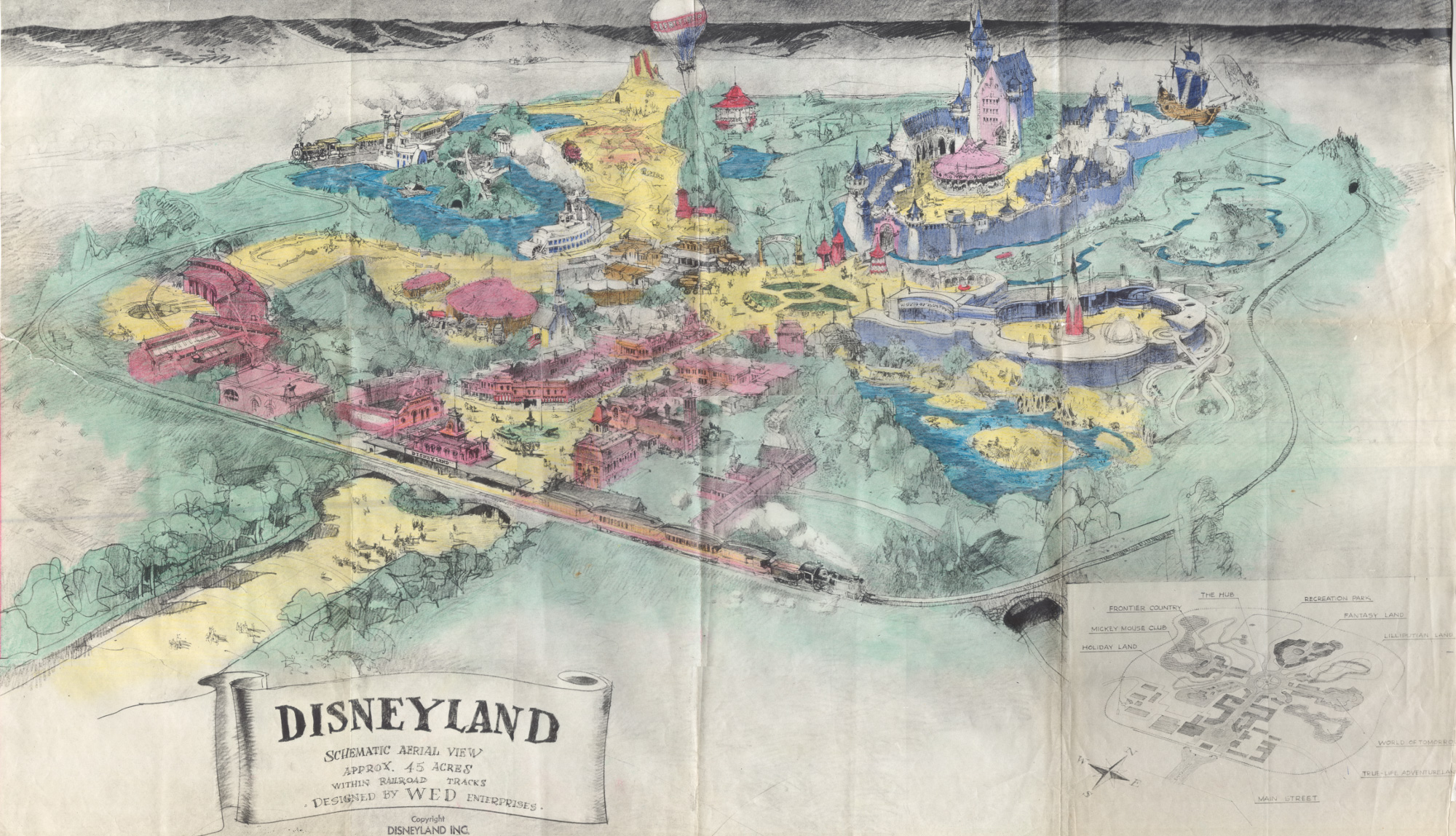
Thanks to a benefactor, Boing Boing has posted the original Disneyland prospectus, drafted in 1953. These “extremely high-resolution scans,” Boing Boing says, “were made from one of the three sets of pitch-documents Roy and Walt Disney used to raise the money to build Disneyland.” The document isn’t long. It runs 12 pages from front to back. And it imagines some of the first parts of the park. Of course, there’s Main Street, but there’s also “True Life Adventureland,” “Lilliputian Land” and “Fantasy Land.” These imagined parts of the park were meant to entertain youngsters. They were also meant to educate. (The last page of the Prospectus sums things up by saying, “The idea of Disney land is a simple one. It will be a place for people to find happiness and knowledge.…, a place for teachers and pupils to discover greater ways of understanding and education.” And, as Cory Doctorow notes, they were meant to make money. (In “True-Life Adventureland,” says the Prospectus, “magnificently plumed birds and fantastic fish from all over the world… may be purchased and shipped anywhere in the U.S. if you so desire.”) These days, the educational mission of Disneyland isn’t much in evidence, while the “merchantainment” side remains. But that doesn’t stop me from enjoying it. You can find the Prospectus on Archive.org in different formats. Or see it below.
via BoingBoing
Related Content:
Disneyland 1957: A Little Stroll Down Memory Lane
How Walt Disney Cartoons Are Made (1939)
Read More...Geometria: Watch Guillermo del Toro’s Very Early, Ghoulish Short Film (1987)
Guillermo Del Toro is one of those lucky filmmakers, like Steven Spielberg and Tim Burton, whose personal obsessions naturally seem to align with mainstream movie-going audiences. From Chronos to Hellboy to his Oscar-nominated 2006 movie Pan’s Labyrinth, Del Toro’s movies are often macabre and frightening but they are leavened by his goofy sense of humor and his incredible visual imagination.
Prior to making his breakout debut feature Cronos, Del Toro directed a string of short films including his 1987 horror comedy Geometria, which displays both his sense of humor and some serious directing chops. Check out the short above and, as you watch, remember that the flick was reportedly made for about $1000.
Geometria opens with a recent widow haranguing her teenaged son about how he is flunking out of geometry. At the end of the fight, the son vows that he will never fail at the subject again. Instead of hitting the books or even hiring a tutor, though, the lad turns to black magic. Spoiler: this proves to be a bad idea.
After drawing a bloody pentagon on the floor, he summons a demon and requests it fulfill two wishes: to resurrect his recently deceased father and to help him not flunk geometry again. The creature, who looks a bit like Linda Blair from The Exorcist, grants the teen his first wish. Dear old dad does come back but in the form of a rotting zombie who immediately starts to feast on his mother’s neck. From there, as you might expect, things get much worse for the lad.
You can see the director’s cut of Geometria below. Sadly this clip doesn’t have subtitles though the image quality is much better.
Find many other great films in our collection, 4,000+ Free Movies Online: Great Classics, Indies, Noir, Westerns, Documentaries & More.
Related Content:
Tim Burton’s Early Student Films: King and Octopus & Stalk of the Celery Monster
Sketches by Guillermo del Toro Take You Inside the Director’s Wildly Creative Imagination
Jonathan Crow is a Los Angeles-based writer and filmmaker whose work has appeared in Yahoo!, The Hollywood Reporter, and other publications. You can follow him at @jonccrow.
Read More...
World War I Unfolds in a Three Minute Time-Lapse Film: Every Day From 1914 to 1918
As time places us ever further from the event, our knowledge of (and—generally speaking—interest in World War I) has shrunk precipitously. That trend is reversing as the centennial of Archduke Franz Ferdinand’s assassination draws nigh.
The Atlantic’s Alan Taylor launched an excellent 10-part series on World War I, which thusfar explored the role of technology and animals.
Cartoonist Joe Sacco documented the Battle of the Somme’s first day in The Great War, an astonishing twenty-four-foot-long panorama.
The UK’s Imperial War Museum is inviting the public to contribute photos and family anecdotes to Lives of the First World War, an interactive digital database.
It’s a good time to play catch up.
Before I started studying this game-changing catastrophic event with my young son, one of my few germane pieces of information was that a lot of soldiers lived and died in trenches dug along the Western front. Even without photos, statistics, or personal stories, this defining aspect hits home hard in Emperor Tigerstar’s animated map of the Great War’s changing front lines in Europe and the Middle East, above.
The trenches were built following the First Battle of the Marne in September 1914. Eventually they covered over 25,000 miles. Hundreds of thousands met their ghastly ends there, via bombs, illness, and poison gas attacks, but these losses resulted in very little geographic gain for one side or the other.
If you’re looking for change, keep your eye peeled for the Russian Revolution. The Western Front was a deadlock.
An animated timeline of World War II can be found here.
Related Content:
The BBC’s Horrible Histories Videos Will Crack You Up and Teach You About WWI (and More)
British Actors Read Poignant Poetry from World War I
World War I Remembered in Second Life
Ayun Halliday is the author of seven books, and creator of the award winning East Village Inky zine. Follow her @AyunHalliday
Read More...Samuel Beckett’s Waiting for Godot Airs on American TV (1961): Starring Burgess Meredith & Zero Mostel
1961 saw the television debuts of The Bob Newhart Show, The Dick Van Dyke Show, ABC’s Wide World of Sports, Yogi Bear, and …um, Samuel Beckett’s Waiting for Godot, famously described by theater critic Vivian Mercier as “a play in which nothing happens, twice.”
Burgess Meredith and Zero Mostel, both trying to salvage careers after being blacklisted in the McCarthy period, starred as Vladimir and Estragon, in WNTA-TV’s Play of the Week series’ no-frills production. In contrast to the recent Broadway revival starring grizzled, grubby knights of the realm, Ian McKellen and Patrick Stewart, Meredith and Mostel make a pretty harmless—and apparently unharmed—team. Vladimir’s prostate trouble was scrubbed from the shooting script, along with some 40 minutes of the stage version, five years after its disastrous American premiere.
Alan Schneider, who directed that production, returned to helm the Play of the Week, along with original American cast members Kurt Kaszner and Alvin Epstein, reprising their supporting turns as Pozzo and Lucky. Schneider appears to have had his hands full with the always-larger-than-life Mostel who chews plenty of scenery in addition to his carrot.
For his part, Mostel stated that he “wished to be re-blacklisted” if that would keep him from ever having to work with that director again.
Despite the tension, he and Meredith achieve a winsome Laurel and Hardy-like rapport as they plod up and down a painted road with choreographed aimlessness.
It’s still a bit hard for me to imagine American television audiences tuning-in in numbers sufficient to justify the effort.
To be fair, there were a lot fewer channels then. Play of the Week was a high brow project serving up serious theatrical work on the small screen. The first episode was Judith Anderson’s Medea. Compared to that, or Shakespeare, or Ibsen, a prostate-free Godot might be passed off as televised entertainment the whole family could tolerate for an hour and forty-nine minutes.
If you’re up for it, the entire production is yours for the viewing below.
Related Content:
Samuel Beckett Directs His Absurdist Play Waiting for Godot (1985)
Monsterpiece Theater Presents Waiting for Elmo, Calls BS on Samuel Beckett
Rare Audio: Samuel Beckett Reads Two Poems From His Novel Watt
Ayun Halliday is the author of seven books, and Chief Primatologist of the award-winning East Village Inky zine. Follow her @AyunHalliday
Read More...Doña Lupe: An Early, Short Horror Film by Guillermo del Toro (1985)
Long before Pan’s Labyrinth (2006), Blade II (2002), and Hellboy (2004), the Mexican-born director Guillermo del Toro shot Doña Lupe. Del Toro made the short film in 1985, when he was only 19 years old. According to one reviewer, the film “feels like the work of an amateur artist getting to grips with his craft.” The film is in Spanish. Currently, subtitles are unavailable. You can find Doña Lupe listed in our collection, 4,000+ Free Movies Online: Great Classics, Indies, Noir, Westerns, Documentaries & More.
If you would like to support the mission of Open Culture, consider making a donation to our site. It’s hard to rely 100% on ads, and your contributions will help us continue providing the best free cultural and educational materials to learners everywhere. You can contribute through PayPal, Patreon, and Venmo (@openculture). Thanks!
Read More...Support Us
We're hoping to rely on loyal readers, rather than erratic ads. Please click the Donate button and support Open Culture. You can use Paypal, Venmo, Patreon, even Crypto! We thank you!

About Us

Open Culture scours the web for the best educational media. We find the free courses and audio books you need, the language lessons & educational videos you want, and plenty of enlightenment in between.
Advertise With Us

FREE UPDATES!
GET OUR DAILY EMAIL
Get the best cultural and educational resources on the web curated for you in a daily email. We never spam. Unsubscribe at any time.
FOLLOW ON SOCIAL MEDIA

Open Culture editor Dan Colman scours the web for the best educational media. He finds the free courses and audio books you need, the language lessons & movies you want, and plenty of enlightenment in between.
Advertise With Us

