The History of the Movie Camera in Four Minutes: From the Lumiere Brothers to Google Glass
For their annual Lifetime Achievement Awards, the folks over at the Society of Camera Operators put together a lovely, surprisingly rousing video about the evolution of the movie camera over the course of the past century or so of cinema. And, as you can see above, it has changed quite a bit.
The piece begins at the beginning, with the early pioneers of film: the Lumiere brothers’ first motion picture cameras and their revolutionary actualités, Georges Méliès’ baroque flights of fancy, D. W. Griffith’s sprawling epics. The cameras that shot these films were crude, boxy and hand-powered but their basic mechanics were roughly the same as the sophisticated 70mm cameras Stanley Kubrick used to shoot 2001: A Space Odyssey six decades later.
Then in the ‘80s, things started to change with the release of analog video. Suddenly, you could capture movement in a manner that didn’t involve exposing frame by frame an unspooling reel of light-sensitive celluloid. And with the digital revolution that started in the ‘90s, cameras, and the very nature of cinema, changed. Dazzling spectacles like Avatar and Gravity could be created almost entirely within a computer, while at the same time the cameras themselves grew smaller and more portable.
To underscore just how democratized the technology of movie making has become, the end of the video shows Hollywood cameramen shooting movies with iPhones. The piece ends with what could only be seen as an ominous technological development for the Society of Camera Operators: Google Glass, which has the potential to turn every single person into a perpetual camera operator.
Related Content:
40 Great Filmmakers Go Old School, Shoot Short Films with 100 Year Old Camera
What David Lynch Can Do With a 100-Year-Old Camera and 52 Seconds of Film
A Trip to the Moon (and Five Other Free Films) by Georges Méliès, the Father of Special Effects
Jonathan Crow is a Los Angeles-based writer and filmmaker whose work has appeared in Yahoo!, The Hollywood Reporter, and other publications. You can follow him at @jonccrow.
Read More...
William S. Burroughs Teaches a Free Course on Creative Reading and Writing (1979)
According to Ted Morgan, author of William S. Burroughs biography Literary Outlaw (which Burroughs hated), the hard-living Beat writer added “teacher” to the list of jobs he did not like after an unhappy semester teaching creative writing at the City College of New York. He complained about dimwitted students, and disliked the job—arranged for him by Allen Ginsberg—so much that he later turned down a position at the University of Buffalo that paid $15,000 a semester, even though he desperately needed the money. That Burroughs had recently kicked heroin may have contributed to his unease with the prosaic regularities of college life. Whatever the story, he later remarked that the “teaching gig was a lesson in never again.”
What then could have lured Burroughs out to Boulder Colorado five years later to deliver a series of lectures on creative writing at Naropa University? He’d picked up his heroin habit again, and his friendship with Ginsberg—who co-founded Naropa’s writing program—must have played a part. Whatever the reasons, this assignment differed greatly from his City College stint: no student writing, no office hours or admin. Just Burroughs doing what came naturally—holding court, on literature, parapsychology, occult esoterica, violence, aliens, neuroscience, and his own novels Naked Lunch and The Soft Machine.
Burroughs’ lectures are heavily philosophical, which might have turned off his New York students, but surely turned on his Naropa audience. And if you stopped to listen, it will probably turn you on too, in ways creative and intellectual. Ostensibly on the subject of creative reading, Burroughs also offers creative writing instruction in each talk. His discussions of writers he admires—from Carson McCullers to Aleister Crowley to Stephen King—are fascinating, and he uses no shortage of examples to illustrate various writing techniques. Fortunately for us, the lectures were recorded. Says Dangerous Minds, who provide helpful descriptions of each lecture: “now you can have your very own creative writing class from William S. Burroughs, all thanks to the wonders of YouTube.” Hear all three lectures above, and be by turns inspired, instructed, enlightened, and warped.
You can find Burrough’s lectures on Creative Reading listed in our collection of Free Online Literature Courses, part of our larger collection, 1,700 Free Online Courses from Top Universities.
If you would like to support the mission of Open Culture, consider making a donation to our site. It’s hard to rely 100% on ads, and your contributions will help us continue providing the best free cultural and educational materials to learners everywhere. You can contribute through PayPal, Patreon, and Venmo (@openculture). Thanks!
Related Content:
William S. Burroughs on the Art of Cut-up Writing
William S. Burroughs Reads His Controversial 1959 Novel Naked Lunch
Josh Jones is a writer and musician based in Durham, NC. Follow him at @jdmagness
Read More...Sid Vicious Sings Paul Anka’s “My Way” in His Own Spectacular Way
A film that began its life as a script called Who Killed Bambi?, written by Roger Ebert and Russ Meyer, The Great Rock and Roll Swindle (trailer below) became a farcical caper starring the Sex Pistols minus their lead singer. Johnny Rotten had quit the band at this point and appears only in archival footage. Mostly The Great Rock and Roll Swindle was a vehicle for Malcolm McLaren to sell himself as the guru of punk and the driving force behind the band. Directed by Julien Temple (who also made the far superior Sex Pistols doc, The Filth and the Fury), Swindle is also notable for almost launching a Sid Vicious solo career, and it might have worked, were it not for his epically destructive flame-out in 1978.
The film saw release two years later, and produced a soundtrack album, which I remember finding in a used record bin—pre-Google—and thinking I’d discovered some long lost Sex Pistols album. One listen disabused me of the notion. Some of album is a snapshot of the band’s shambolic final days, but most of it is devoted to “jokey material” from the movie and most of that is pretty terrible. The sole exception is Sid’s version of Paul Anka’s “My Way” (top), a sneering piss take on the song Sinatra made famous. After some obnoxious faux-crooning, Sid tears through song with punk aplomb. Allmusic aptly describes the performance as “inarguably remarkable” yet showing that Sid was “incapable of comprehending the irony of his situation.”
The moment of the performance itself is bathed in sad irony. I’ve always thought it showed that—had he just a little more instinct for self-preservation—we might have someday seen Sid Vicious recording an album’s worth of bratty takes on the American Songbook, but probably at McLaren’s behest. What more he might have had in him is anyone’s guess; in life he seemed unable to rise above the role McLaren assigned him in the film “Gimmick.” But he made it look good. Those familiar with Alex Cox’s definitive portrait Sid and Nancy will of course remember Gary Oldman’s recreation of Sid’s “My Way” (above). Convincing stuff, but no substitute for the real thing.
Related Content:
Sid Vicious and Nancy Spungen Take Phone Calls on New York Cable TV (1978)
Watch the Sex Pistols’ Very Last Concert (San Francisco, 1978)
Josh Jones is a writer and musician based in Durham, NC. Follow him at @jdmagness
Read More...Aldous Huxley, Psychedelics Enthusiast, Lectures About “the Visionary Experience” at MIT (1962)
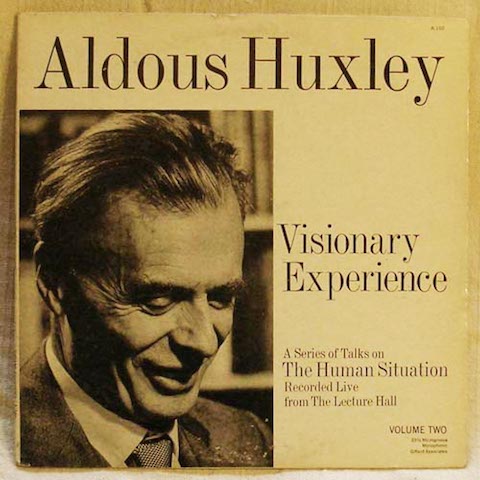
Today, those who get “turned on” to Aldous Huxley (as they might have said back in the 1960s) get it through his books: the dystopian novel Brave New World, usually, or perhaps the mescaline memoir The Doors of Perception. But during Huxley’s lifetime, especially in its final years from the late 1950s to the early 60s, he made no small number of adherents through lecturing. Having transplanted himself from his native England to California in 1937, he eventually achieved great regard among the region’s self-styled intellectuals and spiritual seekers, giving talks at such mystically high-in-the-zeitgeist places as Hollywood and Santa Barbara’s Vedanta temples and even Big Sur’s famous Esalen Institute. But the prolific speech-giver also went farther afield, to far squarer venues such as the Massachusetts Institute of Technology. There, in 1962, he recorded the album Visionary Experience: A Series Of Talks On The Human Situation, which you can hear on Ubuweb, or right below.
At that point, Huxley had already gained worldwide fame for his views on better living, which was sometimes achieved, he believed, through psychedelic drugs. This might have already sounded like old hat in, say, the San Francisco of the late 1960s, let alone the 70s and onward, but in these recordings Huxley says his piece in — I still can’t quite believe it — the MIT of the early 1960s. But Huxley, diagnosed a couple years before with the cancer that would claim his life the next, had nothing to lose by spreading the word of his substance-induced discoveries. These would, as you may remember, even facilitate the death itself, Huxley’s final visionary experience. To learn even more about all those that preceded it, see his collection Writings on Psychedelics and the Visionary Experience (1931–1963), that’s available on the Internet Archive. While we here at Open Culture don’t endorse drug use, we do endorse the words of Huxley as a substitute, and perhaps an even more vivid one.
Related Content:
Aldous Huxley’s Most Beautiful, LSD-Assisted Death: A Letter from His Widow
Aldous Huxley Reads Dramatized Version of Brave New World
Zen Master Alan Watts Discovers the Secrets of Aldous Huxley and His Art of Dying
Colin Marshall hosts and produces Notebook on Cities and Culture and writes essays on cities, language, Asia, and men’s style. He’s at work on a book about Los Angeles, A Los Angeles Primer. Follow him on Twitter at @colinmarshall or on Facebook.
Read More...See The Guidonian Hand, the Medieval System for Reading Music, Get Brought Back to Life
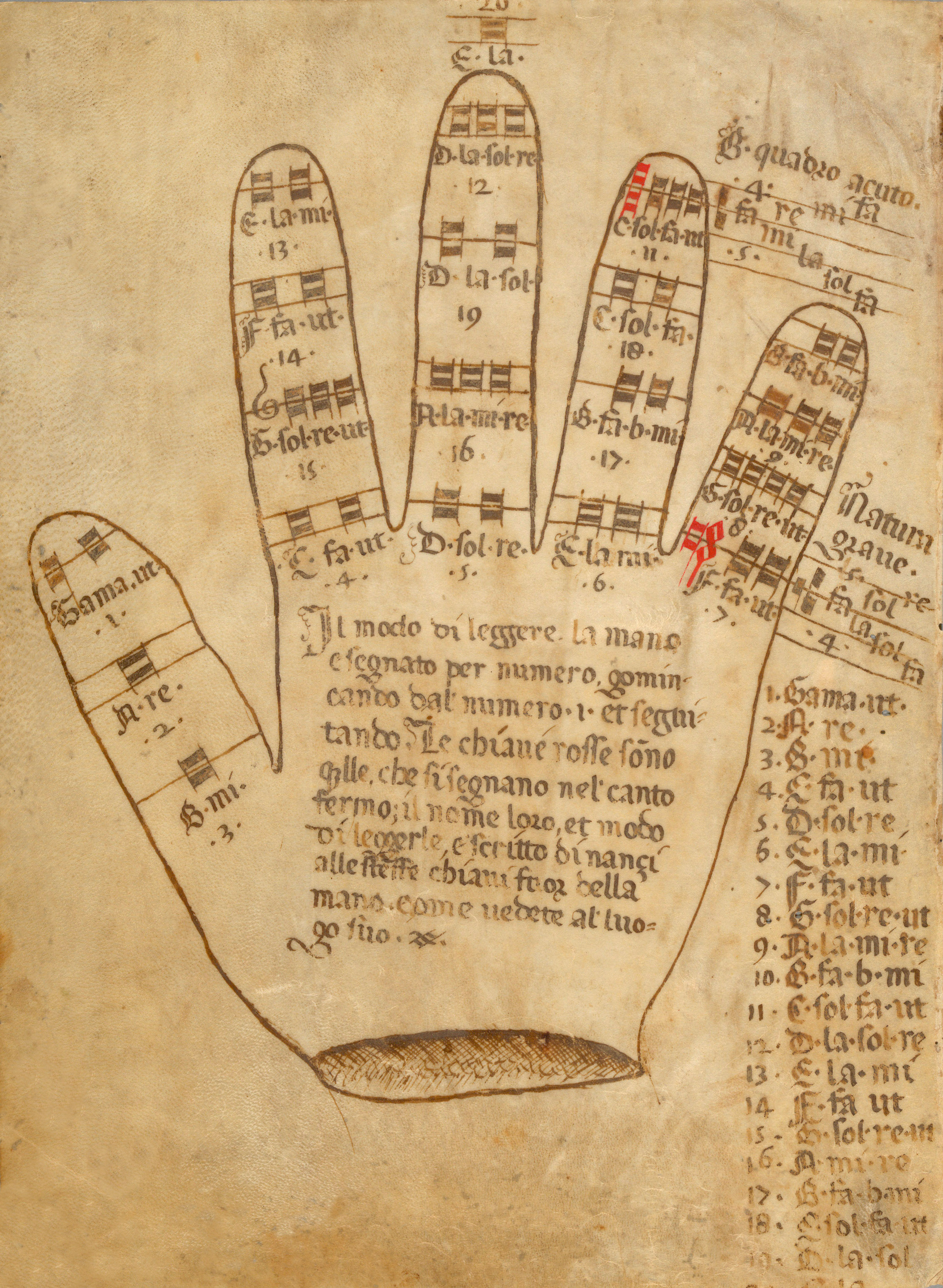
Singing a piece of music for the first time while reading the notes from a sheet is hard, and requires complete control of one’s vocals. Today, the most popular ways of teaching this skill to musicians are based on the solfège method, where notes on a scale are matched to particular syllables: your standard do, re, mi, fa, so la, si. Students practice singing different combinations of these syllables, using varying rhythms and intervals, and eventually cement their knowledge of that particular scale. The method is, surprisingly, almost a millenium old, with the first European use of this mnemonic technique dating back to the middle ages.
In the 11th century, a monk known as Guido of Arezzo, began to use the “Guidonian hand” as way to teach medieval music singers his hexachord, or six-note scales. Arezzo, who had also devised the modern musical notation system, had noticed that singers struggled to remember the various Gregorian chants that the monastic orders performed in the monasteries.
To help their memorization, Guido decided to take the first syllable in each line of the well known hymn Ut Queant Laxis, and created a hexachord, or six note scale, that singers familiar with the hymn already knew: ut, re, mi, fa, sol, la. The hand, shown above, was a map of the musical notes in this hexachord system, with each note associated with a particular joint. In all, the Guidonian hand ranges almost three octaves. Although it had fallen out of use for the past few centuries, the Guidonian hand seems to be making a comeback. Here’s a video of the method in action, forwarded our way by Anton Hecht, an Open Culture reader:
I love the concept, but can’t help feel that using the Guidonian hand during a performance makes you look a little like a first grader struggling with basic arithmetic.
For more information on the Guidonian hand, check out this writeup of a 2011 Stanford symposium, and watch another demonstration video, here.
Ilia Blinderman is a Montreal-based culture and science writer. Follow him at @iliablinderman, or read more of his writing at the Huffington Post.
Related Content:
What Ancient Greek Music Sounded Like: Hear a Reconstruction That is ‘100% Accurate’
Explosive Cats Imagined in a Strange, 16th Century Military Manual
Read More...Seinfeld & Nothingness: A Supercut of the Show’s Emptiest Moments
They say Seinfeld was about nothing. But the clip above puts that sense of nothingness into perspective. Running six plus minutes, the montage assembled by LJ Frezza presents “A supercut of empty shots. A New York without people.” Essentially moments of pure nothingness. When you’re done, you can graduate to some more existentialist ideas — some fun, some substantive — in our archive.
Related Content:
The Existential Star Wars: Sartre Meets Darth Vader
The Jean-Paul Sartre Cookbook: Philosopher Ponders Making Omelets in Long Lost Diary Entries
Walter Kaufmann’s Lectures on Nietzsche, Kierkegaard and Sartre (1960)
Sartre, Heidegger, Nietzsche: Documentary Presents Three Philosophers in Three Hours
100 Free Philosophy Courses Online
Animated Video Features Werner Herzog Discussing His Childhood Adventures & 20th-Century Rage
I’m not surprised that filmmaker Werner Herzog hates the commodification of the word “adventure,” when he’s spent over four decades courting it in the most classic sense. In the New York Public Library Conversation Portrait above (one of a series that includes the John Waters profile we brought you earlier this week), the venerable director describes the sort of childhood that could cause one to take a dim view of packaged tours masquerading as adventure.
After the infant Herzog survived a bombing that covered him in rubble, his mother, understandably fearing for her children’s safety, fled to the mountains. The remoteness of his upbringing sheltered him in some ways (“I did not even know that cinema existed until I was 11”) and not, in others. (“At age four, I was in possession of a functioning submachine gun and my brother had a hand grenade.”)
When he says that hunger was a prevailing theme, I dare you to disagree.
I’m likewise inclined to pay attention when he asserts that the modern obsession with technology is gobbling resources at a disastrous pace, and that thousands of world languages will have disappeared for good by 2050.
Dire predictions, and yet he fills me with cheer every time he opens his mouth. I swear it’s not just that marvelous, much imitated voice. It’s also a comfort to know we’ve got a prolific artist remaining at his outpost from a sense of duty, gloomy yet stout as a child in his belief that an ecstasy of truth lies within human grasp.
Related Content:
Werner Herzog’s Eye-Opening New Film Reveals the Dangers of Texting While Driving
Portrait Werner Herzog: The Director’s Autobiographical Short Film from 1986
Ayun Halliday looks in the eyes of the bear … Follow her @AyunHalliday
Read More...Free Stanley Kubrick App Features Great Photos, Script Notes, Interviews & More
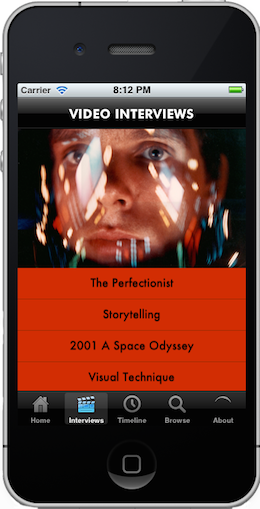 In 2012, the Los Angeles County Museum of Art (LACMA) unveiled a sprawling, exhaustive exhibit on Stanley Kubrick. And it had just about everything you might want on the great director. Early photographs he took for Look magazine in the 1940s? Check. The blood soaked dresses of those creepy twins from The Shining? You got it! Sketches, notes and documents about Napoleon, the greatest movie he never made? They had a whole room for that. For those cinephiles who worship at Kubrick’s altar, LACMA’s exhibit was akin to a visit to the Vatican. There were more holy relics there than you could shake a monolith at—oh, and they had one of those there too.
The exhibit wrapped up in June 2013. If you missed it and you are jonesing for more Kubrick memorabilia, take heart — LACMA designed an app in conjunction with the exhibit for the iPhone, iPad and Android and you can download it right now. For free. The app is about as sprawling as the exhibit (and it will take a bit of time to download) but it features hand drawn notes from Kubrick, behind-the-scenes pictures from all of his movies, and interviews with the director, plus ones with the likes of Elvis Mitchell, Christopher Nolan and Douglas Trumbull.
The only thing that the app and the exhibit didn’t cover is the ever-growing number of insane conspiracy theories surrounding his work. Want something about how The Shining is really about a faked moon landing or how Eyes Wide Shut is really about the Illuminati? Look somewhere else.
Related Content:
Stanley Kubrick’s Daughter Shares Photos of Herself Growing Up on Her Father’s Film Sets
Dark Side of the Moon: A Mockumentary on Stanley Kubrick and the Moon Landing Hoax
Stanley Kubrick’s Very First Films: Three Short Documentaries — Free Online
Rare 1960s Audio: Stanley Kubrick’s Big Interview with The New Yorker
Jonathan Crow is a Los Angeles-based writer and filmmaker whose work has appeared in Yahoo!, The Hollywood Reporter, and other publications. You can follow him at @jonccrow.
Read More...David Bowie and Cher Sing Duet of “Young Americans” and Other Songs on 1975 Variety Show
David Bowie and Cher: the combination sounds so incongruous, but then you think about it and realize the two could hardly have more in common. Two singers of the same generation, close indeed in age but both (whether through their sensibilities or through various cosmetic technologies) perpetually youthful; both performers of not exactly rock and not exactly pop, but some oscillating form between that they’ve made wholly their own; both masters of the distinctively flamboyant and theatrical; both given to sometimes radical changes of image throughout the course of their careers; and both immediately identifiable by just one name. The only vast difference comes in their performance schedules: Bowie, despite releasing an acclaimed album The Next Day last year, seems to have quit playing live shows in the mid-2000s, while Cher’s continuing tours grow only more lavish.
Long before this current stage of Bowie and Cher’s lives as musical icons, the two came together on an episode of the latter’s short-lived solo (i.e., without ex-husband Sonny Bono, with whom she’d hosted The Sonny & Cher Show) television variety show, simply titled Cher. On the broadcast of November 23, 1975, Bowie and Cher sang “Young Americans,” at the top, “Can You Hear Me,” just above, and bits of other songs besides.
Watch these clips not just for the performances, and not just for the outfits — costumes, really, especially when you consider Cher’s even then-famous variety of artificial hairstyles — but for the video effects, which by modern standards look like something out of a late-night public-access cable program. An especially trippy set of visuals accompanies Bowie’s solo moment on the episode below, singing about the one quality that perhaps unites he and Cher more than any other: “Fame.” And lots of it.
Related Content:
David Bowie Releases Vintage Videos of His Greatest Hits from the 1970s and 1980s
David Bowie Recalls the Strange Experience of Inventing the Character Ziggy Stardust (1977)
Colin Marshall hosts and produces Notebook on Cities and Culture and writes essays on cities, language, Asia, and men’s style. He’s at work on a book about Los Angeles, A Los Angeles Primer. Follow him on Twitter at @colinmarshall or on Facebook.
Read More...Stanley Kubrick’s Daughter Shares Photos of Herself Growing Up on Her Father’s Film Sets
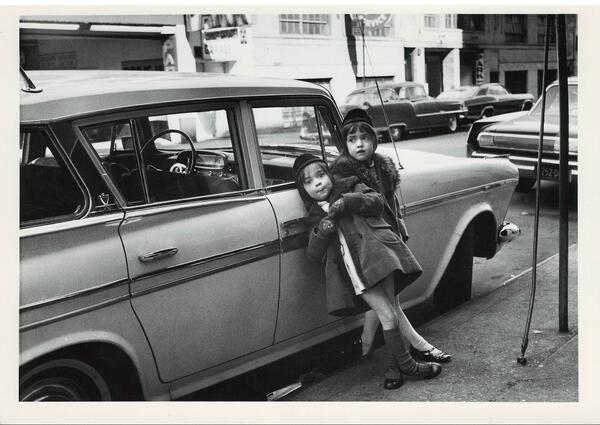
Since Vivian Kubrick was in grade school, she worked as a collaborator with her famous filmmaker father. She had cameos in a number of his movies including 2001: A Space Odyssey and Barry Lyndon. She shot the behind-the-scenes documentary about the making of The Shining at the age of 24. And she composed the score for Full Metal Jacket under the pseudonym of Abigail Mead. Kubrick seemed to groom his daughter to be his cinematic heir. And then in the late 90s, that all stopped. She cut off all contact with her family.
Kubrick’s family was initially cagey about what happened to her, saying simply that she was living in LA. But then in 2010, Kubrick’s stepdaughter Katharina opened up. “We weren’t lying, we were just being economical with the truth,” she told The Daily Beast. “Because if you say, ‘My sister has become a Scientologist,’ where do you go from that?”
The Church of Scientology’s policy of disconnection is one of its most controversial practices. It’s not clear if Vivian formerly disconnected with her family but she did reportedly attend her father’s funeral in 1999 with a Scientologist minder. When her sister Anya died of cancer in 2009, she did not attend that funeral even though they were, by all accounts, inseparable growing up.
The rift between Kubrick and his daughter became final when he asked her to score Eyes Wide Shut and she refused, as “They had a huge fight. He was very unhappy,” recalled Kubrick’s wife and Vivian’s mother. “He wrote her a 40-page letter trying to win her back. He begged her endlessly to come home from California. I’m glad he didn’t live to see what happened.”
Critic Laurent Vachaud argues that Eyes Wide Shut – a movie that seems about as open to interpretation as The Shining – is really a requiem to his lost daughter.
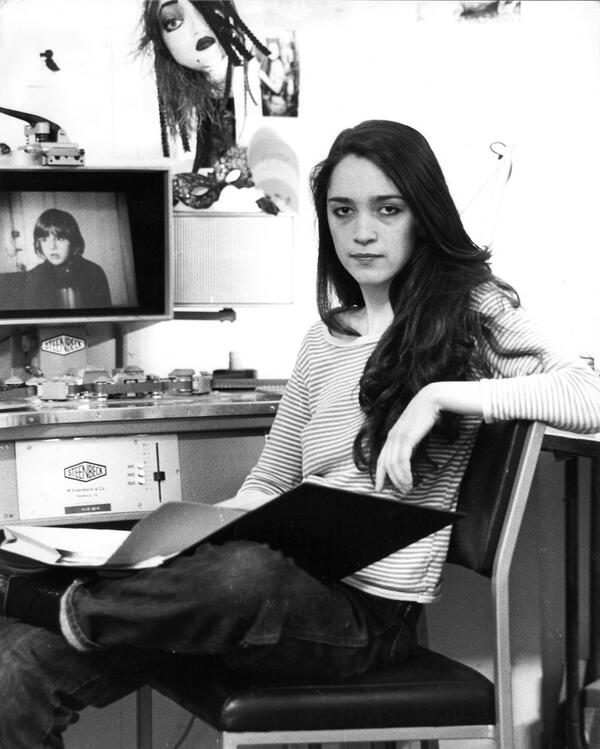
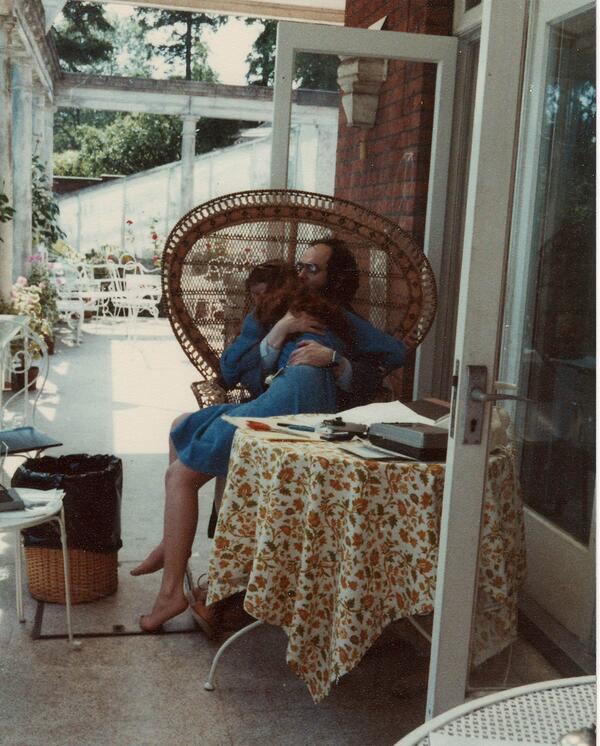
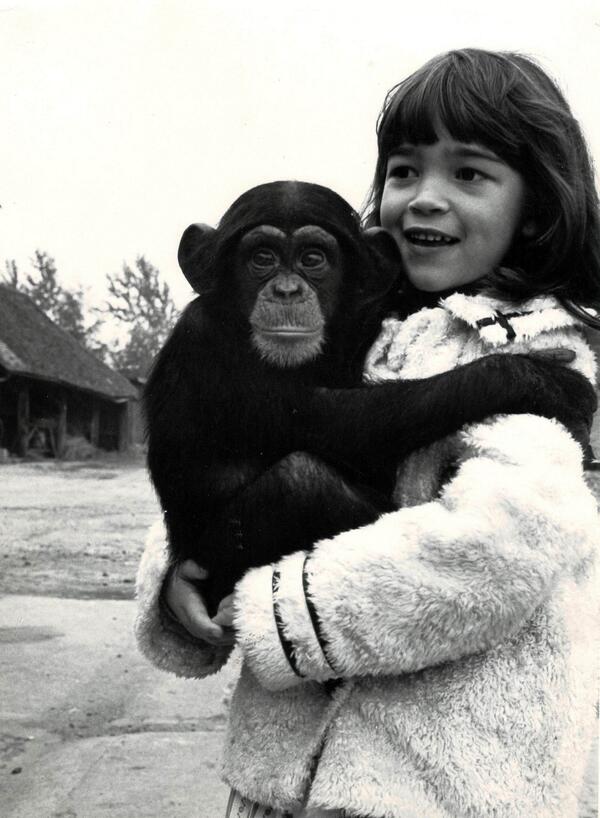
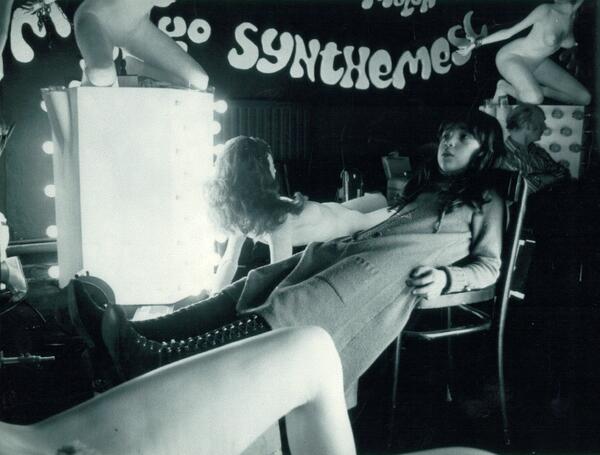
Recently on her Twitter feed, Vivian posted a series of photos of herself on the set of her father’s movies. One picture shows an eight-year old Vivian clutching a baby chimp used on 2001. Another shows her hanging out on the milk bar set of A Clockwork Orange. “I helped cut out those Styrofoam letters on the wall,” she writes. Another picture shows Vivian sitting before a 16mm Steenbeck, editing her documentary on The Shining. And, most poignantly, one of her picture’s shows Vivian and Kubrick embracing on a deck chair.
“In Memory of my Dad,” she writes. “Who I loved with all my heart and soul… Dad and Me on the back veranda of Abbots Mead.”
More photos can be found on her Twitter stream.
Related Content:
Stanley Kubrick’s Annotated Copy of Stephen King’s The Shining
Rare 1960s Audio: Stanley Kubrick’s Big Interview with The New Yorker
Stanley Kubrick’s List of Top 10 Films (The First and Only List He Ever Created)
Jonathan Crow is a Los Angeles-based writer and filmmaker whose work has appeared in Yahoo!, The Hollywood Reporter, and other publications. You can follow him at @jonccrow.
Read More...Support Us
We're hoping to rely on loyal readers, rather than erratic ads. Please click the Donate button and support Open Culture. You can use Paypal, Venmo, Patreon, even Crypto! We thank you!

About Us

Open Culture scours the web for the best educational media. We find the free courses and audio books you need, the language lessons & educational videos you want, and plenty of enlightenment in between.
Advertise With Us

FREE UPDATES!
GET OUR DAILY EMAIL
Get the best cultural and educational resources on the web curated for you in a daily email. We never spam. Unsubscribe at any time.
FOLLOW ON SOCIAL MEDIA

Open Culture editor Dan Colman scours the web for the best educational media. He finds the free courses and audio books you need, the language lessons & movies you want, and plenty of enlightenment in between.
Advertise With Us


