World Science U Starts to Offer Innovative, Free Courses in the Sciences
In high school, my physics teacher taught the class by having us listen to his long, monotonous lectures. After I realized that I couldn’t digest his verbal lessons, I stopped listening. Instead, I picked up a textbook and never looked back. I can only imagine how much better off I would have been had I taken a physics class like Brian Greene’s special relativity course on World Science U.
We featured Greene’s work two years ago, when the Columbia University physicist and mathematician launched his impressive PBS series, The Fabric of The Cosmos. Now, Greene and other scientists have created a new education platform called World Science U, and it promises to offer rich, rigorous and engaging courses in the sciences — for free. As Greene explains above, the free courses offered by World Science U take abstract concepts and represent them graphically, using a slew of interactive activities and real-world scenarios. Students receive immediate performance feedback on the problem sets they complete, and have access to a large number of video lectures. Theory is illustrated by way of intuitive animations, and exercises are paired with video solutions that take students through the ideal way to derive the answer.
Although later classes will tackle general relativity, quantum mechanics, and other subjects, World Science U has only two full courses available at present. The first is Greene’s brief conceptual class on special relativity that lasts 2–3 weeks, called Space, Time, and Einstein. There’s also a more advanced, university level course on the same topic called Special Relativity, which lasts about 10 weeks. Interested? We’ll let Greene himself tell you a little more about them in the video below.
World Science U also has a nifty section called Science Unplugged, where readers can find dozens of short video answers to a multitude of questions they may have about scientific concepts, like dark matter and quantum mechanics. Below, for example, Greene explains the anthropic principle:
To learn more, visit World Science U. We’ve added its early courses to our large list of free physics courses, part of our compendium of over 825 free online courses.
Ilia Blinderman is a Montreal-based culture and science writer. Follow him at @iliablinderman, or read more of his writing at the Huffington Post.
Related Content:
The Fabric of the Cosmos with Brian Greene: Watch the Complete NOVA Series Online
Read More...The Harvard Classics: Download All 51 Volumes as Free eBooks
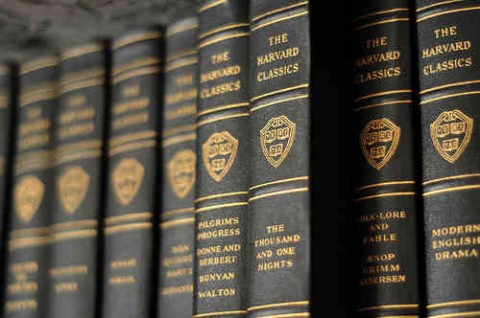
Every revolutionary age produces its own kind of nostalgia. Faced with the enormous social and economic upheavals at the nineteenth century’s end, learned Victorians like Walter Pater, John Ruskin, and Matthew Arnold looked to High Church models and played the bishops of Western culture, with a monkish devotion to preserving and transmitting old texts and traditions and turning back to simpler ways of life. It was in 1909, the nadir of this milieu, before the advent of modernism and world war, that The Harvard Classics took shape. Compiled by Harvard’s president Charles W. Eliot and called at first Dr. Eliot’s Five Foot Shelf, the compendium of literature, philosophy, and the sciences, writes Adam Kirsch in Harvard Magazine, served as a “monument from a more humane and confident time” (or so its upper classes believed), and a “time capsule…. In 50 volumes.”
What does the massive collection preserve? For one thing, writes Kirsch, it’s “a record of what President Eliot’s America, and his Harvard, thought best in their own heritage.” Eliot’s intentions for his work differed somewhat from those of his English peers. Rather than simply curating for posterity “the best that has been thought and said” (in the words of Matthew Arnold), Eliot meant his anthology as a “portable university”—a pragmatic set of tools, to be sure, and also, of course, a product. He suggested that the full set of texts might be divided into a set of six courses on such conservative themes as “The History of Civilization” and “Religion and Philosophy,” and yet, writes Kirsch, “in a more profound sense, the lesson taught by the Harvard Classics is ‘Progress.’” “Eliot’s [1910] introduction expresses complete faith in the ‘intermittent and irregular progress from barbarism to civilization.’”
In its expert synergy of moral uplift and marketing, The Harvard Classics (find links to download them as free ebooks below) belong as much to Mark Twain’s bourgeois gilded age as to the pseudo-aristocratic age of Victoria—two sides of the same ocean, one might say.
The idea for the collection didn’t initially come from Eliot, but from two editors at the publisher P.F. Collier, who intended “a commercial enterprise from the beginning” after reading a speech Eliot gave to a group of workers in which he “declared that a five-foot shelf of books could provide”
a good substitute for a liberal education in youth to anyone who would read them with devotion, even if he could spare but fifteen minutes a day for reading.
Collier asked Eliot to “pick the titles” and they would publish them as a series. The books appealed to the upwardly mobile and those hungry for knowledge and an education denied them, but the cost would still have been prohibitive to many. Over a hundred years, and several cultural-evolutionary steps later, and anyone with an internet connection can read all of the 51-volume set online. In a previous post, we summarized the number of ways to get your hands on Charles W. Eliot’s anthology:
You can still buy an old set off of eBay for $399 [now $299.99]. But, just as easily, you can head to the Internet Archive and Project Gutenberg, which have centralized links to every text included in The Harvard Classics (Wealth of Nations, Origin of Species, Plutarch’s Lives, the list goes on below). Please note that the previous two links won’t give you access to the actual annotated Harvard Classics texts edited by Eliot himself. But if you want just that, you can always click here and get digital scans of the true Harvard Classics.
In addition to these options, Bartleby has digital texts of the entire collection of what they call “the most comprehensive and well-researched anthology of all time.” But wait, there’s more! Much more, in fact, since Eliot and his assistant William A. Neilson compiled an additional twenty volumes called the “Shelf of Fiction.” Read those twenty volumes—at fifteen minutes a day—starting with Henry Fielding and ending with Norwegian novelist Alexander Kielland at Bartleby.
What may strike modern readers of Eliot’s collection are precisely the “blind spots in Victorian notions of culture and progress” that it represents. For example, those three harbingers of doom for Victorian certitude—Marx, Nietzsche, and Freud—are nowhere to be seen. Omissions like this are quite telling, but, as Kirsch writes, we might not look at Eliot’s achievement as a relic of a naively optimistic age, but rather as “an inspiring testimony to his faith in the possibility of democratic education without the loss of high standards.” This was, and still remains, a noble ideal, if one that—like the utopian dreams of the Victorians—can sometimes seem frustratingly unattainable (or culturally imperialist). But the widespread availability of free online humanities certainly brings us closer than Eliot’s time could ever come.
You can find the Harvard Classics listed in our collection, 800 Free eBooks for iPad, Kindle & Other Devices.
Related Content:
The Harvard Classics: A Free, Digital Collection
975 Free Online Courses from Top Universities
Josh Jones is a writer and musician based in Durham, NC. Follow him at @jdmagness
Read More...Free Course: “Darwin and Design” Examines Philosophical Questions of Intelligence and Human Behavior
Darwin’s theory of evolution by natural selection provided a scientific answer to a philosophical question: must design imply a designer? To the dismay and disbelief of many of Darwin’s contemporaries, and a great many still, his theory can answer the question in the negative. But there are many more questions yet to ask about seemingly designed systems, such as those posed by Alan Turing and John Searle: might such organized systems, natural and manmade, themselves be intelligent? The history of these inquiries among philosophers, scientists, and writers is the subject of Prof. James Paradis’ MIT course, “Darwin and Design.” The class explores such a diverse range of texts as Aristotle’s Physics, the Bible, Adam’s Smith’s Wealth of Nations, William Gibson’s Neuromancer, and of course, Darwin’s Origin of Species.
Alongside the scientific conclusions so-called “Darwinism” draws are the implications for human self-understanding. Given the thousands of years in which humanity placed itself at the center of the universe, and the few hundred in which it at least held fast to concepts of its special creation, what, asks Prof. Paradis, does Darwinism mean “for ideas of nature and of mankind’s place therein?” The class explores this question through “manifestations of such undesigned worlds in literary texts” both classical and contemporary. See the full course description below:
Humans are social animals; social demands, both cooperative and competitive, structure our development, our brain and our mind. This course covers social development, social behaviour, social cognition and social neuroscience, in both human and non-human social animals. Topics include altruism, empathy, communication, theory of mind, aggression, power, groups, mating, and morality. Methods include evolutionary biology, neuroscience, cognitive science, social psychology and anthropology.
Prof. Paradis taught the class in the Fall of 2010, but thanks to MIT’s Open Courseware, all of the lectures (above), assignments, and course materials are freely available, though you’ll have to purchase most of the texts (you can find some in our list of 500 free ebooks). You can’t register or receive credit for the course—so you can skip writing the papers and meeting deadlines of around 100 pages of reading per week—but if you work through some or all of the lectures and assigned readings, Prof. Paradis promises an enlightening “historical foundation for understanding a rich literary tradition, as well as many assumptions held by people in many contemporary cultures.” Given that this is an MIT course, Prof. Paradis assumes some familiarity on the part of his students with the basic Darwinian concepts and controversies. For a broad overview of Darwin’s importance to a wide variety of fields, take a look at Stanford’s online lecture series “Darwin’s Legacy.”
“Darwin and Design” is but one of over 800 free online courses we’ve compiled, including many on evolution, anthropology, philosophy, and cognitive science.
Related Content:
The Genius of Charles Darwin Revealed in Three-Part Series by Richard Dawkins
Darwin: A 1993 Film by Peter Greenaway
Charles Darwin’s Son Draws Cute Pictures on the Manuscript of On the Origin of Species
875 Free Online Courses from Top Universities
Josh Jones is a writer and musician based in Durham, NC. Follow him at @jdmagness
Read More...Watch Kevin Smith’s Clever First Film, Mae Day: The Crumbling of a Documentary (1992)
Since 1994’s Clerks turned him from a proud New Jersey slacker into a leading light of the 1990s’ American independent film boom, cinephiles have energetically debated Kevin Smith’s abilities as a filmmaker. Even Smith admits that he considers himself more a writer who happens to direct than a director per se, and his fans and detractors alike seem to consider his scripts more a vehicle for his entertaining way with speech — with jokes, with cultural references, with elaborate foulmouthedness — than anything else. It certainly doesn’t surprise me that so much of his 21st-century output consists of podcasts, nor that, when you go all the way back in his filmmaking career, even before Clerks, you find a short but talkative, jocular, by turns placid and vitriolic, only seemingly improvisational piece like Mae Day: The Crumbling of a Documentary, his first and only student film, made while enrolled for just four months at the technically oriented Vancouver Film School.
Having come up with the idea for a documentary on a local transsexual named Emelda Mae, Smith and classmate Scott Mosier, who would go on to become Smith’s longtime producing partner, found themselves unprepared to follow through on the project as they’d (vaguely) envisioned it. To make matters worse, Mae herself then skipped town, leaving behind not a hint as to her whereabouts. But amid this film-school crisis, Smith’s true filmmaking talent flowered: instead of a “serious” profile of his absent subject, he made a satirical examination of how that idea ran so quickly and unsalvageably aground, consisting not just of his and Mosier’s parodically confident reflections on the nature of the “failure,” but also their irate instructors’ and collaborators’ earnestly detailed accounts of how they couldn’t get their act together. But just two years later, Clerks would slouch its way to game-changing prominence in American cinema. Whatever you think of everything Smith and Mosier have put out since, you have to admit that this lazy-student gambit worked out pretty well for them.
You will find Mae Day: The Crumbling of a Documentary listed in our collection of Free Online Documentaries, part of our larger collections of 635 Free Movies Online.
Related Content:
Hear Kevin Smith’s Three Tips For Aspiring Filmmakers (NSFW)
Lick the Star: Sofia Coppola’s Very First Film Follows a 7th-Grade Conspiracy (1998)
The First Films of Great Directors: Kubrick, Coppola, Scorsese, Tarantino & Truffaut
Colin Marshall hosts and produces Notebook on Cities and Culture and writes essays on cities, language, Asia, and men’s style. He’s at work on a book about Los Angeles, A Los Angeles Primer. Follow him on Twitter at @colinmarshall or on Facebook.
Read More...Hunter S. Thompson Writes an Ode to Jack Kerouac in 1998 (After Calling Him an “Ass, a Mystic Boob” in 1958)
Today is the 92nd birthday of author and cultural icon Jack Kerouac. Born in Lowell, Massachusetts in 1922, Kerouac was one of the troika of writers – along with Allen Ginsberg and William S. Burroughs – who formed the core of the Beat Generation. He wrote shaggy dog stories — thinly veiled autobiographical tales about sex and drugs, friendship and spiritual yearning. His style was spontaneous and off-hand, yet he crafted passages of such poetic beauty that they make the reader gasp. He wrote his hugely influential book On the Road — legend has it — during a 20-day writing bender. He went so far as to tape together strips of paper into one continuous scroll of paper so as not to break his flow.
It’s hard to imagine Hunter S. Thompson and his distinctive brand of journalism without Jack Kerouac. Both wrote brilliant, rambling tracts about America. Both could turn a phrase like nobody’s business. Both had political philosophies that didn’t fit comfortably on either the left or right side of the spectrum. The difference is that Kerouac was doing all of this while Thompson was just hitting puberty.
So it might be surprising to learn that Thompson apparently loathed Kerouac’s writing when he was a young man. In a letter penned when the future gonzo journalist was a mere 21 years old, he savaged the Beat writer.
The man is an ass, a mystic boob with intellectual myopia. The Dharma thing was quite as bad as The Subterraneans and they’re both withered appendages to On The Road — which isn’t even a novel in the first place…If somebody doesn’t kill that fool soon, we’re all going to be labeled “The generation of the Third Sex.”
Is this a sincere opinion or is this bluster? Or is it both?
Thirty years later, it’s hard to see if Thompson’s opinion of Kerouac has evolved. In a recording from 1998, which you can listen to above, he seems to praise Kerouac while at the same time slipping in the shiv. In the video, an obviously inebriated Thompson can be heard reading a poem dedicated to the author.
Now I want to tell you.… In fact he (Kerouac) was a great influence on me.… So now I wanna put out my poem…This is my Ode to Jack Kerouac, who remains one of my heroes…Uhhhh…How about this… This is called, let’s see…This is called ‘Hippy Ode To Jack’…
“Four dogs went to the wilderness, Only three came back.
Two dogs died from Guinea Worm, The other died from you.
Jack Kerouac.”Well, Jack was not innocent. He ran over dogs…Just think of it…OK…That’s enough of that for now…Thank you very much. And.…Ahhh…Ya, well…Jack was an artist in every way…I admire the dog thing most of all.
So Happy Birthday, Jack. Hunter brings insults and backhanded compliments with a side of innuendo.
Related Content:
Jack Kerouac Lists 9 Essentials for Writing Spontaneous Prose
Pull My Daisy: 1959 Beatnik Film Stars Jack Kerouac and Allen Ginsberg
Jack Kerouac Reads from On the Road (1959)
Jack Kerouac’s Naval Reserve Enlistment Mugshot, 1943
Jonathan Crow is a Los Angeles-based writer and filmmaker whose work has appeared in Yahoo!, The Hollywood Reporter, and other publications. You can follow him at @jonccrow.
Read More...Watch 8 Classic Cult Films for Free: Night of the Living Dead, Plan 9 from Outer Space & More
The whole category of cult movies is a slippery one. Everyone knows what a horror flick or a Western looks like but describing a cult movie is much more subjective. Cult movies can be any genre. They tend to be campy or kitschy or in some other way very strange. Often they are either movies that are so weirdly and intensely personal that they alienate and baffle mainstreams audiences, or films that are such utter and complete train wrecks that somehow they push through the merely mediocre into the sublime. Or, in the best cases, both.
Danny Peary, in his seminal 1981 book Cult Movies, put such high art movies as Citizen Kane alongside midnight movie staples like Freaks (watch it free online) and El Topo. Somehow that doesn’t feel right. Having the supposed best (or second best) movie ever made in the same category as a hapless mess like Troll 2 seems to be a disservice to both movies, no matter how rabid the fanbase is.
For their list 30 Cult Movies That Absolutely Everybody Must See, the writers of the website io9 wrestled with this exact issue:
We debated a lot what we would consider a “cult movie” for the purposes of this list, and we mostly stuck to films that were not huge box-office hits and didn’t get massive mainstream exposure when they were first released. The films on this list mostly either flew under the radar or were considered massive flops when they came out originally.
Like any such list, there is plenty to be quibbled with — Donnie Darko is ranked higher than Eraserhead? Really? – but that’s really just part of the fun. Below are a few cult movies that you can watch right now for free – two of which are on the io9 list.
Plan 9 from Outer Space – There’s a great scene in Tim Burton’s biopic Ed Wood where a cross-dressing Wood runs into Orson Welles at a bar. They share a drink and commiserate about the difficulties of being a visionary in Hollywood. By all definitions, Wood was as much of an auteur as Welles. His movies were a prism through which he worked through some very personal issues.
It’s just that, unlike Welles, Wood was a comically inept and lazy filmmaker. Critic Michael Medved once dubbed his Plan 9 from Outer Space as the worst movie ever made. And it’s a hard to argue with that assertion. Shots in the movie alternate disorientingly between day and night in the middle of the same scene. The acting isn’t so much as wooden as somnambulistic. The special effects are laughably childish –a flaming spacecraft at one point of the movie was accomplished by setting a hubcap alight with some gasoline. Yet throughout the entire film, Wood’s boyish enthusiasm shines through. Plan 9 might be terrible, but it’s also a lot of fun.
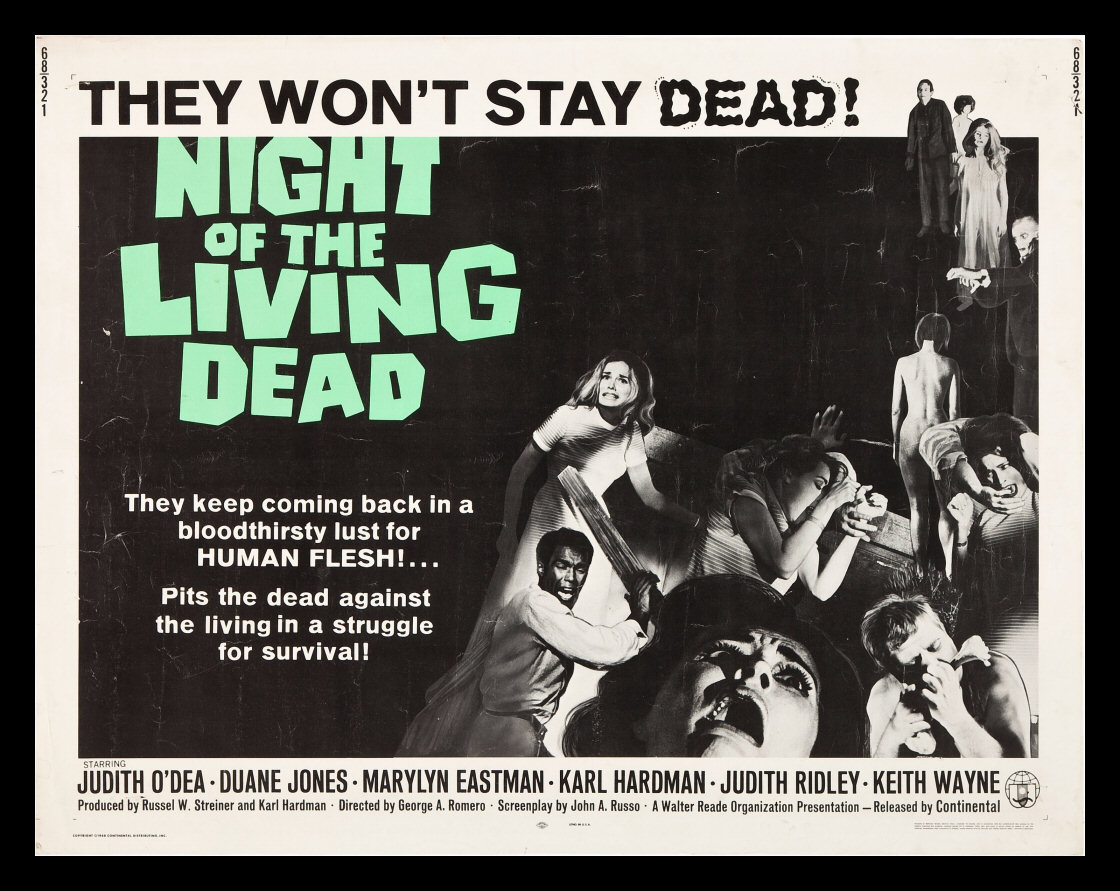
Night of the Living Dead – Though George A. Romero’s Night of the Living Dead was made for next to nothing, all of the production’s limitations somehow turned into assets. The film’s grainy black-and-white cinematography and hand-held camera gave Romero’s zombie gore-fest a level of realism that was unseen in horror movies up to that point — like a newsreel from the apocalypse. The Living Dead wound up being one of the most profitable movies of all time, which for investors proved to be unfortunate. In what has to be one of the costliest clerical errors in movie history, the distributors forgot to include a copyright statement in credits. As a result, the movie quickly fell into the public domain. Check it out.
Detour — Edgar G. Ulmer’s hastily produced film noir bears all the marks of a movie made on a shoestring. The direction is ham handed. The acting is often shrill. A tale about toxic love and ill-gotten gains, Detour should have by all rights been another forgotten, disposable B‑movie. Yet somehow Ulmer managed to capture lighining in a bottle. “Haunting and creepy,” writes Roger Ebert. “An embodiment of the guilty soul of film noir. No one who has seen it has easily forgotten it.”
You can find more cult classics in our collection of 4,000+ Free Movies Online: Great Classics, Indies, Noir, Westerns, Documentaries & More, including The Wild Ride with Jack Nicholson, Bluebeard (also directed by Edgar G. Ulmer), the 1962 indie horror film Carnival of Souls, Dementia 13 (an early Francis Ford Coppola horror film), and Abel Ferrara’s cult classic slasher film The Driller Killer.
Jonathan Crow is a Los Angeles-based writer and filmmaker whose work has appeared in Yahoo!, The Hollywood Reporter, and other publications. You can follow him at @jonccrow.
Read More...Enjoy the Greatest Silent Films Ever Made in Our Collection of 101 Free Silent Films Online
We all know the stages of cinema’s early development: first came the pictures, second came the motion, and third came the sound. But many of us, even reasonably active film buffs, don’t realize how much the art form took its shape between steps two and three. Most of the visual language we instinctively recognize as standard in the movies today came together before their characters ever spoke an audible word. Hence the importance of not just watching the films of today, and not just catching up with important works back to the the “golden age” of Hollywood, but going even farther back, to the early 1930s, even all the way to the 1910s — deep, in other words, into the silent era. Outside a university film-studies program, you couldn’t always do this easily. But now, to free you from the need to haunt specialist video stores (if your city has them) and hope for silent screenings at the nearest repertory cinema (if your city has one), we give you our collection of 101 free silent films online, part of our collection 4,000+ Free Movies Online: Great Classics, Indies, Noir, Westerns, Documentaries & More.
We don’t mean obscure silent films, either. You may remember our post on Sight & Sound magazine’s list of the ten greatest silents of all time, nine of which you can watch right now in our collection. In chronological order: D.W. Griffith’s Intolerance (1916), Erich von Stroheim’s Greed (1923), Buster Keaton’s Sherlock Jr. (1924), Sergei Eisenstein’s Battleship Potemkin (1925), Buster Keaton’s The General (1926), Fritz Lang’s Metropolis (1927), F.W. Murnau’s Sunrise (1927), Luis Buñuel’s Un chien andalou (1928), Carl Theodor Dreyer’s The Passion of Joan of Arc (1928), Dziga Vertov’s Man with a Movie Camera (1929). You can also catch up, finally, on a variety of other important films besides, from four by French visual-spectacle pioneer Georges Méliès (After the Ball, Cinderella, The Devilish Tenant, The Impossible Voyage) and six of English suspense king Alfred Hitchcock’s earliest works (Downhill, Easy Virtue, The Lodger, The Pleasure Garden). And that’s just scratching the surface of our collection of Free Silent Films.
Related Content:
The Power of Silent Movies, with The Artist Director Michel Hazanavicius
Hollywood, Epic Documentary Chronicles the Early History of Cinema
Watch 10 of the Greatest Silent Films of All Time, All Free Online
Three Great Films Starring Charlie Chaplin, the True Icon of Silent Comedy
Colin Marshall hosts and produces Notebook on Cities and Culture and writes essays on cities, language, Asia, and men’s style. He’s at work on a book about Los Angeles, A Los Angeles Primer. Follow him on Twitter at @colinmarshall or on Facebook.
Read More...Monty Python Sings “The Philosopher’s Song,” Revealing the Drinking Habits of Great European Thinkers
Did you know, student of dead white philosophers, that Heidegger was a “boozy beggar”? Wittgenstein a “beery swine” and Descartes a “drunken fart”? What about Plato, who, “they say, could stick it away; Half a crate of whiskey every day”? Neither did I until I saw members of Monty Python sing “The Philosopher’s Song,” above, from their 1982 live show at the Hollywood Bowl. Eric Idle, in what looks like an Australian bush hat strung with teabags, introduces the number, saying it’s “a nice intellectual song for those two or three of you in the audience who understand these things.” Then Idle, joined by Michael Palin and frequent Python collaborator Neil Innes, launches into a paean to drinking that colorfully calls the great philosophers crazed dipsomaniacs. Well, all but John Stuart Mill, who got “particularly ill” from “half a pint of shandy.”
It’s all nonsense, right? Maybe so, but the Pythons were no strangers to philosophy. Having assembled from the august bodies of Oxford and Cambridge Universities, they perpetually revisited academic themes, if only to mock them. And yet some philosophers take the work of Monty Python very seriously. In his Monty Python and Philosophy: Nudge, Nudge, Think Think!, Philosophy Professor Gary Hardcastle refers to an essay called “Tractatus Comedio-Philosophicus,” which “wants us to know that the only difference between Monty Python and academic philosophy is that philosophy isn’t funny.” So there you have it. Skip the years of penury and overwork and go directly to Youtube for your higher education in the classics from the Pythons. Then listen to Professor Hardcastle—in Open Court’s “Popular Culture and Philosophy” podcast above—expound at length on the philosophic virtues of Cleese, Idle, Palin, Gilliam, and Jones. And finally, a bonus: below watch Christopher Hitchens sing “The Philosopher’s Song” from memory in a 2009 interview.
The song grew out of an earlier Python setup known as “The Bruce Sketch” (below). The sketch is pretty dated—some moments certainly come off as more offensive than perhaps deemed at the time. (Our English readers will have to let us know if “pommy bastard” smarts.) Four Australian philosophy professors at the fictitious University of Woolamaloo, all of them named Bruce, welcome a new member, Michael Baldwin (whom they insist on calling “Bruce”). The Bruces seem a nice bunch of chaps until they start in on their rules, revealing a contemptuous obsession with keeping out the “poofters.” It’s perfectly in keeping with this assembly of amiable right-wing nationalists: The Bruces inform their English colleague that he may teach “the great socialist thinkers, provided he makes it clear that they were wrong,” and then they get a visit from a shuffling caricature of an Aboriginal servant (whom one mustn’t mistreat, state the rules, “if there’s anyone watching”). In addition to bigotry, Australia, politics and prayer, the Bruces, their new member learns, seem mostly concerned with drinking rather than philosophy. In my personal experience of some academic quarters, this is at least one part of the sketch that hasn’t aged at all.
Related Content:
Monty Python’s Best Philosophy Sketches
Watch Monty Python’s “Summarize Proust Competition” on the 100th Anniversary of Swann’s Way
Monty Python’s Life of Brian: Religious Satire, Political Satire, or Blasphemy?
Josh Jones is a writer and musician based in Durham, NC. Follow him at @jdmagness
Read More...Watch Episode #1 of Neil deGrasse Tyson’s Cosmos Reboot on Hulu (US Viewers)
After a long wait, Neil deGrasse Tyson’s reboot of Cosmos began airing on Fox this past Sunday night, some 34 years after Carl Sagan launched his epic series on the more heady airwaves of PBS. Fox execs predicted big numbers for the first show — 40 million viewers. But only 5.8 million showed up. But, as we know, quantity has nothing to do with quality. Critics have called Tyson’s show a “striking and worthy update” of the original. If you live in the US, you can see for yourself. Episode 1 appears above, and it looks like the remaining 12 episodes will appear on Hulu. For those outside the US, our apologies that you can’t see this one. But we do have some great related material below, including one of our favorite posts: Neil deGrasse Tyson Lists 8 (Free) Books Every Intelligent Person Should Read.
via Kottke
Related Content:
Neil deGrasse Tyson Lists 8 (Free) Books Every Intelligent Person Should Read
Neil deGrasse Tyson Delivers the Greatest Science Sermon Ever
Stephen Colbert Talks Science with Astrophysicist Neil deGrasse Tyson
Neil deGrasse Tyson on the Staggering Genius of Isaac Newton
Read More...John Waters Talks About His Books and Role Models in a Whimsical Animated Video
Kudos to cartoonist Flash Rosenberg for having the huevos to illustrate cult film icon John Waters’ remarks at the New York Public Library in real time before a live audience. The first half minute of this animated Conversation Portrait had me worried on her behalf. What a relief when the the coiled lump she was swabbing with brown watercolor turned out to be a cinnamon roll, and not the substance Divine (the director’s muse) famously ate—for real—in 1972’s Pink Flamingos.
It’s a very free associative process. The topic under discussion turns out to be not baked goods, but rather role models. (Roll models, get it?)
As to who the Sire of Sleaze chooses to elevate in this capacity:
Crooner Johnny Mathis, whose heavenly pipes Waters prescribes as a potential remedy for bipartisan ugliness.
Playwright Tennessee Williams (whose work Cardinal Spellman denounced as “revolting, deplorable, morally repellent…”)
And, touchingly, his parents, whom Rosenberg draws with arms encircling their pencil-mustached tot, a sweet Three Is a Magic Number tableau. (In non-animated life, Waters is one of four children.)
The Prince of Puke modestly deflects interviewer Paul Holdengräber’s assertion that he himself is a role model, advising his fans to pick ten flawed individuals from whom they’ve learned something and “let them know how much you mean to them.” (He may have meant “let them know how much they mean to you,” but it might be a fun sort of exercise to follow his instructions as uttered.)
And if on some far off evening, you’re moved to have sex on his grave, know that this role model’s ghost will rest content.
Related Content:
John Waters Makes Handmade Christmas Cards, Says the “Whole Purpose of Life is Christmas”
An Anti, Anti-Smoking Announcement from John Waters
Ayun Halliday told you cha cha heels, black ones! Follow her @AyunHalliday
Read More...Support Us
We're hoping to rely on loyal readers, rather than erratic ads. Please click the Donate button and support Open Culture. You can use Paypal, Venmo, Patreon, even Crypto! We thank you!

About Us

Open Culture scours the web for the best educational media. We find the free courses and audio books you need, the language lessons & educational videos you want, and plenty of enlightenment in between.
Advertise With Us

FREE UPDATES!
GET OUR DAILY EMAIL
Get the best cultural and educational resources on the web curated for you in a daily email. We never spam. Unsubscribe at any time.
FOLLOW ON SOCIAL MEDIA

Open Culture editor Dan Colman scours the web for the best educational media. He finds the free courses and audio books you need, the language lessons & movies you want, and plenty of enlightenment in between.
Advertise With Us


