Allen Ginsberg’s Last Three Days on Earth as a Spirit: The Poet’s Final Days Captured in a 1997 Film
You may have read Allen Ginsberg’s final poem “Things I’ll Not Do (Nostalgias)” when we featured it last month. In it, the leading Beat poet, nearing the very end of his life, lists off all of the people, places, and things he knew he would never see, visit, and do again. But a practicing Buddhist such as Ginsberg certainly wouldn’t have viewed the event of his death with total finality. What, then, happened to him after April 5th, 1997, when his official biography came to a close? Here we have one attempt at an answer by Lithuanian avant-garde luminary Jonas Mekas (who, incidentally, happens to remain active in this mortal coil today at the age of 91). Mekas documentary Scenes from Allen’s Last Three Days on Earth as a Spirit observes Ginsberg’s Buddhist wake and collects memories and impressions from his friends and collaborators, Mekas himself included.
The scenes occasioned by Ginsberg’s death slant, perhaps unsurprisingly, toward the artistic and literary: musician Patti Smith, poet Gregory Corso, writer Amiri Baraka, visual artist Hiro Yamagata, and poet Anne Waldman all make appearances. You can watch an excerpt of the film above and its 67-minute entirety on Ubuweb. (Also find the film listed in the documentaries section of our collection of Free Movies Online.) Allen’s Last Three Days on Earth, a kind of video diary as well as a memorial statement, gives as much insight into Mekas’ perspective as it does to Ginsberg’s existence. By the time of Ginsberg’s passing, Mekas’s body of work included “two narrative films and nearly twenty years’ worth of private recordings,” at which point he had “decided to make feature films from his home movies.” That description comes from Aaron Cutler in The Believer, writing on Mekas’ methods of turning into “oppositional cinema” records of his life spent immersed in the art world. Such a practice captures many important questions, often inadvertently. In this case, one in particular has left me thinking: what on Earth would Allen Ginsberg have reincarnated as?
Related Content:
Read Allen Ginsberg’s Poignant Final Poem “Things I’ll Not Do (Nostalgias)”
Hear the Very First Recording of Allen Ginsberg Reading His Epic Poem “Howl” (1956)
Colin Marshall hosts and produces Notebook on Cities and Culture and writes essays on cities, Asia, film, literature, and aesthetics. He’s at work on a book about Los Angeles, A Los Angeles Primer. Follow him on Twitter at @colinmarshall or on his brand new Facebook page.
Read More...Jack Kerouac’s On The Road Turned Into Google Driving Directions & Published as a Free eBook
Note: You can find lectures (1 + 2) discussing the importance of On the Road in Yale’s course, The American Novel Since 1945. It appears in the Literature section of our collection, 1,700 Free Online Courses from Top Universities.
If you would like to support the mission of Open Culture, consider making a donation to our site. It’s hard to rely 100% on ads, and your contributions will help us continue providing the best free cultural and educational materials to learners everywhere. You can contribute through PayPal, Patreon, and Venmo (@openculture). Thanks!
via @SteveSilberman and PRI
Related Content:
Jack Kerouac Lists 9 Essentials for Writing Spontaneous Prose
Pull My Daisy: 1959 Beatnik Film Stars Jack Kerouac and Allen Ginsberg
Jack Kerouac Reads from On the Road (1959)
500 Free eBooks: Download Great Books for Free
Read More...Watch All of The Beatles’ Historic Appearances on The Ed Sullivan Show, 50 Years Ago
As you surely know by now, The Beatles invaded the U.S. by way of the Ed Sullivan Show fifty years ago yesterday. What you may not know is that they appeared for three consecutive Sunday night broadcasts that year, beginning on February 9, 1964. That performance garnered a record 73 million viewers and took place at the now historic Ed Sullivan Theater. The second show on February 16 was broadcast from Miami Beach where the then-Cassius Clay and Sonny Liston were promoting their famous bout on Feb. 25. The third broadcast, February 23, showed a performance taped earlier in the day of the original Feb. 9 appearance. Watch all three of those ’64 broadcasts above. (The band made a final live appearance on the show on August 14, 1965—watch “I Feel Fine” from that broadcast below.)
It seemed like everyone wanted a piece of The Beatles—the American press, the screaming hordes of teenage fans, even certain British politicians—but the first Sullivan appearance was a gamble, arranged by their very savvy manager Brian Epstein to break the band in the States. Sullivan stood behind the band’s initial headlining booking, despite his producer’s objections, later telling the New York Times, “I made up my mind that this was the same sort of mass hit hysteria that had characterized the Elvis Presley days.”
Sullivan, the legend goes, first noticed the crazed response the band inspired (see above) when he witnessed “more than 1,500 youngsters lin[ing] the rooftop gardens of the Queen’s Building and others congregated on the ground” at Heathrow airport after the group returned home from a trip to Stockholm in October, 1963. While the actual story of the first booking is a bit more complicated, writes Beatles’ historian Bruce Spizer, it still speaks to Sullivan’s impeccable instincts.
What was it like to be a viewer of that first broadcast as a young fan? Above, Dennis Mitchell, host of the “Breakfast with the Beatles” radio show, remembers the moment. “Everything changed after that,” he says. Although the Sullivan broadcasts are memorable for all sorts of historical reasons, “in the end, after it all,” says Mitchell, “it was the songs, it was the music.”
Seeing it on Ed Sullivan was overwhelming, and the start of it all, but then we took it into our bedrooms with the record players and got deeper into the music, because we knew that even though they’d done four or five songs on the Ed Sullivan show, there was more.
As the band evolved politically and stylistically, says Mitchell, their fans “were all along for the ride. And they genuinely, it was almost like a magic wand, changed things by changing themselves.” Could such a cultural moment happen again? “No,” says Mitchell, “not at the level that it did and not with the significance that it did.” In the fifty years since The Beatle’s arrival on U.S. shores, the world seems to have become both more fragmented and more closely drawn together, but we live in such a vastly different media landscape than the one that produced the Ed Sullivan Show—and the lasting fame of Elvis, The Supremes, and The Beatles. After fifty years of post-Beatles’ pop music, it’s impossible to imagine a television performance having such a widespread impact that it almost singlehandedly transforms an entire generation.
Related Content:
The Beatles’ Rooftop Concert: The Last Gig Filmed in January 1969
The Kinks’ Ray Davies Reviews the Beatles’ 1966 Album Revolver; Calls It “A Load of Rubbish”
A Short Film on the Famous Crosswalk From the Beatles’ Abbey Road Album Cover
Josh Jones is a writer and musician based in Durham, NC. Follow him at @jdmagness
Read More...Comedian Reggie Watts Teaches Students Bad Science in 70s Sitcom-Style Show, Teach
Not since Gabe Kaplan’s Mr. Kotter has there been such a hip, big-haired, TV teacher to “help make you smart and listen to your feelings, too.”
Does it really matter if comedian, musician, and now web series star Reggie Watts’ Teach is deeply unclear on the science he’s imparting, if the kids in his classroom are learning important life lessons? Why it’s uncool to bully single-celled organisms, for instance. (“You might be multicellular but there’s no need to be cellulist.”)
As we all know, the best teachers awaken their students’ curiosity, send them bounding off in pursuit of knowledge, rather than spoon-feeding them correct answers.
That’s exactly what Mr. Watts did for—or possibly to—me when he talked about ‘tons: protons, contons, decepticons, and tauntauns. Had he said, “That last one refers to a species of imaginary omnivorous reptomammals from the 3rd highest grossing franchise in film history,” I would’ve spelled it “tontons” without a second thought. But because he deliberately left things a little vague, asking, “How many of you have seen The Empire Strikes Back?” I was motivated to do a little research. Star Wars was never my bag…
It boggles the mind how much more I would’ve learned had the Internet existed back when I was in high school. (Teach’s classroom is most definitely a blast from the past—not an iPad in sight and the overhead projector restored to its place of honor. The quickly uptilted flask is, of course, timeless.)
The opening credits suggest that we should look forward to an education in Literature, Music, and History in upcoming episodes.
via BoingBoing
Related Content:
Musical Comedian Reggie Watts Reinvents Van Halen’s Classic, “Panama”
Free Comic Books Turns Kids Onto Physics: Start With the Adventures of Nikola Tesla
Ayun Halliday’s graphic novel, Peanut, is a Young Adult Library Services Association 2014 Quick for Reluctant Young Readers. Follow her @AyunHalliday
Read More...Groucho Marx and T.S. Eliot Become Unexpected Pen Pals, Exchanging Portraits & Compliments (1961)
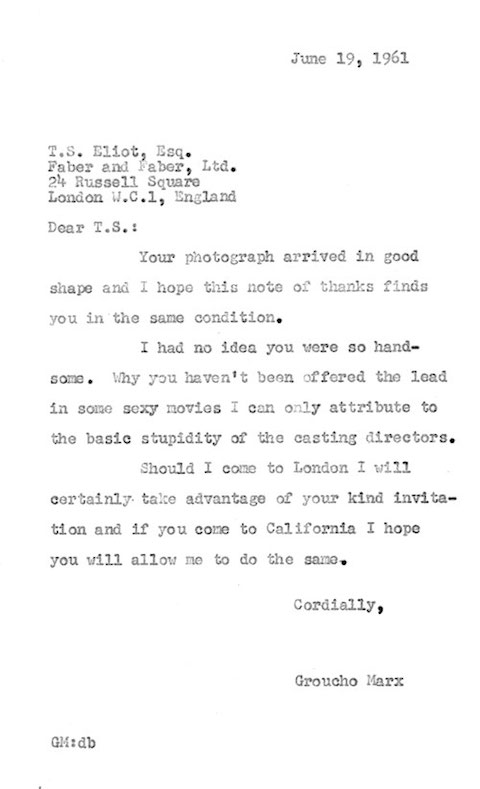
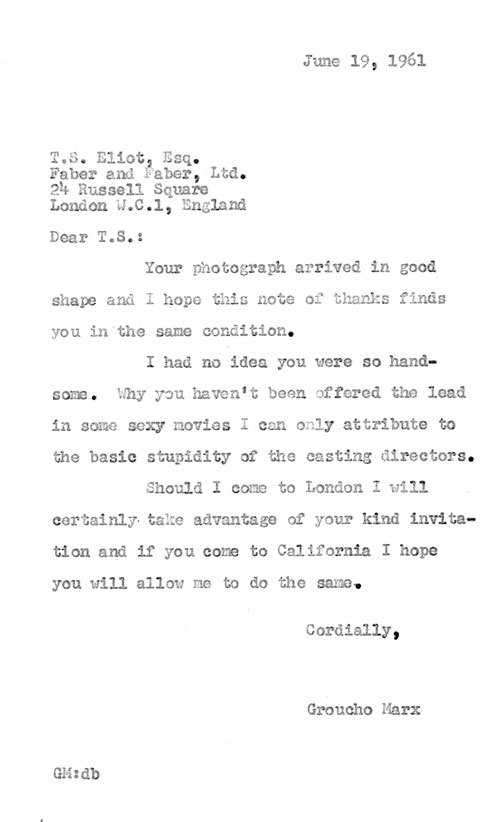
Groucho Marx and T.S. Eliot: they’ve got to rank as one of the twentieth century’s most surprising pair of pen pals. More intriguingly still, they first got in touch — as luminaries seem to do — out of the spirit of mutual admiration. Marx took the praise beyond Eliot’s poetry to his looks: “Why you haven’t been offered the lead in some sexy movies I can only attribute to the basic stupidity of the casting directors.” This he wrote in the letter of June 19, 1961 above, after having received a portrait of the poet, from the poet, in exchange for a portrait of the comedian, from the comedian. This constitutes only part of what The Economist calls “among the strangest and most delightful epistles ever created.” That same article quotes a darker observation on Eliot from Anthony Julius’ T.S. Eliot, Anti-Semitism, and Literary Form: “Anti-Semitism supplied part of the material out of which he created poetry.”
There we have only one of the reasons to believe that the author of The Waste Land counted as no friend of the Jewish people. Yet at least in correspondence, between 1961 and 1964, he did befriend one particular Jewish person. “Enter Groucho,” the Economist article continues, “whose wit was as uniquely Jewish as it was universally comic. Where Eliot was the famous defender of tradition, order and civilised taste, the crux of Groucho’s humour was flouting tradition, fomenting chaos and outraging taste. ‘I have had a perfectly wonderful evening,’ he once said to a host, ‘but this wasn’t it.’ ” The famous quip could well have come at the end of Marx and Eliot’s first, and last, meeting in person, a dinner at the Eliot house. “There were awkward lulls in the conversation,” according to Anna Knoebel at The Outlet. “Neither man was inclined to discuss his own work, while the other was eager to praise it. They stopped writing shortly thereafter.”
Related Content:
Ray Bradbury Gabs with Groucho Marx on You Bet Your Life (1955)
Colin Marshall hosts and produces Notebook on Cities and Culture and writes essays on cities, Asia, film, literature, and aesthetics. He’s at work on a book about Los Angeles, A Los Angeles Primer. Follow him on Twitter at @colinmarshall or on his brand new Facebook page.
Read More...The Reader: A Touching South African TV Commercial Celebrates Literacy and Scotch
In the world of advertising, books and booze rarely go together, especially if you’re selling beer in America. But when it comes to scotch and whisky, you’ll find some exceptions. Last year, Dewars channeled the ghost of Charles Bukowski to sell its scotch. And now Bells, a British Whisky maker, aired a commercial in South Africa showing an elderly man learning to read — all so that, touchingly, he could read a book authored by his own son. You can watch a behind-the-scenes, making-of video here.
via Devour
Related Content:
Dewars Channels the Ghost of Charles Bukowski to Sell Scotch
Fellini’s Fantastic TV Commercials
500 Free eBooks: Download Great Books for Free
Read More...Haunting Unedited Footage of the Bombing of Nagasaki (1945)
Making the rounds on the web today is a silent film showing “the final preparation and loading of the ‘Fat Man’ bomb into ‘Bockscar,’ ” the plane that would drop a devastating bomb on Nagasaki on August 9, 1945. The footage from the Los Alamos National Laboratory is raw, except for the helpful annotations added by Alex Wellerstein, who runs Nuclear Secrecy: The Restricted Data Blog. Eventually, toward the 8 minute mark, the video shows “the Nagasaki explosion from the window of an observation plane.” What you don’t see is the calamitous outcome. To get a feel for the destruction, you can see our previous post, Rare Color Footage of the Hiroshima Aftermath. (Obviously Hiroshima is the other Japanese city that experienced the ruinous effects of the nuclear bomb.) Also we have 360 Degree Images of Hiroshima After the Bombing.
If you would like to support the mission of Open Culture, consider making a donation to our site. It’s hard to rely 100% on ads, and your contributions will help us continue providing the best free cultural and educational materials to learners everywhere. You can contribute through PayPal, Patreon, and Venmo (@openculture). Thanks!
via Metafilter
Related Content:
53 Years of Nuclear Testing in 14 Minutes: A Time Lapse Film by Japanese Artist Isao Hashimoto
How a Clean, Tidy Home Can Help You Survive the Atomic Bomb: A Cold War Film from 1954
Hiroshima Atomic Bombing Remembered with Google Earth
67 Free Online History Courses
Read More...15,000 Colorful Images of Persian Manuscripts Now Online, Courtesy of the British Library
When a country is in the headlines almost every day, it can be easy to forget that today’s news isn’t the whole story. Iran’s modern story features its long, bloody war with Iraq, contested presidential election results, and protests that became part of the Arab Spring.
But Iran is also known by its ancient name of Persia and is one of the world’s oldest civilizations.
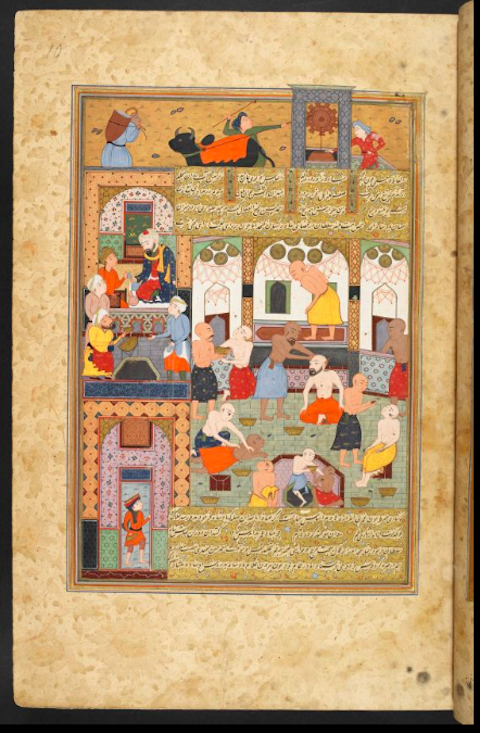
In the 12th century, all of Mesopotamia blossomed. The Islamic Golden Age was a time of thriving science, scholarship and art, including bright and vivid Persian miniatures—small paintings on paper created to be collected into books.
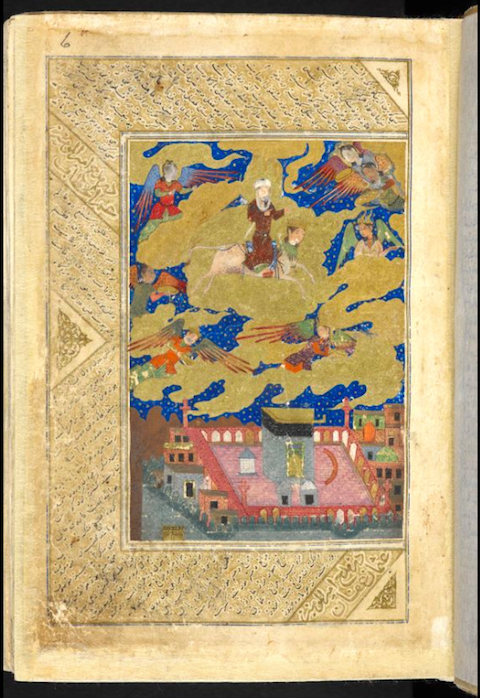
Thousands of these miniatures—known for their bright and pure coloring—are now included in a new digital archive developed by the British Library. The paintings, often accompanied by beautiful Persian texts, are meticulously preserved, making available delicate treasures on par with, if not more beautiful than other illuminated manuscripts like the Book of Kells.
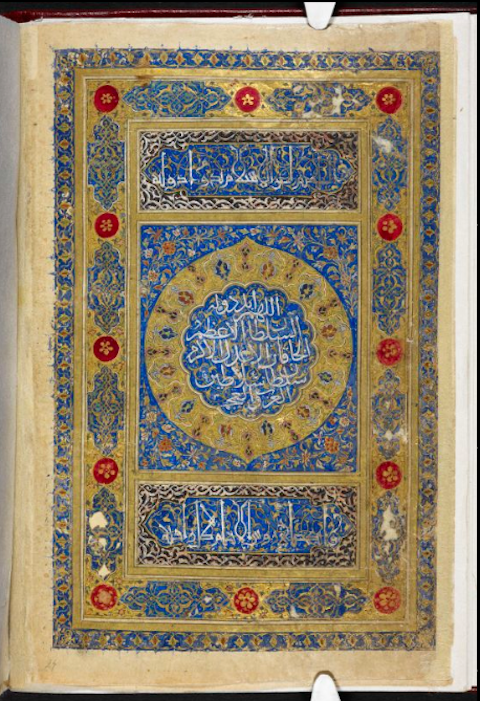
Because the miniatures were meant to be enjoyed in private, in books, artists could be freer with their subjects than with public wall paintings. Most miniatures included human figures, including depictions of the prophet Muhammed that showed his face, and “illuminated” ornamental borders.
The joy of the archive, which includes works from the British Museum and India Office Library, is how close we can get to the work. Zoom in as close as you like to examine the delicate flowers and script (click the screenshots to zoom into each painting). With this technology, it’s possible to see things that the naked eye would miss.
A separate archive houses rare Persian texts, including this pocket encyclopedia. The greatest beneficiaries are scholars, who can pore over beautiful, fragile documents and artwork from wherever they work, without damaging the old materials.
via The Paris Review
Related Content:
Free: The Metropolitan Museum of Art and the Guggenheim Offer 474 Free Art Books Online
Download Over 250 Free Art Books From the Getty Museum
Kate Rix writes about digital media and education. Visit her on Twitter.
Read More...Learn To Pick Locks, With The MIT Guide To Lock Picking (1991)
When I was young, I decided that I would learn how to pick locks. If countless intrepid TV heroes could dismantle a pair of handcuffs with nothing but a hastily swiped paperclip, why couldn’t I? The process, it turns out, was quite easy: I practiced on an old, lockable diskette cabinet, and quickly figured out how to crack the lock’s mechanism using two paperclip halves. This allowed me to proclaim that I was an expert lock picker to my friends, and that, really, the whole thing was an elementary procedure.
Although, as the astute reader would surmise, I knew next to nothing about lock picking, I was right on one count: it’s easy. Or, at least, so notes the MIT Guide to Lock Picking, written by the mysterious Ted The Tool. This primer was first published in 1987 and has been floating around various websites for the past two decades. And it’s still considered an essential introduction to the art of picking locks. It begins by outlining lock terminology:
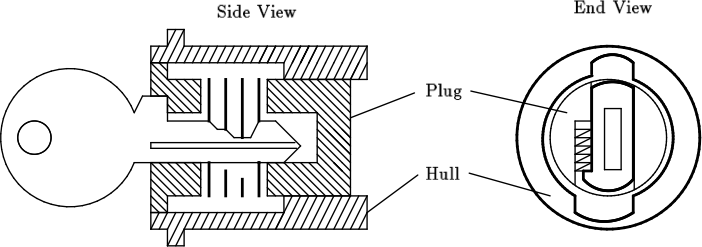
The key is inserted into the keyway of the plug. The protrusions on the side of the keyway are called wards. Wards restrict the set of keys that can be inserted into the plug. The plug is a cylinder which can rotate when the proper key is fully inserted. The non-rotating part of the lock is called the hull. The first pin touched by the key is called pin one. The remaining pins are numbered increasingly toward the rear of the lock.
The proper key lifts each pin pair until the gap between the key pin and the driver pin reaches the sheer line. When all the pins are in this position, the plug can rotate and the lock can be opened. An incorrect key will leave some of the pins protruding between the hull and the plug, and these pins will prevent the plug from rotating.
Over its 50 pages, the guide explains the flatland and pin column lock models, and lays out the theory behind opening them. It also includes guidelines on making lock picking tools, legal information, and numerous pieces of practical advice. Most useful? It contains numerous exercises, and stresses the importance of doing your lock picking homework:
“Anyone can learn how to open desk and filing cabinet locks, but the ability to open most locks in under thirty seconds is a skill that requires practice.”
lia Blinderman is a Montreal-based culture and science writer. Follow him at @iliablinderman.
Related Content:
Learn How Richard Feynman Cracked the Safes with Atomic Secrets at Los Alamos
MIT Teaches You How to Speak Italian & Cook Italian Cuisine All at Once (Free Online Course)
The Enigma Machine: How Alan Turing Helped Break the Unbreakable Nazi Code
Read More...14,000 Free Images from the French Revolution Now Available Online
 It’s often said that the French Revolution (1789–1799) created the “blueprint” for all revolutions to come. Unlike any event before it, the Revolution drew its strength from ideology — an ideology that turned on the belief that France had created a radical break with its monarchical past, and would now radically re-organize itself along egalitarian and democratic lines. To drive this message home, the revolutionaries produced thousands of pamphlets and political works of art. What’s more, they created a new revolutionary calendar and a series of revolutionary festivals that helped give cultural expression to the idea that France had entered a new political age.
More than a century later, the Russian revolutionaries would use the French blueprint and all cultural tools at their disposal to promote its Marxist ideals. You’ve seen the posters. You’ve watched the films. Maybe you’ve read their texts. But perhaps you’re not as familiar with where revolutionary propaganda all began, in which case you’ll want to rummage through a new archive of 14,000 images from the French Revolution, created by Stanford University and the Bibliothèque nationale de France (BnF). The new archive contains visual materials that will intrigue scholars as much as history buffs.
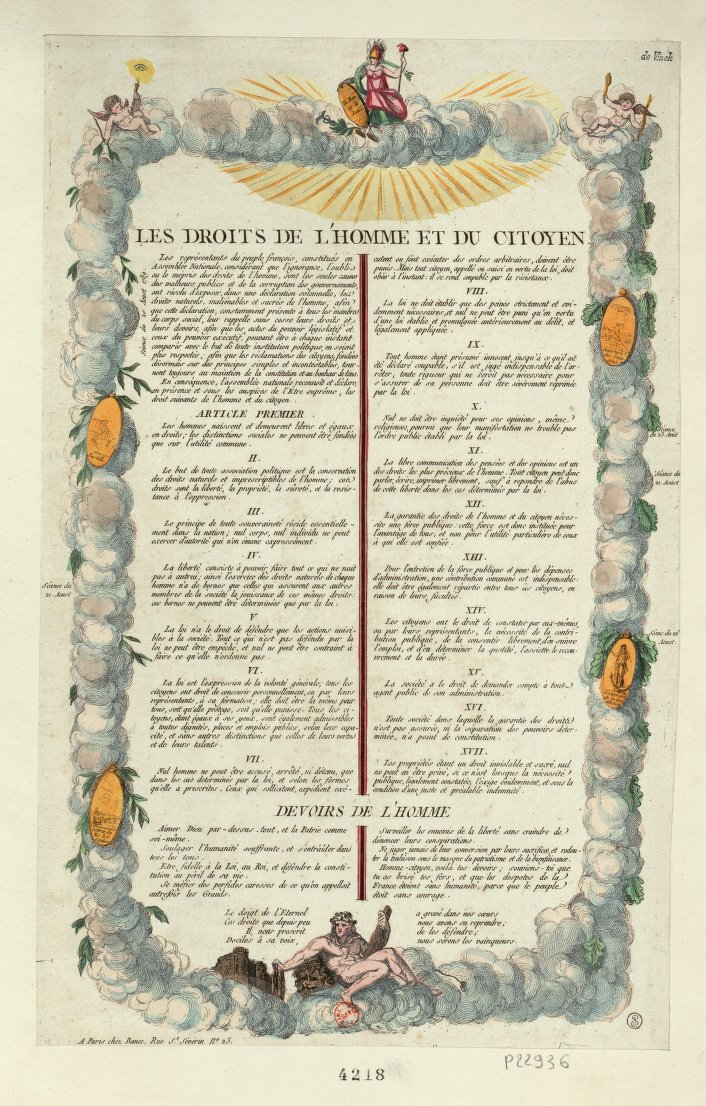
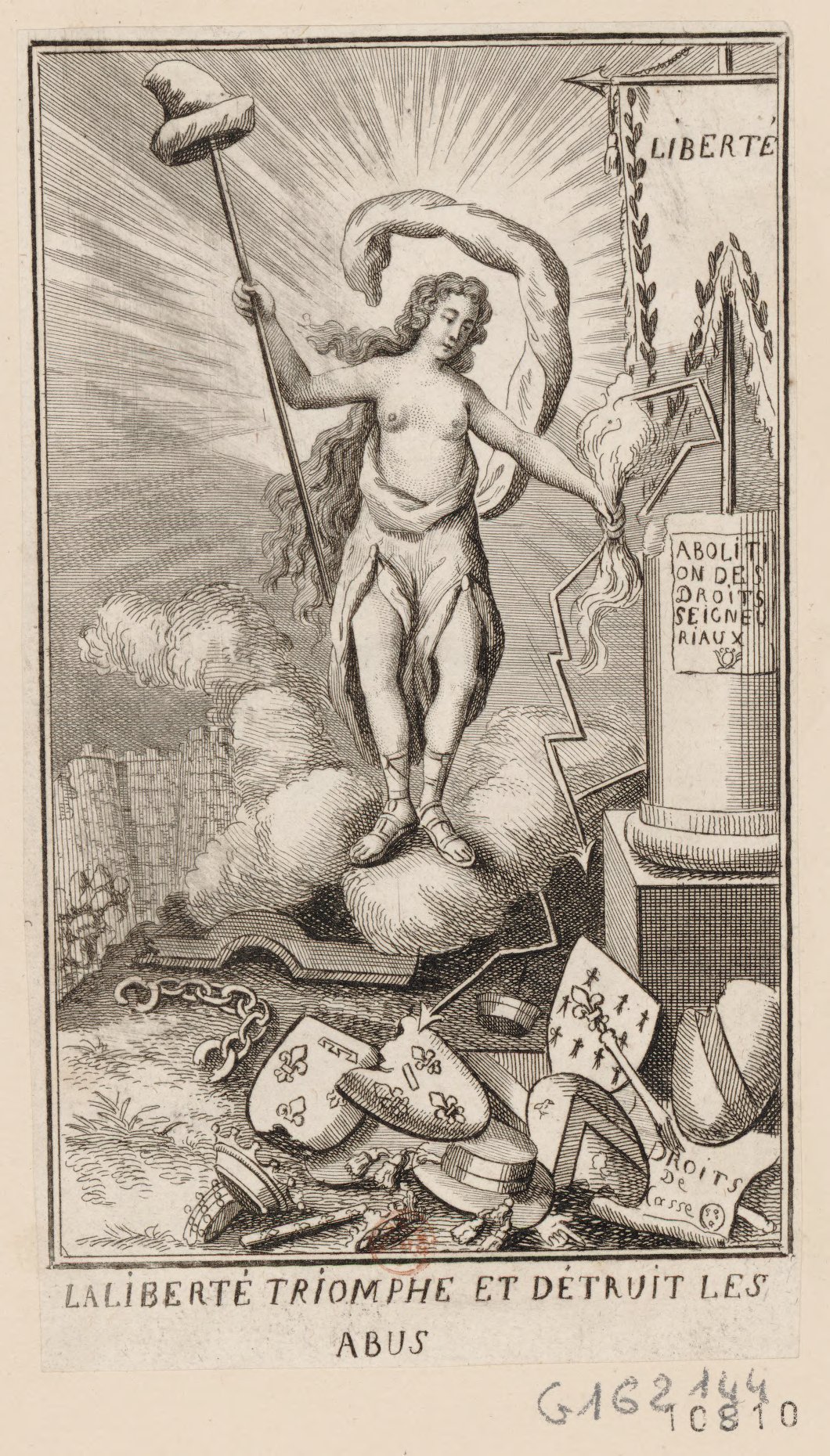
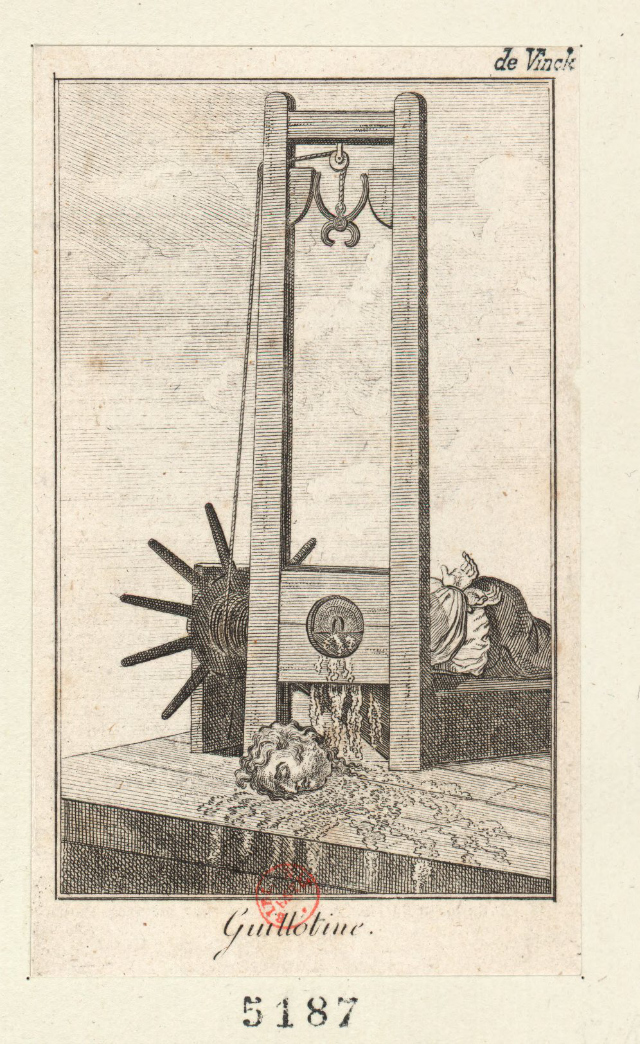
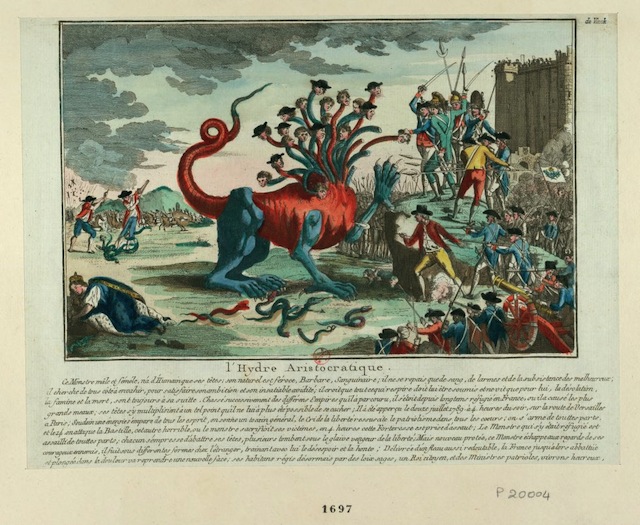
Above you can see one image celebrating a founding document of the Revolution — 1789’s Les droits de l’homme et du citoyen (The Rights of Man and Citizen). Immediately below, you can see a depiction of Liberty (a modern version of a Greek goddess) triumphing over past political abuses. And, at the bottom, we have a vivid display of the Revolution’s choice instrument of capital punishment — the guillotine. Plus an image of an “aristocratic hydre” in combat with the people.
The images in the archive can be sorted by theme. If you find one you like, you can choose to download the image in a high-resolution format, ranging from small to extra large. Scholars of the French Revolution won’t want to miss another part of the newly-created archive. It contains the Archives parlementaires, a series of historical documents that record the political events of the Revolution. In the mid 1990s, I spent long stretches of time reading those documents in the great reading room of the old BN.
To explore more image archives, please see our recent post: Where to Find Free Art Images & Books from Great Museums & Libraries.
Note: Some lectures on the French Revolution can be found in Yale’s course European Civilization, 1648–1945, which appears in our collection, 1,700 Free Online Courses from Top Universities.
via Hyperallergic
Related Content:
Read 700 Free eBooks Made Available by the University of California Press
The Rijksmuseum Puts 125,000 Dutch Masterpieces Online, and Lets You Remix Its Art
Read More...Support Us
We're hoping to rely on loyal readers, rather than erratic ads. Please click the Donate button and support Open Culture. You can use Paypal, Venmo, Patreon, even Crypto! We thank you!

About Us

Open Culture scours the web for the best educational media. We find the free courses and audio books you need, the language lessons & educational videos you want, and plenty of enlightenment in between.
Advertise With Us

FREE UPDATES!
GET OUR DAILY EMAIL
Get the best cultural and educational resources on the web curated for you in a daily email. We never spam. Unsubscribe at any time.
FOLLOW ON SOCIAL MEDIA

Open Culture editor Dan Colman scours the web for the best educational media. He finds the free courses and audio books you need, the language lessons & movies you want, and plenty of enlightenment in between.
Advertise With Us