Kafka’s Famous Character Gregor Samsa Meets Dr. Seuss in a Great Radio Play
If you don’t have enough existential angst in your life — and if you’re operating on the theory that there’s no such thing as too much Kafka (see our post from earlier today) — then check out this radio play called Samsa & Seuss, which aired originally on the CBC show Wiretap before appearing on This American Life. The piece is based on an epistolary short story by the late, great David Rakoff and is performed by Rakoff along with Jonathan Goldstein.
The story begins with a desperate Gregor Samsa reaching out to Dr. Seuss looking for some way to cure him of his malady — i.e. being a bug. Seuss’s reply is written entirely in verse — “Rest assured, I’ll endeavor to glean and deduce. You’ll be better than ever or my name isn’t Seuss” – which confuses Samsa to no end. At one point, Samsa asks, “Is metrical rhyme an American mode of correspondence?”
Yet what could be a one-joke novelty grows surprisingly poignant in Rakoff’s deft hands. When it becomes clear that the doctor’s eccentric health regime – “magnolia custard and rosehip soufflé and some dew drops with mustard” – has failed to fix the ailment of the increasingly depressed Samsa, Seuss’s cheery can-do attitude turns reflective:
I’m astonished at times when I think of the past, of my thousands of rhymes, of how life is so vast. I’m left, then, to wonder how anyone gleans a purpose or sense of what anything means. It’s not ours for the knowing. It’s meaning abstruse. We both best be going. Your loving friend, Seuss.
And you thought The Lorax felt a little bleak.
Jonathan Crow is a Los Angeles-based writer and filmmaker whose work has appeared in Yahoo!, The Hollywood Reporter, and other publications. You can follow him at @jonccrow.
Related Content:
BBC Radio Play Based on Pink Floyd’s The Dark Side of the Moon Streaming Free Online
Download Brave New World for Free: Dramatized Version Read by Aldous Huxley
Isaac Asimov’s Science Fiction Classic, The Foundation Trilogy, Dramatized for Radio (1973)
Read More...
What Happens When Your Brain is on Alfred Hitchcock: The Neuroscience of Film
If you have 22 minutes, why not sit back and watch the classic piece of television above, Alfred Hitchcock Presents’ 1961 episode “Bang, You’re Dead”? You may well have seen it before, quite possibly long ago, but you’ll find it holds up, keeping you in suspense today as artfully as it or any other Hitchcock production always has. But why do we get so emotionally engaged in this simple tale of a five-year-old boy who comes into possession of a real handgun that he mistakenly thinks a harmless toy? Here with detailed answers rooted in the mechanics of the human brain, we have “Neurocinematics: the Neuroscience of Film,” a presentation by Uri Hasson of Princeton University’s Neuroscience Institute.
Hitchcock conceived of his style of cinema, says Hasson in the clip below, as “doing experiments on the audience,” and of a movie itself as “a sequence of stages designed to have an effect on your brain.”
The brains of everyone sitting in the theater thus, theoretically, all become “resonant and aligned with the movie in a very powerful and complicated way.” Various types of research bear this out, from measuring the skin temperature, perspiration, and blood flow in the brains of subjects as they watch Hitchcock’s young protagonist add more “toy” bullets to the “toy” gun he brandishes around the neighborhood. In the clip below, you can see exactly how the scientists’ functional MRI machines scan the viewers as they watch the episode, whose plot, as one of the research team puts it, “keeps the participants a bit on their feet,” flat on their back though they need to remain for the duration. You’ll find the watching experience much more comfortable in your chair. It won’t produce much data for the scientific community, but at least now you’ll know what goes on in your brain as it happens, something about which even Hitchcock himself could only guess. To conduct your own experiments, see our collection of 21 Free Hitchcock Movies Online.
Related Content:
Alfred Hitchcock Explains the Plot Device He Called the ‘MacGuffin’
Alfred Hitchcock on the Filmmaker’s Essential Tool: ‘The Kuleshov Effect’
Hitchcock’s Seven-Minute Editing Master Class
Colin Marshall hosts and produces Notebook on Cities and Culture and writes essays on cities, Asia, film, literature, and aesthetics. He’s at work on a book about Los Angeles, A Los Angeles Primer. Follow him on Twitter at @colinmarshall or on his brand new Facebook page.
Read More...An Online Gallery of 30,000 Items from The British Library, Including Leonardo da Vinci’s Notebooks And Mozart’s Diary
(Click image to enlarge)
This past December, we wrote about the British Library’s releasing “over a million images onto Flickr Commons for anyone to use, remix and repurpose.” For those who enjoyed this treasure trove of historical content, we bring more good tidings: the British Library also has a freely accessible online gallery, numbering some 30,000 items.
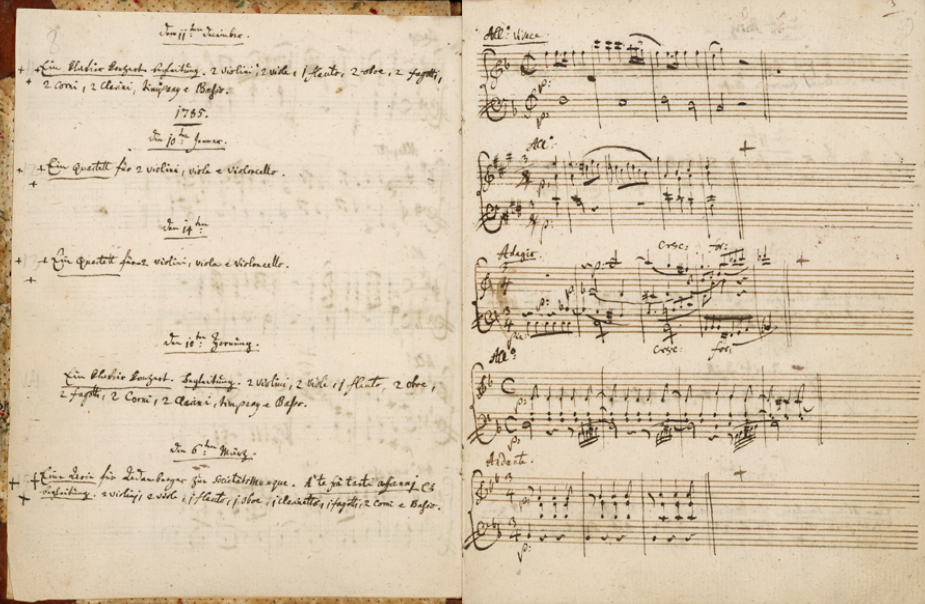
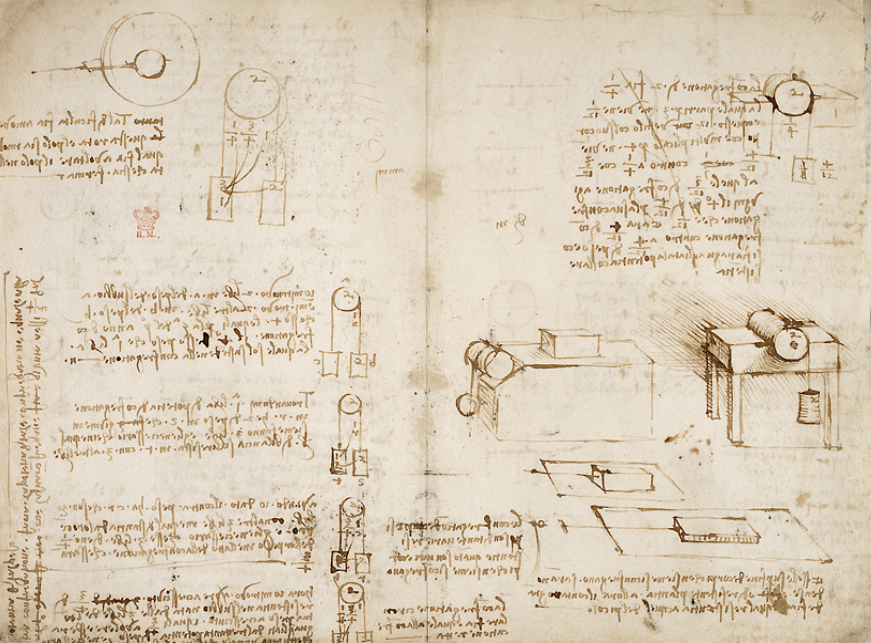
The vast digital collection includes books, ancient maps, and priceless prints. Amid the countless virtual tomes, some of the more impressive holdings include Mozart’s musical diary from the last seven years of his life, and Leonardo da Vinci’s notebook (find both above) where the artist and inventor theorized about mechanics. Da Vinci also recorded riddles in his notes, including: “The dead will come from underground and by their fierce movements will send numberless human beings out of the world” (Answer: “Iron, which comes from under the ground, is dead, but the weapons are made of it which kill so many men”).
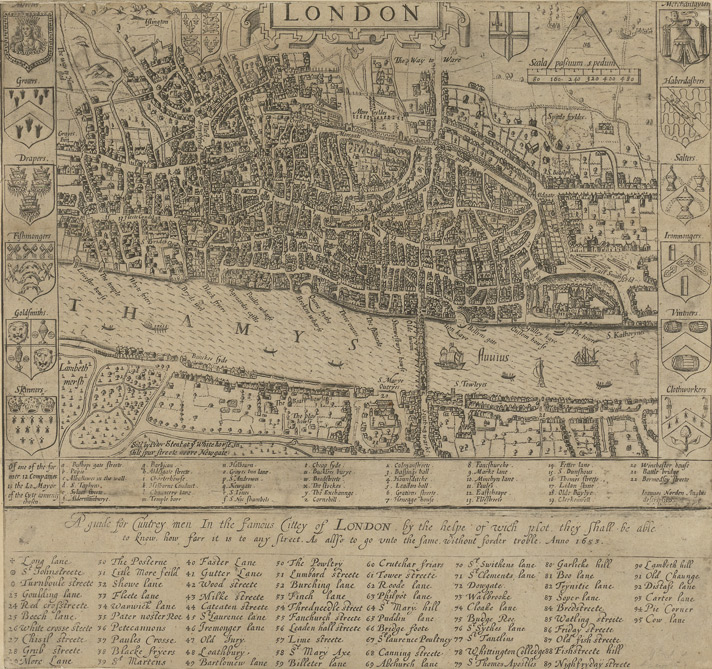
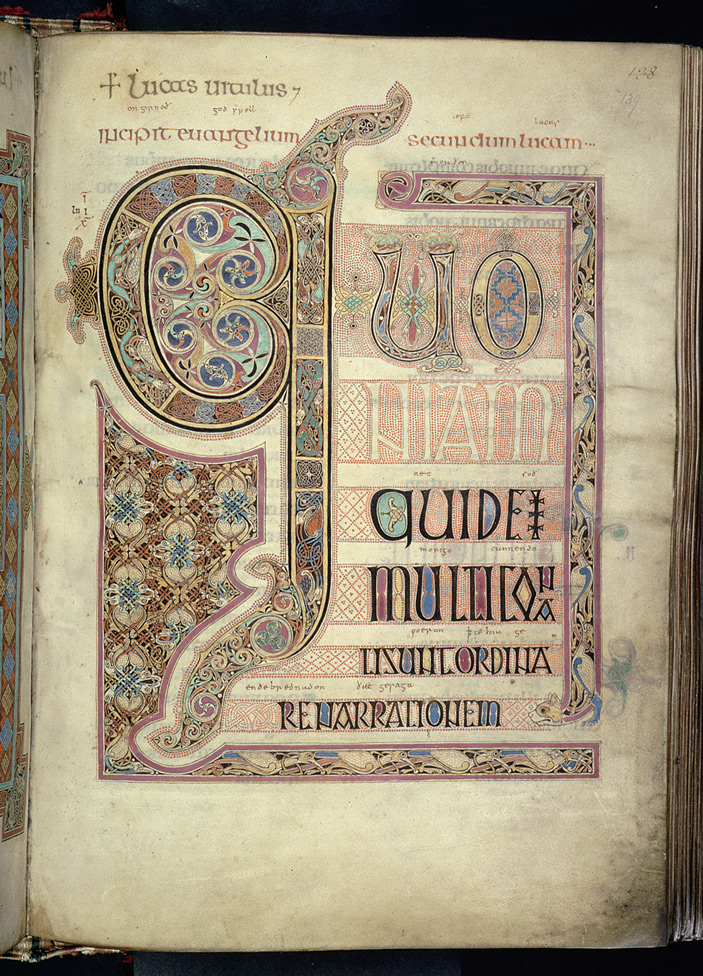
The online collection also contains a number of expertly curated exhibits by British Library staff, many of which are accompanied by a thorough introduction to guide readers through the material. I’ve always liked getting lost in old, detailed maps and particularly enjoyed the Crace Collection of Maps of London, which range from a 16th century “guide for cuntrey men in the famous cittey of London by the helpe of wich plot they shall be able to know how far it is to any street,” to a 19th century puzzle-type map, whose readers must find a particular route from the Strand to St. Paul’s. The collection also contains a terrific selection of pre-printing-press-era illuminated manuscripts, deemed “illuminated” because they were meticulously decorated, often using gold leaf. Among these are the opening of St. Luke’s Gospel from the Lindisfarne Bible (below), one of the earliest surviving English language Gospels (circa 715 CE), and scenes from the life of St. Guthlac, which dates to the early 13th century.
For more of the British Library’s Online Collection, head here.
Ilia Blinderman is a Montreal-based culture and science writer. Follow him at @iliablinderman, or read more of his writing at the Huffington Post.
Related Content:
The Getty Puts 4600 Art Images Into the Public Domain (and There’s More to Come)
The National Gallery Makes 25,000 Images of Artwork Freely Available Online
Read More...Watch Langston Hughes Read Poetry from His First Collection, The Weary Blues (1958)
Today we feature recordings of Langston Hughes reading two of his earliest and best-known poems from his debut 1926 collection The Weary Blues. The first, “The Negro Speaks of Rivers,” Hughes wrote in 1920 when he was only 17. In her very close reading of this poem, Alexandra Socarides tells us that Hughes was just “emerging from a distinctly Midwestern childhood” and taking a train to Mexico City to spend a year with his estranged father when he wrote the lines: “I’ve known rivers: / I’ve known rivers ancient as the world and older than the / flow of human blood in human veins.” (You can hear Hughes tell the story of writing the poem here). The short poem spans four rivers in three different continents, though “at the moment of its composition, it was the landscape of the Midwest [Hughes] knew best.”
Even before he had traveled the globe, Hughes’ concerns were global in scope. But he is most often associated with the jazz-age Harlem Renaissance scene, and rightly so. After his year in Mexico City, Hughes moved to New York to study at Columbia and helped pioneer a jazz poetry that anticipated Beats and Black Arts poets alike. The title poem of The Weary Blues is firmly situated in Harlem—“Down on Lenox Avenue” where a bluesman “made that poor piano moan with melody.” It’s a poem meant to be read aloud, and in the video above, you can see Hughes do so with accompanying jazz ensemble The Doug Parker Band for a 1958 Canadian program. That next year, Hughes collaborated with Charles Mingus and Leonard Feather on an album of jazz readings called The Weary Blues.
Critic Donald B. Gibson once noted that Hughes may have “read his poetry to more people (possibly) than any other American poet.” His generous populism didn’t always mean critical success—the two are often at odds—such that in 1969, Lindsay Patterson called him “the most abused poet in America” for the neglect or outright scorn his accessible poetry received from both black and white critics at the time. In a review of Ossie Davis and Ruby Dee’s hard-to-find recorded readings of 50 of Hughes’ poem, Patterson wrote that Hughes’ work “must be heard, rather than read silently, for one to realize its emotional scope.” I disagree. From early short poems like “A Wooing” to later, longer works like “Prelude to Our Age,” Hughes’ work on the page is deeply evocative, complex, and rewarding. But while Hughes was steeped in history, he was also steeped in poetic tradition of a very American variety—Walt Whitman, Claude McKay, Countee Cullen—that privileged musical language, vernacular expressions, and an exuberant personal voice, and that makes his work a particular joy to hear read, especially by the poet himself.
Related Contents:
Poems as Short Films: Langston Hughes, Pablo Neruda and More
Hear Sylvia Plath Read Fifteen Poems From Her Final Collection, Ariel, in 1962 Recording
Hear the Very First Recording of Allen Ginsberg Reading His Epic Poem “Howl” (1956)
Ezra Pound’s Fiery 1939 Reading of His Early Poem, ‘Sestina: Altaforte’
Josh Jones is a writer and musician based in Durham, NC. Follow him at @jdmagness
Read More...Painters Painting: The Definitive Documentary Portrait of the New York Art World (1940–1970)
Emile de Antonio is one of those people who simply had a knack for being in the right place at the right time. He was a Harvard classmate of John F. Kennedy. He knew all of the core members of the Beat movement, even helping to distribute the seminal Beat movie Pull My Daisies. And De Antonio was a friend with virtually everyone in the New York art scene from Jasper Johns to Willem de Kooning. He once drank himself into a stupor for Andy Warhol’s experimental movie Drink. Warhol even famously praised De Antonio saying, “Everything I learned about painting, I learned from De.”
De Antonio was also a major voice of dissent during the Cold War. He directed a series of scathing documentaries including Point of Order (1964), about the McCarthy hearings; Rush to Judgment (1966), a staple among JFK assassination theorists; and the Oscar-nominated anti-Vietnam war movie In the Year of the Pig. (1968)
For his 1972 movie Painters Painting: The New York Art Scene 1940–1970, De Antonio managed to get artists like Warhol, Johns, and De Kooning along with Robert Rauschenberg, Frank Stella, Barnett Newman and Helen Frankenthaler to talk about their craft. It is the definitive documentary portrait of the New York art world.
De Antonio talked about Painters Painting in a 1988 interview:
I was probably the only filmmaker in the world who could [have made Painters Painting] because I knew all those people, from the time that they were poor, and unsuccessful and had no money. I knew Warhol and Rauschenberg and Jasper Johns and Stella before they ever sold a painting, and so it was interesting to [do the film about them]. They appeared in the film along with De Kooning, whom I knew very well, and Barnett Newman, who is now dead. They talked to me in a way that they would never have talked to anybody else because they knew I knew the subject.
The film, a tad grainy, appears above. A higher res version of the film can “rented” on Amazon. Amazon Prime member can watch it for free.
Related Content:
Watch Portrait of an Artist: Jackson Pollock, the 1987 Documentary Narrated by Melvyn Bragg
635 Free Movies Online: Great Classics, Indies, Noir, Westerns, etc.
Rauschenberg Erases De Kooning
Jonathan Crow is a Los Angeles-based writer and filmmaker whose work has appeared in Yahoo!, The Hollywood Reporter, and other publications. You can follow him at @jonccrow.
Read More...Mark Twain Creates a List of His Favorite Books For Adults & Kids (1887)
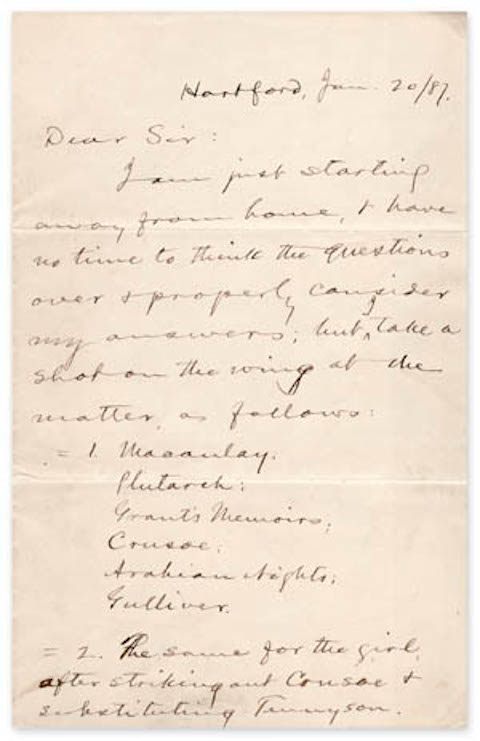
In January of 1887, Mark Twain wrote the above letter to a Reverend Charles D. Crane, pastor of a Methodist Episcopal Church in Maine, to advise him of the most suitable reading for both children and adults. Twain’s letter—which, as he did nearly all his letters, he signed with his given name of Samuel Clemens (or “S.L. Clemens”)—came in response to a query in three parts from the Rev. Crane. But we do not seem to have Crane’s letter (at least a thorough search of the exhaustive catalog at the online Mark Twain Project yields no results.) Nonetheless, we can reasonably infer that he asked the famous author—who was between Adventures of Huckleberry Finn and A Connecticut Yankee in King Arthur’s Court—something like the following:
1) What books should young boys read? 2) And young girls? … 3) [and both/either] What should grown-ups read? [and/or] What are Mr. Samuel Clemens’ favorite books?
Twain, in a hurry, “took a shot on the wing” and replied with the letter below, which, despite his protestations of haste, seems fairly well-considered. I’ll admit that the ambiguity of the last sentence, however, gives me the researcher’s buzz to go back and dig through more archives for Crane’s original letter.
Dear Sir:
I am just starting away from home, & have no time to think the questions over & properly consider my answers; but I take a shot on the wing at the matter, as follows:
1.Macaulay;
Plutarch;
Grant’s Memoirs;
Crusoe;
Arabian Nights;
Gulliver.
= 2. The same for the girl, after striking out out Crusoe & substituting Tennyson.
I can’t answer No. 3 in this sudden way. When one is going to choose twelve authors, for better for worse, forsaking fathers & mothers to cling unto them & unto them alone, until death shall them part, there is an awfulness about the responsibility that makes marriage with one mere individual & divorcible woman a sacrament sodden with levity by comparison.
In my list I know I should put Shakspeare [sic]; & Browning; & Carlyle (French Revolution only); Sir Thomas Malory (King Arthur); Parkman’s Histories (a hundred of them if there were so many); Arabian Nights; Johnson (Boswell’s), because I like to see that complacent old gasometer listen to himself talk; Jowett’s Plato; & “B.B.” (a book which I wrote some years ago, not for publication but just for my own private reading.)
I should be sure of these; & I could add the other three — but I should want to hold the opportunity open a few years, so as to make no mistake.
Truly Yours
S.L. CLEMENS
See all six manuscript pages of Twain’s letter (and zoom in to examine them closely) at the Shapell Manuscript Foundation. We’ve added links to Twain’s recommended texts above. You can find many in our Free eBooks and Free Audio Books collections.
Related Content:
Christopher Hitchens Creates a Reading List for Eight-Year-Old Girl
Neil deGrasse Tyson Lists 8 (Free) Books Every Intelligent Person Should Read.
“Nothing Good Gets Away”: John Steinbeck Offers Love Advice in a Letter to His Son (1958)
Josh Jones is a writer and musician based in Durham, NC. Follow him at @jdmagness
Read More...The Very First Written Use of the F Word in English (1528)
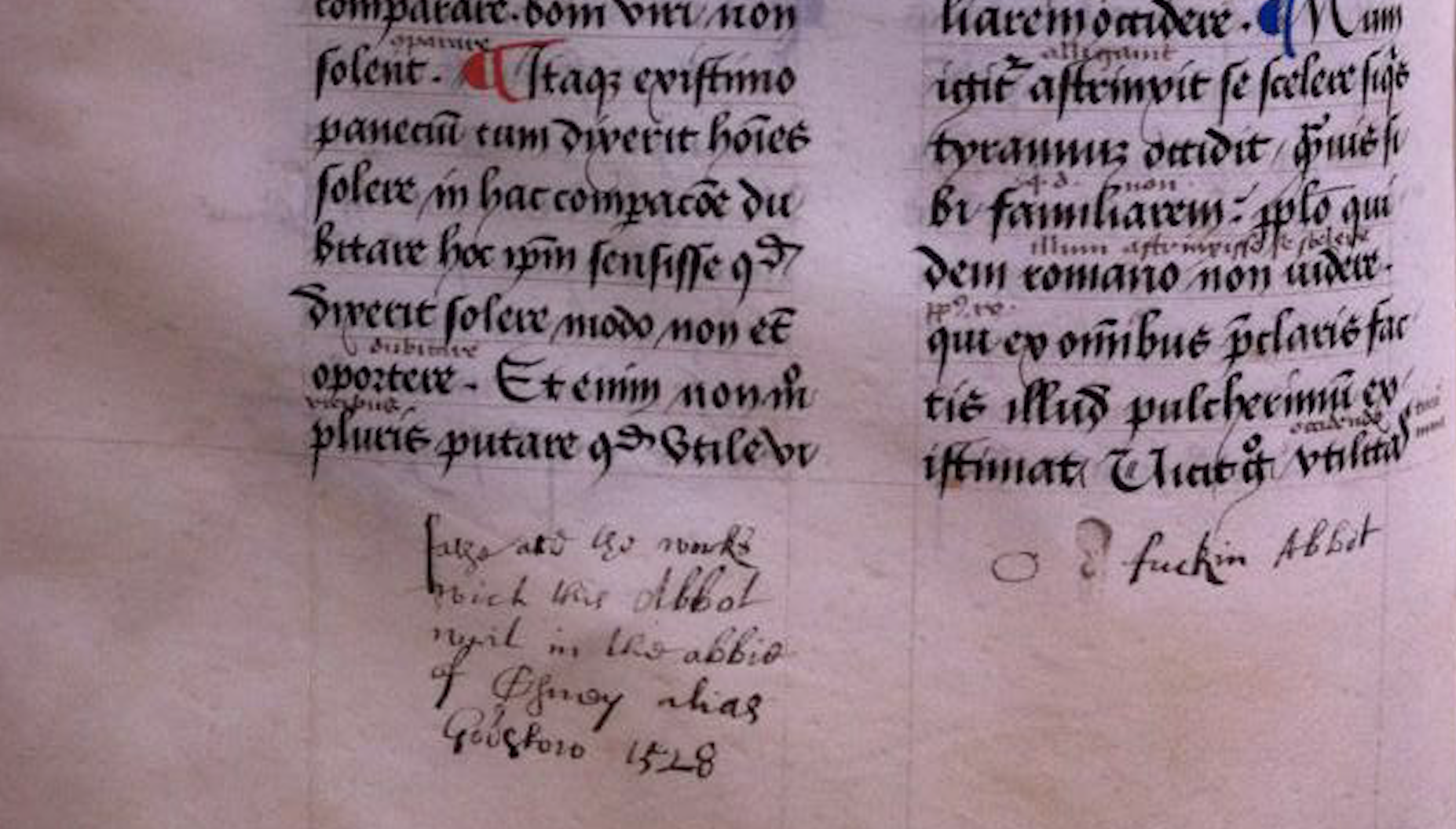
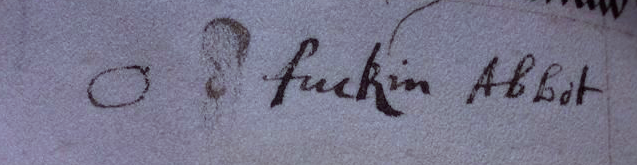
English speakers enjoy what seems like an unmatched curiosity about the origins and historical usages of their language’s curses. The exceedingly popular “F word” has accreted an especially wide body of textual investigation, wide-eyed speculation, and implausible folk etymology. (One of the term’s well-known if spurious creation myths even has a Van Halen album named after it.) “The history begins in murky circumstances,” says the Oxford English Dictionary’s site, and that dictionary of dictionaries has managed to place the word’s earliest print appearance in the early sixteenth century, albeit written “in code” and “in a mixed Latin-and-English context.” Above, you can see one of the few concrete pieces of information we have on the matter: the first definitive use of the F word in “the English adjectival form, which implies use of the verb.”
Here the word appears (for the first time if not the last) noted down by hand in the margins of a proper text, in this case Cicero’s De Officiis. “It’s a monk expressing his displeasure at an abbot,” writes Katharine Trendacosta at i09. “In the margins of a guide to moral conduct. Because of course.” She quotes Melissa Mohr, author of Holy Sh*t: A Brief History of Swearing, as declaring it “difficult to know” whether this marginalia-making monk meant the word literally, to accuse this abbott of “questionable monastic morals,” or whether he used it “as an intensifier, to convey his extreme dismay.” Either way, it holds a great deal of value for scholars of language, given, as the OED puts it, “the absence of the word from most printed text before the mid twentieth century” and the “quotation difficulties” that causes. If you find nothing to like in the F word’s ever-increasing prevalence in the media, think of it this way: at least future lexicographers of swearing will have more to go on.
To view the complete manuscript page, click here. The document seemingly resides at Brasenose College, Oxford.
via io9
Related Content:
Steven Pinker Explains the Neuroscience of Swearing (NSFW)
Stephen Fry, Language Enthusiast, Defends The “Unnecessary” Art Of Swearing
George Carlin Performs His “Seven Dirty Words” Routine: Historic and Completely NSFW
Colin Marshall hosts and produces Notebook on Cities and Culture and writes essays on cities, Asia, film, literature, and aesthetics. He’s at work on a book about Los Angeles, A Los Angeles Primer. Follow him on Twitter at @colinmarshall or on his brand new Facebook page.
Read More...Play the Great Language Game: It’s Fun and Free

Are you ready to play The Great Language Game? This online game “challenges you to distinguish between some eighty or so languages [see a list here] based on their sound alone. In each game you’re allowed three mistakes, which are kept for you to study at the end. If you’re feeling competitive, share your score with some friends and compete for some serious bragging rights.” You can even see how other players are faring internationally.
If you rock the game, let us know in the comments below.
If you come out of the game feeling like you could brush up on your languages (which you pretty well might), then head over to our collection of Free Language Lessons. It offers free lessons in 46 languages, everything from Arabic to Yiddish. Have fun.
via Kottke
Related Content:
Learn 46 Languages Online for Free: Spanish, Chinese, English & More
Learn Latin, Old English, Sanskrit, Classical Greek & Other Ancient Languages in 10 Lessons
Speaking in Whistles: The Whistled Language of Oaxaca, Mexico
“Learn English With Ricky Gervais,” A New Podcast Debuts (NSFW)
Read More...How a Book Thief Forged a Rare Edition of Galileo’s Scientific Work, and Almost Pulled it Off
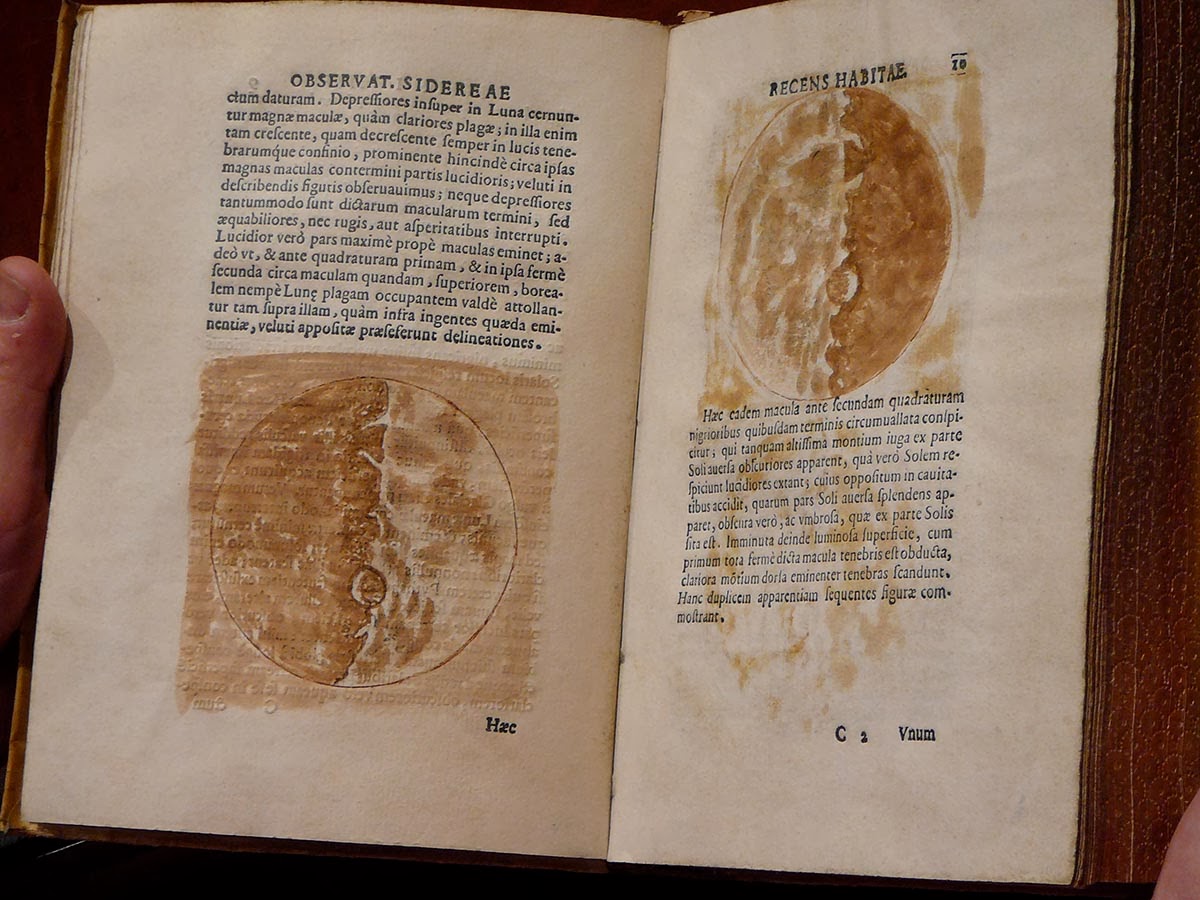
A couple of weeks ago, we published a post that featured Galileo’s Moon drawings, “the first realistic depictions of the moon in history.” As it turns out—some readers alerted us—some of the Moon illustrations attributed to Galileo are actually very convincing forgeries, so convincing, in fact that when the drawings surfaced in 2005, they initially swayed such experts as rare books dealer Richard Lan, Harvard professor of astronomy and history of science Owen Gingerich, and art historian Horst Bredekamp. All of these experts have since come to learn—partially through the investigations of Georgia State University historian Nick Wilding—that an unusual edition containing detailed watercolors, purportedly in Galileo’s own hand (above and below), was in fact created by forger, book thief, and former director of the State Library of Girolamini, Marino Massimo De Caro, who now stands accused of stealing thousands of volumes, including centuries-old editions of Aristotle, Descartes, Galileo and Machiavelli.
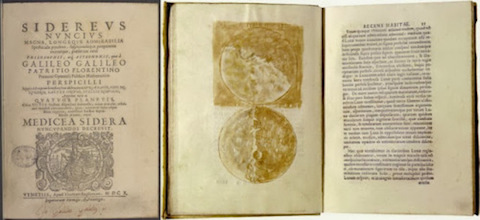
The drawings we featured at the top of our previous post—from a set of five inkwashes made in 1609, called “the Florence Sheet”—are genuine, as are the etchings in the original text of Galileo’s scientific treatise, Sidereus Nuncius. However, as investigative reporter Nicholas Schmidle documented in a lengthy article published in last December’s New Yorker, the edition pictured above—purchased for half a million dollars by Richard Lan of rare booksellers Martayan Lan and once valued at over ten million dollars for its unique rust-colored illustrations—is a fake, despite being authenticated by a team of scholars in 2007.
The story of how De Caro’s forgery came to fool nearly everyone who examined it (ending up in Time magazine and dozens of other publications and scholarly websites) is a long and winding tale. Like many forgers, De Caro acted out of a mixture of greed, envy, and a desire to prove himself to a field he felt did not recognize his talents (De Caro also forged a copy of Galileo’s 1606 Compasso to replace a stolen version). A college dropout, he “held an imperious grudge against people who had spent years studying in libraries,” writes Schmidle. Instead, De Caro had earned an honorary professorship by donating four Galileo editions (presumably genuine) and a chunk of meteorite to a private institution in Buenos Aires. More than just a story of fraud and theft, De Caro’s is one of academic imposture. In 2006, for example, he participated in a panel discussion on Galileo at Fordham University, and despite the skepticism of actual scholars, his expertise was trusted in the rare books and museum worlds until his discovery.
According to Schmidle, De Caro and an accomplice artist aged several bottles of nineteenth-century ink to create the Galileo drawings, using the Florence Sheet as a guide for the seventeenth-century astronomer’s hand. After opening a bottle of red wine, he had his accomplice trace the outline of the moons with the foot of his wineglass. Then they baked the pages in his home oven to age them. It’s hard to believe De Caro’s fake survived scrutiny for over five years, until Wilding began to express his doubts in 2011. Though facing several years in prison, De Caro hopes to work someday with the F.B.I., helping them discover forged and stolen books. He cites famous con man Frank Abagnale, played by Leonardo Di Caprio in the 2002 film Catch Me If You Can, as an inspiration. “I want to do for books what he did for checks,” says De Caro. “I can help them find all the black, offshore accounts of all the booksellers.” Read a facsimile of Schmidle’s article here. And for more on De Caro’s brazen crimes, see this detailed Examiner article.
Related Contents:
Galileo’s Moon Drawings, the First Realistic Depictions of the Moon in History (1609–1610)
Meet “Father Philanthropy”: America’s Most Prolific and Unlikely Master Art Forger
Josh Jones is a writer and musician based in Durham, NC. Follow him at @jdmagness
Read More...Free Guided Meditations From UCLA: Boost Your Awareness & Ease Your Stress
Previously, we’ve written about a growing number of cultural figures who practice transcendental meditation, with Paul McCartney, David Lynch, Leonard Cohen, Ellen Degeneres, and Sheryl Crow being ardent supporters. Mindfulness meditation, while less known, has also steadily increased in popularity over the past half-decade. In part, there’s its inherent appeal: mindfulness cultivates an all-accepting awareness of the present moment, thereby dissolving anxieties about the future or preoccupations with thoughts of the past. There’s also the growing momentum of mindfulness research in the scientific community, with studies suggesting that mindfulness-based therapeutic approaches may benefit a host of psychological issues. Its use to alleviate anxiety, depression, and stress is particularly promising.
“Sounds tempting,” you say, “but where does one try this mindfulness meditation business, anyway? Can I try it without going anywhere?” You’re in luck, my friend! UCLA’s Mindful Awareness Research Center (MARC) has uploaded a set of mindfulness meditations to iTunesU, where the series is presently the #1 download. “I’m too busy,” you say, opening a Facebook tab. Not so fast! Most of the meditations are under 10 minutes long, with the complete series clocking in at two hours.
We’ve had trouble listening to the lectures on the UCLA site, so if you’re interested, head over to iTunesU to download Mindful Meditations. Otherwise, if you live within a reasonable distance of UCLA’s Hammer Museum, drop in for free weekly meditation sessions (recordings for most of these are available here).
Ilia Blinderman is a Montreal-based culture and science writer. Follow him at @iliablinderman, or read more of his writing at the Huffington Post.
Related Content:
Alan Watts Introduces America to Meditation & Eastern Philosophy (1960)
David Lynch Talks Meditation with Paul McCartney
David Lynch Explains How Meditation Enhances Our Creativity
Read More...Support Us
We're hoping to rely on loyal readers, rather than erratic ads. Please click the Donate button and support Open Culture. You can use Paypal, Venmo, Patreon, even Crypto! We thank you!

About Us

Open Culture scours the web for the best educational media. We find the free courses and audio books you need, the language lessons & educational videos you want, and plenty of enlightenment in between.
Advertise With Us

FREE UPDATES!
GET OUR DAILY EMAIL
Get the best cultural and educational resources on the web curated for you in a daily email. We never spam. Unsubscribe at any time.
FOLLOW ON SOCIAL MEDIA

Open Culture editor Dan Colman scours the web for the best educational media. He finds the free courses and audio books you need, the language lessons & movies you want, and plenty of enlightenment in between.
Advertise With Us


