Saul Bass’ Vivid Storyboards for Kubrick’s Spartacus (1960)
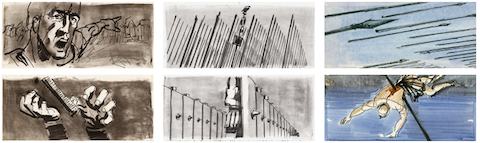
Those who know the work of Stanley Kubrick know that the longer he made films, the more insistently he demanded the best: the most flexible, varied material to adapt to his cinematic methods; the shots with the greatest impact among hundreds of takes each; the collaborators with the strongest and most useful visions, no matter their department. That very need for high craftsmanship would, you’d think, have lead the director straight to the door of Saul Bass, the graphic designer who lived and rose to eminence in his field during the same era that Kubrick lived and rose to eminence in his. They did work together on 1960’s Spartacus and 1980’s The Shining, Kubrick’s fifth and eleventh features, but as Empire’s feature on Bass’ early work explains, “it wasn’t Stanley Kubrick who recruited him to piece together Spartacus’s opening sequences.” Still, “Kubrick had been an admirer of his fellow New Yorker from his early work with Otto Preminger,” presumably including work like his still-striking titles for The Man with the Golden Arm.
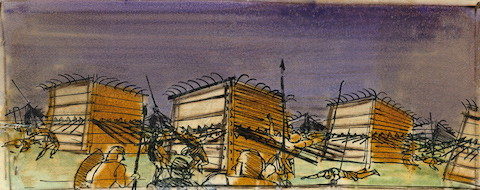
When Kubrick took a first look at Bass’ storyboards for Spartacus, as visually vivid as any of his movies themselves, he must have liked what he saw. Now you can examine them too, both at Empire and at Flavorwire’s collection of “Awesome Storyboards from 15 of Your Favorite Films.” Those of you who have watched Spartacus over and over again will recognize the look and feel sketched out (not that sketched sounds quite right for images of such a solidity unusual for storyboards) by Bass. But when the film and the drawing part ways, they do so because the plans actually came out less elaborate than the final product, not more. We see in the storyboards, as Empire says, “an elliptical sequence with the camera lingering on fragments of the fighting” with “a row of shields here, a skewered legionary there,” “but in those long-distant days when budgets went up as well as down, it was scrapped in favor of just recreating the whole thing lock, stock and flaming barrel” — very much a Kubrickian way of doing things.
Related Content:
A Brief Visual Introduction to Saul Bass’ Celebrated Title Designs
Stanley Kubrick’s List of Top 10 Films (The First and Only List He Ever Created)
Colin Marshall hosts and produces Notebook on Cities and Culture and writes essays on cities, Asia, film, literature, and aesthetics. He’s at work on a book about Los Angeles, A Los Angeles Primer. Follow him on Twitter at @colinmarshall or on his brand new Facebook page.
Read More...Impressions of Upper Mongolia : Salvador Dalí’s Last Film About a Search for a Giant Hallucinogenic Mushroom
Salvador Dalí and his fellow surrealists owed a great debt to the wealthy, dandyish French writer Raymond Roussel, as much as modernist poets owed the Symbolist Jules Laforgue. But like Laforgue, Roussel is much more often referenced than read, and he isn’t referenced often. A hermetic, insular writer who seems to belong to a private world almost entirely his own, Roussel despaired of his lack of success and committed suicide in 1933. His aesthetic progeny, on the other hand— Dalí, Marcel Duchamp, André Breton—were showmen, self-promoters and media geniuses. So it’s particularly poignant, in the quirkiest of ways, that Dalí chose for his final film project a collaboration with Jose Montes Baquer in 1976 called Impressions of Upper Mongolia (“Impressions de la haute Mongolie”—above with English subtitles), an homage to Roussel’s self-published 1910 novel Impressions of Africa.
Roussel, who traveled widely, never traveled to Africa, and his “impressions” are wholly creations of the kind of wordplay that Dalí made visual in his painting (including a canvas with Roussel’s title). Like Roussel’s novel, Impressions of Upper Mongolia is a surrealist fantasy with only the most tenuous connection to its ostensible geographical subject.
The entire 50-minute adventure takes place, MUBI tells us, “in [Dalí’s] studio-museum in Cadacès (Spain).” The film opens with an epitaph for Roussel in German, French, and English that lionizes the proto-surrealist as “the monstrous master of mystical language.” “Mystical” is indeed the mot juste for this film. Dalí narrates a story about an expedition he supposedly sent to the titular region in search of a giant hallucinogenic mushroom. Flavorwire describes the “quasi-fake documentary” succinctly: “…it’s every bit as trippy as you would expect it to be. Along the way, there’s a lot of mustache-waggling, yelling at Hitler, discussions about Outer Mongolia and Raymond Roussel, intense close-ups of insects, and other eccentric additions — like Dalí’s overacting.”
For all his ease with film, and his outsized reputation in film history, Dali only ever collaborated with other filmmakers, first Luis Buñuel, then Walt Disney, and finally Baquer (who called him, approvingly, “an intellectual vampire”). In an interview, Baquer reveals that Dali chose the title and the Roussel references. He also “commissioned” the film, in a way, by handing Baquer a pen that he had been urinating on for several weeks after “observing how the urinals in the luxury restrooms of [the St. Regis Hotel] have acquired an entire range of rust colours through the interaction of the uric acid on the precious metals.”
Baquer recounts that Dali ceremoniously told him to “take this magical object, work with it, and when you have an interesting result, come see me. If the result is good, we will make a film together.” The result is most certainly interesting. A fitting tribute to Roussel, it recalls Trevor Winkfield’s comments on the world of the writer, one that “belongs entirely to the imagination. Nothing real intrudes; it all derives from his head. Like a fairy tale, but a believable one.”
Watch Part 1 up top, and the remaining parts on YouTube here.
Related Content:
Two Vintage Films by Salvador Dalí and Luis Buñuel: Un Chien Andalou and L’Age d’Or
Destino: The Salvador Dalí – Disney Collaboration 57 Years in the Making
A Soft Self-Portrait of Salvador Dali, Narrated by the Great Orson Welles
Josh Jones is a writer and musician based in Durham, NC. Follow him at @jdmagness
Read More...William S. Burroughs on Saturday Night Live, 1981
Today marks the 100th birthday of beat writer William S. Burroughs (1914–1997). Grab a bottle of wine … preferably cheap wine … and let’s travel back to November 7, 1981. That’s when Burroughs made his first appearance on American national television. And quite appropriately, it was on the irreverent, late-night comedy show, Saturday Night Live. As you’ll see, actress Lauren Hutton made the introduction, setting up Burroughs to read from Naked Lunch (1959) and Nova Express (1964). The clip itself is an outtake from the opening scene of Burroughs, a 1983 documentary by Howard Brookner, which is currently getting restored. We originally featured this video back in early 2012. Since then we’ve brought you many other intriguing posts on Burroughs, whose life and art provides so much to talk about. See some of our favorites below:
Gus Van Sant Adapts William S. Burroughs’ The Discipline of D.E.: An Early 16mm Short
“The Thanksgiving Prayer,” Read by William S. Burroughs and Shot by Gus Van Sant
William S. Burroughs “Sings” R.E.M. and The Doors, Backed by the Original Bands
William S. Burroughs on the Art of Cut-up Writing
William S. Burroughs’ Free Short Course on Creative Reading
If you would like to support the mission of Open Culture, consider making a donation to our site. It’s hard to rely 100% on ads, and your contributions will help us continue providing the best free cultural and educational materials to learners everywhere. You can contribute through PayPal, Patreon, and Venmo (@openculture). Thanks!
Read More...Watch the Highly-Anticipated Evolution/Creationism Debate: Bill Nye the Science Guy v. Creationist Ken Ham
Bill Nye the Science Guy has spent his career trying to “help foster a scientifically literate society, to help people everywhere understand and appreciate the science that makes our world work.” A graduate of Cornell and a student of Carl Sagan, Nye has produced educational programs for the Science Channel, the Discovery Channel, and PBS. Most recently, he has gone on record saying that teaching creationism in America’s classrooms is bad for kids, and bad for America’s future. “If the United States produces a generation of science students who don’t believe in science, that’s troublesome” because the United States needs science to remain competitive,” he warns in this video.
For some weeks, the internet has been abuzz about a debate between Bill Nye and Ken Ham, the president of Answers in Genesis (AiG) and the Creation Museum. The debate — something Richard Dawkins called a pointless endeavor — took place last night in Petersburg, Kentucky. It’s now online, all two and a half hours of it. We’re you’re done watching the spectacle, you can view some other high-profile religion-science debates that we’ve featured in the past.
If you would like to support the mission of Open Culture, consider making a donation to our site. It’s hard to rely 100% on ads, and your contributions will help us continue providing the best free cultural and educational materials to learners everywhere. You can contribute through PayPal, Patreon, and Venmo (@openculture). Thanks!
Related Content:
Bertrand Russell and F.C. Copleston Debate the Existence of God, 1948
Does God Exist? Christopher Hitchens Debates Christian Philosopher William Lane Craig
Richard Dawkins and Jon Stewart Debate Whether Science or Religion Will Destroy Civilization
Animated: Stephen Fry & Ann Widdecombe Debate the Catholic Church
Find the Stanford course Darwin’s Legacy in our collection, 1,700 Free Online Courses from Top Universities
Read More...The Notecards on Which Vladimir Nabokov Wrote Lolita: A Look Inside the Author’s Creative Process
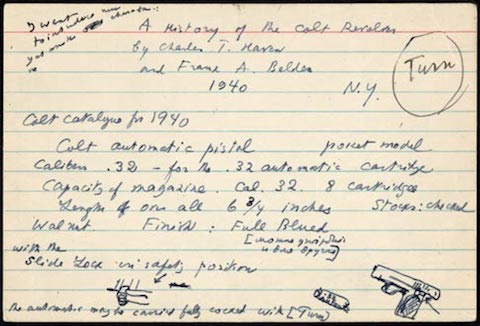
If you picked up The Original of Laura, Vladimir Nabokov’s final novel, you’ll have seen his distinctive index card-based writing method in action. Having died in 1977, Nabokov never completed the book, and so all Penguin had to publish decades later came to, as the subtitle indicates, A Novel in Fragments. These “fragments” he wrote on 138 cards, and the book as published includes full-color reproductions that you can actually tear out and organize — and re-organize — for yourself, “complete with smudges, cross-outs, words scrawled out in Russian and French (he was trilingual) and annotated notes to himself about titles of chapters and key points he wants to make about his characters.” That comes from a post by Dominic Basulto at Big Think, who highlights cards with “a full-on discussion of the precise word that Nabokov would like to describe a female character (fille, in French) and how best to render that word in English, while keeping the connotations and meaning of the word in French.” Reviewing The Original of Laura, Alexander Theroux describes the cards as a “portable strategy that allowed [Nabokov] to compose in the car while his wife drove the devoted lepidopterist on butterfly expeditions.”
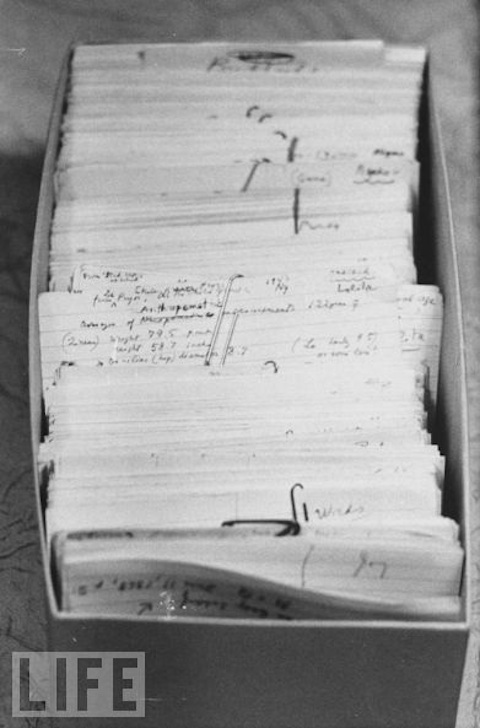
Nabokov could thus, between thoughts of his winged objects of interest, use the cards for “inserting words, writing memos to himself, scribbling afterthoughts: ‘invent tradename [for a medicine], e.g., cephalopium.’ ” They also served him earlier in his career; at the Library of Congress’ site for its Manuscript Division’s Nabokov collection, you can see a couple of the cards on which he wrote his best-known novel, 1955’s Lolita. Asked about his working methods by Herbert Gold in the Paris Review, he described the method forthrightly: “The pattern of the thing precedes the thing. I fill in the gaps of the crossword at any spot I happen to choose. These bits I write on index cards until the novel is done. My schedule is flexible, but I am rather particular about my instruments: lined Bristol cards and well sharpened, not too hard, pencils capped with erasers.” For every craft, the proper tool, and Nabokov remains, fragmentary last book and all, one of western literature’s most respected craftsmen of language — or, rather, languages, plural.
Note: You can download essential works by Vladimir Nabokov as free audiobooks (including Jeremy Irons reading Lolita) if you sign up for a free 30 Trial with Audible. Find more information on that program here.
Related Content:
Vladimir Nabokov Marvels Over Different Lolita Book Covers
Vladimir Nabokov (Channelled by Christopher Plummer) Teaches Kafka at Cornell
Alfred Hitchcock and Vladimir Nabokov Trade Letters and Ideas for a Film Collaboration (1964)
Nabokov Reads Lolita, Names the Great Books of the 20th Century
Vladimir Nabokov’s Delightful Butterfly Drawings
Colin Marshall hosts and produces Notebook on Cities and Culture and writes essays on cities, Asia, film, literature, and aesthetics. He’s at work on a book about Los Angeles, A Los Angeles Primer. Follow him on Twitter at @colinmarshall or on his brand new Facebook page.
Read More...The Greatest Jazz Films Ever Features Classic Performances by Miles, Dizzy, Bird, Billie & More
Though both have their roots in the previous century, jazz and cinema came of age as 20th century art forms, and they very often did so together (though not always in the most tasteful ways). Al Jolson’s The Jazz Singer introduced the world to talkies. Cabaret, Lady Sings the Blues, The Cotton Club are all well-known fictional films that nearly anyone might name if asked about the subject. And though Ken Burns’ Jazz may seem like a definitive statement in jazz documentary, for decades, filmmakers have made jazz musicians their central subject—for example, in jazz fan-favorites like Mingus and Thelonious Monk: Straight No Chaser. Before these excellent, if sometimes painful, portraits, there were short films like Life magazine photographer Gjon Mili’s 1944 Jammin’ the Blues with Lester Young and other bop stalwarts, and 1950’s Jazz at the Philharmonic, a selection of clips featuring Coleman Hawkins, Charlie Parker, Lester Young, Buddy Rich, Ella Fitzgerald, and others performing at Norman Granz’s legendary series of concerts.
You’ll see excerpts from both Jammin’ the Blues and Jazz at the Philharmonic above in The Greatest Jazz Films Ever, a two-disc DVD set that appears to be out of print. (New copies currently retail on Amazon for anywhere from $259.00 to almost $4,000, but you can watch it free online.) This greatest hits collection also includes highlights from several television specials like Be Bop’s Nest—a rare Charlie Parker appearance with Dizzy Gillespie on the short-lived variety show Stage Entrance—and “The Sound of Miles Davis,” a 1959 episode of television show The Robert Herridge Theater that showcased one of Davis’ most celebrated ensembles.
You’ll also see excerpts from The Sound of Jazz, which Fresh Sound Records calls “one of the great glorious moments on television,” and which contains performances from Billie Holiday, Lester Young, Thelonious Monk, the Count Basie Orchestra, and more. Finally, we get excerpts from a 1959 television special called Jazz From Studio 61, featuring the original Ahmad Jamal Trio with the Ben Webster Quintet. The Greatest Jazz Films Ever is an impressive and enduring collection of documents from the golden age of jazz. While the emphasis here is generally on musicianship, not filmmaking, it’s a collection that also demonstrates jazz’s close relationship to film and television in the mid-20th century. Allmusic has a complete tracklist of the collection. And for a detailed breakdown of each clip, you won’t want to pass up a scroll through this helpful French site.
Related Content:
‘Jammin’ the Blues,’ by Gjon Mili
‘The Sound of Miles Davis’: Classic 1959 Performance with John Coltrane
Jazz ‘Hot’: The Rare 1938 Short Film With Jazz Legend Django Reinhardt
Josh Jones is a writer and musician based in Durham, NC. Follow him at @jdmagness
Read More...Ira Glass’ Advice on Achieving Creative Excellence Presented in Two Artful, Typographic Videos
”All of us who do creative work,” says Ira Glass, creator This American Life, quite possibly the most respected program on public radio, “we get into it because we have good taste.” Yet despite this discernment, or indeed because of it, “there’s a gap: for the first couple years that you’re making stuff, what you’re making isn’t so good. [ … ] Your taste is good enough that you can tell that what you’re making is kind of a disappointment to you.” For this reason, Glass argues, the tasteful often fail at their creative endeavors entirely. “Most everybody I know who does interesting creative work,” he continues, “they went through a phase of years where they had really good taste, and they could tell what they were making wasn’t as good as they wanted it to be.” This astute diagnosis of a “totally normal” syndrome comes extracted from Glass’ talk on the craft of storytelling, previously featured here on Open Culture.
Fortunately for those of us struggling with the very taste-ability mismatch Glass describes, a solution exists. If you want a quick fix, though, prepare for disappointment. “Do a lot of work,” he flatly advises. “Do a huge volume of work. Put yourself on a deadline so that every week or every month you know you’re going to finish one story. Because it’s only by actually going through a volume of work that you’re actually going to catch up and close that gap.” These words have proven inspiring enough that they’ve surely spurred listeners on to plow paths of sheer production through their chosen rocky yet fertile creative fields. Two listeners in particular, David Shiyang Liu and Frohlocke, apparently found themselves immediately galvanized to work with the words themselves, resulting in the typographically focused video interpretations above. Only one question remains: how large a volume of typographically focused video interpretations of Ira Glass’ words did they have to create before they could make ones this impressive?
Related Content:
Ira Glass, the Host of This American Life, Breaks Down the Fine Art of Storytelling
Ira Glass on the Art and Craft of Telling Great Radio Stories
Colin Marshall hosts and produces Notebook on Cities and Culture and writes essays on cities, Asia, film, literature, and aesthetics. He’s at work on a book about Los Angeles, A Los Angeles Primer. Follow him on Twitter at @colinmarshall or on his brand new Facebook page.
Read More...Teddy Roosevelt’s 10 Rules For Reading: Seek Enjoyment, Spurn Fads, Read What You Like
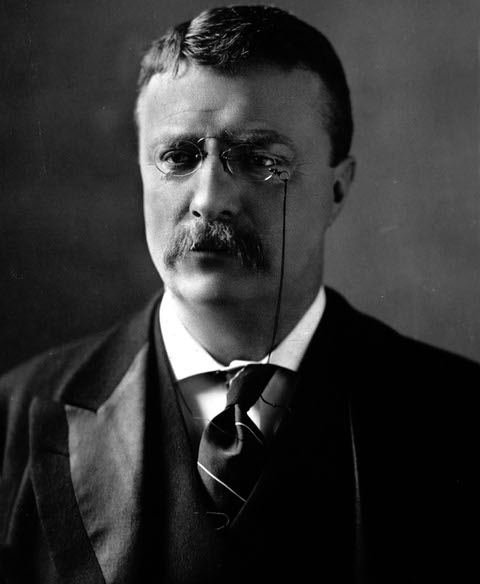
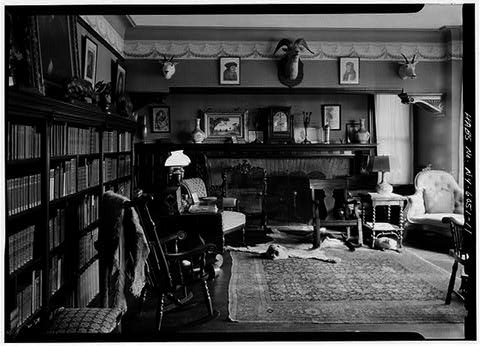
Teddy Roosevelt seems to us a paradox today, and did in his time as well: A man’s man hunter, cowboy, and war hero, who supposedly saved the game of football from extinction (Roosevelt worried that banning the game would produce “mollycoddles instead of vigorous men”); also, a Harvard-educated New York progressive and treehugging conservationist hero, who re-defined presidential style with Brooks Brothers three-piece suits and uniforms. And for all of his public heroics, Roosevelt was also a doting father who gave his nickname to the most universally cuddly species of bear. Perhaps some of the best representations of Roosevelt’s personal ethos are photographs of his combination library and gun room, hung with hunting trophies and skins in the home he built for his family in Oyster Bay, New York (below—see more at the appropriately named “Art of Manliness”).
One significant reason Roosevelt could embody seemingly widely divergent traits was that he was a devourer of books, reading tens of thousands in his lifetime, absorbing thousands of points of view from every possible source. But Roosevelt did not read the way we do today—rapidly taking in information for its own sake, with automated services compiling recommendations from the metadata (a phenomenon Susan Jacoby has indicted as part of our hyper-partisan, groupthink culture). He read according to his whim, putting pleasure ahead of profit and disdaining fads and rigid cultural norms. He was, literary site Book Riot supposes, “probably the most well-read president, and perhaps one of the most well-read men in all of history.”
Book Riot points us toward a few pages of Roosevelt’s autobiography, in which—amidst picaresque chapters like “In Cowboy Land” and heavy ones like “The Presidency; Making an Old Party Progressive”—Roosevelt pauses to detail his thoughts on reading in a particularly pragmatic chapter titled “Outdoors and Indoors.” Although Roosevelt does not present his contemplation as an easily digestible list of rules, as is the fashion now, Book Riot has seen fit to condense his thought. Below see the first five of their list, “Teddy Roosevelt’s 10 Rules for Reading.” I’d be willing to bet that if everyone followed Teddy’s advice, we could up the woeful national literacy quotient within a few short years.
1. “The room for choice is so limitless that to my mind it seems absurd to try to make catalogues which shall be supposed to appeal to all the best thinkers. This is why I have no sympathy whatever with writing lists of the One Hundred Best Books, or the Five-Foot Library [a reference to the Harvard Classics]. It is all right for a man to amuse himself by composing a list of a hundred very good books… But there is no such thing as a hundred books that are best for all men, or for the majority of men, or for one man at all times.”
2. “A book must be interesting to the particular reader at that particular time.”
3. “Personally, the books by which I have profited infinitely more than by any others have been those in which profit was a by-product of the pleasure; that is, I read them because I enjoyed them, because I liked reading them, and the profit came in as part of the enjoyment.”
4. “The reader, the booklover, must meet his own needs without paying too much attention to what his neighbors say those needs should be.”
5. “He must not hypocritically pretend to like what he does not like.”
Head over to Book Riot for the remaining five of Roosevelt’s “rules,” along with some witty commentary.
Related Content:
‘The Right of the People to Rule’: Listen to Theodore Roosevelt Speaking 100 Years Ago Today
Ernest Hemingway Creates a Reading List for a Young Writer, 1934
Josh Jones is a writer and musician based in Durham, NC. Follow him at @jdmagness
Read More...Neil Gaiman Reads Dr. Seuss’ Green Eggs and Ham
This morning, we’re serving up some green eggs and ham. Or rather Neil Gaiman is. Whenever I think about someone reading Dr. Seuss’ classic children’s book, I can’t help but think back to Jesse Jackson’s classic reading on SNL in 1991. But who knows, maybe 20 years from now, another generation might call to mind this version by the unshaven Gaiman. If the reading whets your appetite a bit, don’t miss our collection of Neil Gaiman’s Free Short Stories, which includes, among other things, audio & video recordings of @neilhimself reading his own stories. We’ve got some more good Dr. Seuss material below.
If you would like to support the mission of Open Culture, consider making a donation to our site. It’s hard to rely 100% on ads, and your contributions will help us continue providing the best free cultural and educational materials to learners everywhere. You can contribute through PayPal, Patreon, and Venmo (@openculture). Thanks!
Looking for free, professionally-read audio books from Audible.com? Here’s a great, no-strings-attached deal. If you start a 30 day free trial with Audible.com, you can download two free audio books of your choice. Get more details on the offer here.
via Metafilter
Related Content:
Fake Bob Dylan Sings Real Dr. Seuss
The Epistemology of Dr. Seuss & More Philosophy Lessons from Great Children’s Stories
550 Free Audio Books: Download Great Books for Free
Read More...New Carl Sagan Archive Features His Digitized Home Movies, Student Journalism, Draft of His Pale Blue Dot & More
Several days ago, we brought you a rare Carl Sagan sketch, where the young scientist depicted an imagined history of interstellar space flight. In that post, we made brief mention of the Seth MacFarlane Collection of the Carl Sagan and Ann Druyan Archive, which merits to be highlighted in its own right: its arrival means that the Internet now has access to a vast repository of the eminent science educator’s original papers and personal artifacts.
Historians, biographers, and die-hard Sagan devotees will inevitably want to visit the Library of Congress in person to view the full archive, which contains over 1700 boxes of material. The lay reader curious about Sagan’s life, however, won’t need to make the trek to the U.S. capital to sample the archive’s contents. That’s because the Library of Congress has uploaded a portion of the collection online, including sundry fascinating biographical pieces. Above, you can view a digitized set of the Sagan family’s silent home movies, where young Carl shows off his boyhood boxing prowess, rides horseback, and plays piano (preciously, we presume).
It was during high school that Sagan began to fill out intellectually. His senior yearbook is testimony to both his interest in science and the humanities: not only was Sagan president of both the science and chemistry clubs, he also led the French club, served as an editor on his school’s newspaper, debated, took part in theatre productions, and was a member of the photography club.
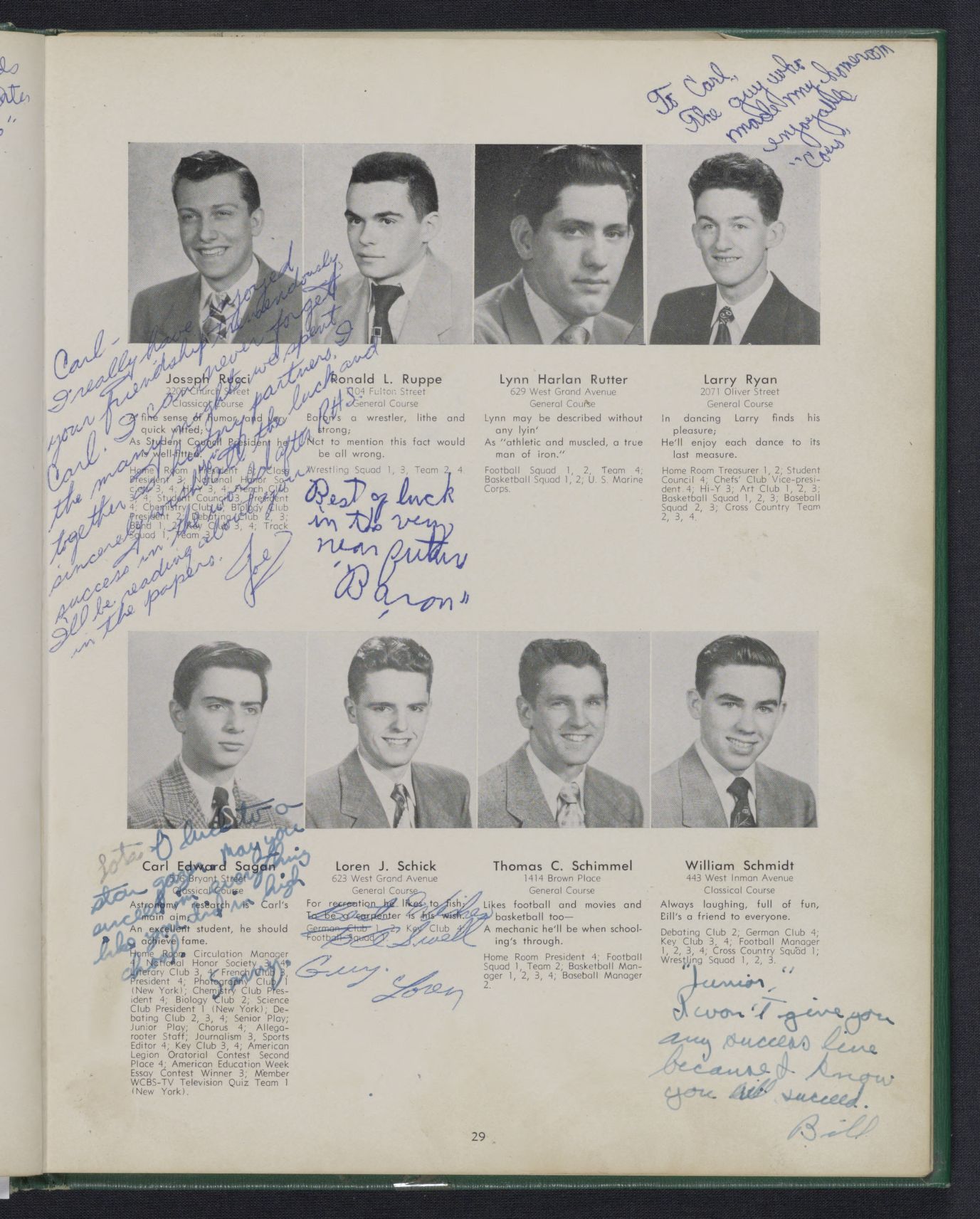
Indeed, Sagan displayed his uncanny ability to merge science with the humanities in Wawawhack, his high school newspaper, writing a piece entitled “Space, Time, and The Poet.” He begins by saying, “it is an exhilarating experience to read poetry and observe its correlation with modern science. Profound scientific thought is hardly a rarity among the poets.” Throughout the piece, Sagan goes on to draw from verses by Alfred Lord Tennyson, T. S. Eliot, John Milton, and Robert Frost.
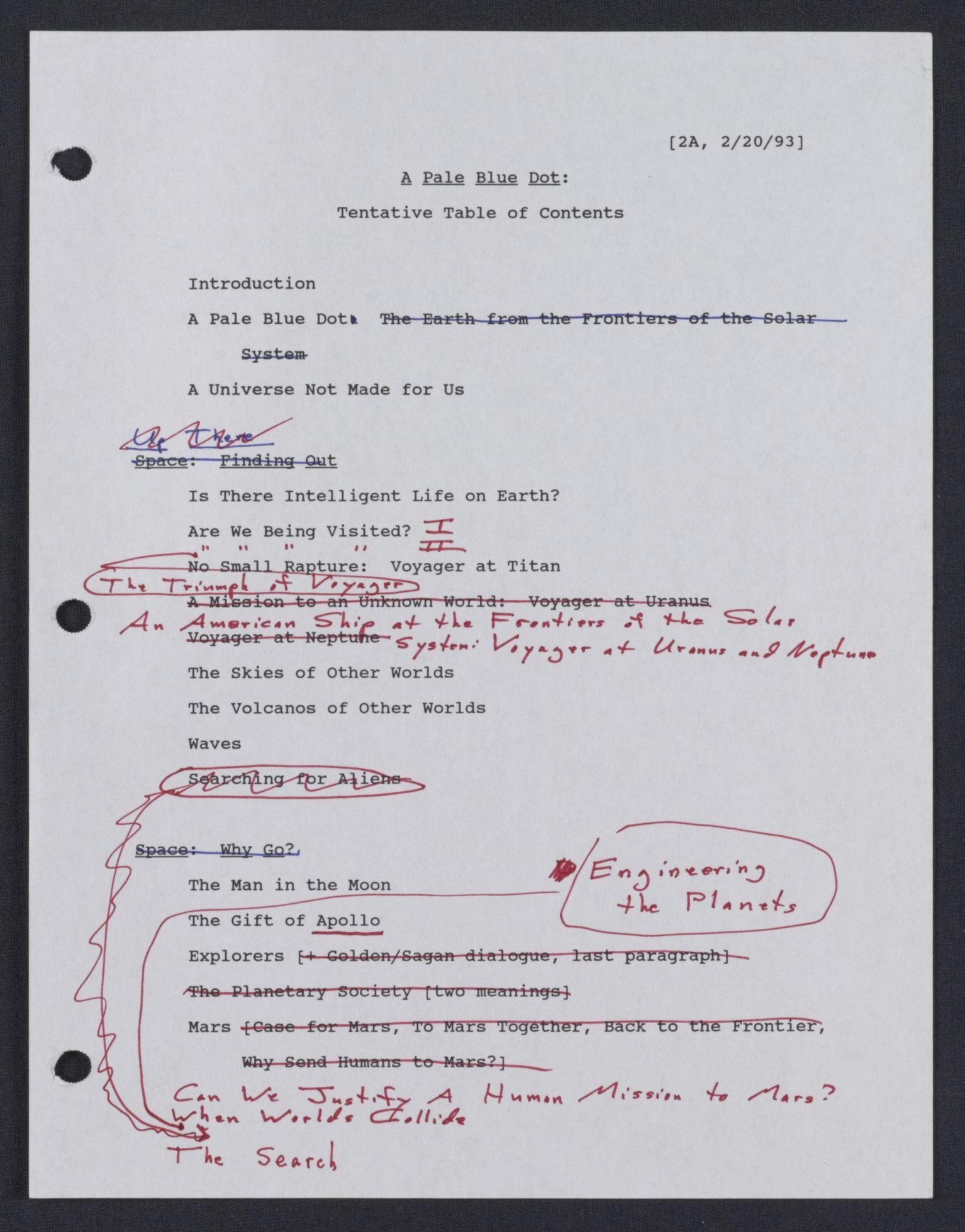
Mixing science and literature would remain one of Sagan’s specialties, and would eventually lead to his writing The Pale Blue Dot: A Vision of Human Future In Space (1994). The book discusses humankind’s place in the universe, past, present, and future, and a PDF version of the annotated second draft, pictured below, is available in the archive.
For more of the digitized collection, visit Seth MacFarlane Collection of the Carl Sagan and Ann Druyan Archive.
via Boing Boing
Ilia Blinderman is a Montreal-based culture and science writer. Follow him at @iliablinderman.
Related Content:
Carl Sagan’s Undergrad Reading List: 40 Essential Texts for a Well-Rounded Thinker
Carl Sagan, Stephen Hawking & Arthur C. Clarke Discuss God, the Universe, and Everything Else
Read More...Support Us
We're hoping to rely on loyal readers, rather than erratic ads. Please click the Donate button and support Open Culture. You can use Paypal, Venmo, Patreon, even Crypto! We thank you!

About Us

Open Culture scours the web for the best educational media. We find the free courses and audio books you need, the language lessons & educational videos you want, and plenty of enlightenment in between.
Advertise With Us

FREE UPDATES!
GET OUR DAILY EMAIL
Get the best cultural and educational resources on the web curated for you in a daily email. We never spam. Unsubscribe at any time.
FOLLOW ON SOCIAL MEDIA

Open Culture editor Dan Colman scours the web for the best educational media. He finds the free courses and audio books you need, the language lessons & movies you want, and plenty of enlightenment in between.
Advertise With Us

