Neil Gaiman Reads Dr. Seuss’ Green Eggs and Ham
This morning, we’re serving up some green eggs and ham. Or rather Neil Gaiman is. Whenever I think about someone reading Dr. Seuss’ classic children’s book, I can’t help but think back to Jesse Jackson’s classic reading on SNL in 1991. But who knows, maybe 20 years from now, another generation might call to mind this version by the unshaven Gaiman. If the reading whets your appetite a bit, don’t miss our collection of Neil Gaiman’s Free Short Stories, which includes, among other things, audio & video recordings of @neilhimself reading his own stories. We’ve got some more good Dr. Seuss material below.
If you would like to support the mission of Open Culture, consider making a donation to our site. It’s hard to rely 100% on ads, and your contributions will help us continue providing the best free cultural and educational materials to learners everywhere. You can contribute through PayPal, Patreon, and Venmo (@openculture). Thanks!
Looking for free, professionally-read audio books from Audible.com? Here’s a great, no-strings-attached deal. If you start a 30 day free trial with Audible.com, you can download two free audio books of your choice. Get more details on the offer here.
via Metafilter
Related Content:
Fake Bob Dylan Sings Real Dr. Seuss
The Epistemology of Dr. Seuss & More Philosophy Lessons from Great Children’s Stories
550 Free Audio Books: Download Great Books for Free
Read More...New Carl Sagan Archive Features His Digitized Home Movies, Student Journalism, Draft of His Pale Blue Dot & More
Several days ago, we brought you a rare Carl Sagan sketch, where the young scientist depicted an imagined history of interstellar space flight. In that post, we made brief mention of the Seth MacFarlane Collection of the Carl Sagan and Ann Druyan Archive, which merits to be highlighted in its own right: its arrival means that the Internet now has access to a vast repository of the eminent science educator’s original papers and personal artifacts.
Historians, biographers, and die-hard Sagan devotees will inevitably want to visit the Library of Congress in person to view the full archive, which contains over 1700 boxes of material. The lay reader curious about Sagan’s life, however, won’t need to make the trek to the U.S. capital to sample the archive’s contents. That’s because the Library of Congress has uploaded a portion of the collection online, including sundry fascinating biographical pieces. Above, you can view a digitized set of the Sagan family’s silent home movies, where young Carl shows off his boyhood boxing prowess, rides horseback, and plays piano (preciously, we presume).
It was during high school that Sagan began to fill out intellectually. His senior yearbook is testimony to both his interest in science and the humanities: not only was Sagan president of both the science and chemistry clubs, he also led the French club, served as an editor on his school’s newspaper, debated, took part in theatre productions, and was a member of the photography club.
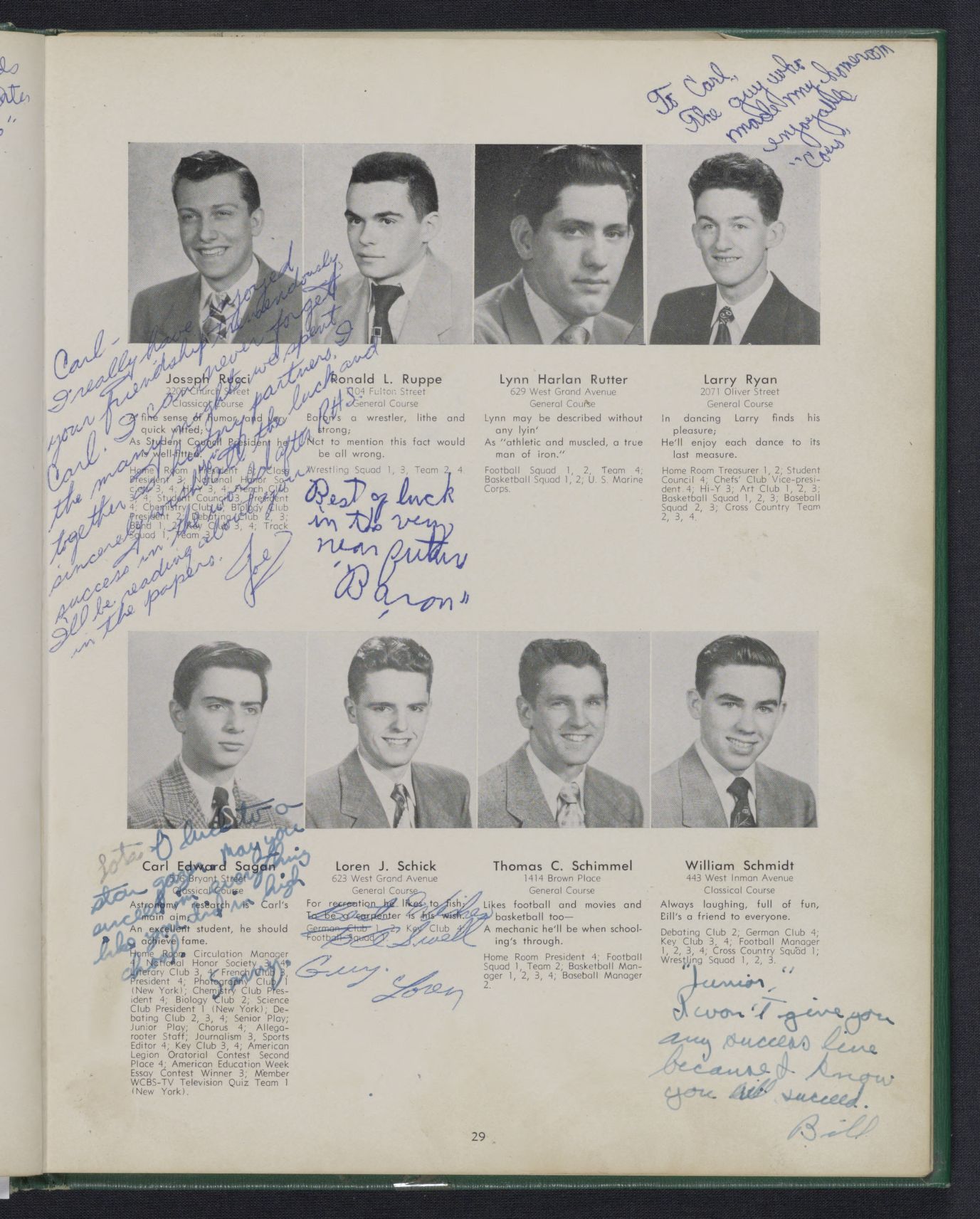
Indeed, Sagan displayed his uncanny ability to merge science with the humanities in Wawawhack, his high school newspaper, writing a piece entitled “Space, Time, and The Poet.” He begins by saying, “it is an exhilarating experience to read poetry and observe its correlation with modern science. Profound scientific thought is hardly a rarity among the poets.” Throughout the piece, Sagan goes on to draw from verses by Alfred Lord Tennyson, T. S. Eliot, John Milton, and Robert Frost.
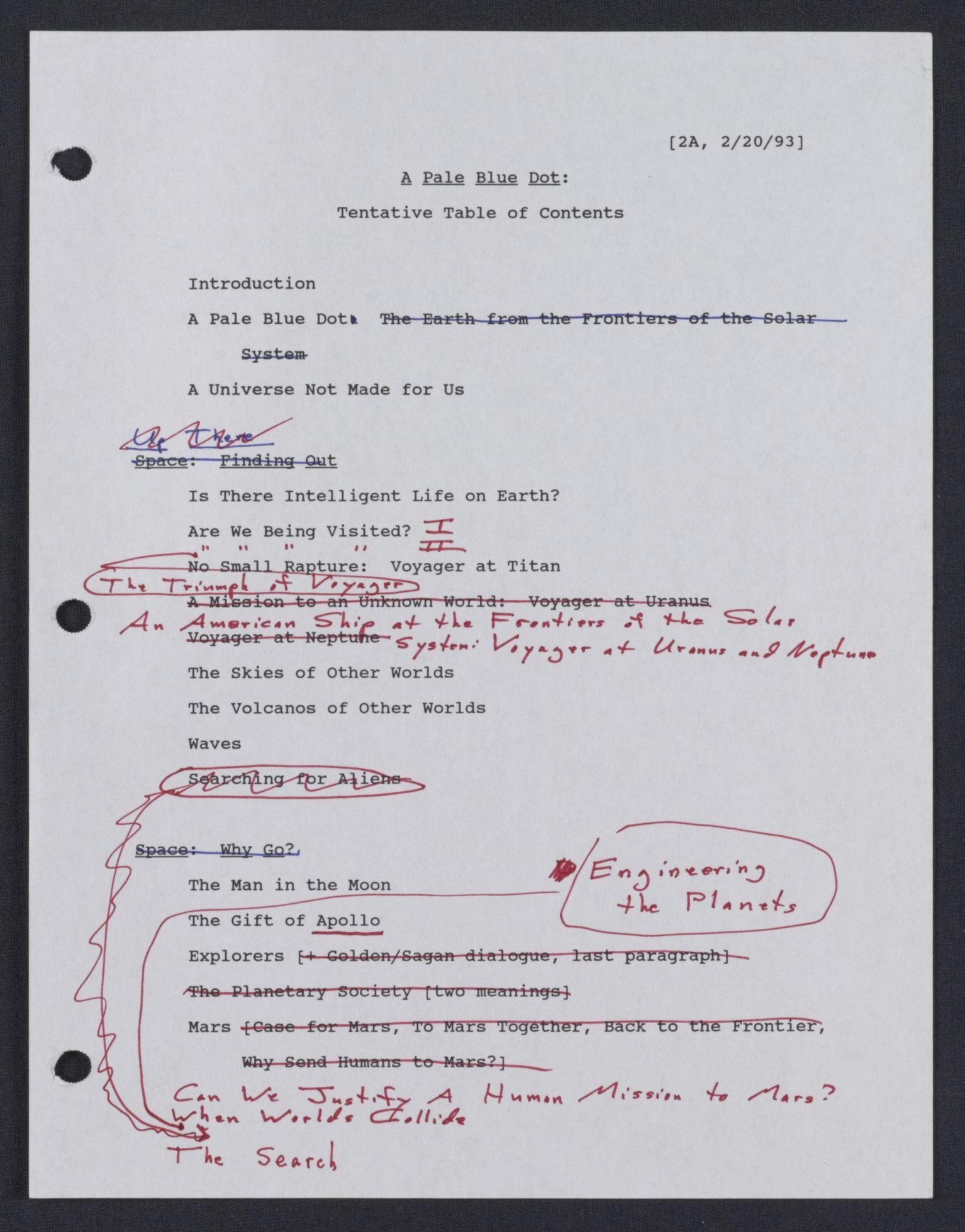
Mixing science and literature would remain one of Sagan’s specialties, and would eventually lead to his writing The Pale Blue Dot: A Vision of Human Future In Space (1994). The book discusses humankind’s place in the universe, past, present, and future, and a PDF version of the annotated second draft, pictured below, is available in the archive.
For more of the digitized collection, visit Seth MacFarlane Collection of the Carl Sagan and Ann Druyan Archive.
via Boing Boing
Ilia Blinderman is a Montreal-based culture and science writer. Follow him at @iliablinderman.
Related Content:
Carl Sagan’s Undergrad Reading List: 40 Essential Texts for a Well-Rounded Thinker
Carl Sagan, Stephen Hawking & Arthur C. Clarke Discuss God, the Universe, and Everything Else
Read More...1967 Cookbook Features Recipes by the Rolling Stones, Simon & Garfunkel, Barbra Streisand & More
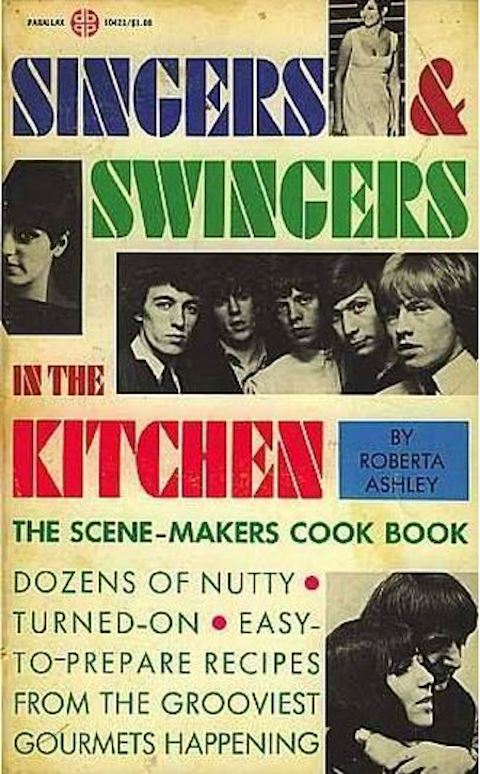
Am I alone in thinking that the “dozens of nutty, turned-on, easy-to-prepare recipes” in 1967’s Singers and Swingers in the Kitchen bear more than passing resemblance to the festively photographed dishes in Betty Crocker’s 1965 New Boys and Girls Cook Book?
Could Sonny and Cher, Simon and Garfunkel, and Herman’s Hermits — to name a few of the “top scenemakers” Singers and Swingers author Roberta Ashley designates as the “grooviest gourmets happening” — really shared a common palate with Betty and her child-chefs?
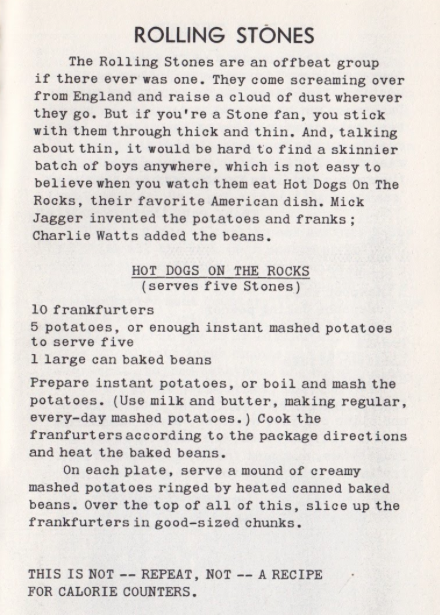
(Though take away the recipe’s three middle words, and you’re left with the title of a certain multi-platinum double hits album. Coincidence?)
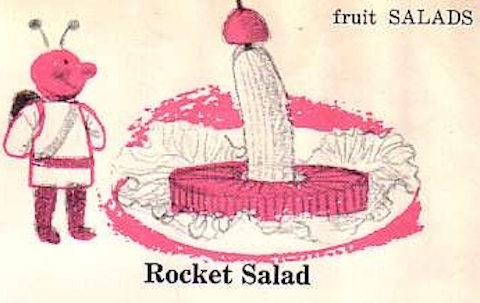
Moving on to Singers and Swingers’ salad course, Monkee Peter Tork’s “Mad Mandarin Salad” (click here for ingredients) sounds like it would taste quite similar to the New Boys and Girls Cook Book’s “Rocket Salad”, above. Canned fruit features prominently in both, but “Rocket Salad” is way more phallic, and thus more rock n’ roll.

“Barbra Streisand’s Instant Coffee Ice Cream” sounds sophisticated, mayhaps because coffee, like alcohol, has no place in the Betty Crocker New Boys and Girls’ realm. It seems like it would uphold the Singers and Swingers’ mandate by being “easy-to-prepare”. Dare I say “easy enough for a child to prepare”? So my own mother told the Indianapolis Star sometime in the late 60’s. The evidence is below. Just like Barbra’s, my mother’s recipe required marshmallows and a blender.

And, oh by the way, don’t miss Simon and Garfunkel’s Potato Pancake Recipe. It’s to die for…
Related Content:
The Recipes of Iconic Authors: Jane Austen, Sylvia Plath, Roald Dahl, the Marquis de Sade & More
Learn to Make Borscht with Neko Case and Get a Taste of Her New Album
Alice B. Toklas Talks About Her Famous Recipe for Hashish Fudge
Ayun Halliday continues to lust after Betty Crocker’s Enchanted Castle Cake. Follow her @AyunHalliday
Read More...Read Two Poems David Foster Wallace Wrote During His Elementary School Days

Some readers discover David Foster Wallace through his fiction, and others discover him through his essays. (Find 30 Free Stories & Essays by DFW here.) Now that the publishing industry has spent more than five years putting out everything of the late writer’s leftover material they can reasonably turn into books, new DFW fans may arrive through more forms still: his interviews, Kenyon commencement speech, philosophy thesis, etc.. And though he produced too few of them to appear collected between covers, Wallace once wrote poems as well, though judging by the handwriting of the two shown here, he seems to have both started down and abandoned that particular literary avenue in childhood. Still, that very quality — and the opportunity it holds out to see the linguistic formation of a man later regarded as a prose genius — makes them all the more intriguing. First, we have the untitled poem above, a sympathetic paean to the labors of motherhood:
My mother works so hard
And for bread she needs some lard.
She bakes the bread. And makes the bed.
And when she’s threw
She feels she’s dayd.

Second, we have ”Viking Song”, which he probably wrote later. (The Harry Ransom Center at UT-Austin, where the text resides, believes he was 6 or 7 when he wrote the poem.)
Vikings oh! They were so strong
Though there warriors won’t live so long.
For a long time they rode the stormy seas.
Whether there was a great big storm or a little breeze.
There ships were made of real strong wood
As every good ship really should.
If you were to see a Viking today
It’s best you go some other way.
Because they’d kill you very well
And all your gold they’ll certainly sell
For all these reasons stay away
From a Viking every day.
Though not what we would call mature works, these two poems still offer much of interest to the dedicated DFW exegete. “Note Wallace’s uncommon phrasing in ‘so hard and for bread,’ ” writes Justine Tal Goldberg of the first. “I can’t think of a single child who would opt for this phrasing over, say, a more simple ‘so hard to make bread,’ ” a choice that demonstrates he “was already exhibiting the masterful grasp of language for which he would later become famous.” Alex Balk at The Awl calls “Viking Poem” “ ‘charming and tragic,” adding that “the obvious enthusiasm with which he wrote it makes me reflect on the joys of childhood that we tend to forget.” Wallace’s biographer D.T. Max goes into more depth at the New Yorker, identifying “moments in these poems that herald (or just accidentally foreshadow?) the mature David’s American plainsong voice.” I’ve heard it asserted that every child has a natural capacity for poetry, but the young Wallace, preternaturally perceptive even then, must have soon realized that his textual strengths resided elsewhere.
Related Content:
David Foster Wallace’s Love of Language Revealed by the Books in His Personal Library
30 Free Essays & Stories by David Foster Wallace on the Web
David Foster Wallace: The Big, Uncut Interview (2003)
David Foster Wallace’s 1994 Syllabus
Colin Marshall hosts and produces Notebook on Cities and Culture and writes essays on cities, Asia, film, literature, and aesthetics. He’s at work on a book about Los Angeles, A Los Angeles Primer. Follow him on Twitter at @colinmarshall or on his brand new Facebook page.
Read More...A Quick Animation of Frida Kahlo’s Famous Self Portrait
In 1940, Frida Kahlo painted a self portrait for her lover, the photographer Nickolas Muray. According to the Frida Kahlo fan site, the painting entitled “Autorretrato con collar de espinas” (or Self Portrait with Necklace of Thorns) features Kahlo wearing Christ’s crown of thorns
as a necklace, presenting herself as a Christian martyr. The thorns digging into her neck are symbolic of the pain she still feels over her divorce from Diego [Rivera]. Hanging from the thorny necklace is a dead hummingbird whose outstretched wings echo Frida’s joined eyebrows. In Mexican folk tradition, dead hummingbirds were used as charms to bring luck in love. Over her left shoulder the black cat, a symbol of bad luck and death, waits to pounce on the hummingbird. Over her right shoulder the symbol of the devil, her pet monkey…a gift from Diego. Around her hair, butterflies represent the Resurrection. Once again, Frida uses a wall of large tropical plant leaves as the background.
In late 2013, Florent Porta dropped the painting into Photoshop and brought everything in the background to life. If this short clip intrigues, you shouldn’t miss the recent viral video called “Beauty,” which animates paintings by Caravaggio, Vermeer, & other great masters.
via Coudal
Related Content:
Watch Moving Short Films of Frida Kahlo and Diego Rivera at the “Blue House”
Frida Kahlo and Diego Rivera Visit Leon Trotsky in Mexico, 1938
Read More...Ridley Scott on the Making of Apple’s Iconic “1984” Commercial, Aired on Super Bowl Sunday in 1984
“I like to claim that I bought the second Macintosh computer ever sold in Europe,” writes actor, comedian, writer, wit, and die-hard Apple enthusiast Stephen Fry in a Telegraph essay marking the Macintosh computer’s 30th anniversary. “My friend and hero Douglas Adams was in the queue ahead of me. For all I know someone somewhere had bought one ten minutes earlier, but these were the first two that the only shop selling them in London had in stock on the 24th January 1984, so I’m sticking to my story.”
Fry had found the only computer that made him want to write; “I couldn’t wait to get to it every morning,” he remembers. He didn’t even need convincing from “1984,” Ridley Scott’s “legendary commercial” above, which he didn’t see “until it crept onto English television screens way past its dramatic Super Bowl debut.”
Now that we’ve come upon the 30th anniversary of that dramatic Super Bowl debut, why not get a little insight from the man who directed it? In the clip just above, Scott, who by that time already had the rich and troubling futuristic visions Alien and Blade Runner under his belt, talks about his experience bringing the storyboards — audacious by the television commercial standard of the era, let alone for personal computers — onto the screen. He discusses looking to the past for his “slightly decadent-looking” future, hanging jet engines on the set as an act of “good dramatic bullshit,” putting out a “frightening” casting call for a background full of skinheads, getting the totalitarian text for Big Brother to intone, and finding a young lady who could swing a hammer. And what would he have done with an even bigger budget? “Not very much. I think we nailed it.” As, Fry and his fellow user-enthusiasts agree, did Apple.
Related Content:
Every Apple Ad Ever Aired on TV
Martin Scorsese Appears in New Apple Ad with Siri, Plays on His Chilling Cameo in Taxi Driver
Steve Jobs Narrates the First “Think Different” Ad (Never Aired)
Colin Marshall hosts and produces Notebook on Cities and Culture and writes essays on cities, Asia, film, literature, and aesthetics. He’s at work on a book about Los Angeles, A Los Angeles Primer. Follow him on Twitter at @colinmarshall or on his brand new Facebook page.
Read More...David Foster Wallace Creates Lists of His Favorite Words: “Maugre,” “Tarantism,” “Ruck,” “Primapara” & More

Everyone I know has a list of least-favorite words. For various reasons, “moist” always seems to make the top three. But perhaps it takes a writer—someone who savors the sounds, textures, and histories of peculiar words—to compile a list of their most-favorites. A few I’ve placed in keepsake boxes over the years—little corrugated minerals that remind me of what words can do: “palaver,” “obdurate,” “crevasse,” “superfecund”….
I could go on, but it’s certainly not my list you’ve come for. You’re reading, I suspect, because you well know the consummate care and attention David Foster Wallace lavished on his prose—his reputation as a smith of endless creativity who, Alex Ross wrote in a series of McSweeney’s tributes, spent his time “keenly observing, forging acronyms, reanimating lifeless OED entries, and creating sentences that make us spit out our beer.”
Ross’s mention of the Oxford English Dictionary, that venerable repository of the vast breadth and depth of written English (sadly kept behind a paywall), helps us appreciate Wallace’s list, which features such archaic adverbs as “maugre” (“in spite of, notwithstanding”) and obscure adjectives as “lacinate” (“fringed”). Who has read, much less written, the Anglo-Saxon “ruck” (“a multitude of people mixed together”)? And while the equally rock-hard, monosyllabic “wrack” is familiar, I have not before encountered the lovely “primapara” (“woman who’s pregnant for the first time”).

Another page of Wallace’s list (above—click images to enlarge) includes such treasures as “tarantism,” a “disorder where you have an uncontrollable need to dance,” and “sciolism,” a “pretentious air of scholarship; superficial knowledgability.” While it is true that Wallace has been accused of the latter, I do not think this is a competent judgment. Instead, I would describe him with another of my favorite words—“amateur”—not at all, of course, in the sense of an unpaid or unskilled beginner, but rather, as it meant in French, a “devoted lover” of the English language.
These pages come to us from Lists of Note (and the Harry Ransom Center at UT-Austin), who writes that they are “just two pages from the hundreds of word lists he amassed over the years.” Perhaps one day we’ll see a published edition of David Foster Wallace’s favorite words. For the nonce, head on over to Lists of Note to see this minim of his lexicon transcribed.
Related Content:
David Foster Wallace’s Love of Language Revealed by the Books in His Personal Library
David Foster Wallace Breaks Down Five Common Word Usage Mistakes in English
David Foster Wallace’s 1994 Syllabus: How to Teach Serious Literature with Lightweight Books
30 Free Essays & Stories by David Foster Wallace on the Web
Josh Jones is a writer and musician based in Durham, NC. Follow him at @jdmagness
Read More...Sir Ian McKellen Puts on a Dazzling One-Man Shakespeare Show
Long before he played Gandalf or Magneto, Sir Ian McKellen was known as one of the finest stage actors in England. A stand out in the Royal Shakespeare Company, Sir Ian played the lead in its 1974 staging of Doctor Faustus and its 1977 staging of Macbeth. He was made a Commander of the Order of the British Empire (CBE) in 1979 almost entirely because of his stage work.
If you want a sense of just how good Sir Ian is, watch his one-man show Acting Shakespeare. You can see it in its entirety above.
Developed on the road in the late ‘70s, the show is part a scholarly history of the Bard, part an autobiographical yarn and part a greatest hits of Shakespeare’s speeches. And Sir Ian is absolutely dazzling. At one point, he gives a spot on impersonation of Sir John Gielgud. At another he performs a scene from Romeo and Juliet playing both Romeo and Juliet. He shifts effortlessly from giving a soliloquy by Hamlet to delivering a witty anecdote about life on the stage with sense of timing of a veteran stand-up comedian.
Acting Shakespeare is a 95-minute long sustained display of acting bravura. It’s pretty entertaining too. Seriously, check it out.
Related Content:
Jonathan Crow is a Los Angeles-based writer and filmmaker whose work has appeared in Yahoo!, The Hollywood Reporter, and other publications. You can follow him at @jonccrow.
Read More...The President of Northwestern University Predicts Online Learning … in 1934!
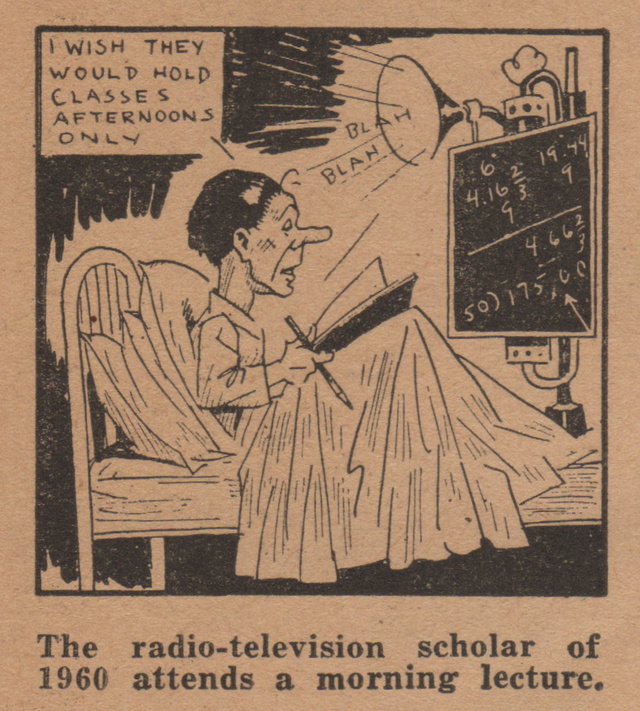
One of our most popular posts this year centered around a prescient set of predictions that Isaac Asimov made for 2014, way back in 1964. Asimov, however, wasn’t the only one whose vision of the future seems to have been realized.
The web site Paleofuture features a 1934 issue of Everyday Science and Mechanics magazine, where Northwestern University president Walter Dill Scott made some farsighted pronouncements of his own. Scott believed that the physical college campus would no longer need to be a lynchpin for education, and that students could learn by way of radio and pictures. Fax machines and televisions would allow students to access lecture materials worldwide, and ensure that researchers could conduct their research remotely. He also figured that we’d all end up commuting by planes. Everyday Science and Mechanics wrote:
The university of twenty-five years from now will be a different looking place, says President Scott of Northwestern. Instead of concentrating faculty and students around a campus, they will “commute” by air, and the university will be surrounded by airports and hangars. The course will be carried on, to a large extent, by radio and pictures. Facsimile broadcasting and television will enlarge greatly the range of a library; and research may be carried on by scholars at great distances.
Airports and hangars aside, Scott’s conjectures hit pretty close to home. While fax machines and radio may have been supplanted by the Internet, the essence of our educational advancements is the same: university students can often listen to lectures and complete assignments online, spending only a few short face-to-face hours in the classroom. Other times, classes may be wholly available online, and students may never step foot on campus altogether. Scholars, too, can trawl through databases like JSTOR and PsycINFO without getting out of bed, conducting research as they travel.
In fact, today almost anyone can have access to university knowledge. Feel like taking a Technology Entrepreneurship class offered by Stanford, or learn about Walt Whitman, courtesy of The University of Iowa? Nothing simpler! Massive Open Online courses (MOOCs) are proliferating, and you can download audio & video lectures from top tier universities. Visit our collection of 825 Free Online Courses to see what we mean.
In the end, it’s a good thing Scott was right. Otherwise, there’d be no Open Culture.
Ilia Blinderman is a Montreal-based culture and science writer. Follow him at @iliablinderman.
Related Content:
Isaac Asimov Predicts in 1964 What the World Will Look Like Today — in 2014
Arthur C. Clarke Predicts the Future in 1964 … And Kind of Nails It
Walter Cronkite Imagines the Home of the 21st Century … Back in 1967
The Internet Imagined in 1969
Marshall McLuhan Announces That The World is a Global Village
Read More...New York’s Famous Chelsea Hotel and Its Creative Residents Revisited in a 1981 Documentary
Last year, we featured a clip of Nico singing “Chelsea Girls” at the Hotel Chelsea, the much-mythologized Manhattan institution that, at one time or another, housed a range of cultural figures including Mark Twain, Bob Dylan, Dylan Thomas, Charles Bukowski, Janis Joplin, Leonard Cohen, Patti Smith, Robert Mapplethorpe, Allen Ginsberg, Henri Cartier-Bresson, Iggy Pop, Gaby Hoffmann, Sid Vicious, and Arthur Miller. “The Chelsea in the Sixties seemed to combine two atmospheres,” writes Miller in a 1978 essay on his time there. “A scary optimistic chaos which predicted the hip future, and at the same time the feel of a massive, old-fashioned, sheltering family. That at least was the myth one nursed in one’s mind, but like all myths it did not altogether stand inspection.” That era more than arguably marked the Chelsea’s social and cultural heyday.
A few years later, in 1981, BBC’s arts documentary series Arena made its way to New York to investigate the history and then-current state of this veritable counterculture incubator. The film spends time with current Chelsea residents, former Chelsea residents, and Chelsea habitués notable, creative, and otherwise — the notably creative Andy Warhol, William Burroughs, and Quentin Crisp all make appearances. It also talks to the hotel’s staff and follows a tour guide as he leads a curious group through its storied corridors. “With all my misgivings about the Chelsea,” Miller reflects, “I can never enter it without a certain quickening of my heartbeat. There is an indescribably homelike atmosphere which at the same time lacks a certain credibility. It is some kind of fictional place, I used to think. As in dreams things are out front that are concealed in other hotels.”
For more, you might want to spend time with “An Oral History of the Chelsea Hotel: Where the Walls Still Talk,” which appeared in Vanity Fair last October.
Find the documentary above listed in our collection of 625 Free Movies Online: Great Classics, Indies, Noir, Westerns, etc.
Related Content:
Nico Sings “Chelsea Girls” in the Famous Chelsea Hotel
Iggy Pop Conducts a Tour of New York’s Lower East Side, Circa 1993
Charles Bukowski Takes You on a Very Unconventional Tour of Hollywood
Colin Marshall hosts and produces Notebook on Cities and Culture and writes essays on cities, Asia, film, literature, and aesthetics. He’s at work on a book about Los Angeles, A Los Angeles Primer. Follow him on Twitter at @colinmarshall or on Facebook.
Read More...Support Us
We're hoping to rely on loyal readers, rather than erratic ads. Please click the Donate button and support Open Culture. You can use Paypal, Venmo, Patreon, even Crypto! We thank you!

About Us

Open Culture scours the web for the best educational media. We find the free courses and audio books you need, the language lessons & educational videos you want, and plenty of enlightenment in between.
Advertise With Us

FREE UPDATES!
GET OUR DAILY EMAIL
Get the best cultural and educational resources on the web curated for you in a daily email. We never spam. Unsubscribe at any time.
FOLLOW ON SOCIAL MEDIA

Open Culture editor Dan Colman scours the web for the best educational media. He finds the free courses and audio books you need, the language lessons & movies you want, and plenty of enlightenment in between.
Advertise With Us

