Toni Morrisson: Forget Writing About What You Know; Write About What You Don’t Know
On December 12th, the New York Public Library hosted a live program featuring Pulitzer Prize-winning author Junot Díaz in conversation with the writer who most deeply influenced his career, Toni Morrison, winner of the 1993 Nobel Prize in Literature. The talk was originally streamed live on the web (including our site), and now you can watch a recorded version below, plus some highlights above. Introductions by Paul Holdengräber and friends begin at the 40:09 mark, and everything gets really going at the 49:35 timestamp in the video below. Despite some nerves, Díaz engages his now 82 year-old literary idol in a conversation that’s engaging, colorful, sometimes even amusingly off-color — like when he tells Morrison “you can outwrite every motherf#cker on the planet sentence for sentence.” The interview touches on her formative years as a writer and editor, and then her years writing her masterful novels — Song of Solomon, Beloved and the rest. Commentary on the craft of writing is sprinkled throughout. If you’d like to get Morrison’s writing advice in a neatly-packaged format, please see our previous posts: Toni Morrison Dispenses Writing Wisdom in 1993 Paris Review Interview and Toni Morrison, Nora Ephron, and Dozens More Offer Advice in Free Creative Writing “Master Class”.
Related Content:
Writing Tips by Henry Miller, Elmore Leonard, Margaret Atwood, Neil Gaiman & George Orwell
Ray Bradbury Gives 12 Pieces of Writing Advice to Young Authors (2001)
Seven Tips From F. Scott Fitzgerald on How to Write Fiction
Read More...Download 100 Free Philosophy Courses and Start Living the Examined Life
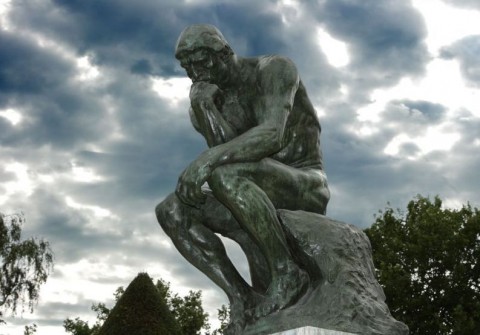
The Philosophy section of our big Free Online Courses collection just went through another update, and it now features 100 courses. Enough to give you a soup-to-nuts introduction to a timeless discipline. You can start with one of several introductory courses.
- Philosophy for Beginners – iTunes – Web Video – Marianne Talbot, Oxford
- Critical Reasoning for Beginners - iTunes Video – iTunes Audio – Web Video – Oxford
- A Romp through Ethics for Complete Beginners — iTunes Video – Web Video – Oxford
- Introduction to Political Philosophy – YouTube – iTunes – Web Video — Steven B. Smith, Yale
- The Art of Living — Web Video – Stanford
- The History of Philosophy Without Any Gaps - Multiple Formats– Peter Adamson, King’s College London
Then, once you’ve found your footing, you can head off in some amazing directions. As we mentioned many moons ago, you can access courses and lectures by modern day legends – Michel Foucault, Bertrand Russell, John Searle, Walter Kaufmann, Leo Strauss, Hubert Dreyfus and Michael Sandel. Then you can sit back and let them introduce you to the thinking of Aristotle, Socrates, Plato, Hobbes, Hegel, Heidegger, Kierkegaard, Kant, Nietzsche, Sartre and the rest of the gang. The courses listed here are generally available via YouTube, iTunes, or the web.
Explore our collection, 1,700 Free Online Courses from Top Universities, to find topics in many other disciplines — History, Literature, Physics, Computer Science and beyond. As we like to say, it’s the most valuable single page on the web.
Don’t miss anything from Open Culture. Sign up for our Daily Email or RSS Feed. And we’ll send quality culture your way, every day.
Related Content:
Michel Foucault: Free Lectures on Truth, Discourse & The Self
Take First-Class Philosophy Lectures Anywhere with Free Oxford Podcasts
Walter Kaufmann’s Lectures on Nietzsche, Kierkegaard and Sartre (1960)
Leo Strauss: 15 Political Philosophy Courses Online
Read More...Read 100 Entries From America’s Most Unique Dictionary, Now Available Online For The First Time
Earlier this year, we wrote about the regional differences in how Americans refer to soft drinks. An exploration of the various geographical names for a carbonated beverage is all well and good, but it’s important to remember that America’s lexical variations are significantly more colorful than “soda,” (East and West coasts), “coke,” (South), and “pop” (Midwest and Northwest).
For those interested in experiencing the full range of verbal Americana, the Dictionary of American Regional English (DARE) has finally become available online after 47 years of work. Unlike any other dictionary, DARE attempts to document the regional aspects of American English, and systematize the wide array of geographically unique terms and expressions. As John McWhorter notes in The New Republic, this labor of linguistic love contains some 60,000 entries from 1,002 communities, collected between 1965 and 1970. Of course, as McWhorter points out, some of the terms indexed in DARE are dated, having succumbed to mass-media’s democratizing effects on language over the course of DARE’s lengthy preparation. Still, with entries like “rich relatives” (dust bunnies) and “Canadian perjunkety” (pimples), the dictionary provides a fascinating glimpse of the verbal curios, both old and new, that have sprung up around the country.
Although DARE is a subscription-based service, its website provides visitors with a list of 100 free and browsable terms. We’ve included a selection below:
- “To acknowledge the corn – to admit to being drunk; by extension, to admit to any mistake, fault, or impropriety (formerly widespread, now chiefly Midland).”
- “Flannel cake – pancake (chiefly Appalachian)”
- “Flea in one’s ear – A hint, warning, disquieting disclosure; a rebuke (chiefly Northeast)”
- “Lucy Bowles – loose bowels, diarrhea (scattered, but esp. Pennsylvania, New Jersey, southeastern New York)”
- “Slick and a promise – A hasty or superficial performance of a task (chiefly New Jersey)”
Additionally, a sample of audio recordings demonstrating the breadth of accents and vocabularies in various generations, cities, and classes during the ‘60s may be found on the University of Wisconsin-Madison DARE website.
Ilia Blinderman is a Montreal-based culture and science writer. Follow him at @iliablinderman.
Read More...David Lynch Presents the Interview Project: 121 Mini-Documentaries About Life in America
What is the Interview Project? David Lynch describes it as “a 20,000-mile road trip over 70 days across and back the United States” where “people have been found and interviewed,” and if you watch the videos this trip produced, you’re “going to meet hundreds of people,” all different, found “by driving along the roads, going into bars, going into different locations, and there they were. The people told their story. It’s so fascinating to look and listen to people.” This all comes straight from the Interview Project’s Lynch-starring introductory video above. As for its actual 121 video episodes, those come directed by Lynch’s son Austin and his collaborator Jason S. And what elements of the U.S. population have they curated? Let’s just say you wouldn’t hear these voices in the mainstream media — and probably not even on This American Life. “Today we’re meeting Jeremie,” Lynch père tells us in his opener to the Interview Project episode below. “The team found Jeremie in a restaurant in Hammond, Louisiana.”
From the corner of a hotel bed, young Jeremie, who looks at first like a Mormon missionary on casual day, describes his little-known town as “about 45 minutes from Baton Rouge and about fifteen hours from New Orleans.” He then recounts the impressive number of lifestyles he’s lived so far: in the military, on the streets, “the drug scene,” “the nature scene.” He then gets into the reasons behind his taste for one-night stands and orgies. In the episode below, the team meets Traci, a motel manager in Marfa, Texas, who tells them under the moonlight of her victory over alcoholism, her first encounter with her lifelong best friend, and her once-recurring dreams of a faceless man with a goatee. At an auction in Bellville, Wisconsin, they find Robin, who discusses his attempts to start a massage-and-healing cooperative, only to have them thwarted by the prevailing notion that “This is the Midwest. It’s not going to happen here.” The Interview Project has gathered small-town America’s personal stories of tragedy, triumph, and all those rich experiences in-between. “It’s something that’s human,” to quote David Lynch again, “and you can’t stay away from it.” And at three or four minutes apiece, you certainly can’t watch just one.
Related Content:
David Lynch Talks About His 99 Favorite Photographs at Paris Photo 2012
David Lynch Presents the History of Surrealist Film (1987)
David Lynch Teaches You to Cook His Quinoa Recipe in a Weird, Surrealist Video
Colin Marshall hosts and produces Notebook on Cities and Culture and writes essays on cities, Asia, film, literature, and aesthetics. He’s at work on a book about Los Angeles, A Los Angeles Primer. Follow him on Twitter at @colinmarshall or on his brand new Facebook page.
Read More...Hear Michel Foucault Deliver His Lecture on “Truth and Subjectivity” at UC Berkeley, In English (1980)
Michel Foucault first arrived at the University of California, Berkeley in 1975. By this time, he was already a celebrity in France. He had just published his enormously influential history and critique of the penal system, Discipline and Punish, and he occupied a position at the prestigious Collège de France as chair in the “history of systems of thought,” a position he created for himself. But when he arrived on the West Coast, writes Marcus Wohlsen, “few at Berkeley had heard of Michel Foucault.” Leo Bersani, then chairman of the French department, even had to call philosophy professor Hubert Dreyfus to help “come and fill out the ranks” for Foucault’s lectures.
After the publication of volume one of The History of Sexuality, Foucault would return to Berkeley in the fall of 1979, then again in 1980. By then, the scene had changed dramatically. Foucault was invited to deliver the Howison Lecture that year, a distinguished invitation previously extended to such thinkers as John Dewey, Willard V.O. Quine and, the year previous, John Rawls. By this time, Wohlsen writes, Foucault was, reluctantly, “an international academic superstar.” Filling the hall for his lectures would not be an issue. In fact, Wohlsen tells us,
Crowds crammed the 2,000-seat Zellerbach Hall so quickly that police had to bar the doors. Foucault fans milled around restlessly outside until [philosophy professor Hans] Sluga arranged for a live broadcast of the letures to Wheeler Hall. Its 760 seats filled almost immediately.
According to Sluga, Foucault, increasingly wary of his fame, intentionally titled his lecture—“Truth and Subjectivity: the Stoic Practice of Self Examination”—to sound “learned, abstract, remote” in order to deter a large crowd. That ploy clearly failed.
In the first part of the lecture (at top), the presenter who introduces Foucault begins by gesturing to the philosopher’s fame, then comments that Foucault’s prominent post at the Collège de France was “very paradoxical, since Michel Foucault, although prestigious, is not a typical kind of academic. He is suspicious of all titles and claims to disinterested truth that has been [sic] associated with academia.” After mentioning Foucault’s fierce criticism of every historical assumption and methodology (he was a guest of the History and French Departments), he breaks off his remarks to note that “there’s a mob of people all around, trying to get in.”
Foucault begins his lecture in French (at 8:08), then switches to English for the remainder (at 9:18). He quotes from a historical French psychiatrist’s account of a “cure” involving an “interrogation” and a coerced confession of madness. Foucault calls this one among many examples of “truth therapies,” and it serves—as do such vividly specific archival examples in his books—as a harrowing introduction to the policing of capital‑T Truth that is the essence of the humanist enterprise.
Despite the often profoundly unsettling nature of his investigations, and his attempt to scare off the crowd, Foucault is not dour or boring, nor does he seem at all unapproachable or forbidding. He is patient and self-deprecatingly funny: in a cutting, rueful reference to the growing dominance of analytic philosophy in British and American universities, he says, “I confess, with the appropriate chagrin, that I am not an analytical philosopher. Nobody is perfect.” Then he sums up his project succinctly: “I have tried to explore another direction. I have tried to get from a philosophy of subjectivity to a genealogy of the subject.”
Foucault is a very charming speaker, sprinkling his lecture with little jokes like “It goes without saying… but it goes better with saying…” and dropping in Americanisms like “Monday morning quarterbacking,” to the amusement of the crowd. He shows himself to be very much aware of his audience—these are deeply serious lectures, without a doubt, but Foucault never forgets that he’s facing living human beings, with their own domains of knowledge and subjectivities—and he seeks to reach them where they are while reporting on his disturbing discoveries as an archaeologist of Western humanist discourse.
Foucault returned to Berkeley again as a visiting professor in 1981 and again 1983, the year before his death. Alain Beaulieu, who has catalogued Foucault’s Berkeley archives, described his time in California as happy and productive, “while he remain[ed] critical of some features associated with the ‘Californian cult of the self.’” In fact, “Cult of the Self” was the title of three lectures Foucault delivered at Berkeley in 1983 (listen here), along with six lectures on “Discourse and Truth.” During his time at Berkeley in 1980, when he delivered the lecture above, graduate student Michael Bess interviewed the philosopher. Foucault spoke plainly and passionately about the impetus for his relentless critiques of institutional power and knowledge:
In a sense, I am a moralist, insofar as I believe that one of the tasks, one of the meanings of human existence—the source of human freedom—is never to accept anything as definitive, untouchable, obvious, or immobile. No aspect of reality should be allowed to become a definitive and inhuman law for us.
We have to rise up against all forms of power—but not just power in the narrow sense of the word, referring to the power of a government or of one social group over another: these are only a few particular instances of power.
Power is anything that tends to render immobile and untouchable those things that are offered to us as real, as true, as good.
Read the complete interview, first published in the November 10, 1980 Daily Californian, here.
Related Content:
Clash of the Titans: Noam Chomsky & Michel Foucault Debate Human Nature & Power on Dutch TV, 1971
Download Free Courses from Famous Philosophers: From Bertrand Russell to Michel Foucault
Michel Foucault: Free Lectures on Truth, Discourse & The Self
90 Free Philosophy Courses in our Collection of 800 Free Courses Online
Josh Jones is a writer and musician based in Durham, NC. Follow him at @jdmagness
Read More...The New Yorker Launches a New Poetry Podcast: Listen to Robert Pinsky Reading Elizabeth Bishop
A quick fyi: The New Yorker has just launched a new poetry podcast, and it’s introduced and hosted by Paul Muldoon, the Pulitzer Prize-winning poet who formerly taught poetry at Oxford. On The New Yorker’s web site, Muldoon writes:
I can’t be but thrilled at the prospect of the first of a series of New Yorker Poetry Podcasts. For decades, The New Yorker has led the field of poetry in print journalism. But the eye is not the only buyer into, and beneficiary of, the poem. The ear has been in the poetry business for much longer, given poetry’s origins in the oral tradition. That’s why it’s particularly appropriate for us to take this opportunity to foreground poetry as an aural experience.
He then explains the format of the podcast. “Each podcast consists of a conversation between myself and a guest poet. In each, the guest reads not only a poem of hers that has appeared in The New Yorker but also introduces, and reads, a poem by another contributor to the magazine that she particularly admires.” The first episode features Philip Levine. Feel free to play it above.
You can subscribe to The Poetry podcast on iTunes, and it should eventually find a home (I’d imagine) on SoundCloud too. More poems read aloud can be found in our collection of Free Audio Books.
Related Content:
The New Yorker’s Fiction Podcast: Where Great Writers Read Stories by Great Writers
Hear the Very First Recording of Allen Ginsberg Reading His Epic Poem “Howl” (1956)
Bill Murray Reads Poetry at a Construction Site
Hear Sylvia Plath Read Fifteen Poems From Her Final Collection, Ariel, in 1962 Recording
Read More...Teacher Helps His Student Overcome Stuttering and Read Poetry, Using the Sound of Music
Musharaf Asghar, a student at Thornhill Academy in northeast England, overcame an acute stammer when his teacher, Matthew Burton, borrowed an idea from The King’s Speech. The teacher asked his student to put on some headphones playing the music of Ben Howard, and to start reciting a poem called ‘The Moment.’ Suddenly, for the first time, the words began to flow. All of this was captured in a documentary series, Educating Yorkshire, that aired on the BBC. The segment above concludes with Mushy, as he’s known, giving a short talk in front of his class, at what looks like a graduation ceremony. It didn’t take long for his fellow students to break down in tears.
Writing recently in The Guardian, the student recalls. “My nerves over speaking in assembly were TERRIBLE though. I didn’t realise how big 200 people looks like. I was sweating and I had a little wobble but eventually, I managed to get through it. I was excited, if nervous, about the whole thing going out. But I’m really happy and proud to be on telly as I hope it gives other people with a stammer the confidence to have a go at public speaking. My speech is getting better every week. Everyone at college gives me time, but I’m getting quicker anyway so they don’t miss their bus while they are listening to me. I still won’t be applying for any call-centre jobs yet though.” Find more information on how music therapy can help people overcome stuttering here.
Don’t miss anything from Open Culture. Sign up for our Daily Email or RSS Feed. And we’ll send quality culture your way, every day.
via @courosa
Read More...The Power of Empathy: A Quick Animated Lesson That Can Make You a Better Person
Several years back, the RSA (Royal Society of the Arts) created a series of distinctive animated shorts where heavy-hitter intellectuals presented big ideas, and a talented artist rapidly illustrated them on a whiteboard. Some of those talks featured the likes of Slavoj Zizek, Steven Pinker and Barbara Ehrenreich. Now RSA presents a new video series created in an entirely different aesthetic. Above, you can watch what will hopefully be the first of many “espresso shots for the mind.” This clip features Dr. Brené Brown, a research professor at the University of Houston Graduate College of Social Work, providing some quick insights into the difference between sympathy and empathy, and explaining why empathy is much more meaningful. To learn more about The Power of Empathy, you can watch Brown’s complete RSA lecture here. You can also watch her very popular TED Talk on The Power of Vulnerability here.
If you would like to support the mission of Open Culture, consider making a donation to our site. It’s hard to rely 100% on ads, and your contributions will help us continue providing the best free cultural and educational materials to learners everywhere. You can contribute through PayPal, Patreon, and Venmo (@openculture). Thanks!
Related Content:
Free Online Psychology Courses (Part of our list of Free Online Courses)
Jacques Lacan’s Confrontation with a Young Rebel: Classic Moment, 1972
New Animation Explains Sherry Turkle’s Theories on Why Social Media Makes Us Lonely
Read More...
Listen to the 1963 Song the Beatles Gave to the Stones; Then Hear Them Sing Backup on a 1967 Stones Tune, “We Love You”
After reading some of the encyclopedic comments on this NPR site featuring author and professor John McMillian—who has written a new book on The Beatles vs. The Stones—and after hearing McMillan himself tell his “revealing, behind the scenes stories” in the interview below, I’m fairly certain we’re in good historical hands for a reappraisal of the two bands’ friendly rivalry. McMillan discusses their first meeting and earliest collaboration, the track above, 1963’s “I Wanna Be Your Man,” written by, and credited to, John Lennon and Paul McCartney.
The song was the result of a chance encounter, we learn from Stones historian Bill Janowitz: “[Stones manager Andrew Loog] Oldham had almost literally bumped into Lennon and McCartney as they stepped out of a cab.” Oldham brought The Beatles into the studio and the song was born from a McCartney fragment. The Stones had to this point only released American R&B or blues covers, though they also turned this track into a bluesy stomper. Hear The Beatles decidedly less gritty version of the song below, over a montage of their early sixties British comedy act that the Monkees stole so well. They released this three weeks later, giving the lead vocal to Ringo.
Despite Tom Wolfe’s quip that “The Beatles want to hold your hand but the Stones want to burn down your town,” the early sixties versions of both bands looked very much alike. Until the late sixties, the Stones were often a step behind The Beatles’ image. They appear on the cover of 1965’s Out of My Head in modish dress with modish haircuts looking almost exactly like their counterparts. 1967’s Their Satanic Majesties Request, for its occasional beauty, was an obvious and slightly ridiculous attempt to capitalize on Sgt. Pepper’s psychedelic success.
But even during those times, the bands diverged sharply in musical terms, and the Stones’ path led in a darker direction. The budding image of the band as arsonists may have contributed to their targeting by the authorities. After a 1967 drug bust, Lennon and McCartney came to their aid, then sang (uncredited) backing vocals for the Stones track “We Love You,” a song written to the band’s dedicated fans and to The Beatles. Purportedly, Allen Ginsberg sat in on the sessions. “They looked like little angels,“ he later wrote, “like Botticelli Graces singing together for the first time.”
Related Content:
Mick Jagger Defends the Rights of the Individual After His Legendary 1967 Drug Bust
Josh Jones is a writer and musician based in Durham, NC. Follow him at @jdmagness
Read More...Quentin Tarantino Tells You About The Actors & Directors Who Provided the Inspiration for “Reservoir Dogs”
Quentin Tarantino has never been one to shy away from sharing his views on filmmaking with the public, and we’ve previously written about his 2008 and 2012 lists of the greatest movies ever made. Even a casual comparison of his 2008 and 2012 picks, however, shows that the onetime video store clerk’s tastes are liable to change over time. When making his directorial debut with Reservoir Dogs (1992), Tarantino made another list; on the second page of the script, under a heading marked “Dedicated to:” Tarantino enumerated the actors and directors who had inspired him to make what Empire Magazine would rank the greatest independent film of all time.
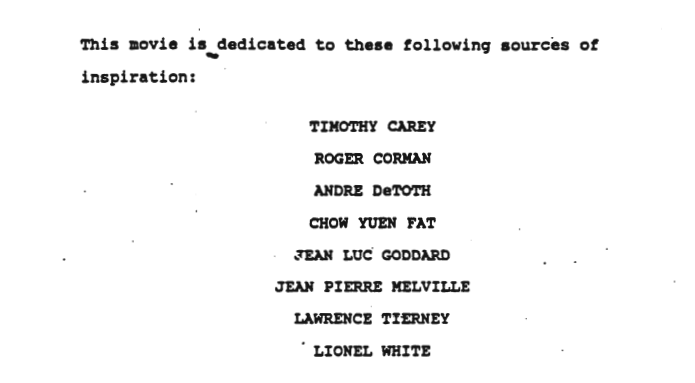
In the video above, which was shot some years after Reservoir Dogs’ release, Tarantino revisits this list and gives his latest thoughts on its constituents. Some are scarcely-remembered figures, such as the king of ‘60s and ’70s misfit roles Timothy Carey whom Tarantino wryly remembers treating flatulence “almost like a religion.” Others include then obscure actors on their way to becoming internationally-recognized names, such as Chow Yun Fat. Although Tarantino initially saw something effortlessly cool about Fat, reminiscent of trenchcoat-wearing French star Alain Delon, he claims to have since downgraded his opinion of the Hong Kong actor. And don’t even get him started on Jean-Luc Godard. For the full list accompanied by Tarantino’s colorful commentary, check out the video.
Ilia Blinderman is a Montreal-based culture and science writer. Follow him at @iliablinderman.
Related Content:
Quentin Tarantino’s Handwritten List of the 11 “Greatest Movies”
Tarantino’s 10 Favorite Films of 2013
Quentin Tarantino Lists His Favorite Films Since 1992
Read More...Support Us
We're hoping to rely on loyal readers, rather than erratic ads. Please click the Donate button and support Open Culture. You can use Paypal, Venmo, Patreon, even Crypto! We thank you!

About Us

Open Culture scours the web for the best educational media. We find the free courses and audio books you need, the language lessons & educational videos you want, and plenty of enlightenment in between.
Advertise With Us

FREE UPDATES!
GET OUR DAILY EMAIL
Get the best cultural and educational resources on the web curated for you in a daily email. We never spam. Unsubscribe at any time.
FOLLOW ON SOCIAL MEDIA

Open Culture editor Dan Colman scours the web for the best educational media. He finds the free courses and audio books you need, the language lessons & movies you want, and plenty of enlightenment in between.
Advertise With Us

