Every Time “Making Love” Was Uttered in a Woody Allen Film: A Four Minute Montage
Woody Allen once said that “sex without love is a meaningless experience, but as far as meaningless experiences go it’s pretty damn good.” Most readers would be compelled to think that Allen’s slight frame, trademark horn-rimmed glasses, and stuttering delivery would preclude his characters from achieving much of anything in the sexual realm. After all, how could the consummate nebbishes that Allen portrays in most of his films possibly impress a member of the fairer sex? Somehow, however, in spite of their whinging neuroticism, Allen’s geek incarnates transform into gallants of prodigious proportions in almost every role. Those wanting concrete evidence may take a look at Take the Money and Run (1969), Annie Hall (1977), or Manhattan (1979), among myriad others, and note that Allen’s characters repeatedly end up with women who seemed to make a gross error in sexual selection.
Last month, we brought you a supercut of Woody Allen’s stammers, comprising a 44-minute graduate course in Allen’s awkward mannerisms. Today, we continue this tradition and bring you another Allen supercut; this time, the montage consists of four-odd minutes of every occurrence of the term “making love” in Allen’s films, beginning with What’s New Pussycat (1965) and ending in To Rome With Love (2012). Merry Christmas!
If you would like to support the mission of Open Culture, consider making a donation to our site. It’s hard to rely 100% on ads, and your contributions will help us continue providing the best free cultural and educational materials to learners everywhere. You can contribute through PayPal, Patreon, and Venmo (@openculture). Thanks!
Related Content:
Woody Allen Answers 12 Unconventional Questions He Has Never Been Asked Before
Watch a 44-Minute Supercut of Every Woody Allen Stammer, From Every Woody Allen Film
Woody Allen Boxes a Kangaroo, 1966
Read More...
Akira Kurosawa to Ingmar Bergman: “A Human Is Not Really Capable of Creating Really Good Works Until He Reaches 80”
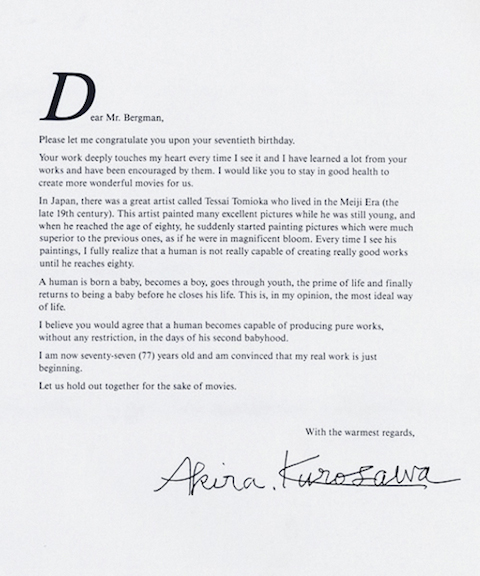
In July of 1988, Ingmar Bergman—retired from film—turned 70. He had every reason to believe that his best work lay behind him. After all, he had won three Academy Awards (and the Irving G. Thalberg Memorial Award), two BAFTAs, seven Cannes prizes, six Golden Globes, and a host of other honors. His oeuvre included such seemingly unsurpassable achievements as Wild Strawberries, The Seventh Seal, Fanny and Alexander, and too many more to name, and that year he published his memoirs, The Magic Lantern, in which he confessed “I probably do mourn the fact that I no longer make films.”
But no!, writes the Swedish director’s Japanese counterpart, Akira Kurosawa, the “real work is just beginning.” At least that’s how Kurasawa, then 77, felt about his “second babyhood.” Kurosawa wrote the letter above to Bergman on his birthday, professing his deep admiration. The feeling went both ways. The typically self-deprecating Bergman once called his The Virgin Spring a “a lousy imitation of Kurosawa” and added, “at the time my admiration for the Japanese cinema was at its height. I was almost a samuri myself!” Read the full transcript of Kurosawa’s birthday wishes to Bergman below (originally published in Chaplin magazine).
Dear Mr. Bergman,
Please let me congratulate you upon your seventieth birthday.
Your work deeply touches my heart every time I see it and I have learned a lot from your works and have been encouraged by them. I would like you to stay in good health to create more wonderful movies for us.
In Japan, there was a great artist called Tessai Tomioka who lived in the Meiji Era (the late 19th century). This artist painted many excellent pictures while he was still young, and when he reached the age of eighty, he suddenly started painting pictures which were much superior to the previous ones, as if he were in magnificent bloom. Every time I see his paintings, I fully realize that a human is not really capable of creating really good works until he reaches eighty.
A human is born a baby, becomes a boy, goes through youth, the prime of life and finally returns to being a baby before he closes his life. This is, in my opinion, the most ideal way of life.
I believe you would agree that a human becomes capable of producing pure works, without any restrictions, in the days of his second babyhood.
I am now seventy-seven (77) years old and am convinced that my real work is just beginning.
Let us hold out together for the sake of movies.
With the warmest regards,
Akira Kurosawa
Related Content:
Stanley Kubrick to Ingmar Bergman: “You Are the Greatest Filmmaker at Work Today” (1960)
Watch Kurosawa’s Rashomon Free Online, the Film That Introduced Japanese Cinema to the West
Josh Jones is a writer and musician based in Durham, NC. Follow him at @jdmagness
Read More...How the Iconic 1968 “Earthrise” Photo Was Made: An Engrossing Visualization by NASA
Let’s let NASA paint the picture for you:
In December of 1968, the crew of Apollo 8 became the first people to leave our home planet and travel to another body in space. But as crew members Frank Borman, James Lovell, and William Anders all later recalled, the most important thing they discovered was Earth.
Using photo mosaics and elevation data from Lunar Reconnaissance Orbiter (LRO), this video commemorates the 45th anniversary of Apollo 8’s historic flight by recreating the moment when the crew first saw and photographed the Earth rising from behind the Moon. [See the original photo here.] Narrator Andrew Chaikin, author of A Man on the Moon, sets the scene for a three-minute visualization of the view from both inside and outside the spacecraft accompanied by the onboard audio of the astronauts. The visualization draws on numerous historical sources, including the actual cloud pattern on Earth from the ESSA‑7 satellite and dozens of photographs taken by Apollo 8, and it reveals new, historically significant information about the Earthrise photographs. It has not been widely known, for example, that the spacecraft was rolling when the photos were taken, and that it was this roll that brought the Earth into view.
The visualization establishes the precise timing of the roll and, for the first time ever, identifies which window each photograph was taken from. The key to the new work is a set of vertical stereo photographs taken by a camera mounted in the Command Module’s rendezvous window and pointing straight down onto the lunar surface. It automatically photographed the surface every 20 seconds. By registering each photograph to a model of the terrain based on LRO data, the orientation of the spacecraft can be precisely determined.
This video above is public domain and can be downloaded here. In 1972, astronauts took another famous picture of the Earth, known as The Big Blue Marble. You can watch a film (“Overview”) that commemorates that photograph and explores the whole concept of seeing the Earth from afar. And, of course, you should always see the Carl Sagan-narrated film, The Pale Blue Dot, too.
via Metafilter/BrainPickings
Related Content:
Astronaut Takes Amazing Self Portrait in Space
Read More...Werner Herzog Presents Two Visions of America in How Much Wood Could a Woodchuck Chuck (1981) and God’s Angry Man (1976)
As an American, I admit that only an outsider can view my country with the greatest clarity. And as long as we want to look at the United States through foreign eyes, why not look through those of Werner Herzog? Even aside from his wildly creative body of work as a feature filmmaker — he made Aguirre, the Wrath of God; he made Fitzcarraldo; he made Bad Lieutenant: Port of Call New Orleans — Herzog the documentarian has offered up a host of his own rich and surprising perceptions. He’s traveled the globe, from the Lesser Antilles (La Soufrière) to Antarctica (Encounters at the End of the World) to southern France’s prehistoric caves (Cave of Forgotten Dreams), looking intensely and commenting even more intensely on people, from champion ski jumpers (The Great Ecstasy of the Woodcarver Steiner) to Vietnam prisoners of war (Little Dieter Needs to Fly) to wildlife filmmakers eaten by bears (Grizzly Man). By comparison, most of us might consider places like the auction houses and televangelical broadcast studios of America comparatively unexotic territory.
Not Herzog, however: when he watches a livestock sale, he hears in the rapid-fire babble of the auctioneer “the last poetry possible, the poetry of capitalism,” and when he watches a television preacher, he sees an appeal to “the paranoia and craziness of our civilization.” Here we have two fruits of these strands of Herzog’s fascination with his now-adopted homeland of America: 1976’s How Much Wood Could a Woodchuck Chuck and 1981’s God’s Angry Man. Like many other documentaries of Herzog’s, and not a few of his fiction films, these documentaries deal with pursuits so specialized, obsessive, or both that watching them in practice becomes mesmerizing. The first witnesses a series of auctioneers as their obscure, quasi-musical patter keeps one highly particular gear of the economy spinning. The second, one even more concerned with money and with an original title of Creed and Currency, looks into the world of Los Angeles’ flamboyant, donation-demanding, FCC-hating, seemingly untiring religious broadcaster Dr. Gene Scott. Do cowboy-hatted rural businessmen and manic televangelists accurately represent America? Hardly. But interpreted by Herzog, they show you the country in a way nobody else could.
Find more great films in our collection of 600 Free Movies Online.
Related Content:
Werner Herzog’s Eye-Opening New Film Reveals the Dangers of Texting While Driving
Portrait Werner Herzog: The Director’s Autobiographical Short Film from 1986
Errol Morris and Werner Herzog in Conversation
Werner Herzog Has a Beef With Chickens
Colin Marshall hosts and produces Notebook on Cities and Culture and writes essays on cities, Asia, film, literature, and aesthetics. He’s at work on a book about Los Angeles, A Los Angeles Primer. Follow him on Twitter at @colinmarshall or on his brand new Facebook page.
Read More...Charles Mingus’ “Top Secret” Eggnog Recipe Contains “Enough Alcohol to Put Down an Elephant”
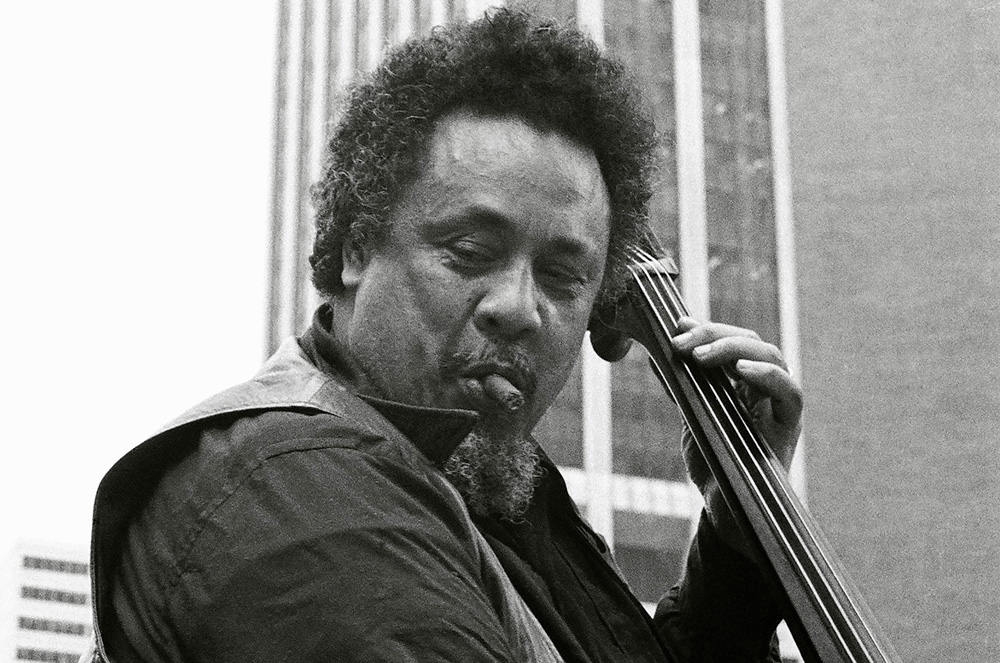
Image by Tom Marcello Webster, via Wikimedia Commons
Just in time for a hard-drinking Christmas, the Village Voice brings us the “top secret” eggnog recipe from “Angry Man of Jazz” Charles Mingus. Despite his generally irascible temperament, Mingus had a legendary “zeal for parties and drink” and “felt the yuletide spirit—or spirits, if you will—according to biographer Janet Coleman.” Mingus passed his recipe to Coleman over the phone, and she published it in Mingus/Mingus: Two Memoirs. The ‘nog, the Voice tells us, “calls for enough alcohol to put down an elephant,” so if you happen to be hosting one, this might just come in handy. Humans seem to dig it too. Coleman called it “a concoction so delicious and mind-blowing, you would do anything to make sure you saw him at Christmas.”
Charles Mingus’ “Top Secret” Eggnog
* Separate one egg for one person. Each person gets an egg.
* Two sugars for each egg, each person.
* One shot of rum, one shot of brandy per person.
* Put all the yolks into one big pan, with some milk.
* That’s where the 151 proof rum goes. Put it in gradually or it’ll burn the eggs,
* OK. The whites are separate and the cream is separate.
* In another pot- depending on how many people- put in one shot of each, rum and brandy. (This is after you whip your whites and your cream.)
* Pour it over the top of the milk and yolks.
* One teaspoon of sugar. Brandy and rum.
* Actually you mix it all together.
* Yes, a lot of nutmeg. Fresh nutmeg. And stir it up.
* You don’t need ice cream unless you’ve got people coming and you need to keep it cold. Vanilla ice cream. You can use eggnog. I use vanilla ice cream.
* Right, taste for flavor. Bourbon? I use Jamaica Rum in there. Jamaican Rums. Or I’ll put rye in it. Scotch. It depends.
See, it depends on how drunk I get while I’m tasting it.
If you’re drinking tonight, make sure you drink responsibly!
Related Content:
Try George Orwell’s Recipe for Christmas Pudding, from His Essay “British Cookery” (1945)
Prepare Marilyn Monroe’s Personal, Handwritten Turkey-and-Stuffing Recipe on Thanksgiving
Charles Mingus Explains in His Grammy-Winning Essay “What is a Jazz Composer?”
Josh Jones is a writer and musician based in Durham, NC. Follow him at @jdmagness
Read More...Try George Orwell’s Recipe for Christmas Pudding, from His Essay “British Cookery” (1945)
British cooking has been the butt of many jokes, and serious thought-pieces have been devoted to “why British food was so bad for so long.” While that article blames WWI for the decline of English Cuisine, the stigma long precedes the 20th century. In his unpublished essay “British Cookery,” for example, George Orwell opens with a quote from Voltaire, who wrote that Britain has “a hundred religions and only one sauce.” This, Orwell writes, “was untrue” and “is equally untrue today.” His “today” was 1945, before the best British cuisine was Indian. And though he does defend his country’s cooking, and did so in another essay published that year in the Evening Standard, Orwell also makes some critical comments that confirm some of the stereotypes, calling the British diet “a simple, rather heavy, perhaps slightly barbarous diet” and writing: “Cheap restaurants in Britain are almost invariably bad, while in expensive restaurants the cookery is almost always French, or imitation French.”
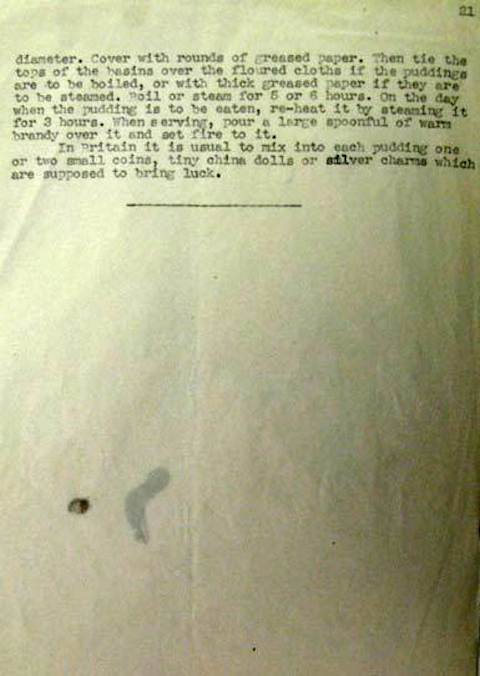
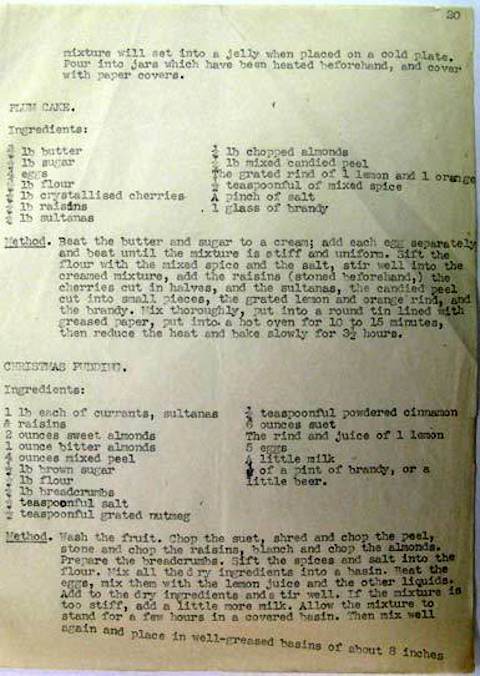
The essay is an exhaustive survey of the British palate of the time, and it concludes with some of Orwell’s own recipes for sweets, including treacle tart, orange marmalade, plum cake, and, lastly, Christmas pudding. You can see the stained typescript of the last two recipes above, and read the full transcript of Orwell’s “British Cookery” here (the recipes are at the end). Having no experience with the strange world of British sweets and pies, I’ll have to take The Guardian’s Alex Renton’s word when he tells us that “the Orwell Christmas pudding is nothing radical.” Nonetheless, I’m tempted to try this recipe more than any of the others Renton mentions, even if I may not get my hands on real suet or sultanas. Read a transcript of Orwell’s Christmas pudding recipe below.
CHRISTMAS PUDDING.
Ingredients:
1 lb each of currants, sultanas & raisins
2 ounces sweet almonds
1 ounces sweet almonds
1 ounces bitter almonds
4 ounces mixed peel
½ lb brown sugar
½ lb flour
¼ lb breadcrumbs
½ teaspoonful salt
½ teaspoonful grated nutmeg
¼ teaspoonful powdered cinnamon
6 ounces suet
The rind and juice of 1 lemon
5 eggs
A little milk
1/8 of a pint of brandy, or a little beer
Method. Wash the fruit. Chop the suet, shred and chop the peel, stone and chop the raisins, blanch and chop the almonds. Prepare the breadcrumbs. Sift the spices and salt into the flour. Mix all the dry ingredients into a basin. Heat the eggs, mix them with the lemon juice and the other liquids. Add to the dry ingredients and stir well. If the mixture is too stiff, add a little more milk. Allow the mixture to stand for a few hours in a covered basin. Then mix well again and place in well-greased basins of about 8 inches diameter. Cover with rounds of greased paper. Then tie the tops of the basins over the floured cloths if the puddings are to be boiled, or with thick greased paper if they are to be steamed. Boil or steam for 5 or 6 hours. On the day when the pudding is to be eaten, re-heat it by steaming it for 3 hours. When serving, pour a large spoonful of warm brandy over it and set fire to it.
In Britain it is unusual to mix into each pudding one or two small coins, tiny china dolls or silver charms which are supposed to bring luck.
via Biblioklept
Related Content:
George Orwell and Douglas Adams Explain How to Make a Proper Cup of Tea
The Recipes of Iconic Authors: Jane Austen, Sylvia Plath, Roald Dahl, the Marquis de Sade & More
Prepare Marilyn Monroe’s Personal, Handwritten Turkey-and-Stuffing Recipe on Thanksgiving
Josh Jones is a writer and musician based in Durham, NC. Follow him at @jdmagness
Read More...Horror Legend Christopher Lee Presents a Heavy Metal Version of The Little Drummer Boy
Every year, around this time, I give thanks that I no longer work retail. Sore feet and rude customers go with the territory, but December (nay, November) brings with it a terrifying onslaught of Little Drummer Boys. I know folks who can’t abide Grandma Got Run Over By a Reindeer, or the Singing Dogs’ Jingle Bells, but as far as I’m concerned, nothing hastens a psychotic break faster than a few dozen pa rum pa pum pum pum rum pa pum pum pum rum pa pum pum pums.
It seems horror legend Christopher Lee, familiar to younger fans as Star Wars’ Count Dooku, feels my pain..and relishes it. It’s a cliche for an aging actor to release an album of seasonal chestnuts, but the 91-year-old Lee’s A Heavy Metal Christmas is a thing apart. His take on The Little Drummer Boy is the sonic equivalent of Rosemary’s Baby.
I can’t say that I prefer Lee’s to any other version — they’re all tortuous in my book- but I’m at peace with admiring it in the abstract. A stunt? Maybe, but he seems wholly sincere in his video greeting below, wishing us all a very happy Christmas and “for the sake of the world and those people in it” a safe New Year.
Ayun Halliday reveals the true meaning of of Xmas here. Follow her @AyunHalliday
Related Content:
Edgar Allan Poe’s “The Raven,” Read by Christopher Walken, Vincent Price, and Christopher Lee
Orson Welles Records Two Songs with the 1980s Heavy-Metal Band Manowar
Read More...The Rolling Stones “Shattered” Covered by Eddie Vedder & Julie Andrews (Ok, It’s Really Jeanne Tripplehorn)
Pearl Jam frontman Eddie Vedder and actress Jeanne Tripplehorn (Basic Instinct, The Firm, Big Love) performed this delightful cover of The Rolling Stones’ 1978 hit “Shattered” at a recent fundraiser for a non-profit called Heal EB. EB stands for Epidermolysis Bullosa, a disease that causes blisters (sometimes potentially fatal ones) to erupt on the skin after the mildest trauma. You can listen to The Rolling Stones’ original recording here, and follow along with the lyrics here. Or, better yet, you can close your eyes and simply imagine Julie Andrews singing these risqué lines. Yeah, on second thought, do that. H/T Marc
Don’t miss anything from Open Culture. Sign up for our Daily Email or RSS Feed. And we’ll send cultural curiosities your way, every day.
Related Content:
The Rolling Stones Jam With Their Idol, Muddy Waters
The Rolling Stones Sing Jingle for Rice Krispies Commercial (1964)
Read More...How to Get Great Deals on Great Books Through Audible.com

Open Culture has had a relationship with Audible.com for close to six years, and, here and there, we’ve told you about their 30-day free trial, which gives you the opportunity to download a free audio book, listen to it, and then decide whether you want to become an Audible subscriber or not. (You can keep the audio book regardless of the decision you make.) I personally became an Audible subscriber a long time ago, and while I’ve always enjoyed listening to audio books, I’ve recently realized that an Audible subscription can be a real deal if you’re a fan of big audio books and great lectures. Let me break it down for you.
If you sign up for Audible’s Gold plan, you pay $158 for 12 books over a year. (You get one book credit/download per month … and you’re billed in installments monthly.) That translates to $13.20 per book on average. That’s not a bad price (given that mainstream audio books often sell for $30). But here’s where the Audible plan becomes a great deal. Earlier this fall, I re-read Joyce’s Ulysses and wanted to listen to a professionally-read unabridged narration of the novel that runs 27 hours. For the cost of one book credit — $13.20 — I downloaded the entire audio book. Naxos, the publisher, sells it for £85.00, or $134.00. Audible sells it to non-members for $104.00.
Here’s another example. For the holidays, I’m listening to Mark Lewisohn’s new Beatles biography Tune In: The Beatles: All These Years. The well-reviewed book runs 944 pages in print and 42 hours on audio. The audio usually retails for somewhere between $53 and $63 — much more than the $13.20 you can snag it for on the Audible plan.
If this sounds like a good plan for you, you can sign up for Audible’s Gold plan via this link. You could also try out their 30-day free trial. And, of course, there’s always our collection: 1,000 Free Audio Books: Download Great Books for Free. Whatever way you go, we wish you happy listening.
NB: Audible is an Amazon.com subsidiary, and we’re a member of their affiliate program.
If you would like to support the mission of Open Culture, consider making a donation to our site. It’s hard to rely 100% on ads, and your contributions will help us continue providing the best free cultural and educational materials to learners everywhere. You can contribute through PayPal, Patreon, and Venmo (@openculture). Thanks!
Read More...Neil Armstrong, Buzz Aldrin & Michael Collins Go Through Customs and Sign Immigration Form After the First Moon Landing (1969)

Click for larger image
I’m not saying Man of Steel depressed me, but I found myself pining for Richard Donner’s sense of humor recently as I watched Zack Snyder’s take on Superman for the first time. I thought of a scene—Superman has to go through immigration once he’s discovered. They won’t let him in. He’s too high-minded to resist, so he sleeps in an airport waiting room for six months. Plenty of dramatic potential there.
Less preposterous but still absurd is the story around the document above, signed by Neil Armstrong, Buzz Aldrin, and Michael Collins after they landed from the first manned trip to the moon. The three astronauts came down in the Pacific Ocean and were taken to Honolulu on July 24, 1969, where they supposedly signed the immigration form, declaring a cargo of moon rocks and dust.
The form, NASA spokesperson John Yembrick told Space.com, is authentic. And, he says, it was a joke. He does not, however, say exactly when the form was signed, either on the day the crew splashed down or sometime afterward. They did not actually arrive in Honolulu until the 26th. After their return,
The astronauts were trapped inside a NASA trailer as part of a quarantine effort just in case they brought back any germs or disease from the moon. They even wore special biological containment suits when they walked out on the deck of the USS Hornet after being retrieved.
NASA transported them to Houston, quarantine trailer and all, and they emerged from isolation three weeks later.
Astronauts these days mostly just need a shower when they touch down, although internet savvy International Space Station astronaut Chris Hadfield did recently tell some customs related stories on a Reddit AMA—maybe nothing so weird as the current space snorkeling up there, but still a pretty great read.
Related Content:
“Moon Hoax Not”: Short Film Explains Why It Was Impossible to Fake the Moon Landing
Dark Side of the Moon: A Mockumentary on Stanley Kubrick and the Moon Landing Hoax
Find Astronomy Courses in our Collection of 800 Free Courses Online
Josh Jones is a writer and musician based in Durham, NC. Follow him at @jdmagness
Read More...Support Us
We're hoping to rely on loyal readers, rather than erratic ads. Please click the Donate button and support Open Culture. You can use Paypal, Venmo, Patreon, even Crypto! We thank you!

About Us

Open Culture scours the web for the best educational media. We find the free courses and audio books you need, the language lessons & educational videos you want, and plenty of enlightenment in between.
Advertise With Us

FREE UPDATES!
GET OUR DAILY EMAIL
Get the best cultural and educational resources on the web curated for you in a daily email. We never spam. Unsubscribe at any time.
FOLLOW ON SOCIAL MEDIA

Open Culture editor Dan Colman scours the web for the best educational media. He finds the free courses and audio books you need, the language lessons & movies you want, and plenty of enlightenment in between.
Advertise With Us


