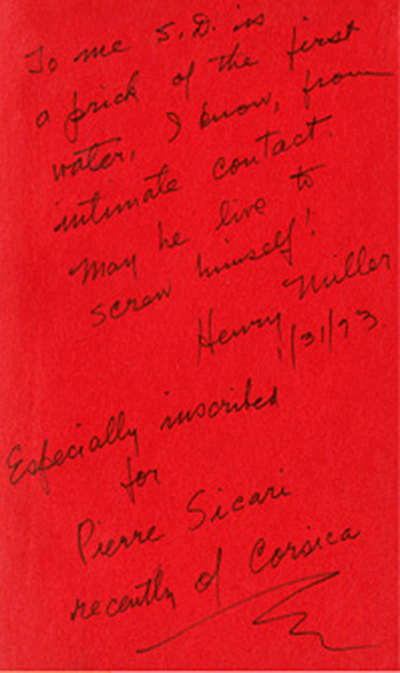
Salvador “Dalí is the Biggest ‘Prick’ of the 20th Century,” Says the Quotable Henry Miller
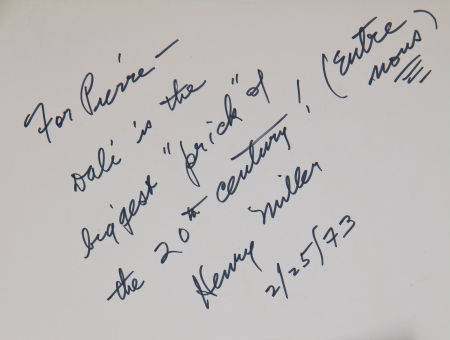
There’s no two ways about it. Henry Miller had a way with words. He could be blunt, lewd, cutting, all in one short sentence. You want a little case study? Ok, how about the notes Miller scrawled back in 1973, when he called Salvador Dalí “the biggest ‘prick” of the 20th century” (or, in another instance a “prick of the first water”). What was his beef with the Spanish surrealist? It all started in 1940, when Miller and his lover, the incomparable Anaïs Nin, spent some time cooped up in the same house with Dalí, who turned out to be an insufferable prima donna. Their time together ended in a wild shouting match, with Miller and Nin storming out of the home and holding a grudge for decades to come. The story is nicely recounted by Book Tryst, a site that has recently become a new favorite of ours.
Related Content:
Alice’s Adventures in Wonderland, Illustrated by Salvador Dalí in 1969, Finally Gets Reissued
Destino: The Salvador Dalí – Disney Collaboration 57 Years in the Making
Tom Schiller’s 1975 Journey Through Henry Miller’s Bathroom (NSFW)
Read More...Hear the Isolated Vocal Tracks for The Beatles’ Climactic 16-Minute Medley on Abbey Road
I have many memories growing up of gingerly placing my father’s Abbey Road LP on the turntable and spending the afternoon lying on the floor and peering at the photos inside the album cover’s gatefold—trying to wrap my head around what kind of hairy geniuses could make music like this. I had no inkling that this was their final recording together, that the band was about to come apart. None of that mattered to me. I didn’t quite grasp how this band evolved from the teen pop sensations in identical suits and haircuts with their legions of flailing schoolgirl fans and goofy comedy troupe banter. This seemed like an entirely different entity—and the particular sublimity of the medley on side 2 (listen to it here) had me lifting up the needle and dropping it back at the intro to “You Never Give Me Your Money” over and over.
That medley is such an impressive demonstration of The Beatles’ range of voice and sensibility that it almost functions as a capsule for the sound of their whole later career—all the weird narratives, blues, ballads, and gorgeously lush hymns and lullabies. What remains constant throughout every Beatles’ record—even before George and Ringo’s songwriting contributions—is the vocal and lyrical interplay of Lennon/McCartney, and it’s all on fine display in the medley.
George Harrison described side 2 in 1969 as “a big medley of Paul and John’s songs all shoved together.” Lennon gave George and Ringo more credit for the medley in an interview that same year:
We always have tons of bits and pieces lying around. I’ve got stuff I wrote around Pepper, because you lose interest after you’ve had it for years. It was a good way of getting rid of bits of songs. In fact, George and Ringo wrote bits of it… literally in between bits and breaks. Paul would say, ‘We’ve got twelve bars here– fill it in,’ and we’d fill it in on the spot. As far as we’re concerned, this album is more ‘Beatley’ than the double (White) album.
However it all came about, it’s the medley’s strange lyrical twists, mélange of vocal styles, and powerful harmonies that stay with me, and that I find myself singing softly, even after having gone several years without hearing the album in full. Perhaps you do this too. Now we can hear what The Beatles’ themselves sounded like in the studio sans instruments with the isolated vocal tracks for the side 2 medley at the top of the post. Hear the full album version here and see the Medley tracklist below.
You Never Give Me Your Money
Sun King
Mean Mr. Mustard
Polythene Pam
She Came in Through the Bathroom Window
Golden Slumbers
Carry That Weight
The End
via Eric Alper
Related Content:
A Short Film on the Famous Crosswalk From the Beatles’ Abbey Road Album Cover
John Lennon’s Raw, Soul-Baring Vocals From the Beatles’ ‘Don’t Let Me Down’ (1969)
The 10-Minute, Never-Released, Experimental Demo of The Beatles’ “Revolution” (1968)
Josh Jones is a writer and musician based in Durham, NC. Follow him at @jdmagness
Read More...Jacques Lacan’s Confrontation with a Young Rebel: Classic Moment, 1972
This is fascinating to watch.
On October 13, 1972, the charismatic and controversial French theorist and psychoanalyst Jacques Lacan is giving a lecture at the Catholic University of Louvain, Belgium, when a young man with long hair and a chip on his shoulder walks up to the front of the lecture hall and begins making trouble. He spills water and what appears to be flour all over Lacan’s lecture notes and then stammers his way into a strange speech that sounds as if it were taken straight out of Guy Debord’s The Society of the Spectacle:
“The composite body which up to fifty years ago could be called ‘culture’– that is, people expressing in fragmented ways what they feel — is now a lie, and can only be called a ‘spectacle,’ the backdrop of which is tied to, and serves as, a link between all alienated individual activities. If all the people here now were to join together and, freely and authentically, wanted to communicate, it’d be on a different basis, with a different perspective. Of course this can’t be expected of students who by definition will one day become the managers of our system, with their justifications, and who are also the public who with a guilty conscience will pick up the remains of the avant-garde and the decaying ‘spectacle.’ ”
The 71-year-old Lacan never loses his composure. (His cigar appears bent out of shape, but it was that way from the beginning.) The audience, too, retains a certain Gallic nonchalance. Dangerous Minds sums it up in the headline “The Single Most ‘French’ Moment in all of 1972: Jacques Lacan Accosted, But No One Stops Smoking.” The scene is from Jacques Lacan Speaks, a one-hour documentary by Belgian filmmaker Françoise Wolff. You can watch the complete film, which includes Lacan’s extended and rather cryptic response to the incident and other excerpts from the lecture, followed by Wolff’s interview with Lacan the following day, in our post: “Charismatic Psychoanalyst Jacques Lacan Gives Public Lecture (1972).”
If you would like to support the mission of Open Culture, consider making a donation to our site. It’s hard to rely 100% on ads, and your contributions will help us continue providing the best free cultural and educational materials to learners everywhere. You can contribute through PayPal, Patreon, and Venmo (@openculture). Thanks!
via Literary Kicks
Related Content:
Free Online Philosophy Courses
Michel Foucault: Free Lectures on Truth, Discourse & The Self
John Searle on Foucault and the Obscurantism in French Philosophy
Derrida: A 2002 Documentary on the Abstract Philosopher and the Everyday Man
Read More...Rare Recording of Controversialist, Journalist and American Literary & Social Critic, H.L. Mencken
http://www.youtube.com/watch?v=QpGzpqU-b04
Henry Louis Mencken (1880–1956) was a famous American journalist, essayist, critic of American life and culture, and a scholar of American English. An expert in so many fields, he was called “the Baltimore Sage.” At the age of 22, Mencken became managing editor of the Morning Herald in his hometown of Baltimore. But it was not only through his work as a journalist that he was “as famous in America as George Bernard Shaw was in England.” The influential literary critic helped launch the Southern and Harlem literary renaissances. With his literary journal The Smart Set, Mencken paved the way for writers such as F. Scott Fitzgerald, Eugene O’Neill, Sinclair Lewis, Theodore Dreiser, and James Joyce. He also wrote several books, most notably his monumental study The American Language.
“The two main ideas that run through all of my writing, whether it be literary criticism or political polemic are these: I am strong in favor of liberty and I hate fraud.” (source) His spirited defense of the freedom of speech and of the press almost landed him in jail when he fought against the banning of his second literary journal, The American Mercury.
This interview above was conducted by Mencken’s colleague Donald Howe Kirkley of The Baltimore Sun in a small recording room at the Library of Congress in Washington on June 30, 1948. It gives you a rare chance to hear his voice.
Bonus material:
By profession, Matthias Rascher teaches English and History at a High School in northern Bavaria, Germany. In his free time he scours the web for good links and posts the best finds on Twitter.
Read More...Hear 38 Versions of “September Song,” from James Brown, Lou Reed, Sarah Vaughan and Others
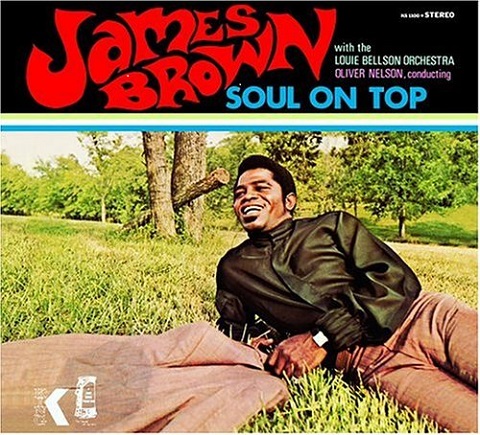
September having begun, let us listen to its song. Rather, let us listen to 38 of its songs. Or, speaking even more precisely, 38 versions of one of its songs: “September Song,” originally written by Kurt Weill and Maxwell Anderson for the 1938 musical Knickerbocker Holiday, which has since made its way into the American pop songbook. A few Septembers ago, Ken Freedman of famed independent radio station WFMU tried to spin every version of “September Song” he possibly could on his show. Toward the end of the month, he posted on WFMU’s Beware of the Blog a roundup of the 38 finest versions he found. “Nothing beats the James Brown version from his 1970 LP Soul on Top,” says Freedman, ”on which he was backed up by the Louis Bellson Big Band, with arrangements by Oliver Nelson.” You can hear it just below:
Some of these 38 only broadly count as a version of “September Song,” which, of course, only makes the collection more interesting. Take, for instance, John Lennon’s “cover,” which occurs accidentally in the course of an unrelated recording. Freedman describes it as “a work in progress called ‘Dear John,’ reportedly one of the last songs Lennon was working on before his death. It’s included here only because his melody and lyrics stumble into ‘September Song’ mid-way through the tune, eliciting a chuckle from Lennon.” Listen to it, and continue your month’s true musical beginning, below:
Related Content:
Colin Marshall hosts and produces Notebook on Cities and Culture and writes essays on literature, film, cities, Asia, and aesthetics. He’s at work on a book about Los Angeles, A Los Angeles Primer. Follow him on Twitter at @colinmarshall.
Avant-Garde Poet Henri Michaux Creates Educational Film Visualizing Effects of Mescaline & Hash (1964)
You don’t need to understand French to appreciate the project. In 1964, the Swiss pharmaceutical company Sandoz (now Novartis) commissioned the Belgian writer, poet and painter Henri Michaux to produce a film that demonstrated the effects of hallucinogenic drugs. The company saw the film as a way to help its scientists get closer to the hallucinogenic experience — not surprising, given that Sandoz was the company that first synthesized LSD back in 1938.
Henri Michaux had already published accounts where he used words, signs and drawings to recount his experiences with trip-inducing drugs. (See his translated book, Miserable Miracle.) And that continued with the new film, Images du monde visionnaire (Images of a Visionary World.) At the top, you can find the trippy segment devoted to mescaline, and, below that, Michaux’s visual treatment of hashish. Watch the complete film, except for one unfortunately blemished minute, here.
Related Content:
This is What Oliver Sacks Learned on LSD and Amphetamines
Aldous Huxley’s LSD Death Trip
Ken Kesey’s First LSD Trip Animated
How to Operate Your Brain: A User Manual by Timothy Leary (1993)
Beyond Timothy Leary: 2002 Film Revisits History of LSD
Read More...What We Still Don’t Know: Martin Rees Tackles Deepest Scientific Questions in Great Documentary
Episode one: ‘Are We Alone?’
“The Universe is still a place of mystery and wonder,” says cosmologist Martin Rees in this three-part series from Channel 4. “With each advance, new questions come into sharper focus.”
What We Still Don’t Know was first broadcast in 2004. It won a British Indie Award the following year for best science documentary. Directed by Srik Narayanan and narrated by David Malone, the series offers a fascinating look at some of the most fundamental questions in science — or indeed, in life. “Are We Alone?” (above). “Why Are We Here?” and “Are We Real?” (Both below).
Episode two: ‘Why Are We Here?
Episode three: ‘Are We Real?’
FBI’s “Vault” Web Site Reveals Declassified Files on Hemingway, Einstein, Marilyn & Other Icons
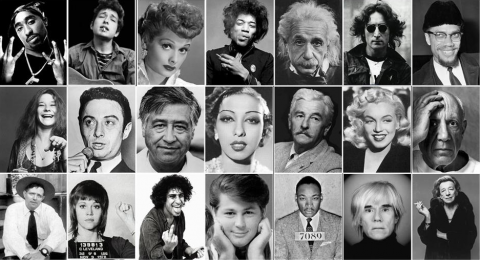
Yesterday we featured pages from Charles Bukowski’s FBI file and, along the way, mentioned William T. Vollman’s. But the Federal Bureau of Investigation has kept tabs on a much wider variety of cultural figures than just writers: musicians, comedians, filmmakers, scientists, actors, and activists have also caught its much-seeing eye. You can browse a great many of these files, now declassified, in The Vault, the FBI’s “new electronic reading room, containing 6,700 documents and other media that have been scanned from paper into digital copies so you can read them in the comfort of your home or office.” The FBI helpfully breaks down the files into categories, from anti-war (Abbie Hoffman,Howard Zinn) to gangster era (Al Capone, John Dillinger) to unexplained phenomena (Roswell UFO, extra-sensory perception). But you, Open Culture reader, might find the most material of interest in The Vault’s popular culture section.
There you’ll find materials pertaining to:
- Ernest Hemingway’s “intelligence work on behalf of the U.S. Embassy in Havana, Cuba between 1942 and 1944″
- Orson Welles’ “potential ties to communist activities in 1940s Hollywood”
- Charlie Chaplin’s ties to communist organizations (along with an interstate prostitution investigation)
- John Lennon’s connections to anti-war groups, which you’d expect, and an investigation of a threat made against him, which you may not
- Marilyn Monroe’s connections to communism through her onetime husband Arthur Miller and otherwise
- Albert Einstein’s ”radical background”
- Jefferson Airplane’s “involvement in concerts at demonstrations such as one organized by the Youth International Party [ … ] to impeach President Nixon”
- Helen Keller’s communist sympathies
- The Doors’ ”trash” music and its dissemination
- The potential obscenity of the Kingmen’s “Louie, Louie” (nobody could tell for sure)
If you dig into the Vault, you’ll see that not every FBI investigation begins with a suspicion that the luminary in question is up to no good. In many cases, cultural figures received threats (usually extortion-related) from mysterious parties and called in the FBI to, well, investigate. As with any tool in human hands, nations can use their investigation organizations for good, or for, shall we say, more ambiguous purposes. Whatever their aims, they do produce fascinating reading.
Above you can find a mosaic of cultural figures that were on the FBI radar. The image comes from decryptedmatrix.com.
Related Content:
Read 113 Pages of Charles Bukowski’s FBI File From 1968
How to Spot a Communist Using Literary Criticism: A 1955 Manual from the U.S. Military
Colin Marshall hosts and produces Notebook on Cities and Culture and writes essays on literature, film, cities, Asia, and aesthetics. He’s at work on a book about Los Angeles, A Los Angeles Primer. Follow him on Twitter at @colinmarshall.
Read More...The Music of Queen Re-Imagined by “Extraordinary” Classical Pianist, Natalia Posnova
Queen’s conjunction of the highly theatrical with the musically virtuoso set the bar for rock opera as high as it will go. Freddie Mercury and Brian May were such extraordinarily talented musicians that it seems impossible for anyone to do their compositions justice in cover versions, and I can’t think of anyone who has. Until now, perhaps. Because now, I have seen pianist Natalia Posnova cover Queen’s 1980 movie theme song “Flash,” written for the, shall we say, less-than-memorable Flash Gordon film of the same year. The original song is an almost ridiculously cool operatic rock anthem, featuring everything we love about the classic Queen song: John Deacon’s tense, thumping bassline, Roger Taylor’s explosive drum fills, Brian May’s guitar arpeggios, and, of course, vocal harmonies the likes of which the Mormon Tabernacle Choir might envy.
Natalia Posnova’s version features none of these things. Only a piano, and in the video, her shiny red Flash Gordon-themed outfit. Nevertheless, she manages to completely capture the drama of the original in her version, titled “Flash Fantasy.” She certainly convinced Brian May, who writes on his blog, “THIS WOMAN IS EXTRAORDINARY! I just ‘discovered’ Natalia Posnova. She is an amazing pianist and interpreter of songs. And I do not use this term lightly. This video clip is worth a million hits. I hope it gets them … I have seriously, in all these years, never seen or heard anything like this. To see this amount of beauty, talent, innovation and pure bravura in one shot is astounding.” He hopes to see her live someday. Above, she tackles another theatrical Queen song, “Who Wants to Live Forever,” this time in suitable evening wear for the hyperdramatic ballad. Posnova’s renditions bring to the foreground the classical harmonies embedded in these songs. For more on Posnova’s interpretations of Queen, see Freddie Mercury’s friend Peter Freestone and Posnova herself discuss her approach in the video below, and enjoy her take on another lovely ballad, “Don’t Try So Hard.”
HT to OC reader, Dirk, for sending this along.
Related Content:
Guitarist Brian May Explains the Making of Queen’s Classic Song, ‘Bohemian Rhapsody’
Queen Documentary Pays Tribute to the Rock Band That Conquered the World
Josh Jones is a writer and musician based in Durham, NC. Follow him at @jdmagness
Read More...Author Rob Sheffield Picks Karaoke Songs for Famous Authors: Imagine Wallace Stevens Singing the Velvet Underground’s “Sunday Morning”
The poet Wallace Stevens‘ reclusiveness would have made him an unlikely candidate for karaoke, but death is a great leveler. One who’s shuffled off this mortal coil can no longer claim to be publicity shy or highly protective of his privacy. Nor can he object if a living author—Rob Sheffield, say—selects a song for him to hypothetically butcher.
This is how a quiet poet-accountant of Stevens’ stature finds himself holding the mic in a beyond-the grave karaoke suite, facing the scrolling lyrics of The Velvet Underground’s “Sunday Morning” (above).
The strange pairing is part of a publicity stunt in service of Sheffield’s new book, Turn Around Bright Eyes: the Rituals of Love and Karaoke. Visit Bookish to see his ultimate karaoke tracks for four other late authors, including Oscar Wilde and the agoraphobic Emily Dickinson.
It’s all in fun, naturally, but Sheffield, the music journalist and karaoke convert, is not just having an ironic laugh at his favorite poet’s expense. (Though no doubt Stevens’ poem, “Sunday Morning,” factored heavily into the decision-making process.)
Here’s how we know Sheffield is sincere. Karaoke became his unlikely emotional rescuer following the untimely death of his first wife, and helped forge bonds with a new romantic partner. Listen to his passionate description of its transformative effects in the video below. He could be a poet describing his muse. Even die hard karaoke resistors may be moved to give it a whirl after hearing him speak.
May we suggest “Sunday Morning” for your first outing? If you’re feeling nervous, dedicate it to Wallace Stevens. There in spirit, surely.
Related Content:
Wallace Stevens Reads His Own Poetry
Find Readings by Wallace Stevens in our collection of Free Audio Books
Ayun Halliday‘s favorite karaoke tune is the the Divinyls’ always-inappropriate “I Touch Myself.” Follow her @AyunHalliday
Support Us
We're hoping to rely on loyal readers, rather than erratic ads. Please click the Donate button and support Open Culture. You can use Paypal, Venmo, Patreon, even Crypto! We thank you!

About Us

Open Culture scours the web for the best educational media. We find the free courses and audio books you need, the language lessons & educational videos you want, and plenty of enlightenment in between.
Advertise With Us

FREE UPDATES!
GET OUR DAILY EMAIL
Get the best cultural and educational resources on the web curated for you in a daily email. We never spam. Unsubscribe at any time.
FOLLOW ON SOCIAL MEDIA

Open Culture editor Dan Colman scours the web for the best educational media. He finds the free courses and audio books you need, the language lessons & movies you want, and plenty of enlightenment in between.
Advertise With Us