Bryan Cranston Reads Shelley’s Sonnet “Ozymandias” in Ominous Teaser for Breaking Bad’s Last Season
Since his improbable but riveting rise from put-upon, cancer-stricken chemistry teacher Walter White to sociopathic meth kingpin Heisenberg, Bryan Cranston’s character in Breaking Bad has come to embody all of the characteristics of an ancient despot: cunning, paranoia, the nursing of old wounds and pretensions to undeserved greatness. It seems perfectly in character, then, that the show’s producers would tease the final season with the ominous and dusty clip above, with Cranston reading Percy Bysshe Shelley’s sonnet “Ozymandias,” a poem about the hubris of another desert tyrant—well-known for his megalomaniacal folly—Ramesses II (also known by a transliteration of his throne name, Ozymandias).
The speaker of Shelley’s poem meets a traveller from an “antique land,” who describes an immense statue, broken to pieces and lying strewn in the desert where “Nothing beside remains.” On the statue’s pedestal, a sculptor has inscribed the words, “My name is Ozymandias, king of kings. / Look on my works, ye Mighty, and despair.” As Slate describes the teaser’s match-up:
The poem echoes all the show’s big themes: the mythology of evil, the nuances of morality, the arc of coronation and decay. The images, on the other hand are fleeting—mostly New Mexico desert and suburbia, though we end with a lingering shot of Heisenberg’s dusty, worn hat resting, like the poem’s once-colossal statue.
Fans of the show familiar with the poem’s most pronounced theme, the fleeting nature of empires, no matter how great, will know to anticipate the fall of Heisenberg in some spectacular fashion, though all we have so far are the vague hints of Walter’s escalating violence and paranoia from the last few episodes. Cranston seethes the poem’s most famous line—that one about despair (and the source of the poem’s central irony)—with particular menace.
The poem’s imagery, so common to the early nineteenth century Egyptology of Shelley’s time and after, was allegedly inspired by a passage in Roman-era historian Diodorus Siculus describing just such a statue. Also fueling Shelley’s imagination were the Napoleonic archaeological finds in Egypt, including news of the 1816 discovery of a massive Ramesses II statue by Italian explorer Giovani Belzoni (who sold it to the British Museum in 1821). Shelley wrote “Ozymandias” in competition with a friend, financier and novelist Henry Smith. Smith’s submission, “In Egypt’s Sandy Silence,” came first.
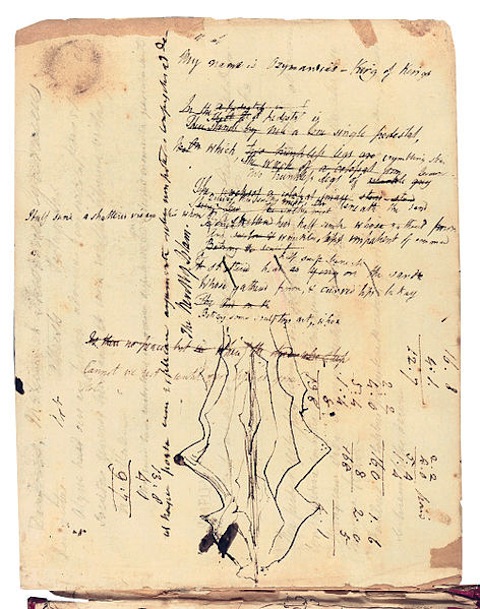
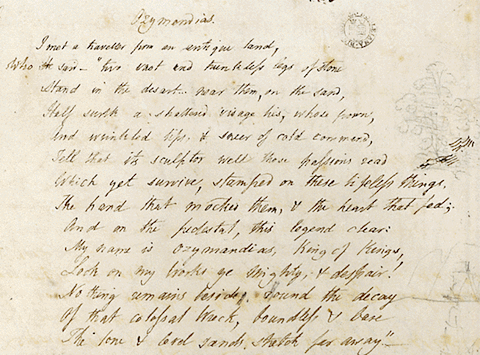
Critic and writer Leigh Hunt published both poems in 1818 editions of his monthly magazine The Examiner. While Smith’s poem barely rises to the occasion, more clumsy parody than serious literary endeavor, Shelley’s—like the sculptor’s inscription in his poem—has outlasted the empire of his day and lives on in the microcosmic TV representations of our own imperial works. Above, see an 1817 draft copy of Shelley’s iambic pentameter sonnet, worked over with corrections and revisions. Below see the fair copy he sent to Hunt for publication. Both copies reside at the Bodleian Library.
Related Content:
Inside Breaking Bad: Watch Conan O’Brien’s Extended Interview with the Show’s Cast and Creator
Discovered: Lord Byron’s Copy of Frankenstein Signed by Mary Shelley
Josh Jones is a writer and musician based in Washington, DC. Follow him at @jdmagness
Read More...Stanley Kubrick’s List of Top 10 Films: The First and Only List He Ever Created
Image by Moody Man, via Flickr Commons
When, over the past weekend, I noticed the words “Stanley Kubrick” had risen into Twitter’s trending-topics list, I got excited. I figured someone had discovered, in the back of a long-neglected studio vault, the last extant print of a Kubrick masterpiece we’d somehow all forgotten. No suck luck, of course; Kubrick scholars, given how much they still talk about even the auteur’s never-realized projects like Napoleon, surely wouldn’t let an entire movie slip into obscurity. The burst of tweets actually came in honor of Kubrick’s 85th birthday, and hey, any chance to celebrate a director whose filmography includes the likes of Dr. Strangelove, The Shining, and 2001: A Space Odyssey, I’ll seize. The British Film Institute marked the occasion by posting a little-seen list of Kubrick’s top ten films.
“The first and only (as far as we know) Top 10 list Kubrick submitted to anyone was in 1963 to a fledgling American magazine named Cinema (which had been founded the previous year and ceased publication in 1976),” writes the BFI’s Nick Wrigley. It runs as follows:
1. I Vitelloni (Fellini, 1953)
2. Wild Strawberries (Bergman, 1957)
3. Citizen Kane (Welles, 1941)
4. The Treasure of the Sierra Madre (Huston, 1948)
5. City Lights (Chaplin, 1931)
6. Henry V (Olivier, 1944)
7. La notte (Antonioni, 1961)
8. The Bank Dick (Fields, 1940—above)
9. Roxie Hart (Wellman, 1942)
10. Hell’s Angels (Hughes, 1930)
But seeing as Kubrick still had 36 years to live and watch movies after making the list, it naturally provides something less than the final word on his preferences. Wrigley quotes Kubrick confidant Jan Harlan as saying that “Stanley would have seriously revised this 1963 list in later years, though Wild Strawberries, Citizen Kane and City Lights would remain, but he liked Kenneth Branagh’s Henry V much better than the old and old-fashioned Olivier version.” He also quotes Kubrick himself as calling Max Ophuls the “highest of all” and “possessed of every possible quality,” calling Elia Kazan “without question the best director we have in America,” and praising heartily David Lean, Vittorio de Sica, and François Truffaut. This all comes in handy for true cinephiles, who can never find satisfaction watching only the filmmakers they admire; they must also watch the filmmakers the filmmakers they admire admire.
If you would like to support the mission of Open Culture, consider making a donation to our site. It’s hard to rely 100% on ads, and your contributions will help us continue providing the best free cultural and educational materials to learners everywhere. You can contribute through PayPal, Patreon, and Venmo (@openculture). Thanks!
Related Content:
Stanley Kubrick’s Very First Films: Three Short Documentaries
Terry Gilliam: The Difference Between Kubrick (Great Filmmaker) and Spielberg (Less So)
Napoleon: The Greatest Movie Stanley Kubrick Never Made
4,000+ Free Movies Online: Great Classics, Indies, Noir, Westerns, Documentaries & More
Colin Marshall hosts and produces Notebook on Cities and Culture and writes essays on literature, film, cities, Asia, and aesthetics. He’s at work on a book about Los Angeles, A Los Angeles Primer. Follow him on Twitter at @colinmarshall.
Read More...The Lost/Animated Interview with Fidel Castro: If the Revolution Fails, Cuba Will be “Hell Itself” (1959)
“If this Revolution falls, what we will have here in Cuba is a hell,” Fidel Castro said in Havana in 1959. “Hell itself.”
Castro was 32 when he made the proclamation during an interview recorded just weeks after the overthrow of dictator Fulgencio Batista. The new Cuba was still taking shape after the revolution led by the 26th of July Movement. Castro spoke extensively about his vision for Cuba during a 35-minute interview with an American journalist that has never been heard publicly until now.
The interview was discovered a few years ago when Laura Galloway found a tape in her late grandfather’s archives that simply said “Galloway/Castro.” Clark Hewitt Galloway was the intra-American affairs editor for U.S. News and World Report. Galloway covered Latin and South America for the magazine after serving in the same region with the U.S. Army Intelligence corps during WWII. Blank on Blank’s new episode for its PBS series animates the story behind the tape and a collection of outtakes from the interview. Castro talks about: why Che Guevara, Raul Castro and the 26th of July Movement were not Communist; and why Cuba had issues with the American presence in the Guantanamo Naval Base and, specifically, American sailors stirring up trouble while out on the town in Guantanamo.
Blank on Blank has also posted the entire 35-minute interview in Spanish with the English translation by Sebastian Betti. During the full interview, Castro goes into great detail about how the Cuban economy would be rebuilt and how the agrarian reform plan would be put into effect. He disputes whether American interests in Cuba would be nationalized. And he downplays the idea of being asked to be a presidential candidate.
The release of this unearthed interview comes as Castro’s brother, Raul, just gave a lengthy speech about the demise of Cuban culture and conduct despite what the revolution has brought to the country.
This post was brought to you by David Gerlach, the founder of Blank on Blank.
Read More...Guitar Stories: Mark Knopfler on the Six Guitars That Shaped His Career
When Dire Straits frontman Mark Knopfler was a kid growing up in Newcastle-Upon-Tyne, England, he dreamed about getting his own guitar. “I remember standing outside music stores with my nose pressed up against the glass, just staring at those electric guitars,” he told People magazine in 1985. “I used to smell Fender catalogs, I wanted one so bad.” Knopfler eventually talked his father into buying him a Höfner Super Solid V2 guitar for £50. The only problem was, it didn’t come with an amplifier. “I didn’t have the nerve to ask poor old dad for an amp,” Knopfler says in the documentary above. “I blew up the family radio in fairly short order.”
Knopfler tells the story of that first guitar and five others that shaped his career in this fascinating 45-minute documentary that aired in Britain last October on the Sky Arts television channel. Guitar Stories: Mark Knopfler is hosted by Knopfler’s friend and co-founder of Dire Straits, bassist John Illsley. The film offers a number of insights into Knopfler’s music and the key instruments that influenced his evolving style.
From the opening scenes at a music shop in Newcastle’s Central Arcade, where the young Knopfler spent hours staring at guitars through windows, Illsley and Knopfler move on to the city of Leeds, where Knopfler once worked as a junior reporter for the Yorkshire Evening Post. There they meet up with his longtime friend and mentor Steve Phillips, a member of Knopfler’s post-Dire Straits band The Notting Hillbillies. An aficionado of the Delta Blues, Phillips introduced the young Knopfler to the distinctive sound of “resonator” acoustic guitars.
Although it wasn’t the first resonator guitar he ever owned, Knopfler chooses as his second key guitar a 1937 National Style “O” guitar he bought from Phillips in 1978. The distinctive nickel-plated brass guitar, with its palm tree etchings around the edges and on the back, was featured on the cover of Dire Straits’ bestselling 1985 album Brothers in Arms, and was used for some of the band’s best songs. At one point in the film, Knopfler picks up the National and demonstrates how he hit on the famous arpeggio lines in “Romeo and Juliet,” from the Making Movies album, while experimenting with an open G tuning.
From Leeds, Illsley and Knopfler travel to the location of the original Pathway Studios in London, where they recorded their 1978 debut album, Dire Straits. Knopfler picks up his third key guitar, a 1961 Fender Stratocaster, and plays a few notes from the band’s breakthrough song, “Sultans of Swing.” The Stratocaster was the guitar Knopfler had always wanted, but as his music progressed he sought to diversify his sound. Knopfler’s fourth key guitar, which he played on Brothers in Arms, is a sunburst 1958 Gibson Les Paul. In one particularly interesting moment in the film, Knopfler explains how he came up with the distinctive guitar sound for the hit song “Money for Nothing” by playing the Les Paul through a static, partly depressed wah-wah pedal.
While touring with Dire Straits, Knopfler found it difficult to constantly change back and forth between guitars, so he decided to look for a single guitar that could produce a variety of sounds. To explain what happened next, Knopfler and Illsley travel to the SoHo neighborhood of New York, where they pay a visit to Rudy’s Music on Broome Street and talk to the proprietor, Knopfler’s longtime friend Rudy Pensa, who has built custom guitars since 1982. Knopfler and Pensa describe their collaboration on the design of Knopfler’s fifth key guitar, the Pensa MK‑1, which he played during his final years with Dire Straits.
The film ends with a visit to the Long Island workshop of master luthier John Monteleone. In 2008 Monteleone built the sixth key guitar in Knopfler’s life, the acoustic “Isabella” archtop, named after Knopfler’s eldest daughter. Knopfler was so inspired by Monteleone’s craftsmanship that he wrote a song called “Monteleone” for his 2009 solo album, Get Lucky. The song speaks eloquently of Knopfler’s admiration of Monteleone and, between the lines perhaps, of his lifelong love affair with guitars:
via MetaFilter
Related content:
Read More...See What Happens When You Run Finnegans Wake Through a Spell Checker
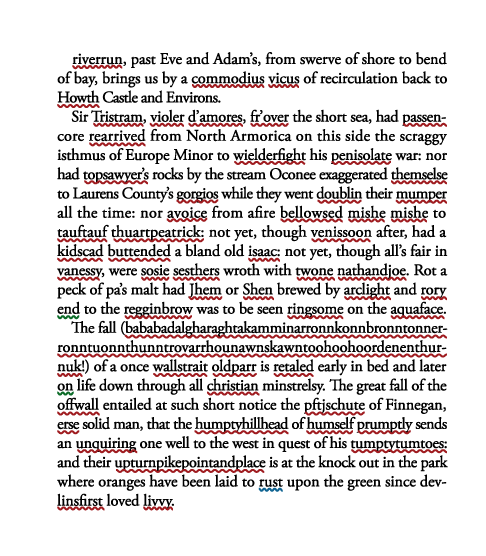
Reading James Joyce’s Ulysses is no walk in the park. Why else would so many people falsely claim to have read it. (See our post from last week, 20 Books People Pretend to Read.) But Finnegans Wake is a whole ‘nother deal. Joyce’s final work is considered one of the most difficult works of fiction ever written, and contrary to Ulysses, the novel “has some claim to be the least read major work of Western literature,” according to Joyce scholar Lee Spink. Put simply, people don’t even bother reading … or pretending to read … Finnegans Wake (unless, of course, they live in China, where the novel reached the #2 position on a Shanghai bestseller list earlier this year.)
But I digress: why don’t readers even give Finnegans Wake a shot? The illustration above perhaps says it all. The web site stammpunct.com has created a visual showing what happens when you run a page of the novel through a spell checker. It yields a lot of red, and then some more red. A framable print of this visual can be purchased at stammpunct for $35.
Copies of Ulysses and Finnegans Wake can be downloaded from our collection of Free eBooks. And you can hear James Joyce reading ‘Anna Livia Plurabelle’ from Finnegans Wake here. It was recorded in 1929.
via The Paris Review
Related Content:
Hear James Joyce Read From his Epic Ulysses, 1924
Henri Matisse Illustrates 1935 Edition of James Joyce’s Ulysses
Stephen Fry Explains His Love for James Joyce’s Ulysses
Marilyn Monroe Reads Joyce’s Ulysses at the Playground (1955)
Read More...
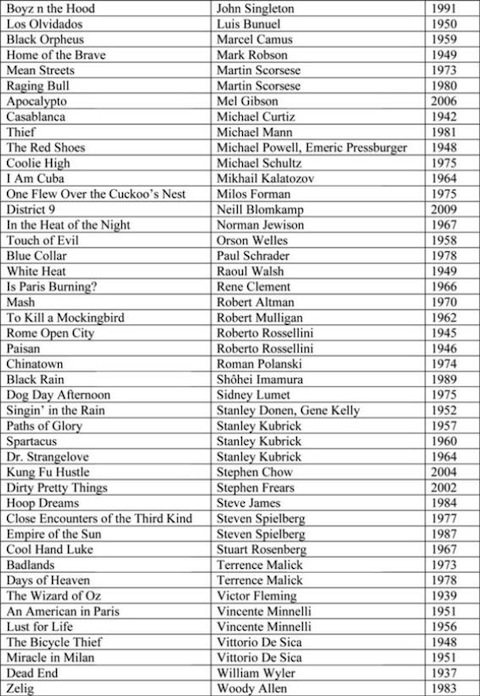
Spike Lee Shares His NYU Teaching List of 87 Essential Films Every Aspiring Director Should See
I’m sure you’ve heard by now: wealthy, successful film director Spike Lee hopes to fund his next film via a Kickstarter campaign. Yes, that’s right, he wants you to pay for his art. His campaign, perhaps needless to say, is hardly popular with the average film fan, many of whom find it hard enough to scrounge up the skyrocketing prices of tickets these days. Lee has responded to his critics, but somehow I doubt his reasoning will go over well.
But we’re not here to talk about alleged crowdfunding abuses (have at it in the comments if you must). Instead, today we have for you—in the tradition of our many posts on famous teachers’ syllabi—one of Lee’s teaching tools in his role as an NYU professor. Where all of our previous posts have featured reading lists, Lee’s is a list of films, which he hands out to all of the students who take his graduate class–not required viewing, but recommended as “essential” for every aspiring director.
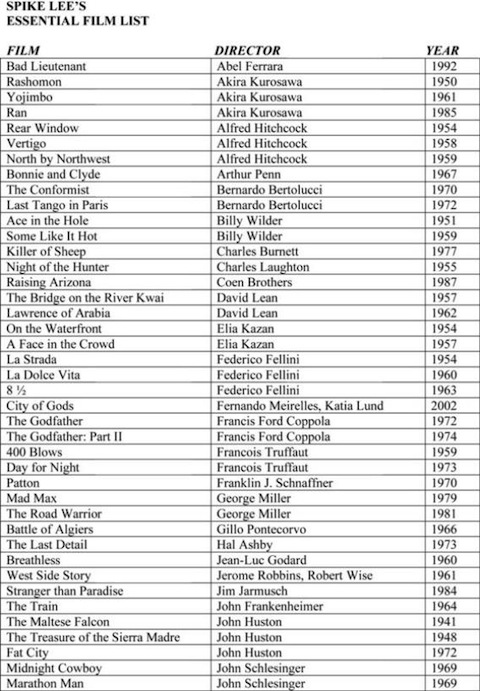
In the video at the top of the post, see Lee introduce the list of what he considers, “the greatest films ever made.” “If you want to be a filmmaker,” he says, “you should see these films.” The list, above and continued below, includes some of the usual critical favorites—Rashomon, Vertigo, On the Waterfront—and some pretty left field choices, like Mel Gibson’s Apocalypto.
Slate, which first published the list, notes the omission of usually revered directors like Howard Hawks, John Ford, Fritz Lang, and Yasujirō Ozu as well as the paucity—or near non-existence—of female directors (only one makes the list, the co-director of City of God). In addition to possibly ranting about, or defending, Lee’s use of Kickstarter, many of you may find yourselves quibbling over, or defending, his definition of “essential.” And so, I say again, have at it, readers!
Note: When Spike originally released this list, many noted the lack of female filmmakers. Lee accepted that critique and released an updated list. Find it here.
Related Content:
How Spike Lee Got His First Big Break: From She’s Gotta Have It to That Iconic Air Jordan Ad
David Foster Wallace’s 1994 Syllabus: How to Teach Serious Literature with Lightweight Books
Josh Jones is a writer and musician based in Washington, DC. Follow him at @jdmagness
Read More...Nobel Laureates Draw Playful Pictures of Their Discoveries

As an arty, unathletic only child in the 70s, I refused to buy into the idea that science could be fun. This despite a wealth of zippy educational programming, and the efforts of at least two cute young teachers whose hands-on approach included throwing eggs off of a railroad trestle, demolishing toothpick bridges and dipping things into liquid nitrogen for the sheer pleasure of seeing them explode when they hit the wall. Nice try. As far as I was concerned, those dullsville black-and-white films from the ’50s embodied the subject’s general vibe far more honestly than any attempt to force it down our throats with a fashionable Honeycomb Kids-style spin.
Having by now met dozens of scientists and science enthusiasts who are left cold by the arts, I’m not ashamed to be plainspoken here. I certainly don’t begrudge them their passion, and appreciate it when they don’t belittle mine. Different strokes, you know?
Still, it’s nice to stumble across common ground and for me, photographer Volker Stegerfor’s Nobel laureate portraits provides acreage on the order of Jim Ottaviani and Leland Myrick’s graphic biography of Richard Feynman. I may be hard pressed to articulate what the people in the portraits are famous for, but I appreciate their willingness to be a play by the artist’s rules. (By his estimate, the decline rate is somewhere around 4. 29%)
Stegerfor’s method for capturing big brained innovators in a light frame of mind resembles a well run experiment. His unsuspecting specimens were apprehended at Germany’s annual Lindau Nobel Laureate Meeting. Thus secured, they were led one at a time into a temporary studio where each was invited to draw whatever it was that had earned him or her the Nobel prize. The results weren’t much as art, but they’re unmistakably playful, bristling with arrows, exclamation points, smiley faces, and word bubbles. The photographer let his subjects pick the pose, at which points things did become art.
I’m going to award 1996 Chemistry laureate Sir Harold Kroto Best in Show for his well warranted action pose. Apparently, his discovery’s molecular structure looks like a soccer ball.
It’s not exactly Breaking Bad, but it does bring Chemistry alive for me as a subject others might find enjoyable in the empirical sense.
View a gallery of Volker Stegerfor’s Sketches of Science. If you’re really into it, the Nobel Museum is heralding a traveling exhibition of Stegerfor’s work with audio recordings of the scientists on the subject of their discoveries.
- Ayun Halliday is slated to direct the world’s first bio-historical musical in November. Follow her @AyunHalliday
Read More...
When William S. Burroughs Joined Scientology (and His 1971 Book Denouncing It)
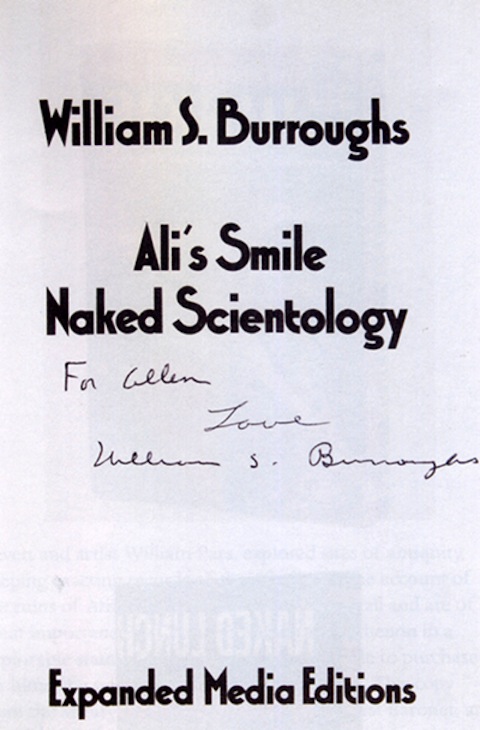
Crash director Paul Haggis impressed us all when his defection from the Church of Scientology became the subject of “The Apostate,” a 2011 New Yorker profile by Lawrence Wright. But Haggis’ high-profile departure from the lavish if shadowy house that L. Ron Hubbard built had a notable precedent in William S. Burroughs’ Naked Scientology. The Naked Lunch author and Beat Luminary published it after his own disillusionment with the organization of Scientology, though he retained his esteem for what he considered their mind-improving techniques. Booktryst offers a brief summary of Burroughs’ intense flirtation with the Church and its teachings: his initial attraction “because of its promise to liberate the mind by clearing it of traumatic memories that impeded personal growth, and, by extension, social progress and freedom from social control,” and his ultimate disappointment that, as biographer Ted Morgan puts it, he “had hoped to find a method of personal emancipation and found instead another control system.”
For a more in-depth look at what brought Burroughs into Scientology and what put him off of it, read Lee Konstantinou’s i09 post on the subject. “Burroughs took Scientology quite seriously indeed for the better part of a decade — during what was arguably his most artistically fertile period,” Konstantinou writes. “Today, where so much attention focuses on the science fictional origins of Scientology, it is easy to forget how seemingly in harmony the Church was with a whole range of countercultural, ‘New Age,’ and anti-psychiatric practices in the Sixties.” He files Scientology with Burroughs’ other “mind-expanding and mind-freeing practice,” including hallucinogens, “Mayan calendrical mind control systems,” apomorphine, and his signature “cut-up” texts. To hear all about it straight from Burroughs, read his 1970 Los Angeles Free Press j’accuse against Hubbard and his “fascist” tendencies, and the whole of Naked Scientology in PDF form.
via @SteveSilberman
Related Content:
Commissioner of Sewers: A 1991 Profile of Beat Writer William S. Burroughs
William S. Burroughs on the Art of Cut-up Writing
William S. Burroughs’ Short Class on Creative Reading
William S. Burroughs Reads His First Novel, Junky
Colin Marshall hosts and produces Notebook on Cities and Culture and writes essays on literature, film, cities, Asia, and aesthetics. He’s at work on a book about Los Angeles, A Los Angeles Primer. Follow him on Twitter at @colinmarshall.
Read More...Watch D.W. Griffith’s Silent Masterpiece Intolerance Free Online — It’s the “Ulysses of the Cinema!”
In 1915, D.W. Griffith shot one of the most controversial films in the history of cinema. Birth of a Nation “was a decisively original work of art—in effect, the founding work of cinematic realism,” writes Richard Brody in The New Yorker. But, despite being “titanically original,” the film was outrageously racist in the way that it depicted African-Americans during the Reconstruction Era. Even in 1915, audiences knew that the film had crossed a line. The NAACP protested against the film’s fabrications and inaccuracies. Riots broke out in Boston, Philadelphia and other major cities. And Griffith’s legacy never recovered, even if he tried to atone (some say) in 1916 with the release of Intolerance, another masterpiece of the Silent Era.
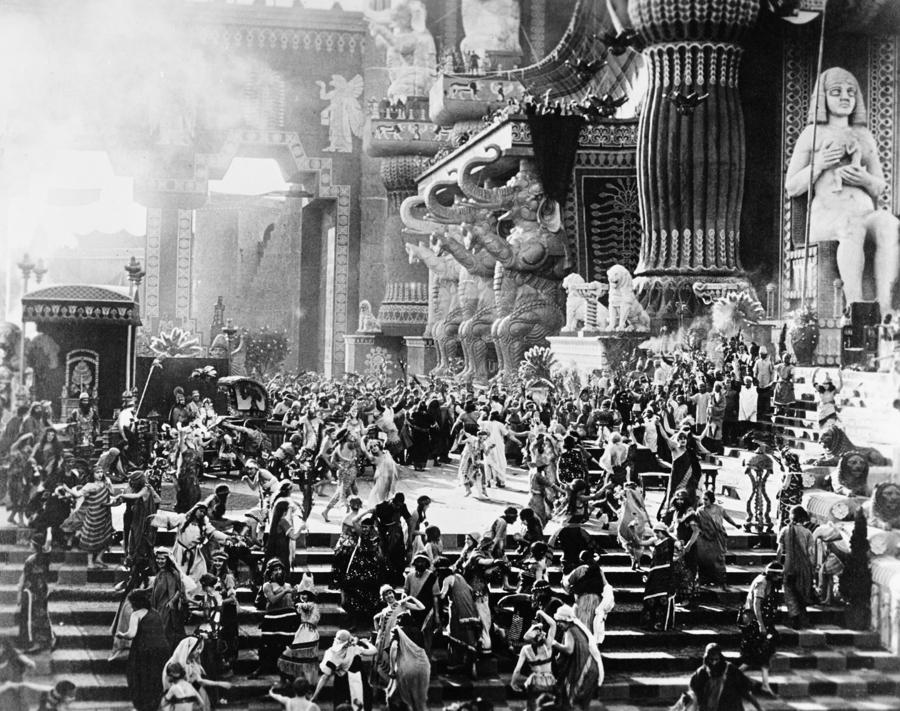
Billed as a “colossal spectacle,” Intolerance featured massive sets, extravagant period costumes, and more than 3,000 extras, and, in grand fashion, it wove together “four distinct but parallel stories that demonstrated mankind’s intolerance during four different ages in world history.” A century later, Birth of a Nation might not get many public viewings. But this past weekend a restored version of Intolerance began a weeklong run at the Film Forum in New York City. If the restored version doesn’t make it to a city near you, you can view the original film, all three epic hours of it, online for free. Intolerance is catalogued in our collection of 525 Free Movies Online.
Related Content:
The Power of Silent Movies, with The Artist Director Michel Hazanavicius
Hollywood, Epic Documentary Chronicles the Early History of Cinema
25 Free Charlie Chaplin Films Online
Read More...Remembering J.J. Cale, Virtuoso Guitarist and Author of ‘Cocaine’ and ‘After Midnight,’ with a 1979 Concert
J.J. Cale died on Friday. Cale was one of the greatest and most influential guitar players of the rock and roll era. “Of all the players I ever heard,” said Neil Young, “it’s gotta be Hendrix and J.J. Cale who are the best electric guitar players.”
It’s hard to imagine a musician more diametrically opposed to Jimi Hendrix than Cale, who was the master of nuance and understatement. Perhaps the best word to describe his country swing-inflected guitar playing would be “cool.” The restrained dynamics, the delicate touch — Cale’s playing demanded close attention and sensitivity in a listener. His vocals, too, were kept way down in the mix, a reflection of his introverted personality. “The effortlessness, that restraint and underplaying, under-singing — it was just very powerful,” said pop musician Beck to the Los Angeles Times in 2009. “The power of doing less and holding back in a song, I’ve taken a lot of influence from that.”
Perhaps the greatest exemplar of Cale’s wide influence was Eric Clapton, who made hits out of two previously obscure songs written by Cale — “After Midnight” and “Cocaine” — and patterned much of his ’70s music after the Tulsa Sound Cale helped create. When asked by Vanity Fair to name the living person he most admired, Clapton was unequivocal: J.J. Cale. “In my humble opinion,” Clapton wrote in his 2007 autobiography, “he is one of the most important artists in the history of rock, quietly representing the greatest asset his country has ever had.”
To remember Cale and his artistry, we bring you a 1979 video (above) of Cale and his band playing live at Rainbow Studios in Los Angeles with his old friend and fellow Oklahoman Leon Russell. Here’s the set list:
- “T‑Bone Shuffle” (prologue)
- “Nowhere to Run”
- “Cocaine”
- “Ten Easy Lessons”
- “Sensitive kind”
- “Hands Off Her”
- “Lou-Easy-Ann”
- “Going Down”
- “Corina Corina”
- “Roll On”
- “No Sweat”
- “Crazy Mama”
- “Fate of a Fool”
- “Boilin’ Pot”
- “After Midnight”
- “T‑Bone Shuffle”
- “T‑Bone Backwards”
- “Same Old Blues”
- “Don’t Cry Sister”
- “Set Your Soul Free (Tell Me Who You Care)”
- “24 Hours a Day”
Support Us
We're hoping to rely on loyal readers, rather than erratic ads. Please click the Donate button and support Open Culture. You can use Paypal, Venmo, Patreon, even Crypto! We thank you!

About Us

Open Culture scours the web for the best educational media. We find the free courses and audio books you need, the language lessons & educational videos you want, and plenty of enlightenment in between.
Advertise With Us

FREE UPDATES!
GET OUR DAILY EMAIL
Get the best cultural and educational resources on the web curated for you in a daily email. We never spam. Unsubscribe at any time.
FOLLOW ON SOCIAL MEDIA

Open Culture editor Dan Colman scours the web for the best educational media. He finds the free courses and audio books you need, the language lessons & movies you want, and plenty of enlightenment in between.
Advertise With Us

