Johnny Rotten’s Cordial Letter to the Rock and Roll Hall of Fame: Next to the Sex Pistols, You’re ‘a Piss Stain’
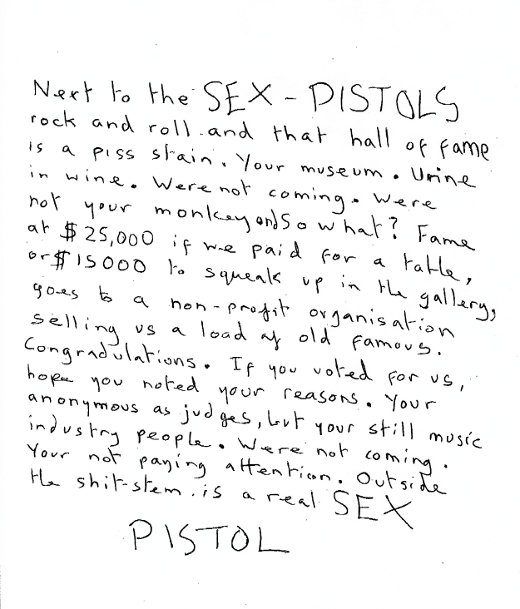
The Sex Pistols certainly weren’t the first to balk at showing up to receive a trophy at the Rock and Roll Hall of Fame induction ceremony. They were, however, notable for the style in which they declined to attend. When word came in early 2006 that the Pistols would be inducted, the band’s singer John Lydon, whose stage name was “Johnny Rotten,” faxed the Hall of Fame a handwritten note. “Next to the SEX-PISTOLS rock and roll and that hall of fame is a piss stain,” wrote Lydon. “Your museum. Urine in wine. Were not coming. Were not your monkey and so what?” You can read the rest above, or watch below as a bemused Jann Wenner, co-founder of the museum, reads the letter out loud during the ceremony.
via Letters of Note
Related Content:
The History of Punk Rock: A Documentary
The Art of Punk, MOCA’s Series of Punk Documentaries, Begins with Black Flag
Malcolm McLaren on The Quest for Authentic Creativity
Punk Meets High Fashion in Metropolitan Museum of Art Exhibition PUNK: Chaos to Couture
Read More...Download a Free Course from “The Great Courses” Through Audible.com’s Free Trial Program

Hardly a day goes by where I’m not doing one of two things — listening to an audio book from Audible.com, or listening to a lecture from The Great Courses (formerly known as The Teaching Company). So, I was naturally pleased when the two companies announced a partnership yesterday. From now on, Audible subscribers can download courses/lectures from The Great Courses, and they’re pretty cheap. For example, members of Audible’s Gold plan can purchase a polished 36-hour course, such as How to Listen to and Understand Great Music, for roughly $15. Not bad, especially considering that it would cost exponentially more to buy it directly through the Great Courses’ web site. If you’ve never tried out Audible or The Great Courses, then you may want to sign up for Audible’s 30-Day Free Trial. It will let you download any one course for free. NB: Audible is an Amazon.com subsidiary, and we’re a member of their affiliate program.
If none of the above sounds any good, well, you could always lose yourself in our collections of 900 Free Audio Books and 1700 Free Online Courses from Top Universities.
Related Content:
Download 90 Free Philosophy Courses and Start Living the Examined Life
Learn to Code with Harvard’s Intro to Computer Science Course And Other Free Tech Classes
The Art of Living: A Free Stanford Course Explores Timeless Questions
150 Free Online Business Courses
Read More...The Grateful Dead’s “Ultimate Bootleg” Now Online & Added to the Library of Congress’ National Recording Registry
I have known many a Deadhead, and I’ve loved ‘em—friends and friends of friends; I’ve hung out in parking lots, at parties and campsites, and done what ‘Heads do in such gatherings. And yet, to paraphrase St. Paul, I was in the scene but not of it, never one of the faithful, just a hanger-on in a world that bemused me, listening to music whose intense appeal I didn’t quite get. Don’t get me wrong; I thought the first album was a country-rock classic. But that’s where my Dead knowledge ended. Of the two sixties bands who both once called themselves The Warlocks—The Dead and The Velvet Underground—my psychedelic tastes ran decidedly in the East Coast direction.
So I’m probably as far as it gets from an expert on the labyrinthine world of Grateful Dead bootlegs. But I have to admit, just like the parking lot scene the young, aloof me observed through the eyes of my old hippie friends, I’m intrigued and a little intimidated by the obsessive cataloguing of Deadhead fandom.
My teenage punk-rock self admired the DIY ethos, despite serious stylistic misgivings, and now as a grown-up who couldn’t care less about labels, I’m finding the time to go back and re-listen to some of those bootleg recordings. I’m catching up on the history of live Dead by reading Nick Paumgarten’s exhaustive “Deadhead: The Afterlife” article in The New Yorker, and luckily for me, and for the real fans too, the days of trading tapes are gone. Hundreds of hours of live concert audio now exist in the Internet Archive.
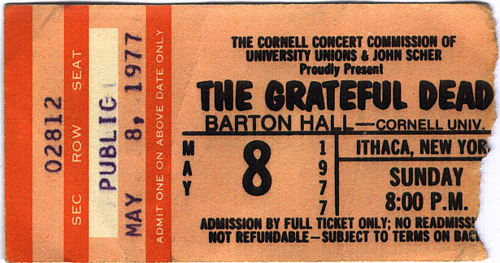
One of those concert recordings—the May 8, 1977 Barton Hall/Cornell University gig available above in its entirety—is said by some to be the “ultimate bootleg.” I’m in no position to judge, so I’ll quote the Library of Congress’s National Recording Registry, who write that this recording “has achieved almost mythic status among ‘Deadhead’ tape traders because of its excellent sound quality and early accessibility.” The LOC also points out that “fans of the Grateful Dead will never completely agree about which one of their over 2,300 concerts was the best.” Debates like this can, and should, go on forever. If they didn’t, whole subcultures would shrivel up and die. The armchair anthropologist in me thinks that would be a shame. The music fan (and inner hippie) in me is happy to groove to whatever catches my fancy these days, and I’m getting down to this one, for sure.
Note: You can find more information on the Barton Hall/Cornell concert here. And here you can find 13 essential bootlegs selected by Nick Paumgarten, complete with links to audio from the concerts.
Related Content:
8,976 Free Grateful Dead Concert Recordings in the Internet Archive, Explored by the New Yorker
Bob Dylan and The Grateful Dead Rehearse Together in Summer 1987. Listen to 74 Tracks.
The Grateful Dead Rock the National Anthem at Candlestick Park: Opening Day, 1993
Josh Jones is a writer and musician based in Washington, DC. Follow him at @jdmagness
Read More...Three Great Films Starring Charlie Chaplin, the True Icon of Silent Comedy
Writing about the sort of creators and works of art we do here at Open Culture, I constantly struggle not to overuse the word “iconic.” But in the case of actor and filmmaker Charlie Chaplin, no other adjective could do. When we call Chaplin iconic, we mean it literally: not only did he find great success as a comic figure in the silent-film era, he visually represents the concept of a comic figure in the silent film era. Yet he didn’t attain icon status in just one form, having continually tweaked, refined, and improved his look and sensibility throughout his 75-year career. Now, 35 years after his death, we see all of these performances as subtly different but still recognize them as expressions of the broader Chaplin persona. At the top of the post, you can watch the film that established his most beloved one, 1915’s The Tramp.
But the Little Tramp didn’t emerge fully formed just then and there. Technically, the character debuted in the previous year’s Kid Auto Races at Venice, and even before that, Chaplin portrayed a few fellows we might call proto-Tramps. Just above, you’ll find 1914’s Making a Living, a picture that casts the London-born Chaplin, with hat, cane, and mustache, as flirtatious thief Henry English. His criminal ways lead him into the path of those other silent-comedy stalwarts (if not quite icons), the Keystone Kops. A decade later, Chaplin, by that point the quintessential writing-directing-acting auteur, wouldn’t need to share the screen. In 1925, he made the Klondike-set The Gold Rush, whose “streaks of poetry, pathos, tenderness, linked with brusqueness and boisterousness” drew special praise from the New York Times, and for which Chaplin said he wanted to be remembered. You can watch it below, and then you can browse our collection of 25 Free Charlie Chaplin Films on the web.
Related Content:
The Power of Silent Movies, with The Artist Director Michel Hazanavicius
Hollywood, Epic Documentary Chronicles the Early History of Cinema
4,000+ Free Movies Online: Great Classics, Indies, Noir, Westerns, Documentaries & MoreColin Marshall hosts and produces Notebook on Cities and Culture and writes essays on literature, film, cities, Asia, and aesthetics. He’s at work on a book about Los Angeles, A Los Angeles Primer. Follow him on Twitter at @colinmarshall.
Read More...New Robert Rauschenberg Digital Collection Lets You Download Free High-Res Images of the Artist’s Work
After the waning of abstract expressionism, Robert Rauschenberg’s exuberant prints, paintings, sculptures, and three-dimensional collages he called “Combines” rejuvenated the New York art world and helped bring pop art to prominence, anticipating Warhol’s experiments. And now students of twentieth-century American art can connect with all of the artist’s work in the San Francisco Museum of Modern Art’s permanent collection without setting foot in the Bay area, thanks to SFMOMA’s Rauschenberg Research Project, which allows users to download high res images of the museum’s Rauschenbergs. Research materials—including commentary, interviews, essays, and more—accompany each image. Clicking on the main link for each image will send you to a page with a lengthy description. Scrolling down to the bottom of the page, you’ll find individual links for each of the associated files and an omnibus link for all of them at once.
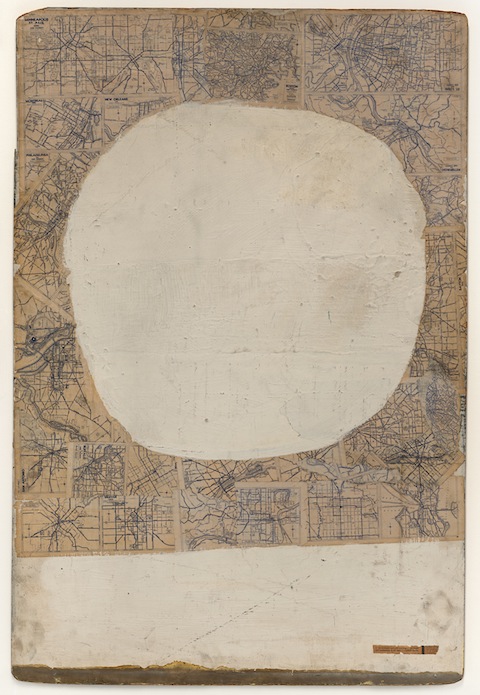
It’s certainly not a substitute for seeing the work up close in all its ontological materiality, but it’s still quite a wonderful resource for researchers, art historians, and even general enthusiasts of Rauschenberg, particularly since many of the works in SFMOMA’s database are not currently on display (and the museum is temporarily closed during an expansion). A painting you can’t see in person is the dense collage Mother of God (at top), one of Rauschenberg’s earliest surviving paintings from a period in the 50s when the artist explored several religious themes. The painting’s brown background is composed of layers of maps of American locales, and the site allows you to zoom in and examine each one in fine detail. In the video above—one of the digital project’s collection of artifacts—see Rauschenberg discuss the painting with curator Walter Hopps and SFMOMA Director David A. Ross in a 1999 interview.
via Metafilter
Related Content:
Rauschenberg Erases De Kooning
The Rijksmuseum Puts 125,000 Dutch Masterpieces Online, and Lets You Remix Its Art
LA County Museum Makes 20,000 Artistic Images Available for Free Download
The National Gallery Makes 25,000 Images of Artwork Freely Available Online
Josh Jones is a writer and musician based in Washington, DC. Follow him at @jdmagness
Read More...Alfred Hitchcock Explains the Plot Device He Called the ‘MacGuffin’
Alfred Hitchcock liked to call it the “MacGuffin” — the mysterious object in a spy thriller that sets the whole chain of events into motion.
But despite the supposed centrality of the MacGuffin, a Hitchcock movie is always about something else. In The 39 Steps, for example, the MacGuffin turns out to be the coveted plans for an advanced airplane engine, stored in the mind of a vaudeville performer named “Mr. Memory.” But really the film is about a wrongfully accused man’s desperate struggle to solve a mystery so he can clear his name and live to see another day.
The MacGuffin is always particular — often to the point of absurdity — while the hero’s motivation is universal. Some of the characters may care about the MacGuffin, but the audience certainly does not. In his 1962 interview with François Truffaut, Hitchcock explains:
The main thing I’ve learned over the years is that the MacGuffin is nothing. I’m convinced of this, but I find it very difficult to prove it to others. My best MacGuffin, and by that I mean the emptiest, the most nonexistent, and the most absurd, is the one we used in North by Northwest. The picture is about espionage, and the only question that’s raised in the story is to find out what the spies are after. Well, during the scene at the Chicago airport, the Central Intelligence man explains the whole situation to Cary Grant, and Grant, referring to the James Mason character, asks, “What does he do?” The counterintelligence man replies, “Let’s just say that he’s an importer and exporter.” “But what does he sell?” “Oh, just government secrets!” is the answer. Here, you see, the MacGuffin has been boiled down to its purest expression: nothing at all!
The term “MacGuffin” was coined by a screenwriter Hitchcock worked with named Angus MacPhail, according to Donald Spoto in The Art of Alfred Hitchcock: Fifty Years of His Motion Pictures. But the principle goes back at least as far as Rudyard Kipling, as Hitchcock explains in this whimsical little film by Isaac Niemand with audio from Hitchcock’s June 8, 1972 appearance on the Dick Cavett Show. Perhaps the most important thing to remember about the MacGuffin is that it contains the word “guff,” which means a load of nonsense. “There’s a lot to look for in Hitchcock’s films,” writes Spoto, “but watch out for the MacGuffin. It will lead you nowhere.”
NOTE: The 39 Steps and other Hitchcock thrillers can be found in our collection of 16 Free Hitchcock Movies Online, not to mention our big collection, 4,000+ Free Movies Online: Great Classics, Indies, Noir, Westerns, Documentaries & More.
If you would like to support the mission of Open Culture, consider making a donation to our site. It’s hard to rely 100% on ads, and your contributions will help us continue providing the best free cultural and educational materials to learners everywhere. You can contribute through PayPal, Patreon, and Venmo (@openculture). Thanks!
Related content:
Alfred Hitchcock on the Filmmaker’s Essential Tool: ‘The Kuleshov Effect’
Hitchcock’s Seven-Minute Editing Master Class
37 Hitchcock Cameos over 50 Years: All in One Video
Read More...Four American Composers: Peter Greenaway on John Cage, Philip Glass, Meredith Monk, and Robert Ashley (1983)
Why would a noted British filmmaker want to take as a subject four American composers? Perhaps the question answers itself, in part, when I tell you the identity of the filmmaker, Peter Greenaway, and the composers, Philip Glass, Meredith Monk, John Cage, and Robert Ashley. No wonder this selection of musical personalities appealed to the director of The Draughtsman’s Contract;The Cook, the Thief, His Wife, and Her Lover; and Prospero’s Books, whom critics have labeled, at various times, a classicist, an experimenter, a formalist, and a weirdo. Alas, Greenaway’s fans may not know much about Glass, Monk, Cage, and Ashley, just as those composers’ adherents may never have encountered a movie of Greenaway’s. To bridge the gap, we give you the documentary series Four American Composers, free to watch online. At the top of this post, you’ll find the first episode, on Cage. The second, below, covers Glass. The third and fourth take on Monk and Ashley, respectively.
Greenaway die-hards such as myself may, watching these documentaries the filmmaker created in 1983, think back to his early career. At that time, he made pictures like The Falls, which rigidly followed the documentary form while completely abandoning its aspirations to capture the literal truth. Thoroughly nonfictional, or at least seeming that way, the documentaries that make up Four American Composers nonetheless exude the Greenaway sensibility. “Because he made mostly mock-documentaries in the seventies,” writes Amy Lawrence in The Films of Peter Greenaway, “the ‘real’ documentaries are nearly indistinguishable from the fakes. Real people (especially John Cage) tend to become Greenaway characters.” The project thus slides neatly in with his other, more “straightforward” films, all of which take place in a deliberately structured labyrinth of joke and allusion peopled by architects, inventors, aristocrats, and artists — obsessives, all.
You can find two other films by Greenaway — Darwin and Rembrandt’s J’accuse — in our collection of 525 Free Movies Online.
Related Content:
Darwin: A 1993 Film by Peter Greenaway
Peter Greenaway Looks at the Day Cinema Died — and What Comes Next
Colin Marshall hosts and produces Notebook on Cities and Culture and writes essays on literature, film, cities, Asia, and aesthetics. He’s at work on a book about Los Angeles, A Los Angeles Primer. Follow him on Twitter at @colinmarshall.
Read More...Listening to Proust’s Remembrance of Things Past, (Maybe) the Longest Audio Book Ever Made
I’m impressed by the undertaking. Neville Jason and Naxos Audio Books have completed an unabridged audio version of Proust’s epic, seven-part novel, Remembrance of Things Past. Proust published the first volume, Swann’s Way, one hundred years ago, in 1913, and completed the last volume, Time Regained, fourteen years later, in 1927. By that time, Proust had a masterpiece on his hands — a very long masterpiece. The classic (available in our collection of Free eBooks) spans some 3,000 pages and contains more than 1.5 million words. Until now, Remembrance of Things Past has never been available in an unabridged audio format, perhaps because it would amount to the longest audio book ever made (or something approaching that). But Neville Jason has pulled it off, producing a 151-hour recording that’s now available on Audible.com. Below, we’ve provided seven free audio excerpts (one from each volume), and if you care to sign up for Audible’s 30-Day Free Trial, you can download any one volume for free. NB: Audible is an Amazon.com subsidiary, and we’re a member of their affiliate program. If Proust isn’t your cup of tea, you can find many other great works in our collection of 630 Free Audio Books.
Related Content:
Watch Monty Python’s “Summarize Proust Competition” on the 100th Anniversary of Swann’s Way
Arthur Conan Doyle Fills Out the Questionnaire Made Famous By Marcel Proust (1899)
Read More...Marvin Gaye’s Classic Vocals on ‘I Heard it Through the Grapevine’: The A Cappella Version
It’s hard to believe, but Marvin Gaye’s classic 1967 recording of “I Heard it Through the Grapevine” was rejected by his record label.
The song, about a man’s grief over hearing rumors of his lover’s infidelity, was written by the legendary Motown Records producer Norman Whitfield and singer Barrett Strong. It was first recorded in 1966 by Smokey Robinson and the Miracles, but that version was nixed by Motown founder Berry Gordy during a weekly quality control meeting. Whitfield recorded the song with Gaye in early 1967, but for some reason Gordy didn’t like that version either. So Whitfield changed the lyrics a bit and recorded it with Gladys Knight and the Pips. The fast-tempo arrangement, influenced by Aretha Franklin’s “Respect,” was released as a single in September of 1967 and rose to number one on the Billboard R&B chart.
Gaye’s version might have been forgotten had it not been included in his 1968 album, In the Groove, where it soon became noticed. “The DJs played it so much off the album,” Gordy said later, “that we had to release it as a single.” Gaye’s recording of the song became a cross-over hit. It rose not only to the top of the R&B charts, but also spent seven weeks at the top of the Billboard Pop Singles chart. It was Motown’s biggest-selling single up to that time, and the In the Groove album name was changed to I Heard It Through the Grapevine.
Gaye was known for his sweet-sounding tenor voice, which he could modulate from a baritone to a silky high falsetto. During the “Grapevine” sessions, the singer reportedly quarreled with Whitfield over the producer’s insistence that he sing the song in a high rasp. Whitfield prevailed, and Gaye’s performance is one of the greatest of the Motown era. You can hear his classic vocals “a cappella” in the video above. And for a reminder of Whitfield’s classic arrangement, with its pulsing electric piano introduction and shimmering strings, see the video below. The Funk Brothers, the legendary Motown backing group, played on the track, as did the backing vocal group The Andantes and the Detroit Symphony Orchestra.
Vi Hart Uses Her Video Magic to Demystify Stravinsky and Schoenberg’s 12-Tone Compositions
Having one of those mornings where you wake up thinking it’d be “awesome” if you jazzed up Stravinsky’s atonal musical setting of Edward Lear’s famous nonsense poem, “The Owl and the Pussycat”?
You are? Wow! What luck! Apparently Recreational Mathemusician Vi Hart had the exact same kind of morning recently, and used it as the springboard for addressing the 12-Tone Technique originally devised by Arnold Schoenberg. Uninitiated philistines may want to double down on the caffeinated beverage of their choice, as this stuff is dense, and Hart talks the way a hummingbird flies.
But as she notes at the 15 minute mark, “Creativity means fearlessly embracing things that seem odd, even random, knowing that if you keep your brain open you’ll eventually find the connections.”
Ergo, those of us whose reference level (or, it must be said, interest) is no match for a 30 minute treatise on the history and logic of ordering the twelve pitch-classes of the chromatic scale into numerically designated sets should find something to chew on, too: copyright and Fair Use Law, for starters; the constraint-bound experimental fiction of French literary group Oulipo, not to mention Borges’ “Library of Babel” and the organized randomness of Rorschach blots and constellations; zombies… John Cage…
(Easy to imagine the sort of jacked-up, explanation-crazed, bed-resistant child she must have been.)
As ever, her sharpie-on-spiral stop-motion visuals add dimension, especially now that she seems to be experimenting with giving her on-the-fly stick figures a certain Hyperbole-and-a-Half exuberance.
For good measure, we’ve added a conventional video primer on the 12 Tone Technique by The New York Times below.
H/T Hannes
Related Content:
Interviews with Schoenberg and Bartók
Ayun Halliday would’ve resorted to Vi Hart’s snake drawing technique had this been a live lecture. Follow her @AyunHalliday
Read More...Support Us
We're hoping to rely on loyal readers, rather than erratic ads. Please click the Donate button and support Open Culture. You can use Paypal, Venmo, Patreon, even Crypto! We thank you!

About Us

Open Culture scours the web for the best educational media. We find the free courses and audio books you need, the language lessons & educational videos you want, and plenty of enlightenment in between.
Advertise With Us

FREE UPDATES!
GET OUR DAILY EMAIL
Get the best cultural and educational resources on the web curated for you in a daily email. We never spam. Unsubscribe at any time.
FOLLOW ON SOCIAL MEDIA

Open Culture editor Dan Colman scours the web for the best educational media. He finds the free courses and audio books you need, the language lessons & movies you want, and plenty of enlightenment in between.
Advertise With Us

