The Most “Intellectual Jokes”: Our Favorite Open Culture Reader Submissions
Last week, we pointed to a Reddit thread that asked for users’ most “intellectual jokes.” Using that idea as a platform, we asked our readers to submit their favorites, and we received a healthy number of howlers (and some clunkers). We also got a piece of dour criticism from one reader, who wrote, “really? intelligent humor means that it’s witty and subtle, not that it’s [sic] standard type of joke with ‘smarter’ content.. come on americans, you can do better.”
I can only assume two things here (perhaps making an an ass of u and me): the writer is not an “american” and is something of a connoisseur of what he or she calls “intelligent humor.” I am very sympathetic. Whether this person has in mind the mordant absurdism of Beckett, the trenchant wit of Swift or Wilde, the surrealistic flights of farce in Vonnegut, or the heights of high-toned silliness in Monty Python, I can’t say. All of these are excellent examples of “intelligent humor.”
But I’m afraid our reader has misread the prompt, which asked specifically for “intellectual jokes”—like the animated New Yorker cartoon above. The formula for jokes everyone knows: setup, punchline. The “intellectual” part relates, I think, expressly to the “smarter” content, but the judgment of such humor is subjective, of course, and in the brief selection below of my favorite submissions, I will certainly admit as much. My sense of humor is neither witty nor subtle; I’m partial to the puerile—puns, silly reversals, broad satire. Of course, the same can be said of all of the writers above to some degree or another.
So without further going-on about it, here are a few of my favorite Open Culture readers’ “intellectual jokes” (with my editorial intrusions in brackets):
- Rene Descartes is attending a soiree at the Palais Versailles. A sommelier approaches and asks, “Monsieur Descartes, would you like a glass of wine?” Descartes pauses and answers, “I think not.” And poof!–he disappears.
[This one’s not particularly funny—it’s cute—but I quite like the specificity in the setup and the fun surprise of “poof!”]
- I used to be a structural linguist, but now I’m not Saussure.
[Told you I like puns]
- Masochist walks up to a sadist in a bar, says to the sadist “hurt me.” Sadist says “no.”
- What do you get when you combine a joke with a rhetorical question?
[So dry and deadpan, these two. Love it.]
- What did the indigenous person say to the postmodern anthropologist? “Can we talk about me for a change?”
[A little crack at navel-gazing po-mo academics—part of a popular genre]
- Blind guy with a seeing eye dog walks into a department store. Guy picks up dog by the tail and starts swinging him around over his head. Clerk rushes over and says nervously “Can I help you sir?” Guy replies: “No thanks, I’m just looking around.”
[I don’t think the content of this one is particularly “intellectual,” but the style is—it’s dark and weird and skirts a line between slapstick and cruelty, requiring a morbid and elastic imagination.]
- Q: What does a dyslexic, agnostic insomniac do? A: Stays up nights wondering if there’s a dog.
- JOKE: What do Japanese pigeons sing? Answer: High Coos
[More puns, bless ‘em]
- Argon walks into a bar and orders a drink. The bartender says, “sir, we don’t serve noble gasses.” There was no reaction.
[For you science types. Another reader responds with a pun for bonus points]:
- Thanks. Now all the good chemistry jokes Argon.
Good work, readers. Keep ‘em coming. This was fun. Remember, you can scan through the other submissions here.
Related Content:
What’s the Most Intellectual Joke You Know?: The Best from Reddit (and You?)
New Yorker Cartoon Editor Bob Mankoff Reveals the Secret of a Successful New Yorker Cartoon
What’s the Deal with Pop Tarts? Jerry Seinfeld Explains How to Write a Joke
Josh Jones is a writer and musician based in Washington, DC. Follow him at @jdmagness
Read More...George Orwell Explains How to Make a Proper Cup of Tea
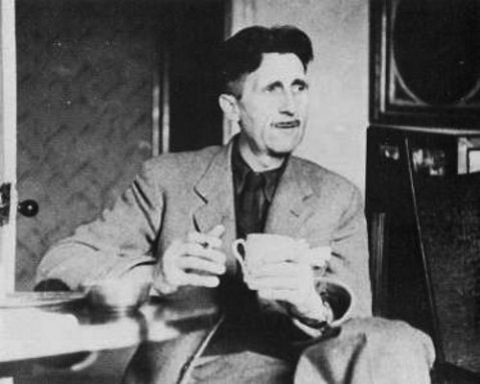
Next to my bed lies George Orwell’s Essays, the bricklike Everyman’s Library edition of the 1984 author’s thoughts on ideology, colonialism, the abuse of language, crime and punishment, and just what constitutes a nice cup of tea. The astute essayist keeps his mind prepared to go anywhere, and Orwell’s rigorous love of simple English pleasures places him especially well to write on the subject of how best to prepare a serving of “one of the main stays of civilization in this country, as well as in Eire, Australia and New Zealand.” His essay “A Nice Cup of Tea,” which first ran in the Evening Standard of January 12, 1946, breaks the process down into eleven points, from “One should use Indian or Ceylonese tea” to “One should take the teapot to the kettle and not the other way about” to, finally, “Tea — unless one is drinking it in the Russian style — should be drunk without sugar.” These guidelines may sound to us a tad austere at worst, but Orwell presents some of them as downright “controversial.” Dare he so boldly insist upon drinking only out of a “good breakfast cup,” de-creaming milk before pouring it into tea, and never, ever using strainers nor bags?
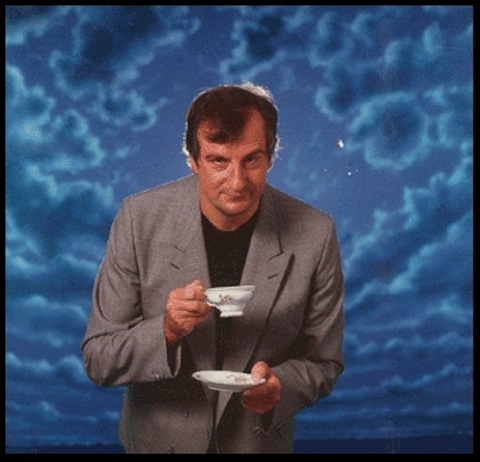
He does indeed. History has remembered Orwell as one of authoritarianism’s most outspoken enemies, but clearly he had moments, especially when it came to his beverage of choice, where he himself would brook no dissent. Decades later, a much more easygoing writer would make his own contribution to the literature of English tea procedure: A short piece by Hitchhiker’s Guide to the Galaxy author Douglas Adams suggests that you “go to Marks and Spencer and buy a packet of Earl Grey tea” (this may, depending upon your location, require an overseas trip), that “the water has to be boiling (not boiled) when it hits the tea leaves,” and that “it’s probably best to put some milk into the bottom of the cup before you pour in the tea,” since “if you pour milk into a cup of hot tea you will scald the milk.” Though we here at Open Culture have made no secret of our interest in coffee, how could we turn down a cup of tea made to the standards of such well-respected men of letters?
via BoingBoing
Related Content:
10 Golden Rules for Making the Perfect Cup of Tea (1941)
Epic Tea Time with Alan Rickman
Colin Marshall hosts and produces Notebook on Cities and Culture and writes essays on literature, film, cities, Asia, and aesthetics. He’s at work on a book about Los Angeles, A Los Angeles Primer. Follow him on Twitter at @colinmarshall.
Read More...What’s the Most Intellectual Joke You Know?: The Best from Reddit (and You?)
Long before capital “A” Academia became a professional network of accredited scholars and fund-grubbing institutions, intellectual discourse consisted of nearly as much humor—bad puns, scatology, innuendo, biting caricature—as deep philosophical dialogue and sparkling erudition. So-called “wits” gathered in coffee houses to trade barbs and bon mots and to circulate their favorite literary satires from writers like Jonathan Swift, Alexander Pope, and John Wilmot, the 2nd Earl of Rochester, whose poetic output was often equal parts raunchy prosody and thoughtful critical inquiry.
In our digital times, intellectual humor bubbles around the margins of high culture, as much as in the oblique cartoons of The New Yorker as in forums like Reddit, where jokes can be crude, hateful, and borderline psychotic, or genuinely witty and unique. Slate recently picked up on a Reddit thread that asked users “what’s the most intellectual joke you know?” The authors of the Slate piece compiled several contenders (and inanely explained each joke with “why it’s funny” addenda—good humor shouldn’t require didactic commentary).
Below, find a sampling of some of the Reddit submissions. In the comments section, please feel free to submit your own “intellectual jokes” after perusing Reddit to make sure someone hasn’t beat you to the punchline.
- From user Watch_Closely: “It’s hard to explain puns to kleptomaniacs because they always take things literally.”
- From user Arcadian 5656: “A biologist, a chemist, and a statistician are out hunting. The biologist shoots at a deer and misses 5ft to the left, the chemist takes a shot and misses 5ft to the right, and the statistician yells, ‘We got ‘im!’ ”
- From user shannman: “Who does Polyphemus hate more than Odysseus? Nobody!”
And below, two of the Redditors’ favorites:
- From user phattmatt: “Jean-Paul Sartre is sitting at a French cafe, revising his draft of Being and Nothingness. He says to the waitress, “I’d like a cup of coffee, please, with no cream.” The waitress replies, “I’m sorry, Monsieur, but we’re out of cream. How about with no milk?”
- From user snakesanddoves: “An Irishman goes to a building site for his first day of work, and a couple of Englishmen think, ‘Ah, we’ll have some fun with him!’ So they walk up and say, ‘Hey, Paddy, as you’re new here make sure you know a joist from a girder…’ ‘Ah, sure, I knows’ says Paddy, ‘twas Joyce wrote Ulysses and Goethe wrote Faust.’”
Some clever humor above, I’d say (and in the animated New Yorker cartoon at the top of the post). So, you think you can do better? Let’s hear your jokes in the comments.
via Kottke
Related Content:
New Yorker Cartoon Editor Bob Mankoff Reveals the Secret of a Successful New Yorker Cartoon
Friedrich Nietzsche & Existentialism Explained to Five-Year-Olds (in Comical Video by Reddit)
What’s the Deal with Pop Tarts? Jerry Seinfeld Explains How to Write a Joke
Josh Jones is a writer and musician based in Washington, DC. Follow him at @jdmagness
Read More...Charles Bukowski Sets His Amusing Conditions for Giving a Poetry Reading (1971)
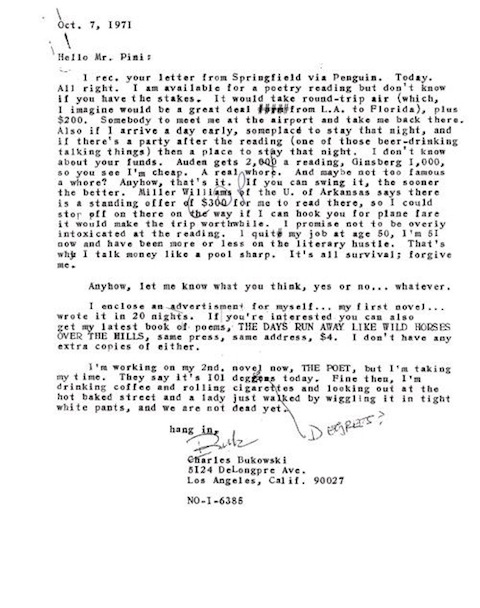
It takes a special kind of dedication for a writer to quit his day job. When notably hard-living, hard-writing poet Charles Bukowski took the plunge in 1969, at the behest of his Black Sparrow Press publisher John Martin, he did it in the same spirit of seriousness he’d reserved for smoking, drinking, women, and the written word. “I have one of two choices,” he wrote in a letter at the time, “stay in the post office and go crazy… or stay out here and play at writer and starve. I have decided to starve.” Later, in 1971, he wrote the letter above, a reply to an inquiry about the possibility of his giving a reading in Florida. His price? Round-trip airfare from his home in Los Angeles to Florida, rides from and back to the airport, a place to stay, and $200.
Having already spent about two years working as a writer and a writer alone (and having spent the first twenty nights of that period furiously composing his first novel, Post Office), Bukowski quickly developed a head for what he called “the literary hustle.” He makes a distinctive pitch for his poetic services: “Auden gets $2,000 a reading, Ginsberg $1,000, so you see I’m cheap. A real whore.” I can easily envision Bukowski hammering out this letter at the front window of his now-iconic bungalow up on De Longpre Avenue on another hot summer 42 years ago, not least because he describes himself doing it: “They say it’s 101 degrees today. Fine then, I’m drinking coffee and rolling cigarettes and looking out at the hot baked street and a lady just walked by wiggling it in tight white pants, and we are not dead yet.” If you never had a chance to catch a Bukowski reading yourself, you can catch his reading at City Lights Poets Theater, recorded in September 1973. It’s just above.
Related Content:
Charles Bukowski Reads His Poem “The Secret of My Endurance”
“Don’t Try”: Charles Bukowski’s Concise Philosophy of Art and Life
Charles Bukowski: Depression and Three Days in Bed Can Restore Your Creative Juices (NSFW)
Colin Marshall hosts and produces Notebook on Cities and Culture and writes essays on literature, film, cities, Asia, and aesthetics. He’s at work on a book about Los Angeles, A Los Angeles Primer. Follow him on Twitter at @colinmarshall.
Read More...Rapping About Science: Watch High School Senior Jabari Johnson Talk Physics with Poetic Lyrics
Christopher Emdin, an Associate Professor at Teachers College, Columbia University, loves to rap. And he loves using rap to teach kids all about science. That’s why he helped put together B.A.T.T.L.E.S., a New York City-wide competition that challenges students to put scientific concepts into lyrical raps. The kids were up to the task and rapped about everything from “rock science, natural selection and genetics to how materials freeze or melt.” And the winner — Jabari Johnson, a senior from Urban Assembly School for the Performing Arts in Harlem — was named on June 21, after the final competition took place on the Columbia University campus. Johnson will now have a chance to make a professional recording of his song about Kinetic Energy and post it on the Rap Genius website.
via Columbia
Related Content:
The Greatness of Charles Darwin Explained with Rap Music
The Large Hadron Collider Rap, Yo
Read More...A Short Film on the Famous Crosswalk From the Beatles’ Abbey Road Album Cover
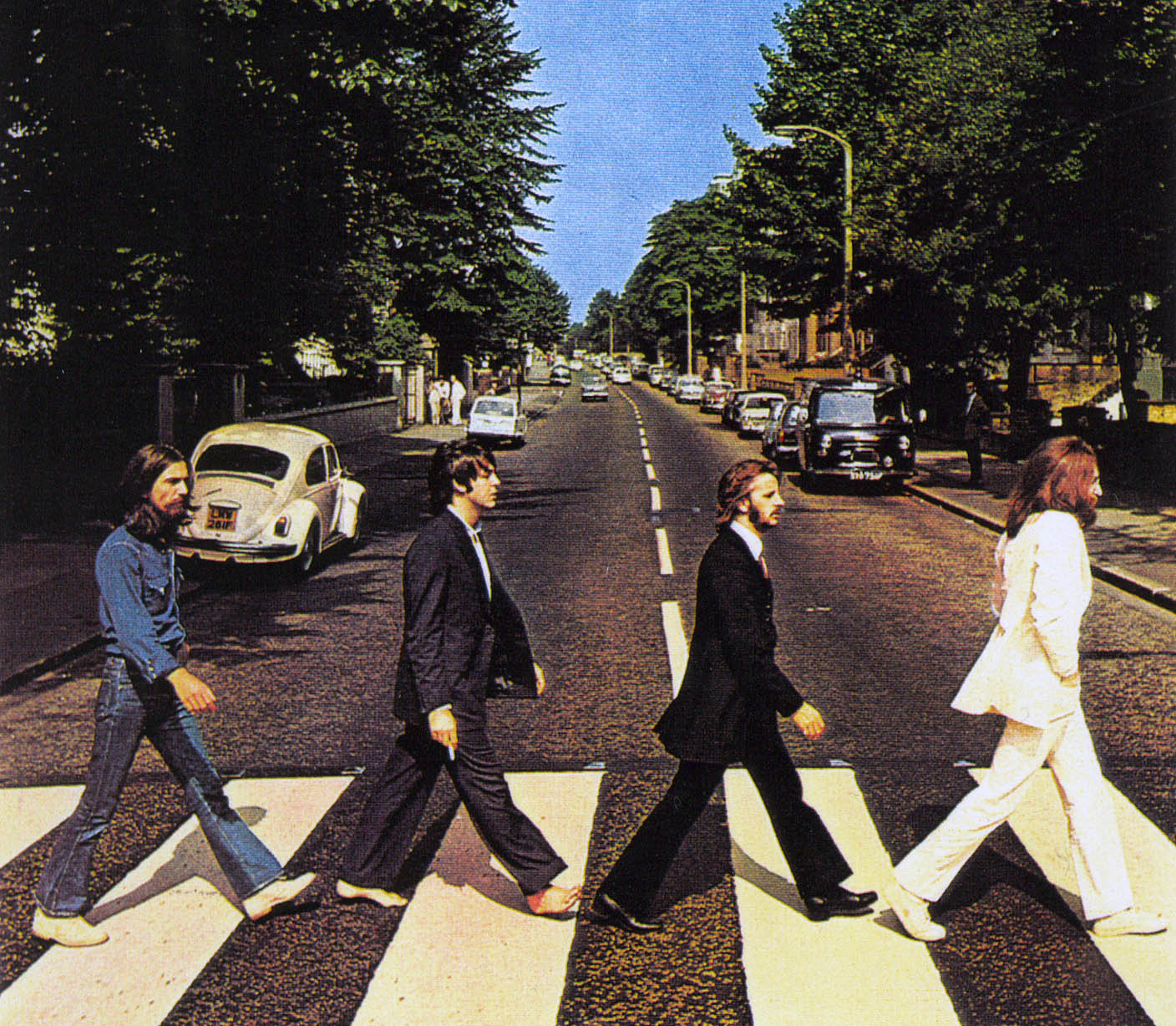
It’s one of the most famous images in pop culture: the four members of the Beatles — John Lennon, Ringo Starr, Paul McCartney and George Harrison — striding single-file over a zebra-stripe crossing on Abbey Road, near EMI Studios in St. John’s Wood, London.
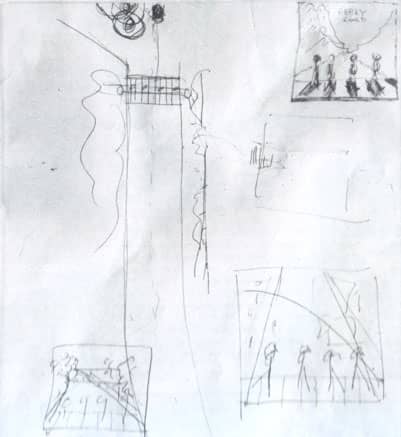
The photograph was taken on the late morning of August 8, 1969 for the cover of the Beatles’ last-recorded album, Abbey Road. The idea was McCartney’s. He made a sketch and handed it to Iain Macmillan, a freelance photographer who was chosen for the shoot by his friends Lennon and Yoko Ono.
Macmillan had only ten minutes to capture the image. A policeman stopped traffic while the photographer set up a ladder in the middle of the road and framed the image in a Hasselblad camera. The Beatles were all dressed in suits by Savile Row tailor Tommy Nutter — except Harrison, who wore denim. It was a hot summer day. Midway through the shoot, McCartney kicked off his sandals and walked barefoot. Macmillan took a total of only six photos as the musicians walked back and forth over the stripes. The fifth shot was the one.
Since then, the crossing on Abbey Road has become a pilgrimage site for music fans from all over the world. Every day, motorists idle their engines for a moment while tourists reenact the Beatles’ crossing. It’s a special place, and filmmaker Chris Purcell captures the sense of meaning it has for people in his thoughtful 2012 documentary, Why Don’t We Do It In the Road? The five-minute film, narrated by poet Roger McGough, won the 2012 “Best Documentary“award at the UK Film Festival and the “Best Super Short” award at the NYC Independent Film Festival. When you’ve finished watching the film, you can take a live look at the crosswalk on the 24-hour Abbey Road Crossing Webcam.
via That Eric Alper
Related Content:
Chaos & Creation at Abbey Road: Paul McCartney Revisits The Beatles’ Fabled Recording Studio
John, Paul and George Perform Dueling Guitar Solos on The Beatles’ Farewell Song (1969)
Bob Egan, Detective Extraordinaire, Finds the Real Locations of Iconic Album Covers
Read More...Mark Twain Drafts the Ultimate Letter of Complaint (1905)

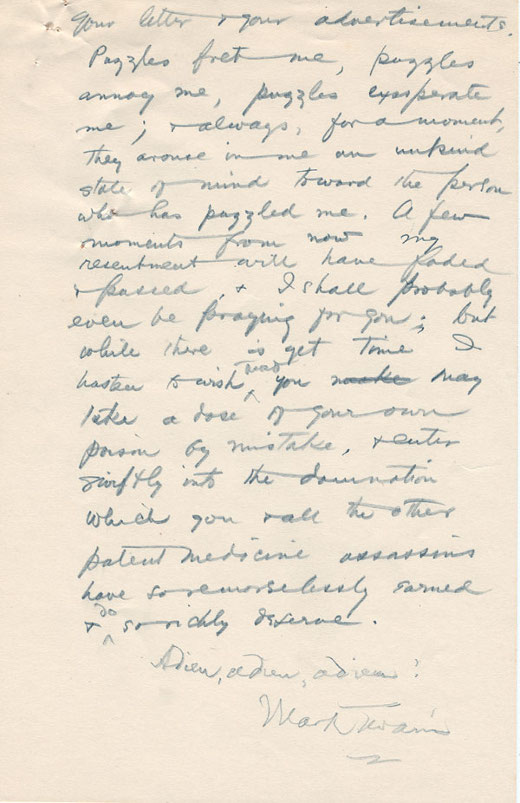
Click above for a larger version of page one and click here to see page two.
I recently made the mistake of crafting a letter of complaint that sounded much more temperate than I felt. On the advice of my husband, I deleted anything smacking of emotion, limiting my grievances to incontrovertible fact. A month later and I am still waiting for a reply.
Wish that I had let it all hang out, as Mark Twain did in the above 1905 letter to J. H. Todd, a snake oil salesman whose “Elixir of Life” was alleged to cure even the most terminal of medical conditions. How satisfying it would have been to indulge in phrases like “idiot of the 33rd degree” and “scion of an ancestral procession of idiots stretching back to the Missing Link”!
Having answered phones in customer service, I can attest that there are times when such phrases are misdirected. This was not one of them. Subject yourself to a thorough reading of the Elixir’s claims (a typography challenge on order of a Dr. Bronner’s label) and you will share the author’s outrage.
Charlatans could be dealt with lightly in literature—witness Huckleberry Finn’s self-proclaimed Duke—but having lost children to two of the diseases Todd’s potion purported to cure, Twain refused to let Todd off the hook in real life. His “unkind state of mind” is as bracing as it is warranted.
Though I doubt he got a reply either.
Transcription:
Nov. 20. 1905
J. H. Todd
1212 Webster St.
San Francisco, Cal.
Dear Sir,
Your letter is an insoluble puzzle to me. The handwriting is good and exhibits considerable character, and there are even traces of intelligence in what you say, yet the letter and the accompanying advertisements profess to be the work of the same hand. The person who wrote the advertisements is without doubt the most ignorant person now alive on the planet; also without doubt he is an idiot, an idiot of the 33rd degree, and scion of an ancestral procession of idiots stretching back to the Missing Link. It puzzles me to make out how the same hand could have constructed your letter and your advertisements. Puzzles fret me, puzzles annoy me, puzzles exasperate me; and always, for a moment, they arouse in me an unkind state of mind toward the person who has puzzled me. A few moments from now my resentment will have faded and passed and I shall probably even be praying for you; but while there is yet time I hasten to wish that you may take a dose of your own poison by mistake, and enter swiftly into the damnation which you and all other patent medicine assassins have so remorselessly earned and do so richly deserve.
Adieu, adieu, adieu!
Mark Twain
via Letters of Note
Related Content:
Mark Twain Wrote the First Book Ever Written With a Typewriter
Mark Twain Shirtless in 1883 Photo
Mark Twain Captured on Film by Thomas Edison in 1909. It’s the Only Known Footage of the Author.
Ayun Halliday suspects Mummy Powder is not an effective treatment for epilepsy. Follow her @AyunHalliday
Read More...Stevie Ray Vaughan’s Version of “Little Wing” Played on Traditional Korean Instrument, the Gayageum
Earlier this year, we showed you Luna Lee rocking out a version of Jimi Hendrix’s 1968 song “Voodoo Chile” on the traditional Korean stringed instrument called the Gayageum. Now she’s back with an Asian-inflected rendition of “Little Wing,” a song originally written by Hendrix, but then later covered in a 1991 Grammy-winning version by the late, great bluesman Stevie Ray Vaughan. On her YouTube page, Lee tells us that it’s Vaughan’s version that she’s basing her charming production on.
Related Content:
Watch Jimi Hendrix’s ‘Voodoo Chile’ Performed on a Gayageum, a Traditional Korean Instrument
Pakistani Musicians Play Amazing Version of Dave Brubeck’s Jazz Classic, “Take Five”
Read More...The Genius of Albrecht Dürer Revealed in Four Self-Portraits
Age 13:
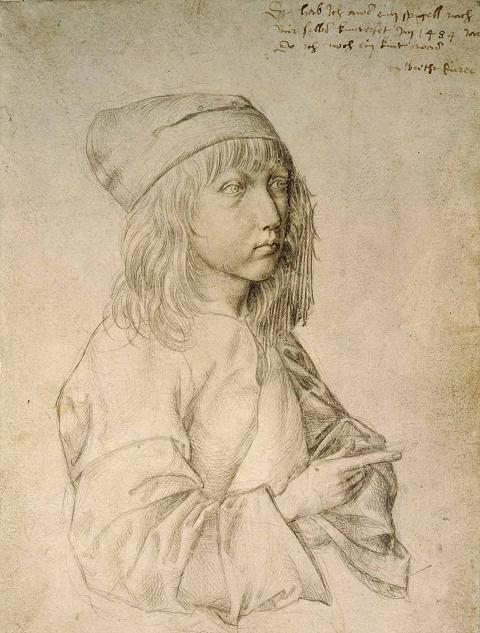
The German artist Albrecht Dürer (1471–1528) was one of the greatest figures of the Northern Renaissance. As a draughtsman and painter, he rivaled his elder contemporary Leonardo Da Vinci, and his masterful woodcuts and engravings of mythical and allegorical scenes made him famous across Europe.
In the first half of his life, Dürer made a series of exquisite self-portraits. The earliest (above) was made in 1484, when the artist was a precocious boy of 13. It was drawn in silverpoint. Sometime later, he wrote in the upper right-hand corner: “This I have drawn from myself from the looking-glass, in the year 1484, when I was still a child — Albrecht Dürer.” The drawing, now in the collection of the Albertina museum in Vienna, was made at about the time Dürer became an apprentice goldsmith in his father’s jewelry shop in Nuremberg. Much to his father’s disappointment, he would leave the goldsmith shop about a year later to become an apprentice to the prominent Nuremberg artist and printmaker Michael Wolgemut. But the early experience of working with the tools in the goldsmith shop would prove invaluable to Dürer’s later work as an engraver.
Age 22:
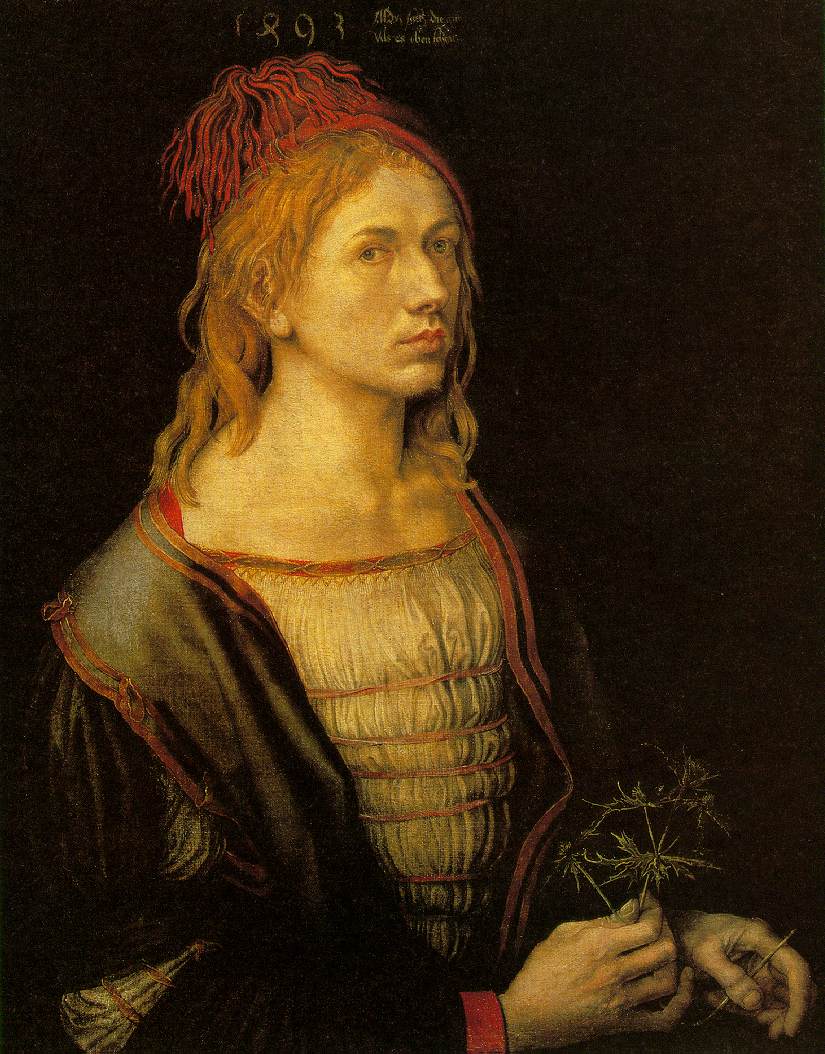
After Dürer finished his apprenticeship with Wolegmut at the age of 19, he followed the tradition of young artists and embarked on a guild tour of southern Germany to study the work of various artists and printmakers. He was probably in Strasbourg when he painted his “Portrait of the Artist holding a Thistle” (above) in 1493. He was 22 years old. The portrait was painted in oil on vellum, and was pasted on canvas several centuries later. Johann Wofgang von Goethe saw the painting in 1805 at a museum in Leipzig and was deeply impressed. In 1922 it was purchased by the Louvre.
“The face still has some of the childish features seen in his early drawing of a Self-Portrait,” says the Louvre Web site, “but the manly neck, the strong nose, and the vigorous hands are already those of an adult. Dürer, who was also an excellent engraver, composed his works in a very graphic fashion. The almost metallic fineness of detail, seen in the prickles of the thistle, also recalls his early training as a goldsmith.”
There are two competing theories about the meaning of the painting. Some scholars believe it was an engagement present for Agnes Frey, whom Dürer would marry the following year. “In fact,” says the Louvre, “the thistle held by the artist is called ‘Mannstreu’ in German, which also means ‘husband’s fidelity.’ This pledge of love would also explain the elegance of the costume. The main loophole in this hypothesis is that Dürer may still have been unaware of the marriage, which had been arranged by his father.” A rival theory is that the thistle represents the crown of thorns from Christ’s Passion. In any case, the artist’s inscription reads, “Things happen to me as it is written on high.”
Age 26:
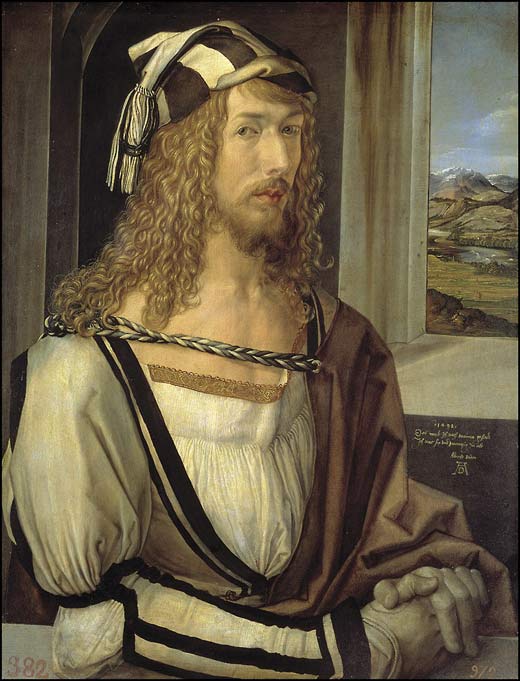
The second of Dürer’s three painted self-portraits was made in 1498, when he was 26 years old and entering his mature period as a master artist. Dürer had made his first of two visits to northern Italy a few years earlier to study Italian art and mathematics. While there, he was impressed and gratified by the elevated social status granted to great artists. In Germany he had been looked down upon as a lowly craftsman. “How I shall freeze after this sun!” Dürer wrote home to his friend Willibald Pirckheimer from Italy. “Here I am a gentleman, at home only a parasite.” Upon his return to Nuremberg, Dürer asserted his new sense of social position. In the portrait above he depicts himself as something of a dandy, with flamboyant dress and a haughty bearing. The painting was made in oil on a wood panel, and now resides in the Museo del Prado in Madrid.
Age 28:
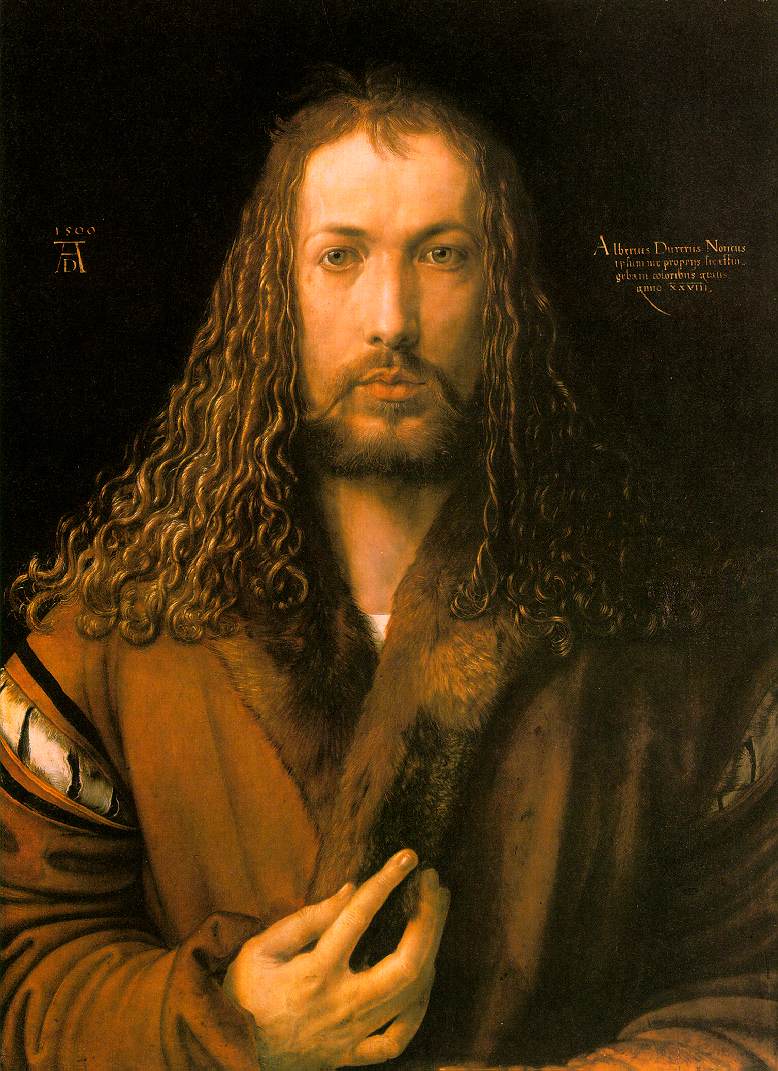
The Christ-like self-portrait above was painted in 1500, shortly before Dürer’s 29th birthday. The painting was made in oil on a wooden panel, and is now in the collection of the Alte Pinakothek in Munich. Unlike his earlier self-portraits, which were composed in the customary three-quarters view, Dürer’s self-portrait of 1500 depicts the artist faced squarely toward the viewer — a pose usually reserved at that time for images of Christ. His hand, touching the fur collar of his coat, brings to mind the gestures of blessing in religious icons. The highly symmetric composition draws attention to the eyes, which gaze directly at the viewer. The artist’s monogram, “AD,” and the Latin inscription — “I, Albrecht Dürer of Nuremberg, portrayed myself in everlasting colors aged twenty-eight years” — are placed at eye-level to strengthen the effect. The year “1500” is written directly above the monogram, giving the “AD” a second meaning as Anno Domini, which further reinforces the connection between Dürer and Christ. The art historian Joseph Koerner has suggested that the entire composition, from the triangular outline of the frontal likeness to the curve of Dürer’s fingers, echoes the overarching “A” and nestled “D” of the artist’s monogram. “Nothing we see in a Dürer is not Dürer’s,” writes Koerner, “monogram or not.”
Read More...The Relativity Series Features 24 Free Plays About Great Scientists and Scientific Endeavors

I grew up listening to radio plays, keeping in high rotation vintage broadcasts of shows like Suspense, Amos ‘n Andy, and Dragnet. These stoked in me a fascination with the medium of radio, and they also taught me a thing or two about life in early 20th-century America — mostly lessons, by way of the commercials, about its various consumer products (usually soaps). With the modern internet, kids today can not only listen to their fill of old-time radio programs essentially without effort — no bootleg cassette tapes for them, like I had to use — but easily find newer, more innovative, and I daresay more interesting audio productions as well. Case in point: the Los Angeles Theatre Works’ Relativity Series, offering science-themed plays you can listen to free online, featuring performances by well-known actors like Alfred Molina, Jason Ritter, and Ed Asner.
But don’t mistake any of the Relativity Series’ 24 currently available productions as straightforwardly “educational.” Knowing that no listener, man, woman, or child, wants a simple physics or biology lesson tarted up with a thin scrim of drama, the producers have instead recorded new versions of full-fledged works for the stage that happen to have scientific themes or involve events and players from the history of science. How it delighted me to find, for instance, Tom Stoppard’s Arcadia in the Relativity Series. Stoppard, perhaps the most intellectually omnivorous writer alive, became a fascination of mine around the same time I delved into old-time radio, and Arcadia remains the finest play dealing with chaos theory to take place on an English country estate in two centuries at once. Other productions deal with the lives of scientists like Alan Turing and Richard Feynman as well as events like the Scopes Monkey Trial and the development of the atomic bomb. Above, you can listen to a unique performance where members of the Star Trek cast recreate Orson Welles’ dramatic 1938 “War of the Worlds” broadcast.
You can access all 24 plays in the Relativity Series here.
via Metafliter
Related Content:
Orson Welles Vintage Radio: The War of the Worlds That Petrified a Nation
Werner Herzog and Cormac McCarthy Talk Science and Culture
Ira Glass on the Art and Craft of Telling Great Radio Stories
Neil deGrasse Tyson’s StarTalk Radio Show Podcast Tackles the History of Video Games
Colin Marshall hosts and produces Notebook on Cities and Culture and writes essays on literature, film, cities, Asia, and aesthetics. He’s at work on a book about Los Angeles, A Los Angeles Primer. Follow him on Twitter at @colinmarshall.
Read More...Support Us
We're hoping to rely on loyal readers, rather than erratic ads. Please click the Donate button and support Open Culture. You can use Paypal, Venmo, Patreon, even Crypto! We thank you!

About Us

Open Culture scours the web for the best educational media. We find the free courses and audio books you need, the language lessons & educational videos you want, and plenty of enlightenment in between.
Advertise With Us

FREE UPDATES!
GET OUR DAILY EMAIL
Get the best cultural and educational resources on the web curated for you in a daily email. We never spam. Unsubscribe at any time.
FOLLOW ON SOCIAL MEDIA

Open Culture editor Dan Colman scours the web for the best educational media. He finds the free courses and audio books you need, the language lessons & movies you want, and plenty of enlightenment in between.
Advertise With Us