Cutting-Edge Technology Reconstructs the Battle of Gettysburg 150 Years Later
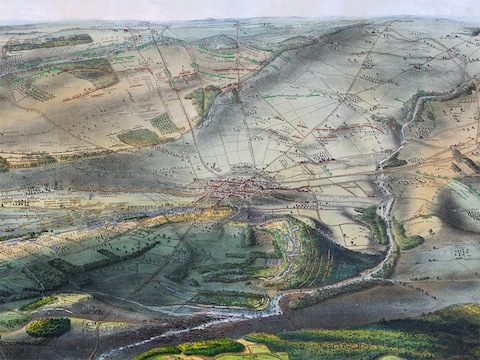
Today, as the U.S. celebrates the “nation’s birthday,” we also round the corner of the 150th anniversary of Gettysburg, the bloodiest and arguably most decisive battle of an internal struggle that never ceases to haunt the national psyche. With over 50,000 Union and Confederate soldiers killed, injured, gone missing, or captured during the days of July 1–3, 1863, historians continue to pore over the most minute details of the battle strategies of Generals Lee and Meade. Today’s digital imaging and satellite technology means that our views of the action are in many ways far superior to anything commanders on the field could have hoped for.
Since 2000, the National Park Service has used military engineering techniques to restore the historic battlefield to something resembling its 1863 state, and, in the past few years, cartographers and researchers Anne Kelly Knowles, Dan Miller, Alex Tait, and Allen Carroll have analyzed new and old maps of the Pennsylvania terrain in and around Gettysburg to get a renewed appreciation for what the generals could and could not see during the conflict. Confederate officers had their views obstructed not only by limited mapping technology and relative field positions, but also by their own communication failures. As Knowles points out at the Smithsonian’s website:
We know that Confederate general Robert E. Lee was virtually blind at Gettysburg, as his formerly brilliant cavalry leader J.E.B. Stuart failed to inform him of Federal positions, and Confederate scouts’ reconnaissance was poor. The Confederates’ field positions, generally on lower ground than Yankee positions, further put Lee at a disadvantage. A striking contrast in visual perception came when Union Gen. Gouvernour K. Warren spotted Confederate troops from Little Round Top and called in reinforcements just in time to save the Federal line.
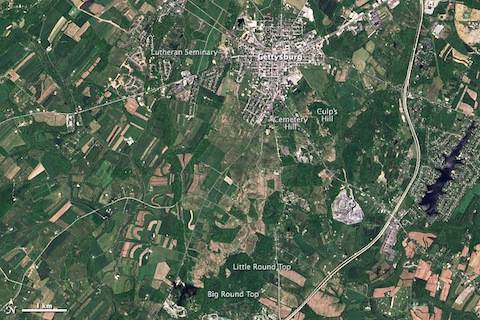
Using so-called GIS (Geographic Information Systems), Knowles and her team are able to show what was hidden from the solders’ views during such key moments as Pickett’s Charge. The team used several period maps, like the 1863 “isometrical drawing” at the top, in their reconstructions. They also used satellite images from NASA, including the May 2013 picture below from the Operational Land Imager (OLI). You can see Knowles and her team’s painstaking geographical and topographic reconstructions of the country’s costliest rift at the Smithsonian Magazine’s site.
Related Content:
Hiroshima Atomic Bombing Remembered with Google Earth
The Gettysburg Address Animated
Josh Jones is a writer and musician based in Washington, DC. Follow him at @jdmagness
Read More...Teacher Wears Same Groovy Outfit In Yearbook Photo 40 Years Straight
In 1973, Dale Irby, a teacher at Prestonwood Elementary in Dallas, decided to wear a polyester shirt and coffee-colored sweater for school-picture day. Without realizing it, he wore the same outfit the following year. According to the Dallas News, Dale’s wife noticed the emerging trend and dared him to do it a third year. And then they figured, ‘Why stop?’ The tradition continued 40 years in total, until Dale and his outfit retired this year.
via Mashable
Read More...Great Moments in Computer History: Douglas Engelbart Presents “The Mother of All Demos” (1968)
Douglas Engelbart, a technology pioneer best known for his invention of the computer mouse, died in Atherton, California on Wednesday. He was 88 years old. Engelbart began working at the Stanford Research Institute (SRI International) in 1957, and there, according to John Markoff’s obituary in The New York Times, he began trying to make the computer screen “a workstation that would organize all the information and communications for a given project.” It’s a concept we take for granted today. But it was considered far-fetched back then. A decade later, Engelbart brought us all into the world of interactive computing and graphic interfaces when, in 1968, he presented what’s now called “The Mother of All Demos.” You can watch it in its entirety above. Stanford’s MouseSite sets the stage for what you’re going to see:
On December 9, 1968, Douglas C. Engelbart and the group of 17 researchers working with him in the Augmentation Research Center at Stanford Research Institute in Menlo Park, CA, presented a 90-minute live public demonstration of the online system, NLS, they had been working on since 1962. The public presentation was a session of the Fall Joint Computer Conference held at the Convention Center in San Francisco, and it was attended by about 1,000 computer professionals. This was the public debut of the computer mouse. But the mouse was only one of many innovations demonstrated that day, including hypertext, object addressing and dynamic file linking, as well as shared-screen collaboration involving two persons at different sites communicating over a network with audio and video interface.
If you want to get right to the action, you can watch the section where Engelbart demos the mouse here, plus see pictures of his original mouse here. Through the links below, you can relive other great moments in computing history.
Related Content:
Pong, 1969: A Milestone in Video Game History
The First 3D Digital Film Created by Ed Catmull, Co-Founder of Pixar (1970)
The First Pizza Ordered by Computer, 1974
Steve Jobs Demos the First Macintosh in 1984
Read More...Watch Franz Kafka, the Wonderful Animated Film by Piotr Dumala
Let’s sneak in a quick birthday celebration before the 4th. Franz Kafka was born on this day (July 3), a good 130 years ago. To commemorate the occasion, we’re presenting Piotr Dumala’s 1992 short animated film called, quite simply, Franz Kafka. Dumala’s animation technique grew out of his training as a sculptor, when he started experimenting with scratching images into painted plaster. Later he developed a more full blown method known as “destructive animation,” which is on full display in the film. You can learn more about Dumala and his approach here. The 16-minute film is based on The Diaries of Franz Kafka, and now appears in our collection of 525 Free Movies Online. Also on our site, you can view Dumala’s adaptation of Dostoevsky’s Crime and Punishment.
Note: This film/post originally appeared on our site in 2010. Still enamored by Dumala’s work, we thought it was time to bring it back.
If you would like to support the mission of Open Culture, consider making a donation to our site. It’s hard to rely 100% on ads, and your contributions will help us continue providing the best free cultural and educational materials to learners everywhere. You can contribute through PayPal, Patreon, and Venmo (@openculture). Thanks!
Related Content:
Kafka’s Nightmare Tale, ‘A Country Doctor,’ Told in Award-Winning Japanese Animation
Vladimir Nabokov (Channelled by Christopher Plummer) Teaches Kafka at Cornell
Nabokov Makes Editorial Improvements to Kafka’s The Metamorphosis
Find works by Kafka in our Free eBooks and Free Audio Books collections
Read More...Hearsay of the Soul: A 5‑Channel Video Installation by Celebrated German Filmmaker Werner Herzog
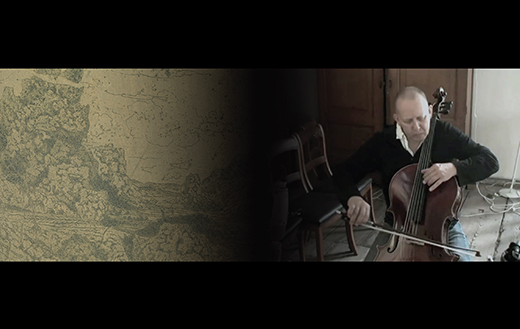
David Lynch has embraced visual art and the possibilities of the new music industry. With Pina, Wim Wenders made one of the most acclaimed works in the latest, superhero-filled wave of 3D movies. Jean-Luc Godard… well, I couldn’t quite tell you what he has got up to with his latest picture, but it sounds conceptually and technologically forward-looking indeed. Clearly, some of the creators best suited for the new cinematic reality in which we find ourselves also happen to have already logged decades and decades in the craft. Werner Herzog, director of Cave of Forgotten Dreams, another one of the few recent 3D movies you still hear people talking about, has executed his latest project not in the theater, but in a museum, and not as a traditional film, but as a five-channel video installation.
Hearsay of the Soul will run at the Getty Center, a particularly well-known museum overlooking Los Angeles — Herzog’s city of residence and my own — from July 23 to January 19. In it, Herzog combines landscape etchings by Dutch Golden Age master printmaker and Rembrandt-influencer Hercules Segers with music from two of Segers’ modern countrymen, cellist Ernst Reijseger and organist Harmen Fraanje. (Herzog aficionados will, in fact, recognize Reijseger’s work from the score of Cave of Forgotten Dreams.) “They are like flashlights held in our uncertain hands,” Herzzog says of Segers’ images, “a frightened light that opens breaches into the recesses of a place that seems somewhat known to us: our selves. We morph with these images. Hercules Segers’s images and my films do not speak to each other, but for a brief moment, I hope, they might dance with each other.” You can glimpse a few of the installation’s images and hear a few of its sounds just above.
Related Content:
Werner Herzog and Cormac McCarthy Talk Science and Culture
Errol Morris and Werner Herzog in Conversation
Portrait Werner Herzog: The Director’s Autobiographical Short Film from 1986
Watch Werner Herzog Eats His Shoe by Les Blank, Director of Quiet, Quirky Films
Colin Marshall hosts and produces Notebook on Cities and Culture and writes essays on literature, film, cities, Asia, and aesthetics. He’s at work on a book about Los Angeles, A Los Angeles Primer. Follow him on Twitter at @colinmarshall.
Read More...A Song of Our Warming Planet: Cellist Turns 130 Years of Climate Change Data into Music
If you use data graphics and technical illustrations to explain climate change to most Americans, their eyes will glaze over. So University of Minnesota undergrad Daniel Crawford is trying a different approach. He’s using music to communicate the latest in climate science. Drawing on a method called “data sonification” that converts global temperature records into a series of musical notes, Crawford and his trusty cello have created “A Song of Our Warming Planet.” Here’s some of the technical backstory you need to know:
Crawford based his composition on surface temperature data from NASA’s Goddard Institute of Space Studies. The temperature data were mapped over a range of three octaves, with the coldest year on record (–0.47 °C in 1909) set to the lowest note on the cello (open C). Each ascending halftone is equal to roughly 0.03°C of planetary warming.
In Crawford’s composition, each note represents a year, ordered from 1880 to 2012. The pitch reflects the average temperature of the planet relative to the 1951–80 base line. Low notes represent relatively cool years, while high notes signify relatively warm ones.
Crawford has released the score and sound files under a Creative Commons license.
Download the sheet music (PDF) | Download the audio file (MP3) | Play the audio file only | Code to embed the audio file
To delve deeper into what’s happening to our climate, we suggest you spend time with Global Warming: a free course from the University of Chicago.
via i09
Follow us on Facebook, Twitter and Google Plus and share intelligent media with your friends! They’ll thank you for it.
Read More...
Learn 48 Languages for Free Online: A Big Update to Our Master List
 Right in time for your travels, we’ve just completed a big update to our rich collection of Free Foreign Language Lessons. Featuring free audio and video lessons, this handy resource will help you learn to speak Spanish, French, German, English, Chinese, Arabic, Italian, and Russian, plus 36 other languages. And it’s all for free, which is a lot less than what Rosetta Stone and other vendors will charge you. Not bad, especially considering that some of the lessons come from venerable institutions like Yale, Cambridge, Carnegie Mellon, Emory, the BBC, the US Peace Corps, the Foreign Service Institute, and more.
The complete list of Free Foreign Language Lessons, includes the following languages: Arabic, Bulgarian, Cambodian, Catalan, Chinese (Mandarin & Cantonese), Czech, Danish, Dutch, English, Finnish, French, Gaelic, German, Greek, Hebrew, Hindi, Hungarian, Icelandic, Indonesian, Irish, Italian, Japanese, Korean, Lao, Latin, Lithuanian, Luxembourgish, Maori, Norwegian, Polish, Portuguese, Romanian, Russian, Serbo-Croatian, Sign Language, Spanish, Swahili, Tagalog, Thai, Turkish, Ukrainian, Urdu, Vietnamese, Welsh and Yiddish.
If we’re missing any great resources, please tell us in the comments section below.
Related Content:
Free Online Courses from Top Universities
Free Kids Educational Resources: Video Lessons, Apps, Books, Websites & More
Free MOOCs from Great Universities (Many Offering Certificates)
Free Audio Books: Download Great Books for Free
Free eBooks: Download to Kindle, iPad/iPhone & Nook
Read More...The Earliest Footage of Elvis Presley, Buddy Holly and Johnny Cash (1955)
Here are some rare home movies from the earliest days of rock and roll. Although accounts differ, this is apparently the oldest footage of four legendary performers: Elvis Presley, Buddy Holly, Johnny Cash and Carl Perkins. The film was shot in 1955 with an 8mm camera in Holly’s hometown of Lubbock, Texas, by his friend Ben Hall, a local disc jockey and musician who would later write the song “Blue Days, Black Nights” from Holly’s That’ll Be The Day album. The silent footage is widely reported to have been taken at one of Presley’s April 29, 1955 shows at the Cotton Club in Lubbock. But that may not be entirely true, because Holly, Cash and Perkins were not on the advertised bill for those shows.
Presley performed in Lubbock several times that year. He first met Holly at a show at the Fair Park Coliseum on February 13, when Holly and his friend Bob Montgomery appeared at the bottom of the bill as the country duo Buddy & Bob. Holly was 18 years old and still a senior in high school. The charismatic Presley, though still unknown in most parts of the country in 1955, was already treated as a star in the South, where he was mobbed by fans.
According to the Scotty Moore Web site, the footage of Presley was taken on April 29 and the others were filmed later in the year. Presley is shown onstage and off with his original band, the Blue Moon Boys, with Scotty Moore on guitar and Bill Black on bass. Perkins appears in an orange jacket, Cash is wearing a white string tie over a black shirt, and Holly, who turned 19 around that time, is easily recognizable in his trademark eyeglasses.
Related Content:
Buddy Holly at Age 12: His First Recording
Library Card Signed by 13-Year-Old Elvis Presley, the Earliest Known Signature of the King
Jimmy Page, 13, Plays Guitar on BBC Talent Show (1957)
Read More...Deconstructing The Master Track of The Beatles’ “Sgt. Pepper’s Lonely Hearts Club Band”
There are several versions of the story of how The Beatles’ most highly-acclaimed album Sgt. Pepper’s Lonely Hearts Club came to be. In one, John gives the full credit to Paul, who, inspired by “America and the whole West Coast, long-named group thing”—of bands like Quicksilver Messenger Service and Big Brother and the Holding Company—came up with the concept. According to Lennon, Paul “was trying to put some distance between the Beatles and the public”:
And so there was this identity of Sgt. Pepper…. Sgt. Pepper is called the first concept album, but it doesn’t go anywhere. All my contributions to the album have absolutely nothing to do with the idea of Sgt. Pepper and his band; but it works ‘cause we said it worked, and that’s how the album appeared. But it was not as put together as it sounds, except for Sgt. Pepper introducing Billy Shears and the so-called reprise. Every other song could have been on any other album.
Lennon’s typical mix of grandiosity and self-deprecation probably sells the album short in any fan’s estimation (certainly in mine), but I believe that Paul cooked up the goofy personas and marching-band look. It is, after all, as Lennon says, “his way of working.” Paul himself has said of Sgt. Pepper’s: “I thought it would be nice to lose our identities, to submerge ourselves in the persona of a fake group. We could make up all the culture around it and collect all our heroes in one place.”
Despite the complex of personalities (both real and imagined) in the writing and recording of what many consider the band’s masterpiece, the recording process was incredibly simple, at least by today’s standards. Today’s digital recording enables bands to record an unlimited number of tracks—either live or, more often, in layers upon layers of overdubs—leaving mixing engineers with sometimes hundreds of individual tracks to integrate into a coherent whole. In 1967, during the age of tape and the tracking of Sgt. Pepper’s, engineers were limited to four tracks at a time, which they could then “bounce,” or merge together, to free up room for additional recording.
This is how the title song “Sgt. Pepper’s Lonely Heart’s Club Band” was made, and you can hear the four final master tracks “deconstructed” above. First, in green, you’ll hear the original rhythm tracks, with drums, bass, and two guitars, all recorded on two tracks. The red line represents tracks 3 and 4—all of the vocals. The blue portion is the horns and lead guitar, and yellow is the audience sounds. You’ll hear each track individually, then hear them all come together, so to speak. The description below of the recording process comes from that inerrant (so I’ve heard) source, The Beatles Bible:
The song was recorded over four days. On 1 February 1967 The Beatles taped nine takes of the rhythm track, though only the first and last of these were complete. They recorded drums, bass and two guitars — the latter played by McCartney and Harrison.
The next day McCartney recorded his lead vocals, and he, Lennon and Harrison taped their harmonies. The song was then left for over a month, until the French horns were overdubbed on 3 March. McCartney also recorded a lead guitar solo, leaving the song almost complete.
On 6 March they added the sounds of the imaginary audience and the noise of an orchestra tuning up, a combination of crowd noise from a 1961 recording of the comedy show Beyond The Fringe and out-takes from the 10 February orchestral overdub session for A Day In The Life.
For the segue into With A Little Help From My Friends, meanwhile, they inserted screams of Beatlemaniacs from the recordings of The Beatles live at the Hollywood Bowl.
Related Content:
The Beatles: Unplugged Collects Acoustic Demos of White Album Songs (1968)
Josh Jones is a writer and musician based in Washington, DC. Follow him at @jdmagness
Read More...Jump Start Your Creative Process with Brian Eno’s “Oblique Strategies” Deck of Cards (1975)
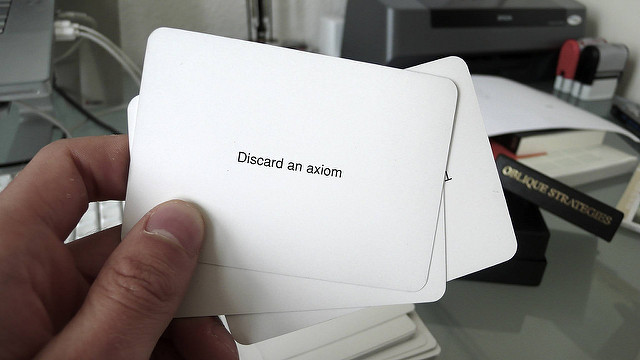
Image by Bastiaan Terhorst, via Flickr Commons
The likes of U2, Coldplay, and David Bowie can afford to hire producer, artist, and thinker Brian Eno to shake up their creative processes. You and I, alas, probably can’t. We can, however, afford to consult the Oblique Strategies, a deck of cards invented by Eno and painter Peter Schmidt in 1975. Each card offers, in its own oblique fashion, a strategy you can follow when you find yourself at an impasse in your own work, be it music, painting, or any form at all: “Honor thy error as a hidden intention.” “State the problem in words as clearly as possible.” “Remember those quiet evenings.” “Once the search is in progress, something will be found.” “Work at a different speed.” “Look closely at the most embarrassing details and amplify them.”
“The Oblique Strategies evolved from me being in a number of working situations when panic, particularly in studios, tended to make me quickly forget that there were others ways of working,” said Eno in a 1980 radio interview, “and that there were tangential ways of attacking problems that were in many senses more interesting than the direct head-on approach.”
Should you feel the need for just such a break with the obvious approach, you can track down one of the official physical editions of the Oblique Strategies deck. Or you can consult one of its many virtual versions available on the internet. Eno talks about how the deck of cards came into being. Vintage sets can be found on Amazon here.
Related Content:
Brian Eno on Creating Music and Art As Imaginary Landscapes (1989)
Watch Brian Eno’s “Video Paintings,” Where 1980s TV Technology Meets Visual Art
Day of Light: A Crowdsourced Film by Multimedia Genius Brian Eno
Colin Marshall hosts and produces Notebook on Cities and Culture and writes essays on literature, film, cities, Asia, and aesthetics. He’s at work on a book about Los Angeles, A Los Angeles Primer. Follow him on Twitter at @colinmarshall.
Read More...Support Us
We're hoping to rely on loyal readers, rather than erratic ads. Please click the Donate button and support Open Culture. You can use Paypal, Venmo, Patreon, even Crypto! We thank you!

About Us

Open Culture scours the web for the best educational media. We find the free courses and audio books you need, the language lessons & educational videos you want, and plenty of enlightenment in between.
Advertise With Us

FREE UPDATES!
GET OUR DAILY EMAIL
Get the best cultural and educational resources on the web curated for you in a daily email. We never spam. Unsubscribe at any time.
FOLLOW ON SOCIAL MEDIA

Open Culture editor Dan Colman scours the web for the best educational media. He finds the free courses and audio books you need, the language lessons & movies you want, and plenty of enlightenment in between.
Advertise With Us


