New Yorker Cartoon Editor Bob Mankoff Reveals the Secret of a Successful New Yorker Cartoon
A friend of mine rails against the New Yorker’s weekly cartoon caption contest, insisting that while the reader-submitted entries are universally bad, the winner is always the weakest of the lot.
I disagree, agog at people’s cleverness. Any line I come up with feels too obvious or too obscure. Unlike my friend, I never feel I could do better.
Cartoon editor Bob Mankoff’s recent TED Talk offers some key insights into what the magazine is looking for (incongruity, dispositional humor, cognitive mash ups), as well as what it’s not interested in (gross-out jokes, mild child-centered cannibalism) He also cites former contributor and author of my father’s favorite New Yorker cartoon, E.B. White on the futility of analyzing humor.
Frequent contributor Matthew Diffee’s short satirical film Being Bob suggests Mankoff editorial selections owe much to gut response (and a jerking knee). Such intuition is hard won. Mankoff gleefully alludes to the 2000 rejection letters he himself received between 1974 and 1977, following an unceremonious dismissal from psychology school. Then, finally, he got his first acceptance.
That acceptance letter is something to see.
Ayun Halliday used Charles Barsotti’s New Yorker cartoon of a dancing bird as her highschool yearbook’s senior saying. Follow her @AyunHalliday
Related Content:
The New Yorker’s Fiction Podcast: Where Great Writers Read Stories by Great Writers
Improv with New Yorker Cartoonists
Einstein’s Relativity: An Animated New Yorker Cartoon
Read More...How to Keep Following Open Culture After the Demise of Google Reader
 For years, many readers have followed our daily posts through Google Reader. Well, after today, Google Reader will be no more. It’s getting powered down. Before that happens, we want to tell you how to keep following the posts that flow through our RSS feed. Your best bet is Feedly. Feedly has a nice customizable interface. And it gives you the ability to import everything from Google Reader in one quick click. You can find tips for migrating to Feedly right here. But, if Feedly isn’t your cup of tea, Lifehacker has a bunch of other options for you. Or, as others have, feel free to add your suggestions below.
Of course, you can also follow our posts via social media platforms. You can find us on Facebook, Twitter, and Google Plus. If you opt for Facebook, please note this: You mostly likely won’t see every post from Open Culture. But the odds of seeing our posts on Facebook will supposedly increase if you click “Like” on our posts when they do appear in your FB news feed.
If you’re a committed RSS fan, Feedly is probably your best bet. So please import your feeds today and start following us there tomorrow.
Just for the record, here is the address for our feed: http://www.openculture.com/rss
Read More...John Searle on Foucault and the Obscurantism in French Philosophy
It is sometimes noted–typically with admiration–that France is a place where a philosopher can still be a celebrity. It sounds laudable. But celebrity culture can be corrosive, both to the culture at large and to the celebrities themselves. So it’s worth asking: What price have French philosophy and its devotees (on the European continent and elsewhere) paid for the glamour?
Perhaps one casualty is clarity. The writings of the French postmodernist philosophers (and those inspired by them) are notoriously abstruse. In a scathing critique of theorist Judith Butler, an American who writes in the French poststructuralist style, philosopher Martha Nussbaum of the University of Chicago suggests that the abstruseness is calculated to inspire admiration:
Some precincts of the continental philosophical tradition, though surely not all of them, have an unfortunate tendency to regard the philosopher as a star who fascinates, and frequently by obscurity, rather than as an arguer among equals. When ideas are stated clearly, after all, they may be detached from their author: one can take them away and pursue them on one’s own. When they remain mysterious (indeed, when they are not quite asserted), one remains dependent on the originating authority. The thinker is heeded only for his or her turgid charisma.
On Friday we posted an excerpt from an interview in which linguist Noam Chomsky (something of a political celebrity himself) excoriates Jacques Derrida and Jacques Lacan, along with Lacan’s superstar disciple, Slovenian theorist Slavoj Žižek, for using intentionally obscure and inflated language to pull the wool over their admirers’ eyes and make trivial “theories” seem profound. He calls Lacan a “total charlatan.”
Lacan had a penchant for using trendy mathematical terms in curious ways. In a passage on castration anxiety, for example, he equates the phallus with the square root of minus one:
The erectile organ can be equated with the √-1, the symbol of the signification produced above, of the jouissance [ecstasy] it restores–by the coefficient of its statement–to the function of a missing signifier: (-1).
Chomsky’s criticism of Lacan and the others provoked a wide range of comments from our readers. Today we thought we would keep the conversation going with a fascinating audio clip (above) of philosopher John Searle of the University of California, Berkeley, describing how Michel Foucault and Pierre Bourdieu–two eminent French thinkers whose abilities Searle obviously respected–told him that if they wrote clearly they wouldn’t be taken seriously in France.
Searle begins by reciting Paul Grice’s four Maxims of Manner: be clear, be brief, be orderly, and avoid obscurity of expression. These are systematically violated in France, Searle says, partly due to the influence of German philosophy. Searle translates Foucault’s admission to him this way: “In France, you gotta have ten percent incomprehensible, otherwise people won’t think it’s deep–they won’t think you’re a profound thinker.”
Searle has been careful to separate Foucault from Derrida, with whom Searle had an unfriendly debate in the 1970s over Speech Act theory. “Foucault was often lumped with Derrida,” Searle says in a 2000 interview with Reason magazine. “That’s very unfair to Foucault. He was a different caliber of thinker altogether.” Elsewhere in the interview, Searle says:
With Derrida, you can hardly misread him, because he’s so obscure. Every time you say, “He says so and so,” he always says, “You misunderstood me.” But if you try to figure out the correct interpretation, then that’s not so easy. I once said this to Michel Foucault, who was more hostile to Derrida even than I am, and Foucault said that Derrida practiced the method of obscurantisme terroriste (terrorism of obscurantism). We were speaking in French. And I said, “What the hell do you mean by that?” And he said, “He writes so obscurely you can’t tell what he’s saying. That’s the obscurantism part. And then when you criticize him, he can always say, ‘You didn’t understand me; you’re an idiot.’ That’s the terrorism part.” And I like that. So I wrote an article about Derrida. I asked Michel if it was OK if I quoted that passage, and he said yes.
NOTE: For more on John Searle, including links to his full Berkeley lectures on the philosophy of mind, language and society, see our post, “Philosophy with John Searle: Three Free Courses.”
Related Content:
Michel Foucault: Free Lectures on Truth, Discourse & The Self
Clash of the Titans: Noam Chomsky & Michel Foucault Debate Human Nature & Power on Dutch TV, 1971
90 Free Philosophy Courses
Read More...Watch “The Secret Tournament” & “The Rematch,” Terry Gilliam’s Star-Studded Soccer Ads for Nike
We’ve never known footwear giant Nike to spare the advertising dollars, just as we’ve never known filmmaker Terry Gilliam to compromise his vision. Only natural, then, that the two would cross creative and financial paths. Shot in late 2001 and early 2002, the 12 Monkeys director’s pair of Nike spots, meant to coincide with the 2002 World Cup, brought together some of the era’s finest footballers for a characteristically grim, dystopian, but visually rich and smirkingly humorous tournament to end all tournaments. “Hidden from the world,” announces Nike’s original press release about the first commercial, “24 elite players hold a secret tournament, with eight teams, and only one rule… ‘First goal wins!’ ”
“Controlling the action is Eric Cantona,” the text continues, “who oversees every three-on-three match noir that takes place in a huge container ship docked in an unknown harbor. With Monsieur Cantona at the helm, you can be assured there will be no whining, no judgment calls, and no mercy.” The teams assembled include “Triple Espresso” (Francesco Totti, Hidetoshi Nakata, and Thierry Henry), “Equipo del Fuego” (Hernan Crespo, Claudio Lopez, and Gaizka Mendieta), and the “Funk Seoul Brothers” (Denílson de Oliveira Araújo, Ki Hyeon Seol, and Ronaldinho). You’ll see quite a lot of action between them on this broken-down futuristic prison of a pitch in the three minutes of “The Secret Tournament,” but things intensify further in “The Rematch” just above. You can find more behind-the-scenes material at Dreams: The Terry Gilliam Fanzine.
Related content:
Terry Gilliam’s Debut Animated Film, Storytime
A Very Terry Gilliam Christmas: Season’s Greetings, 1968 and 2011
Lost In La Mancha: Terry Gilliam and the “Curse of Quixote”
Terry Gilliam: The Difference Between Kubrick (Great Filmmaker) and Spielberg (Less So)
Colin Marshall hosts and produces Notebook on Cities and Culture and writes essays on literature, film, cities, Asia, and aesthetics. He’s at work on a book about Los Angeles, A Los Angeles Primer. Follow him on Twitter at @colinmarshall.
Read More...In “The Dictionary of Obscure Sorrows,” Artist John Koenig Names Feelings that Leave Us Speechless
It may be a misconception, it may be a cliché: I’m not a German speaker—but reading translator’s introductions to, say, Kant, Hegel or Goethe has convinced me that their language does a much better job than English at capturing those oddly specific twilight moods and compound feelings that so often escape definition. Then again, English absorbs, cannibalizes, appropriates, steals, and bastardizes words wherever it can find them, driving lexicographers and grammar purists mad.
Graphic designer and filmmaker John Koenig does all of these things in his “Dictionary of Obscure Sorrows,” a blog project in which he names emotions that otherwise leave us speechless. In his short video above, he illustrates one of his words, “Sonder,” or “the realization that each random passerby is living a life as vivid and complex as your own…”—something like the shock of sudden empathy that shakes us out of navel-gazing. It’s an emotion I’ve experienced, without knowing what to call it.
This being an “obscure sorrow,” there’s more to it than empathy—in Koenig’s poetic video, “sonder” relates to the infinite number of overlapping stories, in which each of us feels we are the hero, others supporting cast or extras. In a state of “sonder,” we suddenly occupy all of those roles at once, our screen time diminishing as others take the lead. After watching Koenig’s film, I’m thinking “sonder” is a portmanteau of “sublime” and “wonder.” It’s a mystical philosophy contained within a single made-up word.
Some other Koenig coinages: “Ruckkehrunruhe,” “nodus tollens,” “adronitis,” “rigor samsa”.…. I leave it to you to visit Koenig’s Dictionary and learn what these words mean. It’s an experience well worth your time.
Related Content:
The Atlas of True Names Restores Modern Cities to Their Middle Earth-ish Roots
The History of the English Language in Ten Animated Minutes
Oxford Scholars Name Top Ten Irritating Phrases
Josh Jones is a writer and musician based in Washington, DC. Follow him at @jdmagness
Read More...Revealed: The Visual Effects Behind The Great Gatsby
Several days ago, Chris Godfrey, the VFX supervisor on the latest film adaptation of The Great Gatsby, posted a remarkable “before and after” film on Vimeo. Running four minutes, the short compilation reveals the many sets and scenes created with computer generated images. It’s all pretty impressive from a technical point of view. No doubt. And yet this wizardry contributed to making what’s widely considered a mediocre film. In The New Yorker, film critic David Denby writes:
Luhrmann’s version is merely a frantic jumble. The picture is filled with an indiscriminate swirling motion, a thrashing impress of “style” (Art Deco turned to digitized glitz), thrown at us with whooshing camera sweeps and surges and rapid changes of perspective exaggerated by 3‑D.… Luhrmann’s vulgarity is designed to win over the young audience, and it suggests that he’s less a filmmaker than a music-video director with endless resources and a stunning absence of taste.
Sometimes, as they say, less is more.…
via Richard Brody
Related Content:
Seven Tips From F. Scott Fitzgerald on How to Write Fiction
F. Scott Fitzgerald in Drag (1916)
Read More...A Short, Animated Look at What’s Inside Your Average Cup of Coffee
What’s inside your average cupe of joe? Wired breaks it down for us. Let’s start with the obvious, water and caffeine. But did you know about the traces of 2‑ethylphenol, which otherwise doubles as a cockroach pheromone? Or how about dimethyl disulfide, which has industrial uses in oil refineries? And acetylmethylcarbinol? It gives the coffee its pleasant, buttery odor. Want to keep contemplating coffee? Check out the related resources below:
The History of Coffee and How It Transformed Our World
Everything You Wanted to Know About Coffee in Three Minutes
Read More...Noam Chomsky Slams Žižek and Lacan: Empty ‘Posturing’
Noam Chomsky’s well-known political views have tended to overshadow his groundbreaking work as a linguist and analytic philosopher. As a result, people sometimes assume that because Chomsky is a leftist, he would find common intellectual ground with the postmodernist philosophers of the European Left.
Big mistake.
In this brief excerpt from a December, 2012 interview with Veterans Unplugged, Chomsky is asked about the ideas of Slavoj Žižek, Jacques Lacan and Jacques Derrida. The M.I.T. scholar, who elsewhere has described some of those figures and their followers as “cults,” doesn’t mince words:
What you’re referring to is what’s called “theory.” And when I said I’m not interested in theory, what I meant is, I’m not interested in posturing–using fancy terms like polysyllables and pretending you have a theory when you have no theory whatsoever. So there’s no theory in any of this stuff, not in the sense of theory that anyone is familiar with in the sciences or any other serious field. Try to find in all of the work you mentioned some principles from which you can deduce conclusions, empirically testable propositions where it all goes beyond the level of something you can explain in five minutes to a twelve-year-old. See if you can find that when the fancy words are decoded. I can’t. So I’m not interested in that kind of posturing. Žižek is an extreme example of it. I don’t see anything to what he’s saying. Jacques Lacan I actually knew. I kind of liked him. We had meetings every once in awhile. But quite frankly I thought he was a total charlatan. He was just posturing for the television cameras in the way many Paris intellectuals do. Why this is influential, I haven’t the slightest idea. I don’t see anything there that should be influential.
via Leiter Reports
Related content:
John Searle on Foucault and the Obscurantism in French Philosophy
Jacques Lacan Talks About Psychoanalysis with Panache (1973)
Read More...Two Drawings by Jorge Luis Borges Illustrate the Author’s Obsessions
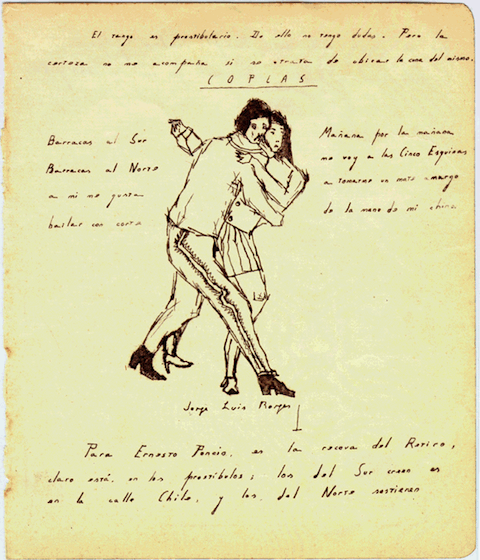
Jorge Luis Borges had many fascinations—detective novels, gauchos, libraries, and labyrinths. Two prominent figures that occupied his mind, the tango and mythical monsters, appear in drawings Borges made in his manuscripts. Of the tango, Borges did much to spread the idea that the sensual Argentine dance originated in brothels. In his drawing above of a tango-ing couple, he writes at the top (in Spanish): “The tango is a brothel dance. Of this I have no doubt.”
Borges would repeat this claim on many occasions. In his 1930 biography of Evaristo Carreiego, he writes, “my informants concur on one essential fact: the tango originated in the brothels.”
Why this history so intrigued Borges I do not know, but I do know that he once collaborated with Argentine composer Astor Piazzola on an album of tangos in 1965. The drawing comes from the University of Notre Dame’s special collections (you can read a Spanish transcription of the rest of the text at their site).
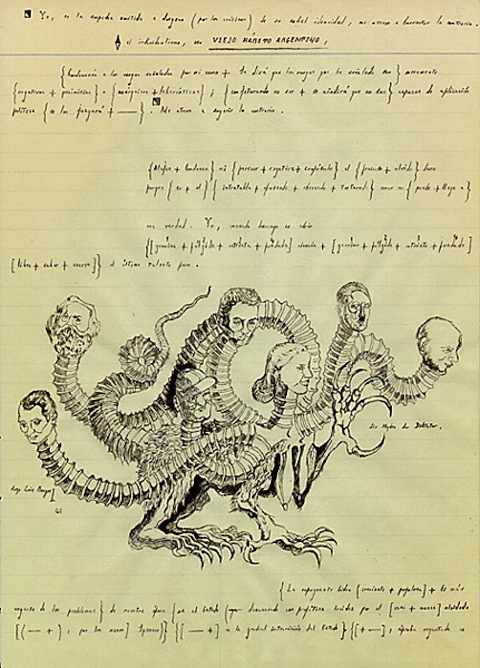
Above, see another of Borges’ sketches, this one from the University of Virginia’s extensive Borges collection. The drawing appears in a manuscript titled “The Old Argentine Habit,” penned in 1946 and published (as “Our Poor Individualism”) in Borges’ 1952 essay collection Other Inquisitions. According to C. Jared Lowenstein, the drawing is titled in German, “Die Hydra der Diktator” (“The Hydra of the Dictators”) and depicts Rosas, Peron, Mussolini, Hitler, and Marx and is signed “Jorge Luis Borges 46.” Lowenstein writes:
The theme of the artwork is a stunning political statement by a writer who has often been deemed apolitical. It is also a remarkably detailed drawing, especially for someone who was losing his eyesight as Borges was at this time. This marvelous depiction supplements Borges’s declaration in his text that Argentineans see themselves as individuals, not as citizens of a specific nation.
It is indeed a remarkably detailed work. I only wish Borges had supplied illustrations for his Book of Imaginary Beings.
Related Content:
Jorge Luis Borges’ 1967–8 Norton Lectures On Poetry (And Everything Else Literary)
James Joyce, With His Eyesight Failing, Draws a Sketch of Leopold Bloom (1926)
Two Childhood Drawings from Poet E.E. Cummings Show the Young Artist’s Playful Seriousness
Josh Jones is a writer and musician based in Washington, DC. Follow him at @jdmagness
Read More...Jean-Luc Godard’s Debut, Opération béton (1955) — a Construction Documentary
“A 2500 m. d’altitude, dans le Val des Dix, un millier d’homme dresse un mur de béton aussi haut que la Tour Eiffel: le barrage de la ‘GRANDE-DIXENCE’.” So begins Jean-Luc Godard’s very first film, Opération béton. You Francophones will have gathered that, for the debut that would begin his long, passionate career in filmmaking, Godard chose to shoot the construction of “a wall as high as the Eiffel Tower” by a thousand men and out of concrete — a great deal of concrete indeed. Valais’ Grande Dixence dam not only provided Godard the director the subject of his first movie, but the funds to make it as well. Despite having already gained some momentum writing critical pieces for Cahiers du cinéma, the 23-year-old Godard took hard manual work on the dam’s job site, joining his friend Jean-Pierre Laubscher already employed there. Then the idea came to him: why not shoot a documentary about all of this?
Arranging a transfer through Laubscher to a less taxing place on the dam as a switchboard operator, Godard then borrowed a 35-millimeter camera from a friend of a friend and got to work — his real work, that of cinema. “The original commentary for La Campagne du beton (The Campaign of Concrete or The Concrete Countryside), written by Laubscher and dated October 17, 1954, was two pages long and concise; it merely labeled the action,” writes critic Richard Brody in Everything is Cinema: The Working Life of Jean-Luc Godard. “But Godard gave the film a rhyming title instead, Opération béton (Operation Concrete) and rewrote the commentary. Though he kept several of Laubscher’s felicitous turns of phrase, Godard’s version, which he recorded in his own voice, greatly amplified the verbiage and resembled, instead of a series of photo captions, a person’s enthusiastic, digressive account of his experience at work.” Certain die-hard Godard-heads may also identify hints of the auteur’s favorite themes: labor, capital, nationalism, the machine-like systems that surround humanity. Certainly the industry-admiring tone seems suitably, er, breathless.
Related Content:
Jean-Luc Godard Films The Rolling Stones Recording “Sympathy for the Devil” (1968)
Jefferson Airplane Wakes Up New York; Jean-Luc Godard Captures It (1968)
Meetin’ WA: Jean-Luc Godard Meets Woody Allen in 26 Minute Film
Jean-Luc Godard’s After-Shave Commercial for Schick
Colin Marshall hosts and produces Notebook on Cities and Culture and writes essays on literature, film, cities, Asia, and aesthetics. He’s at work on a book about Los Angeles, A Los Angeles Primer. Follow him on Twitter at @colinmarshall.
Read More...Support Us
We're hoping to rely on loyal readers, rather than erratic ads. Please click the Donate button and support Open Culture. You can use Paypal, Venmo, Patreon, even Crypto! We thank you!

About Us

Open Culture scours the web for the best educational media. We find the free courses and audio books you need, the language lessons & educational videos you want, and plenty of enlightenment in between.
Advertise With Us

FREE UPDATES!
GET OUR DAILY EMAIL
Get the best cultural and educational resources on the web curated for you in a daily email. We never spam. Unsubscribe at any time.
FOLLOW ON SOCIAL MEDIA

Open Culture editor Dan Colman scours the web for the best educational media. He finds the free courses and audio books you need, the language lessons & movies you want, and plenty of enlightenment in between.
Advertise With Us


