Gertrude Stein Gets a Snarky Rejection Letter from Publisher (1912)
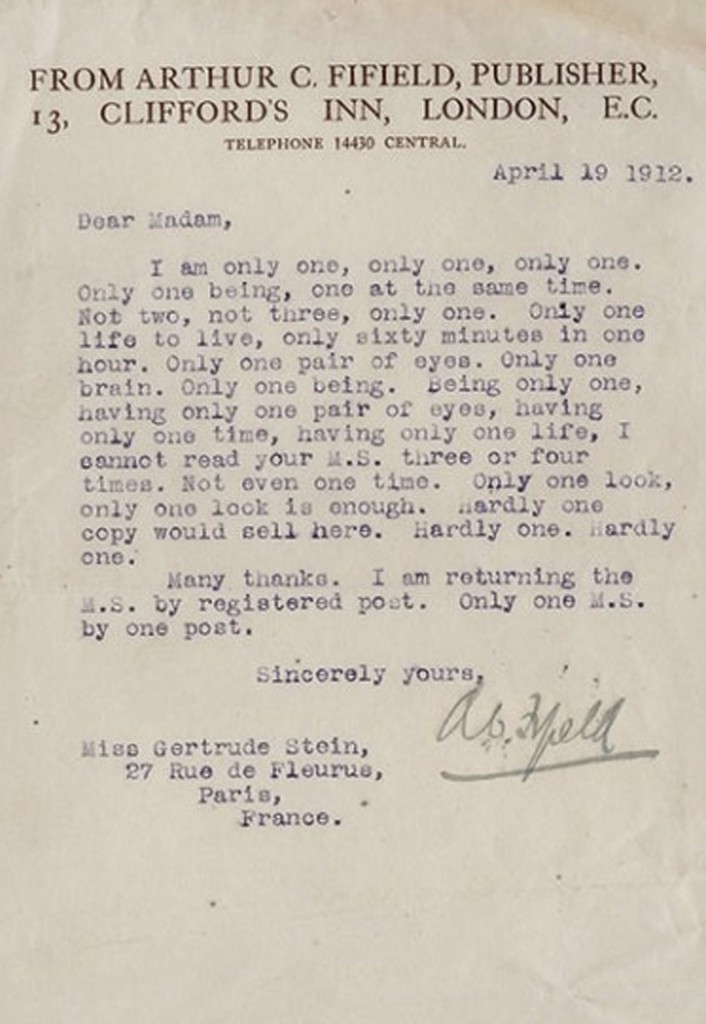
Gertrude Stein considered herself an experimental writer and wrote what The Poetry Foundation calls “dense poems and fictions, often devoid of plot or dialogue,” with the result being that “commercial publishers slighted her experimental writings and critics dismissed them as incomprehensible.” Take, for example, what happened when Stein sent a manuscript to Alfred C. Fifield, a London-based publisher, and received a rejection letter mocking her prose in return. According to Letters of Note, the manuscript in question was published many years later as her modernist novel, The Making of Americans: Being a History of a Family’s Progress (1925). You can hear Stein reading a selection from the novel below. Also find other Gertrude Stein works in our collections of Free eBooks and Free Audio Books.
Related Content:
Hear Gertrude Stein Read Works Inspired by Matisse, Picasso, and T.S. Eliot (1934)
Gertrude Stein Recites ‘If I Told Him: A Completed Portrait of Picasso’
The Dead Authors Podcast: H.G. Wells Comically Revives Literary Greats with His Time Machine
James Joyce in Paris: “Deal With Him, Hemingway!”
Read More...The Beatles Perform in a Spoof of Shakespeare’s A Midsummer Night’s Dream, 1964
In late April of 1964, England was celebrating the 400th birthday of William Shakespeare. At the same time, “Beatlemania” was in full swing. And for a brief moment, two of Britain’s cultural treasures intersected when the Beatles performed in a playful send-up of A Midsummer Night’s Dream.
The sketch was recorded in London on April 28, 1964. Only the month before, the Beatles had made their American debut on the Ed Sullivan Show. The Shakespearean spoof was part of a one-hour British TV special called “Around the Beatles.” It’s from the play-within-a-play in Act 5, Scene 1 of A Midsummer Night’s Dream, in which a group of actors make a mess of the classic Pyramus and Thisbe story from Ovid’s Metamorphoses.
Pyramus and Thisbe, a source of inspiration for Shakespeare’s Romeo and Juliet, are a pair of star-crossed lovers whose feuding parents forbid them from seeing one another. They live next-door to each other but are separated by walls. Through a crack in one wall they whisper their love and make plans to meet on a moonlit night under a mulberry tree. Thisbe arrives first, only to see a lion with blood dripping from its mouth after eating its prey. Terrified, she drops her veil and runs. Pyramus arrives soon afterward and sees both the blood and the veil. He assumes the lion has killed Thisbe, so he falls on his sword and dies. Thisbe returns and finds Pyramus dead. She takes his sword and kills herself.
In the silly Beatles sketch, Paul McCartney plays Pyramus, John Lennon plays Thisbe, Ringo Starr plays the Lion and George Harrison plays Moonshine. When Lennon was asked why he took the role of the maiden, he said, “Because if anyone likes dressing up more stupid than the rest, I enjoy it, you know. I was asked to do it because they thought I had the deeper voice.”
via BrainPickings
Related Content:
Peter Sellers Performs The Beatles “A Hard Day’s Night” in Shakespearean Mode
Pink Floyd’s David Gilmour Sings Shakespeare’s Sonnet 18
Shakespeare’s Satirical Sonnet 130, As Read By Stephen Fry
Find Shakespeare’s Collected Works in our Free eBooks and Free Audio Books Collections
Download Shakespeare Courses from our Collection of Free Online Courses
Read More...Helen Keller & Annie Sullivan Appear Together in Moving 1930 Newsreel
Helen Keller was born on this day in 1880, some 133 years ago. If you don’t know the Helen Keller story, you can watch The Miracle Worker below, the 1962 film starring Patty Duke and Anne Bancroft. You’ll learn about how Keller, at 19 months, contracted a disease — either scarlet fever or meningitis, it’s still not clear — that left her deaf and blind. You’ll also learn how Annie Sullivan, her beloved teacher, taught her to communicate by spelling words into her hand. Their relationship would last 49 years. And you’ll discover how Keller became the first deafblind person to earn a Bachelor of Arts degree, en route to becoming an activist, author and overall source of inspiration. In the clip above, filmed roughly 83 years ago, Helen Keller and Annie Sullivan appear in the flesh. Captured in an old newsreel, Sullivan explains how Keller learned to talk and, in the final line, Helen movingly declares, “I am not dumb now!” Find more Helen Keller vintage footage below.
Related Content:
Helen Keller Speaks About Her Greatest Regret — Never Mastering Speech
Helen Keller Pays a Visit to Martha Graham’s Dance Studio Circa 1954
Read More...Watch a Surprisingly Moving Performance of John Cage’s 1948 “Suite for Toy Piano”
At some point during his 1948 mania for the Rube Goldberg pieces of prepared pianos, John Cage, inspired by minimalist French composer Erik Satie, decided to turn back to melody for a moment. Still building with a dull percussive tonal palate, he wrote solely for the keyboard this time… of a toy piano. “Suite for Toy Piano” consists of five short movements, none over two minutes. Cage liked the abrasive chiming and limited range of the instrument.
The piece can be mechanical or structurally immersive, depending on the player. In the performance above, Portuguese pianist Joana Gama achieves the latter effect, imbuing the composition with dynamic energy many other renditions lack, though I do not know whether Cage intended a flat affect. In any case, he tended to appreciate improvisatory takes on his work at all times, so he wouldn’t have been bothered.
The surrounding audience—shuffling, whispering, wheezing—only add to Gama’s intensity. The event marked the 2011 opening of the Centre for Art and Architecture Affairs in Guimarães, Portugal.
Josh Jones is a writer and musician based in Washington, DC. Follow him @jdmagness
Related Content:
John Cage Plays Amplified Cacti and Plant Materials with a Feather (1984)
John Cage Unbound: A New Digital Archive Presented by The New York Public Library
John Cage Performs Water Walk on “I’ve Got a Secret” (1960)
Read More...The Art of Punk Presents a New Documentary on The Dead Kennedys and Their Gritty Aesthetics
Last week, Colin Marshall told you all about The Art of Punk, the new documentary series from the Museum of Contemporary Art in Los Angeles. This week, the series continues with a new video looking at The Dead Kennedys and the artist behind their striking artwork, Winston Smith. A “punk art surrealist” known for his “hand-carved” collages, Smith is perhaps best known for creating The Dead Kennedys’ iconic logo and other arresting images (see a slideshow here). The new MOCA video covers all of that, and then some, above.
Related Content:
Punk Meets High Fashion in Metropolitan Museum of Art Exhibition PUNK: Chaos to Couture
Malcolm McLaren: The Quest for Authentic Creativity
Read More...Free Business Courses: Discover Our New Collection (and Offer Your Own Suggestions)
 Almost daily, readers write us and ask for courses that can deepen their professional education. Some want to learn new tech skills. Others want to bone up on statistics and calculus. And still others want to learn about project management. We decided to address this by creating a new collection of Free Online Business Courses. So far, we’ve compiled a list of 145 business-oriented courses and related resources. Some courses come from leading universities. Others come from government, non-profits and the occasional MOOC provider. The list is fairly rich. But we will keep adding to it over time. If you know of a great course (or a great business resource that’s free) please tell us in the comments below, or send us an email via this page. We would love to benefit from your collective wisdom. And you will be helping many people in the process, during a tough economic time. Visit: 145 Free Online Business Courses.
The Atlas of True Names Restores Modern Cities to Their Middle Earth-ish Roots
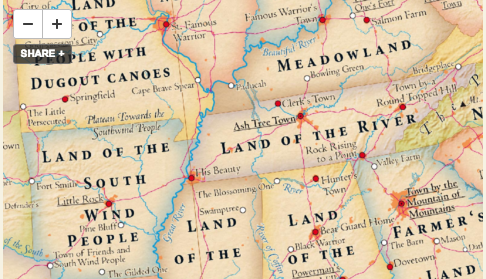
I was born in the City of the Flowland People, made my way to Stink Onion upon reaching maturity, then onward to New Yew Tree Village where I have lived for the last 217 moons.
Look up some of your key co-ordinates in The Atlas of True Names and you too can have a personal history as mythic-sounding as mine. The maps—for the UK, USA, Canada, and World—replace modern geographical names with the original etymological roots of cities, countries, and bodies of water, translated into English. Their website picks the “Sahara desert” to illustrate the true name selection process. Their chosen label “The Tawny One” has its basis in es-sahra, translated from the Arabic as “the fawn colored desert”. It would be interesting to learn how many professional translators lent a hand with the etymological parsing. There are a lot of languages in this world and we all know the havoc Google Translate can wreak.
Married cartographers (and Lord of the Rings fans) Stephan Hormes and Silke Peust acknowledge that there could be alternates to their translations. This should come as a relief to the civic boosters of Philadelphia. Quibblers will no doubt enjoy taking issue with Hormes and Peust’s choices. Hopefully, any resulting internet brawls will take place on a higher—and dustier—plateau than those where vultures pick hapless celebrities to shreds.
Order one of these maps and pack it along on your summer road trip. Even if younger family members can’t be bothered to learn how to navigate without a phone, the narratively rich names are sure to leaven those long hours in the car. (How badly do you have to go, Jason? Can you hold out until Table or should Daddy pull over in the Valley of the Darkland Dweller?)
It’s living history in travel version.
Related Content:
Discover J.R.R. Tolkien’s Personal Book Cover Designs for The Lord of the Rings Trilogy
Download Eight Free Lectures on The Hobbit by “The Tolkien Professor,” Corey Olsen
Willie Nelson Auditions for The Hobbit Film Sequel, Turns 80 Today
Ayun Halliday is the author of seven books including the increasingly obsolete Zinester’s Guide to NYC and No Touch Monkey! and Other Travel Lessons Learned Too Late. Follow her @AyunHallliday
Read More...Louis Armstrong’s 1964 Interview with a Pair of Intrepid Kid Reporters
In the summer of 1964, two young boys from the North Shore suburbs of Chicago took a tape recorder and set out to interview jazz legend Louis Armstrong for their high school radio station. Armstrong was playing a concert at the Ravinia Festival in Highland Park, not far from the boys’ school in Winnetka. He agreed to an interview, and as a group of professional reporters from the city’s major news outlets waited impatiently outside his dressing room door, Armstrong spent 20 minutes answering questions for a little 10-watt FM radio station.
The story is told above, in the latest installment of PBS’s ongoing animation project with Blank on Blank, a group that brings unheard interviews back to life. Michael Aisner, who was 15 when he met Armstrong, and his friend James R. Stein, who was 14, recount their adventure and play a few highlights from the interview. Armstrong explains how he got the nickname “Satchmo” and talks a little about his Dickensian childhood and how he learned to play the coronet in the Home for Colored Waifs in New Orleans. He talks about the need for practicing hard every day, and about the talent that was his ticket out of the slums. “You’ve got to be good,” Armstrong says, “or bad as the devil.”
Related content:
Louis Armstrong and His All Stars Live in Belgium, 1959
Muhammad Ali Plans to Fight on Mars in Lost 1966 Interview with Child Reporter
Read More...What Do Most Philosophers Believe? A Wide-Ranging Survey Project Gives Us Some Idea
What do most philosophers believe? The question may only interest other philosophers—and when it comes to such esoteric concerns as the “analytic synthetic distinction,” this is probably true. But when it comes to the big issues that have given every thoughtful person at least one sleepless night, or the questions regularly explored by speculative fictions like Star Trek or zombie movies, the rest of us might sit up and take notice.
Two contemporary philosophers, David Chalmers and David Bourget, decided to find out where their colleagues stood on 30 different philosophical issues by constructing a rigorous survey that ended up accounting for the views of over 3,000 professors, graduate students, and independent thinkers. Most of the respondents were affiliated with prestigious philosophy departments in the English-speaking world, though several continental European departments are also represented.
Some semi-famous names come up in a perusal of the list of public respondents, like A.C. Grayling and Massimo Pigliucci. For the most part, however, the survey group represents the rank-and-file, toiling away as teachers, thinkers, writers, and researchers at colleges across the Western world. You survey geeks out there can dig deeply into Chalmers and Bourget’s detailed accounting of their methodology here. But for a quick and dirty summary, let’s take a couple of general categories and look at the results.
Metaphysics:
The issues that fall under this heading broadly involve questions about what exists, and why and how it does. Here’s a breakdown of some of the biggies:
- God: atheism 72.8%; theism 14.6%; other 12.6%
Granted, this is an oversimplification. Popular notions of these categories don’t necessarily correspond to more subtle distinctions among philosophers, who may be strong or weak atheists (or theists), or hold some version of deism, agnosticism, or none of the above.
- Free will: compatibilism 59.1%; libertarianism 13.7%; no free will 12.2%; other 14.9%
Compatibilism, the majority view here, is the theory that we can choose our actions to some degree, and to some degree they are determined by prior events. Libertarianism (related to, but not synonymous with, the political philosophy) claims that all of our actions are freely chosen.
- Metaphilosophy: naturalism 49.8%; non-naturalism 25.9%; other 24.3%
Naturalism, according to the Oxford English Dictionary, is “the idea or belief that only natural (as opposed to supernatural or spiritual) laws and forces operate in the world,” or “the belief that nothing exists beyond the natural world.” Note that metaphysical naturalism needs to be distinguished from methodological naturalism, which nearly all scholars and scientists embrace.
- Abstract objects: Platonism 39.3%; nominalism 37.7%; other 23.0%
This distinction gets at whether abstractions like geometry or the laws of logic exist in some immutable form “out there” in the universe (as Platonic ideas) or whether they are “nominal,” no more than convenient formulas we create and apply to our observations. It’s a debate at least as old as the ancient Greeks.
Personal Identity:
In this general category, we deal with questions about what it means to be a person and how we can exist as seemingly coherent individuals over time in a world in constant flux. Let’s take two fun examples that deal with these quandaries, shall we?
- Teletransporter: survival 36.2%; death 31.1%; other 32.7%
Here, we’re dealing with a thought experiment proposed by Derek Parfit (one of the participants in the survey) that pretty much takes the Star Trek transporter technology (or the horror version in The Fly) and asks whether the transported individual—completely disintegrated and reconstituted somewhere else—is the same person as the original. In other words, can a “person” survive this process or does the individual die and a new one take its place? The question hinges on ideas about a “soul” or “spirit” that exists apart from the material body and asks whether or not we are nothing more than very specific arrangements of matter and energy.
- Zombies: conceivable but not metaphysically possible 35.6%; metaphysically possible 23.3%; inconceivable 16.0%; other 25.1%
Zombies are everywhere. Try to escape them! You can’t. Their prevalence in popular culture is mirrored in the philosophy world, where zombies have long served as metaphors for the possibility of a pure (and ravenous) bodily existence, devoid of conscious self-awareness. The prospect may be as frightening as the zombies of the Walking Dead, but is it a real possibility? A significant number of philosophers seem to think so.
As I said, these are just a few of the issues Chalmers and Bourget’s survey queries. Physicist Sean Carroll has a quick summary of all of the results on his blog, and Chalmers and Bourget have made all of their data and analysis very transparent and freely available at their Philpapers site. David Chalmers, who specializes in philosophy of mind and looks like one of Spinal Tap’s doomed drummers, spills the beans on his ideas of consciousness in the video at the top.
Related Content:
Do Physicists Believe in God?
50 Famous Academics & Scientists Talk About God
Daniel Dennett and Cornel West Decode the Philosophy of The Matrix in 2004 Film
Download 90 Free Philosophy Courses and Start Living the Examined Life
Josh Jones is a writer and musician based in Washington, DC. Follow him at @jdmagness
Read More...Explore the Massive Stanley Kubrick Exhibit, at the Los Angeles County Museum of Art Until June 30
No American filmmaker commands such overwhelming critical respect and popular acclaim as Stanley Kubrick. A hero to art house film students and everyday lovers of sci-fi, horror, and war movies, Kubrick’s meticulous craftsmanship and visionary reimagining of genre films are legendary, and his genius is currently on display at the Los Angeles County Museum of Art. Or at least it is until the end of the month.
The traveling Kubrick exhibit, housed at LACMA since November, will move on June 30, so if you’re in the area, don’t delay. The Kubrick exhibit covers his work as a photographer for Look magazine in the 1940s through his filmmaking achievements from the 50s to the 90s. LACMA further describes the collection on its site:
His films are represented through a selection of annotated scripts, production photography, lenses and cameras, set models, costumes, and props. In addition, the exhibition explores Napoleon and The Aryan Papers, two projects that Kubrick never completed, as well as the technological advances developed and utilized by Kubrick and his team.
If you can’t make it to L.A., a YouTube user has created the wonderful three-part video tour of the exhibit above, set to classic Kubrick-ian film scores. Also, be sure to flip through the 100 photos of the exhibit—including shots of famous props, Kubrick’s cameras, lenses, and scripts, and his director’s chair—at Jamie & Adam Tested.
Note: In conjunction with the exhibition, LACMA has created a free app for iPhone, iPad and Android. It “features photographs, script notes, an interactive timeline of Kubrick’s career, and original interviews with Stan Douglas, Elvis Mitchell, Chris Nolan, Terry Semel, David Slade and Douglas Trumbull about the director’s life and legacy. Excerpts from a rare 1965 interview with Kubrick, courtesy of Jeremy Bernstein, are also included.”
Related Content:
Rare 1960s Audio: Stanley Kubrick’s Big Interview with The New Yorker
Stanley Kubrick’s Jazz Photography and The Film He Almost Made About Jazz Under Nazi Rule
Room 237: New Documentary Explores Stanley Kubrick’s The Shining and Those It Obsesses
Josh Jones is a writer and musician based in Washington, DC. Follow him at @jdmagness
Read More...Support Us
We're hoping to rely on loyal readers, rather than erratic ads. Please click the Donate button and support Open Culture. You can use Paypal, Venmo, Patreon, even Crypto! We thank you!

About Us

Open Culture scours the web for the best educational media. We find the free courses and audio books you need, the language lessons & educational videos you want, and plenty of enlightenment in between.
Advertise With Us

FREE UPDATES!
GET OUR DAILY EMAIL
Get the best cultural and educational resources on the web curated for you in a daily email. We never spam. Unsubscribe at any time.
FOLLOW ON SOCIAL MEDIA

Open Culture editor Dan Colman scours the web for the best educational media. He finds the free courses and audio books you need, the language lessons & movies you want, and plenty of enlightenment in between.
Advertise With Us

