Free Interactive e‑Books from NASA Reveal History, Discoveries of the Hubble & Webb Telescopes

Earlier this month NASA announced that the Hubble Space Telescope found evidence of a planet forming 7.5 billion miles from its star. This astonishing discovery challenges all of our current theories about how planets develop.
A few days later, Hubble captured images of two galaxies merging.
Hubble has been in orbit since 1990, collecting images with one of the largest and most versatile telescopes designed for deep space. No single tool has done as much to advance astronomical public relations in recent years.
Hubble’s development, launch and discoveries are the subject of a new, free interactive e‑book (best viewed on the iPad) that brings to life Hubble’s distinguished service as our eye on the universe.
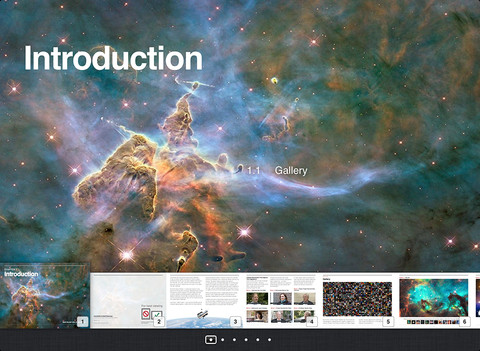
For almost as long as Hubble has been in space, NASA has been working on the next generation space telescope. The James Webb Space Telescope will feature a mirror three times the size of Hubble’s. Once launched, the telescope will travel far beyond our Moon. NASA’s free e‑book about the Webb Telescope reveals the preparation going on to get the new tool ready for take-off.
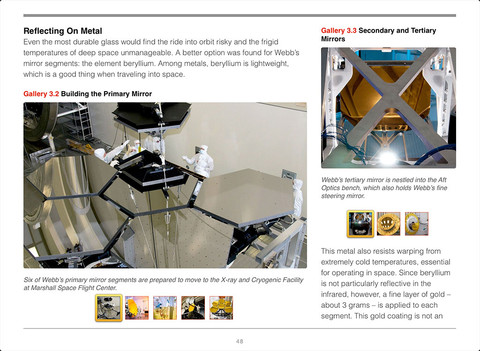
Its large mirror and distant viewing position are expected to give Webb’s images higher resolution and sensitivity, allowing scientists to study the birth and evolution of galaxies as well as the formation of stars and planets.
The e‑books are written at a high school level and can be viewed on an iPad using a free iBooks app. If you don’t have an iPad, no need to worry. A non-interactive version of the Hubble eBooks is also available, as is one about the Webb Telescope.
You will find these books in our collections, 800 Free eBooks for iPad, Kindle & Other Devices and 200 Free Kids Educational Resources: Video Lessons, Apps, Books, Websites & More
Related Content:
Live: Watch NASA’s Coverage of Asteroid As It Buzzes By Earth
NASA Sends Image of the Mona Lisa to the Moon and Back
Leonard Nimoy Narrates Short Film About NASA’s Dawn: A Voyage to the Origins of the Solar System
Kate Rix writes about digital media and education. Visit her website and follow her on Twitter @mskaterix.
Read More...Watch Monty Python’s “Summarize Proust Competition” on the 100th Anniversary of Swann’s Way
Marcel Proust’s Swann’s Way, the first volume of In Search of Lost Time, appeared in 1913. This year, exactly a century later, Proust enthusiasts, both individually and institutionally, have found all manner of ways to celebrate. The Morgan Library and Museum, for instance, put on an exhibition of “a fascinating selection of the author’s notebooks, preliminary drafts, galley-proofs, and other documents from the collection of the Bibliothèque nationale de France” — literarily serious stuff. For a Proust centennial experience equally literary but far less serious, why not watch the Monty Python sketch above depicting the “All-England Summarize Proust Competition”?
The situation presents the challenge you’d expect: contestants must relate, in fifteen seconds, the entirety of Proust’s seven-volume masterwork, “once in a swimsuit, and once in evening dress.” The attempt of one hapless participant, portrayed by Graham Chapman, runs as follows: “Proust’s novel ostensibly tells of the irrevocability of time lost, the forfeiture of innocence through experience, the reinstallment of extra-temporal values of time regained. Ultimately, the novel is both optimistic and set within the context of a humane religious experience, re-stating as it does the concept of atemporality. In the first volume, Swann, the family friend, visits…” But ah, too long. Watch the whole thing and find out if Michael Palin’s character fares any better at summarizing the unsummarizable, and, this happening in Monty Python’s reality, how quickly it will all cease to matter anyway.
Works by Proust can be found in our collection of Free eBooks.
Related Content:
New Animated Film Tells the Life Story of Monty Python’s Graham Chapman
Monty Python’s Best Philosophy Sketches
Monty Python Channel Launches on Youtube
Colin Marshall hosts and produces Notebook on Cities and Culture and writes essays on literature, film, cities, Asia, and aesthetics. He’s at work on a book about Los Angeles, A Los Angeles Primer. Follow him on Twitter at @colinmarshall.
Read More...The Musical Mind of Albert Einstein: Great Physicist, Amateur Violinist and Devotee of Mozart
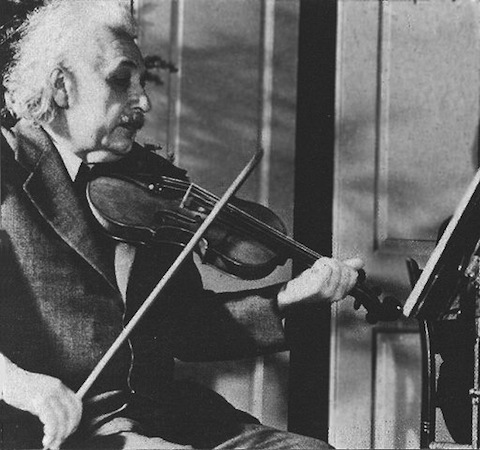
At the height of Albert Einstein’s popularity, the public knew him not only as the world’s foremost theoretical physicist, but also as an enthusiastic sometime violinist. As a publication for the 2005 “World Year of Physics” puts it: “to the press of his time… Einstein was two parts renowned scientist, one jigger pacifist and Zionist fundraiser, and a dash amateur musician.” While this description may get at the public perception of his composition, Einstein himself seems to have favored the musician over all of his other “parts.” “Life without playing music is inconceivable for me,” he once said, “I live my daydreams in music. I see my life in terms of music… I get most joy in life out of music.”
The famous scientist never travelled without his beloved violin, “Lina.” His affair with music began with violin lessons in Munich at the age of 5. However, his early experiences with the instrument seem at best perfunctory and, at worst, antagonistic (one anecdote has him throwing a chair at his teacher, who left the house in tears).
He did not truly fall in love until discovering Mozart at age 13. A high school friend reported to biographer Carl Seeling that at this time, when the young Einstein’s “violin began to sing, the walls of the room seemed to recede—for the first time, Mozart in all his purity appeared before me, bathed in Hellenic beauty with its pure lines, roguishly playful, mightily sublime.”
This gushing recollection must inevitably prompt the question, raised in every account of Einstein and music—was he really any good? Since he played mostly for his own enjoyment, the answer seems irrelevant; yet, as particle physicist Brian Foster says in the video above, Einstein was “competent.” In his Berlin years, he played with renowned musicians like Austrian violinist Fritz Kreisler and pianist Artur Schnabel (as well as with founder of quantum theory, Max Planck). His scientific notoriety garnered invitations to perform at benefit concerts. One critic remarked, “Einstein plays excellently. However… there are many violinists who are just as good.” Another concert-goer quipped, “I suppose now Fritz Kreisler is going to start giving physics lectures.” Accounts of his abilities do differ.
Brian Foster’s interest in Einstein the musician transcends the man’s virtuosity, or lack thereof. Since 2005—the 100th anniversary of Einstein’s “miracle year,” during which he published his most influential papers—Foster has teamed up with British violinist Jack Liebeck and other classical musicians to present lectures and concerts on the role of music in Einstein’s life and work. Einstein’s devotion to Mozart may be of particular interest to historians of science. Foster describes Einstein’s tastes as “conservative”; he found Beethoven too “creative,” but Mozart, on the other hand, revealed to him a universal harmony he believed existed in the universe. As another author puts it:
Einstein relished Mozart, noting to a friend that it was as if the great Wolfgang Amadeus did not “create” his beautifully clear music at all, but simply discovered it already made. This perspective parallels, remarkably, Einstein’s views on the ultimate simplicity of nature and its explanation and statement via essentially simple mathematical expressions.
While the interpretation of Einstein as a “realist” has its detractors, his insistence on the beauty and simplicity of scientific theories is not in dispute. Foster points out above that part of Einstein’s legacy is his push for beauty, unification, and harmony in our physical understanding of reality, a push that Foster credits to the scientist’s musical mind.
Related Content:
Listen as Albert Einstein Reads ‘The Common Language of Science’ (1941)
James Joyce Plays the Guitar, 1915
Albert Einstein Expresses His Admiration for Mahatma Gandhi, in Letter and Audio
Josh Jones is a writer and musician based in Washington, DC. Follow him at @jdmagness
Read More...Serge Gainsbourg & Brigitte Bardot Perform Outlaw-Inspired Love Song, ‘Bonnie and Clyde’ (1968)
In 1967, two icons of French popular culture went out on a date. It didn’t go well. The usually cool Serge Gainsbourg was so intimidated by Brigitte Bardot’s beauty that his notorious charm failed him. Believing he had blown his chance, Gainsbourg was surprised when Bardot telephoned and said he could make amends by writing her “the most beautiful love song you can imagine.”
Gainsbourg responded by writing two songs. One was called “Bonnie and Clyde.” It was inspired by that year’s hit film of the same name by Arthur Penn, starring Faye Dunaway and Warren Beatty as the notorious 1930s outlaws Bonnie Parker and Clyde Barrow.
Gainsbourg composed the song around a French translation of a poem Parker wrote a few weeks before she and Barrow were gunned down by lawmen. (See footage from the scene of their death here.) It begins:
You’ve read the story of Jesse James
of how he lived and died.
If you’re still in need;
of something to read,
here’s the story of Bonnie and Clyde.
Now Bonnie and Clyde are the Barrow gang
I’m sure you all have read.
how they rob and steal;
and those who squeal,
are usually found dying or dead.
There’s lots of untruths to these write-ups;
they’re not as ruthless as that.
their nature is raw;
they hate all the law,
the stool pigeons, spotters and rats.
They call them cold-blooded killers
they say they are heartless and mean.
But I say this with pride
that I once knew Clyde,
when he was honest and upright and clean.
But the law fooled around;
kept taking him down,
and locking him up in a cell.
Till he said to me;
“I’ll never be free,
so I’ll meet a few of them in hell.”
The scene above, with Gainsbourg and Bardot performing the song, was broadcast on The Brigitte Bardot Show in early 1968. The song was released later that year on two albums: Initials B.B. and Bonnie and Clyde. The romance between Gainsbourg and Bardot was short. She returned to her second husband and he met actress Jane Birkin, with whom he recorded the second song he wrote for Bardot: “Je t’aime…mois non plus,” which means “I Love You…Me Neither.”
Two Childhood Drawings from Poet E.E. Cummings Show the Young Artist’s Playful Seriousness
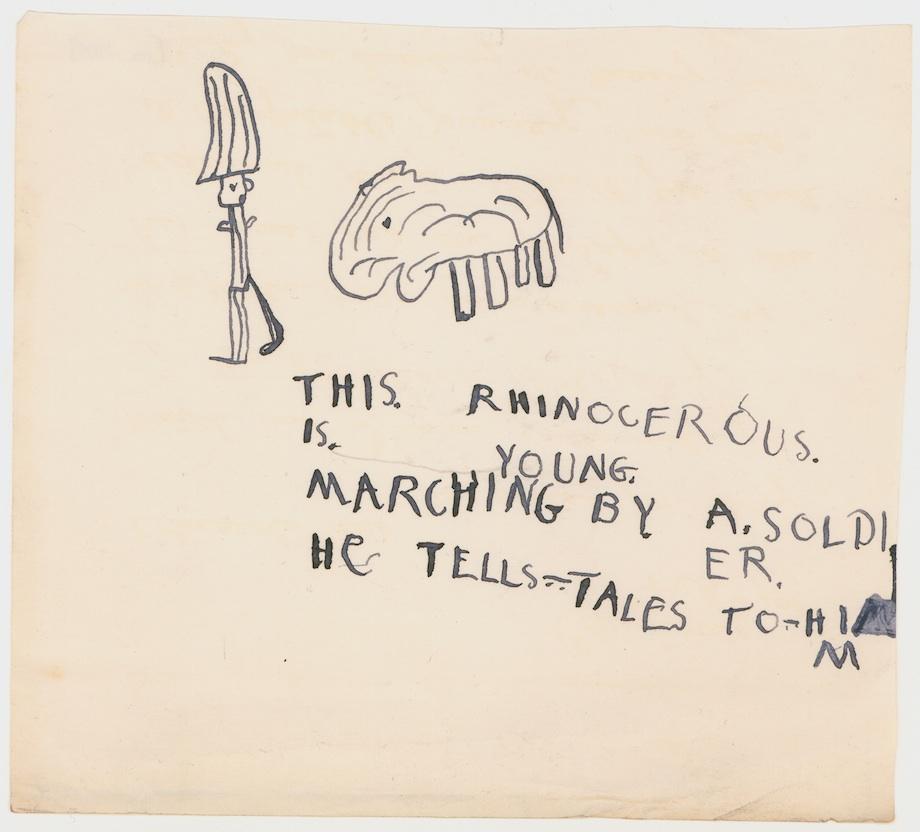
Click images for larger versions
Rebecca Onion over at Slate’s history blog “The Vault” has brought to our attention two delightful finds from the Massachusetts Historical Society: childhood drawings by poet and painter E.E. Cummings, made when he was 6 and 7 years old. Dating from 1900–1902, the sketches, writes Onion, “reflect Cummings’ immersion in the popular culture of the time: circuses, Wild West shows, and adventure fiction.” These two drawings are fascinating portraits of the young Cummings’ mind at work. What a young mind he had.
Cummings began writing poetry at age 8, and wrote a poem a day until he was 22. His mature work, which he began publishing after his release from an internment camp in Normandy during WWI (where he was held for suspected treason), shows the same kind of childlike playfulness and discipline. And while the drawing at the top is the work of a young boy struggling with the conventions of the written word, its oddly-spaced and punctuated text—the lexical and syntactical ambiguities created by the layout—could certainly have come from the pen of the adult poet. Cummings’ ideas about his poetry were deliberately idiosyncratic and forcefully individual. As he would write, “may I be I is the only prayer—not may I be great or good or beautiful or wise or strong.” Or, as he expressed in a similar sentiment in his 1926 collection, is 5, perhaps in response to some critical opprobrium:
mr youse needn’t be so spry
concernin questions arty
each has his tastes but as for i
i likes a certain party

In the drawing above, the young Edward Estlin Cummings imagines himself as a Buffalo Bill-like character. Onion points us toward the adult Cummings’ darkly ironic poem “[Buffalo Bill ‘s],” as a companion to the boy Cummings’ starry-eyed self-fashioning and “hero worship.” While on a superficial reading, Cummings’ work can sometimes seem maddeningly childish and silly, poems like “[Buffalo Bill ‘s]” show him plucking apart naïve illusions about heroism and spectacle as in so many of his other poems he skewers the pretensions of urban sophisticates and tastemakers, promoting a Romantic, uninhibited idea of the self unfettered by social, and typographical, conventions.
Cummings would be very appreciative of the work the Massachusetts Historical Society has done in cataloguing his family papers; he had a deep respect for history—above all for personal history. In the first of his so-called “nonlectures,” delivered at Harvard in 1952, he refers to his “autobiographical problem” in a passage that conjures the dystopian visions of Huxley and Orwell:
There’d be no problem, of course, if I subscribed to the hyperscientific doctrine that heredity is nothing because everything is environment; or if (having swallowed this supersleepingpill) I envisaged the future of socalled mankind as a permanent pastlessness, prenatally enveloping semiidentical supersubmorons in perpetual nonunhappiness. Rightly or wrongly, however, I prefer spiritual insomnia to psychic suicide.
Perhaps Cummings could thank “spiritual insomnia” for his serious wordplay and boundless curiosity—two childhood traits he never let go of.
Related Content:
The Art of Sylvia Plath: Revisit Her Sketches, Self-Portraits, Drawings & Illustrated Letters
Dylan Thomas Sketches a Caricature of a Drunken Dylan Thomas
William S. Burroughs Shows You How to Make “Shotgun Art”
Josh Jones is a writer and musician based in Washington, DC. Follow him at @jdmagness
Read More...Mickey Mouse In Vietnam: The Underground Anti-War Animation from 1968, Co-Created by Milton Glaser
During World War II, Disney’s lovable characters made their own contribution to the war effort. In short propaganda films, Donald Duck, Goofy and the gang encouraged fellow Americans to support the draft and pay their taxes. And, through Disney characters, Americans learned about the evils of the Nazi regime. Here, we’ve gathered five of these animated propaganda films: Donald Gets Drafted (1942); Der Fuehrer’s Face (1943), The Spirit of 43′ (1943), The Old Army Game (1943), and Commando Duck (1944).
Fast forward 25 years and America found itself fighting a very different war, the Vietnam War. So far as I know, Disney never threw its cultural weight behind this divisive conflict. It wouldn’t have made good business sense. However, Disney’s most iconic character, Mickey Mouse, did appear in an animated underground film created by two critics of the war, Lee Savage and the celebrated graphic designer Milton Glaser.
Produced in 1968 for The Angry Arts Festival, the one minute animation shows Mickey getting lured into fighting in Nam, and then, rather immediately, getting shot in the head. The anti-war commentary gets made brutally and economically. Sometimes less is more. In a recent interview with Buzzfeed, Glaser recalls: “[O]bviously Mickey Mouse is a symbol of innocence, and of America, and of success, and of idealism — and to have him killed, as a solider is such a contradiction of your expectations. And when you’re dealing with communication, when you contradict expectations, you get a result.”
Mickey Mouse In Vietnam aired once at the aforementioned festival, then faded into oblivion, only to resurface later at the Sarajevo Film Festival and now on YouTube.
If you would like to support the mission of Open Culture, consider making a donation to our site. It’s hard to rely 100% on ads, and your contributions will help us continue providing the best free cultural and educational materials to learners everywhere. You can contribute through PayPal, Patreon, and Venmo (@openculture). Thanks!
Related Content:
Donald Duck’s Bad Nazi Dream and Four Other Disney Propaganda Cartoons from World War II
How Bertrand Russell Turned The Beatles Against the Vietnam War
Bed Peace Revisits John Lennon & Yoko Ono’s Famous Anti-Vietnam Protests
Read More...“Notebook on Cities and Culture,” a Worldwide In-Depth Interview Podcast, Kickstarting Now
Ever since I’ve written posts here on Open Culture, I’ve hosted and produced Notebook on Cities and Culture, a podcast dedicated to in-depth, long-form interviews with cultural creators, internationalists, and observers of the urban scene. In its three seasons so far, I’ve roamed cities like Los Angeles, San Francisco, Portland, Vancouver, Mexico City, Kyoto, Nara, and Osaka recording all of these conversations face to face with guests like writer of place Pico Iyer, Bookworm host Michael Silverblatt, MetaFilter founder Matt Haughey, film critic Karina Longworth, Los Angeles Review of Books editor Tom Lutz, graphic designer Clive Piercy, parking theorist Donald Shoup, conceptual artist Jonathon Keats, Slate podcast producer Andy Bowers, Japan specialist Roland Kelts, novelist Timothy Taylor, and monologist Josh Kornbluth.
 For the next season, the show’s fourth and most ambitious, I’ll record full-length conversations with sixty more luminaries not just in Los Angeles, but in the London, Toronto, and Copenhagen as well. As with previous seasons, I launched a Kickstarter drive last week to fund it. As of this writing, it’s raised $5,138 of its $8,000 budget, but it only has sixteen hours. If we don’t raise the full amount by Monday, June 24th at noon Pacific time, the season won’t happen at all. If Notebook on Cities and Culture’s fourth season strikes you as something you’d like to help make a reality, please do visit the show’s Kickstarter page. Thanks very much indeed!
Colin Marshall hosts and produces Notebook on Cities and Culture and writes essays on literature, film, cities, Asia, and aesthetics. He’s at work on a book about Los Angeles, A Los Angeles Primer. Follow him on Twitter at @colinmarshall.
Read More...Iggy Pop Conducts a Tour of New York’s Lower East Side, Circa 1993
I moved to New York City in 2000, and to the Lower East Side in 2002. To my dismay, the gritty downtown New York I’d loved from afar since childhood—represented by films like The Warriors, bands like Sonic Youth, and graffiti artists like Zephyr—was nearly at an end. CBGB’s was staggering toward its final years; local venue Brownies, right across the street, closed during my tenure, then re-opened as another bar, the live bands replaced by a jukebox; the few remaining artists from the old days holed up in their apartments, surly and forgotten; and rumors of Whole Foods and glass & steel condos proved true in the coming years. It was sad.
But oh, to be there in the 80s and early 90s, when flowers of dirty punk art grew from the needle-strewn Tompkins Square Park and the decaying squatters paradises along Avenue A. Of course I’m romanticizing a time of high crime, poverty, and low expectations, a time many native New Yorkers do not remember fondly (then again, it seems, just as many do). There are many, many documents of the old East Village mean streets—too many to properly list in this short post. But I can imagine no better tour guide to pre-millennial NYC than Iggy Pop.
In the short film above, watch him show Dutch filmmaker Bram van Splunteren around Alphabet City. Granted this is 1993. Things weren’t nearly as hairy as they were a few years prior (a fact Iggy points out right away), but it’s still a world away from the Lower East Side of today. Pop traipses through the neighborhood, pointing out favorite landmarks and pieces of graffiti. No stranger to urban decay, the Detroit native seems right at home. This being New York, Pop can stroll around without being molested (or mostly even recognized). All in all it’s a pretty leisurely tour of the 90s Lower East Side on a bright and sunny day with the guy who more-or-less invented punk. What more could you want?
via Coudal.com
Related Content:
From The Stooges to Iggy Pop: 1986 Documentary Charts the Rise of Punk’s Godfather
Jim Power, aka “the Mosaic Man,” Adorns the Lampposts of New York City’s East Village
Nico Sings “Chelsea Girls” in the Famous Chelsea Hotel
Josh Jones is a writer and musician based in Washington, DC. Follow him at @jdmagness
Read More...150 Free Online Business Courses
Find over 150 courses, many from leading universities, that will deepen your professional education. Topics include finance, technology, entrepreneurship and much more.
Note: If you sign up for a Massive Open Online Course (MOOC), select the “Full Course, No Certificate” (edX) or “Audit” (Coursera) option when you enroll in order to take the course for free. If you opt to take the course for a certificate/credential, you will be charged a fee, and we will receive a commission from our affiliate partners–Coursera, FutureLearn and edX.
- An Introduction to Consumer Neuroscience & Neuromarketing — Massive Open Online Course (MOOC) — University of Copenhagen
- Advanced Business Strategy — Massive Open Online Course (MOOC) — University of Virginia
- Agile Meets Design Thinking — Massive Open Online Course (MOOC) — University of Virginia
- Becoming a Changemaker: Introduction to Social Innovation — Massive Open Online Course (MOOC) — University of Cape Town
- Blitzscaling — Free Online Video — Reid Hoffman, Stanford
- Blockchain and Money — Free Online Video — Gary Gensler, MIT
- Budgeting and Scheduling Projects — Massive Open Online Course (MOOC) — UC Irvine
- Building a Business — Free Online Audio — Oxford University
- Building a Business: Moving Your Product to the Market — Free Online Audio — Free Tunes Audio — Oxford University
- Building a Data Science Team — Massive Open Online Course (MOOC) — Johns Hopkins
- Building Your Leadership Skills — Massive Open Online Course (MOOC) — HEC
- Business Growth Strategy — Massive Open Online Course (MOOC) — University of Virginia
- Business Strategy from Wharton: Competitive Advantage — Massive Open Online Course (MOOC) — University of Pennsylvania/Wharton
- Business Writing — Massive Open Online Course (MOOC) — UC-Boulder
- Computer Science for Business Professionals — Massive Open Online Course (MOOC) — Harvard
- Computer Science for Lawyers — Massive Open Online Course (MOOC) — Harvard
- Corporate Finance — Free Online Video — Aswath Damodaran, NYU
- Corporate Finance for Healthcare Administrators — Free Online Video — Jack Wheeler, University of Michigan
- Corporate Financial Strategy — Free Online Video — Alternate Source — Burcu Esmer, Bilkent University
- Corporate Lifecyle — Free Online Video — Aswath Damodaran, NYU
- Cost and Economics in Pricing Strategy — Massive Open Online Course (MOOC) — University of Virginia and Boston Consulting Group
- Customer Analytics — Massive Open Online Course (MOOC) — University of Pennsylvania/Wharton
- Design-Led Strategy: Design thinking for business strategy and entrepreneurship — Massive Open Online Course (MOOC) — University of Sydney
- Design Thinking for Innovation — Massive Open Online Course (MOOC) — University of Virginia
- Design Thinking for the Greater Good: Innovation in the Social Sector — Massive Open Online Course (MOOC) — University of Virginia
- Digital Transformation — Massive Open Online Course (MOOC) — University of Virginia + Boston Consulting Group
- Effective Business Presentations with Powerpoint — Massive Open Online Course (MOOC) — PricewaterhouseCoopers
- Entrepreneurship 1: Developing the Opportunity — Massive Open Online Course (MOOC) — University of Pennsylvania/Wharton
- Entrepreneurship 2: Launching your Start-Up — Massive Open Online Course (MOOC) — University of Pennsylvania/Wharton
- Entrepreneurship 3: Growth Strategies — Massive Open Online Course (MOOC) — University of Pennsylvania/Wharton
- Entrepreneurship 4: Financing and Profitability — Massive Open Online Course (MOOC) — University of Pennsylvania/Wharton
- Entrepreneurship through the Lens of Venture Capital — Free Online Video - Multiple staff, Stanford
- Excel Skills for Business: Essentials — Massive Open Online Course (MOOC) — Macquarie University
- Financial Accounting Fundamentals — Massive Open Online Course (MOOC) — University of Virginia
- Firm Level Economics: Consumer and Producer Behavior — Massive Open Online Course (MOOC) — University of Illinois
- Foundations of Business Strategy — Massive Open Online Course (MOOC) — University of Virginia
- Foundations of Everyday Leadership — Massive Open Online Course (MOOC) — University of Illinois
- Fundamentals of Project Planning and Management — Massive Open Online Course (MOOC) — University of Pennsylvania
- Futures and Options (Agriculture) — Free Online Video — Colin Carter, UC Davis
- Global Supply Chain Management — Free Online Video — Free Video Download — N.Viswanadham, IISc Bangalore
- Grow to Greatness: Smart Growth for Private Businesses, Part I — Massive Open Online Course (MOOC) — University of Virginia
- Grow to Greatness: Smart Growth for Private Businesses, Part II — Massive Open Online Course (MOOC) — University of Virginia
- How Software Ate Finance — Massive Open Online Course (MOOC) — R. Martin Chavez, Jeffrey Conn, Stanford University
- High Stakes Leadership: Leading in Times of Crisis — Massive Open Online Course (MOOC) — University of Michigan
- How to Develop Breakthrough Products and Services — Free Online Video — Eric Von Hippel, MIT
- How to Start a Start Up — Free Online Course — YCombinator/Stanford
- How to Succeed at: Interviews — Massive Open Online Course (MOOC) — Sheffield University
- How to Write a Resume — Massive Open Online Course (MOOC) — State University of New York
- Improving Communication Skills — Massive Open Online Course (MOOC) — University of Pennsylvania/Wharton
- Influencing People — Massive Open Online Course (MOOC) — Scott DeRue, University of Michigan
- Initiating and Planning Projects — Massive Open Online Course (MOOC) — UC Irvine
- Inspiring Leadership through Emotional Intelligence — Massive Open Online Course (MOOC) — HEC
- Introduction to Marketing — Massive Open Online Course (MOOC) — University of Pennsylvania/Wharton
- International Finance — Free Online Video — Free Video Download — Arun K. Misra, IIT Kharagpur
- International Taxation II — Free iTunes Video — Jeffrey Kadet, University of Washington
- Introduction to Consumer Behavior — Free Online Video — Free Video Download — Dr. Sangeeta Sahney, IIT Kharagpur
- Introduction to Data Analysis Using Excel — Massive Open Online Course (MOOC) — Rice University
- Introduction to Data Analytics for Business — Massive Open Online Course (MOOC) — UC Boulder
- Introduction to Financial Accounting — Massive Open Online Course (MOOC) — University of Pennsylvania-Wharton
- Introduction to Negotiation: A Strategic Playbook for Becoming a Principled and Persuasive Negotiator — Massive Open Online Course (MOOC) — Barry Nalebuff, Yale
- Leadership in 21st Century Organizations — Massive Open Online Course (MOOC) — University of Copenhagen
- Managing Project Risks and Changes — Massive Open Online Course (MOOC) — UC Irvine
- Marketing Analytics — Massive Open Online Course (MOOC) — Rajkumar Venkatesan, University of Virginia
- Marketing in a Digital World — Massive Open Online Course (MOOC) — University of Illinois
- More Introduction to Financial Accounting — Massive Open Online Course (MOOC) — University of Pennsylvania-Wharton
- Introduction to Managerial Economics — Massive Open Online Course (MOOC) — IIMB
- Introduction to Negotiation: A Strategic Playbook for Becoming a Principled and Persuasive Negotiator — Massive Open Online Course (MOOC) — Yale University
- Introduction to Strategic Management — Free Online Video — R. Srinivasan, IISC Bangalore
- Investment Philosophies — Free Online Video — Aswath Damodaran, NYU
- Leadership Through Social Influence — Massive Open Online Course (MOOC) — Northwestern University
- Legal Tech & Startups — Massive Open Online Course (MOOC) — IE Law School
- Managing Social and Human Capital — Massive Open Online Course (MOOC) — University of Pennsylvania/Wharton
- Marketing in a Digital World — Massive Open Online Course (MOOC) — University of Illinois
- Money and Banking — Free Online Video — Thomas Wyrick, Missouri State
- Money and Banking — Free Online Video — Gerald Epstein, UMass-Amherst
- Organizational Behavior: How to Manage People — Massive Open Online Course (MOOC) — IESE Business School
- Organizational Behavior — Free Online Video — Free Video Download — Susmita Mukhopadhyay, IIT Kharagpur
- People Analytics — Massive Open Online Course (MOOC) — University of Pennsylvania
- Personal Finance — Free Online Video — Roger Wallenberg, Missouri State
- Poker Theory and Analytics — Free Online Course — Kevin Desmond, MIT
- Private Equity and Venture Capital — Massive Open Online Course (MOOC) — Bocconi University
- Project Management: The Basics for Success — Massive Open Online Course (MOOC) — UC Irvine
- Startups — Lecture Notes — Peter Thiel, Stanford
- Startup School — Free Online Course — YCombinator
- Strategic Marketing — Contemporary Issues — Free Online Video — Free Video Download — Jayanta Chatterjee, IIT Kanpur
- Strategic Planning and Execution — Massive Open Online Course (MOOC) — University of Virginia
- Statistics 101 (for Corporate Finance and Investing) — Free Online Video — Related Material — Aswath Damodaran, NYU
- Successful Negotiation: Essential Strategies and Skills — Massive Open Online Course (MOOC) — University of Michigan
- Supply Chain Management & Logistics: An Intro to Principles and Concepts — Free iTunes Video — Richard Wilding, Cranfield University
- Taxation of Trans-Pacific Transactions — Free iTunes Video — Jeffrey Kadet, University of Washington
- Technology Entrepreneurship — Free Online Video — Free Tunes Video — Chuck Eesley, Stanford
- The Fundamentals of Revenue Management: The Cornerstone of Revenue Strategy — Massive Open Online Course (MOOC) — ESSEC Business School
- The Strategy of Content Marketing — Massive Open Online Course (MOOC) — UC Davis
- The Startup Workshop — Free Online Video — Free iTunes Video — Stanford
- Valuation Undergraduate — Free Online Video — Aswath Damodaran, NYU
- Valuation MBA— Free Online Video — Aswath Damodaran, NYU
- Viral Marketing and How to Craft Contagious Content — Massive Open Online Course (MOOC) — University of Pennsylvania/Wharton
- What is Corruption: Anti-Corruption and Compliance — Massive Open Online Course (MOOC) — University of Pennsylvania/Wharton
- Women in Leadership: Inspiring Positive Change — Massive Open Online Course (MOOC) — Case Western Reserve
For a complete list of online courses, please visit our complete collection, 1,700 Free Online Courses from Top Universities.
For a list of online certificate programs, visit 200 Online Certificate & Microcredential Programs from Leading Universities & Companies, which features programs from our partners Coursera, Udacity, FutureLearn and edX.
And if you’re interested in Online Mini-Masters and Master’s Degrees programs from universities, see our collection: Online Degrees & Mini Degrees: Explore Masters, Mini Masters, Bachelors & Mini Bachelors from Top Universities.

How to Make a Mummy — Demonstrated by The Getty Museum
From the day we first learn of them, ancient Egyptian mummies fascinate us. Granted, that day usually comes in elementary school, and soon after it we become aware of the mummy as a prominent presence in various horror movies. But the elaborate, ritualistic process of mummification, and what it says about ancient Egyptian society, continues to intrigue, even though we might no longer want a mummy of our own to prop up in our room like we did at age seven. As it happens, though, the Getty Villa in Malibu has a mummy of their own: a fellow by the name of Herakleides, mummified around 150 A.D., who “combines the millennia-old Egyptian tradition of mummification of the dead with the Roman tradition of individualized portraiture.”
In the three-minute Getty-produced video at the top of the post, you can see a reconstruction of Herakleides’ mummification process, from internal organ removal (a particularly interesting phase back in first grade, as I recall) to de-moisturizing with salt, to the application of oils and resins, to the characteristic wrapping with layer upon layer of linen strips. Though this gives you an accurate overview of how the ancient Egyptians preserved their dead, much more remains to be said about mummies in general and this mummy in particular. If you now feel that same desire for further detail that you felt in the classroom those decades ago, see also the lecture just above, “Getting to Know Herakleides: Exploring a Red-Shroud Mummy from Roman Egypt,” from the Getty Museum’s associate conservator of antiquities Marie Svoboda.
Related Content:
How the Egyptian Pyramids Were Built: A New Theory in 3D Animation
How a Baltimore Hairdresser Became a World-Renowned “Hair Archaeologist” of Ancient Rome
Rome Reborn – An Amazing Digital Model of Ancient Rome
Colin Marshall hosts and produces Notebook on Cities and Culture and writes essays on literature, film, cities, Asia, and aesthetics. He’s at work on a book about Los Angeles, A Los Angeles Primer. Follow him on Twitter at @colinmarshall.
Read More...Support Us
We're hoping to rely on loyal readers, rather than erratic ads. Please click the Donate button and support Open Culture. You can use Paypal, Venmo, Patreon, even Crypto! We thank you!

About Us

Open Culture scours the web for the best educational media. We find the free courses and audio books you need, the language lessons & educational videos you want, and plenty of enlightenment in between.
Advertise With Us

FREE UPDATES!
GET OUR DAILY EMAIL
Get the best cultural and educational resources on the web curated for you in a daily email. We never spam. Unsubscribe at any time.
FOLLOW ON SOCIAL MEDIA

Open Culture editor Dan Colman scours the web for the best educational media. He finds the free courses and audio books you need, the language lessons & movies you want, and plenty of enlightenment in between.
Advertise With Us

