The Real Value of a Guitar
True story — back in 2010 I bought a Martin D‑28 from (gulp) Guitar Center. The salesman rushed me out of the store and didn’t bother to tune the guitar, let alone set it up properly. When I got home, I felt immediate buyer’s remorse — remorse not that I had bought the Martin, but that I hadn’t bought it from the best little guitar shop in the San Francisco Bay area, Gryphon Strings. The next day, I did the right thing. I returned the Martin to GC and re-bought the same guitar from Gryphon. I lost a few bucks in the process. But the guitar was set up just right. And I felt unburdened. Lesson learned.
Nowadays, I stop by Gryphon weekly for lessons and occasional salivation sessions, and I get to see firsthand what this video by Cinema Mercantile lets you see all too briefly. The care, craft and emotion (note the poignant chin quiver at the 2:22 mark) that goes into working with guitars … if you’re doing it for the right reasons. In Silicon Valley, there are very few places where business isn’t the main reason for being. Gryphon offers a good escape from that sometimes soul-deadening reality. That’s why I will be heading back there tomorrow.
You can find two more short films by Cinema Mercantile here.
via The Atlantic
Related Content:
The Story of the Guitar: The Complete Three-Part Documentary
Making Fender Guitars, Then (1959) and Now (2012)
The Joy of Making Artistic Homemade Guitars
Read More...World-Renowned Graphic Designer Milton Glaser Has a Laugh on Old Jews Telling Jokes
Old Jews Telling Jokes: as Youtube series go, this one has a certain conceptual purity. That its videos have become very popular indeed won’t come as a surprise to anyone who grew up in a large Jewish family; you want a joke told right, you go to the top of the family tree. We’ve seen jokes told by dentists, businessmen and even the likes of lawyer and political commentator Alan Dershowitz and former New York City mayor Ed Koch. Above you’ll see “I Want to Have a Monkey,” one of the series’ jokes told by graphic designer and New York magazine co-founder Milton Glaser, creator of logos for DC Comics, the Brooklyn Brewery, and of course, in the form of the universally recognized I ♥ NY, his city. You can learn more about his 60-year design career in the short documentary by Hillman Curtis just below:
Unlike most of the videos’ stars, who stand in front of a standard white background, Glaser tells his jokes in a more interesting setting: his longtime office, of which you’ll see more in Curtis’ documentary. When the Old Jews Telling Jokes crew turned up, they found in this force of graphic design a veritable fount of punchlines. He demonstrates his comedic acumen in eight other episodes: “The Resurrecting Rabbi,” “Magician and a Sledgehammer,” “Two Garmentos,” “Edward R. Murrow,” “Am I Thirsty,” “Elephant and Crocodile,” “I’d Like to Be Castrated,” and “The Parrot.” Here we have another lesson to take from our elders, or at least from this specific elder: you can’t just rise to and remain for decades at the very top of your exotic and challenging field. You’ve also got to have good timing.
Related Content:
The Most “Intellectual Jokes”: Our Favorite Open Culture Reader Submissions
Sketches of Artists by the Late New Media Designer Hillman Curtis
Mickey Mouse In Vietnam: The Lost Anti-War Animation from 1968
Colin Marshall hosts and produces Notebook on Cities and Culture and writes essays on literature, film, cities, Asia, and aesthetics. He’s at work on a book about Los Angeles, A Los Angeles Primer. Follow him on Twitter at @colinmarshall.
Read More...Rare Print of Censored 1972 Rolling Stones Concert Film Cocksucker Blues Goes on Sale for £25,000
In 1971, The Rolling Stones recorded their masterful double album Exile on Main Street, under some fabulous circumstances in the south of France. That same year, they embarked on their first American tour since the 1969 disaster at Altamont tarnished their brand. Photographer Robert Frank was there to film it all, and I mean all, with cameras backstage and everywhere else, wielded by band members, groupies, and roadies. The resulting film, Cocksucker Blues (short clip above)—named after an equally elusive and decadent unreleased single—was embargoed by the band, banned by censors, and only shown in 1979 and then only once every five years thereafter, with Frank present, under a strange agreement negotiated with much legal wrangling by Frank, the band, and the courts.
The film’s depiction of drug use and debauchery is to be expected, but it’s an artifact that deserves to be seen on other grounds as well, and it has been by many in bootleg versions circulating for decades. Don DeLillo made a pointed reference to the film in the fourth section of his Great American Novel ™, Underworld, and as one of the few critics to review the film has said, it’s a movie as much about late 20th century America as about the Rolling Stones, “a far truer picture of the USA than anything else Frank ever did.” Now, British rare bookseller Peter Harrington has obtained one of the few quality prints of the film and offers it for sale for 25,000 pounds. On the Peter Harrington website, writer Glenn Mitchell cites Terry Southern’s remembrance of Keith Richard’s response to the film. When Robert Frank explained to Richards his idea by saying, “it’s vérité,” Richards apparently responded, “never mind vérité, I want poetry.” “Maybe,” writes Mitchell, “they both got what they wanted.”
Related Content:
Jean-Luc Godard Captures The Rolling Stones Recording “Sympathy for the Devil” (1968)
Watch Phish Play All of The Rolling Stones’ Classic Album, Exile on Main Street, Live in Concert
Josh Jones is a writer and musician based in Washington, DC. Follow him at @jdmagness
Read More...Noam Chomsky Calls Postmodern Critiques of Science Over-Inflated “Polysyllabic Truisms”
To the delight and satisfaction of hundreds of our readers, we recently featured an interview in which Noam Chomsky slams postmodernist intellectuals like Slavoj Zizek and Jacques Lacan as “charlatans” and posers. The turn against postmodernism has been long in coming, a backlash the political right has made theater of for years, but that thinkers on the political left, like anarchist Chomsky, Marxist Vivek Chibber, and self-described “old leftist” Alan Sokal have pursued with just as much vigor (and more rigor). In the interview clip above, Chomsky makes a blanket critique of what the interviewer calls the “left criticism of science” as imperialist, racist, sexist, etc. His answers shed quite a bit of light on what Chomsky perceives as the political ramifications of postmodern thought as well as the origins of the discourse.
Chomsky characterizes leftist postmodern academics as “a category of intellectuals who are undoubtedly perfectly sincere” (I suspect this is a bit of uncharacteristic politesse on his part). Nonetheless, in his critique, such thinkers use “polysyllabic words and complicated constructions” to make claims that are “all very inflated” and which have “a terrible effect on the third world.” Chomsky argues (as does Chibber) that “in the third world, popular movements really need serious intellectuals to participate. If they’re all ranting postmodernists… well, they’re gone.” His assessment of postmodern critiques of science echoes his criticism of Zizek and Lacan. (Chomsky appears to use the words “polysyllabic” and “monosyllabic” as terms for jargon vs. ordinary language.):
It’s considered very left wing, very advanced. Some of what appears in it sort of actually makes sense, but when you reproduce it in monosyllables, it turns out to be truisms. It’s perfectly true that when you look at scientists in the West, they’re mostly men, it’s perfectly true that women have had a hard time breaking into the scientific fields, and it’s perfectly true that there are institutional factors determining how science proceeds that reflect power structures. All of this can be described literally in monosyllables, and it turns out to be truisms. On the other hand, you don’t get to be a respected intellectual by presenting truisms in monosyllables.
This last point is something Chomsky elaborates on as the impetus for post-structuralism in the academy, saying “it’s pretty easy to figure out what’s going on. Suppose you’re a literary scholar…. If you do your work seriously, that’s fine, but you don’t get any prizes for it.” He makes the claim that humanities scholars use mystifying jargon and cook up “theory” in order to compete with theoretical physicists and mathematicians, who get prizes, grants, and prestige for advancing incredibly complicated scientific work.
Even more than this general accusation against theorists in the humanities, Chomsky makes the political point that French intellectuals in Paris, “the center of the rot,” were the last group of leftists to be dedicated, “flaming” Stalinists and Maoists. In order to save face, such people had to suddenly become “the first people in the world to have discovered the gulags.” It’s a very damning characterization, and one he could no doubt support, as he does all of his claims, with a dizzying number of specific examples, though he declines to name names here. He does, however, reference Alan Sokal and Jean Bricmont’s sadly out-of-print Intellectual Impostures, a book that patiently exposes French post-structuralist thinkers’ abuse of scientific concepts. (Sokal, a physics professor, famously punked a well-regarded humanities journal in the mid-nineties with a phony article).
Chomsky’s cranky contrarianism is nothing new, and some of his polemic recalls the analytic case against “continental” philosophy or Karl Popper’s case against pseudo-science, although his investment is political as much as philosophical. The interviewer then moves on to religion. Chomsky’s thoughts on that subject are generally nuanced and fair-minded, but we don’t get to hear them here, alas, though he’s had plenty to say elsewhere.
Related Content:
Noam Chomsky Slams Žižek and Lacan: Empty ‘Posturing’
Clash of the Titans: Noam Chomsky & Michel Foucault Debate Human Nature & Power on Dutch TV, 1971
Noam Chomsky Spells Out the Purpose of Education
Josh Jones is a writer and musician based in Washington, DC. Follow him at @jdmagness
Read More...Never Mind the Bollocks, Here’s … John Lydon in a Butter Commercial?
A few days ago we posted an expletive-laced letter that John Lydon, formerly known as “Johnny Rotten,” faxed to the Rock and Roll Hall of Fame in 2006 to make it clear that the surviving members of the Sex Pistols would have nothing to do with their induction. “We’re not your monkey,” he wrote. At least one reader felt edified. “Thanks JR,” he said, “for not selling out.”
So we thought it would be a fun time to bring back Lydon’s 2008 commercial for Country Life Butter. The ad, which reportedly netted Lydon a cool $8 million, plays on the incongruity between two very British things: the iconic punk rocker and a rather bucolic-sounding brand of butter. The commercial places Lydon in a series of uncharacteristic situations — reading the newspaper in a gentlemen’s smoking room, waving the Union Jack as the Queen’s motorcade goes by, running from cows in the English countryside — as he says to the viewer, “Do I buy Country Life Butter because it’s British?” Do I buy Country Life because I yearn for the British countryside? Or because it’s made only from British milk? Nah. I buy Country Life because I think it’s the best.”
Lydon drew a great deal of criticism for his decision to appear in the ad, but he has been steadfastly unapologetic. “The advert was for a British product,” he told The Sun last year. “All Britain. Fantastic. We don’t seem to believe in ourselves as a country any more. And I found great empathy with that. Plus it was the most maddest thing to consider doing. I thought it was very anarchic of the dairy company to want to attach themselves to me. And they treated me with the utmost respect and I love them forever as it all allowed me to set up my record label and put out this record.”
Lydon was referring to This Is PiL, the first album in 20 years from his post-punk band Public Image Ltd. He reportedly used some of the money from the commercial to bring the group back together for rehearsals, record the album and launch their 2012 tour. “The money,” he said, “got us out of no end of troubles.” And anyway, Lydon has always had a sense of humor when it comes to the financial demands of life. His 1996 reunion with the Sex Pistols was officially named the “Filthy Lucre Tour.”
Related Content:
The History of Punk Rock: A Documentary
The Art of Punk, MOCA’s Series of Punk Documentaries, Begins with Black Flag
Malcolm McLaren on The Quest for Authentic Creativity
Punk Meets High Fashion in Metropolitan Museum of Art ExhibitionPUNK: Chaos to Couture
Read More...Can Science Fiction Save the Liberal Arts? (Asks The New Republic)
Both the literary and science fiction worlds have come out in the past few weeks with poignant tributes and accolades for recently deceased Scottish writer Iain Banks. The remembrances from both quarters are very well deserved, and very rare. Banks was an unusual kind of artist; he maintained a highly respected presence as both a writer of realist literary fiction (as Iain Banks) and superbly well-crafted, highly imaginative science fiction (as Iain M. Banks). In the brief video interview above, you can hear Banks recount the origin of the two names and make an impassioned case for science fiction as “the most important genre” of fiction.
Banks’ accomplishments are all the more extraordinary given that so-called literary fiction and so-called genre writing—sci-fi, horror, romance, etc.—have for so long occupied entirely different cultural spheres, worlds, to use the words of Thomas Pynchon, as different as “the hothouse and the street.” There were the obvious exceptions—the work of Franz Kafka, Dracula and Frankenstein, 1984, Fahrenheit 451—that slipped through the gates, grandfathered in as legacy cases or exemplars of “Speculative Fiction,” the respectable term for genre writing deemed “serious” by academics and the literati. Literary scholar Frederic Jameson has long been a fan of sci-fi. Critical theorist Felix Guatari once wrote a science fiction film script. Again, more exceptions.
All of this has changed. After the success of popular culture studies programs in the freewheeling postmodern 90s, even the most traditional departments have begun turning toward genre fiction—the current popular obsession with vampires and zombies, for example—as a means of re-invigorating the liberal arts and reclaiming relevance. (I myself once helped an academic press acquire and publish a fun collection called Better Off Dead: The Evolution of the Zombie as Post-Human.)

Is this a cynical piece of strategy to market struggling humanities programs to increasingly business- and science-minded students? A generational turnover in the professorate? An attempt to expand the market share of the humanities in the overall picture of university funding? In a recent article in the New Republic, science editor Judith Shulevitz argues, like Banks, that sci-fi is a genre of fiction that the academy should take more and more seriously on practical grounds—sci-fi writers show us the future of technology more accurately than any technologist. Shulavitz also writes that doing so will raise the profile, and funding, of humanities programs.
As you can see from the charts above, the arts and sciences have reached a dire funding asymmetry. Shulevitz quotes Vladimir Nabokov, who wrote, “There is no science without fancy and no art without fact” as part of her case for the importance of literature to the “practical arts” and vice-versa. I don’t know if I’m entirely convinced, but Shulevitz’s argument is worthy of consideration, unless you believe, with Oscar Wilde, that “all art is quite useless” and in no need of an apologetics or a defense to bureaucrats.
Related Content:
Free Science Fiction Classics Available on the Web (Updated)
Andy Samberg Announces Death of Liberal Arts, Coolness of Science Majors at Harvard Class Day
Serial Entrepreneur Damon Horowitz Says “Quit Your Tech Job and Get a Ph.D. in the Humanities”
Josh Jones is a writer and musician based in Washington, DC. Follow him at @jdmagness
Read More...Selling Cool: Lou Reed’s Classic Honda Scooter Commercial, 1984
In the early 1980s the Honda Motor Company was trying to get people to think of its new Honda Elite scooters as a cool way of getting around. To that end, the company enlisted a series of celebrities, including Miles Davis, Grace Jones and Devo, to appear in its ad campaign. The most notable piece in the campaign, by far, was a one-minute TV commercial in 1984 starring former Velvet Underground frontman Lou Reed.
The film was shot in what was then a very rough-and-tumble Lower East Side of Manhattan. Director Steve Horn, hired by the Portland, Oregon-based agency Wieden & Kennedy, underexposed and overdeveloped the film to give it a grainy, documentary appearance. Editor Lawrence Bridges, well-known for his work on Michael Jackson’s “Beat It” video, was hired to piece it all together.
Bridges found the task of setting the images to Reed’s classic 1972 song “Walk on the Wild Side” extremely daunting. The idea of using that song in a commercial seemed like a sacrilege. “The generation being advertised to at that point was probably the most cynical and suspicious toward the medium to date,” writes Bridges at Vimeo, “and, moreover, I had this monumental piece of music that I had to honor. For me, the answer was to make it into an ‘underground’ film.”
Bridges used techniques he had learned from French New Wave films and that he had experimented with in MTV videos. “I got to work and used the junk cuts,” says Bridges, “including flash frames and run outs and whip pans that would normally end up being left on the floor for an assistant to clean up. I did all the things I’d done in music videos, like taking a shot and dividing it randomly in jump cuts, and all other manner of post-production techniques we used in music videos when we had less footage than the length of the actual video.”
When it was finished, Bridges and his colleagues arranged a meeting with a marketing manager from Honda. It was a nerve-racking encounter. “The client was a very shrewd, practical person and I knew that he was averse to conspicuously daring creative work,” says Bridges. “This gritty, almost avant-garde spot, set in pre-gentrified Lower Manhattan with every art film trope you could imagine might have put considerable demands on his charm.” Instead, Bridges recalls, when the commercial was finished playing the man from Honda broke the tension by saying, “We need to be THAT scooter company.”
The spot made a huge splash on Madison Avenue. Its influence could be seen all over the next generation of commercials. But it didn’t sell many scooters. “For all its impact on the advertising industry,” writes Randall Rothenberg in Where the Suckers Moon: The Life and Death of an Advertising Campaign, “the Lou Reed commercial did little for Honda. Young Americans had little interest in scooters, no matter how hip they were made out to be.”
NOTE: To see some of the earlier scooter ads created for Honda by the Los Angeles-based Dailey & Associates, you can follow these links: Devo; Miles Davis; Grace Jones and Adam Ant.
Related Content:
David Lynch’s Surreal Commercials
Fellini’s Fantastic TV Commercials
Ingmar Bergman’s Soap Commercials Wash Away the Existential Despair
Read More...Virginia Woolf and Friends Dress Up as “Abyssinian Princes” and Fool the British Royal Navy (1910)

Click image for larger version
On February 7th, 1910, Virginia Woolf (then Virginia Stephen) and five of her Bloomsbury companions—painter Duncan Grant, Woolf’s brother Adrian, Anthony Buxton, Guy Ridley, and Horace de Vere Cole—boarded the pride of the British Royal Navy, the HMS Dreadnought, dressed in blackface and outlandish stage costumes. (In the photo above, from left to right.) In what became known as “The Dreadnought Hoax,” the six convinced the Dreadnought’s officers that they were the “Emperor of Abyssinia” (now Ethiopia) and his entourage, and they were received with high honors.
The hoax, masterminded by Cole, began when he sent a telegram to the ship telling the crew to expect a visit from some North African dignitaries. Once on board, the group spoke in accented Latin (quoting the Aeneid) and gibberish. Woolf kept quiet so as to disguise her gender. One of the officers on the ship was a cousin of Virginia and Adrian, but he failed to recognize them. It wasn’t a flawless performance on either side: at one point, Buxton sneezed and almost lost his mustache, and the Navy, unable to find an Abyssinian flag, flew the flag of Zanzibar instead.
The “princes” asked for prayer mats, presented the officers with fake military honors, and exclaimed “bunga, bunga!” each time they were shown some marvel of the ship. The Dreadnought was then, in the words of Woolf’s nephew and biographer, Quentin Bell, “the flagship of the Home Fleet, the most formidable, the most modern, and the most secret man o’ war then afloat.” (This incident is said to be the origin of the ludicrous phrase “bunga, bunga,” most associated with the exploits of the recently convicted Silvio Berlusconi.) The next day, Cole anonymously sent the photograph at the top to The Daily Mirror, revealing the hoax. According to Woolf scholar Mairead Case—who sees the incident as a precursor to Woolf’s gender-bending novel Orlando—the Mirror described the “Abyssinians” thus:
All the princes wore vari-coloured silk sashes as turbans, set off with diamond aigrettes, white gibbah tunics, over which were cast rich flowing robes and round their necks were suspended gold chains and jeweled necklaces … They also all wore patent leather boots which, Oriental fashion, tapered to a point, the ends projecting fully six inches beyond the toes. White gloves covered the princes’ hands, and over the gloved fingers, they wore gold wedding rings – heavy, plain circlets, which looked very impressive.
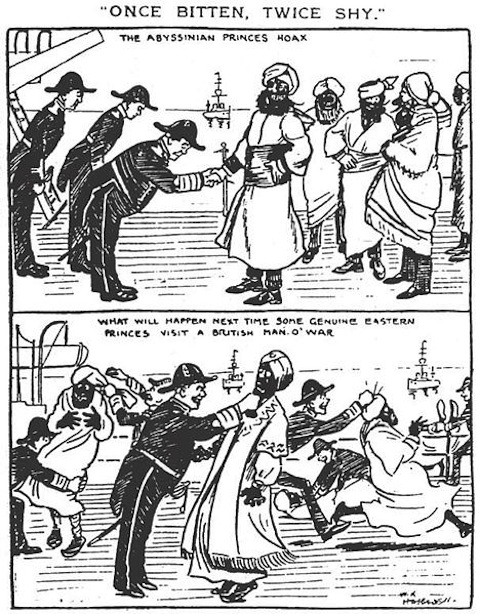
In a recently discovered letter, Cole wrote to a friend that the hoax was “glorious” and “shriekingly funny.” The group intended to mock what they saw as an outmoded Victorian imperialism, and they succeeded, at least in the popular press. The Mirror published the cartoon above and the Royal Navy was a laughingstock for weeks afterward. None of this pseudo-racist pranksterism (which reflected just as badly on the officers) struck the actual Emperor of Ethiopia—Menelik II—as particularly funny. When he visited England later that year, he was taunted in the streets by children shouting “Bunga! Bunga!” and denied permission to inspect the navy’s fleet for fear that his visit might cause further embarrassment.
Related Content:
F. Scott Fitzgerald in Drag (1916)
Josh Jones is a writer and musician based in Washington, DC. Follow him at @jdmagness
Read More...Two Scenes from Stanley Kubrick’s Dr. Strangelove, Recreated in Lego
Stanley Kubrick, among the many other skills that made him perhaps the best-known auteur of the second half of the twentieth century, could craft an immediately memorable scene. Moreover, he could construct entire films out of nothing but immediately memorable scenes. This goes especially for his Cold War black comedy Dr. Strangelove: Or, How I Learned to Stop Worrying and Love the Bomb, whose fans tend to quote to each other not individual lines but entire five‑, ten‑, fifteen-minute stretches from the movie. One such oft-reenacted scene, the phone conversation in which President Merkin Muffley warns inebriated Premier Dimitri Kisov of the U.S. bombers headed toward Russia appears at the top of the post, in the original black-and-white, with the original voices of Peter Sellers, Peter Bull, and George C. Scott, and — with nothing in front of the camera but Lego bricks and Lego men.
Just above, you can see Sellers’ performance as the titular eccentric, alien hand-syndrome-suffering doctor physically rendered in Lego. Dr. Strangelove fans know the scene comes late in the film, when a long series of errors and acts of unreason on all sides has made imminent the moment of mutually assured destruction. “I had to take out the famous scene of Slim Pickens riding the bomb and the nuclear holocaust credits to have this video viewable, because those scenes were taken directly from the movie,” explains these videos’ creator, a Youtube user by the name of XXxOPRIMExXX. “I was hoping to have the Slim Pickens scene done in Lego by now but I just never had enough time or effort to do it, maybe some time in the future.” Let me say that, if I have confidence in anyone to get that job done, I have confidence in someone with the stamina to successfully build a Lego War Room.
Related Content:
Inside Dr. Strangelove: Documentary Reveals How a Cold War Story Became a Kubrick Classic
Classic Photographs Remade Lego Style
Colin Marshall hosts and produces Notebook on Cities and Culture and writes essays on literature, film, cities, Asia, and aesthetics. He’s at work on a book about Los Angeles, A Los Angeles Primer. Follow him on Twitter at @colinmarshall.
Read More...Annotated Photographs of Beat Writers Featured in The Allen Ginsberg Festival, Starting Today
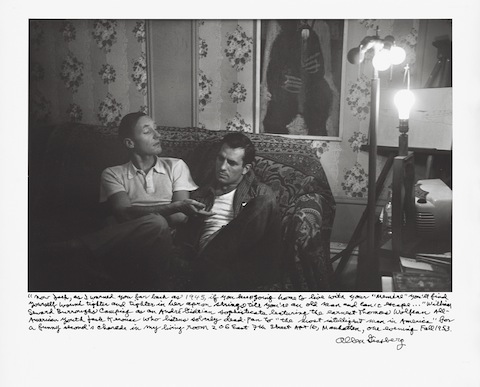
Starting today, the Contemporary Jewish Museum (CJM) begins its four-day celebration of Allen Ginsberg with The Allen Ginsberg Festival in San Francisco, produced in cooperation with The Beat Museum, City Lights Bookstore, and several other organizations. The festival, which runs from the 11th to the 14th of this month, celebrates Ginsberg’s life and art with a host of events (some free, some ranging from $10 to $15 for admission). While the literary tours, panel discussions, and lectures promise to be a treat for those lucky enough to attend, perhaps the centerpiece of the Ginsberg Festival is an exhibition of the poet’s annotated photographs, on view at CJM until September 8th.
The photos, which moved through NYU’s Grey Art Gallery earlier this year, show Ginsberg and his beat buddies in intimate and unguarded moments, such as the snap above of William Burroughs and Jack Kerouac. In his tidy script handwriting, Ginsberg writes below the photo:
“Now Jack as I warned you far back as 1945, if you keep going home to live with your ‘Memère’ you’ll find yourself wound tighter and tighter in her apron strings till you’re an old man and can’t escape…” William Seward Burroughs camping as an André Gide-ian sophisticate lecturing the earnest Thomas Wolfean All-American youth Jack Kerouac who listens soberly dead-pan to “the most intelligent man in America” for a funny second’s charade in my living room 206 East 7th Street Apt 16, Manhattan, one evening Fall 1953
Flavorwire has compiled 25 of these photos, including the portrait of the young merchant marine, Allen Ginsberg, below, which he annotates as, “Allen Ginsberg, utility man S.S. John Blair just back from Galveston-Dakar doldrums trip, I handed my camera to the radio-man on the ship’s fantail, smoking what? In New York harbor, circa October 30, 1947.”

As the CJM page notes, “the late 1940s and early 1950s marked a crucial period for Allen Ginsberg as he found his poetic and sexual voices simultaneously.” The photos in this exhibit document not only Ginsberg finding himself, but also finding himself among a group of men—Burroughs, Kerouac, Neal Cassady, Gregory Corso—whose restlessness and erudite enthusiasm changed the course of twentieth century literature.
Related Content:
Hear the Very First Recording of Allen Ginsberg Reading His Epic Poem “Howl” (1956)
Allen Ginsberg’s Personal Recipe for Cold Summer Borscht
Josh Jones is a writer and musician based in Washington, DC. Follow him at @jdmagness
Read More...Support Us
We're hoping to rely on loyal readers, rather than erratic ads. Please click the Donate button and support Open Culture. You can use Paypal, Venmo, Patreon, even Crypto! We thank you!

About Us

Open Culture scours the web for the best educational media. We find the free courses and audio books you need, the language lessons & educational videos you want, and plenty of enlightenment in between.
Advertise With Us

FREE UPDATES!
GET OUR DAILY EMAIL
Get the best cultural and educational resources on the web curated for you in a daily email. We never spam. Unsubscribe at any time.
FOLLOW ON SOCIAL MEDIA

Open Culture editor Dan Colman scours the web for the best educational media. He finds the free courses and audio books you need, the language lessons & movies you want, and plenty of enlightenment in between.
Advertise With Us

