Gertrude Stein Sends a “Review” of The Great Gatsby to F. Scott Fitzgerald (1925)
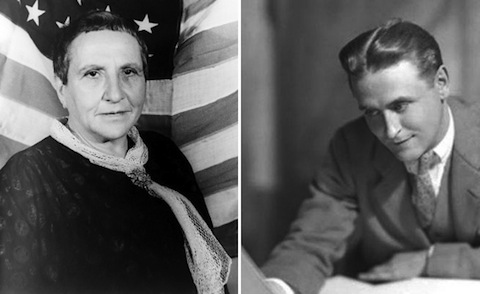
“Here we are and have read your book and it is a good book.” That sentence about The Great Gatsby may read, in isolation, like one out of a particularly unmotivated high school student’s summer-reading report. But it actually comes from astute woman of letters Gertrude Stein in a letter — and, in its way, a review of the then-new novel — to F. Scott Fitzgerald himself. This missive from one distinguished literary member of America’s “Lost Generation” to another continues as follows:
I like the melody of your dedication and it shows that you have a background of beauty and tenderness and that is a comfort. The next good thing is that you write naturally in sentences and that too is a comfort. You write naturally in sentences and one can read all of them and that among other things is a comfort. You are creating the contemporary world much as Thackeray did his in Pendennis and Vanity Fair and this isn’t a bad compliment. You make a modern world and a modern orgy strangely enough it was never done until you did it in This Side of Paradise. My belief in This Side of Paradise was alright. This is as good a book and different and older and that is what one does, one does not get better but different and older and that is always a pleasure. Best of good luck to you always, and thanks so much for the very genuine pleasure you have given me. We are looking forward to seeing you and Mrs. Fitzgerald when we get back in the Fall. Do please remember me to her and to you always
Gtde Stein
Stein’s words, come to think of it, might make just the ticket for the aforementioned English-class slacker who may have actually read The Great Gatsby, and might even have enjoyed it, but can’t pin down what everyone expects him to respect about it. “You write naturally in sentences and one can read all of them” tells you everything you need to about why so many other skilled writers have made a habit of re-reading the novel every decade, every year, even every few months. “You are creating the contemporary world” sums up much of Fitzgerald’s thematic accomplishment, and that bit about “a modern orgy” makes the point much more vivid indeed. And thinking in the longer term, this hypothetical teenager might well benefit from the piece of all-purpose wisdom that “one does not get better but different and older and that is always a pleasure.”
You can find much more pleasure of the literary-historical variety at Letters of Note, which originally posted this one. While there, do consider taking a look at what Fitzgerald’s editor said about an early Gatsby draft, and a rejection of Stein’s The Making of Americans.
via Letters of Note
Related Content:
Gertrude Stein Gets a Snarky Rejection Letter from Publisher (1912)
Haruki Murakami Translates The Great Gatsby, the Novel That Influenced Him Most
83 Years of Great Gatsby Book Cover Designs: A Photo Gallery
Colin Marshall hosts and produces Notebook on Cities and Culture and writes essays on literature, film, cities, Asia, and aesthetics. He’s at work on a book about Los Angeles, A Los Angeles Primer. Follow him on Twitter at @colinmarshall.
Read More...Charles Mingus Explains in His Grammy-Winning Essay “What is a Jazz Composer?”
I remember the first time I heard Charles Mingus. My senior year of high school, a friend who, at the time, was studying electric bass at Boston’s Berklee College of Music, introduced me by putting on 1956’s Pithecanthropus Erectus and saying “you have to hear this.” I knew jazz in a passing way—some Ellington, some Miles Davis… not enough to make many distinctions. But I knew right away Mingus was something special. His compositions were so cool, so dynamic and angular and thoughtful, with the push-pull of his measured double bass against the occasional cacophony of piano and sax. Entranced, I sought out more, and discovered favorites like the bluesy “Goodbye Pork Pie Hat”—live at Montreux in 1975 above—from Mingus’s 1959 watershed Mingus Ah Um, a record that shared the spotlight with other instant classics that year, including Miles Davis’ Kind of Blue, John Coltrane’s Giant Steps, and Ornette Coleman’s The Shape of Jazz to Come. (On that note, don’t miss the documentary, 1959: The Year That Changed Jazz.)
Mingus stood among giants, and was a giant himself. But oddly enough, while all of the artists on this list won, often multiple, Grammy awards, Mingus received no nods from the Recording Academy for any of his several dozen original albums. The snubs—if that’s what they were—may have been due to his famously irascible personality, or to the fact that Mingus eluded classification. As his friend Nat Hentoff wrote of him in 1999, jazz critics could not “find a category, a convenient term, to describe him.” Mingus himself told Hentoff, “I am trying to play the truth of what I am. The reason it’s difficult is because I’m changing all the time.” But while the bassist’s musical compositions were ignored, he did receive one nomination, in 1971, for another kind of writing—the liner notes to his 1971 album Let My Children Hear Music, a record he called “the best album I have ever made” (hear it in full below). Mingus’s liner-notes essay—a lost art these days—is titled “What is a Jazz Composer?,” and it’s an insightful exploration of the artist’s own history and compositional technique.
Eloquent, but loose, Mingus’s prose wanders from personal anecdotes to philosophical ruminations. On the role of jazz soloists as composers, he writes,
Each jazz musician when he takes a horn in his hand- trumpet, bass, saxophone, drums-whatever instrument he plays—each soloist, that is, when he begins to ad lib on a given composition with a title and improvise a new creative melody, this man is taking the place of a composer.
Later, however, Mingus seems skeptical of this idea: “each jazz musician is supposed to be a composer. Whether he is or not, I don’t know.” Although Mingus struggled as a child to read music—and faced racial barriers to a classical career—he trained first on the cello and incorporated many elements of classical music, as well as gospel and big band, into his compositions. When the bop era of improvisation came along, Mingus rolled with it, but found himself looking critically at the new wave represented by, for example, Ornette Coleman’s showy solos. The essay, even so many years after the bop revolution, reflects his ambivalence. He writes:
Today, things are at the other extreme. Everything is supposed to be invented, the guys never repeat anything at all and probably couldn’t. They don’t even write down their own tunes, they just make them up as they sit on the bandstand. It’s all right, I don’t question it. I know and hear what they are doing. But the validity remains to be seen—what comes, what is left, after you hear the melody and after you hear the solo. Unless you just want to hear the feeling, as they say.
Mingus was an oddity in the post-bop world; he generally eschewed the soloist approach. Instead, he seems to see himself operating in a classical, or at least more formal, tradition, drawing as much from Stravinsky as from Ellington. As one writer puts it, his music was “schizophrenic in that it both harked back to the New Orleans roots of jazz and looked forward to progressive chamber jazz and ‘third stream’ jazz. His compositions ranged wildly in mood and dynamics, from puntillistic counterpoint to massive Wagner-ian explosions.” In his liner notes, he laments the limited instrumentation of jazz, which he finds “stifling.” Mingus makes it clear that as a composer, he strives for highbrow respectability, while also stressing that he thinks the virtuosity of jazz has pushed all forms forward, including classical. Bequeathing his album to his successors, his musical “children,” Mingus urges future jazz composers to expand their range into symphonic territory:
I think it is time our children were raised to think they can play bassoon, oboe, English horn, French horn, lull percussion, violin, cello. The results would be-well the Philharmonic would not be the only answer for us then. If we so-called jazz musicians who are the composers, the spontaneous composers, started including these instruments in our music, it would open everything up, it would get rid of prejudice because the musicianship would be so high in caliber that the symphony couldn’t refuse us.
Some of Mingus’s contemporaries found his classical aspirations cold and offputting. For example, Mingus describes in an interview how Fats Navarro—who said he “always played with hate”—chided the bassist by saying, “Mingus, you just played the theory. you didn’t tell me how you felt. You didn’t say, ‘Hello, Fats, I love you.’ You didn’t play nothing beautiful” (an observation Mingus says “woke him up”).
The liner notes essay is replete with other reminisces of Mingus’s musical coming-of-age, from his love for Debussy, Stravinsky, and Strauss, to his tutelage under “master musician” Lloyd Reese. You can read the whole thing here at the official Mingus site, which features more of his writing, such as “An Open Letter to Miles Davis,” originally published in Down Beat Magazine in 1955.
Related Content:
1959: The Year that Changed Jazz
How to Potty Train Your Cat: A Handy Manual by Charles Mingus
Rare Miles Davis Live Recordings Capture the Jazz Musician at the Height of His Powers
Josh Jones is a writer and musician based in Washington, DC. Follow him at @jdmagness
Read More...How the Tesla Model S is Made: A Behind-the-Scenes Tour
Earlier today, we showed you what goes into making a Steinway grand piano. Now we’re heading clear across the country, from New York to California, to the factory where the Tesla Model S is made. The process couldn’t be more different. Steinway is all about wood and craftsmen; Tesla about metal and mind-blowing robotics. A piano takes a year to build; a Tesla, 3–5 days. But what do they ultimately have in common? A price tag that can rise well north of $60,000.
Read More...Slavoj Žižek Responds to Noam Chomsky: ‘I Don’t Know a Guy Who Was So Often Empirically Wrong’
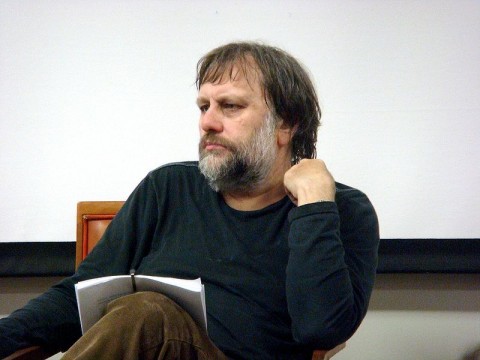
Earlier this month we posted an excerpt from an interview in which linguist Noam Chomsky slams the Slovenian philosopher and cultural critic Slavoj Žižek, along with the late French theorists Jacques Lacan and Jacques Derrida, for cloaking trivial ideas in obscure and inflated language to make them seem profound.
“There’s no ‘theory’ in any of this stuff,” Chomsky says to an interviewer who had asked him about the three continental thinkers, “not in the sense of theory that anyone is familiar with in the sciences or any other serious field. Try to find in all of the work you mentioned some principles from which you can deduce conclusions, empirically testable propositions where it all goes beyond the level of something you can explain in five minutes to a twelve-year-old. See if you can find that when the fancy words are decoded. I can’t. So I’m not interested in that kind of posturing. Žižek is an extreme example of it.”
Chomsky’s remarks sparked a heated debate on Open Culture and elsewhere. Many readers applauded Chomsky; others said he just didn’t get it. On Friday, Žižek addressed some of Chomsky’s criticisms during a panel discussion with a group of colleagues at the Birkbeck Institute for the Humanities in London:
Žižek’s remarks about Chomsky don’t appear until about the one-hour, 30-minute mark, but Sam Burgum, a PhD student at the University of York, has transcribed the pertinent statements and posted them on his site, EsJayBe. Here are the key passages:
What is that about, again, the academy and Chomsky and so on? Well with all deep respect that I do have for Chomsky, my first point is that Chomsky, who always emphasizes how one has to be empirical, accurate, not just some crazy Lacanian speculations and so on… well I don’t think I know a guy who was so often empirically wrong in his descriptions in his whatever! Let’s look… I remember when he defended this demonstration of Khmer Rouge. And he wrote a couple of texts claiming: No, this is Western propaganda. Khmer Rouge are not as horrible as that.” And when later he was compelled to admit that Khmer Rouge were not the nicest guys in the Universe and so on, his defense was quite shocking for me. It was that “No, with the data that we had at that point, I was right. At that point we didn’t yet know enough, so… you know.” But I totally reject this line of reasoning.
For example, concerning Stalinism. The point is not that you have to know, you have photo evidence of gulag or whatever. My God you just have to listen to the public discourse of Stalinism, of Khmer Rouge, to get it that something terrifyingly pathological is going on there. For example, Khmer Rouge: Even if we have no data about their prisons and so on, isn’t it in a perverse way almost fascinating to have a regime which in the first two years (’75 to ’77) behaved towards itself, treated itself, as illegal? You know the regime was nameless. It was called “Angka,” an organization — not communist party of Cambodia — an organization. Leaders were nameless. If you ask “Who is my leader?” your head was chopped off immediately and so on.
Okay, next point about Chomsky, you know the consequence of this attitude of his empirical and so on — and that’s my basic difference with him — and precisely Corey Robinson and some other people talking with him recently confirmed this to me. His idea is today that cynicism of those in power is so open that we don’t need any critique of ideology, you reach symptomatically between the lines, everything is cynically openly admitted. We just have to bring out the facts of people. Like “This company is profiting in Iraq” and so on and so on. Here I violently disagree.
First, more than ever today, our daily life is ideology. how can you doubt ideology when recntly I think Paul Krugman published a relatively good text where he demonstrated how this idea of austerity, this is not even good bourgeois economic theory! It’s a kind of a primordial, common-sense magical thinking when you confront a crisis, “Oh, we must have done something wrong, we spent too much so let’s economize and so on and so on.”
My second point, cynicists are those who are most prone to fall into illusions. Cynicists are not people who see things the way they really are and so on. Think about 2008 and the ongoing financial crisis. It was not cooked up in some crazy welfare state; social democrats who are spending too much. The crisis exploded because of activity of those other cynicists who precisely thought “screw human rights, screw dignity, all that maters is,” and so on and so on.
So as this “problem” of are we studying the facts enough I claim emphatically more than ever “no” today. And as to popularity, I get a little bit annoyed with this idea that we with our deep sophisms are really hegemonic in the humanities. Are people crazy? I mean we are always marginal. No, what is for me real academic hegemony: it’s brutal. Who can get academic posts? Who can get grants, foundations and so on? We are totally marginalized here. I mean look at my position: “Oh yeah, you are a mega-star in United States.” Well, I would like to be because I would like power to brutally use it! But I am far from that. I react so like this because a couple of days ago I got a letter from a friend in United States for whom I wrote a letter of recommendation, and he told me “I didn’t get the job, not in spite of your letter but because of your letter!” He had a spy in the committee and this spy told him “You almost got it, but then somebody says “Oh, if Žižek recommends him it must be something terribly wrong with him.”
So I claim that all these “how popular we are” is really a mask of… remember the large majority of academia are these gray either cognitivists or historians blah blah… and you don’t see them but they are the power. They are the power. On the other hand, why are they in power worried? Because you know… don’t exaggerate this leftist paranoia idea that “we can all be recuperated” and so on and so on. No! I still quite naively believe in the efficiency of theoretical thinking. It’s not as simple as to recuperate everything in. But you know there are different strategies of how to contain us. I must say that I maybe am not innocent in this, because people like to say about me, “Oh, go and listen to him, he is an amusing clown blah blah blah.” This is another way to say “Don’t take it seriously.”
via Partially Examined Life
Related content:
Noam Chomsky Slams Žižek and Lacan: Empty ‘Posturing’
Noam Chomsky Calls Postmodern Critiques of Science Over-Inflated ‘Polysyllabic Truisms’
John Searle on Foucault and the Obscurantism in French Philosophy
Download 90 Free Philosophy Courses and Start Living the Examined Life
Read More...David Foster Wallace’s Love of Language Revealed by the Books in His Personal Library
“I didn’t think much of Infinite Jest in the beginning,” writes Jacqueline Munoz, librarian at the University of Texas at Austin’s Harry Ransom Center. But as she read further into Wallace’s seemingly “wordy and unfocused” landmark novel, the author’s mind, and how it dealt with “how unforgiving it is to be human” and how different generations “struggle internally with the same issues,” won her over: “I thought, this man is a genius; I want to know him better.” Many of us Wallace fans harbor the same desire, and now that the Ransom Center has acquired and made available a considerable chunk of the writer’s heavily annotated library, a few more of us can. The books in Wallace’s library, as Munoz puts it, reveal “a philosopher, mathophile, physics buff, grammarian, pop-fiction reader, lit professor, creative writer, and spiritual seeker,” and Maria Bustillos, writing in The Awl back in 2011, traced Wallace’s seemingly strange but ultimately meaningful presence of titles like The Spirituality of Imperfection and The Drama of the Gifted Child.
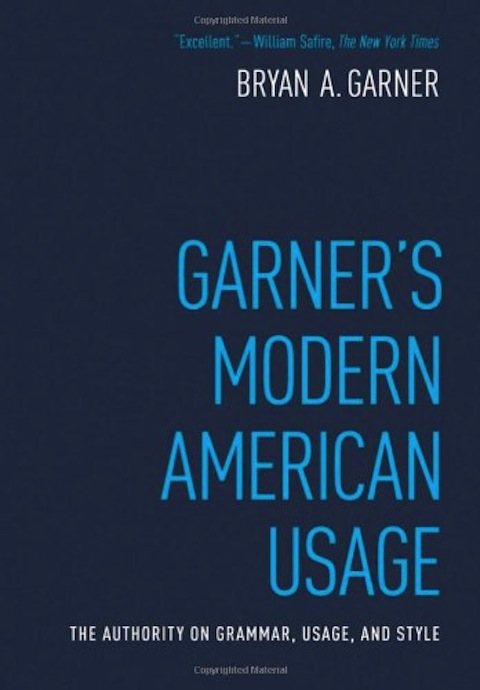
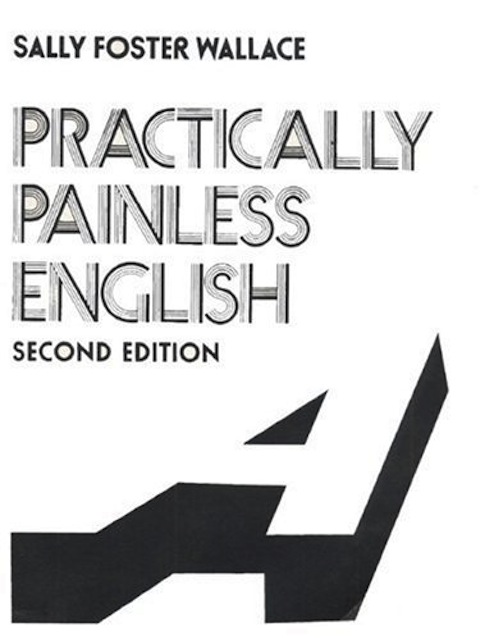
Bustillos’ exploration of Wallace’s proclivity for self-help brings in a volume written by Sally Foster Wallace, David’s mother: a grammar textbook called Practically Painless English, “the only book of English grammar I know of that can hold a candle to the works of the Fowler brothers.” Her book has a place in the Ransom Center’s collection, and anyone who’s read Wallace’s Harper’s article “Tense Present” may smile at its presence, remembering stories of the songs about solecisms and other linguistic misuses his family would sing on car trips. Ostensibly a review of Bryan A. Garner’s A Dictionary of Modern American Usage, a copy of which also made it into the collection, the piece reveals Wallace’s thoroughgoing interest in the mechanics, well-functioning or otherwise, of English. You can follow the thread through several other titles in his possession, including Albert Baugh’s A History of the English Language, John D. Ramage’s Rhetoric: A User’s Guide, all the way to Peter Ladefoged’s Elements of Acoustic Phoenetics. And when you’re done, you will want to keep following the thread a little further by checking out our previous post: David Foster Wallace Breaks Down Five Common Word Usage Mistakes in the English Language.
Related Content:
30 Free Essays & Stories by David Foster Wallace on the Web
David Foster Wallace: The Big, Uncut Interview (2003)
David Foster Wallace’s 1994 Syllabus
Colin Marshall hosts and produces Notebook on Cities and Culture and writes essays on literature, film, cities, Asia, and aesthetics. He’s at work on a book about Los Angeles, A Los Angeles Primer. Follow him on Twitter at @colinmarshall.
Read More...Pussy Riot Releases First Video in a Year, Taking on Russian Oil Profits and Other High-Profile Targets
Russian punk performance art collective Pussy Riot will not be deterred. Despite two of their members still languishing in prison labor camps for a musical protest in Moscow’s Cathedral of Christ the Savior, the band continues to rail against its country’s corruption and abuses. This time, in their first music video in almost a year, they take on the Russian oil industry and other targets in the song above called “Like in a Red Prison.” The Wall Street Journal writes:
The confusing and caustic lyrics to the hard-to-listen-to song decry sexism, “homophobic vermin,” actor Gerard Depardieu (a recent recipient of Russian citizenship courtesy of Mr. Putin), and likens Russia’s president to the Ayatollah of Iran.
I don’t find the song hard to listen to at all—quite the contrary—and the video’s pretty exhilarating too, with the band members, in trademark multi-colored balaclavas, clambering atop an oil derrick and defacing a portrait of oil executive Igor Sechin and a head of the Investigative Committee (Russia’s FBI). Definitely a lot going on here, but the central focus is the critique of Russian big oil. The band explains on their site that “Russia’s revenues from the oil industry amounted to 7 trillion rubles ($216 billion), but only Russian President Vladimir Putin and ‘several of his friend see this’” [sic]. The new song’s lyrics were partly written by one of the still-imprisoned members, Nadezhda Tolokonnikova.
Related Content:
Russian Punk Band, Sentenced to Two Years in Prison for Deriding Putin, Releases New Single
Fear of a Female Planet: Kim Gordon (Sonic Youth) on Why Russia and the US Need a Pussy Riot
Josh Jones is a writer and musician based in Washington, DC. Follow him at @jdmagness
Read More...Read Ulysses Seen, A Graphic Novel Adaptation of James Joyce’s Ulysses
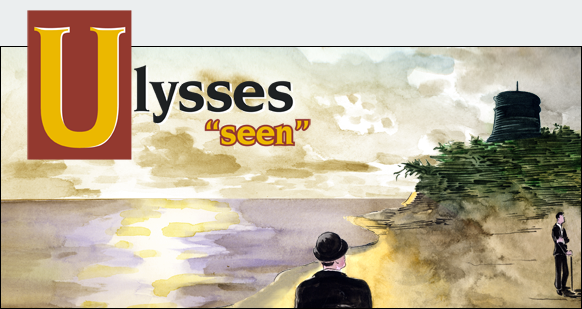
You’ve started reading Ulysses, James Joyce’s modernist classic, and never quite made it the whole way through. Sound familiar? You’re in good company.
So here’s another approach. Start reading Ulysses Seen, the graphic novel adaptation of Joyce’s tome. The artist behind Ulysses Seen is Rob Berry, and he’s devoted to using “the visual aid of the graphic novel” to “foster understanding of public domain literary masterworks.” He’s clear to point out that Ulysses Seen isn’t meant to replace Ulysses. Rather it’s meant to be a visual companion to the original work. It uses the comic narrative to “cut through jungles of unfamiliar references” and to help readers “appreciate the subtlety and artistry” of Joyce’s text. So far Berry has completed about 138 pages of Ulysses Seen, and more pages will be coming online at the Joyce Center web site in the near future. According to Publisher’s Weekly, the artist estimates that it will take roughly a decade to complete the full adaptation. (The original novel spans more than 700 pages after all.) In the meantime, here are some more resources to help you get through Joyce’s great work:
James Joyce’s Ulysses: Download the Free Audio Book
Read Joyce’s Ulysses Line by Line, for the Next 22 Years, with Frank Delaney’s Podcast
James Joyce Manuscripts Online, Free Courtesy of The National Library of Ireland
Stephen Fry Explains His Love for James Joyce’s Ulysses
Read More...Better Living Through Buckminster Fuller’s Utopian Designs: Revisit the Dymaxion Car, House, and Map
To those who haven’t delved deeply into his considerable body of work, twentieth-century architect, inventor, and futurist Buckminster Fuller seems to have left behind a single lasting contribution to the built environment: the geodesic dome. This I remember whenever I pass by the Cinerama Dome on Sunset Boulevard, a famous movie theater built according to Fuller’s sphere-intensive architectural principles. But the fact that you don’t see many other geodesic domes these days — you never did see many, I suppose — belies the abundant fruits of Fuller’s imagination and know-how. Vigilantly mindful of humanity’s potential for a better tomorrow, he also designed a suite of seemingly Utopian, surprisingly innovative, and ultimately unpopular tools for better living. He branded them with a portmanteau of dynamic, maximum, and tension: “Dymaxion” came to stand, or at least Fuller seemed to want it to stand, for unceasing dedication to improving our patterns of life.
To that end, he conceived of the Dymaxion House, or “Dymaxion Dwelling Machine,” a cheaply mass-producible, naturally heated and cooled, nearly maintenance-free, easily modifiable, and, of course, round housing solution. The satisfied resident of Fuller’s future would drive to and from his Dymaxion House, along with ten passengers, in his aerodynamic Dymaxion Car, capable of reaching 90 miles per hour at 30 miles to the gallon. And no matter where he drove, he could find his way with the Dymaxion Map (also known as the “Fuller Projection map”), the only flat whole-earth map with no visual distortions in its representation of what Fuller called Spaceship Earth. You can see the Dymaxion Car in action, and hear Fuller talk about its development, in the video just above. A 1946 newsreel tour of the Dymaxion House appears at the top of the post. If you now find yourself eager to live according to Buckminster Fuller’s ideals, try keeping his ultra-detailed form of a diary, the Dymaxion Chronofile, or taking his periodic 30 minute Dymaxion naps. I know I’d like to get a Dymaxion bathroom installed.

Related Content:
Everything I Know: 42 Hours of Buckminster Fuller’s Visionary Lectures Free Online (1975)
Colin Marshall hosts and produces Notebook on Cities and Culture and writes essays on literature, film, cities, Asia, and aesthetics. He’s at work on a book about Los Angeles, A Los Angeles Primer. Follow him on Twitter at @colinmarshall.
Read More...Hannah Arendt Discusses Philosophy, Politics & Eichmann in Rare 1964 TV Interview
Hannah Arendt’s work has come under some critical fire lately, what with the release of the Margarethe Von Trotta-directed biopic, starring German actress Barbara Sukowa as the controversial political theorist. At issue in the film and the surrounding commentary are Arendt’s (allegedly misleading) characterizations of the subject of her 1963 book Eichmann in Jerusalem, as well as her ambivalent—some have said callous, even “victim-blaming”—treatment of other Jews. None of these controversies are new, however. As Arendt scholar Roger Berkowitz notes in a recent New York Times editorial, at the time of her book’s publication, “Nearly every major literary and philosophical figure in New York chose sides in what the writer Irving Howe called a ‘civil war’ among New York intellectuals.”
While acknowledging Arendt’s flaws, Berkowitz seeks to exonerate the best-known concept that emerged from her work on Eichmann’s trial, the “banality of evil.” And while it can be comforting to have an interpreter explain, and defend, the work of a major, controversial, thinker, there is no intellectual substitute for engaging with the work itself.
In the age of the media interview—radio, television, podcast and otherwise—one can usually see and hear an author explain her views in person. And so we have the interview above (in German with English subtitles), in which Arendt sits with television presenter and journalist Gunter Gaus for a German program called Zur Person (The Person), a Charlie Rose-like show that featured celebrities, important thinkers, and politicians (including an appearance by Henry Kissinger).
A blogger at Jewish Philosophy Place writes that Arendt’s interview—a transcript of which was later published in The Portable Hannah Arendt as “What Remains? Language Remains”—is “slow and deliberative, not sharp and declarative, moving in circles, not straight lines.” The interview touches on a variety of topics, drawing on ideas expressed in Arendt’s earlier works, The Origins of Totalitarianism and The Human Condition. She is somewhat cagey when it comes to the so-called “Eichmann Controversy,” and she may have had personal as well as professional reasons for indirection. Her affair with her former professor, avowed and unrepentant Nazi Martin Heidegger, dogged her post-war career, and the aforementioned intellectual “civil war” probably increased her circumspection.
Arendt’s critics, then and now, often remark upon what the Jewish Philosophy Place writer succinctly calls her “disdain for others.” While the new biopic (trailer above) may obscure much of this critical controversy—unfilmable as such things are anyway—readers wishing to understand one of the Holocaust’s most famous interpreters should read, and hear, her in her own words before making any judgments.
Related Content:
Hannah Arendt’s Original Articles on “the Banality of Evil” in the New Yorker Archive
Martin Heidegger Talks About Language, Being, Marx & Religion in Vintage 1960s Interviews
Download 90 Free Philosophy Courses and Start Living the Examined Life
Josh Jones is a writer and musician based in Washington, DC. Follow him at @jdmagness
Read More...Have I Told You Lately That I Love You?: A 1958 Look at How Modern Gadgets & Conveniences Lead to Existential Hell
Think growing feelings of isolation in a world of modern conveniences is a new phenomenon? Slap a dial on that smartphone, shove a collectible rocket in your kid’s cereal box, hop in a Caddy with fins and think again, pal!
Have I Told You Lately That I Love You, a cautionary tale created by University of Southern California students in 1958, is a far-from-silent film marked by a near-total absence of human speech. The little boy character seems happy enough with his popsicle and television Westerns, but his white-collar dad and housewife mom are marooned in their individual existential hells, unable to connect. Could the newfangled, labor saving devices with which their home and dad’s workplace abound be to blame?
The newsy radio report playing intermittently in the background would certainly have it so. Stories of hair loss, headaches and a kid shooting his father over a TV-related dispute suggest none too subtly that progress has long been a source of anxiety.
I might suggest that the mother is suffering more from the rigid gender roles of her era than the tyranny of an automatic dishwasher. Perhaps the suburbs weren’t offering them much in the way of community. Isn’t it possible that the relationship has gone cold due to the father’s penchant for hopping in bed with the girls from the steno pool?
That’s pretty standard behavior on Mad Men, no?
While this short film offers none of the aforementioned’s sexy, booze-soaked highs, there’s quite a bit of black-and-white design porn on display. Dictaphones, gleaming kitchen appliances, a music box that dispenses cigarettes…
Otherwise it’s a vision of an average American 1950’s family as conceived of by Ingmar Bergman.
Related Content:
Before Mad Men: Familiar and Forgotten Ads from 1950s to 1980s Now Online
How a Clean, Tidy Home Can Help You Survive the Atomic Bomb: A Cold War Film from 1954
How the CIA Secretly Funded Abstract Expressionism During the Cold War
Ayun Halliday has always preferred the Roaring Twenties. Follow her @AyunHalliday
Read More...Support Us
We're hoping to rely on loyal readers, rather than erratic ads. Please click the Donate button and support Open Culture. You can use Paypal, Venmo, Patreon, even Crypto! We thank you!

About Us

Open Culture scours the web for the best educational media. We find the free courses and audio books you need, the language lessons & educational videos you want, and plenty of enlightenment in between.
Advertise With Us

FREE UPDATES!
GET OUR DAILY EMAIL
Get the best cultural and educational resources on the web curated for you in a daily email. We never spam. Unsubscribe at any time.
FOLLOW ON SOCIAL MEDIA

Open Culture editor Dan Colman scours the web for the best educational media. He finds the free courses and audio books you need, the language lessons & movies you want, and plenty of enlightenment in between.
Advertise With Us

