8‑Year-Old Anne Frank Plays in a Sandbox on a Summer Day, 1937
 Before Anne Frank was forced into hiding during World War II, there was a time when she, her family and friends could do normal things that many people take for granted. Like play in a sandbox on a warm summer day. In the shot above, Anne is 2nd from the left. More photos of Frank can be viewed at AnneFrank.org. And here you can watch the only known video showing the world’s most famous memoir writer.
H/T @MiaFarrow
Related Content:
Anne Frank: The Only Existing Video Now Online
Anne Frank’s Diary: From Reject Pile to Bestseller
Google Brings History to Life with 42 New Online Exhibitions
Read More...Free Comic Books Turns Kids Onto Physics: Start With the Adventures of Nikola Tesla
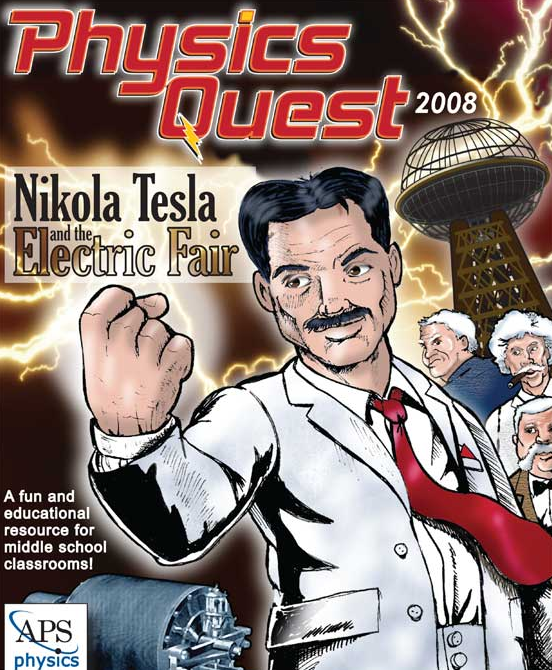
PhysicsCentral, a web site run by The American Physical Society (an organization representing 48,000 physicists), has created a series of comic books designed to get kids excited about physics. If you click here, you can enjoy Nikola Tesla and the Electric Fair for free online. The 2008 comic book pits Thomas Edison against Tesla, the unsung hero of electricity and magnetism. Also on the Physics Central web site, you can enjoy four free comics from the Spectra series, which presents the adventures of a middle school superhero, who possesses all of the great powers of a laser beam.
We’ll be sure to add these comics to our collection of Free K‑12 Educational Resources.
via BoingBoing
Related Content:
Thomas Edison and Nikola Tesla Face Off in “Epic Rap Battles of History”
A Brief, Animated Introduction to Thomas Edison (and Nikola Tesla)
425 Free eBooks: Download to Kindle, iPad/iPhone & Nook
Read More...John Updike’s Advice to Young Writers: ‘Reserve an Hour a Day’
John Updike once said of his task as a writer, “My only duty was to describe reality as it had come to me — to give the mundane its beautiful due.” In book after book, he did just that.
With a sharp eye and a searching intellect, Updike reconstituted the details of everyday life into fluid, lyrical prose. “He turned a sentence better than anyone else,” said Ian McEwan in reaction to Updike’s untimely death in 2009. Philip Roth added: “John Updike is our time’s greatest man of letters, as brilliant a literary critic and essayist as he was a novelist and short story writer. He is and always will be no less a national treasure than his 19th-century precursor, Nathaniel Hawthorne. His death constitutes a loss to our literature that is immeasurable.”
In June of 2004, Updike sat for an interview with the Academy of Achievement, a Washington-based non-profit group dedicated to inspiring young people to succeed. In a wide-ranging conversation, Updike is asked whether he has any advice for writers just starting out. “You hesitate to give advice to young writers,” Updike says, “because there’s a limit to what you can say. It’s not exactly like being a musician, or even an artist, where there’s a set number of skills that have to be mastered.” Nevertheless, he goes on to make several suggestions:
To the young writers, I would merely say, “Try to develop actual work habits, and even though you have a busy life, try to reserve an hour, say — or more — a day to write.” Some very good things have been written on an hour a day. Henry Green, one of my pets, was an industrialist actually. He was running a company, and he would come home and write for just an hour in an armchair, and wonderful books were created in this way. So, take it seriously, you know, just set a quota. Try to think of communicating with some ideal reader somewhere. Try to think of getting into print. Don’t be content just to call yourself a writer and then bitch about the crass publishing world that won’t run your stuff. We’re still a capitalist country, and writing to some degree is a capitalist enterprise, when it’s not a total sin to try to make a living and court an audience. “Read what excites you,” would be advice, and even if you don’t imitate it you will learn from it. All those mystery novels I read I think did give me some lesson about keeping a plot taut, trying to move forward or make the reader feel that kind of tension is being achieved, a string is being pulled tight. Other than that, don’t try to get rich on the other hand. If you want to get rich, you should go into investment banking or being a certain kind of a lawyer. But, on the other hand, I would like to think that in a country this large — and a language even larger — that there ought to be a living in it for somebody who cares, and wants to entertain and instruct a reader.
To read the full interview with John Updike, which includes more video highlights, visit the Academy of Achievement Web site.
Related Content:
Writing Tips by Henry Miller, Elmore Leonard, Margaret Atwood, Neil Gaiman & George Orwell
Ernest Hemingway Creates a Reading List for a Young Writer, 1934
Ray Bradbury Gives 12 Pieces of Writing Advice to Young Authors (2001)
Read More...Alan Turing, Brilliant Mathematician and Code Breaker, Will Be Finally Pardoned by British Government
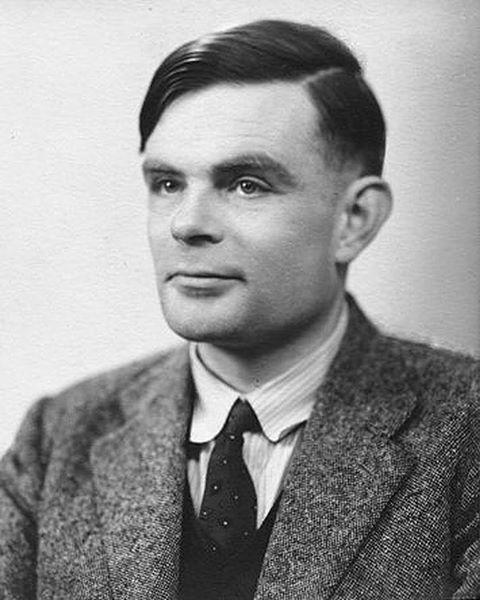 “Alan Turing, the Enigma codebreaker who took his own life after being convicted of gross indecency under anti-homosexuality legislation, is to be given a posthumous pardon,” writes The Guardian today. One of the great mathematicians of the last century, Turing laid the foundations for computer science and played a key role in breaking the Nazi Enigma code during World War II. Despite his contributions to defending Britain, Turing was prosecuted in 1952 for engaging in homosexual acts under an 1885 law that led to the convictions of 49,000 gay men, including Oscar Wilde. It’s a sad tale that gets recounted by another computer pioneer Jaron Lanier here:
For years, supporters have called upon the British government to issue a posthumous pardon. And while British Prime Minister Gordon Brown apologized in 2010 for “the appalling way [Turing] was treated,” members of the House of Lords resisted issuing an actual pardon as recently as last year. But, according to The Guardian, legislators are prepared to pass a new bill as early as this October. As many of our readers will be quick to point out, the concept of a pardon is a bit strange, seeing that Turing did nothing wrong. But the willingness of the government to effectively nullify the conviction and reject an archaic law is a welcomed piece of news.
via @philosophybites
Related Content:
Watch the 1996 Film, Breaking the Code, Starring Derek Jacobi
The Enigma Machine: How Alan Turing Helped Break the Unbreakable Nazi Code
Read More...Musical Comedian Reggie Watts Reinvents Van Halen’s Classic, “Panama”
Jump back, what’s that sound? Oh, it’s just Reggie Watts covering Van Halen’s 1984 cock rock anthem, Panama, in a crazy-ass golf sweater. Carry on.
On the invitation of The Onion’s AV Club, the musical comedian procured an early demo from the band, and used it as the inspiration for this performance, an unrecognizable fugue of live looped vocals.
Um, it’s still about a car, right?
The unlikely pairing came about as part of the AV Club’s Undercover series, a delightful parlor game wherein each act to play in the tiny round office at Onion HQ gets to pick a tune from a dwindling annual list of 25. The last act to visit gets stuck with the cut nobody else wanted. (Reggie arrived close to the middle of this clambake, and was ranked a respectable 5th by readers who went on to award self-proclaimed sickest band in metal history GWAR top honors for their twist on Kansas’ classic “Carry On Wayward Son.”)
For comparison’s sake, here’s Panama in its original form:
Related Content:
OK Go Covers The Muppet Show Theme Song (Stream New Album Online)
Watch Jimi Hendrix’s ‘Voodoo Chile’ Performed on a Gayageum, a Traditional Korean Instrument
Ayun Halliday came of age surrounded by Van Halen concert t‑shirts. Follow her @AyunHalliday
Read More...Star Wars Gets Dubbed into Navajo: a Fun Way to Preserve and Teach a Fading Language
On July 10, Indian Country Today announced the first film ever dubbed in the Navajo (or Dine’) language, with the headline “Jedis and Indians!” Yes, it’s a 35-year-old movie that’s been digitally enhanced and taken on new meaning (some would say cheapened) in the light of the three “prequels,” but it’s a film that will never lose its cultural cachet as a touchstone for several generations of movie lovers. I’m talking of course, about the first Star Wars (or Episode IV: A New Hope). Despite the fact that the film has been dubbed into hundreds of languages for billions of non-English speakers, this event is entirely different—the viewers of the Navajo Star Wars are all native English speakers who have understood and loved the original perfectly well.
Rather than introducing the film to a new audience, the point of this exercise is to bring a very popular, familiar piece of media to an audience eager to connect with their fading traditional language. Manuelito Wheeler, director of the Navajo Nation Museum in Arizona, conceived of the project to preserve the language for generations, including his own, who are losing touch with Dine’. In the short video above, watch Wheeler and the voice actors and translators discuss the project’s success in inspiring young people to speak more Navajo. Wheeler told NPR’s All Things Considered, “Language is at the core of a culture. And I felt we needed a more contemporary way to reach not just young people but the population in general.” He also said that he is not fluent and that “there are thousands and thousands of us out there that are in that same situation.”
So what better way to introduce those thousands to the fine complexities of Navajo than with a movie almost everyone knows all the dialogue to? The translation was not without its challenges. The team of five translators had to find ways to convey concepts unfamiliar to the language, such as “robot,” which was translated to the equivalent of “a machine that thinks for itself.” The newly-dubbed film’s premier at a Window Rock, Arizona rodeo stadium thrilled the small crowd of 200 people. As Indian Country Today reports, the crowd “erupted in cheers and screams when they heard familiar characters like C‑3PO and Darth Vader delivering classic dialogue in their beloved Dine’ language.” And as Wheeler puts it above, “people were very engaged without feeling like they were in a lesson.” As anyone who’s studied languages—their own or others—knows, pop culture nearly always trumps lectures and workbooks.
Speaking of learning languages, don’t miss our handy collection: Learn 46 Languages Online for Free: Spanish, English, Chinese & More. And if anyone knows of free online Dine’ lessons, let us know and we’ll happily add them to the list.
Related Content:
Star Wars Uncut: The Epic Fan Film
Josh Jones is a writer and musician based in Washington, DC. Follow him at @jdmagness
Read More...Building The Eiffel Tower: Three Google Exhibitions Revisit the Birth of the Great Parisian Monument

One of the most stunning views a traveler can have in Paris is to round a corner and see the massive four-legged base of the Eiffel Tower. One of the beautiful things about Eiffel’s tower is that it is so colossal and yet so airy and delicate.
The view from the top is also amazing (though truth be told the views from Notre Dame and Sacré-Coeur may be better because they include the Eiffel Tower too)—so much so that Google photographers hoisted their panoramic Street View camera into the tower and recorded breathtaking views from the three main levels.
The day Google showed up was a typically overcast Paris day. The sky is even a little threatening. After so much gazing out at the city, you might want to dip into a café for un petit café crème.
But keep your laptop with you. The Street View exhibit is one of three that Google now offers about the tower. Google’s Cultural Institute collaborated with the Eiffel Tower Operating Company to create three additional exhibits: The Birth of the Eiffel Tower, the tower’s construction, and another about its inauguration and early visitors.
One of the coolest pieces of archival material is a recording of tower engineer Gustave Eiffel’s voice made by Thomas Edison, who was a big fan of the tower.
Built to display France’s engineering prowess at the centenary of the French Revolution, the tower’s construction is amazing to contemplate. Four men were needed to install one rivet: one to heat it up, another to hold it in place, a third to shape the head and a fourth to beat it with a sledgehammer. A total of 2,500,000 rivets were used to hold the tower together.
For a much older view of the ride up the tower’s elevator, check out this film by the Lumière brothers, made the year the tower opened in 1898.
Related Content:
Climb Three of the World’s Highest Peaks on Google Street View
Google Street View Takes You on a Panoramic Tour of the Grand Canyon
Google Street View Opens Up a Look at Shackleton’s Antarctic
Kate Rix writes about digital media and education. Follow her on Twitter @mskaterix. Learn more about her work by visiting .
Read More...Louis Armstrong Plays Trumpet at the Egyptian Pyramids; Dizzy Gillespie Charms a Snake in Pakistan
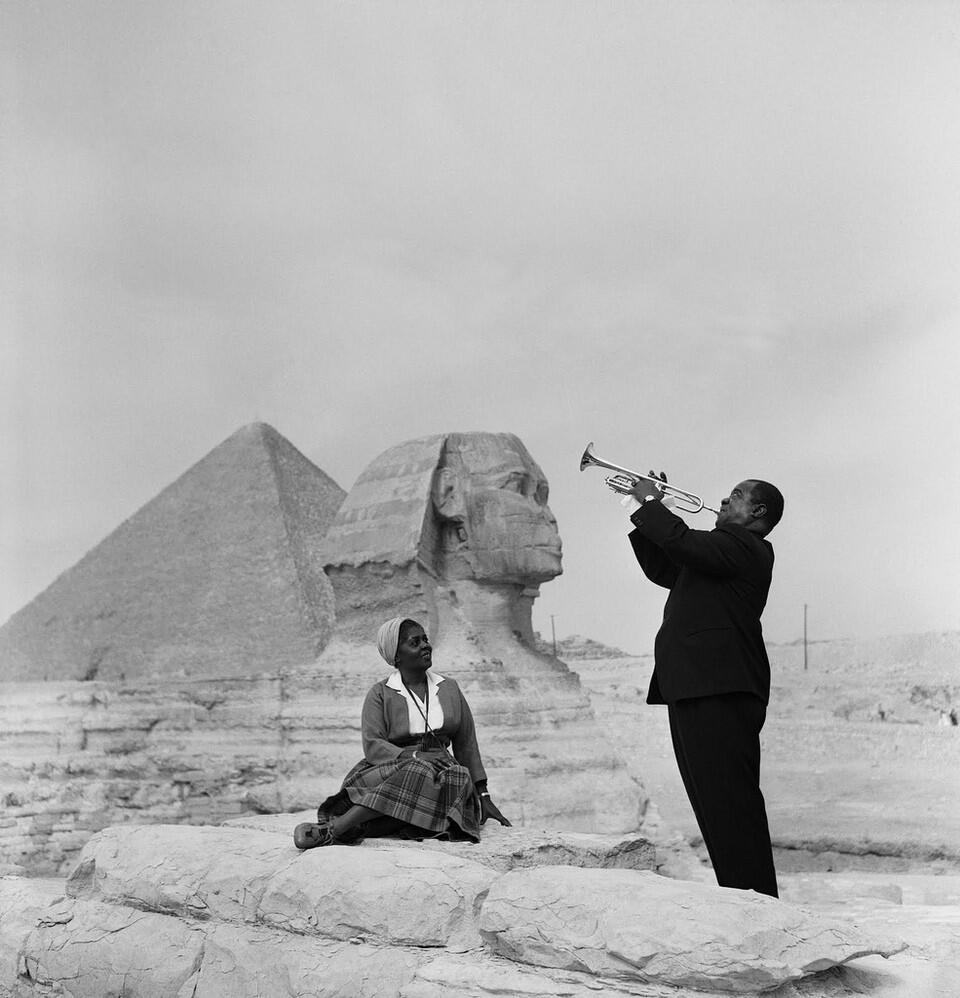
During the Cold War, the United States made the case for the American way of life by sending its best ambassadors abroad — jazz musicians. “Music that was unique to America and represented a fusion of African and African-American cultures with other traditions was a democratic art form that helped others to understand the open-minded and creative sensibility of our country,” writes the Jam Session web site. There, you can see photos of Duke Ellington, Dizzy Gillespie and Dave Brubeck in countries like Syria, Jordan, Afghanistan, Iraq, Japan, Singapore, South Korea, and Hong Kong. As part of this cultural diplomacy, the great Louis Armstrong went to Egypt in 1961 where, in this iconic photo, he played trumpet for his wife, Lucille, at the foot of the Great Sphinx and the pyramids in Giza.

A 2008 New York Times article highlights other images from these goodwill tours — there’s Dizzy Gillespie charming a snake with his trumpet in Karachi (1956), Benny Goodman playing his clarinet in the Red Square (1962) and Duke Ellington smoking a hookah in Iraq (1963). In a previous post, we also have Dave Brubeck talking about his Cold War adventures in Poland. Watch here.
If you would like to support the mission of Open Culture, consider making a donation to our site. It’s hard to rely 100% on ads, and your contributions will help us continue providing the best free cultural and educational materials to learners everywhere. You can contribute through PayPal, Patreon, and Venmo (@openculture). Thanks!
Related Content:
The Nazis’ 10 Control-Freak Rules for Jazz Performers: A Strange List from World War II
Louis Armstrong Plays Historic Cold War Concerts in East Berlin & Budapest (1965)
Stanley Kubrick’s Jazz Photography and The Film He Almost Made About Jazz Under Nazi Rule
Watch Lambeth Walk—Nazi Style: The Early Propaganda Mash Up That Enraged Joseph Goebbels
Jazz ‘Hot’: The Rare 1938 Short Film With Jazz Legend Django Reinhardt
Read More...The Poetry of Leonard Cohen Illustrated by Two Short Films
Looking back on the literary career of Leonard Cohen—in full flower in the mid-sixties before his second life as a folk singer/songwriter—one encounters many comparisons to Joyce. For example, in the National Film Board of Canada’s description of Ladies and Gentlemen… Mr. Leonard Cohen, the 1965 documentary film about the 30-year-old Canadian poet, we find: “it truly is, after Joyce, a portrait of the artist as a young man.” On the back cover of Cohen’s second and final novel, the hallucinatory, postmodernist Beautiful Losers, we find a blurb from the Boston Sunday Herald: “James Joyce is not dead…. He lives in Montreal under the name of Cohen.”
Beautiful Losers’ dense system of historical references does put one in mind of Ulysses, but the language, the syntax, the eagle flights into the holy and dives into the profane, remind me somewhat of another Buddhist poet of Canadian extraction, Jack Kerouac. Cohen even sounds a bit like Kerouac, in the short 1967 film, “Poen” (above), an experimental piece that sets four readings of a prose-poem from Beautiful Losers to a montage of starkly provocative images from black-and-white film and photography, Goya, and various surrealists. Made by Josef Reeve for the National Film Board, the short reels out four different recorded takes of Cohen reading the poem. At the end of each reading, he says, “cut,” and the film fades to black.
Taken from the novel’s context, the poem becomes a personal meditation on meditation, or perhaps on writing: “My mind seems to go out on a path, the width of a thread,” begins Cohen and unfolds an image of mental discovery like that described by Donald Barthelme, who once said “writing is a process of dealing with not-knowing…. At best there’s a slender intuition, not much greater than an itch.”
In the animation above, from the NFB’s 1977 “Poets on Film No. 1,” Canadian actor Paul Hecht reads Cohen’s poem “A Kite is a Victim,” from his 1961 collection The Spice-Box of Earth. Like the poem from Beautiful Losers, “A Kite is a Victim” is also about process, but it’s a formal meditation, focused on the image of the kite, which flutters through each of the four stanzas in metaphors of taming, capturing and nurturing language, then letting it go, hoping to be made “worthy and lyric and pure.” The pace of Hecht’s reading, the piano score behind his voice, and the vibrant color of the hand-drawn animation makes this a very different experience of Cohen’s writing than “Poen.”
To see Leonard Cohen reading his poems as a young man, make sure you visit: Young Leonard Cohen Reads His Poetry in 1966 (Before His Days as a Musician Began)
Related Content:
Ladies and Gentlemen… Mr. Leonard Cohen
Street Artist Plays Leonard Cohen’s “Hallelujah” With Crystal Glasses
Leonard Cohen and U2 Perform ‘Tower of Song,’ a Meditation on Aging, Loss & Survival
Josh Jones is a writer and musician based in Washington, DC. Follow him at @jdmagness
Read More...Watch Out For the Flying Folding Chairs, It’s The Noam Chomsky Show!
The word “philosopher” tends to conjure up the archetypal image of an ascetic figure standing above the follies of everyday life, absorbed in thought. Perhaps that’s why so many people have found it fascinating to hear of the disagreements between Noam Chomsky and Slavoj Žižek.
Several weeks ago we posted an excerpt from an interview in which Chomsky accuses Žižek, along with Jacques Lacan and Jacques Derrida, of empty “posturing.” Yesterday we posted Žižek’s response to Chomsky: “I don’t think I know a guy who was so often empirically wrong.” Some of the responses have been amusing. “The gloves are off!” wrote one reader on Twitter. “Fight! Fight! Fight!” said another.
Of course, we should bear in mind that the two celebrity intellectuals are not really at each other’s throats. Chomsky gave his brief assessment of Žižek and the others in response to a question during a long interview back in December. Žižek’s remarks were a small part of a two-hour panel discussion on various topics. It’s hard to imagine either man seething over what the other has said.
Still, the boisterousness of many of the responses reminded us of the studio audience in this 2009 sketch (above) from The Chaser’s War on Everything, an Australian comedy show. The sketch is a parody of The Jerry Springer Show and the other tabloid TV talk shows that multiplied like weeds in the 1990s. It’s extremely silly, but good for a laugh.
Related Content:
Noam Chomsky Slams Žižek and Lacan: Empty ‘Posturing’
Slavoj Žižek Responds to Noam Chomsky: ‘I Don’t Know a Guy Who Was So Often Empirically Wrong’
Noam Chomsky Calls Postmodern Critiques of Science Over-Inflated “Polysyllabic Truisms”
Clash of the Titans: Noam Chomsky & Michel Foucault Debate Human Nature & Power on Dutch TV, 1971
Read More...Support Us
We're hoping to rely on loyal readers, rather than erratic ads. Please click the Donate button and support Open Culture. You can use Paypal, Venmo, Patreon, even Crypto! We thank you!

About Us

Open Culture scours the web for the best educational media. We find the free courses and audio books you need, the language lessons & educational videos you want, and plenty of enlightenment in between.
Advertise With Us

FREE UPDATES!
GET OUR DAILY EMAIL
Get the best cultural and educational resources on the web curated for you in a daily email. We never spam. Unsubscribe at any time.
FOLLOW ON SOCIAL MEDIA

Open Culture editor Dan Colman scours the web for the best educational media. He finds the free courses and audio books you need, the language lessons & movies you want, and plenty of enlightenment in between.
Advertise With Us