Seven New Courses Coming from the School of Open: Sign Up Today
 The School of Open is offering its second round of free, facilitated, online courses. Through August 4, you can sign up for 7 courses on open science, collaborative workshop design, open educational resources, copyright for educators, Wikipedia, CC licenses, and more. Courses will start after the first week of August and run for 3 to 7 weeks, depending on the course topic and organizer. All courses will offer badges for recognition of skills and/or course completion as part of P2PU’s badges pilot. Here’s a list of the upcoming courses, all of which have been added to our comprehensive list of MOOCs.
- Open Science: An Introduction
- Why Open?
- Copyright 4 Educators (AUS)
- Copyright 4 Educators (US)
- Creative Commons for K‑12 Educators
- Designing Collaborative Workshops
- Writing Wikipedia Articles: The Basics and Beyond
If you are too busy to take a course this time around, you can sign up to be notified for the next round of facilitated courses, or take a stand-alone course at your own pace, at any time. All courses are free and open to take and re-use under the Creative Commons Attribution-ShareAlike license.
Read More...Walter Benjamin’s Philosophical Thought Presented by Two Experimental Films
Literary theorist and scholar Walter Benjamin was part of a small but incredibly significant cohort of German-Jewish intellectuals who fled the Nazis in the thirties. The group included thinkers like Theodor Adorno, Max Horkheimer, Hannah Arendt, Herbert Marcuse, and Bertolt Brecht. Of all of the names above, only Benjamin succumbed, committing suicide by morphine overdose in 1940 at a Catalonian hotel, when it became clear that the Spanish, with whom he had sought refuge, were going to turn him back over to Germany.
Of all of the thinkers above, most of whom are fairly well-known by U.S. students of the liberal arts, it can (and should) be argued that Benjamin was the most influential, even if he rarely appears on a syllabus, excepting one well-known essay, “The Work of Art in the Age of Mechanical Reproducibility,” a staple of film and media theory classes. All of the thinkers listed above adored Benjamin, and all of them figuratively sat at his feet. And while Benjamin—often by reference to the aforementioned essay—gets pegged as a Marxist thinker, he was also something else; he was a mystic and a sage, the critical equivalent, perhaps, of Kafka.
The 1993 experimental film above—One Way Street: Fragments for Walter Benjamin—is part documentary, part low-budget cable-access editing exercise. The film provides an introduction to Benjamin’s life and thought through interviews with scholars, re-enactments of Benjamin’s last days, and montages centered around his many aphoristic expressions. One Way Street opens with an epigram from Benjamin’s pupil Brecht, from the latter’s poem “On the Suicide of the Refugee W.B.,” in which Brecht eulogizes his mentor’s prophetic strain: “the future lies in darkness and the forces of right / Are weak. All this was plain to you.” Indeed, it is this mystical aspect of Benjamin that defies his strict categorization as a dogmatic Marxist materialist. Through the considerable influence of his friend Gershom Scholem, Benjamin acquired a deep interest in Kabbalistic thought, including a messianic streak that colored so much of his writing.
In reference to this Jewish mysticism, Anson Rabinbach, editor of New German Critique summarizes Benjamin’s thought above:
The world is… dispersed in fragments, and in these fragments, the fragments of the world that God has now turned his back on, reside certain presences, which attest to the former existence of their divine character. You cannot actively go about to discover these divine presences, but they can be revealed.
According to Rabinbach, Benjamin’s method was, similar to Freud’s, an attempt to “unlock” these “emanations” by “juxtaposing things that don’t quite necessarily appear to be related to each other… And this is the Kabbalistic sense, that you cannot go directly at the task, because the disclosure of the emanation is blocked.” Benjamin’s fragmentary “method” produced prodigious results—hundreds upon hundreds of pages of essays, and a frustratingly unfinished book published as The Arcades Project.
His thought is so diverse that one commenter in the film above—Michael Jennings, author of Benjamin study Dialectical Images—says that “the way that Benjamin is used most in this country, is to dip in and take a quotation out of context, in support of any argument one could think of, and I used to take umbrage at this, until I realized that this was precisely Benjamin’s own practice.” In this way, Benjamin occupies a similar place in the humanities as Russian literary theorist Mikhail Bakhtin. Where he is famous, he is famous for creating whole conceptual fields one can invoke by uttering a single word or phrase.
One of the most potent words in the Benjamin lexicon is the French term flâneur. The flâneur is a “stroller, idler, walker,” a “well-dressed man, strolling leisurely through the Parisian arcades of the nineteenth century—a shopper with no intention to buy, an intellectual parasite of the arcade” (as Benjamin website “The Arcades Project Project” defines it). The flâneur is an individual of privilege and a progenitor of the male gaze: “Traditionally the traits that mark the flâneur are wealth, education, and idleness. He strolls to pass the time that his wealth affords him, treating the people who pass and the objects he sees as texts for his own pleasure.” The flâneur is not simply a passive observer; he is instead a kind of lazy urban predator, and also a dandy and proto-hipster. Perhaps the most sinister representation of this character (in a different urban context) is the creepy Svidrigailov in Dostoevsky’s Crime and Punishment.
In the 1998 film above, Flâneur III: Benjamin’s Shadow, Danish director Torben Skjodt Jensen and writer Urf Peter Hallberg collaborate on an impressionistic black-and-white meditation on Paris, overlaid with Hallberg’s ruminations and quotations from Benjamin. Benjamin’s fascination with nineteenth-century Paris drove his massive, unfinished Arcades Project, an excavation of the inner workings of modernity. Where One Way Street is marked by a very dated 90’s aesthetic (which may look chic now that the decade’s back in fashion), the above film is both classical and modernist, a testament to the beauties and contradictions of Paris. I think in this respect, it is a more fitting tribute to the critical and contradictory aesthetic theory of Walter Benjamin.
Related Content:
Hear Theodor Adorno’s Avant-Garde Musical Compositions
Hannah Arendt Discusses Philosophy, Politics & Eichmann in Rare 1964 TV Interview
Martin Heidegger Talks About Language, Being, Marx & Religion in Vintage 1960s Interviews
Josh Jones is a writer and musician based in Washington, DC. Follow him at @jdmagness
Read More...20 Books People Pretend to Read (and Now Your Confessions?)
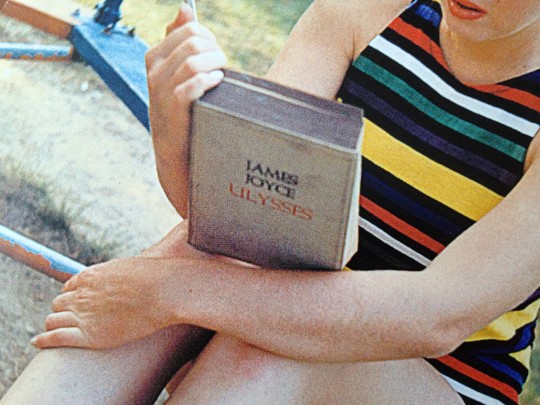 The good folks at Book Riot conducted a survey of 828 readers, hoping to find out what books they’ve faked reading. The top five books (all available in our Free eBooks and Free Audio Books collections) may not come as a surprise:
- Pride and Prejudice by Jane Austen
- Ulysses by James Joyce
- Moby-Dick by Herman Melville
- War and Peace by Leo Tolstoy
- The Bible
Nor will the remaining 15 astound you (give or take a couple). But we’ll let you head over to Book Riot for the complete list. Wait! Stop! Before you leave, let us know what books you’ve fudged before. It’s anonymous and all in good fun. Look forward to your confessions.
Read More...Read Fanny Hill, the 18th-Century Erotic Novel That Went to the Supreme Court in the 20th Century
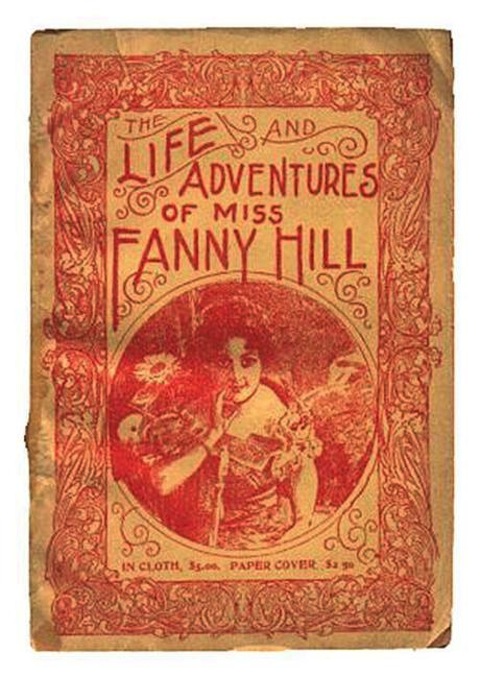
In a recent interview with literary historian Loren Glass about the achievements of taboo-busting publisher Grove Press, I wondered whether anyone growing up today could conceive of a book causing a public scandal, let alone a trial that reaches the Supreme Court. Grove had the highest-profile of its several legal skirmishes after publishing Henry Miller’s Tropic of Cancer in 1961. Two years later, G.P. Putnam Sons would drop their own literary bombshell in the form of Memoirs of a Woman of Pleasure, better known by the name of the protagonist there referenced, Fanny Hill, who, orphaned at fifteen, throws herself into a career in “profit by pleasing.” Originally written in 1748 by John Cleland, a former British East India Company employee locked up in debtors’ prison, the book broke new ground by offering almost nothing but a string of elaborately crafted (and, technically, “vulgar” language-free) sex scenes.
“A partial list of the book’s adventures includes an orgy, sex between women, masturbation, masochism, cross-dressing, and a detailed sodomy scene that is one of only two known explicit depictions of male same-sex ardor in the language before the end of the 19th century,” writes the Boston Globe’s Ruth Graham in an article on the 50th anniversary of the Fanny Hill-vindicating verdict. “The book still has the capacity to shock. As [assistant attorney general William I.] Cowin noted in front of the Supreme Court, after the first 10 pages of the novel, ‘all but 32 have sexual themes.’ But Fanny Hill would not have survived so long if it were merely scandalous in 18th-century terms: It remains revolutionary today because, as English critic Peter Quennell wrote in the introduction to the 1963 edition, “It treats of pleasure as the aim and end of existence.” You can find out just what this means by downloading the book free from Project Gutenberg or iTunes, or listening to a free audio version here. Whether these text-only editions count as worksafe all depends, of course, on the size of your screen and the literacy of your co-workers. You can see bawdy illustrations that appeared in historical editions here. Note that they are very definitively NSFW.
Related Content:
74 Free Banned Books for Banned Books Week
Colin Marshall hosts and produces Notebook on Cities and Culture and writes essays on literature, film, cities, Asia, and aesthetics. He’s at work on a book about Los Angeles, A Los Angeles Primer. Follow him on Twitter at @colinmarshall.
Read More...The Actual Schindler’s List Is For Sale on Ebay, Starting Bid $3,000,000

Click image above to enlarge
The story of Oskar Schindler, savior of thousands of Polish Jews, produced an epic novel, Schindler’s Ark, which in turn produced Steven Spielberg’s epic Schindler’s List. Like that of Anne Frank, Schindler’s story contains actions both unimaginably courageous and relatably human, and so his drama moves us past the stupefyingly brutal machinery of the Nazi death camps and into the lives of the real people under threat and those who helped them. But when we step out of the memoirs and fictionalizations and back into the dry history of documents, memos, and orders, the inhuman bureaucratic cast of Nazi efficiency returns, even in the case of Oskar Schindler.
Take the actual list (page one above). A featureless business ledger, the list is indistinguishable from the many concentration camp registers and death records Schindler’s fellow Nazis kept assiduously as they went about the business of eradicating a whole population. We know, of course, that Schindler played the part of a party believer to save lives instead of take them, but it’s still quite eerie to look over this faceless list of names and contemplate how close these men and women came to the horrors of the camps that took so many of their neighbors, friends, and relatives.
The list above is now on sale through an Ebay auction, starting bid 3 million dollars. It is certified authentic as the actual list typed up by Shindler’s accountant Itzhak Stern (played by Ben Kingsley in the film). The auction page provides the following information:
Itzhak Stern typed up the 14 page list on onion skin paper. Up for auction is not a copy of that list, but the actual one. It was sold by Itzhak Stern’s nephew to the current owner. It is dated in pencil on the first page, April 18, 1945. The auction will also include a copy of the affidavit from Stern’s nephew, recounting more details and provenance on The List. There’s a complete history of the composition of the list in David Crowe’s brilliant bio, Oskar Schindler: The Untold Account of His Life, Wartime Activities, and the True Story Behind the List.
Related Content:
The Trial of Adolf Eichmann at 50
Rare 1940 Audio: Thomas Mann Explains the Nazis’ Ulterior Motive for Spreading Anti-Semitism
Rudolf Brazda, Last Man to Wear the Pink Triangle During the Holocaust, Tells His Story
Hannah Arendt Discusses Philosophy, Politics & Eichmann in Rare 1964 TV Interview
Josh Jones is a writer and musician based in Washington, DC. Follow him at @jdmagness
Read More...
Henry Rollins: Education is the Cure to “Disaster Capitalism”
We’ve already featured former Black Flag frontman and current spoken-word artist Henry Rollins explaining why, to his mind, only education can restore democracy. He also believes it can cure something he calls “disaster capitalism,” and you can hear more from him about it in the Big Think video above. He addresses, in his characteristically straightforward manner, the questions of what exactly ails the American economy, how that ailment might have come about, and how the country can educate itself back to health. We may individually get our educations now, he grants, but “how long will it be until America fiscally turns itself around” to the point of repaying “the risk of the investment on that student loan to get a person through four years of college? Will that person get a job where paying off that loan and getting a house and affording a family, will that be a possibility? In the present America, it doesn’t look like it is.”
Seeing a dire national situation, Rollins recommends doing like China, but not in the way you might assume. He suggests looking “500 years at a time,” much farther up the road than we have of late. “I’d be looking up the road so far my eyes would fall out of my head.” He wants the country to become “like Europe, where they’ll educate your kid until his head explodes,” producing “three doctors per floor of every apartment building” and doing so by making “college tuition either free or really low.” Generally thought of as liberal, Rollins sums this up in a way that might appeal to his ideological opponents: “If you have a country full of whip-crack smart people, you have a country the rest of the world will fear. They will not invade a country of educated people because we are so smart we’ll build a laser that will burn you, the enemy, in your sleep before you can even mobilize your air force to kill us. We will kill you so fast because we are so smart and we will have foreign policy that will not piss you off to the point to where you have to attack us.”
Related Content:
Henry Rollins Pitches Education as the Key to Restoring Democracy
Colin Marshall hosts and produces Notebook on Cities and Culture and writes essays on literature, film, cities, Asia, and aesthetics. He’s at work on a book about Los Angeles, A Los Angeles Primer. Follow him on Twitter at @colinmarshall.
Read More...Rare 1910 Audio: Sarah Bernhardt, ‘The Most Famous Actress the World Has Ever Known,’ in Racine’s Phèdre
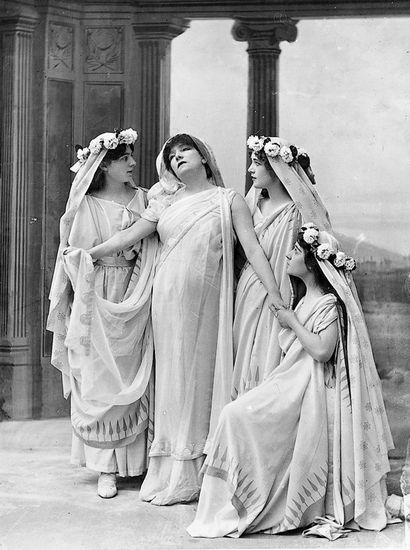
The French actress Sarah Bernhardt is often remembered as the first international superstar. Her hypnotic presence and flamboyant personality are legendary. “She could contrive thrill after thrill,” wrote Lytton Strachey of Bernhardt’s acting ability, “she could seize and tear the nerves of her audience, she could touch, she could terrify, to the top of her astonishing bent.” Bernhardt died before the age of talking movies, notes her biographer Robert Gottlieb, “yet she remains the most famous actress the world has ever known.”
How good was she? Listen below, and you can begin to form your own opinion. The recording was made in February of 1910, when Bernhardt and her troupe were touring America. To tap into the emerging phonographic record market, Bernhardt stopped by Thomas Edison’s laboratory in West Orange, New Jersey, to cut some wax cylinders. For one recording, she chose a scene from Jean Racine’s 1677 tragedy Phèdre, which is based on Euripides’ Hippolytus and Seneca’s Phaedra. Bernhardt plays the title role opposite an unknown actor in the highly dramatic Act II Scene V, in which Phèdre declares her love for Hypolyte, her stepson:
Unfortunately, the video image moves in a distracting way. So perhaps the best way to enjoy the audio is to forget the image and read along with Bernhardt. A full transcript follows the jump:
Read More...The Atheism Tapes Presents Lengthy Interviews with Arthur Miller, Daniel Dennett & Richard Dawkins About Religion and Unbelief
The history of religion(s) is a fascinating subject, one that should be covered, in my humble opinion, as an integral part of every liberal arts education. But the history of atheism—of disbelief—is a subject that only emerges piecemeal, in oppositional contexts, especially in the wake of recent fundamentalist uprisings in the past decade or so. We covered one such history recently, the 2004 BBC series Atheism: A Rough History of Disbelief, made by director Jonathan Miller and featuring such high-profile thinkers as Richard Dawkins, Daniel Dennett, Arthur Miller, and physicist Steven Weinberg.
Miller’s series originally included much more material than he could air, and so the BBC agreed to let him produce the outtake interviews as a separate program called The Atheism Tapes. It’s a series in six parts, featuring interviews with English philosopher Colin McGinn, Weinberg, Miller, Dawkins, Dennett, and British theologian Denys Turner. At the top, watch Miller’s intro to The Atheism Tapes and his interview with Colin McGinn. It’s an interesting angle—Miller gets to quiz McGinn on “what it means to be a skeptical English philosopher in such a seemingly religious country as the United States.” Many readers may sympathize with McGinn’s difficulty in communicating his unbelief to those who find the concept totally alien.
Directly above, watch Daniel Dennett (after the intro) discuss the relationship between atheism and Darwin’s revolutionary theory. Miller is a wonderful interviewer—sympathetic, probing, informed, humorous, humanist. He is the perfect person to bring all these figures together and get their various takes on modern unbelief, because despite his own professions, Miller really cares about these big metaphysical questions, and his passion and curiosity are shared by all of his interviewees. In the introduction to his interview with playwright Arthur Miller (below), Jonathan Miller makes the provocative claim that Christianity believes “there’s something peculiar about the Jews that makes them peculiarly susceptible to profane disbelief.” Watch Arthur Miller’s response below.
One would hope that all manner of people—believers, atheists, and the non-committal—would come away from The Atheism Tapes with at least a healthy respect for the integrity of philosophical and scientific inquiry and doubt. See the full series on YouTube here. Or purchase your copy on Amazon here.
Related Content:
Atheism: A Rough History of Disbelief, with Jonathan Miller
Richard Dawkins Makes the Case for Evolution in the 1987 Documentary, The Blind Watchmaker
Philosopher Daniel Dennett Presents Seven Tools For Critical Thinking
Josh Jones is a writer and musician based in Washington, DC. Follow him at @jdmagness
Read More...The Feud Continues: Noam Chomsky Responds to Žižek, Describes Remarks as ‘Sheer Fantasy’
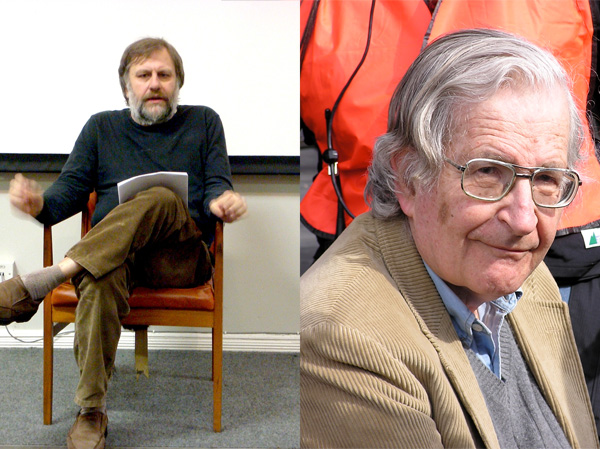
Noam Chomsky has issued a statement in reaction to our July 17 post, “Slavoj Žižek Responds to Noam Chomsky: ‘I Don’t Know a Guy Who Was So Often Empirically Wrong.’ In an article posted yesterday on ZNet titled “Fantasies,” Chomsky says Žižek’s criticism of him is completely ungrounded. “Žižek finds nothing, literally nothing, that is empirically wrong,” writes Chomsky. “That’s hardly a surprise.”
The rift between the two high-profile intellectuals began, as you may recall, when Chomsky criticized Žižek and other continental philosophers for essentially talking nonsense — for cloaking trivialities in fancy language and using the scientific-sounding term “theory” to describe propositions that could never be tested empirically. Žižek lashed back, saying of Chomsky, “I don’t think I know a guy who was so often empirically wrong.” He went on to criticize Chomsky’s controversial early position on American assessments of the Khmer Rouge atrocities in Cambodia. (To read Žižek’s comments, click here to open the earlier post in a new window.) In response yesterday, Chomsky said he had received numerous requests to comment on our post:
I had read it, with some interest, hoping to learn something from it, and given the title, to find some errors that should be corrected — of course they exist in virtually anything that reaches print, even technical scholarly monographs, as one can see by reading reviews in professional journals. And when I find them or am informed about them I correct them.
But not here. Žižek finds nothing, literally nothing, that is empirically wrong. That’s hardly a surprise. Anyone who claims to find empirical errors, and is minimally serious, will at the very least provide a few particles of evidence — some quotes, references, at least something. But there is nothing here — which, I’m afraid, doesn’t surprise me either. I’ve come across instances of Žižek’s concept of empirical fact and reasoned argument.
Chomsky goes on to recount an instance when he says Žižek misattributed a “racist comment on Obama” to Chomsky, only to explain it away later and say that he had discussed the issue with Chomsky on the telephone. “Of course,” writes Chomsky, “sheer fantasy.” Chomsky then moves on to Žižek’s comments reported by Open Culture, which he says are typical of Žižek’s methods. “According to him,” writes Chomsky, “I claim that ‘we don’t need any critique of ideology’ — that is, we don’t need what I’ve devoted enormous efforts to for many years. His evidence? He heard that from some people who talked to me. Sheer fantasy again, but another indication of his concept of empirical fact and rational discussion.”
Chomsky devotes the rest of his article to defending his work with Edward Herman on the Khmer Rouge atrocities. He claims that no factual errors have been found in their work on the subject, and he draws attention to a passage in their book After the Cataclysm, quoted last week by Open Culture reader Poyâ Pâkzâd, in which they write, “our primary concern here is not to establish the facts with regard to postwar Indochina, but rather to investigate their refraction through the prism of Western ideology, a very different task.”
You can read Chomsky’s complete rebuttal to Žižek here.
Related Content:
Noam Chomsky Slams Žižek and Lacan: Empty ‘Posturing’
Slavoj Žižek Responds to Noam Chomsky: ‘I Don’t Know a Guy Who Was So Often Empirically Wrong’
Clash of the Titans: Noam Chomsky & Michel Foucault Debate Human Nature & Power on Dutch TV, 1971
Read More...
Bill Murray Reads Great Poetry by Billy Collins, Cole Porter, and Sarah Manguso
Anyone calling themselves even casual Bill Murray fans — and we here at Open Culture have taken it well beyond casualness — will by now have read a number of articles on how the actor, comedian, and early Saturday Night Live alumnus has reinvented himself in the 21st century. Though he still acts and makes us laugh more than ever in so doing, he picks his projects more carefully, tends to work with creators possessed of particular visions (Wes Anderson comes to mind), and at times apparently lives his life like a form of self-satirizing performance art, popping up now and then in the least expected places amongst the least expected people. Fans of Murray’s from his Caddyshack, Stripes, and Ghostbusters days certainly wouldn’t expect to see him, for instance, at a poetry reading, much less onstage, much less reading seriously.
And yet here we have three examples, captured live, of Bill Murray’s poetry-reading acumen. Up top, you can watch him read former Poet Laureate of the United States Billy Collins’ “Forgetfulness” at the 16th Annual Poets House Walk Across the Brooklyn Bridge. Just above, at the same event, Murray reads “Brush Up Your Shakespeare” by songwriter Cole Porter from the lyrics of Porter’s musical Kiss Me, Kate. Below, at the Poets House Walk dinner, he reads “What We Miss” by Sarah Manguso. We’ll add those three to the list of voices Murray’s performances have done justice — a list that includes such illustrious figures real and imagined as Wallace Stevens, Emily Dickinson, and Drs. Peter Venkman and Hunter S. Thompson.
Related Content:
Bill Murray Reads Poetry at a Construction Site
Colin Marshall hosts and produces Notebook on Cities and Culture and writes essays on literature, film, cities, Asia, and aesthetics. He’s at work on a book about Los Angeles, A Los Angeles Primer. Follow him on Twitter at @colinmarshall.
Read More...Support Us
We're hoping to rely on loyal readers, rather than erratic ads. Please click the Donate button and support Open Culture. You can use Paypal, Venmo, Patreon, even Crypto! We thank you!

About Us

Open Culture scours the web for the best educational media. We find the free courses and audio books you need, the language lessons & educational videos you want, and plenty of enlightenment in between.
Advertise With Us

FREE UPDATES!
GET OUR DAILY EMAIL
Get the best cultural and educational resources on the web curated for you in a daily email. We never spam. Unsubscribe at any time.
FOLLOW ON SOCIAL MEDIA

Open Culture editor Dan Colman scours the web for the best educational media. He finds the free courses and audio books you need, the language lessons & movies you want, and plenty of enlightenment in between.
Advertise With Us

