The Art of Sylvia Plath: Revisit Her Sketches, Self-Portraits, Drawings & Illustrated Letters
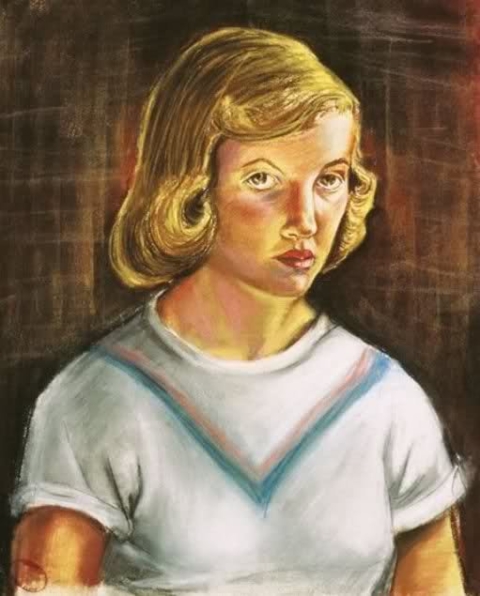
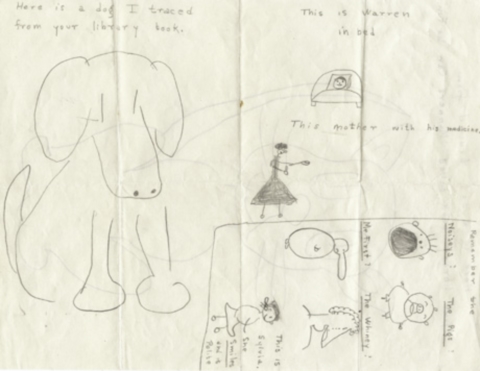
Sylvia Plath’s poetic talent should go unquestioned, but as Plath fans will know, she first intended to become a visual artist, and some of her earliest work—illustrated childhood letters like the adorable dog below—remained hidden away in the family attic until 1996. Editor Kathleen Connors included this juvenilia in a 2007 collection of Plath’s work entitled Eye Rhymes: Sylvia Plath’s Art of the Visual, which also features sketches, photographs, and portraits—such as the brooding 1951 self-portrait above—that represent Plath’s work while an art student at Smith College.
Much of the art-school work is not representative of Plath’s best. While she made the difficult decision at age 20 to abandon aspirations for an art career and focus on her writing, Plath continued to make visual art. For example, at 23, she produced a confidently-rendered series of pen-and-ink drawings—such as the fishing boats below—while she and Ted Hughes honeymooned in Paris and Spain.
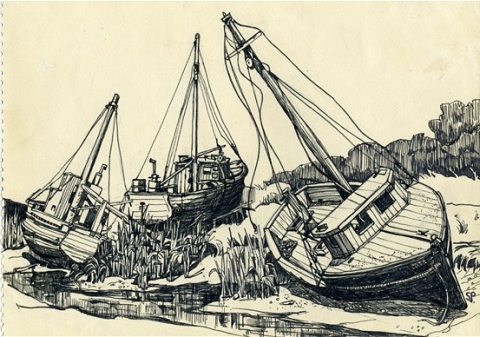
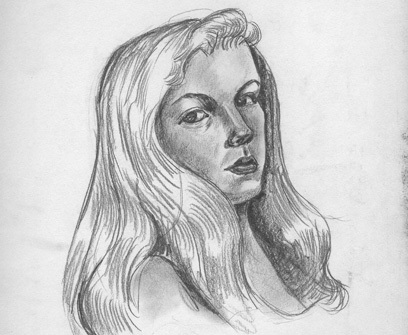
The Telegraph has a gallery of thirty of these drawings, which were on display at London’s Mayor Gallery between November and December of 2011. Plath’s writing has always been remarkably visual, her deft handling of sometimes startling imagery giving her work so much of its ability to seduce, enthrall, and unsettle. As in her poetry, the images of herself seem to attract the most interest. There are other pieces of Plath self-portraiture, but none contrasts so much with the youthful painting above, I think, as the accomplished pencil drawing below, with the poet’s fearless sidelong stare and bare shoulders expressing both her vulnerability and considerable personal and creative power.
Related Content:
On 50th Anniversary of Sylvia Plath’s Death, Hear Her Read ‘Lady Lazarus’
Josh Jones is a writer and musician based in Washington, DC. Follow him @jdmagness
Read More...Daft Punk’s New Album, Random Access Memories, Streaming for Free on iTunes for a Limited Time
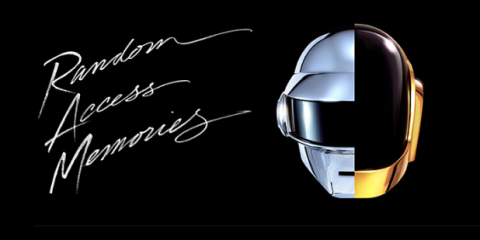
A quick heads up: Daft Punk’s fourth album, Random Access Memories, will be released on May 21. But, right now, you can hop over to iTunes and stream it for free on your computer or iPad (for a limited time).
To access the stream, simply click this link, tap the “View in iTunes” button, and then click the “Listen Now” button.
If you like what you hear, you can always pre-order the album on iTunes and Amazon.
PS If you need iTunes software, you can download it for free here.
Find us on Facebook, Twitter and Google Plus and we’ll make it easy to share cultural media with your friends!
Read More...Carl Jung Explains His Groundbreaking Theories About Psychology in a Rare Interview (1957)
Here’s an extraordinary film of the great Swiss psychologist Carl Gustav Jung speaking at length about some of his key contributions to psychology. Jung on Film (above) is a 77-minute collection of highlights from four one-hour interviews Jung gave to psychologist Richard I. Evans of the University of Houston in August of 1957. In “Sitting Across From Carl Jung,” an article for the Association of Psychological Science, Evans explains how the interviews came about:
I was teaching a graduate seminar called Approaches to Personality when it seemed like an interesting idea to have the graduate students in the seminar role-play in front of the class and pretend to interview the various personality theorists that I was presenting. Carl Jung was one of those theorists, and during the seminar, I learned that he had never agreed to an extensive recorded interview except for a brief exchange on the BBC. I wrote a letter to Dr. Jung to request an interview because I believed that filmed interviews of eminent psychologists would encourage students to read their work.
Jung, who was 82 years old at the time, agreed to the interview and set aside an hour a day over a four-day period. Evans met with Jung in Zurich at the Federal Institute of Technology, or ETH. In the excerpts above, Jung talks about his early association with Sigmund Freud and how he came to disagree with Freud’s fixation on the sex drive as the primary influence in mental life. He talks about his theory of personality types and about universal archetypes, including the anima and animus. He talks about the interplay between instinct and environment, and about dreams as manifestations of the unconscious. At one point he stresses the urgency of understanding psychology in a world where man-made threats, like the threat of the hydrogen bomb, are greater than those posed by natural disasters. “The world hangs on a thin thread,” says Jung, “and that is the psyche of man.”
Note: You can download seminal works by Carl Jung as free audiobooks if you sign up for a 30-Day Free Trial with Audible.com. Find more information on that program here.
If you would like to support the mission of Open Culture, consider making a donation to our site. It’s hard to rely 100% on ads, and your contributions will help us continue providing the best free cultural and educational materials to learners everywhere. You can contribute through PayPal, Patreon, and Venmo (@openculture). Thanks!
Related content:
Carl Gustav Jung Ponders Death
Face to Face with Carl Jung: ‘Man Cannot Stand a Meaningless Life’
Sigmund Freud Speaks: The Only Known Recording of His Voice, 1938
Read More...The Genius of Brian Eno On Display in 80 Minute Q&A: Talks Art, iPad Apps, ABBA, & More
Four years ago, I experienced musical polymath, rock producer, “drifting clarifier,” and high-tech painter Brian Eno’s generative-art installation 77 Million Paintings in Long Beach. I also saw him give an entertaining talk there on his observations of and ideas about sound, images, and culture. This year, he brought the show to New York City, giving it the largest staging yet, and then sat down for an equally entertaining 80-minute Q&A for the Red Bull Music Academy. Perhaps it sounds a little odd that a creator who has based the past few decades of recent solo work on quietude, reflection, and mental receptiveness would appear at such length in a forum sponsored by an energy drink, but hey, we live in interesting times, and Eno has interesting thoughts, no matter where he voices them.
Sitting back on a sofa (whose side table comes stocked with cans of Red Bull), Eno discusses composing music for hospitals after meeting a great many children born to his 1975 album Discreet Music; the amateur chorus he runs and with whom he sometimes invites famous singer friends to sit in; “scenius,” or the special kind of genius that emerges when large numbers of enthusiasts cohere into a scene; the DJ as cultural “lubricant”; his love of early 20th-century Russian painting; what makes popular music, from Abba to Beyoncé, sound popular; the importance of deadlines; and his new iPad app Scape, which, to his mind, should soon displace the tiresome conventions of Hollywood film scoring entirely. While this provides a stimulating introduction to Eno the intellectual, longtime fans will want to catch up with his latest thoughts on several favorite subjects, such as the value of surrender in not just experiencing but creating art, and the counterintuitive bursts of creativity that come when working with fewer options, not more.
H/T goes to Heather
Related Content:
Brian Eno Once Composed Music for Windows 95; Now He Lets You Create Music with an iPad App
Brian Eno on Creating Music and Art As Imaginary Landscapes (1989)
Watch Brian Eno’s “Video Paintings,” Where 1980s TV Technology Meets Visual Art
Day of Light: A Crowdsourced Film by Multimedia Genius Brian Eno
Colin Marshall hosts and produces Notebook on Cities and Culture and writes essays on literature, film, cities, Asia, and aesthetics. He’s at work on a book about Los Angeles, A Los Angeles Primer. Follow him on Twitter at @colinmarshall.
Read More...In 1969 Telegram, Jimi Hendrix Invites Paul McCartney to Join a Super Group with Miles Davis

Click above for a (slightly) larger image
A trending story this weekend brings to light what could have been a pretty super 1969 collaboration between Miles Davis, his phenomenal longtime drummer Tony Williams, Jimi Hendrix and Paul McCartney. Davis and Hendrix had already been jamming together informally in New York, planning to record an album. The pairing seems natural considering this was Davis’ Bitches Brew psychedelic fusion phase.
The inclusion of McCartney’s pop sensibilities seems odd, though, and possibly inspired. It could have resulted in some really fascinating music, or a mess of personalities and ideas. But alas, it never came to pass. Davis and Hendrix sent McCartney an impromptu October 21st, 1969 telegram request to record with them in New York: “We are recording an LP together this weekend. How about coming in to play bass stop call Alan Douglas 212–5812212. Peace Jimi Hendrix Miles Davis Tony Williams.” [Alan Douglass was the ostensible producer.] But, as Rolling Stone explains:
It’s unclear if McCartney was aware of the request…. Beatles aide Peter Brown responded the next day, telling Hendrix and Davis that McCartney was out on vacation and wasn’t expected back for two weeks.
Unfortunately, the only reproductions of the correspondence available online are the poorly visible images at the top and below. Nonetheless, you can make out Davis, Hendrix, and Williams’ request on the right, and the response at the left (the order is reversed below). Both telegrams are located at the Hard Rock Café in Prague. For more on the story, read the Telegraph’s summation. I’m sure it won’t be long before some enterprising music hacker creates the ultimate Davis/Hendrix/McCartney mashup and gives us a taste of what might have been.

Click to (slightly) enlarge
Related Content:
Rare Miles Davis Live Recordings Capture the Jazz Musician at the Height of His Powers
Paul McCartney Shoots New Music Video with Natalie Portman and Johnny Depp
Josh Jones is a writer and musician based in Washington, DC. Follow him @jdmagness
Read More...Astronaut Chris Hadfield Sings David Bowie’s “Space Oddity” On Board the International Space Station
Chris Hadfield has spent the past five months on the ISS. And, if you regularly follow our site, you’ll know that the media-savvy astronaut has engaged earthlings with a steady stream of tweets, a series of educational videos (see below), and the occasional entertaining routine. In recent months, he has kibitzed with William Shatner and even strummed a tune for Peter Gabriel. Now, before handing over command of the ISS to a Russian cosmonaut, Hadfield bade us farewell by singing a zero gravity version of “Space Oddity,” the song that helped launch David Bowie’s music career back in 1969. What could be a more perfect pick? In case you’re wondering, Hadfield is playing a Larrivée Parlor guitar, which he used to make the first album ever recorded in orbit. We’ll eventually tell you more about that.…
Related Content:
Everything You Wanted to Know About Going to the Bathroom in Space But Were Afraid to Ask
If Astronauts Cry in Space, Will Their Tears Fall?
Read More...The Romantic George Carlin Writes a Nano-Powered, Sub Atomic-Filled Love Letter to His Wife
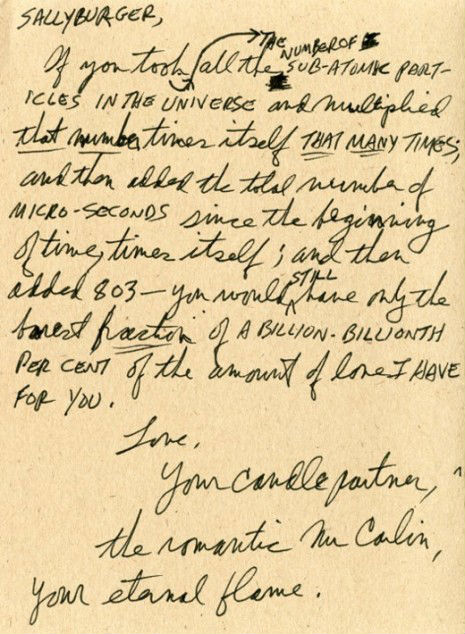
George Carlin was more than a Class Clown. He was also a class act, as evidenced by this undated missive to comedy writer Sally Wade, with whom he shared the final decade of his life. The man who once parsed the Seven Words You Can Never Say on Television showered his “spouse without papers” with such notes daily.
Given such a prodigious output, he wisely turned to science to quantify his ardor in the reproduction above. (His physician’s scrawl can be difficult to decipher — a transcription is supplied below.)
SALLYBURGER,
If you took THE NUMBER OF SUB-ATOMIC PARTICLES IN THE UNIVERSE and multiplied that number times itself THAT MANY TIMES; and then added the total number of MICRO-SECONDS since the beginning of time, times itself; and then added 803—you would STILL have only the tiniest fraction of A BILLION-BILLIONTH PER CENT of the amount of love I HAVE FOR YOU.
Love,
your candle partner,
the romantic Mr Carlin,
your eternal flame
A portion of these sweet nothings were collected in The George Carlin Letters. Its subtitle, The Permanent Courtship of Sally Wade, was taken from the note he left on her computer the day he died, two days shy of their 10th anniversary.
Related Content:
RIP: George Carlin on the Tonight Show (1966)
How the Great George Carlin Showed Louis CK the Way to Success (NSFW)
George Carlin: The Modern Man in Three Minutes
Ayun Halliday has been loving on Greg Kotis since 1991. Such notes as there are remain private, but you can follow her @AyunHalliday
Read More...Google Reveals the Evolution of Our Planet in Timelapse Motion
 Yesterday Google released a trove of timelapse images that offers, it believes, “the most comprehensive picture of our changing planet ever made available to the public.” Featuring a quarter-century of images taken from space by NASA and the U.S. Geological Survey, the repository lets you witness the retreat of glaciers (see above), the deforestation of wide swathes of rainforest, the growth of sprawling cities, and the building of huge artificial islands, all happening in timelapse motion.
To create its Timelapse website, Google “sifted through 2,068,467 images—a total of 909 terabytes of data—to find the highest-quality pixels … for every year since 1984 and for every spot on Earth.” They then used this data to create composite images for each year, all viewable in browsable HTML5 animation. Some striking images have also been posted on Google+.
via Google
Related Content:
Global Warming: A Free Course from UChicago Explains Climate Change
Perpetual Ocean: A Van Gogh-Like Visualization of our Ocean Currents
Harvard Thinks Green: Big Ideas from 6 All-Star Environment Profs
Read More...Freiheit, George Lucas’ Short Student Film About a Fatal Run from Communism (1966)
Here we have an early short film by Star Wars mastermind George Lucas that contains no invented worlds, elaborate special effects, or conscious mythmaking. But Freiheit, the third film Lucas made while a film-school student at the University of Southern California and the first with a narrative, has the kind of impact that convinces you its fledgling creator just might have an interesting picture or two in him. Titled with the German word for “freedom,” the short uses Soviet-era Germany as a setting and freedom as its driving concept, following a young protagonist trapped on the wrong side of the Berlin border who attempts a flight from his restrictive society but meets a grim end.
Even those of you who don’t respect what we now think of as George Lucas’ brand of moviemaking may find much of interest in Freiheit’s three-minute runtime. From the title card reading “a film by LUCAS” onward, you know you’re in for more of an “art” film than you may have expected. Lucas combines still with moving images and dynamically varies the speed of the latter to build as much visual interest as possible in a short time (and on an undoubtedly near-nonexistent budget). He creates an urgent mood quickly by using both music and abstract sound, ultimately introducing a collection of spoken words about freedom itself. Lucas would clearly remain fascinated, even while making blockbuster space operas, by the nature of oppressive power structures, but this little project reveals his aesthetic road not taken.
Related Content:
Martin Scorsese’s Very First Films: Three Imaginative Short Works
Stanley Kubrick’s Very First Films: Three Short Documentaries
David Lynch’s Early Short Film
Colin Marshall hosts and produces Notebook on Cities and Culture and writes essays on literature, film, cities, Asia, and aesthetics. He’s at work on a book about Los Angeles, A Los Angeles Primer. Follow him on Twitter at @colinmarshall.
Read More...Rare 1952 Film: William Faulkner on His Native Soil in Oxford, Mississippi
Early in his life, William Faulkner had an epiphany: “I discovered that my own little postage stamp of native soil was worth writing about, and that I would never live long enough to exhaust it.” And so, as he told The Paris Review in 1956, “by sublimating the actual into the apocryphal” Faulkner was able to take his hometown of Oxford, Mississippi, and the surrounding countryside and use it to create his own imaginary cosmos. He called it Yoknapatawpha County.
In November of 1952, the normally reclusive Faulkner allowed a film crew into his secluded world at Oxford to make a short documentary about his life. The film, shown here in five pieces, was funded by the Ford Foundation and broadcast on December 28, 1952 on the CBS television program Omnibus. The scripted film re-enacts events from November 1950, when Faulkner received the Nobel Prize in Literature, through the spring of 1951, when he spoke at his daughter Jill’s high school graduation.
There are scenes of Faulkner at Rowan Oak, his antebellum house on the edge of Oxford, and at Greenfield Farm, 17 miles away, where he is shown driving a tractor and talking with workers. Faulkner is also shown briefly with his wife, Estelle, and with several prominent Oxford residents, including druggist Mac Reed, Oxford Eagle editor Phil Mullen, who collaborated with the filmmakers on the script, and lawyer Phil Stone, who was an early literary mentor and champion of Faulkner. According to Joseph Blotner in his biography Faulkner, the famous writer put aside his usual cantankerousness when the filmmakers arrived in Oxford:
To the pleasure of director Howard T. Magwood and his ten-man crew, Faulkner showed himself to be a considerate host and an interested actor. He even offered Mullen some advice on reading his lines. He was at ease when he appeared with Mac Reed, but in a scene with Phil Stone he seemed stiff and distant.
The uneasiness between Faulkner and Stone may have had something to do with Stone’s feeling (as Mullen reportedly said later) that Faulkner had come down with a bad case of “Nobelitis in the Head.” Actually the entire film is stiff and unrealistic. It’s a bit of a shock to see Faulkner, a master of the narrative form, going through the motions as a bad actor in a horribly written story about his own life. But any literary fan should be fascinated by this rare glimpse of the master at home on his own little postage stamp of native soil.
via Biblioklept
Related content:
Drinking with William Faulkner
Seven Tips From William Faulkner on How to Write Fiction
William Faulkner Explains Why Writing is Best Left to Scoundrels
Read More...Support Us
We're hoping to rely on loyal readers, rather than erratic ads. Please click the Donate button and support Open Culture. You can use Paypal, Venmo, Patreon, even Crypto! We thank you!

About Us

Open Culture scours the web for the best educational media. We find the free courses and audio books you need, the language lessons & educational videos you want, and plenty of enlightenment in between.
Advertise With Us

FREE UPDATES!
GET OUR DAILY EMAIL
Get the best cultural and educational resources on the web curated for you in a daily email. We never spam. Unsubscribe at any time.
FOLLOW ON SOCIAL MEDIA

Open Culture editor Dan Colman scours the web for the best educational media. He finds the free courses and audio books you need, the language lessons & movies you want, and plenty of enlightenment in between.
Advertise With Us

