Five Cultural Tours of Los Angeles
As an Open Culture reader, you surely enjoy a vast range of interests, and what serves as a more robust nexus of interests than the modern city? Each city produces an infinitude of fascinating case studies in architecture, economics, politics, and social psychology. But even when you examine the less obviously city-relevant intellectual pursuits — language, film, literature, technology, style — countless more connections reveal themselves. Because I’ve found organizing cultural interests by city so fruitful, I offer you here a set of resources to do with Los Angeles, California. These are just a few of the countless possible perceptions of the capital of mainstream cinema, the terminus of mankind’s westward push, the creator and destroyer of new urban forms, and above all the great divider of opinion. Architectural historian Reyner Banham voices his own at the top of Reyner Banham Loves Los Angeles, a 1972 BBC television documentary in which the architectural historian gives a personal tour of the city: “I love the place with a passion that goes beyond sense or reason.”
“They make movies here,” says CalArts professor Thom Andersen in the narration of Los Angeles Plays Itself. “I live here. Sometimes I think that gives me the right to criticize the way movies depict my city.” But he does much more than criticize in his video essay’s nearly three-hour analysis of the roles Los Angeles has played onscreen: as itself, as other cities, and, most often, as no city in particular. Chapman University’s Huell Howser Archive collects the late California-explorer’s nonfictional video journeys in places like Venice Beach, the ever-rising downtown, and even in a helicopter above the city. For a similarly aerial perspective, but a historical one, watch this 1958 footage of Hollywood from above. And for a point of view more forcefully expressed, look no further than Ice Cube’s celebration of Los Angeles as midcentury design mecca, especially for the work of aesthetic luminaries (and Powers of Ten filmmakers) Charles and Ray Eames. “A lot of people think L.A. is just eyesore after eyesore, full of mini-malls, palm trees and billboards,” he says. “So what? They don’t know the L.A. I know.”
- Reyner Banham Loves Los Angeles
- Los Angeles Plays Itself
- Chapman University’s Huell Howser Archive
- Hollywood by Helicopter
- Ice Cube Celebrates the Eames
Colin Marshall hosts and produces Notebook on Cities and Culture and writes essays on literature, film, cities, Asia, and aesthetics. He’s at work on a book about Los Angeles, A Los Angeles Primer. Follow him on Twitter at @colinmarshall.
Read More...An Animated Visualization of Every Observed Meteorite That Has Hit Earth Since 861 AD
Carlo Zapponi, a data visualization designer at Nokia, has created a pretty splendid visualization of the 1,042 meteorites that humans have witnessed hitting our planet since 861 AD. If you click the image above, you will see the visualization in full screen mode. And if you then click on various points along the timeline, you’ll get essential data (produced by The Meteoritical Society) about each observed meteor strike. Most are clustered in the 19th and 20th centuries. The last is the terrifying rock that blasted through Siberia earlier this year.
Note: A total of 34,513 meteorites have hit our planet since 2500 BC. But the vast majority were never observed. They were only later found.
Other Great Visualizations:
Perpetual Ocean: A Van Gogh-Like Visualization of Our Ocean Currents
Visualizing WiFi Signals with Light
Watch a Cool and Creepy Visualization of U.S. Births & Deaths in Real-Time
Stephen Hawking’s Universe: A Visualization of His Lectures with Stars & Sound
Read More...A Theory of Justice, the Musical Imagines Philosopher John Rawls as a Time-Traveling Adventurer
John Rawls’ 1971 book A Theory of Justice—with its famous illustration of “the veil of ignorance”—is a rigorous attempt to make egalitarian principles normative in political philosophy. The work remains a high watermark for liberalism and a meaningful challenge to right-libertarians, meaning that it’s generally taken seriously by critics and admirers alike. Well, almost…. One cadre of admirers, the writers and producers of A Theory of Justice, the Musical (trailer above), decided to have a little fun with the very publicity-shy Rawls (who died in 2002), imagining him on a time-traveling adventure where he meets with Plato, Locke, Rousseau, Mill and others to draw inspiration for his magnum opus. Along the way, Rawls must dodge the “evil designs” of his libertarian antagonist Robert Nozick and “his objectivist lover, Ayn Rand” (Rand and Nozick were, to my knowledge, never so involved, but the idea is amusing).
The farcical production promises “a musical score that covers everything from rap battles to power ballads.” I would imagine that the appeal of Rawls, The Musical might be rather limited to a special subset of people who get the bookish references and love musical theater. But maybe that group is larger than I think. Since the January 30th premier in Oxford this year, A Theory of Justice, the Musical—praised by philosopher Nigel Warburton as “brilliant: hilarious witty and profound”—received several five star reviews and the initial theater run sold out a week before opening. But of course, that was Oxford, not New York. The show’s producers do plan to take the show on the road—to London, Scotland, and the U.S. (and they are actively fundraising; a complete viewing of an Oxford performance will cost you $9.99, and other groups wishing to perform the show must purchase a license).
The widespread appeal of Rawls is understandable given that he best articulates the idea of equality as an inherently ethical value in political life. His is a position that revises so much classical political theory and informs or infuriates so many current political combatants. While opponents of distributive justice will no doubt find reasons to disagree with Rawls on principle, careful critical thinkers will at least consider the arguments before making objections. But if you don’t have time to read all five-hundred plus pages of Rawls’ masterwork, you could certainly do worse than watch Harvard’s Michael Sandel explain Rawls’ theories in his lecture above (featuring some smart student critics of Rawls). The lecture is eighth in a course called “Justice: What’s the Right Thing To Do,” which was released by edX as a MOOC this past March.
Below you can find the soundtrack for the London production.
Related Content:
Michael Sandel’s Famous Harvard Course on Justice Launches as a MOOC on Tuesday
Alain de Botton Proposes a Kinder, Gentler Philosophy of Success
Mike Wallace Interviews Ayn Rand (1959)
Josh Jones is a writer and musician based in Washington, DC. Follow him @jdmagness
Read More...Tom Waits Sings and Tells Stories in Tom Waits: A Day in Vienna, a 1979 Austrian Film
The film begins at a derelict gas station. A paper sign, peeling from the wall, warns in German that open flames and smoking are dangerous and strictly forbidden. In walks Tom Waits, smoking a cigarette.
“This reminds me of a place I used to work in National City, California, called Spotco Self Service,” Waits says as he leans against a pump. “I worked for a gentleman named Charles Spotco. I was always late for work. I used to stay out at night. I’d come dragging to work, used to get there about ten-thirty in the morning. He’d chew me out and scream at me for being late. He always said I’d never amount to nothing. I never thought I’d be standing in a gas station in Vienna Austria. If I’d of told him that one day, Spotco, I’ll be leaning on a gas pump at a gas station in Vienna Austria, he would have said you gotta be out of your mind.”
The scene is from Tom Waits: A Day in Vienna, a half-hour Austrian TV film shot on April 19, 1979, and shown above in its entirety. Filmmakers Rudi Dolezal and Hannes Rossacher approached Waits when he arrived in Vienna on a short European tour, according to Barney Hoskyns in Lowside of the Road: A Life of Tom Waits. “He came in from Amsterdam saying he hadn’t slept all night, but he agreed on the spot to let us film him,” Rossacher told Hoskyns. “He didn’t want to do a proper interview but instead he wanted to tell stories.”
Dolezal and Rossacher drove Waits to the old gas station and later to a Greek cafe, where he told a comic story about a saxophone player. At the Konzerthaus that night they filmed Waits and his band performing “Sweet Little Bullet From a Pretty Blue Gun,” “Shake, Rattle and Roll” and “Christmas Card from a Hooker in Minneapolis.” Backstage before the encore, Waits is shown pacing back and forth, singing “When the Saints Go Marching In.” Afterward, in a lounge, he sits down at a piano and plays a few bars of “I Can’t Wait to Get Off Work” before dancing with a bar girl and retiring for the night.
Related Content:
Tom Waits Reads Charles Bukowski
Tom Waits and Keith Richards Sing Sea Song “Shenandoah” for New Pirate-Themed CD: Listen Online
Tom Waits Shows Us How Not to Get a Date on Valentine’s Day
Read More...David Foster Wallace’s Famous Commencement Speech “This is Water” Visualized in a Short Film
David Foster Wallace was a hyper-anxious chronicler of the minute details of a certain kind of upper-middle-class American life. In his hands, it took on sometimes luminous, sometimes jaundiced qualities. Wallace was also something of a metaphysician: reflective teacher, wise-beyond-his-years thinker, and (tragically in hindsight) quite self-deprecating literary superstar. In the latter capacity, he was often called on to perform the duties of a docent, administering commencement speeches, for example, which he did for the graduating class of Kenyon in 2005.
He began with a story: two young fish meet an older fish, who asks them “How’s the water?” The younger fish look at each other and say, “What the hell is water?” Foster Wallace explains the story this way:
The point of the fish story is merely that the most obvious, important realities are often the ones that are hardest to see and talk about. Stated as an English sentence, of course, this is just a banal platitude, but the fact is that in the day to day trenches of adult existence, banal platitudes can have a life or death importance, or so I wish to suggest to you on this dry and lovely morning.
Foster Wallace acknowledges that the anecdote is a cliché of the genre of commencement speeches. He follows it up by challenging, then re-affirming, another cliché: that the purpose of a liberal arts education is to “teach you how to think.” The whole speech is well worth hearing.
In the video above, “This is Water,” The Glossary—“fine purveyors of stimulating videograms”—take an abridged version of the original audio recording and set it to a series of provocative images. In their interpretation, Foster Wallace’s speech takes on the kind of middle-class neurosis of David Fincher’s realization of Chuck Palahniuk’s Fight Club.
It’s a dystopian vision of post-grad life that brings vivid clarity to one of my mentors’ pieces of advice: “There are two worst things: One, you don’t get a job. Two, you get a job.” Or one could always quote Morrissey: “I was looking for a job, and then I found a job. And heaven knows I’m miserable now.” I still haven’t figured out what’s worse. I hope some of those Kenyon grads have.
If you would like to support the mission of Open Culture, consider making a donation to our site. It’s hard to rely 100% on ads, and your contributions will help us continue providing the best free cultural and educational materials to learners everywhere. You can contribute through PayPal, Patreon, and Venmo (@openculture). Thanks!
Related Content:
David Foster Wallace’s 1994 Syllabus: How to Teach Serious Literature with Lightweight Books
David Foster Wallace: The Big, Uncut Interview (2003)
David Foster Wallace Breaks Down Five Common Word Usage Mistakes in English
Josh Jones is a writer and musician based in Washington, DC. Follow him @jdmagness
Read More...Celebrate Saul Bass’ 93rd Birthday with an Animated Google Doodle
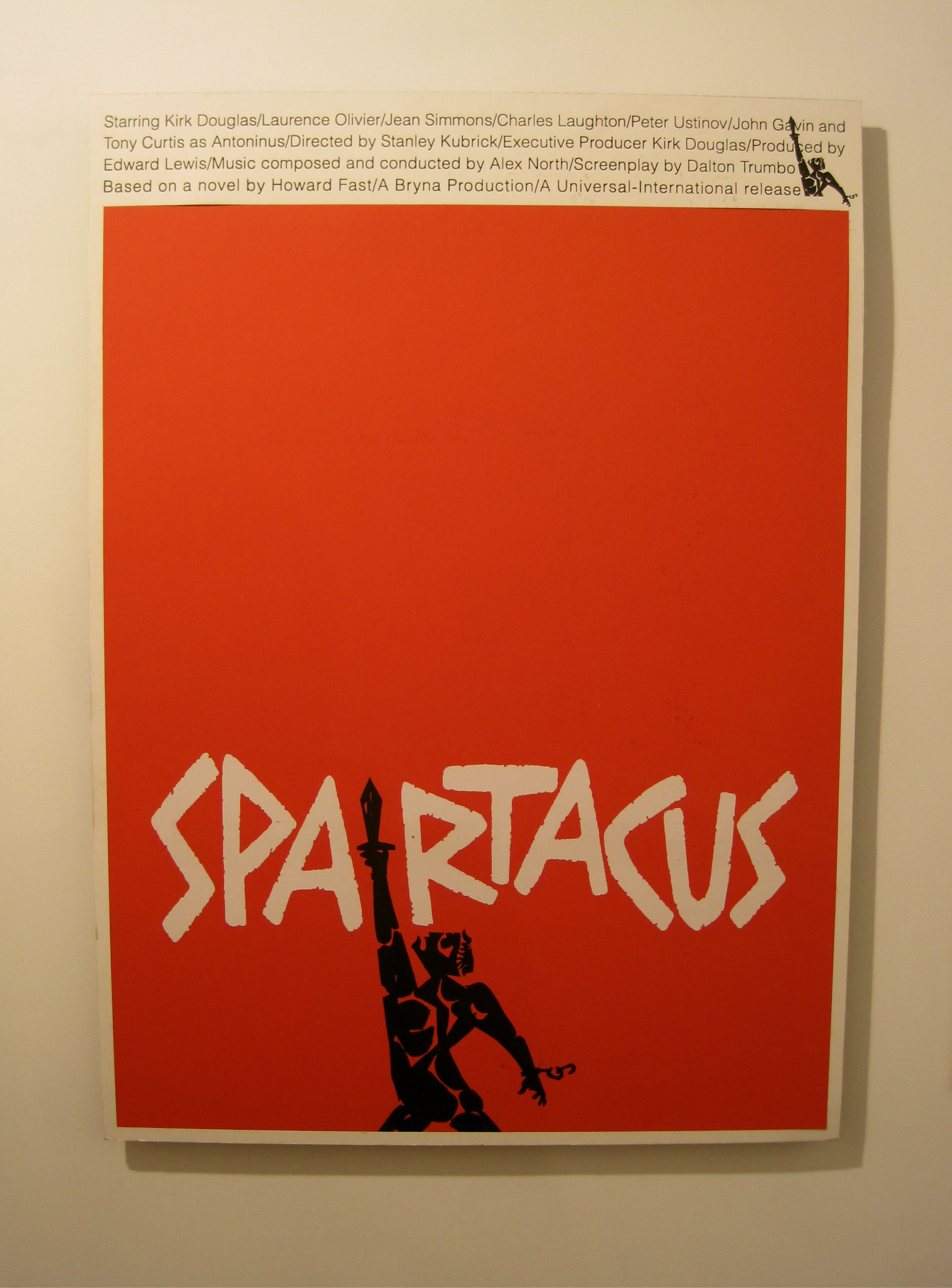
When it comes to title design, no one did it better than Saul Bass (1920–1996). During his long career in Hollywood, Bass designed sequences for Otto Preminger’s The Man with the Golden Arm, Scorsese’s Goodfellas and Cape Fear, Kubrick’s Spartacus, and several classic films by Alfred Hitchcock. And that’s just beginning to scratch the surface. (You can delve into Bass’ other creative work via the links below.)
Today, Google is celebrating what would have been Bass’ 93rd birthday with an animated doodle (above). According to Metafilter, the doodle “pays homage to Bass’ visual work on Psycho, The Man With The Golden Arm, Spartacus, West Side Story,Vertigo, North by Northwest, Anatomy of a Murder, and Around the World in 80 Days.” It’s also set to Dave Brubeck’s 1961 tune, “Unsquare Dance.”
Related Content:
Saul Bass’ Advice for Designers: Learn to Draw, and Create Beauty Even If Nobody Else Cares
Saul Bass’ Oscar-Winning Animated Short Ponders Why Man Creates
Saul Bass Gives Ma Bell a Complete Makeover, 1969
Read More...Growing Up John Waters: The Oddball Filmmaker Catalogues His Many Formative Rebellions (1993)
John Waters seems, now, to have a grand old time being John Waters. But what kind of trials must the director of Pink Flamingos have endured growing up in midcentury suburban America with his distinctive set of interests, proclivities, and aesthetics? The half-hour Channel 4 documentary Growing Up John Waters asks the filmmaker directly, and he responds with stories of the many acts of rebellion he’s had to engage in, from childhood through adulthood, to reach his full taste-transgressing potential. Along the way, we get his always entertainingly askew (if ultimately sensible) perspectives on the early sixties, religion, the Cold War, sports, shoplifting, the Civil Rights movement, and Elvis.
Rebellion John Waters-style, as fans would expect, bears little resemblance to the ways we’ve long expected kids to push back against authority. “What were your childhood fantasies?” the interviewer asks as an opener. “I ain’t tellin’ you,” Waters responds. “If I ever write about my sex life, I’m making the money on it, not Channel 4.” And indeed, you can read much in his three books of prose now available, but Growing Up John Waters by no means skips on the insight, even in matters copulatory. While discussing the surreal nature of his movies’ love scenes, for instance, Waters makes an admission that foreshadows the theme of A Dirty Shame, which he would make a decade later: “I love sex. But it would be better if I had thought it up.”
(via Dangerous Minds)
Related content:
An Anti, Anti-Smoking Announcement from John Waters
John Waters: The Point of Contemporary Art
Colin Marshall hosts and produces Notebook on Cities and Culture and writes essays on literature, film, cities, Asia, and aesthetics. He’s at work on a book about Los Angeles, A Los Angeles Primer. Follow him on Twitter at @colinmarshall.
Read More...How Marie Antoinette, Shakespeare and Other Historical Figures Might Look Today
 What would a modern Marie Antoinette look like? Her hair would hang down; her once crooked teeth would be straightened; she’d continue to wear designer clothes; and, yes, she’d sadly have some surgical enhancements too. A far cry from how the more stately Queen Elizabeth I might look today. These images come out of a Telegraph gallery that gives historical figures a modern makeover. Other figures re-imagined here include Shakespeare (who goes a little hipster doofus), Henry VIII, and Admiral Lord Nelson.
via Kottke
Follow us on Facebook, Twitter and Google Plus and share intelligent media with your friends! They’ll thank you for it.
Read More...An Introduction to Great Economists — Adam Smith, the Physiocrats & More — Presented in New MOOC
Last fall, Tyler Cowen and Alex Tabarrok, two econ professors from George Mason University, launched MRUniversity, a MOOC platform that brings economics courses to the larger world. (If Tyler Cowen’s name sounds familiar, it’s probably because you’re already familiar with his blog Marginal Revolution or his “Economic Scene” column for the New York Times.) Fast forward to this spring, and MRUniversity now offers courses on The Eurozone Crisis, Mexico’s Economy, The American Housing Finance System, and, as of this month, The Great Economists. The short course description for Great Economists: Classical Economics and its Forerunners reads:
Who were the first economic thinkers? What are the very origins of economic thought? What did earlier economists understand but has been lost to the modern world? Why is Adam Smith the greatest economist of all time? How did the economic issues of the 18th and 19th centuries shape the thoughts of the classical economists? This class, which covers the history of economic thought up until the “Marginal Revolution” in the 1870s, will answer all of these questions and many others.
The course starts with Galileo and the theory of value; touches on Montesquieu and Mandeville; offers to an introduction to Mercantilism and the Physiocrats, and then really comes to focus on David Hume and mostly Adam Smith and his classic treatise, The Wealth of Nations (find it in our collection of Free eBooks), before turning to later thinkers and periods.
You can sign up for The Great Economists here. And it will be added to our list of 300 MOOCs from Great Universities.
Related Content:
Marginal Revolution University Launches, Bringing Free Courses in Economics to the Web
Reading Marx’s Capital with David Harvey (Free Course)
Read More...Glenn Gould Offers a Strikingly Unconventional Interpretation of 1806 Beethoven Composition
Here’s a strikingly unconventional interpretation of Ludwig van Beethoven’s 1806 composition, 32 Variations on an Original Theme in C minor, by the Canadian virtuoso pianist Glenn Gould. It was recorded in Toronto in March of 1966 for a special program, “Conversations with Glenn Gould,” which featured an in-depth discussion between Gould and the BBC arts reporter Humphrey Burton. You can find the complete program broken up into pieces at the CBC Web site. And for an especially interesting 35-minute segment, in which Gould explains and demonstrates his idiosyncratic approach to interpreting Beethoven, see below:
Related Content:
Video: Glenn Gould Plays the Goldberg Variations by J.S. Bach
Glenn Gould Explains the Genius of Johann Sebastian Bach (1962)
Glenn Gould Predicts Mash-up Culture in 1969 Documentary
Read More...Support Us
We're hoping to rely on loyal readers, rather than erratic ads. Please click the Donate button and support Open Culture. You can use Paypal, Venmo, Patreon, even Crypto! We thank you!

About Us

Open Culture scours the web for the best educational media. We find the free courses and audio books you need, the language lessons & educational videos you want, and plenty of enlightenment in between.
Advertise With Us

FREE UPDATES!
GET OUR DAILY EMAIL
Get the best cultural and educational resources on the web curated for you in a daily email. We never spam. Unsubscribe at any time.
FOLLOW ON SOCIAL MEDIA

Open Culture editor Dan Colman scours the web for the best educational media. He finds the free courses and audio books you need, the language lessons & movies you want, and plenty of enlightenment in between.
Advertise With Us