Borges: Profile of a Writer Presents the Life and Writings of Argentina’s Favorite Son, Jorge Luis Borges
“Al otro, a Borges, es a quien le ocurren las cosas,” begins the very short story “Borges y yo”. That translates to “It’s to the other man, to Borges, that things happen” in English. The tale’s author, Jorge Luis Borges, lived his life between English and his native Spanish, just as he lived between his public and private personas. No surprise, then, that his writing generates so much energy from matters of identity, language, and thought, and thus makes you want to learn more about the mind behind it. Here at Open Culture, we particularly enjoy doing our learning through Arena, the BBC’s intellectually omnivorous and artistically liberated television documentary series. The 1983 broadcast above, takes as its subject the imaginative Argentine master of the short story. The show has always done well by what we might call cult writers (see also its episode on the no less imaginative Philip K. Dick), and the cult of Borges now seems broader and more enthusiastic than ever. If you count yourself as a member, this episode “Borges and I” makes for required viewing.
Sitting down with Arena, the elderly Borges speaks without hesitation on his relationship to language, his discovery of his own limitations as a writer, the regimes that have ruled his homeland, his professional life spent at libraries (including his time as director of Argentina’s Biblioteca Nacional), and his accelerating blindness. We see scenes of life in Borges’ beloved Buenos Aires. We see the writer stepping carefully through the city streets, cane in one hand, feeling the buildings with the other. We see, perhaps most fascinatingly of all, dramatized passages of Borges’ most famous stories: “Funes the Memorious”, about a peasant condemned to remember everything perfectly, losing his ability to generalize, and thus to think; “The Circular Ruins”, about a man attempting to dream another human being into existence, detail by minute detail; “Death and the Compass”, about a detective who either accidentally or deliberately walks straight into a villain’s elaborate, tetragrammaton-based trap. Borges’ fans tend to think of his stories as thoroughly wrapped up in, and inseparable from, the text that constitute them, but some of these segments convince me that, as movies, they wouldn’t turn out half-bad.
Related Content:
Jorge Luis Borges’ 1967–8 Norton Lectures On Poetry (And Everything Else Literary)
Jorge Luis Borges: The Mirror Man
Colin Marshall hosts and produces Notebook on Cities and Culture and writes essays on literature, film, cities, Asia, and aesthetics. He’s at work on a book about Los Angeles, A Los Angeles Primer. Follow him on Twitter at @colinmarshall.
Read More...David Bowie Releases 36 Music Videos of His Classic Songs from the 1970s and 1980s
Last month, David Bowie released The Next Day, his first new album in a decade. That’s a long time to go without an album — long enough that fans could perhaps use a refresher, a reminder of why they should splurge for the new material. So, in conjunction with the release of The Next Day, Bowie has opened the vaults and put online a wonderful set of videos recorded during his golden years. It’s a visual and aural treat. Today, I’ve pulled together my personal favorites, all from the 1970s. That’s how I roll. But, if you’re an 80s Bowie fan, there’s something there for you too. Fashion, Ashes to Ashes, China Girl, a duet with Mick Jagger recorded for Live Aid in 85 — they’re all included in the collection of 36 videos.
Now watch a few of these clips — we’re starting you off above with “Life on Mars?” — and then ask yourself: Are you ready to download The Next Day?
Space Oddity (1972)
Starman (1972)
The Jean Genie (1972)
Heroes (1977)
Related Content:
How “Space Oddity” Launched David Bowie to Stardom: Watch the Original Music Video From 1969
The Story of Ziggy Stardust: How David Bowie Created the Character that Made Him Famous
David Bowie & Bing Crosby Sing “The Little Drummer Boy” (1977)
Read More...Read the Original Letters Where Charles Darwin Worked Out His Theory of Evolution
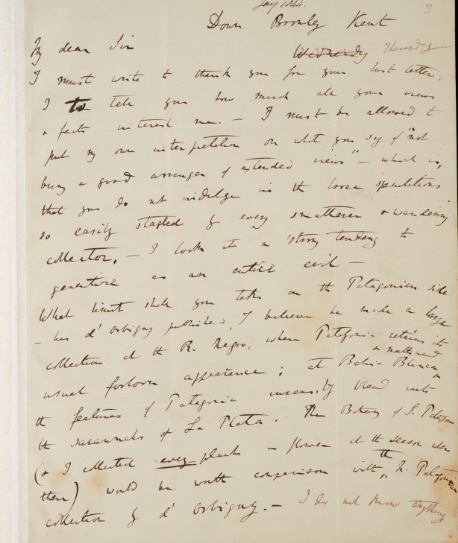
So much has been written about hand-written letters, mostly lamenting their death. What else can be added about the beautiful vulnerability of handwriting and the satisfying feel of paper stationary and envelopes, not to mention the miracle of letter delivery? Think of all those heartsick soldiers in wars old and modern receiving an actual letter from home, thousands of miles away.
The only news about letter writing is that we continue to discover its value. Just recently Cambridge University published some 1,200 letters exchanged between Charles Darwin and his closest friend, the botanist Joseph Dalton Hooker. The letters span 40 years of Darwin’s working life, from 1843 to his death in 1882, and join the other letters in the Darwin Correspondence Project.
There is so much to appreciate about these letters. Call it 19th century bromance, if you must, but the correspondence between Darwin and Hooker touched on nearly every subject, scientific and personal. Darwin wrote Hooker for his help negotiating with publishers, for his opinion about whether seeds from islands without four-legged animals are ever hook-shaped, and for his support after his 6‑year-old daughter Maria died.
From a scientific point of view the most important letter may be the one Darwin wrote Hooker on January 11, 1844. Writing from his home, Down House in Kent, Darwin fires questions at Hooker about seeds, seashells and Arctic species—his mind obviously a blur of activity—and then describes that his work has taken a “presumptuous” turn. After years of research and collecting specimens, he was beginning to form an idea that “species are not (it is like confessing a murder) immutable.”
Fifteen years later Darwin published On the Origin of Species. (Find it on our Free Audio Books and Free eBooks collections.)
In his letters to Hooker, himself a great botanist and explorer, Darwin works out and worries over his ideas. In one letter he expresses impatience with all other existing explanations for the geographical distribution of plants.
The Correspondence Project has archived more than 7,500 of Darwin’s letters altogether, including the mail he sent home while at sea aboard The Beagle. Darwin was 22 when he joined a team to chart the coast of South America, a trip that was planned for two years but which stretched into five. After a bout of seasickness, Darwin wrote home to his father.
A quick aside to those who long for the days of long letters and who believe that our IQs drop a point with each text: Take note of Darwin’s liberal use of ampersands, numerals and quaint 19th century contractions (sh’d for should, etc.). IMHO, these are all just Victorian shortcuts to speed up the process of handwriting when the mind can work so much more quickly.
Kate Rix writes about education and digital media. Visit her website: .
Read More...A Young, Clean Cut Jim Morrison Appears in a 1962 Florida State University Promo Film
Here’s a weird one: weirdo Doors frontman Jim Morrison, native of Florida, the weirdest state in the Union (well, it is!), stars in a promo film for Florida State University. Morrison’s character gets a bummer of a letter informing him that he has been rejected from FSU, and later meets with an administrator who gives him the lowdown. Of course, as one YouTube commenter quips, “when one door closes, The Doors open” (heh). So, fine, Morrison didn’t need Florida State—he lived fast, died young, and left the most famous grave in history.
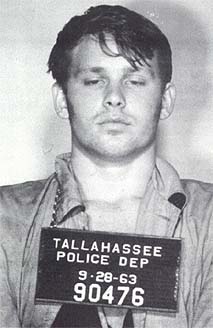
But as his fans know, the well-read Morrison was no intellectual slouch; he started the Doors while studying film at UCLA, to which he’d transferred from Florida State, where he enrolled in 1962. In addition to getting cast in the promo above, while at FSU Morrison got arrested for a school prank (see his ’63 mugshot at left), made some short films, and did his share of carousing. One fellow student, Gerry McClain, remembers Morrison from his FSU days in an interview with the site American Legends:
He hung around with a bohemian crowd: people who liked to wear pants with holes in them. Jim posed as a model for the art department, and they would all sell blood to the Red Cross to get a few bucks. Once, I saw Jim go around the college coffee shop eating scraps off tables. I felt he–and the others–were living an image–the starving young artist.
But Morrison wasn’t exactly a starving artist. He was, in fact, the son of Rear Admiral George Stephen Morrison, commander of the U.S. Naval forces in the incident that sparked the Vietnam War. Weird, right? Watch the elder Morrison and Jim’s sister Anne in interview remembrances of Jim in the video below.
Related Content:
See Jimi Hendrix’s First TV Appearance, and His Last as a Backing Musician (1965)
A Young Frank Zappa Plays the Bicycle on The Steve Allen Show (1963)
Jimmy Page, 13, Plays Guitar on BBC Talent Show (1957)
Josh Jones is a writer and musician based in Washington, DC. Follow him @jdmagness
Read More...Albert Einstein on Individual Liberty, Without Which There Would Be ‘No Shakespeare, No Goethe, No Newton’
We recently posted a rare audio recording of Albert Einstein reading his essay, “The Common Language of Science.” Today we have a similarly rare treat: filmed excerpts from a speech on individual liberty that Einstein gave shortly after the Nazis rose to power and he became a refugee from his native Germany. Without freedom for the individual, Einstein said, “life to a self-respecting man is not worth living.”
Einstein delivered the speech on October 3, 1933 at the Royal Albert Hall in London. As it turned out, the speech was something of a farewell address to his native continent. Four days later Einstein boarded a ship to America and never returned to Europe. The speech was organized by the Academic Assistance Council (now the Council for Assisting Refugee Academics) and other aid groups to help the hundreds of German intellectuals, many of them Jews, who were fired from their university jobs by the Nazis.
Although the Albert Hall now has a maximum allowed capacity of 5,544, according to historical accounts more than 10,000 people crowded into the old hall to hear Einstein, who warned of a coming catastrophe in Europe that would rival the Great War. “Today,” he said, “the questions which concern us are: How can we save mankind and its spiritual acquisitions of which we are the heirs? How can we save Europe from a new disaster?” Einstein reminded the audience to keep clearly in mind what is ultimately at stake: individual liberty. The speech was later published in a different form in Einstein’s book, Out of My Later Years, and you can open a PDF transcript of the original by clicking here. The film clip is cut into four short excerpts. In heavily accented English, Einstein says:
I am glad that you have me given the opportunity of expressing to you here my deep sense of gratitude as a man, as a good European, and as a Jew.
It cannot be my task today to act as a judge of the conduct of a nation which for many years has considered me as her own.
We are concerned not merely with the technical problem of securing and maintaining peace, but also with the important task of education and enlightenment.
Without such freedom there would have been no Shakespeare, no Goethe, no Newton, no Faraday, no Pasteur, and no Lister.
Related content:
Listen as Albert Einstein Reads ‘The Common Language of Science’ (1941)
Einstein Explains His Famous Formula, E=mc², in Original Audio
Albert Einstein Archive Now Online, Bringing 80,000+ Documents to the Web
Find Courses on Einstein in the Physics Section of our Free Online Courses Collection
Read More...Nico Sings “Chelsea Girls” in the Famous Chelsea Hotel
Ah, the Hotel Chelsea: home, in its heyday, to all manner of New York City writers, artists, rockers, and rogues. You can’t move in anymore—the management instituted a short stay-only policy even before closing for renovations in 2011—but even if you could, surely the legacy of so many 20th-century artistic luminaries would weigh heavily indeed. Read up on Bob Dylan, Charles Bukowski, Janis Joplin, Leonard Cohen, Iggy Pop, Dylan Thomas, or Arthur C. Clarke, and you’ll find out about their extended stays at the Chelsea. Read Patti Smith’s memoir Just Kids, and you’ll learn even more about the place from Smith’s remembrance of her days there with photographer Robert Mapplethorpe. Watch Andy Warhol’s Chelsea Girls and you’ll glimpse the lives of the askew ingénues Warhol housed at the hotel, including Velvet Underground singer Nico.
Dig into Nico’s solo career, and you’ll soon hear her album Chelsea Girl. The clip above comes from a documentary including Warhol’s Chelsea Girls, and features Nico singing the almost-title track “Chelsea Girls” from that album. The film, Nico’s record, and the seminal Velvet Underground & Nico all appeared in the counterculturally productive year of 1967. Riding the wave of fame generated by her time as a Warhol “Superstar,” Nico would spend the next twenty years recording five more solo albums, acting in seven pictures by filmmaker Philippe Garrel, making her musical comeback onstage at CBGB, and getting hooked on and subsequently kicking heroin before passing away in 1988. A bit later in the video, an interviewer asks if she considers herself the one who made the Hotel Chelsea famous. “I am one of the persons,” replies the German-born Nico. “Aside from the people that are now in heaven… or in hell, or… not staying here.”
Related Content:
Warhol’s Screen Tests: Lou Reed, Dennis Hopper, Nico, and More
Andy Warhol Quits Painting, Manages The Velvet Underground (1965)
Colin Marshall hosts and produces Notebook on Cities and Culture and writes essays on literature, film, cities, Asia, and aesthetics. He’s at work on a book about Los Angeles, A Los Angeles Primer. Follow him on Twitter at @colinmarshall.
Read More...A Look Back at Jim Carroll: How the Poet and Basketball Diaries Author Finally Finished His First Novel
Like so many denizens of the New York that produced Warhol and The Velvet Underground, then gritty punk rock, hip-hop, and no wave, poet Jim Carroll didn’t fare so well into Bloomberg-era NYC, a developer’s paradise and destination for urban professionals and tourists, but not so much a haven for struggling artists. As the city changed, its creative characters either rose above its shifting demographics, moved away, or—as Carroll did—retreated. Carroll, who died in 2009 at 60, spent his last years in the upper Manhattan neighborhood of Inwood—once a bustling Irish-Catholic enclave—living in the same building where he’d grown up and writing against time to finish his first and only novel, The Petting Zoo. His last years were by no means tragic, however. Given the tumult of his early years as an addict, and the long list of friends from the downtown New York scene that Carroll lost along the way—to overdoses, AIDS, cancer, suicide—I’d say he was a literary survivor, who died (at his writing desk, it’s said) doing what he loved most.
Carroll came to mainstream consciousness with the release of a 1995 film starring Leonardo DiCaprio, based on the book Carroll’s most known for: the 1978 memoir The Basketball Diaries, a collection of teenage journal entries from his double life as a high school basketball star and junkie hustler. But even with that movie’s nods to Carroll’s mature years as a poet and musician, it’s doubtful that few people came away with much more than a vague sense of what the street-wise Catholic schoolboy DiCaprio character had gone on to do. Which is a shame, because Carroll really was a terrific writer, from his debut poetry publications in the 60s and on throughout the next three decades. Even in the obscurity and semi-seclusion of his later years, he wrote wise, incisive essays and criticism (such as this 2002 review of Kurt Cobain’s published Journals for the Los Angeles Times). And despite the memoir and film’s popularity, Carroll considered himself primarily a poet, in the symbolist tradition of his literary heroes Rilke, Rimbaud, and Ashbery. (See Carroll at top, in his harsh New York accent, read from his 1986 collection of poems, The Book of Nods.)
In a manner of speaking, Carroll suffered the curse of one-hit-wonderism, except in his case, he was lucky enough to have two hits—the memoir (and later film) and the song, “People Who Died,” from Catholic Boy, his debut album with the Jim Carroll Band (video above), which even made it onto the E.T. soundtrack (giving Carroll royalties for life). The band came about with the encouragement of Carroll’s fellow poet and former roommate Patti Smith, after Carroll kicked heroin and moved to California. Carroll wrote songs for Blue Oyster Cult and Boz Scaggs and collaborated with Rancid, Sonic Youth’s Lee Ranaldo, Patti Smith guitarist Lenny Kaye, and guitarist Anton Sanko (on his 1998 return to music, Pools of Mercury). His years in rock and roll transmuted through most of the nineties into dramatic readings, spoken word performances, and lively monologues, such as those collected on the 1991 release Praying Mantis. In the track below, “The Loss of American Innocence,” Carroll delivers some shambling, and pretty funny, stories about the characters in his novel-in-progress.
Carroll had been telling these stories about Billy the downtown painter and a certain chatty raven since the late 80s. As the monologues crystallized into short prose pieces, he slowly, painstakingly assembled them into The Petting Zoo, which saw publication in 2010. It took him twenty years, and he didn’t live to see it published, but he left a final legacy behind, and it’s a flawed but serious work worth reading. In 2010, Carroll’s longtime friends Patti Smith and Lenny Kaye celebrated the novel’s publication with readings and performances at the Barnes and Noble in Union Square. Below, see Smith read an excerpt from The Petting Zoo. The sound’s a bit tinny and the camera shakes, but it’s worth it to see living legend Smith read from Carroll’s legendary final song.
Related Content:
Patti Smith Reads Her Final Words to Robert Mapplethorpe
Rock and Roll Heart, 1998 Documentary Retraces the Remarkable Career of Lou Reed
Josh Jones is a writer and musician based in Washington, DC. Follow him @jdmagness
Read More...The Big Problem for MOOCs Visualized
 MOOCs — they’re getting a lot of hype, in part because they promise so much, and in part because you hear about students signing up for these courses in massive numbers. 60,000 signed up for Duke’s Introduction to Astronomy on Coursera. 28,500 registered for Introduction to Solid State Chemistry on edX. Impressive figures, to be sure. But then the shine comes off a little when you consider that 3.5% and 1.7% of students completed these courses respectively. That’s according to a Visualization of MOOC Completion Rates assembled by educational researcher Katy Jordan, using publicly available data. According to her research, MOOCs have generated 50,000 enrollments on average, with the typical completion rate hovering below 10%. Put it somewhere around 7.5%, or 3,700 completions per 50,000 enrollments. If you click the image above, you can see interactive data points for 27 courses.
If you’re a venture capitalist, you’re probably a little less wowed by 3,700 students taking a free course. And if you’re a university, you might be underwhelmed by these figures too, seeing that the average MOOC costs $15,000-$50,000 to produce, while professors typically invest 100 hours in building a MOOC, and another 8–10 hours per week teaching the massive course. And then don’t forget the wince-inducing contract terms offered by MOOC providers like edX — terms that make it hard to see how a university will recoup anything on their MOOCs in the coming years.
Right now, universities are producing MOOCs left and right, and it’s a great deal for you, the students. (See our list of 300 MOOCs.) But I’ve been around universities long enough to know one thing — they don’t shell out this much cash lightly. Nor do professors sink 100 hours into creating courses that don’t count toward their required teaching load. We’re in a honeymoon period, and, before it’s over, the raw number of students completing a course will need to go up — way up. Remember, the MOOC is free. But it’s the finishers who will pay for certificates and get placed into jobs for a fee. In short, it’s the finishers who will create the major revenue streams that MOOC creators and providers are currently relying on.
We have our own thoughts on what the MOOC providers need to do. But today we want to hear from those who started a MOOC and opted not to finish. In the comments section below, please tell us what kept you from reaching the end. You’ll get extra points for honesty!
Read More...Revisit The Life & Music of Sister Rosetta Tharpe: ‘The Godmother of Rock and Roll’
Sure, Keith Richards borrowed some of his best licks from Chuck Berry. But do you know who Chuck Berry borrowed from? Sister Rosetta Tharpe. Tharpe was one of the pioneers of 20th century music, a flamboyant, larger-than-life figure who fused gospel and blues into something new. “Listen to her recordings,” said singer-songwriter Joan Osborne, “and you can hear all the building blocks of rock and roll.” Little Richard, Elvis Presley and Johnny Cash each named Tharpe as one of their fondest childhood influences. “Sister Rosetta Tharpe was anything but ordinary and plain,” said Bob Dylan on his radio program. “She was a big, good-looking woman and divine, not to mention sublime and splendid. She was a powerful force of nature–a guitar-playing, singing evangelist.”
Yet despite the enormity of her influence, Tharpe has been virtually forgotten by the mainstream culture. For many years following her death in 1973, she lay in an unmarked grave. In the last decade, though, there has been a slow resurgence of appreciation for Tharpe. In 2004 Osborne, Maria Muldaur, Bonnie Rait and other artists joined together for a tribute album called Shout, Sister, Shout! A biography of the same name, by Gayle Wald, was published in 2007. And in 2011–the same year Tharpe’s grave finally received a headstone, thanks to a fundraising concert– filmmaker Mike Csaky directed a documentary called The Godmother of Rock & Roll: Sister Rosetta Tharpe, which aired this February on PBS as part of the American Masters series. You can watch the full 53-minute film below.
And for a quick example of Tharpe’s stunning artistry and stage presence, you can start by watching the short clip above, from a 1960s Sunday-morning television program produced in Chicago and distributed by NBC called TV Gospel Time, in which Tharpe sings the gospel standard “Up Above My Head.” Sources differ on the exact year of the performance (TV Gospel Time was broadcast from late 1962 until 1966.) but PBS gives it as 1964–1965. Two-thirds of the way into the song is the famous electric guitar solo that was featured in the French film Amelie. “Tharpe didn’t just play the guitar,” writes her biographer Wald, “she owned it. Like a snake-charmer, she coaxed sounds out of the instruments, turning wood and metal into lomething alive yet completely under her control. her contemporaries referred to this as making a guitar ‘talk.’ Sometimes, too, they said she played ‘like a man,’ as though a woman wasn’t capable of projecting such command–or a woman-in-gospel conveying such palpable eroticism.”
Also featuring Sister Rosetta Tharpe:
“Muddy Waters and Friends on the Blues and Gospel Train, 1964”
James Brown Gives You Dancing Lessons: From The Funky Chicken to The Boogaloo
The Alan Lomax Sound Archive Now Online: Features 17,000 Recordings
Read More...Orson Welles Teaches Baccarat, Craps, Blackjack, Roulette, and Keno at Caesars Palace (1978)
I’ve never gone near Las Vegas’ Caesars Palace. The very idea of a gambling complex of such labyrinthine vastness, slick luxury, and relatively recent construction—especially given the ancient-Rome simulacrum it goes for here and there—frightens me. Then again, so does the idea of Las Vegas itself; I’ve never gone near the city either. Perhaps you feel the same way. The video above promises, by leading us straight into the belly of the beast, to alleviate such fears. Not only does it offer a view of the milder, somewhat less audiovisually aggressive casino of 1978 (though the era’s collars, lapels, and hairstyles compensate with an aggression of their own), it explains such popular games of chance as baccarat, craps, blackjack, roulette, and Keno. Give the Caesars Guide to Gaming with Orson Welles this: it certainly picks a striking Virgil.
“I’ve been asked by Caesars Palace to tell you a little about gaming,” Welles says. “I guess they’ve asked me because I know a little about cards, a little about history, and, well, because I’ve been known to take a long shot or two.” And indeed, he peppers his lessons on betting with anecdotes about Poseidon, Zeus, shield-spinning Greek soldiers, and the primitive bone-tossing games of ancient man. The Caesars Guide to Gaming with Orson Welles appeared five years after F for Fake, Welles’ final theatrical feature. I need hardly highlight the fact that F for Fake this ain’t, nor Welles’ abundance of awkward late-career projects and appearances. Still, you’ll learn a great deal more from it that you will from playing that frozen peas commercial recording session one more time.
via Metafilter
Related Content:
Watch Orson Welles’ The Stranger Free Online, Where 1940s Film Noir Meets Real Horrors of WWII
Orson Welles Narrates Plato’s Cave Allegory, Kafka’s Parable, and Freedom River
Orson Welles’ Last Interview and Final Moments Captured on Film
Colin Marshall hosts and produces Notebook on Cities and Culture and writes essays on literature, film, cities, Asia, and aesthetics. He’s at work on a book about Los Angeles, A Los Angeles Primer. Follow him on Twitter at @colinmarshall.
Read More...Support Us
We're hoping to rely on loyal readers, rather than erratic ads. Please click the Donate button and support Open Culture. You can use Paypal, Venmo, Patreon, even Crypto! We thank you!

About Us

Open Culture scours the web for the best educational media. We find the free courses and audio books you need, the language lessons & educational videos you want, and plenty of enlightenment in between.
Advertise With Us

FREE UPDATES!
GET OUR DAILY EMAIL
Get the best cultural and educational resources on the web curated for you in a daily email. We never spam. Unsubscribe at any time.
FOLLOW ON SOCIAL MEDIA

Open Culture editor Dan Colman scours the web for the best educational media. He finds the free courses and audio books you need, the language lessons & movies you want, and plenty of enlightenment in between.
Advertise With Us

