The World According to John Coltrane: His Life & Music Revealed in Heartfelt 1990 Documentary
In his short life, John Coltrane continually pushed the boundaries of music. From swing to bebop to hard bop to free jazz, Coltrane was a restless seeker of new sounds. Inspired by the hypnotic, trance-inducing traditional music of North Africa and Asia, Coltrane created a new kind of music that fused jazz and Eastern spirituality.
The World According to John Coltrane tells the story of Coltrane’s quest, from his childhood in a deeply religious household in North Carolina to his early days playing saxophone in the Navy, to his apprenticeship with Miles Davis in the 1950s and his emergence as a bandleader and innovator in the 1960s. Most of the one-hour film is devoted to Coltrane’s later period, when he came into his own. The film is not a biography, in the traditional sense. There is very little about Coltrane’s personal life — his marriages, children, drug problems and declining health. Director Robert Palmer focuses instead on Coltrane’s journey as a musician.
The World According to John Coltrane was made in 1990, and includes interviews with Coltrane’s second wife, pianist Alice Coltrane, and a number of other musicians who knew Coltrane and played with him, including saxophonist Wayne Shorter, drummer Rashied Ali and Pianist Tommy Flanagan. It provides some excellent insights into one of the 20th century’s greatest musicians.
via metafilter
Related Content:
John Coltrane’s Naval Reserve Enlistment Mugshot (1945)
John Coltrane Plays Only Live Performance of A Love Supreme
John Coltrane: Three Great European Performances, 1960, 1961 and 1965
Read More...Humans of New York: Street Photography as a Celebration of Life
These days any yahoo with a cell phone and access to the Internet fancies him or herself a Henri Cartier-Bresson, Ruth Orkin or Helen Levitt, but true street photography involves more than just being in the right place at the right time. Brandon Stanton, the self-taught creator of the wildly popular Humans of New York blog, has the dedication as well as the eye and the technical mastery. His curiosity and compassion are abundant, but what really sets his work apart is its 21st century immediacy.
Daily, Stanton wanders the streets of New York, approaches strangers and asks if he can take some pictures. A few hours later, those photos light up Facebook, with captions drawn from the brief collaboration between subject and photographer. In short order, each post garners hundreds of likes and comments. Nasty feedback is a rarity. Stanton’s fans seem content to follow his lead, finding much to celebrate in straightforward poses of parents with children, festively attired seniors, and proud oddballs.
Certain interactions beg longer narratives, which Stanton relates in the “Stories” section of his website. These pieces offer character insights, and often document how the photograph came to be.

His gift for empathy is best exemplified in his portrait of Black Wolf, The Dragonmaster. I’ve run into this dude everywhere from the Coney Island Mermaid Parade to Central Park, but confess that I found his visual presentation off putting. Unlike me, Stanton looked until he found something universal in the deliberate freakishness.
…we all need to feel important. Not New York important, necessarily, but important. We all need to know that there’s a place in this world that only we can fill. Some people need bigger places than others, but everyone needs a place—a hole in the universe that only they can fill. This need is so deep and food-like and so human that we will do anything to fill it. We’ll go crazy to feel important. A protective, evolutionary sort of crazy. When the body has no food, it will break down muscle to feed itself. When the ego has no food, it will break down the mind to feed itself. If we have no place in this world, we’ll withdraw from this world, and inhabit one where we have a place.
Stanton’s lens provides the import, yielding images so arresting, they stop us in our tracks. Appreciate his collection of extraordinary humans, then challenge yourself to notice such specimens in the wild on a daily basis.
Related Content:
Stanley Kubrick’s Jazz Photography and The Film He Almost Made About Jazz Under Nazi Rule
Ayun Halliday hopes every Glamour Don’t will someday find herself a Human of New York. Follow her @AyunHalliday
Read More...David Byrne Discusses Here Lies Love, His Disco Musical with Fatboy Slim on the Life of Imelda Marcos
In Imelda Marcos, widow of controversial former president of the Philippines Ferdinand Marcos, the twentieth century had one of its most colorful first ladies. Or at least, to make the most obvious possible joke, it had its first lady with the most colorful collection of shoes. In fact, given her country’s history of poverty and corruption, Marcos’ reportedly vast and ostentatious wardrobe made her a controversial figure in herself. Yet she has never seemed wholly unconcerned with her legacy, and in fact remains a member of the Philippine House of Representatives today. She has wished aloud that her tombstone read, simply, “Here lies love,” and that epitaph gives a title to the disco musical that Talking Heads mastermind David Byrne and DJ/nineties electronic phenomenon Fatboy Slim have crafted to tell the story of Marcos’ life. “Probably the first thing you need to know,” writes Allan Kozinn in the New York Times, “is that although it is about Imelda Marcos, the former first lady of the Philippines, her famous collection of shoes is neither mentioned nor shown.” At the top of the post, you can watch a short clip of Byrne discussing the inspirations for and long gestation process of Here Lies Love, not to mention his efforts to break down the audience’s preconceptions, shoe-related and otherwise.
“Imelda, who was this flamboyant, notorious kind of person on the scene, loved going to discos,” he says. “She loved going to Studio 54. She turned the top floor of the palace in Manila into a club. She had a mirror ball installed in her New York townhouse. [ … ] Maybe there’s a connection between the euphoria you feel in a dance club and the euphoria a person in power has. ” Just above, you can listen to the musical’s title number. Despite having several times listened to and enjoyed the entire Here Lies Love album, I understand it can’t compare to the live version, because the live version makes you dance — literally. Kozinn describes Byrne’s latest venue as “transformed into an ’80s-style disco, and the audience is meant to stand, mill around or, if the spirit moves, dance through the entire 85-minute show.” Byrne has also written about the development of Here Lies Love on his diary, and promisingly. “The staging and the concept work,” he assures his fans. “It works so well that I sort of cried at every performance. [ … ] In the end, I’d say it’s the best thing I’ve done since the Stop Making Sense tour—which I guess is saying something.”
Related content:
David Byrne Gives Us the Lowdown on How Music Works (with Neuroscientist Daniel Levitin)
Listen to the New David Byrne/St. Vincent Album, Love This Giant
How David Byrne and Brian Eno Make Music Together: A Short Documentary
Colin Marshall hosts and produces Notebook on Cities and Culture and writes essays on literature, film, cities, Asia, and aesthetics. He’s at work on a book about Los Angeles, A Los Angeles Primer. Follow him on Twitter at @colinmarshall.
Read More...History of Rock: New MOOC Presents the Music of Elvis, Dylan, Beatles, Stones, Hendrix & More
Here’s something I can get pretty jazzed about. Er, maybe that’s not quite the right verb. But close enough.…
On May 13, the Eastman School of Music at the University of Rochester will launch the first of two MOOCs that will trace the history of rock music. Taught by John Covach, a professor of music theory, The History of Rock, Part One will revisit the 1950s and 1960s, the halcyon days of rock ’n’ roll, which gave us the music of Elvis Presley, Chuck Berry, Phil Spector, Bob Dylan, the Beatles, the Rolling Stones, Jimi Hendrix, Cream, and other bands. The course will focus on the music itself, the cultural context from which rock emerged, and how changes in the music business and music technology shaped this new musical form. The second course (scheduled to start on July 8) will move forward to the 1970, 80s and 90s and cover the music of Led Zeppelin, the Allman Brothers, Carole King, Bob Marley, the Sex Pistols, Donna Summer, Michael Jackson, Madonna, Prince, Metallica, Run-DMC, Nirvana, and other artists. Students who successfully complete the course will receive a “Statement of Accomplishment” signed by the instructor.
Other music courses listed in our collection of 300 Free MOOCs from Great Universities include Introduction to Guitar and Introduction to Improvisation. They’re both created by the Berklee College of Music and start on April 22.
Related Content:
A History of Rock ‘n’ Roll in 100 Riffs
Carnegie Hall MOOC Will Teach You How to Listen to Orchestras (Free)
Read More...60 Second Adventures in Astronomy Explains the Big Bang, Relativity & More with Fun Animation
Like many positive terms, the phrase “big bang” originated as a pejorative. Fred Hoyle coined the term in 1949 as a way of deflating the concept of an expanding universe. It stuck, even after Edwin Hubble showed that 13.7 billion years ago, all of the matter in our massive universe was indeed compacted into “one superdense ball.” Astronomers have also figured out that the volume of the big bang was only 120 decibels, about the loudness of your average rock show (though how there might have been sound without an atmosphere escapes me). There is some irony in Hoyle’s dig: the “big bang” wasn’t particularly big, and wasn’t much of a bang, but it happened.
We learn all this and more in the video above from The Open University, and all within a minute, as the title of the series, 60 Second Adventures in Astronomy, promises. These amusing animations are very much like other OU series we’ve featured in the past: 60 Second Adventures in Economics; 60-Second Adventures in Economics: and 60 Second Adventures in Thought. (Find them all on iTunesU here.)
The university describes the new astronomy series like this:
Ever wondered where the Universe came from? Or more importantly, where it’s headed? Voiced by David Mitchell, this series of twelve 60 second animations examines different scientific concepts from the big bang to relativity, from black holes to dark matter. The series also explores the possibility of life beyond Earth and considers why David Bowie is still none the wiser about life on Mars.
Spend a few extra minutes educating yourself with some more 60 second astronomy adventures below, or visit the complete collection here on YouTube or iTunesU.
Supernovae
Exoplanets
Special Relativity
Event Horizons
Life on Mars
Related Content:
Neil deGrasse Tyson Answers the Big Enchilada Question, “Does the Universe Have a Purpose?”
The Higgs Boson, AKA the God Particle, Explained with Animation
Demystifying the Higgs Boson with Leonard Susskind, the Father of String Theory
Read More...MOOC Interrupted: Top 10 Reasons Our Readers Didn’t Finish a Massive Open Online Course
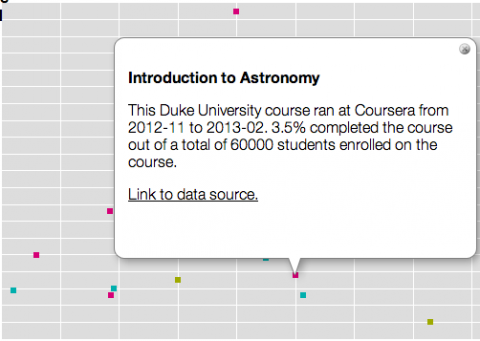
On Tuesday, we gave you a Visualization of the Big Problem for MOOCs, which comes down to this: low completion rates. To be clear, the completion rates aren’t so much a problem for you; they’re more a problem for the MOOC providers and their business models. But let’s not get bogged down in that. We ended our post by asking you to share your own experience with MOOCs — particularly, to tell us why you started and stopped a MOOC. We got close to 50 thoughtful responses. And below we’ve summarized the 10 most commonly-cited reasons. Here they are:
1.) Takes Too Much Time: Sometimes you enroll in a MOOC, only to discover that it takes way too much time. “Just didn’t have time to do all the work.” “As a full-time working adult, I found it exceedingly difficult to watch hours upon hours of video lectures.” That’s a refrain we heard again and again.
2.) Assumes Too Much Knowledge: Other times you enroll in a MOOC, only to find that it requires too much base knowledge, like a knowledge of advanced mathematics. That makes the course an instant non-starter. So you opt out. Simple as that.
3.) Too Basic, Not Really at the Level of Stanford, Oxford and MIT: On the flip side, some say that their MOOCs weren’t really operating on a serious university level. The coursework was too easy, the workload and assignments weren’t high enough. A literature course felt more like a glorified book club. In short, the courses weren’t the real university deal.
4.) Lecture Fatigue: MOOCs often rely on formal video lectures, which, for many of you, is an“obsolete and inefficient format.” And they’re just sometimes boring. MOOCs would be better served if they relied more heavily on interactive forms of pedagogy. Val put it well when she said, “We should not try to bring a brick and mortar lecture to your living room. Use the resources available and make the learning engaging with shorter segments.… The goal should be to teach and teach better. If one of these online universities can figure that out, then the money will follow.”
5.) Poor Course Design: You signed up for a MOOC and didn’t know how to get going. One student related his experience: “From day one I had no idea what I was supposed to do. There were instructions all over the place. Groups to join with phantom members that never commented or interacted, and a syllabus that was being revised as the course went through it’s first week.”
6.) Clunky Community/Communication Tools: This has been the Achilles’ heel of online learning for years, and so far the MOOCs haven’t quite figured it out. It’s not unusual to hear this kind of comment from students: “I find that the discussion forums aren’t very useful or engaging. They are not a very good substitute for active in-class discussion.”
7.) Bad Peer Review & Trolls: Because MOOCs are so big, you often don’t get feedback from the professor. Instead you get it from algorithms and peers. And sometimes the peers can be less than constructive. One reader writes: “I chose to stop doing the peer response section of the class due to some students being treated rudely [by other students]; in fact, the entire peer response section of the class is done in a way I would NEVER have asked of students in a classroom.… [T]here is no involvement of the professor or TA’s in monitoring the TORRENT of complaints about peer reviews.”
8.) Surprised by Hidden Costs: Sometimes you discover that free MOOCs aren’t exactly free. They have hidden costs. Brooke dropped her MOOC when she realized that the readings were from the professor’s expensive textbook.
9.) You’re Just Shopping Around: You shop for courses, which involves registering for many courses, keeping some, and dropping others. That inflates the low completion rate, but it gives you freedom. As one reader said, “I am very, very happy about being able to be so picky.”
10.) You’re There to Learn, Not for the Credential at the End: Sometimes you do everything (watch the videos, do the readings, etc.) but take the final exam. In a certain way, you’re auditing, which suits many of you just fine. It’s precisely what you want to do. But that, too, makes the low completion rates look worse than they maybe are.
Thanks to everyone who took the time to participate. We really appreciate it! And if you’re looking for a new MOOC, don’t miss our list, 300 Free MOOCs from Great Universities (Many Offering Certificates).
Read More...The Shaggy, Cute, Eco-Friendly Lawnmowers of Paris
They toyed with the idea of a donkey, but they went with four sheep instead, and now four ewes are mowing the grounds of Paris’ Municipal Archives. It’s all part of a pilot program where, if successful, sheep will trim the grass of Parisian public spaces and burn no fossil fuels along the way. The New York Times has more on this old school solution to a modern environmental problem.
Read More...Roger Ebert Talks Movingly About Losing and Re-Finding His Voice (TED 2011)
Film critic Roger Ebert, like Pauline Kael before him, leaves behind a great torrent of words. Those of us accustomed to seeking out his opinion can comfort ourselves on the Internet, where his thoughts on the great (and not-so-great) films of the last four decades live in perpetuity.
After a ruptured carotid artery robbed him of the power of speech, words assumed an even greater importance for Ebert. Even though he felt lucky to be alive in an age when most home computers come equipped with a text-to-speech option, he mourned the loss of inflection, timing, and spontaneity. CereProc, a Scottish firm specializing in personalized computer voices, created a custom version he breezily referred to as Roger Junior or Roger 2.0, a Frankenstein’s monster assembled from hours of television appearances. A noble, but flawed attempt. Despite his Midwestern attraction to Apple’s computerized British accent, Ebert returned to its American male voice, “Alex”, as the most expressive option.
In 2011, the speechless Ebert gave a TED Talk on the subject. “Alex” was given his moment to shine, but there’s no way the technological miracle can compete with the human spectacle onstage.
Rather than rely on the relatively autonomous voice substitute, Ebert arranged for his wife, Chaz Hammelsmith, and friends Dean Ornish and John Hunter, to read his words from prepared scripts.
Forget W.C. Fields’ caveat about performing with children and dogs. Ebert stole his own show, shamelessly upstaging his loved ones with jolly pantomimed thumbs ups and other antics. When he’s on camera, you can’t take your eyes off him…as he clearly knew. A 2010 Esquire article by Chicago-based theater critic, Chris Jones, described how the removal of Ebert’s lower jaw gave him the aspect of a permanent smile. The disfigurement was shocking, but especially so on one whose face was so familiar. It led to frequent misassumptions that he had been mentally incapacitated as well. Hammelsmith’s tears when she gets to this part of her husband’s eloquent TED Talk speak volumes as well. His willingness to place himself front and center, where people who might think it impolite to stare could not help but see and hear him as a whole person, was a revolutionary act.
“Without intelligence and memory, there is no history.” — Roger Ebert, 1942 — 2013
- Ayun Halliday is a writer in the Big Apple.
Read More...“Professor Risk” at Cambridge University Says “One of the Biggest Risks is Being Too Cautious”
To eat bacon sandwiches? Or not to eat bacon sandwiches? That’s a question tackled by David Spiegelhalter, who holds the title, “Winton Professor for the Public Understanding of Risk” at Cambridge University. Sometimes they just call him “Professor Risk” for short.
In his academic work, Spiegelhalter looks at risk and uncertainty every day, seeing how they affect the lives of individuals and society. You’d figure that this might make him more cautious than the rest of us. But that’s not how it turns out. After analyzing all of the data, Spiegelhalter comes to this conclusion: some calculated risks are worth it. They have minimal downside and make life worth living. Or, looked at a little differently, sometimes “one of the biggest risks [in life] is being too cautious.”
You can stay current on Spiegelhalter’s thinking by following his blog Understanding Uncertainty.
If you would like to support the mission of Open Culture, consider making a donation to our site. It’s hard to rely 100% on ads, and your contributions will help us continue providing the best free cultural and educational materials to learners everywhere. You can contribute through PayPal, Patreon, and Venmo (@openculture). Thanks!
Related Content:
J.K. Rowling Tells Harvard Grads Why Success Begins with Failure
Paulo Coelho on The Fear of Failure
Find Courses from Cambridge in our Collection of Free Courses Online
Read More...
The Popular Science Digital Archive Lets You Explore Every Science and Technology-Filled Edition Since 1872

Popular Science is the fifth oldest continuously-published monthly magazine—a long way of saying that the magazine has done a fine job of maintaining a niche in a crazily fast-paced industry. Founded in 1872 by science writer Edward Youmans to reach an audience of educated laypeople, Popular Science today combines reviews of the latest gadgets with stories about innovation in design and science. It’s an organized mishmash of news about “the future now,” liberally defined. A recent issue included stories about the military’s use of 3‑D printing and an astrophysicist who questions whether Shakespeare wrote the entire Folio.
With that kind of breadth, the magazine’s archives cover just about everything. And it’s easy to browse through back issues, dating all the way back to 1872, since the magazine teamed up with Google to put a searchable archive on the web. The earliest issues, like this one from February 1920, feature color covers that bring to mind science fiction with a fascination for the imagined future.
One of the cool things about the magazine is its equal attention to new and old technology. Search for “scissors” and you will find this 1964 article about the mechanics of sharpening your own scissors. The archive also offers another search tool that returns results in a visual word frequency grid, which is especially cool if you click the “animate” button. Any social historians out there able to explain why the word “scissor” would appear so often in the mid-20th century?
Interestingly, although the word “internet” dates back to the 1960s, the word didn’t appear in the magazine’s pages until 1989.
Period advertisements are included, which adds to the fun. This issue from September, 1944 includes a house-advertisement on the table of contents page calling for all collectors of back issues to consider surrendering them for the war cause. “There’s a war going on and this is no time for sentiment,” the ad urges. “Grit your teeth and dig out those stacks of back numbers. Then turn them over to your local paper salvage drive!” Enter the archive here.
Related Content:
The Alan Lomax Sound Archive Now Online: Features 17,000 Recordings
NASA Archive Collects Great Time-Lapse Videos of our Planet
Read More...Support Us
We're hoping to rely on loyal readers, rather than erratic ads. Please click the Donate button and support Open Culture. You can use Paypal, Venmo, Patreon, even Crypto! We thank you!

About Us

Open Culture scours the web for the best educational media. We find the free courses and audio books you need, the language lessons & educational videos you want, and plenty of enlightenment in between.
Advertise With Us

FREE UPDATES!
GET OUR DAILY EMAIL
Get the best cultural and educational resources on the web curated for you in a daily email. We never spam. Unsubscribe at any time.
FOLLOW ON SOCIAL MEDIA

Open Culture editor Dan Colman scours the web for the best educational media. He finds the free courses and audio books you need, the language lessons & movies you want, and plenty of enlightenment in between.
Advertise With Us

